It may feel like forever, but it’s only 30 minutes listening and 10 minutes to transfer your answers to answer sheet.
“How many sections are there?”
There are 4 sections.
1. a transaction (2 speakers)
2. a public announcement (1 speaker)
3. an academic discussion (2+ speakers)
4. a lecture (1 speaker).
“How many different types of questions are there?”
There are 14 different question types.
“How long do I have to read the questions?”
You will have 30 seconds to read the questions before listening.
“When should I write on the answer sheet?”
At the end of the test you have 10 extra minutes to transfer your answers.
“Can I write in all capitals?”
Yes, if you want.
“Is capitilisation important?”
No, you will still receive full marks for ‘london’ or ‘London.’
“Is spelling important?”
Yes, you will be marked down for mispelling words.
“Do my answers have to be grammatically correct?”
Yes, pay close attention to the gap-fills to be sure the grammar is accurate.
“What counts as a word for the ‘no more than ____ words’ questions?”
Dates, times and numbers all count as 1 word. 200 is one word, 3,000,000 is one word, 11am is one word, 22% is one word and so on. Words with hyphens like mother-in-law are one word. For dates, 18th September is one word and a number.
“I don’t understand the test. Do you have a guide?”
Yes! Funny you should ask, I have it right here:
“Do wrong answers hurt my score more than blank ones?”
No, fill in all answers even if you are guessing. Do not leave any answers blank.
“How is the listening test made?”
It takes 1 – 2 years for a listening test to be made and every question must be approved and adjusted by dozens of people. The test is very reliable.
“How is the listening test marked?” Usually the local staff in your country will mark them by hand before recording your scores.
“Do the sections get harder as the test goes on?”
Yes, section 4 is usually the hardest and section 1 is the easiest.
“Should I take the computer based IELTS listening?”
There are some key differences to the computer based test (you don’t get 10 minutes at the end to check/transfer answers, you wear headphones, and you must type your answers) but otherwise it is exactly the same. You can still take notes.
Test Day
“How many times can I listen?”
Just once.
“Can I write on the test?”
Yes, go ahead!
“Will I get headphones?”
Yes.
“What if there’s a problem?”
Tell one of the staff working at the center. They will help you.
“Should I write in pen or pencil?”
Pencil for both listening and reading.
“Can I go to the toilet during the test?”
No, you cannot stand up during the listening test.
“Can I bring a drink?”
Yes, as long as the bottle is transparent. (But be careful because in many countries there are no bathroom breaks allowed!)
Improving your Listening
“How can I improve my listening?”
In general, follow the tips here:
For specific tips for IELTS listening, check out this one:
“What else is the listening test testing?”
It tests listening, reading and writing. So practicing listening alone isn’t enough to do well on the test.
It depends on your level of English and the score you want. The important thing is that you do it everyday – that’s more important than how long you practice!
Don’t write your predictions down! Just read the question and make a quick prediction.
Tip #2: Predict the answer itself.
Here’s the same question with some predictions:
Some possible predictions:
1. Flowers, houses, scenery, mountains, rivers
2. Tractor, pony, horse
3. Barn, garden, petting zoo, fields
4. Lunch, a tour, a petting zoo, refreshments, ____ class
Don’t write your predictions down! Only some answers are possible to predict and it’s unlikely you will make the right prediction – but you can get close…
Tip #3: Underline the keywords.
This tip is mainly just to jog your memory if you hear the keywords mentioned.
Tip #4: Watch out for paraphrases!
Be careful! Most keywords and questions will be paraphrased. This means there will be synonyms, different grammar and different ways of saying the same thing.
These become more common and more difficult in sections 2, 3, and 4.
Here are some possible paraphrases for the keywords:
Take photos: take pictures, get a picture of, use their cameras, snap some shots
Surround: around, next to, you can see from the lake, beside,
Children: kids
Help feed: give food to, help the farmers to feed, take part in feeding
Ride: trek, tour the farm, go around the farm on a
Walk: stroll, get some air
Lake: (no synonyms for this one!)
Available: if you’d like, can, there is the option to
Extra cost: isn’t included in the original price, costs extra, for a bit extra, you’ll have to pay extra for
Tip # 5: Watch out for distractors!
The listening exam will try to trick you into choosing or writing the wrong answer.
For example you will hear:
“After you’re done riding the elephant you might want to take a little walk. The barn is a good place to walk around. Closer to the lake you’ll find the gardens. But the barn is way better.”
The answer is: gardens
Distractors can come before or after the correct answer (or both!).
So the tip is to be careful when you think you hear the answer – it might be a distractor, so keep listening to the end of that idea.
Tip #6: Look ahead at the end of each section.
At the end of each section the lovely voice on the tape will say ‘This is the end of section 1/2/3. You now have half a minute to check your answers.’
Ignore her the same way you ignore your parents advice.
Look ahead to the next section and begin reading the questions. This way you will get an extra 30 seconds.
Don’t worry about checking your answers – you can check at the end when you have 10 minutes to transfer your answers.
Now it’s your turn! Put your answers in the comments
Take a look at the question below. Can you predict any of the answers?
At the beginning of each IELTS listening section, the mysterious, beautiful voice on the tape will describe the situation or context for you. For example:
Section 1: You will hear a customer buying a bus ticket.
Section 2: You will hear an announcement about a new museum opening.
Section 3: You will hear two students discussing the topic of their research project.
Section 4: You will hear a lecture on the subject of dinosaur archaeology.
Most students have already started reading the questions so they don’t even hear this part.
But…it’s important to read the questions.
But…it’s also very important to listen to the situation or context.
Why?
Because if you know the situation you are much more likely to be able to understand the listening.
Imagine turning on the TV but closing your eyes. You won’t be able to understand what’s happening.
Open your eyes and it becomes crystal clear.
If you picture the situation in your head before you start reading the questions the listening will become clearer.
For example, if section 1 begins:
“You will hear a customer buying a bus ticket.”
So you already know some of the content that will come up – the cost, the destination, the length, where it leaves from, seating options, the number of stops, etc.
There’s also a second reason it is important to picture the situation.
Picturing the situation (and reading the questions) will start to activate vocabulary related to the topic in your brain automatically.
If the topic is ‘Monkeys’ your brain will immediately and unconsciously activate related vocabulary: bananas, forests, fur, and so on.
Share this post if you want to help a friend with their listening. Here are some other basic tipsas well!
Now it’s your turn! Put your answers in the comments.
At the beginning of section 1 you hear:
“You will hear a man applying for a job at a restaurant.”
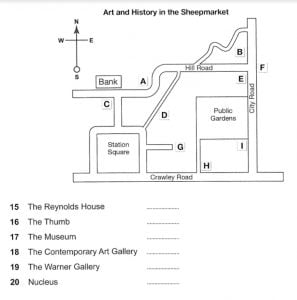
Many of my students find labelling a map to be one of the most difficult questions on the listening test.
This is because you have to pay very careful attention to directions on the map and if you get lost, you might do really badly on a whole section of the IELTS listening test!
Don’t worry – I’m going to show you how to improve your score on this section and the skills you need to practice to make sure you don’t mess it up.
Before you listen you will have 30 seconds to study the map. This time is really valuable.
Tip#1:
Before you listen, you should underline the key locations on the map and circle all the letters.
If you have time read the names of the places you will have to label as well.
Tip #2:
While listening you should trace your route with your pencil.
Pay careful attention to the names of places and turns.
Tip #3:
To improve listening and labelling a map you should practice this as much as you can!
These ones aren’t hard because of difficult vocabulary. They just require some practice until you get used to them.
Tip #4:
Learn some basic vocabulary related to directions.
Turn: go towards the, take the first/second right/left, turn onto _____ street
Go straight: go straight on, continue past, walk past, walk by, pass the ______, walk along ______ street until you reach _______, follow the road until, go beyond
Next to: west of/east of, near, adjacent to, beside
Across from: cross the street/square, diagonal from the _____ is the _______,
Links
Here are some links to our 3 favourite YouTube videos for this:
The IELTS listening test is designed to test, not improve, your listening. One common mistake that many of my students make is trying to use practice tests to improve their listening skills.
Testing your listening is what you do when you take a practice IELTS test. You listen once and find out how good your listening is.
This does not improve your listening very well. In the long-term, it does. Over years and years but it is a slow way to improve.
The other option is to develop your listening using the 3 keys:
1. Listen to something short.
2. Listen again and again.
3. Write something while you listen.
The difference between testing and developing your listening is like the difference between playing a game of football and practicing one skill.
If you play a game you are focusing on tons of different skills at once. You will improve but it will take a long time.
If you want to improve one specific skill, for example shooting, you should practice shooting again and again. This will quickly develop your shooting skills.
Listening is the same – practice one skill again and again and you will improve your listening for IELTS quickly!
Key #1: Listen to something short.
Don’t used a full practice test! Instead, listen to part of it (less than 1 or 2 minutes long). Or find a clip on youtube from BBC One Minute World News or Ted Ed.
It should one be 1 – 2 minutes maximum.
Key #2: Listen again and again.
The reason why you should listen to something short is so that you can listen to it again and again.
And why does listening to something again and again improve (not test) your listening?
Because…
1. You will hear the same sounds repeatedly and get better and better at recognising them.
2. You will hear new sounds and words each time and begin to recognise them as well.
That’s the whole reason why you should listen to something again and again to improve your listening!
Key #3: Write something while you listen.
The IELTS listening test tests 3 skills – Listening, reading and writing.
You have to read the questions. Listen to the answers. And write them.
This means that when you are developing your listening you should do some writing. It will improve your ability to listen and write at the same time and also will focus your listening on one particular skill.
Simple Listening Activities
Here are 10 simple activities for improving your listening:
1. Listen and write down the keywords.
2. Listen and write down a 1 sentence summary after you listen. Then listen again and make your summary more detailed.
3. Listen and write down words with difficult sounds (for example, all words that end with ‘s.’ words that end with ‘y’ and ‘een’ like 50 and 15).
4. Listen and write down every word. If you’re using Ted Ed you can check with the tapescript.
5. Listen and pause – then write down the last sentence or last 5 words your heard.
6. Listen and pause in the middle of a sentence – then write down how you think the sentence will end. Listen to the rest of the sentence and check.
7. Listen and try to write down the unfamiliar words. Then look them up in the dictionary and fix your spelling.
8. Listen and draw a picture of what they are talking about.
9. Write down the question words ‘Where,’ ‘When,’ ‘Why,’ ‘Who,’ ‘How,’ and ‘What’ and try to answer while you listen.
10. Listen and make a mind map of the topic.
For all of the ideas above you should listen multiple times – at least 5 times.
If your listening is only 1 minute long that will only take 5 minutes!
Do this at least once a day and I promise your listening will improve more quickly than any other method.
Here’s a video from ourYouTube Channelexplaining the fastest ways to improve your listening!
Now it’s your turn! Put your answers in the comments.
Do you have any links to interesting listenings on YouTube?
"The highest quality materials anywhere on the internet! Dave improved my writing and vocabulary so much. Really affordable options you don't want to miss out on!"