by Dave | Oct 31, 2017 | Writing your conclusion
Your IELTS conclusion is on a mission should you choose to accept it.
There are 3 simple objectives on this mission:
1. State your opinion/position
2. Give your main reason for this opinion
3. Add an extra detail
Let’s look at these objectives more closely below.
Dave
1. State your opinion/position
This is the main mission for your conclusion. If you only accomplish one objective, it should be this one.
The reason for it is in the band descriptors:
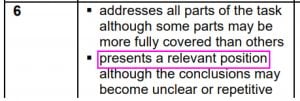
The key here is ‘presents a relevant position’. A position is the same thing as an opinion.
If you don’t say your opinion it is impossible to get a band 6 or above. Mission not accomplished.
Put in your conclusion and you can get at least a 6. So – just do it!
For example, ‘In my opinion, smoking should be banned in public places’ or ‘I believe that all children should be required to take computer lessons in school.’
Here is some vocabulary that will make your position crystal clear:

Be careful – only use the ones in blue and red for writing. The pink ones are only for the speaking test.
(By the way, if you want more tips like this you can check out our Facebook group)
2. Give your Main Reason for this Opinion
This one is pretty simple – just say why you have that opinion!
Don’t make up a new reason – use one that you already talked about in your writing.
For example: ‘In my opinion, smoking should be banned in public places because it has harmful side effects for people who are not smoking‘ or ‘I believe that all children should be required to take computer lessons in school because it will have a positive impact on their ability to get a good job later in life.’
3. An Extra Detail
This one is a little controversial.
Normally, examiners mark everyone’s writing exactly the same.
It doesn’t matter if you are in Bangladesh or France or Japan or Antarctica – you get the same marks because every examiner follows the band descriptors, like a perfectly objective robot.
But there are a few small areas where examiners do mark things a little differently. This is related to how long they have been marking, some unclear areas in the band descriptors, the person who trained them and even just human nature.
In these areas of difference you should always choose the safe option.
The safe option here is to include an extra detail to finish off your essay because some examiners will require you to have this for Band 7+.
What is an extra detail?
It could be a solution, more support for your opinion, a prediction – anything really!
Here are a few examples of extra details:
Prediction: If we ban smoking, people will lead longer, more productive lives and less money will be wasted on healthcare.
Further support: Health is more important than anything else and any effort to improve people’s health, including banning smoking, is a positive step forward.
Solution: The best way for nations to begin to institute these bans is to first raise taxes which will result in fewer smokers overall before completely banning smoking sometime in the next 20 years.
You do not need all 3 of those. 1 or 2 sentences with extra detail is enough to make sure you don’t get bumped down to band 6 because of a malfunctioning robot!

A Complete Conclusion
‘In my opinion, smoking should be banned in public places because it has harmful side effects for people who are not smoking. Health is more important than anything else and any effort to improve people’s health, including banning smoking, is a positive step forward.’
Opinion + Main Reason Why + Extra Detail = Mission Accomplished!
Now it’s Your Turn! Comment below!
Write only the conclusion for the following topic in the comments below:
Some people believe that we should have complete free speech and be allowed to say anything we want. Others think that there should be some limits on free speech. Discuss both views and give your own opinion.
If you need some more information about conclusions check out this post.
by Dave | Oct 21, 2017 | How To
If you are studying IELTS General Training then this is the Task 1 guide for you! Follow our tips to achieve a high score in your exam.
Dave
What is Task 1 General Training?
As part of the 60 minute writing test, you should spend around 20 minutes to write a 150 word letter. This letter might be informal e.g. to a friend, or it might be formal e.g. to a manager of a company.
Here is an example question:
Task 1
A friend has agreed to look after your house and child while you go out drinking.
Write a letter to your friend. In your letter:
-
Give contact details for when you are away.
-
Give instructions for how to take care of your child.
-
Describe other household duties.
Write at least 150 words.
You do not NEED to write any addresses.
Begin your letter as follows:
Dear………………,
|
But people don’t write letters anymore!
Yes, this is true but in the world of the IELTS exam, letters are alive and well, so we just have to pretend people still use them and imagine you are the writer. The more you put yourself into the task, the easier it will be to come up with ideas for your letter.
Cover all three points!
It’s very important that your letter clearly cover the three points in the question, and expand on each one with extra detail. If you don’t write about all three points your Task Achievement score will fall to a 5. Also, It’s a letter so you should write in full sentences – don’t use bullet points.
Use a logical structure and paragraphs!
You should start by writing the purpose of your letter, and finish with a clear sign off. And your paragraphing should also be logical, so only one or two main ideas for each paragraph.
Formal and Informal Letters
The main skill you have to master for IELTS Writing Task 1 General Training is writing different kinds of letters.
You can see from the table below that how formal the letter is depends on the situation and your relationship with the reader. A request letter written to a friend or to a stranger will be very different.
What kind of letter?
|
Formal, Semi-formal or Informal?
|
Notes
|
You write to an important client to invite them to a product launch
|
formal / semi-formal
|
depends on how well you know the client
|
You write a letter to your boss asking them for dinner
|
semi-formal
|
They’re the boss but you’re inviting them to dinner so semi-formal is more appropriate.
|
You write to a close friend to invite them to dinner.
|
Informal / very informal
|
depends on how close you are
|
You write to the lost and found department of a train company to ask if they have found a lost bag which you left on the train.
|
formal
|
Can be very formal if you prefer because it’s to a company
|
You write to a friend to ask if they have found a lost watch from the last time you visited.
|
informal
|
Could be very informal if they are a close friend
|
You leave a letter for the babysitter to look after your child and home for the evening
|
Semi-informal
|
Could be informal if you’ve know them a long time
|
Openings: A Clear Purpose
Let’s look again at our example question:
A friend has agreed to look after your house and child while you go out drinking.
The first sentence of your letter should clearly set out the purpose of your letter, but it should use the correct tone – it should be formal or informal depending on the situation.
This is a good example of an informal opening:
Dear Dave,
How’s it going? Thanks so much for agreeing to take care of Sally for me on Saturday. I really appreciate it mate, as this means I can make it to the work party. And as you remember from last year, our end of year parties are legendary! hahaha.
They are a close friend, so the reader already knows a lot of about the writer, and their life and the writer feels very comfortable with the reader.
Therefore it will much friendlier, the language is much more informal, and the information is much less obvious and refers more to things they both know about.
This is a bad example of an informal opening:
Dear Dave,
I hope that this letter finds you well and your family are healthy too. I am deeply grateful to you, my most trusted friend, for agreeing to supervise my small child this Saturday. I am honoured that you are willing to sacrifice your time so I can attend our annual company celebrations. They are always such a thrilling experience.
Although friendly, the tone and language is much too formal for a letter to a close friend. Also there is too much obvious information and less reference to things the reader and writer know about.
Closings
The same is the case with closing a letter. The style must be suitable.
This is a good example:
So thanks again Dave. You’re a lifesaver!
See you on Saturday.
All the best
Nick
This is a bad example:
Finally, I must thank you again Dave. You are a most honourable man!
I hope to see you at 7pm sharp!
Yours sincerely
Nick Kemp
Vocab and Grammar
There are big differences in the language we use with friends and strangers. As you can see from the examples in the table below, informal writing has simpler structures, uses more contracted forms, and uses more natural vocabulary.
Formal
|
Informal
|
How are you?
|
How’s it going?
|
I am deeply grateful
|
thanks so much
|
supervise my small child
|
take care of Sally for me
|
my most trusted friend
|
mate
|
I am honoured
|
I really appreciate it
|
attend
|
make it to
|
our annual company celebrations
|
the work party
|
you are an honourable man
|
you’re a lifesaver
|
such a thrilling experience
|
legendary
|
How to plan your letter
1. Read the question carefully and answer the following:
2. What type of letter is it?
3. What are the three points that you need to cover?
4. Is it a formal or informal letter? (How well do you know the reader?)
5. Brainstorm information to expand the three points.
6. Think about vocab and functional phrases (formal or informal?)
7. Think about your opening and closing sentences (formal or informal?)
by Dave | Oct 10, 2017 | How To
Surprisingly, one topic that seems to confuse a lot of my students is holidays.
A simple question like ‘What’s your favourite holiday?’ often produces some strange answers.
This is partly because in different cultures it can mean different things.
In this blog post we are going to look at three different topics to do with holiday so you will be able to successfully talk about them.
Here are some of my other IELTS speaking Model Answers: friends here, phones here, and school here.
Check out some of my speaking sample answers for free on TikTok: https://www.tiktok.com/@howtodoielts
Dave
1. To have a holiday:
Meaning: time off from working or studying. This might be a day, a week or even longer.
e.g. What do you like to do when you go on a holiday?
– I like to hang out with my friends/family…
– I like to have a party and invite my family and friends…
– I like to go to the beach…
– I like to travel somewhere new…
– I like to catch up on my sleep and just relax at home…
e.g. Do you like to have holidays?
– Yes, definitely. I like to spend it hanging out with my friends/family…
– Not really. I prefer just to work/study. I think holidays are boring…
2. National holidays
Meaning: a special day/time of the year, related to a festival e.g. Christmas, New Year, or an important day e.g. International Labor Day.
In some countries, people are given time off. This is a national holiday, or ‘public holidays (USA) / ‘bank holidays’ (UK).
Every country is different. For example people in the UK don’t get a day off for International Labor Day.
And Valentine’s Day isn’t celebrated as a national holiday in the UK or the USA.
e.g. What’s your favorite holiday?
– My favourite holiday is definitely Christmas…
– I really like Lunar New Year…
– I love Valentine’s Day, even though it isn’t a national holiday in my country.
e.g. What are some important holidays in your hometown?
– In my country Christmas and New Year are the most important, but Easter and Mother’s Day are also important.
3. To go on holiday (UK) / go on vacation (USA)
Meaning: an activity when you travel and stay in another place for fun.
e.g. What was the best holiday you’ve ever had in your life?
– In 2010, when I went backpacking across Asia for 6 months…
– Disneyland, Paris…
e.g. Where do you normally like to go on holiday?
– I love going to the beach…
– I like going somewhere quiet…
– I love staying in a resort…
– I love going to Singapore…
– I don’t like going anywhere. I usually have a staycation…
Now it’s your turn! Put your answers in the comments.
What do you like to do when you have a holiday?
Do you like to have a holiday?
What’s your favourite holiday?
What are some important holidays in your country?
What was the best holiday you’ve ever had?
Where do you usually like to go on holiday?
by Dave | Oct 10, 2017 | IELTS FAQ
Here are some ‘frequently asked questions‘ (FAQ) about IELTS. If you can’t find your question, please put it in the comments or send us a message.
Dave
What is IELTS?
IELTS means ‘The International English Language Testing System’. It’s the world’s most popular English language test and it covers all four skills – Listening, Reading, Writing and Speaking.
Why do people take an IELTS test?
It’s a requirement for study, work and migration with more than two million tests taken a year. It’s recognised by more than 10,000 organisations, including universities, employers, and governments, in 135 countries around the world.
You can take the Academic or General Training exam depending on the organisation you are applying to and your plans for the future.
How can I book an IELTS test?
There are over 1000 IELTS test centres in over 140 countries. For more info about booking a test you should visit the official IELTS website.
What is the difference between British Council and IDP?
IELTS is owned by Cambridge English Language Assessment, British Council and IDP. Cambridge writes the test and British Council and IDP deliver the test. All three organisations work together as one company to make sure the test is the same in all countries in both British Council and IDP.
For writing and speaking the examiners have been given exactly the same training, they ask the same questions, they use the same marking criteria and they will be monitored regularly using the same system to make sure they are following the same standards. For the reading and listening exams, local staff mark the same tests following the same answer keys from Cambridge. So, again this is the same for BC and IDP.
So if anyone tells you that taking your test with IDP or BC is better because you’re get a higher score then they are telling you a porkie. But if you have any real evidence that supports this then please message us.
How is IELTS scored?
IELTS covers all four skills (reading, listening, speaking and writing) and you get a ‘band score’ for each from 9 (expert) to 1 (non-user).
Reading and Listening: For each test you answer 40 questions. Each questions counts equally. Your marks are converted into a band score. e.g. 18/40 in the reading or listening test will result in a 5.5 score in that skill.
Speaking: You get an overall score based on an average of your fluency, vocabulary, grammar and pronunciation.
Writing: You get an overall score based on on the average of your task achievement (answering the question), coherence and cohesion (organisation), vocabulary and grammar. There are two tasks and task 2 counts twice as much as task 1.
Where can I find a copy of the IELTS band score descriptors?
Here are links to the public versions of the IELTS band descriptors, which are very similar to what real examiners use to mark your speaking and writing. If there is anything you don’t understand, please let us know.
How long is the IELTS exam? How many parts are there?
For both the General Training and Academic modules, the length of the IELTS exam is the same. The four sections include:
– Listening (4 sections- 30 minutes + 10 minutes transfer time)
– Reading (3 sections- 60 minutes)
– Writing (2 tasks-60 minutes)
– Speaking (3 sections- 15 minutes)
Do I take all the parts of the test on the same day?
Listening, reading and writing are all carried out together in one 2 hour 40 minute session, and we’re really sorry but you don’t even get a break between sections, so make sure you get a good night sleep and breakfast and or lunch before your test! The speaking test is separate, although it can be on the same day or different day and may take place at a different location to the other three skills.
How are the Academic and General Training exams different?
– For writing, general candidates have to write a letter and an essay, whereas academic candidates have to describe a chart or diagram and an essay. Even though both general and academic candidates have to write an essay in task 2, the question is not the same. In fact the general task 2 is usually less academic and therefore easier than the academic task 2.
– For reading both general and academic candidates have to answer 40 questions, but in the academic exam these are based on three long articles, whereas in the general exam, most of the readings are shorter with only one long passage so it is not as difficult.
– For speaking and listening, academic and general candidates take exactly the same exam.
What happens in the Speaking test?
The IELTS speaking exam is a 11-14 minute face to face interview with an IELTS examiner which is made up of three parts:
– Part 1 (4-5 mins) – You are asked short questions on three personal, familiar topics e.g. your job, studies, hobbies, music, your childhood etc. You do not see the questions.
– Part 2 – ‘The long turn’ (3-4 mins) – You are asked to talk about a personal topic e.g. ‘Talk about a movie you recently saw’ for 1-2 minutes and you have 1 minute to prepare. You are given a copy of the topic as well as a pencil and paper for making notes.
– Part 3 – You are asked short questions on two academic topics related to the topic in part 2. So for the topic above you might be asked about movie watching habits and the film industry in your country.
What happens in the Writing test?
The IELTS writing exam is 60 minutes and is made up of two parts. It is recommended that you spend around 20 minutes on Task 1 and you must write a minimum of 150 words. Task 2 should take around 40 minutes and the minimum requirement is 250 words. Task 2 is worth twice the marks of Task 1. The tasks themselves are different depending on whether you are taking the Academic or General IELTS exam.
– Task 1 (General): write a letter e.g. a thank you letter or a complaint letter. This might be to a friend, colleague or a stranger.
– Task 1 (Academic): write a report to describe the main trends and key details of a chart, table, process or diagram. There are a range of different task type that should be familiar with.
– Task 2: write an essay. Although the task is the same for both, the topic will be different and often the General Training topic is less academic than the Academic topic.
What happens in the Listening test?
You will listen only once to a series of recordings over four sections. You will have short breaks of around 30 seconds before and after each sections and also in the middle of sections 1-3 to study the questions and prepare to listen. At the end you have 10 minutes to carefully transfer your answers to an answer sheet.
– Section 1: A general English conversation between two people e.g. someone calling to book tickets.
– Section 2: A general English talk by one person e.g. someone talking about the facilities of the local museum.
– Section 3: An academic conversation between two or more people e.g. between two students, or between a student and a teacher discussing a project or a lesson.
– Section 4: An academic presentation e.g. a university lecture.
What happens in the Reading test?
You will have 60 minutes to complete three sections and answer 40 questions. There is no transfer time (unlike in the listening test) so you should write your answers directly onto the question paper.
For the Academic Reading test exam, each section contains one long reading passage of between 700-900 words. These are real articles taken from academic journals, magazines or newspapers and are on academic topics that are of interest to the general public. They might be describe facts or discuss opinions. They may include diagrams, charts or photos.
For the General Training Reading test, the reading texts are taken from adverts and public notices or company training handbooks, books, magazines and newspapers.
– Section 1: contains a number of short reading texts relating to everyday life.
– Section 2: contains two short reading texts relating to the workplace.
– Section 3: contains one longer reading text on general interest topic.
When do I get my result?
You will receive your IELTS scores 13 days after your test. The results are recorded on a test report form but if you can’t wait for the paper copy you can check your results online and some centres even send you your result by text message. There is only one original of the test report form produced so keep it safe as a copy cannot be issued. However your local IELTS office will send a copy to your chosen university free of charge.
Can I use American or Australian English in the speaking and writing test?
Yes you can. It is an international test, so any commonly used accent or vocabulary is acceptable. However due to spelling and pronunciation differences for students aiming for a high band score it is advisable to focus on learning English from one particular country. Also, you should be careful if you use slang which is only used in one particular country. Try to use vocabulary which is used in all the main English speaking countries.
How can I get a high IELTS score?
There are 2 important factors: how high and when. It’s important to know what score you need compared to what you want. IELTS is a test of your English so in order to get a high band score you need very good English. A lot of students think there are shortcuts and tricks to getting a high score, but in fact it takes a long time and a lot of hard work. Once you know what score you need, how long you have, and what your current level is, then send us a message and we can help you to make a study plan that will help you achieve your goals.
How can I improve my IELTS scores?
Start by checking out some of our blog posts – we add new content weekly.
We also suggest that you sign up for our free PDF here.
Am I allowed to bring any personal possessions into the IELTS test?
No, you can’t bring your bag, phone or even a watch with you. You will be scanned thoroughly before entering the rooms to make sure.
Can I write everything in capital letters in the IELTS exam?
In the listening and reading exams, you can write all your answers in capital letters if you want. One benefit of doing this is often the handwriting is clearer so you won’t make mistakes when you copy your answers during the 10 minutes transfer time and it’s easier for the person marking to understand.
In the writing exam, you will not lose marks if you write everything in capital letters. But it’s not a very good idea to do this if you don’t normally write in this way, because it may take longer.
How do IELTS scores compare with CEFR levels?
There is not a direct equivalent between IELTS scores and the Common European Framework of Reference (CEFR) but here is a rough guide:
– C2: between 8.0 and 8.5
– C1: between 6.5 and 7.0
– B2: between 5.0 and 5.5
– B1: around 4.0
How can I improve my IELTS scores?
Start by checking out some of our blog posts – we add new content weekly.
We also suggest that you sign up for our free PDF here.
What is HowtodoIELTS?
HowtodoIELTS was founded by two very experienced IELTS teachers Dave and Nick. They decided to create the site because a lot of students find it difficult to achieve the scores they need. This is because they don’t fully understand what the examiner is looking for and how to give it to them. We know lots of examiners so we know exactly what they want. Our purpose is twofold: teach you how to do the test and, if your English is not good enough, improve your English to get you a higher score.
How can HowtodoIELTS help?
We will give you the best, clearest advice available anywhere. We will provide study tips, speaking and writing model answers, and practice exercises. Follow us on Facebook, Instagram, Twitter, or YouTube. We are working on lots of new content all the time, so if you can’t find what you need, please let us know and we’ll be happy to help.
Can I study with HowtodoIELTS?
Sorry, we can’t teach you at the moment. We currently have a Facebook Group and we will have more online courses available in the future. In the meantime, check out our blog posts and free PDFs – there is a lot of good stuff in those. If you can’t find what you need, please let us know and we’ll be happy to help.
Where is HowtodoIELTS located?
Dave is from the USA and Nick comes from the UK. We are both currently located in Ho Chi Minh City, Vietnam, but we are helping students everywhere through howtodoielts.com and via our Facebook, Instagram, Twitter, and YouTube pages.

by Dave | Oct 10, 2017 | IELTS Writing Task 2
Welcome to the complete guide for IELTS writing task 2 – everything you need to know to get a top score!
The IELTS writing exam is a 60 minute test of your English writing ability and there are two parts – Task 1 and Task 2.
You can find all the most recent topics/questions (along with full sample answer essays) for IELTS academic here and general training here
Dave
What is IELTS task 2 writing?
For Task 2 you will be given an essay question and you have around 40 minutes to write at least 250 words.
This format is the same for the general or the academic IELTS exam.
The basic task 2 essay structure is four paragraphs – an introduction, two main (or body) paragraphs) and a conclusion.
You are expected to give your opinion and support it with reasons and examples.
You should avoid using personal examples as you should use a semi-academic style.
What does an IELTS Task 2 question look like?
Let’s look at some example questions:
Example 1
Some people think that governments should spend money on railways. Others believe that there should be more investment into new roads.
Discuss both sides and give your opinion.
Example 2
Nowadays governments are investing more in public transport such as buses and trains rather than in building new roads.
What are the reasons for this?
Is this a positive or negative development?
Example 3
The first car appeared on British roads in 1888. By the year 2000, there may be as many as 29 million vehicles on the British roads.
Alternative forms of transport should be encouraged and international laws introduced to control car ownership and use.
To what extent do you agree or disagree?
By looking at the three examples above, you can see that a Task 2 question is divided into two parts.
1. Statements giving you Information about the essay topic
2. The essay question(s) you have to answer.
There are different kinds of Task 2 questions.
Some give you more or less information about the essay topic.
Some questions require you to discuss both sides, agree or disagree, to explain a problem and suggest solutions.
However, regardless of the topic and the question, the format of the exam remains the same.
You have 40 minutes to write at least 250 words, and you are expected to give your opinion, present main ideas (reasons) and support those with explanation and examples.
And no matter the question, you can use a basic Task 2 essay structure of four paragraphs – an introduction, two body paragraphs and a conclusion.
How is IELTS Task 2 scored?
Your essay is marked by a qualified IELTS examiner.
They will score your writing equally using four criteria:
– TA – Task Achievement (Answering the the question)
– CC – Coherence and Cohesion. (Clear and well organised)
– LR – Lexical Resource. (Vocabulary and spelling)
– GR – Grammatical Range and Accuracy. (Grammar and punctuation)
For each of the criteria you will get a ‘band score’ of 0-9.
For each task, these will be added together and an average overall score will be calculated.
These two figures will then be added together accordingly with Task 2 counting for twice as many marks as Task 1 ie. Task 2 = 66%, Task 1 = 33%).
Finally, this figure is rounded down to the nearest half band score.
For example, Donald Trump gets the following scores:
|
TA
|
CC
|
LR
|
GR
|
Overall scores
|
Final result
(rounded down)
|
Task 1
|
5
|
7
|
7
|
6
|
6.25
|
|
Task 2
|
6
|
6
|
6
|
5
|
5.75
|
|
Combined score (Task 1 = 33%, Task 2 = 66%).
|
5.91
|
5.5
|
KEY TIP: Task 2 is worth double the marks so make sure you don’t spend too long on Task 1. If you are a slow writer, do task 2 first!
Also notice that being marked down in one criteria can wreck your chances of getting the score you need.
Therefore it isn’t enough to be getting close to your target scores when you are practising at home or in class.
In the lead up to your test, you should ideally be achieving higher than your target scores so you can be sure to achieve your goals on test day, especially as some examiners are very strict.
Comment any questions that you have below!
