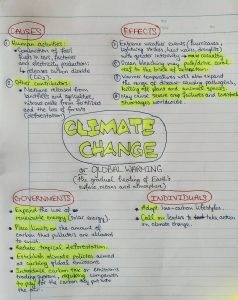
Climate change is a phenomenon that affects countries all over the world. Many people strongly believe that it is the responsibility of individuals, rather than corporations and governments, to deal with this problem.
To what extent do you agree?
Sample Answer
Climate change is a very real danger that threatens not only our lives but also the quality of life of future generations. To combat this I strongly disagree that individuals need to take responsibility because governments, in cooperation with private companies have both a greater responsibility and capacity in this matter.
Climate change cannot simply be the responsibility of private citizens because they do not have the ability to affect large systemic changes in the way that governments in conjunction with corporations do. People can only contribute in small ways; for every person who recycles there are several people who do not and there is no certain way to change this. Governments, on the other hand, can enact legislation requiring both individuals and large corporations to abide by certain restrictions. Laws for corporations are the real solution as they contribute by far the most to climate change and by reducing how much waste produced and how they treat that waste, climate change can be seriously countered.
The second reason governments should be responsible for combating climate change is that governments are responsible for global problems while individuals should only have to deal with local and personal problems. A person should only concern themselves with their job and personal life because that is the extent of their responsibility. Governments are responsible for various things related to their citizens including security, health care in some cases, and education. Included in security is the environment because it impacts citizen’s well-being; therefore this falls under the remit of governmental responsibility.
Individuals will never be able to have the effect government will and it is not their responsibility at any rate. In my opinion, governments, by taking measures to rein in corporate and private waste are taking up their rightful burden.
Analysis
Introduction:1. Climate change is a very real danger that threatens not only our lives but also the quality of life of future generations. 2. To combat this I strongly disagree that individuals need to take responsibility because governments, in cooperation with private companies have both a greater responsibility and capacity in this matter.
1. The first sentence simply restates the topic and adds an extra detail to make it more powerful.
2. The second sentence clearly states my opinion, which necessary to get at least a Band 5 for Task Achievement.
Body Paragraph 1:1. Climate change cannot simply be the responsibility of private citizens because they do not have the ability to affect large systemic changes in the way that governments in conjunction with corporations do. 2. People can only contribute in small ways; for every person who recycles there are several people who do not and there is no certain way to change this. 3. Governments, on the other hand, can enact legislation requiring both individuals and large corporations to abide by certain restrictions. 4. Laws for corporations are the real solution as they contribute by far the most to climate change and by reducing how much waste produced and how they treat that waste, climate change can be seriously countered.
1. The first sentence is a topic sentence that includes my main idea for the whole paragraph (governments can effect more change).
2. The second sentence further supports my main idea by pointing out that individuals will not be able to have a large impact on the environment.
3. The third sentence further supports my main idea by saying what governments can do to have a large impact.
4. The fourth sentence provides more detail about what the government can do specifically (enact legislation).
Body Paragraph 2:1. The second reason governments should be responsible for combating climate change is that governments are responsible for global problems while individuals should only have to deal with local and personal problems. 2. A person should only concern themselves with their job and personal life because that is the extent of their responsibility. 3. Governments are responsible for various things related to their citizens including security, health care in some cases, and education. 4. Included in security is the environment because it impacts citizen’s wellbeing; therefore this falls under the remit of governmental responsibility.
1. The first sentence is a topic sentence that includes my main idea for the whole paragraph (governments are more responsible).
2. The second sentence further supports my main idea by pointing out that individuals should only have to worry about personal problems.
3. The third sentence further supports my main idea by saying that governments have many responsibilities towards their citizens.
4. The fourth sentence further supports this by saying that protecting the environment is part of the basic security the government owes to all its citizens.
Conclusion: 1. Individuals will never be able to have the effect government will and it is not their responsibility at any rate. 2. In my opinion, governments, by taking measures to rein in corporate and private waste are taking up their rightful burden.
1. The first sentence restates the main ideas from the sample answer.
2. The second sentence adds an extra detail (a solution) that is needed to get above a Band 7 for Task Achievement according to some, but not all, examiners.
Vocabulary Practice
Quizlet is one of the best websites on the internet that you are not using (unless if you are using it – then good!)
Don’t believe me? Click on the link below and use it to easily learn some high-level vocabulary from the sample answer above:
So many students lose a lot of marks because they don’t know or forget to do the basic things that examiners want to see in your writing for a band 7 or even 6.
In this article, I’m going to share with you a tip that can help you remember easily, and therefore save you a whole band score.
According to examiners I know, so many students lose marks for their Task Achievement and Coherence and Cohesion because they don’t do the basic things that are needed for a band 6 or 7. This includes things like:
Once you know clearly what you need to do to make the examiner super happy, then of course the next step is to spend weeks, even months practising so you can do it for any topic or question type.
Don’t forget in your exam!
But then, there is one last challenge – remembering to do it in the exam.
I’m not exaggerating when I say that based on the examiners I talk to, more than half of IELTS students fail to do these basic things in the exam.
So why do many students fall at this hurdle? Is it a lack of practice or could it be nerves?
Whatever the reason, all of that study and practice will go to waste if you don’t remember to do it in the exam.
Write a Mini Checklist!
The solution is to write a quick checklist to remind you of all this basic stuff. So as soon as you open your question paper, quickly write down the following notes:
POS 2-2 OWE
And this is code for…
Your introduction –POS:
Paraphrase the question, give your opinion, and then signpost to the examiner what you will do in the essay.
Your Body paragraphs –2-2:
2 main ideasfor2body paragraphs – one main idea per body paragraph, supported with relevant explanation and examples.
Your conclusion –OWE:
Restate your opinion, say why Reasons, then finish with a related extra thought or idea.
Customise it!
You could add to it or even come up with your own version.
Whatever you do, just make sure you find a way of remembering to do the basic things that will help you to get a band 7 for your Task Achievement and Coherence and Cohesion.
I’ve been teaching IELTS in different countries around the world for the last decade and I have experience with every type of student – what makes a student a success?
I’ve had students who improved their IELTS score dramatically in both short and long courses.
I’ve also seen students who studied for years and years without moving their score up an inch.
Let’s take a look at the differences between successful and unsuccessful students!
The main difference between these types of students is simple and has many names: Motivation. Determination. Grit. Resilience. Attitude.
The qualities of successful IELTS students!
Your IELTS journey will be mostly made up of stumbles, failures, and steep challenges.
The students who continue to work in the face of failure, who even enjoy failure and use it to push them forwards, will be successful.
A mountain climber doesn’t get discouraged when it is difficult to climb the mountain. They expect it. They enjoy it. They have a good attitude.
I see evidence of good attitude in several ways: students who show up to every class, take good notes, ask questions, focus, do their homework, do extra homework, and don’t get discouraged when they make mistakes or improve slowly.
If that describes you then you can stop reading this because you are already on your path to becoming successful.
If it doesn’t, read on and I’ll show you the 4 elements of a bad attitude and what you can do to have a good attitude from now on!
Bad Attitude
1. Comparing Yourself to Others
It is harder for you to focus on your own work when you focus on how much faster other people are working.
There may be a number of possible reasons for other students improving more quickly: they have been studying English longer, they have better study habits, they are better motivated or they are naturally talented at learning a language.
Those are just excuses. Ignore the people racing ahead of you!
You will improve as long as you are focused on your own English. As soon as you begin focusing on other people you will start to feel that your study is a waste of time, meaningless.
You can endure the difficulty and struggle if you believe it is meaningful. If you don’t think it is possible, then you will give up.
Be careful – the opposite of this is also true if you are a good student.
If you focus on how much better you are compared to other people, you may become over-confident.
Measure yourself against yourself. No one else.
In this way, you will make the best progress.
2. Failure is Personal
IELTS study is a long series of failures: You can’t write an overview. You make lots of grammar mistakes. You can’t think of the right word. It takes too long to write. And so on and so on.
This is a natural part of the learning process and it does not mean you are dumb. It simply means that you have more to learn.
If you think your failures are a permanent part of who you are, you will become demotivated.
You will not be able to enjoy studying because you will fear the next failure.
The worst part is you’ll try to hide your failures and mistakes from other people.
Failure is the key to success. But it has to be out in the open. You need to see your failures. And then correct them.
Fear or hide your failures and you will not make good progress.
3. Weak/Unclear Motivation
It’s absolutely essential to have a good reason for studying – a deep well of motivation that will get you through difficult challenges.
A lot of students don’t have clear goals for their study.
Maybe your parents are making you take the class but you don’t really want to.
Maybe your family is pressuring you to study abroad or learn English but you’re not interested.
Maybe you want IELTS for no specific reason – just to have it.
None of these reasons is very deep or important so they will fail to motivate you both in the short and long-term.
4. Bad Study Habits
This one is less psychological than the other elements of a bad attitude.
A lot of people just haven’t learned good ways to study. Maybe this is your fault. Or maybe you can blame the schooling system in your country.
It doesn’t matter. You need to improve your study habits if you want to get a good score.
Some bad habits include: taking notes but not reviewing them, not reviewing lessons, taking messy notes, not asking questions in class, studying a lot of hours in one day but not every day, not doing much practice, and having a disorganised notebook/materials folder.
Make a list of all your bad habits and try to cross them off everyday!
Good Attitude
In order to have a good attitude you just need to reverse the elements of a bad attitude:
1. Comparing Yourself to Others Measure Yourself Against Yourself
The only person you should compare yourself to is yourself.
Look at how good or bad your English was in the past. Could it be better? Of course!
Focus on how you could be better and ignore the people around you (both those who are better and those who are worse).
Focus on any improvements you can make. You’ll feel better about yourself and be more motivated to work hard and improve.
2. Failure is Personal Failure is not Personal
No one likes the feeling of failure. It hurts.
It makes you feel stupid. Incapable.
But you should try to connect the words ‘stupid,’ and ‘bad’ to your mistakes, not to you.
Good IELTS students don’t believe failure is personal.
Why?
Stupid and bad are not fixed qualities. Your abilities change over time. You go from bad to not-so-bad to good eventually.
Recent research has shown that your brain can physically change, even as you get older.
No quality is fixed.
Once you attach bad to your mistakes, rather than yourself, you will be free of the emotional impact of making a mistake.
Making a mistake doesn’t mean you are stupid. So make a 100! It’s fine!
Only by making mistakes will you improve your English.
Not feeling bad about your mistakes is the first step to failure which is the first step to success.
That’s a good, motivating reason. But it could be better.
Look at the reasons for your reasons and your motivation will become deeper and stronger, like a house built of stone rather than straw.
You want to study abroad because you want to experience life in another country. You want to get a better job. You want to work in the best companies, with the best people. You want to change the world in some way. You want to bring your experience back to your home country and help it. You want your children to grow up in a more developed country.
There are so many reasons! These are all firm bricks in a wall of motivation.
Add more bricks, more reasons, and the wall will become stronger and won’t be shattered by the occasional setback.
4. Bad Study Habits Good Study Habits
Some people are born with good study habits (maybe) but mostly people have to learn from their mistakes and get better over time.
Here are some of the good study habits I’ve noticed in my best students: reviewing their notes after every lesson within the same day, taking neat organised notes, studying consistently every day even if it is not that long, practicing all the time, focusing on 1 thing at a time (close your Facebook!), and having organised folders with old worksheets and notes.
One popular way to study vocabulary is to use an IELTS vocabulary list available online. It will probably have a sexy title like ‘Essential Band 8 Vocab‘ or ‘100 words you need for your IELTS exam‘.
Check out this list as an example, with the following claim:
“These words are indispensable for the IELTS Examination. You need to use these words in your Speaking and Writing Test. These words will greatly impact your IELTS Score.”
Firstly, the words on this list are the opposite of indispensable (essential) and they certainly won’t improve your score because you will find it very difficult to use them correctly and in the right situation.
In this article, I’ll explain why these words are so unsuitable as well as give you some tips about how to use lists effectively.
As you can see from the table below, it’s not about knowing a good range of vocab, but it’s very important that you know when to use it e.g. how formal it is, and how to use it e.g. correct collocations and/or prepositions
Band
Lexical Resource(Vocabulary)
8
A wide range of vocabulary used naturally and flexibly to express exact meanings
Skillful use of less common and idiomatic vocab
Very rare mistakes with word choice and collocations.
7
A good range of vocabulary used flexibly to discuss any given topic
Some ability to use less common and idiomatic vocab
Some mistakes with word choice and correct collocations.
6
A range of vocabulary used to give long answers
Meaning is clear although mistakes in word choice and form are common.
Too formal and Academic
Let’s take a closer look at the list. It’s arranged alphabetically and here are the first 5 words:
aberration, abhor, acquiesce, alacrity, amiable
These words are all very formal and extremely academic. A lot of native speakers may have never used them and may not even know the meaning of them. Seriously.
Some have very specific meanings. For example, Acquiesce:
to accept a decision, even when you don’t agree, but you don’t say anything, maybe because you know there’s no real alternative.
But the meaning only tells you half the story. You also need to know how to use the word and the kind of situation the word is used for.
The five words above are very formal and academic. So you can only use them to talk about specific, mostly academic topics. Also, you must use them in combination with equally formal grammar and vocabulary.
Let’s check out the following examples. What is the difference? Which is the correct usage?
Student #1. “My mum always makes me eat my vegetables. She spends a lot of time and energy to make dinner for me so I usually acquiesce her.”
Student #2. “Despite my reservations, I usually acquiesce to my mother’s demands for me to always finish my vegetables, as she puts a lot of time and energy into making dinner for me.”
If an examiner heard student #1 the use of acquiesce wouldn’t sound natural as the surrounding vocab is much less formal and they didn’t use a preposition (acquiesce to someone) so they haven’t shown they can use this word correctly and naturally so this keeps their score at band 6 or less.
Student #2 is much better as the surrounding vocab is suitable (e.g. reservations, demands), and they used the correct preposition. So this is correct and natural use which will help them to achieve above band 7+ for vocabulary.
A good tip for how to know how to use the word and more importantly the kind of situation is google it and check out the news tab:
You can see from the search results that this word is commonly used to talk about political decisions and negotiations.
You need to ask yourself “Is it likely that I will want to talk/write about this (accepting political decisions) in my IELTS exam?“.
If the answer is “Yes!”, then go ahead, learn this word, study it’s meaning and usage, including the situation, collocations and grammar, and practice using it in your speaking and writing as often as you can in the weeks and months leading up to your test.
But be aware that a word like this is very specific – so sure it will impress the examiner if you use it correctly, in the right situation, but how likely is that? To be honest, It’s highly unlikely.
STUDY TIP: Read the sentences containing the target word or phrase. If you can’t understand those sentences, then the target vocab is probably too high level for you at the moment.
Phrasal Verbs – natural and idiomatic
A more natural, common and therefore more useful strategy would be to avoid very academic words and focus instead on good collocations with verb phrases and phrasal verbs.
As we saw in the band descriptors earlier, examiners want a good range, including idiomatic vocab, which includes many phrasal verbs and theses are a much safer option than using idioms like ” raining cats and dogs” which native speakers don’t commonly use.
Suitable alternative phrases for acquiesce could include ‘let someone win’, ‘give in to someone’s demands’, ‘agree to someone’s request’, ‘force someone to do something’.
“My mum always forces me to eat all my vegetables. She spends a lot of time and energy to make dinner so sometimes I complain but usually I just give in to make her happy.”
If you search “give in to” on google news, you can see from the examples below that a phrase like “to give in to..” is much more flexible and natural and it can be used to talk about a range of academic and everyday situations:
-Zimbabwe ruling party says will not give in to military pressure.
-Arsenal should not give in to Mesut Ozil’s latest contract demand
-Don’t give in to the pressure of driving drowsy.
-High Grade’s Strawberry Cough Shatter: Give in to the Cough!
Here’s a video from our YouTube Channel with a little more detail on collocations (phrasal verbs are one type of collocation).
Practice in Context
Another good strategy for learning new vocabulary is to link the new phrases you are learning to topics and practice in that way.
So this means either learning a group of words related to a particular topic or to clearly have a topic in mind when you’re practising new words.
For example, make notes about as many real situations as you can both in daily life and in the past when you ‘give/gave in to someone/something’, and/or ‘someone forces/ed you do to do something’.
Next, practice talking about these situations (record yourself on your phone, listen back and check your grammar and collocations).
You can practice talking about these situations from a more personal point of view (to prepare for Speaking Pt1&2) or from a more general point of view (Speaking Pt3 / Writing Task 2).
Personal – “My parents forced me to study business at University. I wanted to study design but in the end I gave in to their wishes.”
General – “In my country, parents of high school students often forced their children to study sensible subjects such as business or accounting. I think they these students often want to study something else but but in the end they give in to their parents’ wishes.”
Create your own lists
So overall lists are a great way to focus you on studying new words, but it’s probably better to create your own lists from suitable words taken from your daily English use, and then follow the strategies above.
If you’re not sure about a word or phrase, try googling it, and if you’re still not sure, please get in touch and we’ll be happy to tell you.
Try to make a list with related words like this if possible:
Now it’s your turn! Put your answers in the comments.
Choose a word you think is good to use in the IELTS exam.
What does the word mean and how to use it?
Here are some ways to start writing your comments:
Brainstorming is such an important skill that can really help your Task 2 IELTS Writing and Part 3 IELTS Speaking.
If you can brainstorm well, you’ll amaze your friends, bosses, and co-workers as if you were a magician pulling amazing ideas out of your hat.
But the key to brainstorming isn’t pulling out an amazing idea every time – it is pulling out hundreds of bad ideas, not feeling bad about that and then finding a good one every once in a while.
Imagine that you are someone else considering the problem.
For example, ‘Should we ban hunting for sport/fun?’
What would different people say about this and why?
A hunter might say ‘No, because it is a traditional activity handed down for generations that has many benefits related to family bonding and personal enjoyment.’
A cop might say ‘Yes, because it allows people to buy powerful guns that can then be used in violent crimes.’
A doctor might say ‘Yes, because there are countless hunting injuries each year, and these often involve people who were not even hunting.’
A liberal-wuss might say ‘Yes, because we share the earth with animals – we do not own them.’
Even try some strange ones like from the point of view of a famous (or imaginary) person or a different gender, age group, time period or location:
Superman might say with a smirk ‘I don’t really have an opinion about this but if there’s an asteroid coming towards the Earth I WILL stop it and save all the humans AND animals.’
A child might say ‘It is simply wrong to hurt animals because they are cute and friendly.’
A person from the past might say ‘Animals should only be killed to be eaten.’
A person in a poor country might say ‘There isn’t enough time or money to spend hunting for fun.’
I would say ‘[fill in your opinion here]’
See how easy that was to think of tons of great ideas? Try it out on your next Task 2 Writing Essay!
Activity #2 Use Humour to Release your Ideas
The best video lecture on creativity was given by John Cleese, the famous comedy writer and actor of Monty Python. You can find it here.
One of his many insights is that humour is a fast way of getting to a creative place and thinking of good ideas.
Tell a joke, everyone laughs and that lowers their defences and helps them think more freely and confidently.
So what can you do on the IELTS exam? Think of a joke from a comedian or a friend or a TV show or movie that you like.
Enjoy the joke for a second. That will relax you. Then write down your ideas after that.
Activity #3 Question Words
Who? Where? Why? When? How? How much/many? What? Which?
Use these question words to generate ideas.
For example, the IELTS question is ‘Should we ban hunting for sport/fun?’
Ask yourself:
“Who wants to ban hunting? Who doesn’t?”
“Where is hunting common?”
“Why do people hunt? Why do people want to band hunting?”
“How do most people hunt? Is it dangerous?”
“Howmuch does hunting cost? Howmany animals are killed every year?”
“What would happen if hunting was banned? What if it becomes more popular?”
“Which countries hunt the most? Does this have an effect?”
This makes it a lot easier to come up with some really good ideas!
Activity #4 Wishful Thinking
Think about the ideal or perfect solution.
If you were doing a Task 2 Writing about Space Tourism – the advantages and disadvantages – what is the best possible outcome?
“We discover new technology and new planets and learn more about the universe. We come in contact with friendly aliens.”
If it was a Part 3 Speaking question – ‘Will people in the future continue to live in the city rather than the countryside?’
“The ideal future would be most people living in cities for work but still large populations outside the cities so that they are not too crowded. Maybe people will live outside cities if there are more opportunities for work there.”
Alternatively, you can think of the worst possible outcome and that will help you to think of ideas as well.
Activity #5 Word Links/Associations
This is a classic brainstorming method.
Write down the main word related to the topic. For example, ‘pollution.’
Now write down all the words that you usually associate with this word – climate change, governments, corporations, taxes, fossil fuels, etc.
Use these words as the basis of your main ideas and support in your paragraphs.
You can also try out this website which is really helpful for starting to think of ideas if you are doing a practice essay at home or practicing your part 3 speaking: WordStorm.com
Activity #6 Doodling and Mind Maps
Drawing pictures is a great way to come up with ideas because it allows your mind to drift and naturally think of a large number of related ideas.
So if you find yourself stuck in your Task 2 Writing, and you like to draw, try doodling a little bit on the test to start thinking again.
You don’t want to spend the full hour drawing pictures because the examiner probably won’t give you a good band score no matter how amazing your pictures are.
But taking a minute to draw what you are talking about will get you thinking again.
Activity #7 A Mathematical Equation
The last idea is for people who think artistically and this one is for people who are more logical and mathematical.
If this was a Task 2 Writing Question, for example, ‘What are the disadvantages of too many people living in cities?’ you could rewrite it like an equation:
Too many people + _________________ = Bad for cities
Then write down a few possibilities for the blank space: traffic jams, pollution, cleanliness, expensive, crime, etc.
Then choose the best 1 or 2 ideas and write about those in your essay.
Activity #8 Reverse Thinking
This means to think backwards from the solution.
Here’s a problem solution Task 2 Writing Question: Children today are becoming less healthy. Why is this a problem and what possible solutions are there?
Start with a solution: getting more exercise.
Now work backwards – how did you get children to exercise more?
Long gym classes at school, more sports facilities open to the public, public service announcements to encourage parents to go out with their kids more often, more parks in cities, etc.
That’s your whole Task 2 solutions paragraph – done!
You can also use the is for Part 3 of the Speaking test: ‘How could governments encourage people to go to museums more often?’
‘By building better, more interesting museums. To do this they could include more interactive exhibitions, update the items in museums more often, make sure museums are free on certain days of the week and advertise the museums better.’
Activity #9 The 6 Thinking Hats
Edward de Bono is one of the most famous writers on the subject of creativity.
One of his most famous books is about the 6 thinking hats.
This is very similar to activity #1 except instead of pretending to be another person, you just pretend to have a different perspective (i.e. ‘wear a different hat’).
Blue hat: manages the brainstorming by look at the overall picture or question. What are you trying to decide overall?
White hat: Uses data and information. Think about statistics, evidence and facts with this hat.
Yellow hat: Always looks for positive answers, always optimistic and hopeful. Think of ideal solutions and perfect situations here.
Green hat: Creative hat. Think about all the different possible alternatives here. This is the brainstorming hat.
Red hat: the instinctive hat. What is the first thing that comes into your head? How do you feel? Answer those questions for this hat.
Black hat: The judging hat. This hat judges the ideas you have thought of. Be careful not to use this hat too early or too much.
Activity #10 Rapid Writing
Just write – don’t stop writing.
This is the fastest method, I think.
Write down as many ideas as you can as quickly as you can. Take maybe 5 minutes.
Then go back and cross off some, circle some and improve some.
Simple but powerful!
Finally! Here’s a video helping you to think about main ideas for Task 2 Writing from our YouTube Channel!
Now it’s Your Turn! Brainstorm ideas for the question below:
What are the best ways to reduce crime in your country?
"The highest quality materials anywhere on the internet! Dave improved my writing and vocabulary so much. Really affordable options you don't want to miss out on!"