by Dave | Jan 18, 2018 | IELTS Listening
The Test Format
It takes the makers of IELTS (Cambridge) an average of 2 years to make every test. Each question has to go through dozens of people before it is finally approved – let’s study the test with the same attention to detail! If you want to learn more about IELTS from former examiners you can check out our YouTube Channel or our Facebook Group.
IELTS Listening is a 30 minute test of your English listening ability and there are 4 parts.
There are 40 total questions and each part has 10 questions.
You will conduct the test in a room full of other candidates and will be provided with your own personal pair of headphones (that you can’t keep!).
You cannot leave the room to go to the toilet during the test because it would disturb other test takers.
Write your answers on the test itself. At the end of the 30 minute test, you will have 10 minutes to transfer your answers from the test paper to the answer sheet.
Dave
IELTS Listening Part 1
In part 1, you will hear an informal conversation typically asking for information or making a purchase.
Some examples of conversations that you might hear in part 1 listening include:
-
Someone asking about a job vacancy over the telephone (at a restaurant, office, The White House, etc.)
-
Someone book a service (a hall for a party, a hotel room, a bus ticket, a plane ticket, a holiday trip, etc.)
-
Someone asking for information about a service or place (a guided tour, an amusement park, a school, etc.)
This is the easiest part of the listening exam because it is only testing one thing: your ability to write what you hear.
You just have to be able to write down names, numbers, spellings, and simple vocabulary.
Here is what part 1 typically looks like (it is almost always a gap-fill):

Pay close attention to the instructions because it will tell you how many words/numbers you can write for this question: ONE WORD AND/OR A NUMBER.
This will not always be the same so make sure you carefully read and circle the instructions.
To do better on these types of questions you can check out the 6 basic tips here.
IELTS Listening Part 2
In part 2, you will hear one person typically talking about a public event or attraction.
Some examples of conversations that you might hear in part 2 listening include:
-
Someone giving information about an event (a museum opening, a concert, a fundraising event, etc.)
-
Someone explaining something (how to get around campus for new students, the details of a guided tour, a project they are involved in, etc.)
In this section the exam begins to become more difficult.
The vocabulary is a little more difficult and there will be more distractors and paraphrases/synonyms.
Here are 2 examples of a listening part 2:


The synonyms and distractors make part 2 really challenging. All the keywords might be paraphrased. The listening might mention options A, B, and C but only 1 of them is coffect.
For example, take a look at this question:
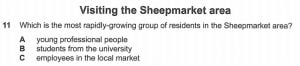
Here are some paraphrases from the tapescript:
‘Most rapidly growing’ changes to ‘has seen the largest increase in population’
‘Group of residents’ changes to ‘demographic’
‘Sheepmarket area’ changes to ‘Sheepmarket and its surrounding community’
‘Young professional people’ changes to ‘young professionals’
‘Students from the university’ changes to ‘young people who are still studying’
‘Employees in the local market’ changes to ‘the local workforce’
The listening will also probably mention all 3 options: A, B, and C.
Maybe the speaker talks about how there are tons of new young professionals first, then about how that has helped the local workforce expand then back to mention how many young professional people there are now before finally saying that this is overshadowed by the number of new university students. Good luck with that!
They could talk about the options in any order so be really careful before circling your final answer!
IELTS Listening Part 3
In part 3, you will hear a discussion usually involving 2 people, but which could be as many as 4 people.
Some examples of conversations that you might hear in part 3 listening include:
-
A discussion of an academic project or research (a teacher discussing the results of a project with a student, a teacher giving a student advice or an overview of a subject area, two students planning to do a project together, etc.)
The difficulty usually also increases in this section because there will be even more distractors, paraphrases and because the vocabulary is more academic and challenging.
Here are 3 examples of listening part 3:


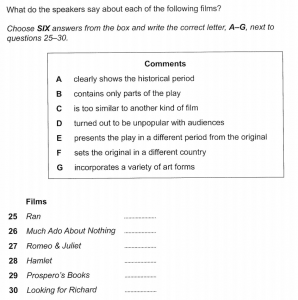
Just like in part 2, a lot of the keywords will be paraphrased or changed.
There will also be distractors – answers that are mentioned and could be correct, but are not.
The main difference between part 2 and 3 is that in part 3 the vocabulary will be more academic and you might have a harder time understanding everything you hear.
IELTS Listening Part 4
In part 4, you will hear part of a lecture on an academic subject.
Some examples of the subjects talked about in the lectures include:
-
Astronomy, history, political science, biology, marine biology, geology, neuroscience, psychology, art history, literature, physiology, etc.
You can see from the list above that many of the topics are related to science.
A lot of my students think this is the most difficult listening passage.
The biggest challenge in part 4 is the difficult vocabulary related to an academic field. It is a professor’s lecture – even native English speakers have to listen very carefully to understand it well!
For example, in this question:
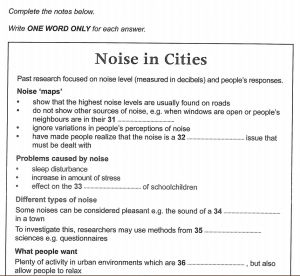
Here is some difficult vocabulary that you might hear related to noise in cities: urban noise pollution, rising decibel levels, neurological effects of noise, personal sensitivity levels to noise, increasingly pertinent problem, abnormal sleep patterns, more acute stress levels, subjective perception of a sound, research methodology, and much more!
If you are interested in reading a lot of academic vocabulary related to noise you can check out this article.
The Question Types
There are 10 different questions types on the listening test.
-
Multiple Choice
-
Matching
-
Labeling a Plan/Map/Diagram
-
Completing a Form
-
Completing a Table
-
Completing Notes
-
Completing a Sentence
-
Completing a Summary
-
Completing a Flowchart
-
Short Answer Questions
In order to do well on the test, you should be familiar with all the types of question so that you feel comfortable during the test. This is one reason to do lots of practice tests.
To do really well on the test, you need to put in a lot of work practicing specific types of questions repeatedly in order to improve your listening skills.
How to Score the IELTS Listening Test
The listening test has 40 questions and each one counts for 1 point. You can get half-bands, for example a 6.5 or 8.5.
Here is a chart provided by the official IELTS page on how the scores are marked:

https://www.ielts.org/ielts-for-organisations/ielts-scoring-in-detail
However, the scores vary slightly based on the difficulty of the test that week.
In general those numbers give you a rough idea of what your score will be.
Do a few practice tests and if the results are similar you should expect to get a similar score on your actual test.
If you are not close to the score you want, don’t waste your money – spend some more time improving your listening first!
How to Improve your Listening Skills
There is a difference between testing and improving your IELTS listening skills.
To test your IELTS listening, do a practice test and add up your points. Use the chart above to figure out what your score is. Now you know how much you have to improve.
Best of luck!
by Dave | Jan 12, 2018 | Model Answers
In IELTS Speaking Part 1 there are a wide range of topics: habits, family, work, transport, food, superheroes, and so on.
Check out some of my speaking sample answers for free on TikTok: https://www.tiktok.com/@howtodoielts
One of the most common topics is school. The most common type of school discussed on IELTS is high school (or secondary school).
Let’s take a look at some sample questions and answers and do some analysis so that you can improve your speaking score to at least a Band 7!
The IELTS Speaking Examiner
You won’t be able to see it but the examiner will have 4 questions related to high school on the paper in front of him.
The examiner will not explain a question and he will only repeat it once before moving on to the next question.
However, if you ask the examiner to explain a word or phrase – for example you ask: ‘What does high school mean?’ – then the examiner will explain it and you will not lose any points for asking the question.
Sample Questions
Here’s an example of the 4 questions that the examiner may ask you:
Do you stay in contact with friends from high school?
What did you not enjoy about high school? (Why not?)
What was your favourite subject in high school? (Why?)
Do you think people generally enjoy their time in high school? (Why/why not?)
Sample Answers
Here are some sample answers:
Examiner: “Do you stay in contact with friends from High School?”
Sample Answer: “I used to keep in touch with a lot of old friends but lately I’m too busy at work. I’ll send a message on Facebook every once in a while but that’s about it. But my best friend is actually from high school and I see him quite a bit. We talk online and meet up to play videogames together way more than we probably should.”
Examiner: “What did you not enjoy about high school?”
Sample Answer: “Well, to be honest, high school was a really terrible time for me. People made fun of me and I really struggled in class. So, everything basically!”
Examiner: “What was your favourite subject in high school? (Why?)”
Sample Answer: “When I was in high school I remember really enjoying gym. Yeah, I think I enjoyed gym class more than anything else. I’ve never been that studious and it was my only chance during the day to do something I was really good at. I was really fit and sporty at the time.”
Examiner: “Do you think people generally enjoy their time in high school? (Why/why not?)”
Sample Answer: “Where I’m from, in Nepal, I think most people have a pretty good time. There is a lot of bullying, like I talked about before. But in general, the teachers are good, the facilities are modern and clean – they’ve got a lot going for them. Things aren’t as good once you get to Uni but in high school I think most people have a decent experience.”
Here are some more questions about high school – post your answers in the comments below!
by Dave | Dec 26, 2017 | Sample Answers
This is an IELTS sample answer on leadership that came up on the test in July – maybe it will come up again next July! (That’s just a joke – questions are not repeated on the test.)
Read this sample answer and complete the vocabulary exercises below it in quizlet so you can be ready for when it comes up again!
Check out the links to articles and videos to become more familiar with a topic that will definitely come up again on the test next July! (Joking!)
If you want some SPEAKING sample answers you can check out our YouTube Channel.
Dave
Task 2 IELTS Sample Question
Some are of the opinion that people are naturally born as good leaders while others feel that leadership skills can be learned.
Discuss both views and give your own opinion.
Sample Answer
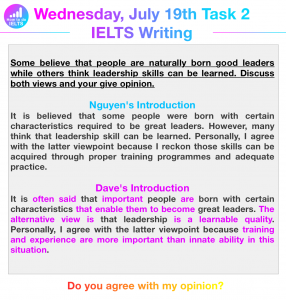
It is often said that important people are born with certain characteristics that enable them to become great leaders. The alternative view is that leadership is a learnable quality. Personally, I agree with the latter viewpoint because training and experience are more important than innate ability in this situation.
It is somewhat true that many individuals are born with distinctive personal traits that allow them the opportunity to become talented leaders. Leaders tend to be those who are charming and persuasive. In contrast, those who lack of these characteristics may have a difficulty inspiring the belief and loyalty that all leaders require and end up as followers rather than leaders. For instance, a salesman who often fails to convince his clients to sign a deal may be dissuaded from becoming the sales team leader since he does not believe that he has what it takes to be one. The more convincing salesmen are more likely to rise to that role.
However, there are also people who assert that leadership skills can actually be achieved through proper training and effort. That is why there is a larger number of institutes offering leadership training programmes helping those who want to learn the skills required to be a leader. Public speaking is one of many skills these schools can teach. Individuals who are shy and lack confidence can find their feet in the leadership battle by learning the essence of good body language, pronunciation, and other elements of good public speaking. This will in turn make them better leaders.
In conclusion, although some traits related to leadership are likely inherited there is tremendous room for people to grow into positions of responsibility if they apply themselves fully to learning the skills and personal characteristics of great leaders.
Analysis
Introduction: 1. It is often said that important people are born with certain characteristics that enable them to become great leaders. The alternative view is that leadership is a learnable quality. 2. Personally, I agree with the latter viewpoint because training and experience are more important than innate ability in this situation.
1. The first sentence simply restates one side of the topic (leaders are born).
2. The second sentence restates the other side (leaders are made).
3. The third sentence states my opinion that leaders are made more, not born.
Body Paragraph 1: 1. It is somewhat true that many individuals are born with distinctive personal traits that allow them the opportunity to become talented leaders. Leaders tend to be those who are charming and persuasive. 2. In contrast, those who lack of these characteristics may have difficulty inspiring the belief and loyalty that all leaders require and end up as followers rather than leaders. 3. For instance, a salesman who often fails to convince his clients to sign a deal may be dissuaded from becoming the sales team leader since he does not believe that he has what it takes to be one. 4. The more convincing salesmen are more likely to rise to that role.
1. The first sentence is a topic sentence that includes my main idea for the whole paragraph (there are some natural traits that help people become talented leaders).
2. The second sentence further supports my main idea by pointing out that people who lack certain qualities often become followers rather than leaders.
3. The third sentence further this idea by giving the example of a salesman without the natural charisma to convince clients also not having the personality to lead other salesmen.
4. The fourth sentence supposes that a more naturally convincing person is more likely to become the leader of that team.
Body Paragraph 2: 1. However, there are also people who assert that leadership skills can actually be achieved through proper training and effort. 2. That is why there are a larger number of institutes offering leadership training programmes helping those who want to learn the skills required to be a leader. 3. Public speaking is one of many skills these schools can teach. 4. Individuals who are shy and lack confidence can find their feet in the leadership battle by learning the essence of good body language, pronunciation, and other elements of good public speaking. 5. This will in turn make them better leaders.
1. The first sentence is a topic sentence that includes my main idea for the whole paragraph (people can become leaders through training and effort).
2. The second sentence further supports my main idea by pointing out that many institutions offer training courses for leadership.
3. The third sentence further supports my main idea by saying that there are clear skills a person can learn related to body language, pronunciation and public speaking.
4. The fourth sentence summarises the paragraph by concluding that the training course will make them better leaders.
Conclusion: 1. In conclusion, although some traits related to leadership are likely inherited there is tremendous room for people to grow into positions of responsibility if they apply themselves fully to learning the skills and personal characteristics of great leaders.
1. The first (and only) sentence restates the main ideas and my overall opinion.
Vocabulary Practice
Quizlet is one of the best websites on the internet that you are not using (unless if you are using it – then good!)
Don’t believe me? Click on the link below and use it to easily learn some high-level vocabulary from the sample answer above:

Use this amazing site to learn some of the vocabulary from our sample answer!
Leadership Articles
Leadership Videos
Example Notes
Here are some notes that I wrote myself (with the aid of a cup of coffee) from our Instagram page:


Student / Expert Answer comparison (Spot the mistake in body paragraph #2?)


Now it’s Your Turn! Comment below:
Are leaders born or made?
by Dave | Dec 10, 2017 | IELTS Reading
It gets pretty boring trying to improve your reading everyday using practice tests – reading the news is a great way to work on your IELTS!
Your life is already pretty boring so let’s see if we can find some ways to make it slightly more interesting.
The news used to be boring too, but now that Donald Trump is president it is better than watching an action movie!
Let’s take a look at how you can use the news in a structured way over a long period of time to improve your reading skills and do better on the test (these tips apply to books and other online articles as well – not just the news).
You can get more tips and reading materials from our Facebook group, too!
Dave
Tip #1: Know your Websites
Here are my favourite websites for reading the news, including a mixture of American and UK sites:
news.google.com Takes the top headlines from hundreds of newspapers and websites. Also allows you to personalize and search news all over the world.
theatlantic.com This magazine has been around for 160 years and employs some of the best writers and journalists in the world.
pitchfork.com The best and most popular blog for reading music news.
bbc.co.uk The gold standard for UK news, publicly funded and 100% impartial.
dailymail.co.uk Often considered to be the pinnacle of professional journalism.
nytimes.com LIberal-leaning and the most famous news organisation in the world.
Tip #2: Read lots of Related Articles

Here are two of the related articles at the bottom:

Make sure that you read articles from the same topic. Since both articles are related you will be able to review a lot of the same vocabulary.
Some of the common vocabulary in both articles includes: administration, white house, democratic, campaign, conceal, institutions and many more!
This is how you learn a language: you read the same words over and over again in slightly different texts and over time understand the word fully.
You don’t learn words with vocabulary lists and translations from L2 to L1 (or even from dictionaries!). That is superficial.
This method of learning slowly as you read a word over and over again encourages deep, meaningful learning, not simple memorisation.

Tip #3: Keep a Journal for Vocab and Ideas
The difference between successful and unsuccessful IELTS students is how active they are.
Don’t just read. Read and DO SOMETHING.
Here are some images of good note-taking (from our Instagram page):

Tip #4 Practice Activities
Besides taking good notes, you should also try to do some meaningful practice with what you read.
You don’t have to be in the classroom with some old, ugly teacher to do practice activities.
Here are some activities you can do all by yourself:
1. Read the article and write a short summary (1-2 sentences long). Then go back the next day and re-read the article and add more detail to your summary.
2. Write your opinion of what is happening in the article.
3. Write a prediction for what will happen in the future related to the article.
4. Record your favourite quotes/lines from the article. Try to memorise them.
5. Add an extra sentence to every paragraph in the article.
by Dave | Dec 7, 2017 | How To
The Most Common Score (because of IELTS overviews)
They should be getting a 6 overall (or higher) for Task 1 Writing. But their scores look like this:
Task Achievement: 5
Cohesion & Coherence: 6
Vocabulary: 6
Grammar: 6
Overall: 5.5
That person’s score should be a 6. But it’s not.
And the reason is because they made one minor mistake with their overview.
The band descriptors state:

Writing that does not have an overview at all gets 5.
Writing that does not have a clear overview also gets a 5.
There’s one minor mistake that makes a major difference and stops the vast majority of students every week from writing a clear overview.
The Minor Mistake
This happens with every type of graph (maybe 75% of the time) but almost 100% with tables.
Here’s a table:
The graph below shows the average number of cups of coffee drunk per minute per person in three countries in 2000 and 2010.
|
2000
|
2010
|
Nepal
|
1.2
|
1.1
|
Vietnam
|
4.2
|
4.2
|
Indonesia
|
8.7
|
9.2
|
For their overview, 99% of students write:
People in Nepal drank the least coffee in both of the years while Indonesians drank the most.
Here’s another example:
The graph below shows the number of tourists (in thousands) visiting different attractions in the United States in 2004 and 2017.
|
2004
|
2017
|
The Grand Canyon
|
110
|
108
|
Yellowstone National Park
|
231
|
252
|
The Golden Gate Bridge
|
301
|
234
|
Disneyland
|
364
|
375
|
Trump Tower
|
870
|
952
|
And another common overview:
Trump Tower had by far the highest total number of visitors in both years surveyed while the Grand Canyon accounted for the lowest number.
The problem with both these overviews is that they just mention the top and the bottom, the high and the low.
That is not an overview – it is only the two key areas.
Both of these students will get 5 for Task Achievement even if the rest of their writing is absolutely amazing.
That’s because the overview requires an overview of all the information.
It is not a summary.
It is not writing about the main factors.
It is like a bird flying over a field seeing everything. You must include everything in your overview or it doesn’t count as an overview.
Are all countries mentioned? Are all tourist attractions mentioned?
If not, it’s not an overview. Task Achievement = 5.
How to Fix the Mistake
What can you do to make sure that you include an overview of everything?
Think of your overview as two sentences, not one.
For the first graph:
The graph below shows the average number of cups of coffee drunk per minute per person in three countries in 2000 and 2010.
|
2000
|
2010
|
Nepal
|
1.2
|
1.1
|
Vietnam
|
4.2
|
4.2
|
Indonesia
|
8.7
|
9.2
|
Band 5 Overview (just the high and low):
People in Nepal drank the least coffee in both of the years while Indonesians drank the most.
Band 6 Overview (all areas included):
People in Nepal drank the least coffee in both of the years while Indonesians drank the most. Vietnamese people occupied the middle position.
Band 7+ Overview (all areas included with more detail):
People in Nepal drank by far the least coffee in both of the years and there was a slight decline over the years while Indonesians drank considerably more than both other countries, including a small upward trend. Vietnamese people were almost directly in the middle in terms of coffee consumption and there was no change over the years.
You can still mention the top and the bottom as the main information.
Just include one more sentence so that you write about everything.
Same thing with the second graph:
The graph below shows the number of tourists (in thousands) visiting different attractions in the United States in 2004 and 2017.
|
2004
|
2017
|
The Grand Canyon
|
110
|
108
|
Yellowstone National Park
|
231
|
252
|
The Golden Gate Bridge
|
301
|
234
|
Disneyland
|
364
|
375
|
Trump Tower
|
870
|
952
|
Band 5 Overview:
Trump Tower had by far the highest total number of visitors in both years surveyed while the Grand Canyon accounted for the lowest number.
Band 6 Overview:
Trump Tower had by far the highest total number of visitors in both years surveyed while the Grand Canyon accounted for the lowest number. The middle posititions were occupied by Yellowstone National Park, the Golden Gate Bridge and Disneyland.
Band 7+ Overview:
Trump Tower had by far the highest total number of visitors as well as the largest rise in both years surveyed while the Grand Canyon accounted for the lowest number and experienced a small drop off. Trump Tower’s popularity was followed distantly by three attractions with roughly similar numbers: Disneyland, Yellowstone National Park, and the Golden Gate Bridge (the only one of the three to also have a downward trend).
The extra sentence does all the extra work!
What You Should Do
When you get to the overview in your Task 1 Writing – slow down.
Open your eyes. Write your overview.
Then go back to the graph and tick all the areas to make sure that everything has been mentioned.
Once you have done this, you know you will get at least a 6 for Task Achievement and the score you deserve.
Now it’s Your Turn!
Write an overview for the following table and post it in the comments below or on our Facebook Group: