by Dave | Oct 7, 2017 | Writing your introduction
A lot of my IELTS students like to start their Task 2 essays with a long and complicated introduction.
This is a really bad idea.
I know a lot of examiners and to be honest they’re not especially clever, and they get tired and hungry like just like everybody else.
So it’s a good idea to make your IELTS essay as simple and clear as possible, and this is especially true for the introduction, as that will be the first thing they read.
So think of the reader (the very tired examiner) and keep it simple.
Dave
The most important part of your introduction
If your opinion is clearly presented in the introduction and then confirmed in the conclusion, then it makes your whole essay clearer.
You can see from the table below, for a band 7 and above, your position should be clear “throughout the response”, which means from your introduction to your conclusion.
Putting your opinion in your introduction won’t guarantee you a band 7 for Task Achievement.
But it makes it more likely because it will make your writing more logical.
So this will also improve your cohesion and coherence score as well
Band Score
|
Official IELTS description
(Task Achievement)
|
What it means
|
7+
|
“Presents a clear position throughout the response.”
|
Your overall opinion is very clear and is well supported by all your reasons and examples in your whole essay.
|
6
|
“Presents a relevant position, although the conclusions may become unclear or repetitive.”
|
Your overall opinion is good but you don’t always clearly support it with reasons or have clear conclusions.
|
5
|
“Expresses a position but the development is not always clear and there may be no conclusions drawn.“
|
You have an overall opinion but you often don’t support it with reasons or have conclusions.
|
4
|
“Presents a position but this is unclear.”
|
You have an opinion but you don’t explain or support it clearly.
|
How to write a clear and simple introduction
A basic introduction has three sentences:
1. A simple paraphrase of the question.
2. Your position (overall opinion).
3. What you will do in the essay. (This sentence is optional.)
Let’s check out some examples on the topic of railways!
Example 1 (agree or disagree question)
Governments should spend money on railways rather than roads.
To what extent do you agree or disagree?
For this kind of question you can discuss one or both sides.
But either way you must clearly state which side your opinion agrees with. If you don’t do this you can’t get higher than a 5 for Task Achievement.
As I suggested earlier, it’s best if you include your opinion in the introduction and conclusion.
Introduction for discuss one side e.g. strongly agree
It is often suggested that governments should increase investment in railway infrastructure rather than on new roads. Personally, I agree that the benefits of rail, which include less traffic and pollution, outweigh the apparent benefits of new roads. I will explain my reasons in this essay.
Introduction for discuss both sides e.g. agree
It is often suggested that governments should increase investment in railway infrastructure rather than on new roads. I will discuss both views but personally, I agree that the rewards of investing in trains, which include a reduction in traffic and pollution, outweigh the benefits of building new roads.
Example 2 (discuss both sides question)
Some people think that governments should spend money on railways.
Others believe that there should be more investment into new roads.
Discuss both sides and give your opinion.
For this kind of Task 2 question you need to discuss both sides of the question.
As with agree/disagree question above, you must clearly state which side your opinion agrees with.
The best way to do this is to include your opinion in the introduction and conclusion.
Technically, it’s OK to write a very general introduction and leave your opinion to the end.
But this isn’t as clear, and you might run out of time before you’ve got to your conclusion, so overall it’s a more dangerous strategy.
So here is the example introduction.
Notice that it’s exactly the same as the discuss both sides from the agree/disagree question.
Introduction for discuss both sides e.g. agree
It is often suggested that governments should increase investment in railway infrastructure rather than on new roads. I will discuss both views but personally, I agree that the rewards of investing in trains, which include a reduction in traffic and pollution, outweigh the benefits of building new roads.
Example 3 (two questions)
Nowadays governments are investing more in public transport such as buses and trains rather than in building new roads.
What are the reasons for this?
Is this a positive or negative development?
For this kind of task you need to discuss both questions equally.
The second question requires an opinion so you must clearly state which side your opinion agrees with.
Again, as above the best way to do this is to include your opinion in the introduction and conclusion.
Introduction for positive development:
It is often noted that many governments are adopting policies which invest in public transport rather than in road infrastructure. Personally, I feel the main reasons for this are an increase in congestion and a reduction in air quality in big cities. I therefore feel this is a positive development. I will explain my reasons in this essay.
Why you should include main ideas in the introduction
All of the example introductions above included main ideas as well as a clear opinion.
It is a good idea to include main ideas as it makes your position very clear.
This is especially important for IELTS students aiming for a band 7 or above.
For more information, check out the article below.
Now it’s your turn! Put your answers in the comments
Why should you always include a clear position in your introduction?
If you don’t include a clear position in your intro, what is the highest score you can get for Task Achievement?
by Dave | Oct 7, 2017 | Writing your introduction
Students often ask me what’s the best way to write an introduction if you’re aiming for a high band score.
I always tell them they should include their main ideas as well as their clear opinion (position) in their introduction.
This isn’t necessary for every IELTS student but it’s highly recommended for students who want to improve to get a band 7 or above.
It will make your position and therefore your essay much clearer. This will boost your Coherence and Cohesion score as well as your Task Achievement.
Dave
Example Question
Governments should spend money on railways rather than roads.
To what extent do you agree or disagree?
Look at the following model introductions.
1. Without main reasons:
It is often suggested that governments should increase investment in railway infrastructure rather than on new roads. Personally, I agree that the benefits of rail outweigh the apparent benefits of new roads. I will explain my reasons in this essay.
2. With main reasons:
It is often suggested that governments should increase investment in railway infrastructure rather than on new roads. Personally, I agree that the benefits of rail, which include less traffic and pollution, outweigh the apparent benefits of new roads. I will explain my reasons in this essay.
Notice the main reasons (less traffic and pollution) tell the reader exactly what will be discussed later.
This is a huge help for your cohesion and coherence!
The standard IELTS Task 2 essay structure is four paragraphs – an introduction, two body paragraphs and a conclusion, with each body paragraph focussing on one main idea.
So for the introduction above the main idea for body paragraph 1 will be traffic, and the main idea for body paragraph 2 will be pollution.
If your essay follows this structure, then the position of your essay is extremely clear.
This will increase your ‘task response’ and ‘coherence and coherence’ scores.
Now it’s your turn! Put your answers in the comments
Brainstorm your main ideas and position for the question above and write an introduction. Put it in comments.
In some countries, governments are making some criminals do voluntary community work rather than being put in prison.
To what extent do you agree with this?
by Dave | Oct 7, 2017 | Understanding Task 2 Writing
In this expert guide I will help you to understand how to answer the main question types for IELTS Writing Task 2.
If you need to learn the basic information about Writing Task 2, please check out our beginner’s guide here.
Dave
You Must Answer the whole Question
Understanding the correct question is very important for your Task Achievement score. Too many IELTS students write about the general topic but they don’t stick to (follow closely) the question.
As you can see from the table below, failing to answer the question means you could get a 5 or even a 4 for Task Achievement.
Band Score
|
Official IELTS description
(Task Response)
|
What it means
|
7+
|
“Addresses all parts of the task.”
|
Your essay discusses both sides or questions in enough detail.
|
6
|
“Addresses all parts of the task although some parts of the task may be more fully covered than others”
|
Your essay discusses both sides or questions but only one half was covered in enough detail.
|
5
|
“Addresses the task only partially.”
|
Your essay only discusses one part of the question.
|
4
|
“Responds to the task in only a minimal way or the answer is tangential”
|
Your essay discusses the general topic but not the specific question. Maybe you misunderstood the question.
|
Analyse the Question Carefully
As well as misunderstanding the question topic, some students misunderstand the type of question
For some IELTS Task 2 question types you have to discuss both sides of a topic, but for other question types you are free to discuss just one side. For some questions you have to answer one question. For others you must answer two separate questions.
But remember, for all Task 2 questions, the basic Task 2 essay structure is the same: four paragraphs – an introduction, two body paragraphs and a conclusion.
When reading the question you should focus on three things:
1. TOPIC – What is the general topic?
2. QUESTIONS – How many questions?
3. SIDES – How many sides do I need to answer for each question?
Question Type 1 – Agree or Disagree (Opinion Essay / Discussion Essay)
Governments should invest more in public transport such as buses and trains rather than building new roads.
To what extent do you agree or disagree?
What is the topic? Should governments spend money on public transport vs new roads.
How many questions? 1 – Do I agree or disagree?
How many sides? 1 or 2 (There are two options – discuss one side or both sides)
Option 1 (Opinion essay – discuss one side): I can choose to write about spending money on public transport OR new roads. For this option I will write two body paragraphs about the benefits of investing in public transport or two body paragraphs supporting new roads.
Option 2 (Discussion essay – discuss two sides): I will write about spending money on public transport AND railways. I will write two body paragraphs – one about the benefits of investing in public transport, and one about the benefits of investing in new roads.
Option 2 is the same as a discuss both sides essay (see Question Type 2, below).
Expert Tip: For both both options 1 and 2, it is strongly recommended that your conclusion always contains a clear opinion (overall do you agree or disagree?). If you don’t have a clear opinion you could lose marks for your Task Achievement score.
For more help with structuring essays for this kind of question click here.
For an expert sample essay with line by line analysis and key vocabulary click here.
Question Type 2a – Discuss Both Sides (Discussion Essay)
Governments should invest more in public transport such as buses and trains rather than building new roads.
Discuss both sides and give your opinion.
What is the topic? Should governments spend money on public transport vs new roads.
How many questions? 1 – public transport vs new roads?
How many sides? 2 (You must discuss both public transport and new roads)
For this question I will write about spending money on public transport and new roads. I will write two body paragraphs – one about the benefits of investing in public transport, and one about the benefits of investing in new roads.
If I only discuss one side I will get a maximum of a 5 for Task Achievement. To achieve a score of 6 or higher I must write equally (one body paragraph) about both sides.
Expert Tip: Some discuss both sides question don’t ask you to ‘give your opinion‘. It is strongly recommended that your conclusion always contains a clear opinion (overall which side do you think is better or more important?). If you don’t have a clear opinion you could lose marks for your Task Achievement score.
For more help with structuring essays for this kind of question click here.
For an expert sample essay with line by line analysis and key vocabulary click here.
Question Type 2b – Advantages AND Disadvantages (Discussion Essay)
Nowadays governments are investing more in public transport such as buses and trains rather than in building new roads.
What are the advantages and disadvantages?
What is the topic? Should governments spend money on railways vs roads.
How many questions? 1 – public transport good or bad?
How many sides? 2 (You must discuss both side of public transport)
For this question I will write about the two sides of spending money on public transport. I will write two body paragraphs – one about the benefits of investing in public transport (compared to new roads), and one about the drawbacks of investing in public transport (compared to new roads).
If I only discuss one side I will get a maximum of a 5 for Task Achievement. To achieve a score of 6 or higher I must write equally (one body paragraph) about both sides.
Expert Tip: Some advantages/disadvantages questions require you to discuss both, whereas others ask you which outweighs the other. It is strongly recommended that your conclusion always contains a clear opinion (overall do the advantages outweigh the disadvantages?). If you don’t have a clear opinion you could lose marks for your Task Achievement score.
Question Type 2c – Advantages OR Disadvantages? (Discussion Essay)
Nowadays governments are investing more in public transport such as buses and trains rather than in building new roads.
Do the advantages outweigh the disadvantages?
What is the topic? Should governments spend money on railways vs roads.
How many questions? 1 – public transport good or bad?
How many sides? 2 (You must discuss both side of public transport)
For this question I will write about the two sides of spending money on public transport. I will write two body paragraphs – one about the benefits of investing in public transport (compared to new roads), and one about the drawbacks of investing in public transport (compared to new roads).
If I only discuss one side I will get a maximum of a 5 for Task Achievement. To achieve a score of 6 or higher I must write equally (one body paragraph) about both sides.
Expert Tip: Some advantages/disadvantages questions require you to discuss both, whereas others ask you which outweighs the other. It is strongly recommended that your conclusion always contains a clear opinion (overall do the advantages outweigh the disadvantages?). If you don’t have a clear opinion you could lose marks for your Task Achievement score.
Question Type 3a – Double Question
Nowadays governments are investing more in public transport such as buses and trains rather than in building new roads.
What are the reasons for this?
Is this a positive or negative development?
What is the topic? Government spending money on public transport vs new roads.
How many questions? 2 – Why is this? Is it a good or bad thing?
How many sides? 1 per question (you don’t need to discuss good and bad for the 2nd question)
For this question I will write about why governments are spending money on public transport and whether it is positive or negative. I will write two body paragraphs – one paragraph about the reasons why governments are doing this, and one paragraph about why this is a good or bad idea.
If I only discuss one question I will get a maximum of a 5 for Task Achievement (maybe lower). To achieve a score of 6 or higher I must write equally (one body paragraph) about both questions.
Two part questions are very common and there are many different kinds. See below for more examples.
Expert Tip: Some double question ask for an opinion, whereas others ask you to explain problems and solutions. It is strongly recommended that your conclusion always contains a clear opinion (overall is it a negative or positive development?) or at least re-state your main ideas (overall, what is the main cause and solution). If you don’t have a clear opinion or clearly re-state your main ideas you could lose marks for your Task Achievement score.
For more help with structuring essays for this kind of question click here.
For an expert sample essay with line by line analysis and key vocabulary click here.
Question Type 3b – Two Topics (Double question)
The first car appeared on British roads in 1888. By the year 2000, there may be as many as 29 million vehicles on the British roads.
Alternative forms of transport should be encouraged and international laws introduced to control car ownership and use.
To what extent do you agree or disagree?
What is the topic? Two solutions for dealing with rise in cars – 1) alternative transport, and 2) international laws to control car ownership and use.
How many questions? 2 – Do I think alternative transport is a good idea? Do I think international laws are a good thing?
How many sides? One for each solution – you don’t need to discuss good and bad for each solution.
For this question I will write about whether I think alternative transport and international laws are a good or bad thing. I will write two body paragraphs – one paragraph about why alternative transport is a good or bad idea, and another paragraph about why international laws are a good or bad idea.
If I only discuss one solution I will get a maximum of a 5 for Task Achievement (maybe lower). To achieve a score of 6 or higher I must write equally (one body paragraph) about both solutions.
Expert Tip: Some double question ask for an opinion, whereas others ask you to explain problems and solutions. It is strongly recommended that your conclusion always contains a clear opinion (overall do you agree or disagree?) or at least re-state your main ideas (overall, what is the main cause and solution). If you don’t have a clear opinion or clearly re-state your main ideas you could lose marks for your Task Achievement score.
Question Type 3c – Causes and Solution (Double question)
The price of rail travel in some countries increases annually while average incomes remain relatively stable.
This causes a problem for many people who rely on trains for travelling to work.
What do you think are the causes of this problem and what measures could be taken to solve them?
What is the topic? The problem of increasing costs of rail travel while incomes remain stable.
How many questions? 2 – What are the causes of this problem? What are some solutions?
How many sides? One for each question – you don’t need to discuss good and bad for your solutions.
For this question I will write about the main causes of and solutions for the problem of rail ticket price increases. I will write two body paragraphs – one paragraph about the main causes, and another paragraph about some solutions.
If I only discuss about causes or solutions I will get a maximum of a 5 for Task Achievement (maybe lower). To achieve a score of 6 or higher I must write equally (one body paragraph) about both causes and solutions.
Expert Tip: Some double question ask for an opinion, whereas others ask you to explain problems and solutions. It is strongly recommended that your conclusion always contains a clear opinion (overall is it a negative or positive development?) or at least re-state your main ideas (overall, what is the main cause and solution). If you don’t have a clear opinion or clearly re-state your main ideas you could lose marks for your Task Achievement score.
For more help with structuring essays for this kind of question click here.
Practise analysing Task 2 questions.
Like anything, if you want to master a skill you need to practise it.
If you find it difficult to understand Task 2 questions, just focus on practising that skill (without worrying about ideas or grammar or vocab or writing anything).
Look at different kinds of questions and practise analysing them following the examples above. Keep practising until you feel confident about dealing with any IELTS Task 2 question.
Relax before you read and fully the question
Even after practising a lot, it’s natural for students to feel very stressed in the exam. I always tell my students that if they feel really nervous in the exam, they should take 10-20 seconds to relax before they read the question.
If you have your own relaxation method then use that (let us know in the comments below). If you don’t then how about this:
In the exam sit up straight, close your eyes and put your hand on your stomach, while you focus on your breathing.
Breathe in slowly through your nose and out of your mouth. Feel the air go in and out of your body. Do this until you feel your heart slowing.
This should reduce your stress because it will lower your heart rate and your blood pressure.

Now it’s your turn! Put your answers in the comments.
Here’s some examples for you to practice with, and don’t forget to practise focusing on your breathing if you’re feeling stressed!
Example 1
a) What is the topic?
b) How many questions?
c) How many sides?
Global warming is one of the most serious issues that the world is facing today.
What are the causes of global warming and what measures can governments and individuals take to tackle the issue?
Example 2
a) What is the topic?
b) How many questions?
c) How many sides?
Global warming is one of the most serious issues that the world is facing today. Some people think the best way to tackle this problem is by investing in renewable energy.
Do you think this is an effective measure?
What alternative solutions are possible?

by Dave | Oct 7, 2017 | Structuring your essay
A lot of my IELTS students struggle with how many ideas they need and how to structure their essay.
Let’s look at an example:
Governments should spend money on railways rather than roads.
To what extent do you agree or disagree?
Dave
Clear position
The first thing to remember is for the question above you don’t need to discuss both sides but you can if you want.
Therefore you have a choice about whether to discuss the ‘agree’ side, the ‘disagree’ side or discuss both sides. We’ll examine these options later.
Even if you choose to discuss both sides you must clearly state whether your opinion is agree or disagree. This is very important for your Task Achievement score.
You can see from the table below that if you don’t clearly choose a side, you will not score above a 5 for Task achievement – no matter how good the rest of your writing is.
Band Score
|
Official IELTS description
(Task Achievement)
|
What it means
|
7+
|
“Presents a clear position throughout the response”
|
Your overall opinion is very clear and is well supported by all your reasons and examples in your whole essay.
|
6
|
“Presents a relevant position, although the conclusions may become unclear or repetitive.”
|
Your overall opinion is good but you don’t always clearly support it with reasons or have clear conclusions.
|
5
|
“Expresses a position but the development is not always clear and there may be no conclusions drawn.“
|
You have an overall opinion but you often don’t support it with reasons or have conclusions.
|
4
|
“Presents a position but this is unclear.”
|
You have an opinion but you don’t explain or support it clearly.
|
So to summarise, for the question above you must have a clear position and you have three possible options:
1. Strongly agree. You think it’s better for governments to spend money on rail rather than roads. You discuss only this side.
2. Strongly disagree. You think it’s better for governments to spend money on roads rather than rail. You discuss only this side.
3. Discuss both sides. You discuss both sides but you have a clear opinion about rail or road.
Clear essay structure
As you can see from the table above a clear position throughout your essay is very important for your Task Achievement.
So I always recommend to my IELTS students that they give their opinion in the introduction as well as the conclusion (for all Task 2 questions).
Technically, it’s OK to write a very general introduction and leave your opinion to the end.
But I strongly suggest that you don’t do this because it’s not as clear.
Also, you might run out of time before you’ve got to your conclusion, so overall it’s a risky strategy.
Therefore my suggested IELTS Task 2 essay structure is four paragraphs – an introduction, two main (or body) paragraphs and a conclusion.
The opinion is presented in the introduction and re-stated in the conclusion, and each body paragraph should only discuss one main idea.
Now let’s look at the options in more detail.
Possible Essay structures
1. Strongly agree – you feel rail is much more important than roads.
You need two good reasons why rail is more important.
Paragraph 1 (intro)
|
Paraphrase the question and state your overall opinion
(you feel rail is more important)
|
Paragraph 2 (body 1)
|
Explain and support your first reason why rail is more important.
|
Paragraph 3 (body 2)
|
Explain and support your second reason why rail is more important.
|
Paragraph 4 (conclusion)
|
Re-state your overall opinion (rail is more important) and summarise your main reasons.
|
2. Strongly disagree – you feel roads are much more important than rail.
You need two good reasons why roads are more important.
Paragraph 1 (intro)
|
Paraphrase the question and state your overall opinion
(you feel roads are more important)
|
Paragraph 2 (body 1)
|
Explain and support your first reason why roads are more important.
|
Paragraph 3 (body 2)
|
Explain and support your second reason why roads are more important.
|
Paragraph 4 (conclusion)
|
Re-state your overall opinion (roads are more important) and summarise your main reasons.
|
3. Discuss both sides – You think one side is good but overall the other side is more important.
You need one good reason for each side.
In the example below you feel the reason for supporting rail is more important than the reason supporting roads.
Paragraph 1 (intro)
|
Paraphrase the question and state your overall opinion
(you feel roads are important but rail is more important)
|
Paragraph 2 (body 1)
|
Explain and support your reason why one side is important.
|
Paragraph 3 (body 2)
|
Explain and support your reason why the other side is important.
|
Paragraph 4 (conclusion)
|
Re-state your overall opinion (you feel roads are important but rail is more important) and summarise your main reasons.
|
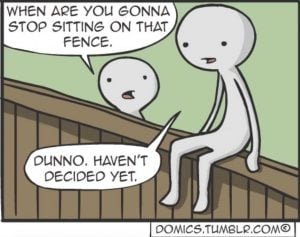
So in summary, one thing that all three options have in common is that each essay clearly chooses a side and that is clear throughout the essay.
None of these options ‘sit on the fence’ (stay in the middle), because you should never write a 50/50 essay.
You should never say “Both roads and rail have benefits and drawbacks.”
That is not a clear conclusion, so you will definitely lose marks for your Task Achievement.
Also, you shouldn’t say “Overall I think roads are important and rail is also important so governments should spend money on both.”
Technically this is OK as your opinion is clear, but some examiners might not agree so this is risky.
So the safest strategy is to choose a side, even if that isn’t your real opinion.
Now it’s your turn! Put your answers in the comments.
Look at the question below then compare your ideas with this sample answer (written by an ex-examiner).
Check out our expert sample answer with line by line analysis and key vocabulary.
Plastic shopping bags are used widely and cause many environmental problems. Some people say they should be banned.
To what extent do you agree or disagree?
Brainstorm some main ideas – what are the main benefits and drawbacks of banning plastic bags.
What’s your overall position – do you agree or disagree?
Which essay structure are you going to choose – will you discuss one side or both?
by Dave | Oct 7, 2017 | Structuring your essay
A lot of my IELTS students struggle with how many ideas they need and how to structure their essay.
This article with explain clearly what you need to do and why. Read some examples of actual IELTS essays here.
Let’s look at an example of this kind of question:
The price of rail travel in some countries increases annually while average incomes remain relatively stable. This causes a problem for many people who rely on trains for travelling to work.
What do you think are the causes of this problem and what measures could be taken to solve them?
Dave
How many causes and solutions?
You’re being asked to discuss causes and solutions (measures) but in fact it’s better if you can think of just one or a maximum of two main causes and solutions.
This means you can spend more time developing those ideas which will then improve your Task Achievement score.
Possible Essay structures
1. Separately – you discuss the main cause first then discuss the main solution.
You need one or two main causes and one or two main solutions.
Paragraph 1 (intro)
|
Paraphrase both questions and state the main cause and solution.
|
Paragraph 2 (body 1)
|
Explain the main cause(s). Support your ideas.
|
Paragraph 3 (body 2)
|
Explain the possible solution(s) . Give reasons to support your ideas.
|
Paragraph 4 (conclusion)
|
Re-state the problem and summarise your main ideas.
|
2. Together – you discuss the causes one at a time together with its solution.
Again, you need at two main causes and two main solutions.
Paragraph 1 (intro)
|
Paraphrase both questions and state you will discuss some causes and solutions.
|
Paragraph 2 (body 1)
|
Explain the first main cause and suggest a suitable solution. Give reasons to support your idea..
|
Paragraph 3 (body 2)
|
Explain the second main cause and suggest a suitable solution. Give reasons to support your idea..
|
Paragraph 4 (conclusion)
|
Re-state the problem and summarise your main ideas.
|
Do not write an opinion essay
A lot of IELTS students are very good at writing agree or disagree essays, so they misunderstand problem/solution questions.
Instead of discussing causes and solutions, they discuss the benefits and drawbacks of expensive tickets.
This would mean a 4 for Task Achievement.
Make sure you read and understand the question carefully.
Other similar types of questions than you can answer in the same way include:
– What do you think are the causes? / What are the solutions?
– Explain some possible reasons for this problem and suggest some solutions.
Now it’s your turn! Put your answers in the comments.
Is travelling by train in your country more expensive than in the past? Why?
How could train companies save money?
