A lot of my students seem surprised by Task 1 writing because it wasn’t what they expected, and to be fair there are quite a few different types of questions!
So here is a breakdown of all the basic info you need.
If you want to read some sample essays that will also give you a leg up on the test! Here is a bar chart, pie chart, table, process, and a map!
The IELTS writing exam is a 60 minute test of your English writing ability and there are two parts – Task 1 and Task 2.
For Task 1 (Academic) you will be given some data in the form of a chart, table, or process.
You have around 20 minutes to write at least a 150 word summary of the data.The data comes in many different formats so you should practise all of them to be ready for your test.
What Does a Task 1 Question Look Like?
The question has three main parts:
1. Task instructions – these are always the same for any academic Task 1
2. A statement that introduces the data.
3. The data itself – presented in a chart, table or diagram.
The Instructions
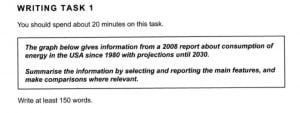
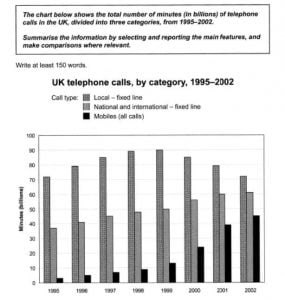
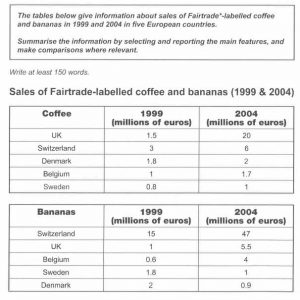
You can see from the three examples below that the instructions can be found above and below the box, as well as the second sentence inside the box.
Every task 1 is the same. You need to:
– Spend about 20 minutes and write at least 150 words.
– Write a summary of the main trends and key details, and make comparisons if possible.
Example 1
Example 2
Example 3
The First Sentence
Look again at the examples. The introductory statement/first sentence is the first sentence in the box.
It is different for each question because the data is different each time.
It is very useful as it gives you the following information:
1. The type of data – chart, table, map, process etc.
2. Other key information e.g. where, when, what
You should read this sentence carefully as you will need to paraphrase this information when you write an introduction to your task 1 essay.
The Data – 6 Task Types
The data is the information you have to describe in your task 1 essay. It will be presented in a chart, table or diagram.
There are six basic types. Let’s take a look:
1. Line graphs – e.g. describe changes to six different kinds of fuel consumption over a period of fifty years in the USA.
2. Bar graphs or charts – e.g. describe changes to three different kinds of phone use over a period of eight years in the UK.
3. Pie charts – e.g. describe changes to the age of the population over a period of fifty years in Italy and Yemen.
4. Tables – e.g. describe and compare sales of two different products in five countries over five years.
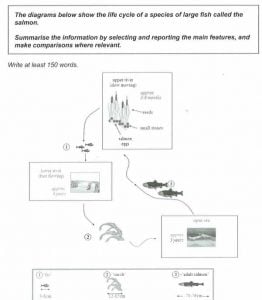
5. Process diagrams – e.g. describe the life cycle of a salmon.
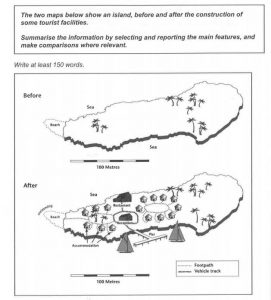
6. Maps – e.g. describe and compare two maps of an island before and after a development.
How Different are the Different Types of IELTS Task 1s?
In some ways every task 1 is the same – they all have the same amount of time, same word length, and in general ask you to do the same thing.
In other ways, they are very different – each task type requires different vocabulary and a different focus.
So you should study and practise each task type separately, so that whichever one you get on your test day, you’ll be able to complete it successfully.
How is Task 1 scored?
Your essay is marked by a qualified IELTS examiner.
They will score your writing equally using four criteria:
1. Task Achievement (Answering the the question)
2. Coherence and Cohesion (Clear and well organised)
3. Lexical Resource (Vocabulary and spelling)
4. Grammatical Range and Accuracy (Grammar and punctuation)
For each of the criteria you will get a ‘band score’ of 0-9.
These will be added together and an average will be calculated and the final figure will be rounded down, even if you are close to the next band score.
Finally the two figures are added together and calculated as ⅓ x Task 1 and ⅔ x Task 2.
This is then rounded down again. Sorry – I didn’t write the test!
For example, Donald Trump gets the following scores:
TA
C&C
LR
GR
Average score
Final result
Task 1
5
7
7
6
6.25
6
Task 2
6
6
6
5
5.75
5.5
(Task 1 score x 1/3) + (Task 2 score x 2/3).
5.775
5.5
KEY TIP: Task 2 is worth double the marks so make sure you don’t spend too long on Task 1. If you are a slow writer, do task 2 first!
Also notice that being marked down in one criteria can wreck your chances of getting the score you need.
Therefore it isn’t enough to get close to the score you want, especially as some examiners are very strict.
You must make sure that through repeated practice that you are consistently getting the scores you need so you can be confident on the day.
Check out our marking service to know your scores, get personal corrections and guaranteed improvement.
Supporting ideas are a combination of explanation and examples (both general and specific).
This may include talking about the result or effect of something, or how a situation is made better or worse by something.
Let’s look at an example question:
In some countries the average weight of people is increasing and their levels of health and fitness are decreasing.
What do you think are the causes of these problems and what measures could be taken to solve them?
For the first body paragraph you should discuss the causes.
Below is a breakdown of the main and supporting ideas for this paragraph:
Main idea: One of the main causes of obesity is unhealthy diets
General example: processed food has become very common
Explanation 1: high levels of sugar and salt
Explanation 2: lots of marketing – especially aimed at children
Result: kids have bad habits – continue when adults
Specific examples: soft drinks e.g. coke, fast food e.g. burgers, pizza
How do I link my supporting ideas?
One way to make your paragraph clearer is to your link ideas using vocabulary phrases, which help the reader follow your idea development.
Phrases include the following:
The main causes of _______ is…
This situation is made worse because…
This results in…
Good examples include…
This has been confirmed by….
Good linking phrases are like landmarks on a map when you’re finding your way around a new city.
They really help the reader to know exactly what kind of idea they are reading and where they are in your discussion.
With practice they will help you to logically organise your supporting ideas into clear, cohesive body paragraphs.
Here is the sample paragraph with the ideas and linking phrases all together:
One of the main causes of obesity and poor health is unhealthy diets. In many parts of the world, processed food, which contains high levels of sugar and salt is readily available. This situation is made worse because this food is supported by large advertising campaigns, which are increasingly aimed at children. This results in young people developing bad habits at an early age, which continue into adulthood. Good examples include soft drinks such as Coke, as well as fast food e.g. pizza and burgers. This has been confirmed by a recent study in the USA which showed that the majority of obese people had a poor diet containing high levels of junk food.
Should I include fake evidence?
You can see from the above paragraph, that the final supporting idea includes scientific evidence.
Many IELTS teachers suggest including this kind of supporting idea as it makes your argument really clear and strong.
However, you should be careful not to be too specific as some examiners might mark you down if it’s really obvious that you’re just making it up.
Compare the following two examples:
General (good!):
This has been confirmed bya recent study in the USA which showed that the majority of obese people had a poor diet containing high levels of junk food.
Too specific (bad!):
This has been confirmed bya recent study from the University of Michigan which showed that 87% of obese people ate junk food more than four times a week.
Therefore keep your evidence as general as possible. Don’t include any data, just general conclusions.
The IELTS examiner has to be able to accept that you are writing this from memory.
If it’s too specific then the examiner will find it difficult to believe that you were able to remember all this data even though you didn’t know what the question would be.
Now it’s your turn! Put your answers in the comments.
In some countries the average weight of people is increasing and their levels of health and fitness are decreasing.
What do you think are the causes of these problems and what measures could be taken to solve them?
For the above question, plan a body paragraph focussing on the main of a lack of exercise due to people being too busy. Think of examples and explanation.
Main idea: One of the main causes of obesity is a lack of exercise.
Supporting idea 1: People are too busy to exercise.
Supporting idea 2:
Supporting idea 3:
Supporting idea 4:
Supporting idea 5:
Now put it together in a paragraph and put it in the comments!
A lot of my students have good main ideas but the supporting ideas – the explanation, and examples don’t always support the main idea clearly.
As you can see from the table below, if your supporting ideas are missing or aren’t relevant then your Task Achievement score will drop – possibly to a 5!
Presents a well-developed response to the question with relevant, extended and supported ideas.
Main ideas are supported and extended very well.
Supporting ideas are relevant.
7
Presents, extends and supports main ideas, but there may be a tendency to overgeneralise and/or supporting ideas may lack focus.
Main ideas are supported and extended well.
Supporting ideas may be too general or not totally relevant.
6
Presents relevant main ideas but some may be inadequately developed/unclear.
Main ideas are sometimes not supported and extended clearly.
5
Presents some main ideas but these are limited and not sufficiently developed; there may be irrelevant detail.
Main ideas are sometimes not supported at all.
Some information may not be relevant to the question.
How much support do I need to provide?
As you can see in the table below, each body paragraph should clearly focus on your one ‘central topic’, with all the supporting ideas logically organised around that.
If you include an idea that isn’t related to the main topic of your paragraph, then this will lower your coherence and cohesion score.
Also, if your supporting ideas within a paragraph are not logically ordered, then your coherence and cohesion score will suffer because of it.
Band Score
Official IELTS description
(Coherence and Cohesion)
What it means.
7+
“logically organises information and ideas…presents a clear central topic within each paragraph.”
Body paragraphs have one main idea.
Topic sentences are clear.
6
“arranges information and ideas coherently…uses paragraphing, but not always logically.”
Body paragraphs don’t always have one main idea.
Topic sentences are not always clear.
5
“presents information with some organisation…may not write in paragraphs, or paragraphing may be inadequate.”
Paragraphs are not used well.
Topic sentences are not clear.
More than one main idea per body paragraph is risky
A lot of IELTS students have lots of good main ideas so they try to include more than one main idea in a body paragraph.
In fact some students spend nearly the whole paragraph discussing one main idea.
But then near the end, they seem to panic or get overexcited, and suddenly add a second unrelated idea
As you can see from the tables above this is risky for two reasons.
First, your coherence and cohesion score might suffer because your body paragraph isn’t focussed on one topic.
Secondly, you might not have enough time to support each idea clearly. Some ideas always end up being better developed than others, and the less developed idea can seem less related to the main idea.
This is easy for the examiner to notice, and your task response band score will be lower.
Even if all the ideas are developed, this will probably result in a paragraph which is far too long, so again your coherence and cohesion score could be hurt.
So in each body paragraph you should only be supporting ONE main idea. Your body paragraph is married to that main idea. You can’t cheat on it with another one.
So to summarise, IELTS examiners are looking for the following:
– Each body paragraph should have only one main idea – all the supporting ideas in the paragraph must link together around a clear central topic.
– Each main idea must be clearly supported – with suitable and relevant explanation and examples that clearly link to the main idea.
Now it’s your turn! Put your answers in the comments
What should be married to what?
What scores will you get for TA and CC if you cheat on your main ideas?
The standard essay structure for a IELTS Task 2 essay is four paragraphs – an introduction, two body paragraphs and a conclusion.
The topic sentence is the first sentence of each body paragraph.
It tells the examiner the main idea of the paragraph so it functions like a mini introduction.
Why are Topic Sentences Important?
Good topic sentences help to make your paragraphs clear and easy to read.
As you can see from the table below, clear paragraphs really help your coherence and cohesion score.
Band Score
Official IELTS description
(Coherence and Cohesion)
What it means.
7+
“logically organises information and ideas…presents a clear central topic within each paragraph.”
Body paragraphs have one main idea.
Topic sentences are clear.
6
“arranges information and ideas coherently…uses paragraphing, but not always logically.”
Body paragraphs don’t always have one main idea.
Topic sentences are not always clear.
5
“presents information with some organisation…may not write in paragraphs, or paragraphing may be inadequate.”
Paragraphs are not used well.
Topic sentences are not clear.
How to Write a Good Topic Sentence?
A good topic sentence should be clear and simple, and the good news is they are pretty easy to write.
A basic topic sentence has two parts:
1. The topic.
2. The reason / main idea
Example Question
Global warming/Climate change are pressing problems that every country and the world will have to deal with in the future.
What are the causes of global warming?
What are some possible solutions?
Body paragraph 1 (the main cause of global warming):
Topic: the main cause of global warming
Reason/main idea: mass consumption of fossil fuels
So the topic sentence is:
The main cause of climate change isthe mass consumption of fossil fuels.
Body paragraph 2 (a possible solution):
Topic: one possible solution for dealing with global warming
Reason/main idea: higher taxes on automobiles
So the topic sentence is:
One possible solution for dealing with climate change could behigher taxes on automobiles.
Topic Sentences Will Help you to Stay Married to One Main Idea
As we saw in the table above, you should “present a clear central topic within each paragraph”.
This means each body paragraph should be focussed on just one main idea.
Therefore planning for your topic sentence helps you to decide what is the main idea for that paragraph.
After that you should ONLY think of support for that idea. You are married to that main idea. You can’t cheat on it with another main idea.
So for the following topic sentence, you should only discuss the mass consumption of fuels:
The main cause of climate change isthe mass consumption of fossil fuels.
A lot of my students spend nearly the whole paragraph discussing one main idea.
But then near the end, they seem to panic or get overexcited, and suddenly add a second unrelated idea e.g. deforestation or methane emissions from animals.
This is a very common mistake but as the table above showed this will lower your coherence and cohesion score.
Remember each paragraph can only have “one central topic”.
As part of your planning stage in the task 2 writing exam, you should write down your topic sentences.
This will make it easier when you start writing your essay to keep your supporting ideas clear, and focussed on your main ideas.
If you accidentally include a second main idea at the end – cross it out. Stay focused.
How to Practise Topic Sentences
Analyse sample essays
1. Look at some task 2 sample essays.
2. Highlight the topic sentence(s) – what is the topic? What is the main idea?
3. Read the body paragraph(s) – do all the supporting ideas relate to that idea?
Practise writing topic sentences for sample essays
"The highest quality materials anywhere on the internet! Dave improved my writing and vocabulary so much. Really affordable options you don't want to miss out on!"