Be sure to avoid the mistakes that most students make on writing by signing up for my exclusive IELTS Ebooks here on Patreon. (You can also sign up for private speaking lessons with me there!)
Dave
Voice Dictation
Do you know how telemarketers in India improve their pronunciation to be understood by native English speakers over the phone?
Many of them practice speaking into dictation software on a computer.
They say a sentence. The computer writes it. They say it again and again and again until it is 100% correct.
Talk to your phone. It is your annoying friend who corrects everything you say.
In the past, voice dictation software was poor. But now the quality is really good!
If there’s a mistake in what is written, it is because of your pronunciation. It is not the phone’s fault!
Check out the video below to see exactly what you should be doing:
This is such a valuable tool for you!
All you have to do is practice speaking into a computer or phone until your pronunciation is accurate.
This will guarantee you at least a 6 for pronunciation because the examiner will be able to understand you – just like the phone!
*A little warning – this won’t get you to a Band 9 for pronunciation because the phone will still understand some words mispronounced and because you might speak a little slowly and not link together sounds naturally, which is needed for the highest band scores.
5 Programs/Apps for Voice Dictation
Google voice search: If you use a phone that runs on Android (Samsung, Sony, LG, HTC, etc) click on the microphone image in the search bar (you can install this on your computer as well: http://bit.ly/2xYVbwA).
Google docs dictation: If you already use Google Drive (drive.google.com) just create a new doc and choose Tools>Voice Typing. Start talking nonsense!
Siri: If you have a mac or an iPhone then you have Siri already. Try doing an internet search or asking Siri to “make a note” or “set a reminder” for you (https://www.apple.com/ios/siri/).
Windows Speech Recognition: Just like Apple Dictation, you can set this up if your computer runs windows: http://bit.ly/2iuWkWc
10 Speech Dictation Practice Ideas
Start a speech dictation diary of your daily activities. This will work well because you will repeat a lot of the same words every day (brush my teeth, not bother to shower, etc) and get better at saying those. You will also work in new vocabulary each day (met my future wife today, had terrible diarrhoea, etc.)
Read one of our sample answers aloud. Read it until it is 100% accurate. This will help you improve for the speaking test format and your pronunciation.
Read aloud one of your favourite passages from a book (or a quote or something from the news).
Use this practice speaking test on YouTube. Pause before Nguyen answers the question. Say your own answer again and again until the computer gets it 100% correct.
Listen to a song and try to say (not sing, haha) the lyrics after pausing the song. This will improve your ability to hear song lyrics, which is a very valuable IELTS skill 😉
Write down a conversation that you had in your native language. Try to translate it into English and read it aloud. This will help you make comparisons between your native language and English.
Start by saying one word (monkey). Make sure it is recorded correctly. Add another (A monkey) and keep going adding 1 word to the sentence each time until the sentence is long (A monkey and a donkey walk into a bar and get into an argument with the bartender about a banana). You could also do this with phrases, not individual words.
Make 10 bold predictions about the future. Repeat them until they are written 100% correct. For example, Donald Trump will become king of the world.
Describe everything you can see in the room around you. Keep repeating it until it is correct. Once you finish with one room, try another room in your house/apartment/school.
Watch a movie or TV show and repeat your favourite lines into a google drive document. Keep different docs for different shows with collections of your favourite quotes.
Top 3 Notes
All those ideas are amazing but you should try to focus on using a few and making them daily habits.
Here are my top 3 to focus on every day:
Top 3 IELTS speaking activities to improve pronunciation
I want to tell you a story about how I learned how to decide if students should be studying IELTS or just improving their English based on what score they need and when.
Dave, your friendly, neighborhood former IELTS examiner!
As a teacher at British Council we test student’s level in order to put them in the correct class. It’s very important and one of the most important questions is: should this student be studying IELTS or improving their English first?
That sounds obvious but few students understand that IELTS is a test made to measure English language ability and it will do just that – measure your ability.
I was lucky when I first started level testing because I had an amazing and experienced teacher who showed me, like a doctor, exactly how to diagnose students.
What she showed me was basically this: after you know their English level, find out what score they need and when they need it. If they are far away from their goal – put them in general English. If they are close to their goal – an IELTS class.
These are general rules and there are exceptions depending on your ability and determination (Leo Tolstoy became fluent in Ancient Greek in just six months for a challenge, but he’s probably a lot smarter than you are).
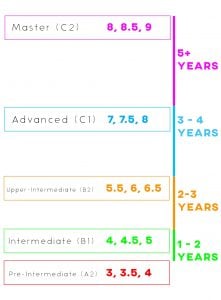
Take a look at the chart on the left to get an idea of how long it will take.
I want to point out 2 things about this chart.
First, this is based on the official IELTS and CEFR website. Most examiners would say that the link between level and band score is not totally accurate. An intermediate student could easily get around a 6 and and upper-intermediate could get around a 7.
Second, the jumps between levels get larger. It takes longer to go from band 6 to 7 than it does from band 5 to 6.
It is always possible to get a score that is better than what you deserve (though it is more likely to get one that is lower than what you deserve).
Very few students understand this. They think if they moved up a point in a year they can expect to keep doing that until they get to band 9.
That’s not how it works. Read below for some examples of how long it will take you to move up to the next band score or level.
Example #1: Elementary Level (A1)
This is a really low level of English and students at this level should only expect to get around a 3 to 4 on IELTS.
Many students at this level come in asking for a 6.5 – that isn’t a realistic goal.
If an elementary student wants a 6.5 in a few months, I tell them the truth: it is impossible.
In these cases, I always put students into general English.
What this means for you: If you are an elementary level student you should not be studying IELTS unless if you need below a 4. You should be improving your English.
The good news for you elementary students is that moving from elementary to pre-intermediate won’t take that long. It’s simply a matter of learning new vocabulary and practicing using it with some different types of grammar and you’ll be there in under a year!
In summary: to get up to 6+ will take you at minimum of 2 years of study and likely longer. Under 6 is possible inside of 1 or 2 years.
Example #2: Pre-Intermediate Level (A2)
As your English level increases, it will begin to take longer and longer to improve and reach the next level. Think of it like a staircase where the next step gets bigger and bigger.
A pre-intermediate student can expect a score in the 4 range, possibly up to 5.
This means if you are pre-intermediate and you want a 6.5 you are very far from your score and should not be studying IELTS (for more information read why here).
If you need a 5.5, possibly even a 6, you can try studying IELTS but there is a very low chance you will reach your desired score.
This might depend on your time frame. If you want a 6.5 or 7 in 3 months it is not possible. But if you have a full year to prepare you will have a better chance of getting a 6.
For these students, unless if they need a score below a 6, I always recommend improving their English, not studying IELTS.
The good news is that going from pre-intermediate to intermediate level is very possible. It is not as easy as going from elementary to pre-intermediate, but most students can do it by working hard within 1-2 years.
Example #3: Intermediate (B1)
If you want are at the intermediate level you should expect a score in the 5 range, possibly up to band 6.
This means that 6.5 is a possibility, but very rare.
If a student is Intermediate level and needs a 6.5 in a few months then I would recommend they study IELTS because this score is possible.
If they want a 6.5, there is a slight chance they could get there, especially if they are good in reading in listening. Many students get 6 for speaking and writing and 7 for reading and listening and end up with a 6.5 overall.
Students who want to get a 6.5 need to spend some time (at least 6 months to a year) improving their English in order to have a good chance of getting that score.
Moving from intermediate level to upper-intermediate is a huge jump up.
Upper-intermediate is where you English becomes more natural; it is sometimes known as the ‘dinner party’ level. I could have a good conversation at a dinner party with an upper-intermediate student.
To move from intermediate to upper-intermediate you should plan to spend at least 1 – 2 years. For many students, you are more likely to need 3 – 4 years of intensive study to reach upper-intermediate level.
Example #4: Upper-Intermediate (B2)
At Upper-Intermediate you should expect a band score in the 6 range, but possibly up to a 7.
Getting to this level is a huge accomplishment and you should be really proud of your level. It can take many years to get here!
Students at this level are usually ready to study IELTS rather than just improve their English.
The only situations where I would recommend someone continue to improve their English rather than study IELTS is if they need above a 7.
In that case, you probably need at least another couple of years of study in order to get that band score.
But, many students are able to get 7 overall (or even higher) because of the difference between skills. Most students have stronger listening and reading skills so it is very common for students to get 6s for speaking and writing and 8s for listening and reading, which averages out to a band 7 overall.
If you are at the upper-intermediate level and you need an 7 – it is possible, but only if you are a very strong upper-intermediate and you can get great scores for listening and reading.
Example #5: Advanced (C1)
At the advanced level you should expect a band score around band 7, including 7, 7.5, and 8.
This level means that your English is becoming very natural and similar to a native speaker.
The best way of thinking of this level is thinking about your native language. Now think about being slightly worse in English than your native language.
How long do you think that will take you?
For many people, this level is unattainable. Some study their whole lives and never reach it.
If you want to get to this level you need to practice all the time and show real dedication or go live abroad and immerse yourself in English every day.
It’s hard to give a realistic time frame for this level, and these IELTS bands, because it takes a lot of time and hard work but varies by learner more than the other levels.
Keep your head down, work hard, and enjoy the journey without focusing too much on the finish line because it is probably years away!
The more you think about getting band 8, rather than just getting better at English, the less likely you will be to ever get band 8.
Example #6: Master (C2)
Once you have your black belt in English you are looking at an 8, 8.5 or 9.
You are essentially a native speaker though you might make some mistakes. Obviously at this level you don’t really need to study IELTS.
You can just take the test and you’ll probably get a score that’s good enough.
However, there is 1reason why you might want to study IELTS.
There are a lot of tricky little elements to IELTS, especially in the writing test, that can even cause native English speakers to get lower scores than what they deserve.
You might want to take a short course or review some key elements of test strategy just to be safe. Some students are at band 8 but they don’t know how to do the test so they get a 7 or 6. That means with just a little bit of study they could move up 1 or 2 full band scores!
Overall or at Least in Every Band?
Another factor that has a huge impact on how long it takes to get your score is whether you need an overall band score or a minimum in each category or a combination of both.
It is very common for schools to ask for a 6.5 overall and nothing lower than a 6 in every category.
This means your skills have to be well-rounded. You won’t be able to get away with really good listening and reading scores and poor speaking or writing scores. If one of your skills is weaker than the others, it might take you longer to make sure every skill is good enough.
Generally, if you need to get at least 6 or 6.5 or 7 in every category, it will take you longer to prepare and you might have to take the test multiple times. This means it is even more important that you figure out your current scores and come up with a good study plan.
On the other hand, if you only need an overall score you have a better chance of getting the score you want.
You should check with the school, company or immigration office to find out if you just need an overall score or a minimum in each skill.
There Are Levels Above Master
Not a lot of people know this because the new CEFR levels have not been released yet and are still being worked on.
I have talked personally with one of the researchers and was interested to learn that the next CEFR will detail levels above Master (C2).
Don’t worry – these are not going to be part of IELTS. There won’t be a band 10 and 11!
But if you are interested the other levels are called ‘G’ and include Translator (G1), Bilingual (G2) and Confident User (G3).
Let’s hope these don’t become part of IELTS anytime soon…
Comment below: How long until you need your IELTS score?
Here’s some help getting started with your comments:
I really need it by …
If I don’t have my score around … then I will have to …
It’s important for me to get my score by …
It’s flexible for me. Anytime in the next … months/years.
Teachers and IELTS examiners talk/laugh about this more than anything else: the students who want to study IELTS now even though they are far away from the score they need.
Studying IELTS is for students who are .5 or 1 band away from their score. Going up 1 band can be accomplished with some test prep in anywhere from a day to a few months.
Students who are more than a point away from their score – the majority of students studying IELTS! – are making a terrible mistake that will cost them time and money.
It’s like deciding that you want to be an Olympic athlete a few months before the Olympics start. It isn’t a realistic goal.
Only once you’ve set a realisticgoal can you start to plan out the steps that will give you a realistic chance of reaching your goal.
Studying IELTS is not about improving your English.
It is about preparing for the test by learning test strategy (and making some small improvements in your English).
The biggest problem for IELTS is vocabulary. English has tons of words that you have to learn how to hear, read, write and speak.
That takes time. Most IELTS courses do not focus on vocabulary (except for some useful phrases) because they only have time to deal with the test itself.
I’ve seen so many students waste years and years studying IELTS while their English barely improves at all. They start as a 6 and two years later they are still a 6.
If they had been improving their English, and then studied some tips for the test at the end, they could have improved to a 7 or 8!
Instead, they wasted their time learning the same tips and tricks over and over again. They’ve been learning with a blindfold over their eyes.
It’s true that their English is improving somewhat (how could it not?). But this is not an efficient method.
The single most important factor in improving your English (more than the school you choose, your teacher, the methods, etc.) is your motivation.
If you are well-motivated by external factors like getting a good job and living abroad or by internal ones like having fun learning you will improve over time. Guaranteed.
If you are not motivated, you can still do it. But it will be a long, painful journey and you are much more likely to give up or improve slowly. Read more about the importance of motivation here.
Because studying for IELTS is boring that means that your motivation will be low in the long-term.
In the short-term, it will be very high. You have a clear band score goal. You know what you need to do. You have a good reason to get IELTS.
Over a few months, IELTS students are usually really highly motivated.
The longer you spend doing boring practice tests and reading about boring topics, the less motivated you will become. Motivation for IELTS has a limit and you will reach it if you study for too long.
In order to keep your motivation high you should be watching movies and TV shows that you like, listening to music, reading interesting books, meeting people on Tinder and learning English in fun, motivating ways.
You will stay motivated, study harder and the things that you learn will be more likely to stick. As Leonardo DaVinci said over 500 years ago:
IELTS does not contain the fuel to keep you motivated for a long time. Your motivation will decrease over time and your English language improvement will plateau (stop improving).
It is sometimes in the best interests of schools to lie to students. Schools tell students they can get a score that is not realistic. Students study IELTS again and again for years without improving.
Schools are afraid to tell students that they should not be studying IELTS because they know the student will just chase impossible promises somewhere else.
To improve your English, you need to put in a lot of work outside class and find interesting materials that are not related to IELTS. That’s much harder for schools to sell.
So schools will lie to you to get you to sign up. They will tell you that you can move up a band or 2 by studying IELTS long-term with them.
Schools are not going to tell you that you are 3 or 4 years away from your score and you need to improve your English first and think about IELTS later.
This is how students end up studying for years at a school without making the improvements you would expect for the money they spend. It’s an abusive relationship based on the insecurity of students and the greed of schools.
Don’t get trapped by schools promising you the world and delivering nothing.
Not all schools are like this. For example, British Council is honest to students about what scores they should expect and their long-term study plans.
What now?
Now you need to know the key question: Should you be studying English? Or improving your English? Read this post to know your score so that you can make a plan and make sure you aren’t wasting your time!
If you’re still reading, you obviously can’t get enough of us. Here’s some more to feed your addiction: Our Instagram, Facebook and YouTube!
Comment below: Are you ready to be studying IELTS?
Here’s some help getting started with your comment:
The best way to reach your goal quickly is to put in more hours every day, every week and every month – all under a yearly plan.
A day is made up of various units just like the human body is made of body parts, muscles, tissues and cells. Each day breaks down into parts of the day, hours, minutes and seconds. Focus on each individual second and the boundaries of ‘day’ expand dramatically and you will have more time than you originally thought.
This is more important than signing up for an IELTS class at a school. Self-study is better than taking a class because you will be responsible for your own learning and take a more active (rather than passive) role in your improvement.
So let’s go through a sample plan together. I recommend that you buy a new notebook and start now!
Dave
Sample Study Plan
Here’s my new notebook and I’m going to put my current level and goal on the cover and the date when I am starting.
You can include an end date for your goal – but it must be realistic or it will be demotivating. Again, check out the links at the top if you’re not sure about your current level and time frame.
On the first page I’m putting a daily and monthly overview of what I’ll be doing. I don’t expect to keep to this exactly, but it will still be helpful. You might want to add a weekly one as well.
Here comes the important part – all the days and hours! The above plans will help you stay organized but this is the engine to your car.
If you don’t put in the daily work the car won’t go anywhere!
Here I write down first what I plan to do for the day. Then later in the day I tick the things that I did and make an X for the things I didn’t do. Don’t feel bad about what you didn’t do. Your attitude to your mistakes will determine your IELTS success.
The most important part of your plan is that you update it consistently. Even if you did nothing – write it down.
Here is the full video process and some advice from me:
A Better Way
The above method is very traditional and suits a lot of people. Most people like to plan things out in advance of doing them. But I think there’s a better way. I think it’s a bad habit to plan things out so I don’t use checklists that often.
A better habit, in my opinion, is to keep track of your work after you do it rather than making a checklist before. This way you won’t get the feeling of accomplishment, peace, and satisfaction that comes with making a checklist.
Instead, briefly sketch out in your head some of the things you want to get done. Maybe jot them down – it’s not a problem to make some notes. But get started doing them right away!
At the end of the day, write down all the things that you did.
This way, you will always be focused on getting things done, not on planning things out.
Don’t stress too much when your plans don’t work out – laugh about it and get back to work!
Take some inspiration from my favorite cartoonist, Chris Hallbeck:
You’ll soon get into the habit of getting more done because otherwise you’ll be facing a disappointed, accusatory blank page at the end of the day. That angry blank page will be the reason you don’t get the score you want.
But if you can fill up that page with accomplishments by the end of everyday and make that page happy, that will be the reason that you do reach your goal!
Best of luck!
Comment below – what score do you need to get on IELTS?
You can use these phrases to help write your comments:
To be honest, you can’t really know your IELTS band score without a qualified teacher.
Wait, don’t go! I’m not wasting your time!
You won’t be able to get a completely accurate score but it is possible to figure out within a band score what you should be getting for each part of IELTS.
I’m a former IELTS examiner so I know the band scores well.
Read below to learn how to test yourself, figure out your score, and afterwards be sure to also check out my sister post on How Long it Will Take to Get Your IELTS Score.
This will take some time and effort but if you follow my instructions you will have a good idea of your speaking score without having to overpay a teacher!
This is Nguyen, the first ever customer for our Band Scores and Writing Corrections Service and a current employee. She lived in Australia for years and her speaking (and overall) scores on two recent tests for speaking were 7.5 and 8.
She uses tons of natural language, accurate vocabulary and has a nice accent.
To figure out your speaking level you are going to compare yourself with her.
Here is the Part 2 Speaking question she will be talking about:
Describe a sci-fi film that you watched.
Practice and record yourself answering the question above for about 2 minutes. Keep the recording – you will need it.
Listen to her response (In this video she speaks for more than 2 minutes. That’s not what will happen on the real test – it is just for you to get as much practice as possible!)
If you can understand 80 – 100% that doesn’t mean you are a band 8 – it just means your listening skills are good. You can’t always use all the language that you understand.
Now it is time to compare your response and hers. Some of the hesitations, repetition, and grammatical mistakes in this answer could bring her fluency and grammar down and make this a 7.5. Her level in this video is 7.5/8.
I’m a former examiner so let me show you exactly what is going through the mind of the examiner when he is listening to you speak.
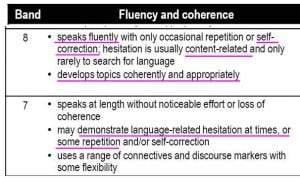
Examiners always have the band descriptors out and look at them before and after the test. In their small heads with their tiny brains, they are highlighting them to get an idea of your score.
Here are Nguyen’s scores (which are mainly from Band 8 with some parts from Band 7):
Her score might go up or down depending on the part and part 2 speaking is usually full of the most hesitations. If she uses more complex structures and hesitates a little less she should be able to get an 8.
Most examiners would give her a 7.5 based on this section of the test because of hesitations and the grammatical mistakes.
Here is some of the good vocabulary that she uses:
had a chance, basically, astronaut crew, revive, dead alien cell, in the end, just a few days, full-grown octopus shape, manages to break free, at this point, horror, gory, killing spree, prevent, reaching earth, threat, human race, locked himself in, eliminate, back into space, for some reason, take control of, twist.
Use your recording to make a list of the vocabulary that you used. You don’t know exactly how accurate or good the vocabulary that you used is – that’s OK. Look it up in the dictionary to check what you can.
Here are some of the different types of grammatical structures that she uses:
Past Simple: had a chance, killed
Present Simple: the movie is about, they succeed, he manages to, the movie turns out to be, etc.
Passive Voice: the astronauts are being killed, the astronauts are killed
Present continuous: are trying, driving them
‘Will’ for future: there will be
Here is the full transcript (the bolded words are corrections):
Recently I had a chance to watch a sci-fi movie called ‘Life.’ Basically the movie’s about an astronaut crew living in space and they were trying to – they are trying to revive a dead alien cell. And the succeed in the end and they name the cell Kevin. And Kevin grows so fast that its size increases incredibly after just a few days into a full grown octopus shaped creature. And Kevin tries to escape from the cage where he was kept inside for so long for the experiments. And in the end he manages to break free. And at this point, the movie turns out to be a horror film and a gory sort of movie because Kevin goes on a killing spree. And the astronauts are being killed slowly, one by one. And the astronauts’ mission now is to survive and prevent Kevin from reaching Earth because they believe that Kevin is a dangerous threat to the human race. After the chasing and the killing I think all the astronauts are killed and only one manages to survive. And I think in the end, he locks himself into a space capsule with Kevin and tries to eliminate Kevin by driving both of them back out into space instead of going back to Earth. But then somehow Kevin manages to take control of the spaceship and both of them land on Earth. And the movie ends there. So I think there will be a part 2 (sequel) for the movie. ‘Did you enjoy the movie?’ It was a good twist at the end and I’m kind of excited to see what will happen next.
Use your recording to make a list of the grammar that you used. When talking about a movie you can refer to it in the past or the present or use a combination. Nguyen smartly sticks to present simple to talk about the events of the film.
I recommend practicing that same technique with as many speaking tests on YouTube as you can find. Here is another example with Minh who also got a Band 8 for IELTS speaking:
After watching a few and recording your own responses you should know your score to within 1 full band.
If you are still not sure, you can comment below and I will message you and we can work out another way to know your speaking score.
How to Figure Out Your IELTS Listening and Reading Scores
This is the easiest one to do. Without too much trouble you can figure out what both your listening and reading scores are!
Buy the past Cambridge Practice Tests. You can get the latest one here: https://goo.gl/t3vDVJ or take a look and see if they are available at the local bookstore in your country.
These are all past tests. Don’t worry about which number book. Anything from 7 to the most current one is fine (ones before 7 are also OK, there are just some small ways in which the test has changed).
Do it under real test conditions. The listening test is 30 minutes and the reading test is 1 hour.
Check your answers in the back of the book and use this guide to roughly figure out your score (scores vary slightly based on the difficulty of the test that week):
IELTS Listening
IELTS Reading (Academic)
IELTS Reading (General Training)
Band score
Raw score out of 40
Band score
Raw score out of 40
Band score
Raw score out of 40
5
16
5
15
4
15
6
23
6
23
5
23
7
30
7
30
6
30
8
35
8
35
7
34
Don’t just do 1 test! It might not give you an accurate score (maybe you were lucky or unlucky with the topics).
Do at least 3 listening and reading tests. If the scores are similar that is your level – now you know before you go to the real exam.
If the scores are very different each time, keep doing them until the scores become more similar – it shouldn’t take too many practice tests for that to happen.
For writing, there are a number of services online that you can use to get a very accurate Band Score estimate. Well actually, there’s only 1 that’s very accurate because it comes from former examiners.
You can trust and rely on the marks we give you. We highlight the band descriptors and give a report on each category to ensure complete accuracy and transparency.
IELTS costs between $200 and $300! If you use our service, you can figure out your score and won’t waste as much money later.
If you also want to get complete writing corrections along with your band scores that is more expensive ($29) but could end up making a huge difference for you!
Using the CEFR to Guide you
There’s one other way that might help you know your English level and IELTS band score.
The CEFR (Common European Framework of Reference for Languages) is the most important, internationally recognized system for defining English ability.
Here is how it defines each level:
Beginner (A1): You can interact in the most basic ways if the other speaker talks slowly and is helpful. You can introduce yourself and others and can ask and answer questions bout where you live, people you know and things you have.
Elementary (A2): You can understand some sentences and frequently used expressions related to personal and family information, shopping, local geography and the environment. You can communicate in simple and routine tasks on familiar topics.
Intermediate (B1): You can deal with most situations while traveling abroad. You can describe experiences and events, dreams, hopes and ambitions and briefly give reasons and explanations for opinions and plans.
Upper Intermediate (B2): You can interact with a degree of fluency and spontaneity that makes regular interaction with native speakers possible without difficulty for either part.
Advanced (C1): You can express ideas fluently and spontaneously without much obvious searching for expressions. You can use language flexibly and effectively for social, academic, and professional purposes.
Master (C2): You can understand with ease virtually everything heard or read. You can express yourself spontaneously, very fluently, and precisely, differentiating finer shades of meaning even in the most complex situations. You understood this paragraph easily.
Here is how those levels compare with IELTS according to their official website. Most examiners would say these scores are a little low. As an Intermediate you should be able to get up to around a 6, for example.
I hope that is helpful but I fear you might just be guessing. That’s why I strongly recommend that you take some time and try the tips I talked about earlier in the post so that you get a more accurate idea of your current level.
Now let’s move on to the big question – not where you are– where you are going…
"The highest quality materials anywhere on the internet! Dave improved my writing and vocabulary so much. Really affordable options you don't want to miss out on!"