This is the IELTS Writing Task 2 Sample Answer from March 24th 2018 on the topic of whether or not museums and art galleries should show more items from their own country or other countries.
I’m going to do something a little bit different with this sample answer. Students are always asking about these ‘to what extent do you agree’ questions.
Can you say you completely disagree? Yes. Can you completely agree? Yes. Can you partly agree or disagree and discuss both sides? Yes, and that is the approach I recommend.
Just make sure that you state your opinion very clearly. I wrote two sample answers for this question.
In the first one, I mostly disagree. In the second one, I mostly agree.
Read on for a sample answer from a former examiner, analysis, vocabulary practice and some handwritten notes!
You can also subscribe to our YouTube Channel for some IELTS Speaking Sample Answers: HowtodoIELTS YouTube.
Dave
SAMPLE ANSWER 1: MOSTLY DISAGREE
Museums and art galleries should focus on works that show the history and culture of their own country rather than works of other parts of the world.
To what extent do you agree or disagree?
Many people claim that it is more important for museums to display work from the country where they are located rather than draw from other places around the world. I partly agree that museums are a valuable educational tool to learn about one’s own country but overall museums should aspire to broaden people’s perspective rather than narrow and deepen it.
Proponents of museums mainly showcasing works from their own country often point out that they help people connect with their country’s culture and history. Children all over the United States learn about American history from their textbooks. They learn about the constitution, the founding fathers, and the various wars of liberation America has fought. However, if they go to a museum to see the actual historical documents from the period this will likely have a more memorable impression. Seeing a famous work of art or historical document up close, they may notice notice details that were not in their book and feel a more personal connection to their country.
Although there is a strong argument to be made for museums specialising in this way, I feel it is more important for people to gain a broader view of cultures around the world. Most people cannot afford to travel abroad and even if they do, they are unlikely to experience another culture deeply as a tourist. Museums are a great opportunity for people of all ages to learn about other countries. Someone visiting the British Museum in London will see artifacts from every continent in the world without a plane ticket. Over the years if they keep returning to the museum they will learn more and more.
Museums will inevitable show a mixture of works from their own country as well as other countries. In my opinion, it is more important for people to take in the breadth of culture of the whole world rather than just their country. If children start from a young age learning about the world they are likely to grow up more tolerant.
SAMPLE ANSWER 2: MOSTLY AGREE
There is natural debate around the issue of whether or not museums should be showcasing works mainly from their own country or other countries. Although it is important to learn about other cultures through museums, countries have the right and responsibility to preserve and maintain their own cultural history.
Proponents of museums showing a variety of works from many different countries rightly argue that people’s lives are enriched through all these different cultures. For example, Europe is a relatively small area that packs in dozens of distinct national identities. Someone going to a museum in a cosmopolitan city like Berlin is likely to find Italian Renaissance paintings next to modernist Spanish sculpture as well as German works. This allows people to feel they are travelling around the world and taking in a variety of viewpoints. Through this exposure to culture they may come to better understand other nations and have greater insight into what connects and differentiates countries from each other.
Despite the clear benefits of learning about other cultures, countries have the right to house the relics of their own history. Many of the museums displaying works from other countries took them without permission. For example, the British Museum’s collection was mainly sourced during the height of the British Empire. Many nations have disputed the right of the museum to house their country’s artifacts and some have been returned. It is only right that countries keep what was made in their country so that they can educate their own people about their history. Anything that has been taken without explicit permission should be returned, just as a thief is required to return what they have stolen if they are caught.
I think that there is tremendous value in museums displaying works from other countries but it does not override the basic right of nations to look after their own history. One way forward would be to encourage museums to have frequent exchanges and temporary exhibitions.
SAMPLE ANSWER 1 ANALYSIS: MOSTLY DISAGREE
Many people claim that it is more important for museums to display work from the country where they are located rather than draw from other places around the world. I partly agree that museums are a valuable educational tool to learn about one’s own country but overall museums should aspire to broaden people’s perspective rather than narrow and deepen it.
In the introduction, I begin by rephrasing the question. Then I make my opinion totally clear by saying that I partly agree but overall disagree. I also give my main reasons why.
Proponents of museums mainly showcasing works from their own country often point out that they help people connect with their country’s culture and history. Children all over the United States learn about American history from their textbooks. They learn about the constitution, the founding fathers, and the various wars of liberation America has fought. However, if they go to a museum to see the actual historical documents from the period this will likely have a more memorable impression. Seeing a famous work of art or historical document up close, they may notice notice details that were not in their book and feel a more personal connection to their country.
In my first body paragraph, I talk about why I partly agree. The reason is that people can connect better with their country by seeing real items from their history. I give the example of a student in America looking at works of art or historical documents and feeling a personal connection.
Although there is a strong argument to be made for museums specialising in this way, I feel it is more important for people to gain a broader view of cultures around the world. Most people cannot afford to travel abroad and even if they do, they are unlikely to experience another culture deeply as a tourist. Museums are a great opportunity for people of all ages to learn about other countries. Someone visiting the British Museum in London will see artifacts from every continent in the world without a plane ticket. Over the years if they keep returning to the museum they will learn more and more.
In my second body paragraph (which has my overall opinion), I say it is more important to learn about other countries. I put this in the context of people who can’t afford to travel or are just tourists and give the example of a famous museum in London.
Museums will inevitable show a mixture of works from their own country as well as other countries. In my opinion, it is more important for people to take in the breadth of culture of the whole world rather than just their country. If children start from a young age learning about the world they are likely to grow up more tolerant.
In my conclusion, I summarise my arguments and restate my overall opinion and the reason for it. I also include one extra sentence to say why I think broadening one’s perspective is important.
SAMPLE ANSWER 2 ANALYSIS: MOSTLY AGREE
There is natural debate around the issue of whether or not museums should be showcasing works mainly from their own country or other countries. Although it is important to learn about other cultures through museums, countries have the right and responsibility to preserve and maintain their own cultural history.
In the introduction, I begin by rephrasing the question. Then I make my opinion totally clear by saying that I mostly agree and the reason why I mostly agree.
Proponents of museums showing a variety of works from many different countries rightly argue that people’s lives are enriched through all these different cultures. For example, Europe is a relatively small area that packs in dozens of distinct national identities. Someone going to a museum in a cosmopolitan city like Berlin is likely to find Italian Renaissance paintings next to modernist Spanish sculpture as well as German works. This allows people to feel they are travelling around the world and taking in a variety of viewpoints. Through this exposure to culture they may come to better understand other nations and have greater insight into what connects and differentiates countries from each other.
In my first body paragraph, I talk about the other side – why it is a good idea to have works from different countries in a museum. I give the example of a museum in Europe and the effect that might have on a person.
Despite the clear benefits of learning about other cultures, countries have the right to house the relics of their own history. Many of the museums displaying works from other countries took them without permission. For example, the British Museum’s collection was mainly sourced during the height of the British Empire. Many nations have disputed the right of the museum to house their country’s artifacts and some have been returned. It is only right that countries keep what was made in their country so that they can educate their own people about their history. Anything that has been taken without explicit permission should be returned, just as a thief is required to return what they have stolen if they are caught.
In my second body paragraph (which has my opinion), I talk about why museums should mainly focus on their country. I give the example of the British Museum and the works it has taken from other countries. My argument is that countries should be able to keep their own artifacts to show to their own citizens.
I think that there is tremendous value in museums displaying works from other countries but it does not override the basic right of nations to look after their own history. One way forward would be to encourage museums to have frequent exchanges and temporary exhibitions.
In my conclusion, I summarise my arguments and restate my overall opinion and the reason for it. I also include one extra sentence to say how I think this could be implemented in the future.
VOCABULARY PRACTICE AND ANALYSIS
I have highlighted 5 of the best vocabulary expressions from the sample answer. This is the type of natural, specific vocabulary that will get you a Band 7+.
Before looking at the definitions I recommend you take out a notebook and try to write down the definitions or a new sentence with the vocabulary. Then check using the definitions below!
Sample Answer 1
Although there is a strong argument to be made for museums specialising in this way, I feel it is more important for people to gain a broader view of cultures around the world. Most people cannot afford to travel abroad and even if they do, they are unlikely to experience another culture deeply as a tourist. Museums are a great opportunity for people of all ages to learn about other countries. Someone visiting the British Museum in London will see artifacts from every continent in the world without a plane ticket. Over the years if they keep returning to the museum they will learn more and more.
Sample Answer 2
Despite the clear benefits of learning about other cultures, countries have the right to house the relics of their own history. Many of the museums displaying works from other countries took them without permission. For example, the British Museum’s collection was mainly sourced during the height of the British Empire. Many nations have disputed the right of the museum to house their country’s artifacts and some have been returned. It is only right that countries keep what was made in their country so that they can educate their own people about their history. Anything that has been taken without explicit permission should be returned, just as a thief is required to return what they have stolen if they are caught.
VOCABULARY DEFINITIONS
specialising (verb): to do one thing very well or be an expert at it
gain a broader view (verb phrase): to understand a greater variety / lots of different things
experience another culture deeply (verb phrase): to get to know another culture very well
a great opportunity (adj + noun): a good chance to do or learn something
over the years (prepositional phrase): for a long period of time
clear benefits (adj. + noun): obvious advantages
without permission (adverb + noun): not allowed to
sourced (verb): comes from / taken from
disputed (adj/verb): in disagreement / argue with / counter / disagree
explicit permission (adj. + noun): clear written or spoken approval or agreement
GRAMMAR ANALYSIS: ‘RATHER THAN’
Rather than is what is known as a ‘coordinating conjunction.’ This means that you can use it exactly like you use ‘and,’ ‘or,’ ‘but.’
It means something is more important or preferable to do. It is always a comparison. For example: ‘Rather than checking your Facebook, you should be learning about IELTS.’
So you can have a verb phrase after it (checking your Facebook) or any other kind of main clause (I like cats, rather than dogs. Rather than some superhero movie, we should try watching something different.)
It can be used in writing because it is formal but it is also informal enough for speaking. That makes it really useful! You can find more useful grammar on our HowtodoIELTS Facebook Group.
It is really common in headlines for articles. Here are some recent examples from the news:
There are two mistakes I *deliberately* put in Example 2 – can you spot them and comment below?
CHECK OUT GOOGLE MUSEUMS!
We’re done with the boring stuff. Let’s take a look at an amazing website put together by Google that has works of art and analysis from museums all over the world! Here it is:https://artsandculture.google.com/explore
COMMENT BELOW
What is the name of the most famous museum in your country? Use these phrases to help write your comments:
In my country, the most famous museum is…
A lot of people where I’m from like going to …
Tourists especially enjoy the …
I don’t know if it is the most popular, but the one I like the most is …
A lot of my students freak out when they see a table. All they can see are the numbers, which means they have to look hard to find the main trends. Even if they can identify (find) one main pattern, they often miss something important.
In this post I show you how to make notes on the table so you can recognise (see) and remember ALL the main trends and key similarities or differences. You can check out a sample answer (and much more) for this questionhere.
Here is a recent question from IELTS Cambridge 14.
You can also subscribe to our YouTube Channel for some IELTS Speaking Sample Answers: HowtodoIELTS YouTube.
Dave
What kind of Table?
The first thing to remember is that there are two main kinds of chart – some focus on changes over a period of time (also known as ‘dynamic’), while some focus on one period of time (known as ‘static’).
You need to be able to recognise the two different types as they require different vocabulary and grammar. In a previous post I showed you how to analyse the first kind of table (over time), and in this post we will look at the second type (not over time).
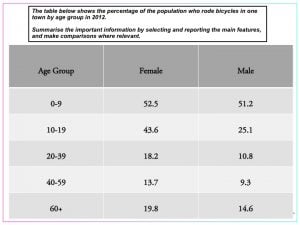
Look at the table below, based on a real question from the IELTS Writing exam from Feb 2018. It focuses on the percentages of males and females that cycled in a particular town in 2012, organised into five different age groups. You can check out a sample answer (and much more) for this question here.
Firstly, you should notice the following things:
This chart is not over time – just one year (2012).
The data is organised in two main ways – gender (males and females) and age (five groups).
The figures are proportions of the total number (the % of males or females), not the number of people (males/females).
Main Trends and Key Similarities / Differences (Gender)
Next pick up your pencil and make notes on all of the main trends and key differences and/or similarities. Remember that you need to look ACROSS (gender) and DOWN (age) the table.
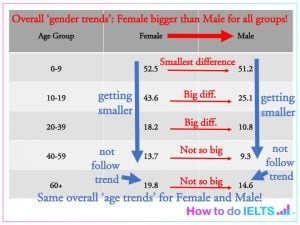
Let’s look at gender (across) first – you should be looking for an overall pattern if possible. You can see that the proportion of females that cycled was higher than males. And in fact this pattern is not just overall, but for EVERY age group, without exception.
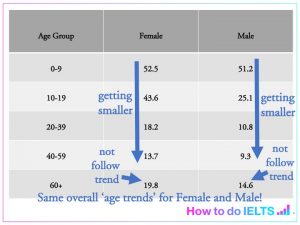
To help me remember this I drew a big arrow at the top from Female to Male and wrote above it “Overall ‘gender trends’: Female bigger than Male for all groups!”
You should also look at the size of the differences. For example, you can see that the smallest gender gap was in the youngest group, whereas the next two groups had the biggest differences, and finally the gap for the two oldest groups was not so big.
I made a note of all these differences, drawing small arrows between each set of figures, and noting the size of the differences.
Main Trends and Key Similarities / Differences (Age)
Now, let’s turn our attention to analysing the pattern DOWN the table. You can see that for both Females and Males, as people got older there was a smaller proportion of people cycling, with the exception of the oldest group.
Again to help me remember this, I drew two big arrows going down the table for Female and Male, and I wrote below it “getting smaller”.
I also drew two small arrows pointing to the figures for the oldest groups and wrote ‘not follow trend’.
As the trend is the same for both Females and Males I wrote at the bottom “Same overall ‘age trends’ for Female and Male!”
So in the exam, your question paper should end up looking something like the one below. This might look like a mess but believe me, this will really help you to find all the important information needed to get a high score for your Task Achievement in IELTS Writing Task 1.
Try it out and let me know how it goes.
Now it’s your turn! Put your answers in the comments.
Using my notes write some sentences to describe these trends and key differences.
This sample answer is based on a real IELTS Writing Task 1 question from Feb 2018. But there is so much more in this post than just a sample answer. Aren’t you guys lucky? I’ve also included:
A quick analysis of the question – check here for more detailed analysis.
Line by line analysis of the sample answer.
Links to vocabulary games and exercises based on the sample answer.
Cool topic-related links about all things bike-tastic!.
You can also subscribe to our YouTube Channel for some IELTS Speaking Sample Answers: HowtodoIELTS YouTube.
Dave
Question Analysis
Looking at the table above, you can see the question focuses on the percentages of males and females that cycled in one town in 2012, organised into five different ages.
If you need more help with analysing this table, check out my recent post on how to identify the main trends and key points.
I suggest making notes on the most important patterns, so in the exam, your question paper should end up looking something like this:
Sample Answer
The table illustrates the proportions of people across different age categories who rode bicycles in one particular town in 2012. Overall, the table clearly shows that a higher proportion of females cycled in the given period compared to males across all ages, although only marginally for the youngest group. This group (0-9 yrs.) also had the largest proportion of cyclists, and age was a clear predictor for decreased cycling activity for both males and females, with the exception of the oldest age group (60+), which bucked this trend.
Turning to the figures, just over half of all young girls and boys aged 0-9 years rode bikes in the town, with 52.5% and 51.2% respectively, amounting to the smallest gender gap of any age group. In contrast, 43.6% of 10-19 year old girls chose to ride bikes, while only 25.1% of boys did the same. This pattern continued with the 20-39 age group, with 18.2% of young women cycling compared to 10.8% of young men. The gender differences were less significant in middle aged cyclists (40-59), with 13.7% (female) and 9.3% (male). Finally, the over 60s reversed this trend with more cyclists than the previous two age groups, with 19.8% and 14.6% respectively for females and males.
Analysis
Firstly, it’s important to note that this answer has clear paragraphing. The first paragraph contains an introductory sentence and the overview. The second paragraph presents the detailed figures.
Although in IELTS Writing Task 1, paragraphing isn’t mentioned in the band descriptors below band 8, it is still a good idea to use paragraphs to organise your writing as it makes it more logical, which helps the examiner to read your answer, and that is always a good thing!
Paragraph 1: Introduction and Overview
The table illustrates the proportions of people across different age categories who rode bicycles in one particular town in 2012. Overall, the table clearly shows that a higher proportion of females cycled in the given period compared to males across all ages, although only marginally for the youngest group. This group (0-9 yrs.) also had the largest proportion of cyclists, and age was a clear predictor for decreased cycling activity for both males and females, with the exception of the oldest age group (60+), which bucked this trend.
The first sentence introduces the chart, by paraphrasing (not copying) the question.
The second sentence begins the overview of the table by describing the the most important overall trend (more female than male cyclists for every age).
The third sentence completes the overview by describing another important trend (younger people cycle more, except for the over 60s).
Paragraph 2: Detailed Figures
Turning to the figures, just over half of all young girls and boys aged 0-9 years rode bikes in the town, with 52.5% and 51.2% respectively, amounting to the smallest gender gap of any age group. In contrast, 43.6% of 10-19 year old girls chose to ride bikes, while only 25.1% of boys did the same. This pattern continued with the 20-39 age group, with 18.2% of young women cycling compared to 10.8% of young men. The gender differences were less significant in middle aged cyclists (40-59), with 13.7% (female) and 9.3% (male). Finally, the over 60s reversed this trend with more cyclists than the previous two age groups, with 19.8% and 14.6% respectively for females and males.
The first sentence begins the description of the detail by talking about the youngest age group (girls cycled slightly more than boys), commenting on the smallest gender difference.
The second sentence gives details of the 10-19 age group, comparing figures for older boys and girls, and noting the contrasting large gender difference.
The third sentence presents the figures for the next age group (20-39), again with figures for each gender, noting the trend in gender difference is the same as the previous group.
The fourth sentence continues with the next group, again with figures for women and men, noting a smaller difference.
The fifth and final sentence gives the figures for the over 60s, noting that these figures are higher than the previous two groups. No conclusion is required for Task 1 writing.
Useful Vocabulary (See Quizet link below for free practice activities)
I’ve prepared some vocabulary games and exerciseson Quizlet for these words taken from the sample answer. Quizlet is a really fun and convenient way to learn and practice vocab and it’s free!
Try it out, and use it whenever you have a spare few minutes.
If you need more help using Quizlet, check out this video lesson (starts from 34m36s).
Check out Quizlet for great online vocabulary activities for free!
Learn more about everything Bike-tastic! – Related Articles and Videos
Check out these links for fun and interesting videos and articles about bikes!
Check out the article about cool and unusual bikes!
She lived in Australia for years, which you can tell from her really nice accent and the range of natural vocabulary that she uses.
I’m a former IELTS examiner and I’m going to go over exactly how I would mark her for this section and give you some great vocabulary and grammar to practice to make sure you can get at lease a band 7!
LEONARDO DAVINCI
Nguyen’s topic for this section was to talk about a person from history and she chose Leonardo DaVinci.
Let’s let Nguyen talk:
And here is the full tapescript with corrections in magenta:
Ok so a person from history I’m going to talk about today is Leonardo DaVinci. Leonardo DaVinci was an Italian Renaissance polymath whose areas of interest included invention architecture, sculpting, science and there are so many more that I can’t remember them all right now. But in general he was a multi-talented man. Um … and he’s also considered one of the greatest painters of all time. And many historians and scholars regard Leonardo DaVinci as a universal genius or a Renaissance man. And among his works the Mona Lisa is the most famous and duplicated portrait with ‘The Last Supper’ being the most reproduced religious painting of all time. And I think one – there was a historian – that I can’t remember the name – once said that “Leonardo DaVinci went beyond his time” – that he could – he could think of inventions that were so advanced that most of his work and designsweren’t feasible during his lifetime, and most of his designs weren’t recognised or realised until 100 years later. And during his time, which was like 500 years ago, he was able to conceptualise the flying machine, armored fighting vehicle and even concentrated solar power. The reason why I admire him is because I think that he – I agree with all other historians and scholars that he was one of the greatest painters of all time and somehow I think his personality and – his personality was quite mysterious and remote in a way that it has made me more curious to learn more about him.
Ok, back to me.
When examiners are marking, they usually have the band descriptors on the chair next to them (so you can’t see them). They might consult them during or after your test.
Here is how I would mark Nguyen based on the IELTS band descriptors.
FLUENCY – 7
This is the weakest part of Nguyen’s answer so I would give her a band 7.
Here’s why: She hesitates a lot during the answer!
If you look at the band descriptors, there is a difference between hesitating because you are thinking of language and when you are thinking of an idea.
That means if the examiner thinks you are hesitating to think of the English words you will lose marks. If you hesitate to think of an idea, you shouldn’t lost any marks.
Some of Nguyen’s hesitations are related to ideas (and remembering information about DaVinci) but many are language related.
That’s the negative side of her fluency score.
What’s good is that she maintains a flow of speech for the full time and her answer is coherent. She begins by introducing DaVinci, then describes why he is famous and ends by talking about what historians have said about him and his legacy.
Like a movie, her answer has a clear beginning, middle and end that makes it easy for the listener to understand.
I gave Nguyen a band 7 for fluency but I think she will end up with band 8 across the whole test. Part 2 is usually the worst for fluency for most students. It’s hard even for a native speaker to talk that long without a lot of hesitations!
VOCABULARY – 8
This is one of the stronger parts of the answer so I would give her a band 8 for vocabulary. This is a very strong 8.
Vocabulary is based on two things: accuracy and range.
There aren’t any mistakes in terms of accuracy but some additions would make it better: quintessential renaissance man, ahead of his time.
There are lots of examples of high-level vocabulary: Italian Renaissance polymath, multi-talented, of all time, historians and scholars, universal genius, duplicated portrait, feasible during his lifetime, recognised or realised, conceptualise, concentrated solar power, admire, quite mysterious and remote.
What does high-level vocabulary mean? It means that the vocabulary fits the context very well. It is descriptive and rich.
Instead of saying ‘he could do many things’ she says ‘multi-talented.’ Instead of ‘invent’ she says ‘conceptualise’ Because he didn’t produce many things, he merely drew sketches of flying machines for example, the word conceptualise is much more descriptive.
Here are some notes for your reference with some vocabulary that you can use to talk about a person from history:
GRAMMAR – 8
There are enough little slips in grammar that I almost gave her a 7, but in fact it deserves an 8 for grammar.
Grammar is about the same two things as vocabulary: accuracy and range.
Here are some of the mistakes that Nguyen makes: one incorrect preposition, one subject/verb disagreement, a mistake with plurals, one incorrect tense.
It’s not a lot of mistakes but they are clearly there throughout. Luckily she doesn’t keep making the same mistake and that means the mistakes are non-systemic. If you keep using the wrong article then the mistake is systemic and will hurt your score more according to the band descriptors.
For the good, she is comfortable using past and present forms as well as active, passive and subordinate structures.
Because her mistakes are minor and rare and do not affect understanding and she uses a variety of grammar, I have given her an 8. It is very close to a 7, though. Her grammar is not quite as strong as her vocabulary.
Nguyen has a nice accent and only makes minor slips with some words so I think she deserved a band 8 for pronunciation.
Pronunciation is marked on an incredibly complex range of features. Most examiners don’t have any idea of makes up pronunciation!
But some of the common areas that examiners look for include: final sounds, intonation, consonant clusters, linking between words (chunking), and individual sounds (phonemes).
Nguyen makes some mistakes with individual phonemes: science (/ts/), universal (/s/).
And there are some moments where she could link together words more naturally using weak sounds so that her chunking is more natural.
Overall, her accent is really nice and her speech is natural and easy to understand throughout.
With three 8s and a 7 her score for the speaking would be 7.5, but Part 2 tends to be when students lose the most marks for fluency and on the real IELTS she got an 8. You can think of her as a good example of a Band 7.5/8.
This sample answer is based on a real IELTS Writing Task 1 Bar Chart question on March 15th, 2018. I’m a former examiner so you can trust this answer. Keep reading for:
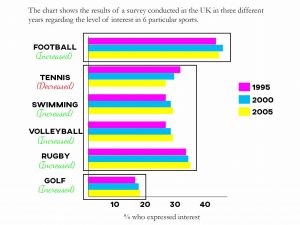
Looking at the bar chart, you can see it is divided into 3 years and 6 sports and it shows change over time.
I recommend making some quick notes on the general trends as well as the overall leaders because these will help to organise your writing later:
Sample Answer
The bar chart details the percentage changes of people in the UK interested in 6 sports between 1995 and 2005. In general, all sports saw gradual increases in interest over the full period with the exception of tennis. Football was by far the most popular throughout the period while tennis, swimming, volleyball and rugby had similar numbers and golf generated the least interest.
Football, the sport most people were interested in, rose from just under 40% in 1995 to around 45% in 2000 before a slight dip in 2005. Golf, the least popular sport, grew at steady intervals from just over 15% in 1995 to almost 20% interested in it by 2005.
The sports in the middle (tennis, swimming, volleyball, and rugby) had similar levels of interest at around 20 – 30% during the period. Rugby was the leader among this group with moderate gains starting at around 33% interested in 2005 and ending up with 35% by 2005. Volleyball and swimming showed nearly identical trends increasing steadily from just over 25% to slightly under 30%. The only sport to lose interest over the period was tennis which fell from over 30% in 1995 to under 30% in 2000 and nearly 25% by 2005.
Quick Analysis
I divided my answer into 3 paragraphs. Paragraph 1 is introducing that chart and the general overview. The general overview is by far the most important sentence of the whole essay because if you don’t have it, or it is not clear, you will get a Band 5 for Task Achievement. 100% – right away. Read more about overviews here.
Paragraphing is really important in Task 1. You can use your paragraphs to group together similar areas (or areas that are different in order to compare them) and it will give your writing structure.
This was a simple task 1, actually. Most of the sports increased and in the same way – gradually. There are some exceptions and a sport that is clearly the most popular and the least popular.
If you took the test this week, you got lucky with this question!
Paragraph 1: Introduction and Overview
1. The bar chart details the percentage changes of people in the UK interested in 6 sports between 1995 and 2005. 2. In general, all sports saw gradual increases in interest over the full period with the exception of tennis. 3. Football was by far the most popular throughout the period while tennis, swimming, volleyball and rugby had similar numbers and golf generated the least interest.
1. The first sentence introduces the chart, by paraphrasing (not copying) the question.
2. The second sentence begins the overview of the bar chart by describing the general trend (upwards for all sports except tennis).
3. The third sentence completes the overview by ranking the interest in each sport from the one people were most interested in to least interested in.
Paragraph 2: Detailed Figures (Football and Golf)
1. Football, the sport most people were interested in, rose from just under 40% in 1995 to around 45% in 2000 before a slight dip in 2005. 2. Golf, the least popular sport, grew at steady intervals from just over 15% in 1995 to almost 20% interested in it by 2005.
1. The first sentence describes the specific data for football, the sport most were interested in. I include all years and accurate data for those years. It’s important to say around/approximately because the exact numbers are not clear.
2. The second sentence describes golf, the least popular sport.
Paragraph 3: Detailed Figures (Other Sports)
1. The sports in the middle (tennis, swimming, volleyball, and rugby) had similar levels of interest at around 20 – 30% during the period. 2. Rugby was the leader among this group with moderate gains starting at around 33% interested in 2005 and ending up with 35% by 2005. 3. Volleyball and swimming showed nearly identical trends increasing steadily from just over 25% to slightly under 30%. 4. The only sport to lose interest over the period was tennis which fell from over 30% in 1995 to under 30% in 2000 and nearly 25% by 2005.
1. The first sentence is a topic sentence that groups together the sports in the middle of the bar chart.
2. The second sentence describes the leader among this group, rugby, with specific data and years.
3. The third sentence describes volleyball and swimming with specific data and years.
4. The fourth sentence describes the final sport, tennis, which was the only one to decrease over the full period.
Useful Vocabulary
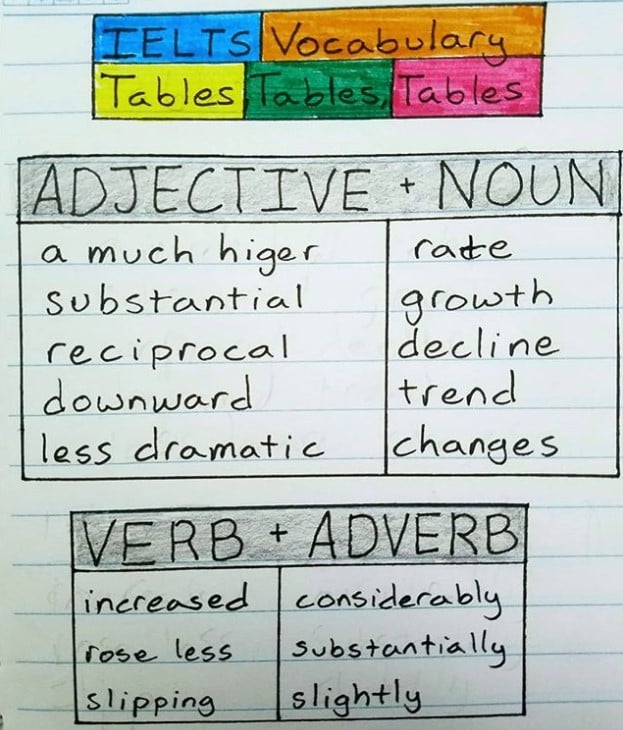
Here is some vocabulary that you can use on your own IELTS Writing Task 1. I recommend that you take some good notes or try using this vocabulary in a different sample answer so that you don’t forget it:
The bar chart details the percentage changes of people in the UK interested in 6 sports between 1995 and 2005. In general, all sports saw gradual increases in interest over the full periodwith the exception of tennis. Football was by far the most popular throughout the period while tennis, swimming, volleyball and rugby had similar numbers and golf generated the least interest.
Football, the sport most people were interested in, rose from just under 40% in 1995 to around 45% in 2000 before a slight dip in 2005. Golf, the least popular sport, grew at steady intervals from just over 15% in 1995 to almost 20% interested in it by 2005.
The sports in the middle (tennis, swimming, volleyball, and rugby) had similar levels of interest at around 20 – 30% during the period. Rugby was the leader among this group with moderate gains starting at around 33% interested in 2005 and ending up with 35% by 2005. Volleyball and swimming showed nearly identical trends increasing steadily from just over 25% to slightly under 30%. The only sport to lose interest over the period was tennis which fell from over 30% in 1995 to under 30% in 2000 and nearly 25% by 2005.
My gift for the lazy! If you got this far and didn’t take any notes of your own, consider this charity! You can find more notes like it on our Instagram page.
Sports Articles and Videos
Check out these links for fun and interesting videos and articles about bikes!
"The highest quality materials anywhere on the internet! Dave improved my writing and vocabulary so much. Really affordable options you don't want to miss out on!"