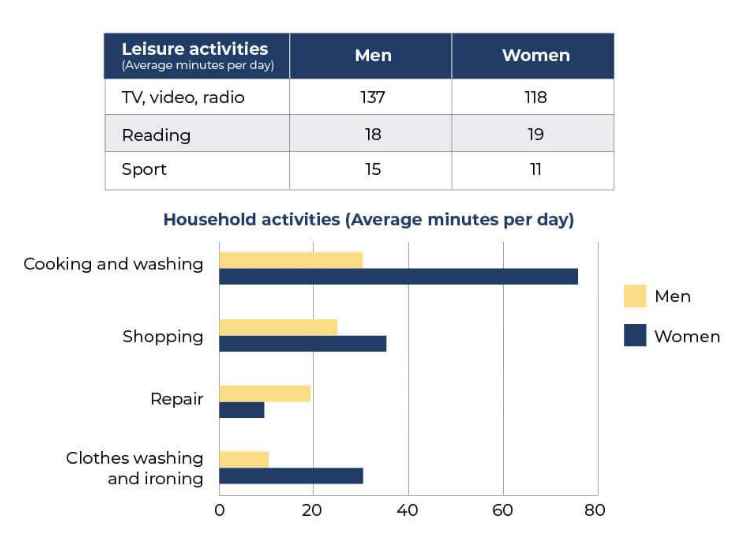
The given charts illustrate household and leisure activities among men and women in terms of average minutes each day. Looking from an overall perspective, it is readily apparent that women spent far more time on household chores, with the exception of time spent on repairs. In terms of leisure activities, both sexes were far more likely to watch television, video, or listen to the radio, and figures for reading and sport were relatively comparable.
Regarding activities in the household, women spent more than twice the amount of time cooking and washing and washing clothes and ironing (78 minutes to 30 minutes and 30 minutes to 10 minutes). The difference in time spent shopping was less extreme at 25 minutes for men and 37 minutes for women. In contrast, men spent double the time on repairs per day (19 minutes) to women (9 minutes).
For leisure time, the data for TV, video, and radio were surveyed at 137 minutes for males and 118 minutes for females. Other free time activities included reading (18 minutes for men and 19 minutes for women) and sport, 15 minutes and 11 minutes for men and women, respectively.
Analysis
1. The given charts illustrate household and leisure activities among men and women in terms of average minutes each day. 2. Looking from an overall perspective, it is readily apparent that women spent far more time on household chores, with the exception of time spent on repairs. 3. In terms of leisure activities, both sexes were far more likely to watch television, video, or listen to the radio, and figures for reading and sport were relatively comparable.
Paraphrase the overall essay topic.
Write a clear overview.
Your overview should be two sentences.
1. Regarding activities in the household, women spent more than twice the amount of time cooking and washing and washing clothes and ironing (78 minutes to 30 minutes and 30 minutes to 10 minutes). 2. The difference in time spent shopping was less extreme at 25 minutes for men and 37 minutes for women. 3. In contrast, men spent double the time on repairs per day (19 minutes) to women (9 minutes).
Begin describing the data.
Make sure that you compare between sentences.
And include as much data as possible.
1. For leisure time, the data for TV, video, and radio were surveyed at 137 minutes for males and 118 minutes for females. 2. Other free time activities included reading (18 minutes for men and 19 minutes for women) and sport, 15 minutes and 11 minutes for men and women, respectively.
Switch to the other table.
Vary short and long sentences.
Vocabulary
What do the words in bold below mean?Make some notes on paper to aid memory and then check below.
The given charts illustrate household and leisure activities among men and women in terms of average minutes each day. Looking from an overall perspective, it is readily apparent that women spent far more time on household chores, with the exception of time spent on repairs. In terms of leisure activities, both sexes were far more likely to watch television, video, or listen to the radio, and figures for reading and sport were relatively comparable.
Regarding activities in the household, women spent more than twice the amount of time cooking and washing and washing clothes and ironing (78 minutes to 30 minutes and 30 minutes to 10 minutes). The difference in time spent shopping was less extreme at 25 minutes for men and 37 minutes for women. In contrast, men spent double the time on repairs per day (19 minutes) to women (9 minutes).
For leisure time, the data for TV, video, and radio were surveyed at 137 minutes for males and 118 minutes for females. Other free time activities included reading (18 minutes for men and 19 minutes for women) and sport, 15 minutes and 11 minutes for men and women, respectively.
Answers
For extra practice, write an antonym (opposite word) on a piece of paper to help you remember the new vocabulary:
The given charts illustrate – The provided graphs depict
average minutes each day – the mean number of minutes per day
Looking from an overall perspective, it is readily apparent that – From an overall standpoint, it is immediately clear that
spent far more time on household chores – devoted significantly more time to domestic tasks
with the exception of – apart from
repairs – maintenance work
In terms of – With regard to
sexes – genders
far more likely to – considerably more inclined to
figures – statistics
relatively comparable – fairly similar
Regarding activities in – Concerning activities in
more than twice the amount of time – over twice as much time
ˈlʊkɪŋ frɒm ən ˌəʊvəˈrɔːl pəˈspɛktɪv, ɪt ɪz ˈrɛdɪli əˈpærᵊnt ðæt
spɛnt fɑː mɔː taɪm ɒn ˈhaʊshəʊld ʧɔːz
wɪð ði ɪkˈsɛpʃᵊn ɒv
rɪˈpeəz
ɪn tɜːmz ɒv
ˈsɛksɪz
fɑː mɔː ˈlaɪkli tuː
ˈfɪɡəz
ˈrɛlətɪvli ˈkɒmpᵊrəbᵊl
rɪˈɡɑːdɪŋ ækˈtɪvətiz ɪn
mɔː ðæn twaɪs ði əˈmaʊnt ɒv taɪm
ðə ˈdɪfᵊrᵊns ɪn taɪm
lɛs ɪkˈstriːm æt
ɪn ˈkɒntrɑːst
ˈdʌbᵊl ðə taɪm
ˈsɜːveɪd æt
ɪnˈkluːdɪd
rɪˈspɛktɪvli
Vocabulary Practice
I recommend getting a pencil and piece of paper because that aids memory. Then write down the missing vocabulary from my sample answer in your notebook:
The ___________ illustrate household and leisure activities among men and women in terms of average ____________ day. Looking ______________________________________ that women spent _________________________________ chores, with _____________ of time spent on r______s. In _______of leisure activities, both s______s were far __________ to watch television, video, or listen to the radio, and f______s for reading and sport were relatively _____________e.
Regarding ____________in the household, women spent more _________________________ time cooking and washing and washing clothes and ironing (78 minutes to 30 minutes and 30 minutes to 10 minutes). The __________________ time spent shopping was less ____________at 25 minutes for men and 37 minutes for women. In _________t, men spent double _____ time on repairs per day (19 minutes) to women (9 minutes).
For leisure time, the data for TV, video, and radio were surveyed ___t 137 minutes for males and 118 minutes for females. Other free time activities i________d reading (18 minutes for men and 19 minutes for women) and sport, 15 minutes and 11 minutes for men and women, r__________y.
Listening Practice
Learn more about this topic by watching from YouTube below and practice with these activities:
In education and employment, some people work harder than others.
Why do some people work harder?
Is it always good to work hard?
Some people clearly put more effort into their studies and jobs than others. This essay will explain why this happens and argue that although hard work often engenders tangible benefits, it is not always a positive approach due to the effects on mental health.
One key reason people work harder is pressure from their background or circumstances. For example, a student from a low-income family may study long hours to achieve high exam scores because education is seen as the main path to financial security. In employment, migrant workers often take extra shifts or accept demanding workloads because they have limited job options and may need to support relatives. In contrast, individuals with strong financial support or secure positions may feel less urgency to push themselves. Situational factors therefore explain the vast majority of hard-working individuals.
However, working hard is not always beneficial. In the short term it can increase productivity, but over time it may lead to burnout and declining long-term performance. Teachers who regularly work late nights marking papers and preparing lessons may initially improve student results, but prolonged stress can cause health problems and reduced teaching quality. Similarly, employees who consistently work overtime may sacrifice personal relationships and creativity, which are also essential for long-term success. Over time the impact on mental health exacts a toll and makes working hard a negative overall when taken to extremes.
In conclusion, people work harder due to necessity, personality, and external rewards. While dedication can lead to achievement, excessive hard work can be harmful, meaning a balanced approach is ultimately more effective.
Analysis
1. Some people clearly put more effort into their studies and jobs than others. 2. This essay will explain why this happens and argue that although hard work often engenders tangible benefits, it is not always a positive approach due to the effects on mental health.
Paraphrase the overall essay topic.
Write a clear opinion. Read more about introductions here.
1. One key reason people work harder is pressure from their background or circumstances. 2. For example, a student from a low-income family may study long hours to achieve high exam scores because education is seen as the main path to financial security. 3. In employment, migrant workers often take extra shifts or accept demanding workloads because they have limited job options and may need to support relatives. 4. In contrast, individuals with strong financial support or secure positions may feel less urgency to push themselves. 5. Situational factors therefore explain the vast majority of hard-working individuals.
Write a topic sentence with a clear main idea at the end.
Explain your main idea.
Develop it with specific or hypothetical examples.
Keep developing it fully.
Better to have more detail.
1. However, working hard is not always beneficial. 2. In the short term it can increase productivity, but over time it may lead to burnout and declining long-term performance. 3. Teachers who regularly work late nights marking papers and preparing lessons may initially improve student results, but prolonged stress can cause health problems and reduced teaching quality. 4. Similarly, employees who consistently work overtime may sacrifice personal relationships and creativity, which are also essential for long-term success. 5. Over time the impact on mental health exacts a toll and makes working hard a negative overall when taken to extremes.
Write a new topic sentence with a new main idea at the end.
Explain your new main idea.
Include specific details and examples.
Add as much information as you can and make sure it links logically.
This essay is a bit long – aim for about 275 words.
1. In conclusion, people work harder due to necessity, personality, and external rewards. 2. While dedication can lead to achievement, excessive hard work can be harmful, meaning a balanced approach is ultimately more effective.
Summarise your main ideas.
Include a final thought. Read more about conclusions here.
Vocabulary
What do the words in bold below mean?Make some notes on paper to aid memory and then check below.
Some people clearly put more effort into their studies and jobs than others. This essay will explain why this happens and argue that although hard work often engenders tangible benefits, it is not always a positive approach due to the effects on mental health.
One key reason people work harder is pressure from their background or circumstances. For example, a student from a low-income family may study long hours to achieve high exam scores because education is seen as the main path to financial security. In employment, migrant workers often take extra shifts or accept demanding workloads because they have limited job options and may need to support relatives. In contrast, individuals with strong financial support or secure positions may feel less urgency to push themselves. Situational factors therefore explain the vast majority of hard-working individuals.
However, working hard is not always beneficial. In the short term it can increase productivity, but over time it may lead to burnout and declining long-term performance. Teachers who regularly work late nights marking papers and preparing lessons may initially improve student results, but prolonged stress can cause health problems and reduced teaching quality. Similarly, employees who consistently work overtime may sacrifice personal relationships and creativity, which are also essential for long-term success. Over time the impact on mental health exacts a toll and makes working hard a negative overall when taken to extremes.
In conclusion, people work harder due to necessity, personality, and external rewards. While dedication can lead to achievement, excessive hard work can be harmful, meaning a balanced approach is ultimately more effective.
Answers
For extra practice, write an antonym (opposite word) on a piece of paper to help you remember the new vocabulary:
clearly put more effort into → demonstrate greater effort
This essay will explain why → This essay will outline the reasons why
I recommend getting a pencil and piece of paper because that aids memory. Then write down the missing vocabulary from my sample answer in your notebook:
Some people clearly ______________ into their studies and jobs than others. This _____________ why this happens and argue that although hard work often engenders ________benefits, it is not always a ________________________________health.
One ________reason people work harder is pressure __________________________ circumstances. For example, a student from a _________________ family may study _____________________________________ scores because education _________________________________ security. In e____________t, migrant w________s often take _______shifts or accept ____________workloads because they have limited___________________________________ relatives. In c_________t, individuals with strong ________________support or secure p________s may feel less _____________________ themselves. Situational _____________________________________________________ of hard-working individuals.
However, working hard is not always b___________l. In ___________ term it can increase p__________y, but over ________________________________________________ performance. Teachers who regularly____________________________________________ lessons may initially __________________ results, but prolonged s_______s can cause _____________________________________________ quality. S________y, employees who consistently _________overtime may sacrifice ___________________________creativity, which are also essential _________________________ success. Over __________________________________________ toll and makes working hard a negative overall when ____________ extremes.
In conclusion, people work harder due to n__________y, p__________y, and external r_________s. While d___________n can lead to a_____________t, excessive _________________ harmful, meaning ___________________________________ effective.
Listening Practice
Learn more about this topic by watching from YouTube below and practice with these activities:
Is there some other kind of work you would rather do?
Lower Level Version
Some people work harder in school and at work than others. This essay will explain the reasons for this and argue that while hard work often brings clear benefits, it is not always good because it can affect mental health.
One main reason people work hard is their background or life situation. For example, a student from a poor family may study for many hours in order to get high exam scores, as education is often seen as the best way to get a stable job in the future. At work, migrant workers often do extra shifts or take difficult jobs because they have few choices and may need to send money to family members. By contrast, people who have financial support or stable jobs may feel less pressure to work very hard. This shows that personal circumstances strongly influence how hard people work.
However, working hard is not always a good thing. In the short term, it can help people be more productive, but in the long run it can cause tiredness and stress. For example, teachers who work late every night to mark papers and prepare lessons may see quick improvements in students’ results, but too much stress can harm their health and reduce the quality of their teaching. In the same way, workers who always do overtime may damage their personal relationships and lose creativity, which are important for long-term success.
In conclusion, people work hard because of necessity, personality, and rewards. Although hard work can lead to success, too much of it can be harmful, so a balanced approach is better.
Writing Practice
Practice with the related IELTS essay topic:
Some countries have introduced laws to limit the working hours that an employer can ask from an employee.
Since university education is seen as a basic right, some people believe the government should make it free for all, regardless of each students’s economic status.
Do you agree or disagree with this belief?
Some people argue that university education should be completely free because it is a basic right, regardless of a student’s financial background. I disagree with this viewpoint. While higher education should be accessible, making it entirely free for everyone would create financial strain and unfair resource allocation.
One major issue is the enormous cost for governments. Universities require funding for laboratories, libraries, lecturer salaries, and research facilities. For example, public universities in countries such as the United States or Australia spend tens of thousands of dollars per student each year. If tuition were removed entirely, governments would either need to increase taxes or divert funds from essential services like healthcare and public transport. This could result in poorer overall outcomes for society, particularly for low-income citizens who rely heavily on these support services.
Another problem is that free university education for all often benefits wealthy families the most. Students from affluent backgrounds can already afford tuition and living expenses, yet they would receive the same subsidy as those from disadvantaged households. In contrast, targeted financial aid systems, such as means-tested scholarships or income-contingent loans used in countries like the UK, direct resources toward students who genuinely need support, while still encouraging personal responsibility.
In conclusion, although university education plays a vital role in social development, making it completely free for all students is neither practical nor fair. A more effective approach would be to provide strong financial assistance to low-income students while requiring those who can afford it to contribute to the cost of their education.
Analysis
1. Some people argue that university education should be completely free because it is a basic right, regardless of a student’s financial background. 2. I disagree with this viewpoint. 3. While higher education should be accessible, making it entirely free for everyone would create financial strain and unfair resource allocation.
Paraphrase the overall essay topic.
Write a clear opinion. Read more about introductions here.
Normally I write 2 sentence introductions but 3 is ok as well.
1. One major issue is the enormous cost for governments. 2. Universities require funding for laboratories, libraries, lecturer salaries, and research facilities. 3. For example, public universities in countries such as the United States or Australia spend tens of thousands of dollars per student each year. 4. If tuition were removed entirely, governments would either need to increase taxes or divert funds from essential services like healthcare and public transport. 5. This could result in poorer overall outcomes for society, particularly for low-income citizens who rely heavily on these support services.
Write a topic sentence with a clear main idea at the end.
Explain your main idea.
Develop it with specific or hypothetical examples.
Keep developing it fully.
Better to have more detail.
1. Another problem is that free university education for all often benefits wealthy families the most. 2. Students from affluent backgrounds can already afford tuition and living expenses, yet they would receive the same subsidy as those from disadvantaged households. 3. In contrast, targeted financial aid systems, such as means-tested scholarships or income-contingent loans used in countries like the UK, direct resources toward students who genuinely need support, while still encouraging personal responsibility.
Write a new topic sentence with a new main idea at the end.
Explain your new main idea.
Include specific details and examples.
1. In conclusion, although university education plays a vital role in social development, making it completely free for all students is neither practical nor fair. 2. A more effective approach would be to provide strong financial assistance to low-income students while requiring those who can afford it to contribute to the cost of their education.
Summarise your main ideas.
Include a final thought. Read more about conclusions here.
Vocabulary
What do the words in bold below mean?Make some notes on paper to aid memory and then check below.
Some people argue that university education should be completely free because it is a basic right, regardless of a student’s financial background. I disagree with this viewpoint. While higher education should be accessible, making it entirely free for everyone would create financial strain and unfair resource allocation.
One major issue is the enormous cost for governments. Universities require funding for laboratories, libraries, lecturer salaries, and research facilities. For example, public universities in countries such as the United States or Australia spend tens of thousands of dollars per student each year. If tuition were removed entirely, governments would either need to increase taxes or divert funds from essential services like healthcare and public transport. This could result in poorer overall outcomes for society, particularly for low-income citizens who rely heavily on these support services.
Another problem is that free university education for all often benefits wealthy families the most. Students from affluent backgrounds can already afford tuition and living expenses, yet they would receive the same subsidy as those from disadvantaged households. In contrast, targeted financial aid systems, such as means-tested scholarships or income-contingent loans used in countries like the UK, direct resources toward students who genuinely need support, while still encouraging personal responsibility.
In conclusion, although university education plays a vital role in social development, making it completely free for all students is neither practical nor fair. A more effective approach would be to provide strong financial assistance to low-income students while requiring those who can afford it to contribute to the cost of their education.
Answers
For extra practice, write an antonym (opposite word) on a piece of paper to help you remember the new vocabulary:
completely free → provided at no cost
a basic right → a fundamental entitlement
regardless of → irrespective of
financial background → economic circumstances
I disagree with this viewpoint → I do not support this argument
While higher education should be accessible → Although university education ought to be available
create financial strain → place pressure on public finances
unfair resource allocation → inequitable distribution of funds
One major issue is → A key concern is
the enormous cost for → the substantial expense associated with
require funding for → depend on financial support for
lecturer salaries → academic staff wages
research facilities → research infrastructure
public universities → state-funded institutions
removed entirely → eliminated completely
increase taxes → raise tax rates
divert funds from essential services like healthcare and public transport → redirect money away from critical sectors such as medical care and transport systems
This could result in poorer overall outcomes for society → This may lead to negative consequences for society as a whole
particularly for low-income citizens → especially among disadvantaged populations
rely heavily on these support services → depend greatly on such public provisions
benefits wealthy families the most → primarily advantages high-income households
I recommend getting a pencil and piece of paper because that aids memory. Then write down the missing vocabulary from my sample answer in your notebook:
Some people argue that university education should be completely_____e because it is a ______right, regardless ___f a student’s financial_________d. I _____________________ viewpoint. While _______________ accessible, making it entirely free for everyone would create _______ strain and unfair ________allocation.
One ______________________ for governments. Universities require _______for laboratories, libraries, lecturer ________s, and research___________s. For example, public __________s in countries such as the United States or Australia spend tens of thousands of dollars per student each year. If tuition were removed _________y, governments would either need to increase _______s or divert ___________________________________________________________________ transport. This _____________________________________________ society, particularly _____________ citizens who rely ________________________ services.
Another problem is that free university education for all often benefits _________________ most. Students from affluent ___________s can already afford _______________ expenses, yet they would receive _____________________________________ households. In ___________, targeted ________________systems, such as means-tested ________________________ loans used in countries like the UK, direct __________ toward students who genuinely _________ support, while still encouraging ____________ responsibility.
In conclusion, although university education plays________________ development, making it completely free for all students is neither ______________ fair. A ________________________________ be to provide __________________________________ students while r__________g those who can a________d it to contribute _____________________ education.
Listening Practice
Learn more about this topic by watching from YouTube below and practice with these activities:
Question 2: Did you have a favourite teacher at school?
Question 3: Would you say that you were a good student at school?
Question 4: Have you ever had a teacher that you didn’t like?
Writing Practice
Practice with the related IELTS essay topic:
The best way to reduce poverty in developing countries is by giving up to six years of free education, so that they can at least read, write and use numbers.
Some people think that the government should provide free public libraries in every town, while others think that this is a waste of money because people can access information on the internet.
Discuss both viewpoints and give your own opinion.
Some people argue that governments should build free public libraries in every town, while others claim that this is unnecessary since the internet already provides easy access to information. Although online sources are undeniably convenient, I believe that libraries still serve an essential social and educational role that the internet cannot fully replace.
On one hand, the internet allows people to access a vast amount of information at little or no cost. For example, students can now locate millions of research papers, lectures, and e-books from websites like Google Scholar or Coursera without leaving their homes. This has made learning more flexible and inclusive, especially for people living in remote areas. Furthermore, maintaining physical libraries can be expensive, requiring staff salaries, electricity, and constant book replacement, whereas digital resources are comparatively cheap to update and distribute. From this perspective, building libraries may appear outdated and financially inefficient.
On the other hand, public libraries provide benefits beyond mere access to information. They offer quiet, structured environments that promote deep reading and concentration, something that online browsing often discourages. For instance, in Finland, libraries act as community centers where children attend storytelling sessions, the elderly join reading clubs, and unemployed residents receive job-search training. These social interactions strengthen community bonds and create equal learning opportunities regardless of income level. As not everyone has reliable internet access, especially in developing countries, libraries remain an essential bridge to intellectual and social progress.
In conclusion, while the internet has revolutionized how people obtain information, libraries continue to play a vital educational and social role. Governments should not view them as a financial burden but as long-term investments in literacy, equality, and community well-being.
Analysis
1. Some people argue that governments should build free public libraries in every town, while others claim that this is unnecessary since the internet already provides easy access to information. 2. Although online sources are undeniably convenient, I believe that libraries still serve an essential social and educational role that the internet cannot fully replace.
Paraphrase the overall essay topic.
Write a clear opinion. Read more about introductions here.
1. On one hand, the internet allows people to access a vast amount of information at little or no cost. 2. For example, students can now locate millions of research papers, lectures, and e-books from websites like Google Scholar or Coursera without leaving their homes. 3. This has made learning more flexible and inclusive, especially for people living in remote areas. 4. Furthermore, maintaining physical libraries can be expensive, requiring staff salaries, electricity, and constant book replacement, whereas digital resources are comparatively cheap to update and distribute. 5. From this perspective, building libraries may appear outdated and financially inefficient.
Write a topic sentence with a clear main idea at the end.
Explain your main idea.
Develop it with specific or hypothetical examples.
Keep developing it fully.
Better to have more detail.
1. On the other hand, public libraries provide benefits beyond mere access to information. 2. They offer quiet, structured environments that promote deep reading and concentration, something that online browsing often discourages. 3. For instance, in Finland, libraries act as community centers where children attend storytelling sessions, the elderly join reading clubs, and unemployed residents receive job-search training. 4. These social interactions strengthen community bonds and create equal learning opportunities regardless of income level. 5. As not everyone has reliable internet access, especially in developing countries, libraries remain an essential bridge to intellectual and social progress.
Write a new topic sentence with a new main idea at the end.
Explain your new main idea.
Include specific details and examples.
Add as much information as you can and make sure it links logically.
This essay is a bit long – aim for about 275 words.
1. In conclusion, while the internet has revolutionized how people obtain information, libraries continue to play a vital educational and social role. 2. Governments should not view them as a financial burden but as long-term investments in literacy, equality, and community well-being.
Summarise your main ideas.
Include a final thought. Read more about conclusions here.
Vocabulary
What do the words in bold below mean?Make some notes on paper to aid memory and then check below.
Some people argue that governments should build free public libraries in every town, while others claim that this is unnecessary since the internet already provides easy access to information. Although online sources are undeniably convenient, I believe that libraries still serve an essential social and educational role that the internet cannot fully replace.
On one hand, the internet allows people to access a vast amount of information at little or no cost. For example, students can now locate millions of research papers, lectures, and e-books from websites like Google Scholar or Coursera without leaving their homes. This has made learning more flexible and inclusive, especially for people living in remote areas. Furthermore, maintaining physical libraries can be expensive, requiring staff salaries, electricity, and constant book replacement, whereas digital resources are comparatively cheap to update and distribute. From this perspective, building libraries may appear outdated and financially inefficient.
On the other hand, public libraries provide benefits beyond mere access to information. They offer quiet, structured environments that promote deep reading and concentration, something that online browsing often discourages. For instance, in Finland, libraries act as community centers where children attend storytelling sessions, the elderly join reading clubs, and unemployed residents receive job-search training. These social interactions strengthen community bonds and create equal learning opportunities regardless of income level. As not everyone has reliable internet access, especially in developing countries, libraries remain an essential bridge to intellectual and social progress.
In conclusion, while the internet has revolutionized how people obtain information, libraries continue to play a vital educational and social role. Governments should not view them as a financial burden but as long-term investments in literacy, equality, and community well-being.
Answers
For extra practice, write an antonym (opposite word) on a piece of paper to help you remember the new vocabulary:
build free public libraries → establish publicly funded libraries
claim → argue / assert
unnecessary → not essential
provides easy access to information → offers convenient availability of information
undeniably convenient → unquestionably practical
still serve an essential social and educational role → continue to fulfill a crucial social and academic function
cannot fully replace → are unable to completely substitute
On one hand → From one perspective
access a vast amount of information at little or no cost → obtain extensive information with minimal or zero expense
locate millions of research papers → find countless academic studies
lectures → instructional talks
flexible → adaptable
inclusive → accessible to all
in remote areas → in isolated regions
staff salaries → employee wages
constant book replacement → ongoing renewal of collections
digital resources → online materials
comparatively cheap to update and distribute → relatively inexpensive to revise and share
From this perspective → Viewed this way
outdated → obsolete
financially inefficient → not cost-effective
On the other hand → Conversely
provide benefits beyond mere access to information → offer advantages that go beyond simple information availability
structured environments → organized settings
promote deep reading → encourage sustained reading
concentration → focused attention
online browsing → casual internet surfing
discourages → undermines
libraries act as community centers → libraries function as communal hubs
attend storytelling sessions → participate in story-reading events
reading clubs → book discussion groups
unemployed residents receive job-search training → jobless individuals are given employment guidance
social interactions strengthen community bonds → interpersonal contact reinforces social ties
create equal learning opportunities regardless of income level → ensure fair educational access independent of financial status
reliable internet access → stable online connectivity
especially in developing countries → particularly in less-developed nations
remain an essential bridge to intellectual and social progress → continue to be a vital link to educational and societal advancement
revolutionized → fundamentally transformed
obtain information → acquire knowledge
play a vital educational and social role → serve a crucial academic and communal function
financial burden → economic strain
long-term investments in literacy → sustained commitments to reading and education
rɪˈmeɪn ən ɪˈsɛnʃᵊl brɪʤ tuː ˌɪntᵊlˈɛkʧuəl ænd ˈsəʊʃᵊl ˈprəʊɡrɛs
ˌrɛvəˈluːʃᵊnaɪzd
əbˈteɪn ˌɪnfəˈmeɪʃᵊn
pleɪ ə ˈvaɪtᵊl ˌɛʤʊˈkeɪʃᵊnᵊl ænd ˈsəʊʃᵊl rəʊl
faɪˈnænʃᵊl ˈbɜːdᵊn
ˈlɒŋtɜːm ɪnˈvɛstmənts ɪn ˈlɪtᵊrəsi
kəˈmjuːnəti ˌwɛlˈbiːɪŋ
Vocabulary Practice
I recommend getting a pencil and piece of paper because that aids memory. Then write down the missing vocabulary from my sample answer in your notebook:
Some people argue that governments should build ______________ libraries in every town, while others c____m that this is u______________y since the internet already provides ______________ information. Although online sources are undeniably ______________t, I believe that libraries still _________________________ role that the internet cannot ________ replace.
On ____ hand, the internet allows people to access ____________________________________ no cost. For example, students can now locate ______________________ papers, l__________s, and e-books from websites like Google Scholar or Coursera without leaving their homes. This has made learning more f______e and i______e, especially for people living in ________ areas. Furthermore, maintaining physical libraries can be expensive, requiring staff _________s, electricity, and constant _________ replacement, whereas digital _________s are comparatively _________________________ distribute. From ______ perspective, building libraries may appear o_______d and financially ________t.
On ____________ hand, public libraries provide _________________________________ information. They offer quiet, structured ________________s that promote _____ reading and c______________n, something that online _______g often d_______s. For instance, in Finland, libraries ____________ centers where children attend _________ sessions, the elderly join reading ___s, and unemployed _______________________________ training. These social interactions ______________________ bonds and create _________________________________________________ income level. As not everyone has reliable __________ access, especially in _________ countries, libraries remain ______________________________________ social progress.
In conclusion, while the internet has r___________d how people obtain _________n, libraries continue to play a __________________________ role. Governments should not view them as a financial ______n but as long-term ___________ literacy, equality, and community _________g.
Listening Practice
Learn more about this topic by watching from YouTube below and practice with these activities:
Most of the urgent problems can only be solved with international cooperation.
Do you agree or disagree?
It is often argued that the world’s most pressing challenges, from climate change to disease control, can only be resolved through cooperation among nations. While some believe individual countries can manage these issues independently, I strongly agree that lasting solutions demand global collaboration.
Environmental problems are fundamentally international in nature. Air pollution, ocean acidification, and climate instability do not respect national borders. For example, even if Greenland decided to halt all emissions tomorrow, its glaciers would still melt if other countries continue to burn coal. A striking illustration of the power of cooperation can be imagined in a recent hypothetical treaty in which every country agrees to launch reflective “sky sails” into the upper atmosphere to deflect solar radiation. No single nation could finance, launch, and monitor millions of such sails; however, through shared technology and pooled budgets, this collective effort could theoretically reduce global temperatures by 0.5°C within a decade.
Similarly, public health crises require synchronized global responses. The COVID-19 pandemic revealed that an outbreak in one small town can spread worldwide in weeks. A purely national strategy would be as ineffective as locking one door while leaving all the windows open. Imagine a future scenario in which scientists from twenty nations collaborate via a quantum computer grid to instantly simulate virus mutations and design counter-vaccines within hours. This would be impossible without seamless cooperation in data sharing, logistics, and ethics.
In conclusion, the interconnectedness of today’s world ensures that isolated solutions are no longer sufficient. Whether cooling the planet or containing disease, only a united human effort that transcends political borders can address the most urgent problems threatening our collective future.
Analysis
1. It is often argued that the world’s most pressing challenges, from climate change to disease control, can only be resolved through cooperation among nations. 2. While some believe individual countries can manage these issues independently, I strongly agree that lasting solutions demand global collaboration.
Paraphrase the overall essay topic.
Write a clear opinion. Read more about introductions here.
1. Environmental problems are fundamentally international in nature. 2. Air pollution, ocean acidification, and climate instability do not respect national borders. 3. For example, even if Greenland decided to halt all emissions tomorrow, its glaciers would still melt if other countries continue to burn coal. 4. A striking illustration of the power of cooperation can be imagined in a recent hypothetical treaty in which every country agrees to launch reflective “sky sails” into the upper atmosphere to deflect solar radiation. 5. No single nation could finance, launch, and monitor millions of such sails; however, through shared technology and pooled budgets, this collective effort could theoretically reduce global temperatures by 0.5°C within a decade.
Write a topic sentence with a clear main idea at the end.
Explain your main idea.
Develop it with specific or hypothetical examples.
Keep developing it fully.
Better to have more detail.
1. Similarly, public health crises require synchronized global responses. 2. The COVID-19 pandemic revealed that an outbreak in one small town can spread worldwide in weeks. 3. A purely national strategy would be as ineffective as locking one door while leaving all the windows open. 4. Imagine a future scenario in which scientists from twenty nations collaborate via a quantum computer grid to instantly simulate virus mutations and design counter-vaccines within hours. 5. This would be impossible without seamless cooperation in data sharing, logistics, and ethics.
Write a new topic sentence with a new main idea at the end.
Explain your new main idea.
Include specific details and examples.
Add as much information as you can and make sure it links logically.
This essay is a bit long – aim for about 275 words.
1. In conclusion, the interconnectedness of today’s world ensures that isolated solutions are no longer sufficient. 2. Whether cooling the planet or containing disease, only a united human effort that transcends political borders can address the most urgent problems threatening our collective future.
Summarise your main ideas.
Include a final thought. Read more about conclusions here.
Vocabulary
What do the words in bold below mean?Make some notes on paper to aid memory and then check below.
It is often argued thatthe world’s most pressing challenges, from climate change to disease control, can only be resolved through cooperation among nations. While some believe individual countries can manage these issues independently, I strongly agree that lasting solutions demand global collaboration.
Environmental problems are fundamentally international in nature. Air pollution, ocean acidification, and climate instabilitydo not respect national borders. For example, even if Greenland decided to halt all emissions tomorrow, its glaciers would still melt if other countries continue to burn coal. A striking illustration of the power of cooperation can be imagined in a recent hypothetical treaty in which every country agrees to launch reflective “sky sails” into the upper atmosphere to deflect solar radiation. No single nation could finance, launch, and monitor millions of such sails; however, through shared technology and pooled budgets, this collective effort could theoretically reduce global temperatures by 0.5°C within a decade.
Similarly, public health crises require synchronized global responses. The COVID-19 pandemic revealed that an outbreak in one small town can spread worldwide in weeks. A purely national strategy would be as ineffective as locking one door while leaving all the windows open. Imagine a future scenario in which scientists from twenty nations collaborate via a quantum computer grid to instantly simulate virus mutations and design counter-vaccines within hours. This would be impossible without seamless cooperation in data sharing, logistics, and ethics.
In conclusion, the interconnectedness of today’s world ensures that isolated solutions are no longer sufficient. Whether cooling the planet or containing disease, only a united human effort that transcends political borders can address the most urgent problems threatening our collective future.
Answers
For extra practice, write an antonym (opposite word) on a piece of paper to help you remember the new vocabulary:
It is often argued that → It is frequently contended that
world’s most pressing challenges → the most urgent global issues
climate change → shifts in global climate patterns
disease control → management of infectious outbreaks
resolved → effectively addressed
cooperation among nations → collaboration between countries
While some believe → Although certain people maintain that
independently → on their own / in isolation
I strongly agree that lasting solutions demand global collaboration → I firmly assert that enduring solutions require worldwide cooperation
fundamentally international in nature → inherently global phenomena
Air pollution → atmospheric contamination
ocean acidification → increasing acidity in marine ecosystems
climate instability do not respect national borders → climatic disruptions transcend national boundaries
decided to halt all emissions tomorrow → were to completely cease emissions overnight
glaciers → ice sheets and mountain glaciers
melt if other → would continue melting if other nations
continue to burn coal → persist in consuming fossil fuels
A striking illustration of the power of cooperation can be imagined in a → A vivid example of collective power can be envisioned through a
hypothetical treaty → proposed international agreement
launch reflective → deploy reflective particles
upper atmosphere → stratospheric layer of the atmosphere
deflect solar radiation → divert incoming sunlight
launch, → implement,
monitor → oversee
shared technology and pooled budgets → jointly developed technology and combined financial resources
collective effort could theoretically reduce global temperatures → unified action could, in theory, lower planetary temperatures
within a decade → in less than ten years
Similarly → In the same vein
require synchronized global responses → necessitate coordinated international action
The COVID-19 pandemic revealed that an outbreak → The coronavirus crisis demonstrated that a contagious disease
spread worldwide in weeks → can encircle the globe within mere weeks
A purely national strategy would be → An exclusively domestic approach would prove
ineffective → futile / inadequate
locking one door while leaving all the windows open → akin to securing one entry while leaving others unguarded
Imagine a future scenario in which → Envision a future context where
collaborate via a quantum computer grid → work together through a quantum computing network
instantly simulate virus mutations → instantly model viral mutations
design counter-vaccines within hours → develop tailored vaccines in a matter of hours
seamless cooperation in data sharing, logistics, and ethics. → flawless coordination in information exchange, distribution systems, and ethical oversight.
interconnectedness → global interdependence
ensures → guarantees
isolated solutions are no longer sufficient → fragmented efforts can no longer suffice
cooling the planet → mitigating global warming
containing disease → curbing the spread of illnesses
a united human effort that transcends political borders → a collective human endeavor that surpasses geopolitical divisions
address the most urgent problems threatening our collective future → confront the gravest challenges endangering humanity’s shared future
I recommend getting a pencil and piece of paper because that aids memory. Then write down the missing vocabulary from my sample answer in your notebook:
It _______________________________________________ challenges, from climate __________e to disease ________l, can only be r_______d through cooperation _________ nations. While ________ believe individual countries can manage these issues i_____________y, I strongly ______________________________________________ collaboration.
Environmental problems are fundamentally ___________________ nature. Air ___________n, ocean _________n, and climate _____________________________________ borders. For example, even if Greenland decided ______________________ tomorrow, its g_______s would still melt if other countries continue _________ coal. A striking ________________________________________ imagined in a recent hypothetical ______y in which every country agrees to launch _______e “sky sails” into the upper _________e to deflect __________ radiation. No single nation could finance, l______h, and m_____r millions of such sails; however, through shared _______________________________ budgets, this collective _____________________________ temperatures by 0.5°C within ___ decade.
S_________y, public health crises require _____________________ responses. The _____________________________________ outbreak in one small town can spread _______________ in weeks. A ___________________________ be as i_________e as locking _______________________________________________ open. Imagine ___________________ which scientists from twenty nations collaborate ______________________ grid to instantly ___________________ mutations and design ____________________ hours. This would be impossible without seamless __________________ sharing, __________, and ethics.
In conclusion, the i__________________s of today’s world e_______s that isolated _______________________ sufficient. Whether cooling ____ planet or containing _________e, only a ________________________________________________ borders can address ________________________________________ collective future.
Listening Practice
Learn more about this topic by watching from YouTube below and practice with these activities:
Question 1: In what ways can air pollution be reduced effectively?
Question 2: What kinds of pollution are serious in your country?
Question 3: What can individuals do to protect our environment?
Question 4: Do you think individuals should be responsible for pollution?
Question 5: Why is there a need to involve the government in environmental protection?
Writing Practice
Practice with the related IELTS essay topic:
Some people think that the main benefit of international cooperation is in the protection of the environment, while others believe that businesses mainly benefit.
Discuss both these views and give your own opinion.
"The highest quality materials anywhere on the internet! Dave improved my writing and vocabulary so much. Really affordable options you don't want to miss out on!"