Many people consider shopping malls as great places to spend their leisure time and meet others. People in the past, however, visited shopping malls only when necessary.
To what extent do you think this is a negative trend?
In the modern world, shopping malls have evolved from being purely commercial centers to becoming social and recreational hubs. While some see this as a positive development, I believe this is a largely negative trend due to its implications for consumerism and the environment.
One major downside of this shift is that it encourages a culture of materialism and overconsumption. In the past, people would go to shopping centers only when they needed something specific, which kept consumer behavior relatively restrained. Now, however, malls are designed to keep visitors inside as long as possible through entertainment options such as cinemas, food courts, indoor playgrounds, and even aquariums. For instance, the Dubai Mall, one of the largest in the world, houses an indoor ice rink and a massive aquarium, encouraging people to spend their entire day inside. This not only leads to unnecessary purchases but also fuels a cycle of spending as a form of leisure, replacing more meaningful or healthy activities like spending time in nature, reading, and exercising.
Additionally, this trend is also damaging from an environmental standpoint. Shopping malls are energy-intensive structures, often kept artificially cool or warm depending on the climate, and require vast amounts of electricity to power escalators, lighting, and digital advertisements. When people spend their free time in these spaces, it reinforces car-centric lifestyles, as malls are often located on the outskirts of cities and are designed for vehicle access rather than pedestrian traffic. In the United States, for example, the average shopping mall parking lot covers dozens of acres and contributes to urban sprawl and heat island effects. In contrast, if people chose to spend their leisure time in public parks or urban centers designed for walking and cycling, the environmental footprint would be significantly smaller.
In conclusion, while shopping malls may provide convenient and comfortable venues for leisure, this trend has negative consequences in terms of promoting consumerism and harming the environment. Therefore, I believe society should encourage alternative forms of social and recreational engagement that are more sustainable and enriching.
Analysis
1. In the modern world, shopping malls have evolved from being purely commercial centers to becoming social and recreational hubs. 2. While some see this as a positive development, I believe this is a largely negative trend due to its implications for consumerism and the environment.
Paraphrase the overall essay topic.
Write a clear opinion. Read more about introductions here.
1. One major downside of this shift is that it encourages a culture of materialism and overconsumption. 2. In the past, people would go to shopping centers only when they needed something specific, which kept consumer behavior relatively restrained. 3. Now, however, malls are designed to keep visitors inside as long as possible through entertainment options such as cinemas, food courts, indoor playgrounds, and even aquariums. 4. For instance, the Dubai Mall, one of the largest in the world, houses an indoor ice rink and a massive aquarium, encouraging people to spend their entire day inside. 5. This not only leads to unnecessary purchases but also fuels a cycle of spending as a form of leisure, replacing more meaningful or healthy activities like spending time in nature, reading, and exercising.
Write a topic sentence with a clear main idea at the end.
Explain your main idea.
Develop it with specific or hypothetical examples.
Keep developing it fully.
Better to have more detail.
1. Additionally, this trend is also damaging from an environmental standpoint. 2. Shopping malls are energy-intensive structures, often kept artificially cool or warm depending on the climate, and require vast amounts of electricity to power escalators, lighting, and digital advertisements. 3. When people spend their free time in these spaces, it reinforces car-centric lifestyles, as malls are often located on the outskirts of cities and are designed for vehicle access rather than pedestrian traffic. 4. In the United States, for example, the average shopping mall parking lot covers dozens of acres and contributes to urban sprawl and heat island effects. 5. In contrast, if people chose to spend their leisure time in public parks or urban centers designed for walking and cycling, the environmental footprint would be significantly smaller.
Write a new topic sentence with a new main idea at the end.
Explain your new main idea.
Include specific details and examples.
Add as much information as you can and make sure it links logically.
This essay is a bit long – aim for about 275 words.
1. In conclusion, while shopping malls may provide convenient and comfortable venues for leisure, this trend has negative consequences in terms of promoting consumerism and harming the environment. 2. Therefore, I believe society should encourage alternative forms of social and recreational engagement that are more sustainable and enriching.
Summarise your main ideas.
Include a final thought. Read more about conclusions here.
Vocabulary
What do the words in bold below mean?Make some notes on paper to aid memory and then check below.
In the modern world, shopping malls have evolved from being purely commercial centers to becoming social and recreational hubs. While some see this as a positive development, I believe this is a largely negative trend due to its implications for consumerism and the environment.
One major downside of this shift is that it encourages a culture of materialism and overconsumption. In the past, people would go to shopping centers only when they needed something specific, which kept consumer behavior relatively restrained. Now, however, malls are designed to keep visitors inside as long as possible through entertainment options such as cinemas, food courts, indoor playgrounds, and even aquariums. For instance, the Dubai Mall, one of the largest in the world, houses an indoor ice rink and a massive aquarium, encouraging people to spend their entire day inside. This not only leads to unnecessary purchases but also fuels a cycle of spending as a form of leisure, replacing more meaningful or healthy activities like spending time in nature, reading, and exercising.
Additionally, this trend is also damaging from an environmental standpoint. Shopping malls are energy-intensive structures, often kept artificially cool or warm depending on the climate, and require vast amounts of electricity to power escalators, lighting, and digital advertisements. When people spend their free time in these spaces, it reinforces car-centric lifestyles, as malls are often located on the outskirts of cities and are designed for vehicle access rather than pedestrian traffic. In the United States, for example, the average shopping mall parking lot covers dozens of acres and contributes to urban sprawl and heat island effects. In contrast, if people chose to spend their leisure time in public parks or urban centers designed for walking and cycling, the environmental footprint would be significantly smaller.
In conclusion, while shopping malls may provide convenient and comfortable venues for leisure, this trend has negative consequences in terms of promoting consumerism and harming the environment. Therefore, I believe society should encourage alternative forms of social and recreational engagement that are more sustainable and enriching.
Answers
For extra practice, write an antonym (opposite word) on a piece of paper to help you remember the new vocabulary:
In the modern world → In today’s society
evolved from being purely commercial centers → transitioned from serving solely as places of trade
social and recreational hubs → gathering places for socializing and leisure
a positive development → a beneficial change
a largely negative trend due to → an overall harmful shift caused by
implications → consequences
consumerism → consumption
the environment → the natural world
One major downside of this shift is → A significant drawback of this change is
culture of materialism and overconsumption → mindset focused on possessions and excessive buying
specific → particular
kept consumer behavior relatively restrained → maintained spending habits under control
as long as possible through entertainment options → for extended periods via leisure attractions
aquariums → marine life exhibits
houses an indoor ice rink and a massive aquarium → features an enclosed skating rink and an enormous marine display
unnecessary purchases → nonessential buys
fuels a cycle of spending as a form of leisure → drives repetitive shopping as entertainment
replacing more meaningful or healthy activities → displacing more valuable or beneficial pastimes
damaging from an environmental standpoint → harmful to ecological well-being
energy-intensive structures → buildings that consume large amounts of power
kept artificially cool or warm → temperature-controlled by mechanical means
the climate → the global weather system
require vast amounts of electricity to power escalators, lighting, and digital advertisements → demand huge energy inputs for lifts, illumination, and electronic billboards
reinforces car-centric lifestyles → encourages dependence on automobiles
located on the outskirts of cities → situated in suburban fringes
designed for vehicle access rather than pedestrian traffic → built with cars in mind instead of foot traffic
parking lot covers dozens of acres → parking area spans many hectares
urban sprawl → city expansion into surrounding land
heat island effects → localized heat buildup in developed areas
public parks → community green spaces
urban centers → city cores
the environmental footprint would be significantly smaller → the ecological impact would be much reduced
convenient → easily accessible
comfortable venues for leisure → pleasant places for relaxation
negative consequences → adverse effects
in terms of → with respect to
promoting consumerism and harming the environment → encouraging excessive consumption and damaging nature
encourage alternative forms → foster different types
social and recreational engagement → participation in social and leisure activities
I recommend getting a pencil and piece of paper because that aids memory. Then write down the missing vocabulary from my sample answer in your notebook:
In ____________ world, shopping malls have evolved _______________________________ centers to becoming social _________________ hubs. While some see this as a ___________ development, I believe this is a _______________________ to its i__________s for c____________m and the e_____________t.
One _______________________________ is that it encourages a culture _____________________ overconsumption. In the past, people would go to shopping centers only when they needed something s________c, which kept ______________________ restrained. Now, however, malls are designed to keep visitors inside as _____________________________________ options such as cinemas, food courts, indoor playgrounds, and even a___________s. For instance, the Dubai Mall, one of the largest in the world, houses ____________________________________________ aquarium, encouraging people to spend their entire day inside. This not only leads to unnecessary _________s but also fuels ________________________ leisure, replacing _____________________________ activities like spending time in nature, reading, and exercising.
Additionally, this trend is also damaging ______________ standpoint. Shopping malls are energy-_________ structures, often kept ____________________ warm depending on the ________e, and require ____________________________________________________________ advertisements. When people spend their free time in these spaces, it reinforces ____________ lifestyles, as malls are often located ___________________ cities and are designed __________________________________ traffic. In the United States, for example, the average shopping mall parking ____________________ acres and contributes to urban _______l and heat __________ effects. In contrast, if people chose to spend their leisure time in public ________s or urban _s des________igned for walking and cycling, the __________________________________________________ smaller.
In conclusion, while shopping malls may provide c_________t and comfortable _____________ leisure, this trend has negative ___________________________________________________________________________ environment. Therefore, I believe society should encourage ____________ forms of social _________________ engagement that are more s___________e and e________g.
Lower Level Simplified Version
In today’s world, shopping malls are no longer just places to buy things. They have become places where people also go for fun and to meet friends. Some people think this change is good, but I think it is mostly bad because it makes people buy more than they need and it is harmful to the environment.
One problem is that malls make people want to buy more things. In the past, people only went to shops when they needed something. Now, malls have many attractions to keep people there for hours, such as cinemas, food courts, children’s play areas, and aquariums. For example, the Dubai Mall has an ice rink and a very large aquarium, so visitors can spend the whole day inside. This often leads to buying things they do not really need, and people start to shop for fun instead of doing healthier or more meaningful activities like walking in nature, reading, or exercising.
Another problem is the damage to the environment. Malls use a lot of electricity for air conditioning, lights, escalators, and advertisements. They are often far from city centers, so most people drive to them. In the United States, many malls have huge parking areas that take up a lot of land and make cities spread out more. If people spent more time in parks or in walking-friendly city areas, it would be much better for the environment.
In conclusion, even though shopping malls can be comfortable and convenient, they encourage too much shopping and harm the environment. It would be better for people to spend their free time in ways that are more sustainable and healthy.
Listening Practice
Learn more about this topic by watching from YouTube below and practice with these activities:
Nowadays, it is easier for young people to have a credit card compared to the past.
Do the advantages of this trend outweigh the disadvantages?
In recent years, it has become increasingly simple for young people to obtain credit cards, often without extensive credit history or financial education. While this trend offers certain conveniences and opportunities, the drawbacks, especially the risks of debt and financial mismanagement, make it a largely negative development.
Proponents argue that early access to credit cards helps young people develop financial independence and responsibility. For instance, in the United States, many university students are offered starter credit cards to build credit scores, which are crucial for renting apartments or taking out loans later in life. Additionally, credit cards offer protection for online purchases, emergency expenses, and travel. In countries like Canada, student credit cards with low limits and cashback features have helped young consumers gain financial literacy and budgeting skills under controlled conditions.
However, the downsides are more significant. Without adequate financial education, many young people misuse credit cards, accumulating debt they cannot repay. A study in the UK recently found that individuals aged 18–24 are the fastest-growing group entering long-term credit card debt, often due to impulse spending and lack of budgeting skills. Relatedly, easy access to credit can encourage a culture of consumption over saving. In South Korea, for example, aggressive marketing of credit cards to young adults in the early 2000s led to a spike in youth bankruptcies, prompting stricter regulations.
In conclusion, although credit cards offer financial flexibility and opportunities to build credit, these benefits are often outweighed by the potential for poor financial decisions and debt accumulation. Unless financial education is significantly improved, making credit cards more accessible to youth is a dangerous trend with long-term consequences.
Analysis
1. In recent years, it has become increasingly simple for young people to obtain credit cards, often without extensive credit history or financial education. 2. While this trend offers certain conveniences and opportunities, the drawbacks, especially the risks of debt and financial mismanagement, make it a largely negative development.
Paraphrase the overall essay topic.
Write a clear opinion. Read more about introductions here.
1. Proponents argue that early access to credit cards helps young people develop financial independence and responsibility. 2. For instance, in the United States, many university students are offered starter credit cards to build credit scores, which are crucial for renting apartments or taking out loans later in life. 3. Additionally, credit cards offer protection for online purchases, emergency expenses, and travel. 4. In countries like Canada, student credit cards with low limits and cashback features have helped young consumers gain financial literacy and budgeting skills under controlled conditions.
Write a topic sentence with a clear main idea at the end.
Explain your main idea.
Develop it with specific or hypothetical examples.
Keep developing it fully.
1. However, the downsides are more significant. 2. Without adequate financial education, many young people misuse credit cards, accumulating debt they cannot repay. 3. A study in the UK recently found that individuals aged 18–24 are the fastest-growing group entering long-term credit card debt, often due to impulse spending and lack of budgeting skills. 4. Relatedly, easy access to credit can encourage a culture of consumption over saving. 5. In South Korea, for example, aggressive marketing of credit cards to young adults in the early 2000s led to a spike in youth bankruptcies, prompting stricter regulations.
Write a new topic sentence with a new main idea at the end.
Explain your new main idea.
Include specific details and examples.
Add as much information as you can and make sure it links logically.
This essay is a bit long – aim for about 275 words.
1. In conclusion, although credit cards offer financial flexibility and opportunities to build credit, these benefits are often outweighed by the potential for poor financial decisions and debt accumulation. 2. Unless financial education is significantly improved, making credit cards more accessible to youth is a dangerous trend with long-term consequences.
Summarise your main ideas.
Include a final thought. Read more about conclusions here.
Vocabulary
What do the words in bold below mean?Make some notes on paper to aid memory and then check below.
In recent years, it has become increasingly simple for young people to obtain credit cards, often without extensive credit history or financial education. While this trend offers certain conveniences and opportunities, the drawbacks, especially the risks of debt and financial mismanagement, make it a largely negative development.
Proponents argue that early access to credit cards helps young people develop financial independence and responsibility. For instance, in the United States, many university students are offered starter credit cards to build credit scores, which are crucial for renting apartments or taking out loans later in life. Additionally, credit cards offer protection for online purchases, emergency expenses, and travel. In countries like Canada, student credit cards with low limits and cashback features have helped young consumers gain financial literacy and budgeting skills under controlled conditions.
However, the downsides are more significant. Without adequate financial education, many young people misuse credit cards, accumulating debt they cannot repay. A study in the UK recently found that individuals aged 18–24 are the fastest-growing group entering long-term credit card debt, often due to impulse spending and lack of budgeting skills. Relatedly, easy access to credit can encourage a culture of consumption over saving. In South Korea, for example, aggressive marketing of credit cards to young adults in the early 2000s led to a spike in youth bankruptcies, prompting stricter regulations.
In conclusion, although credit cards offer financial flexibility and opportunities to build credit, these benefits are often outweighed by the potential for poor financial decisions and debt accumulation. Unless financial education is significantly improved, making credit cards more accessible to youth is a dangerous trend with long-term consequences.
Answers
For extra practice, write an antonym (opposite word) on a piece of paper to help you remember the new vocabulary:
In recent years → Over the past few years
increasingly → more and more frequently
obtain credit cards → gain access to credit cards
without extensive credit history → lacking a long-established credit background
financial education → knowledge of personal finance
While this trend offers certain conveniences and opportunities → Although this shift provides some ease and benefits
drawbacks → downsides
debt → outstanding financial obligations
financial mismanagement → poor handling of finances
largely negative development → mostly an unfavorable trend
Proponents argue → Supporters claim
develop financial independence and responsibility → cultivate money management skills and self-reliance
crucial → essential
taking out loans later in life → borrowing money in adulthood
offer protection for online purchases → provide security for digital transactions
emergency expenses → unexpected financial needs
low limits and cashback features → modest credit caps and reward programs
gain financial literacy → acquire money management knowledge
budgeting skills under controlled conditions → practice planning expenses in a guided environment
downsides → disadvantages
Without adequate financial education → In the absence of proper money-management training
misuse → inappropriate use
accumulating debt they cannot repay → building up unmanageable financial liabilities
A study in the UK recently found that → Recent research from the UK revealed that
fastest-growing group entering long-term credit card debt → most rapidly increasing demographic falling into prolonged card debt
impulse spending and lack of budgeting skills → spontaneous purchases and poor financial planning
Relatedly → In connection with this
encourage a culture of consumption over saving → promote spending rather than frugality
aggressive marketing of credit cards to young adults → intense promotion of credit cards targeting youth
a spike in youth bankruptcies → a surge in financial collapse among young people
prompting stricter regulations → leading to tighter financial controls
financial flexibility → freedom in managing money
opportunities to build credit → chances to establish a credit profile
outweighed → surpassed
potential for poor financial decisions and debt accumulation → risk of bad monetary choices and rising obligations
Unless financial education → If financial literacy is not provided
accessible → widely available
dangerous trend with long-term consequences → risky development with lasting effects
I recommend getting a pencil and piece of paper because that aids memory. Then write down the missing vocabulary from my sample answer in your notebook:
In recent years, it has become increasingly simple for young people to obtain credit cards, often without extensive credit history or financial education. While this trend offers certain conveniences and opportunities, the drawbacks, especially the risks of debt and financial mismanagement, make it a largely negative development.
Proponents argue that early access to credit cards helps young people develop financial independence and responsibility. For instance, in the United States, many university students are offered starter credit cards to build credit scores, which are crucial for renting apartments or taking out loans later in life. Additionally, credit cards offer protection for online purchases, emergency expenses, and travel. In countries like Canada, student credit cards with low limits and cashback features have helped young consumers gain financial literacy and budgeting skills under controlled conditions.
However, the downsides are more significant. Without adequate financial education, many young people misuse credit cards, accumulating debt they cannot repay. A study in the UK recently found that individuals aged 18–24 are the fastest-growing group entering long-term credit card debt, often due to impulse spending and lack of budgeting skills. Relatedly, easy access to credit can encourage a culture of consumption over saving. In South Korea, for example, aggressive marketing of credit cards to young adults in the early 2000s led to a spike in youth bankruptcies, prompting stricter regulations.
In conclusion, although credit cards offer financial flexibility and opportunities to build credit, these benefits are often outweighed by the potential for poor financial decisions and debt accumulation. Unless financial education is significantly improved, making credit cards more accessible to youth is a dangerous trend with long-term consequences.
Listening Practice
Learn more about this topic by watching from YouTube below and practice with these activities:
Taking test after test is just that: testing. It’s like weighing yourself every day and expecting to lose weight – the scale might go up or down, but nothing changes unless you actually do the work.
That’s what most students get wrong. They think doing more tests = more progress.
But practice tests only show you where you are – they don’t help you improve.
If you finish all four tests in the book without reflecting, analyzing, or practicing productively, then you’re not studying IELTS – you’re just taking it again and again.
How to Use Cambridge IELTS 20 Properly (So It Actually Helps You)
Here are 6 smart strategies to make the most of the book:
1. ✅ Be Active – Not Passive
When you do the Listening and Reading sections, don’t just check your score and move on.
Ask yourself questions like:
Why was that the right answer?
Why did I get that wrong?
Did I misunderstand a word or get tricked by a distractor?
Write notes next to each question or keep a mistake journal.
This is how you learn from the tests – not just take them.
2. 🎧 Use the Tapescripts (They’re Gold)
At the back of the book, you’ll find full Listening tapescripts.
Most students ignore them. Big mistake.
The tapescripts are your best friend.
Use them to:
Check what exactly was said and how it connects to the answer.
Highlight unknown words or phrases.
Notice how synonyms and paraphrasing are used.
Pro tip: Try shadowing the audio (repeating what you hear out loud) to improve pronunciation and fluency too.
3. ✍️ Practice Writing & Speaking Multiple Times
You don’t have to do a test under timed conditions every time.
Instead, take the Writing Task 1 or 2 prompts and…
Write multiple versions of your answer.
Compare different ways to organize your ideas.
Try improving vocabulary and grammar each time.
Same with Speaking:
Record yourself answering the Speaking questions.
Try it again with better fluency or more natural language.
Compare yourself with band 8/9 samples.
4. 🕒 Track Your Productive vs. Receptive Practice
Most students spend 90% of their time on passive skills like Listening and Reading.
But IELTS has four skills – and productive skills (Writing and Speaking) are harder, so they get neglected.
Be honest – how many hours have you spent writing essays this week?
Start logging your hours:
Listening: 2 hrs
Reading: 1.5 hrs
Writing: 30 mins
Speaking: 10 mins
If your productive practice is way behind, adjust your schedule. You won’t magically get better at Writing and Speaking if you avoid them.
5. 📺 Supplement With Real English
Cambridge IELTS 20 is great – but it’s still test material.
To truly improve your vocabulary, grammar, and fluency, you need real English input from real life.
Mix in:
YouTube videos (TED-Ed, BBC Learning English, Kurzgesagt, etc.)
Netflix shows (with or without subtitles)
News articles, podcasts, blogs
This makes English feel more natural – and less like a test.
6. 📝 Review with My Sample Answers
Want to see how a band 8+ candidate would write or speak?
Check out my sample answers for every Writing Task 1 and Task 2 in Cambridge 20. Use them to:
Compare structure and vocabulary.
Notice how ideas are developed clearly.
See real examples of coherence, cohesion, and paraphrasing.
If you’re serious about IELTS, don’t treat Cambridge 20 like just another testing machine.
Use it as a learning tool, not just a measuring stick.
Be reflective. Be strategic. And most of all, be productive.
Now go open the book – but do it the smart way. 💪
Simple Steps for Using IELTS Cambridge 13 to Test your English
1. Start with the listening test. Do the listening test fully but don’t check your answers! Read the tapescript carefully after you finish and underline the distractors and paraphrases. This way you learn about how IELTS listening works.
2. Do the reading test. When you check your answers, figure out the reason why you got each one wrong. Because of a paraphrase? Because of vocabulary? Grammar? This way you can improve your weaknesses.
3. Do the writing tests. Time yourself and be strict. Read my samples answers for task 1 and task 2 writing.
4. Practice doing the speaking test yourself or with a partner. If you have a friend who can help, try to do a mock speaking test that feels like the real test. Read here about what will really happen in your IELTS speaking test.
Simple Steps for Using IELTS Cambridge 13 to Improve your English
1. Start with a listening test but don’t do the full test. Just listen to part 1. Listen to it at least 3 times. Repeat this for every part of the test. Read here about how this will improve your listening. Again, check your answers with the tapescript and try to figure out why you got each answer wrong. Usually it will be because of vocabulary – so learn more vocab!
2. Do the reading test. Don’t worry so much about the timing. Review the basic reading steps here and afterwards check why you got each answer wrong.
3. Do both writing tests but don’t worry about the timing. After you finish you can compare with my sample answers and do the practice activities for task 1 and task 2. The next day, do the same sample answer again but try to improve your ideas, vocabulary, and grammar. Keep doing this until you are happy with your writing.
4. Do the practice speaking test by yourself or with a friend/teacher. Don’t move on to a new test. Keep learning new vocabulary related to the same topics and od the test over and over again. If you get bored, try varying or writing slightly new questions related to the questions. Don’t try to give exactly the same answer each time. Vary it a little bit so that your speaking doesn’t become too robotic.
If you have any questions about the book, you can comment them below and I will reply as soon as possible!
The charts below give information about a public library in a town called Little Chalfont.
The various charts provide details about total loans, age demographics, and genres at the public library of Little Chalfont. Looking from an overall perspective, it is readily apparent that adults aged 18-64 represented by far the majority of library-goers, with roughly equal proportions for other age groups. The total number of loans rose considerably overall, with children’s and adult’s fiction representing clearly the most common genres for borrowers by 2016.
In terms of the age demographics for the public library in 2016, a sizable majority of 51% were between the ages of 18 and 64. Other age brackets, adults 65 and over, children, and young adults 13-17, stood at 12%, 22%, and 15% respectively.
Regarding genres, fiction for children and adults were borrowed at the same rate of 38% in 2016. The next closest genre was adult non-fiction at 13%. All other kinds of books (children’s non-fiction, children’s DVDs, young adults, and adult audio books) were loaned at marginal rates ranging from 6 to 1%. Lastly, the total number of loans began in 2007 at just over 15,000, rose steadily to a plateau over 20,000 from 2010 to 2012, before a slight dip in 2013 (to under 20,000), and more than full recovery to near 22,000 by the end of the period.
Analysis
1. The various charts provide details about total loans, age demographics, and genres at the public library of Little Chalfont. 2. Looking from an overall perspective, it is readily apparent that adults aged 18-64 represented by far the majority of library-goers, with roughly equal proportions for other age groups. 3. The total number of loans rose considerably overall, with children’s and adult’s fiction representing clearly the most common genres for borrowers by 2016.
Paraphrase the overall essay topic.
Write a clear overview.
Make sure your overview has two sentences.
1. In terms of the age demographics for the public library in 2016, a sizable majority of 51% were between the ages of 18 and 64. 2. Other age brackets, adults 65 and over, children, and young adults 13-17, stood at 12%, 22%, and 15% respectively.
Begin describing the data from the first one.
Make sure you include data – don’t be general.
1. Regarding genres, fiction for children and adults were borrowed at the same rate of 38% in 2016. 2. The next closest genre was adult non-fiction at 13%. 3. All other kinds of books (children’s non-fiction, children’s DVDs, young adults, and adult audio books) were loaned at marginal rates ranging from 6 to 1%. 4. Lastly, the total number of loans began in 2007 at just over 15,000, rose steadily to a plateau over 20,000 from 2010 to 2012, before a slight dip in 2013 (to under 20,000), and more than full recovery to near 22,000 by the end of the period.
Move on to the rest of the data.
Compare between every sentence.
Include everything.
Aim for balanced paragraphs too.
Vocabulary
What do the words in bold below mean?Make some notes on paper to aid memory and then check below.
The various charts provide details about total loans, age demographics, and genres at the public library of Little Chalfont. Looking from an overall perspective, it is readily apparent that adults aged 18-64 represented by far the majority of library-goers, with roughly equal proportions for other age groups. The total number of loans rose considerably overall, with children’s and adult’s fiction representing clearlythe most common genres for borrowers by 2016.
In terms of the age demographics for the public library in 2016, a sizable majority of 51% were between the ages of 18 and 64. Other age brackets, adults 65 and over, children, and young adults 13-17, stood at 12%, 22%, and 15% respectively.
Regarding genres, fiction for children and adults were borrowed at the same rate of 38% in 2016. The next closest genre was adult non-fiction at 13%. All other kinds of books (children’s non-fiction, children’s DVDs, young adults, and adult audio books) were loaned at marginal rates ranging from 6 to 1%. Lastly, the total number of loans began in 2007 at just over 15,000, rose steadily to a plateau over 20,000 from 2010 to 2012, before a slight dip in 2013 (to under 20,000), and more than full recovery to near 22,000 by the end of the period.
Answers
For extra practice, write an antonym (opposite word) on a piece of paper to help you remember the new vocabulary:
various → a range of
provide details about → outline information on
total loans → overall number of borrowings
age demographics → age distribution
genres → categories of books
public library → community library
Looking from an overall perspective, it is readily apparent that → Taking a broad view, it is clear that
I recommend getting a pencil and piece of paper because that aids memory. Then write down the missing vocabulary from my sample answer in your notebook:
The v________s charts provide ________ about total _______s, age _____________s, and g_______s at the public ________y of Little Chalfont. Looking _______________________________________________ that adults aged 18-64 r____________d by ____r the __________ of library-goers, with roughly _________ proportions for __________ groups. The total number of loans rose ___________ overall, with children’s and adult’s fiction r_________g clearlythe most ____________________ borrowers by 2016.
In ________ of the age d__________s for the public library in 2016, a __________________ of 51% were between the ages of 18 and 64. Other age ________s, adults 65 and over, children, and young adults 13-17, stood ___t 12%, 22%, and 15% r________y.
R_________g genres, fiction for children and adults were borrowed _______________ of 38% in 2016. The ____________ genre was adult non-fiction at 13%. All other kinds of books (children’s non-fiction, children’s DVDs, young adults, and adult audio books) were loaned _______________________________________ 1%. L_______y, the total number of loans began in 2007 at ________ over 15,000, rose _____________________ over 20,000 from 2010 to 2012, before ________________ in 2013 (to under 20,000), and more ___________________ near 22,000 by _____________ period.
Listening Practice
Learn more about this topic by watching from YouTube below and practice with these activities:
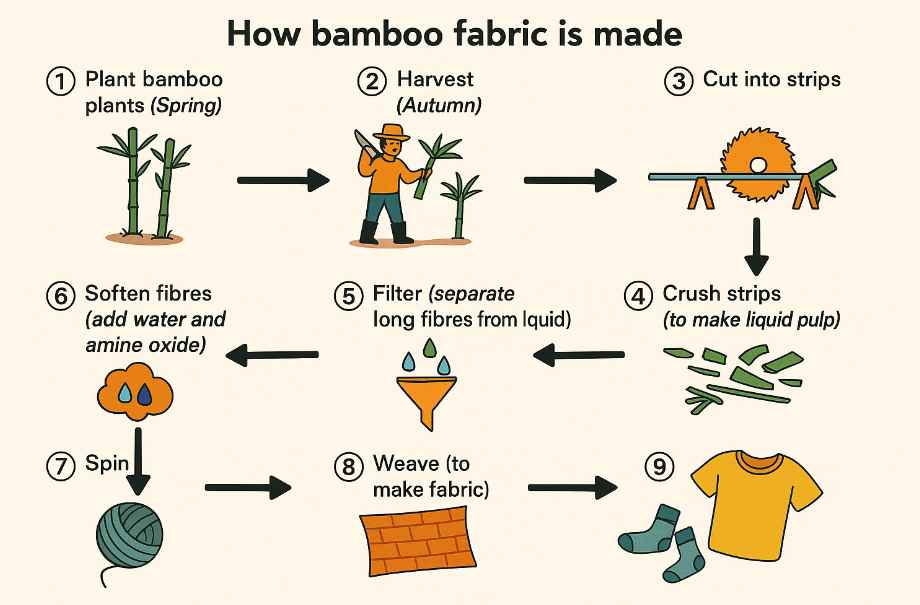
The diagram below shows how fabric is manufactured from bamboo.
Summarise the information by selecting and reporting the main features, and make comparisons where relevant.
The process delineates how bamboo is fabricated into textile products. Looking from an overall perspective, it is readily apparent that there are three main stages in this process beginning with growing and harvesting, followed by mechanical and chemical treatment to form a usable fiber, and lastly the creation of final garments. The process is a combination of man-made and natural stages.
In the initial natural stage, bamboo plants are grown in the spring prior to being hand-harvested by autumn. Once the stalks have been collected, they are then cut into strips by a circular saw. The final mechanical step is to then crush the strips in order to fabricate liquid pulp.
The chemical processing begins with a filter that separates longer fibers from the liquid previously produced. Then water and amine oxide are added to soften the fibers, allowing them to be spun into balls of thread. The thread can then be woven into larger pieces of fabric which themselves form the basis of final clothing products for retail.
Analysis
1. The process delineates how bamboo is fabricated into textile products. 2. Looking from an overall perspective, it is readily apparent that there are three main stages in this process beginning with growing and harvesting, followed by mechanical and chemical treatment to form a usable fiber, and lastly the creation of final garments. 3. The process is a combination of man-made and natural stages.
Paraphrase the overall essay topic.
Start your overview.
Make your overview two sentences.
1. In the initial natural stage, bamboo plants are grown in the spring prior to being hand-harvested by autumn. 2. Once the stalks have been collected, they are then cut into strips by a circular saw. 3. The final mechanical step is to then crush the strips in order to fabricate liquid pulp.
You don’t need a topic sentence – just start the essay.
Go step by step.
Link your sentences well.
1. The chemical processing begins with a filter that separates longer fibers from the liquid previously produced. 2. Then water and amine oxide are added to soften the fibers, allowing them to be spun into balls of thread. 3. The thread can then be woven into larger pieces of fabric which themselves form the basis of final clothing products for retail.
Start a new paragraph at any point.
Transitions are important.
Finish describing the bamboo process including all steps.
Vocabulary
What do the words in bold below mean?Make some notes on paper to aid memory and then check below.
The process delineates howbamboo is fabricated into textile products. Looking from an overall perspective, it is readily apparent that there are three main stages in this process beginning with growing and harvesting, followed by mechanical and chemical treatment to form a usable fiber, and lastly the creation of final garments. The process is a combination of man-made and natural stages.
In the initial natural stage, bamboo plants are grown in the spring prior to being hand-harvested by autumn. Once the stalks have been collected, they are then cut into strips by a circular saw.The final mechanical step is to then crush the strips in order to fabricate liquid pulp.
The chemical processing begins with a filter that separates longer fibers from the liquid previously produced. Then water and amine oxide are added to soften the fibers, allowing them to be spun into balls of thread. The thread can then be woven into larger pieces of fabric which themselves form the basis of final clothing products for retail.
Answers
For extra practice, write an antonym (opposite word) on a piece of paper to help you remember the new vocabulary:
The process delineates how Synonym: The procedure outlines the way
bamboo Synonym: bamboo plants
fabricated into textile products Synonym: transformed into fabric materials
Looking from an overall perspective, it is readily apparent that Synonym: From a broad view, it is clear that
main stages Synonym: key steps
beginning with growing and harvesting Synonym: starting with cultivation and collection
followed by mechanical and chemical treatment to form a usable fiber Synonym: then undergoing physical and chemical processes to create usable fibers
lastly the creation of final garments Synonym: and ending with the production of finished clothing
a combination of man-made and natural stages Synonym: involving both artificial and organic phases
In the initial natural stage Synonym: During the first biological step
in the spring prior to being hand-harvested by autumn Synonym: planted in spring and manually gathered in the fall
stalks Synonym: stems
collected Synonym: gathered
cut into strips by a circular saw Synonym: sliced into thin pieces using a round blade
The final mechanical step is Synonym: The last physical stage involves
crush Synonym: compressing
fabricate liquid pulp Synonym: to produce a viscous pulp
The chemical processing begins with Synonym: The next stage, chemical treatment, starts by
filter Synonym: straining
separates longer fibers from the liquid previously produced Synonym: isolates extended fibers from the earlier-made solution
amine oxide Synonym: a chemical compound known as amine oxide
soften the fibers Synonym: is used to make the fibers more pliable
spun into balls of thread Synonym: twisted into yarn bundles
woven Synonym: interlaced
form the basis of final clothing products for retail Synonym: to create the foundation of garments sold in stores
I recommend getting a pencil and piece of paper because that aids memory. Then write down the missing vocabulary from my sample answer in your notebook:
The process __________ howb______o is fabricated ______________ products. Looking __________________________________________ that there are three main ________s in this process beginning ______________________________ harvesting, followed _____________________________________________________________ fiber, and lastly ____________________________ garments. The process is a __________________________________________ stages.
In _______________________ stage, bamboo plants are grown in _______________________________________________ autumn. Once the s_______s have been c__________d, they are then cut _______________________________ saw.The ________________________ is to then c_______h the strips in order to fabricate ___________ pulp.
The ____________________________________ with a filter that separates ____________________________________________ produced. Then water and amine _____e are added to soften ______ fibers, allowing them to be spun ___________________ thread. The thread can then be w_______n into larger pieces of fabric which themselves form _______________________________ retail.
Listening Practice
Learn more about this topic by watching from YouTube below and practice with these activities:
"The highest quality materials anywhere on the internet! Dave improved my writing and vocabulary so much. Really affordable options you don't want to miss out on!"