When it comes to IELTS task 1 writing, I prefer to write about maps. I think it is easier to structure and describe all the information.
The trickiest part is the overview. I tell my students that they should focus on two things: what changed and a way to group/describe the changes. This is very similar to the overview for a process.
A lot of students make the mistake of just listing the changes or saying that there were major changes. Those don’t count as overviews and you will get band 5 for task achievement.
Make sure that you describe the changes but also define them in some way – for example, by saying that the building has become more modern.
Just be careful not to veer into opinion. Modern is fine. Convenient is not because that is opinion/specualtion about how people will view the changes.
IELTS Writing Task 1: University Sports Centre Map (IELTS Cambridge 13) by Dave (former IELTS examiner)
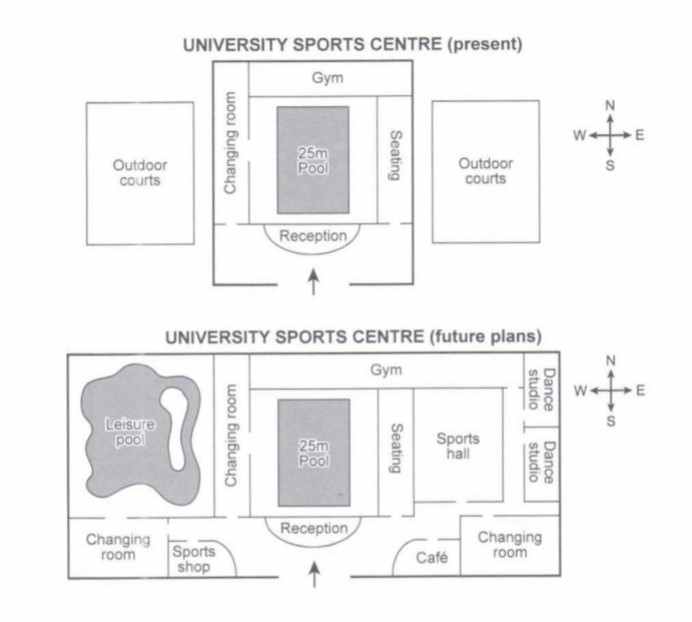
The plans below show the layout of a university’s sports centre now, and how it will look after redevelopment.
Summarise the information by selecting and reporting the main features, and make comparisons where relevant.
The diagrams detail the present construction of a sports centre and plans for its renovation. Looking from an overall perspective, it is readily apparent that there are plans to remove the outdoor courts and expand the gym with additional facilities for swimming, changing, dancing, and activities largely unrelated to exercise like shopping and having coffee.
At the moment, the university’s main building is flanked by large outdoor courts. The plan is to remove the western courts in favour of a leisure pool larger in size than the current pool, which will itself remain unchanged during renovations. The entire main building will not undergo alterations including the changing rooms, reception and seating area. The only slight exception is that the gym on the northern end of the building will be lengthened eastwards and connect with two new adjoining dance studios.
The outdoor court on the eastern side will be replaced by a sports hall and to the southeast of the sports hall the university will add an additional changing room (which is mirrored by the same room in the southwestern corner of the plans) and an abutting cafe to the west. The large entrance area will not be impeded in any way but a new sports shop will open next to the westernmost changing room.
Analysis
1. The diagrams detail the present construction of a sports centre and plans for its renovation. 2. Looking from an overall perspective, it is readily apparent that there are plans to remove the outdoor courts and expand the gym with additional facilities for swimming, changing, dancing, and activities largely unrelated to exercise like shopping and having coffee.
1. My first sentence repeats the topic. This sentence won’t have a major impact on your vocabulary or task achievement score so write it as quickly as possible!
2. The second sentence is my general overview. Be sure that you at least touch on all areas (without simply listing them) by trying to group them together in some say (and define, not give an opinion on, the biggest changes). Try to limit your overview to one or two sentences, though you can add on a conclusion at the end with more information if you feel your overview didn’t include all the changes.
1. At the moment, the university’s main building is flanked by large outdoor courts. 2. The plan is to remove the western courts in favour of a leisure pool larger in size than the current pool, which will itself remain unchanged during renovations. 3. The entire main building will not undergo alterations including the changing rooms, reception and seating area. 4. The only slight exception is that the gym on the northern end of the building will be lengthened eastwards and connect with two new adjoining dance studios.
1. I begin with the map in the past and a general description of the largest area of the map. Try to give your writing a logical structure starting with the topic sentence.
2. The second sentence describes one of the biggest changes (the new pool) and includes a part of the map that has not changed. It is important to mention what changes as well as what doesn’t change.
3. My third sentence further details the areas that will not change.
4. My fourth sentence includes an exception and some of the other changes taking place near the main building.
1. The outdoor court on the eastern side will be replaced by a sports hall and to the southeast of the sports hall the university will add an additional changing room (which is mirrored by the same room in the southwestern corner of the plans) and an abutting cafe to the west. 2. The large entrance area will not be impeded in any way but a new sports shop will open next to the westernmost changing room.
1. In the first sentence I describe the changes to the courts and what will replace them.
2. The second sentence finishes describing all the changes not yet mentioned as well as the entrance area (which will not change).
Vocabulary Practice
Remember and fill in the gaps with the useful vocabulary for maps:
The diagrams detail the present _________________ of a sports centre and plans for its _____________. Looking from an overall perspective, it is readily apparent that there are plans to ____________ the outdoor courts and ____________ the gym with ____________ facilities for swimming, changing, dancing, and activities ____________ unrelated to exercise like shopping and having coffee.
At the moment, the university’s main building is ____________ by large outdoor courts. The plan is to remove the western courts ____________ a leisure pool larger in size than the current pool, which will itself remain unchanged during renovations. The entire main building will not ____________ including the changing rooms, reception and seating area. The only ____________ is that the gym on the northern end of the building will be ____________ ____________ and ____________ with two new ____________ dance studios.
The outdoor court on the eastern side will be ____________ a sports hall and to the ____________ of the sports hall the university will add an additional changing room (which is ____________ the same room in the southwestern corner of the plans) and an ____________ cafe to the west. The large entrance area will not be ____________ in any way but a new sports shop will open next to the westernmost changing room.
Answers
The diagrams detail the present construction of a sports centre and plans for its renovation. Looking from an overall perspective, it is readily apparent that there are plans to remove the outdoor courts and expand the gym with additional facilities for swimming, changing, dancing, and activities largely unrelated to exercise like shopping and having coffee.
At the moment, the university’s main building is flanked by large outdoor courts. The plan is to remove the western courts in favour of a leisure pool larger in size than the current pool, which will itself remain unchanged during renovations. The entire main building will not undergo alterations including the changing rooms, reception and seating area. The only slight exception is that the gym on the northern end of the building will be lengthened eastwards and connect with two new adjoining dance studios.
The outdoor court on the eastern side will be replaced by a sports hall and to the southeast of the sports hall the university will add an additional changing room (which is mirrored by the same room in the southwestern corner of the plans) and an abutting cafe to the west. The large entrance area will not be impeded in any way but a new sports shop will open next to the westernmost changing room.
Vocabulary Definitions
construction: the buildings
renovation: to remodel or change
remove: to get rid of
expand: to make larger
additional: another one
unrelated: not related, different
flanked: on either side of
in favour of: in order to have, replaced by
undergo alterations: have changes made
slight exception: small difference
lengthened eastwards: made longer going to the East
connect: join together
adjoining: connected
replaced: takes the place of
southeast: to the south and east
mirrored: reflected, in the same place but on the other side
abutting: next to
impeded: in the way of, blocking
Grammar Practice
I put some grammar mistakes related to prepositions in it – can you find and correct all the prepositions?
The diagrams detail the present construction of a sports centre and plans to its renovation. Looking at an overall perspective, it is readily apparent that there are plans for remove the outdoor courts and expand the gym towards additional facilities for swimming, changing, dancing, and activities largely unrelated with exercise like shopping and having coffee.
At the moment, the university’s main building is flanked in large outdoor courts. The plan is to remove the western courts in favour at a leisure pool larger in size that the current pool, which will itself remain unchanged during renovations. The entire main building will not undergo alterations including the changing rooms, reception and seating area. The only slight exception is that the gym upon the northern end of the building will be lengthened eastwards and connect for two new adjoining dance studios.
The outdoor court on the eastern side will on replaced by a sports hall and to the southeast of the sports hall the university will add an additional changing room (which is mirrored for the same room in the southwestern corner at the plans) and an abutting cafe at the west. The large entrance area will not be impeded in any way but a new sports shop will open next to the westernmost changing room.
Answers
The diagrams detail the present construction of a sports centre and plans for its renovation. Looking from an overall perspective, it is readily apparent that there are plans to remove the outdoor courts and expand the gym with additional facilities for swimming, changing, dancing, and activities largely unrelated to exercise like shopping and having coffee.
At the moment, the university’s main building is flanked by large outdoor courts. The plan is to remove the western courts in favour of a leisure pool larger in size that the current pool, which will itself remain unchanged during renovations. The entire main building will not undergo alterations including the changing rooms, reception and seating area. The only slight exception is that the gym on the northern end of the building will be lengthened eastwards and connect with two new adjoining dance studios.
The outdoor court on the eastern side will be replaced by a sports hall and to the southeast of the sports hall the university will add an additional changing room (which is mirrored by the same room in the southwestern corner of the plans) and an abutting cafe to the west. The large entrance area will not be impeded in any way but a new sports shop will open next to the westernmost changing room.
This is an IELTS Writing Task 1 Sample Answer based on a bar chart showing the consumption and production of Electricity from the Cambridge IELTS 13 book real past tests.
This isn’t really a tough graph but, to be honest, it’s annoying.
There is a ton of data and it is really repetitive to just list all of it. This graph makes you question why this task exists at all because the visual chart is so much easier to understand compared to what you have to write about it.
But complaining about your lot in life only distracts you from the task at hand!
You can read below to see how I dealt with this annoying graph.
IELTS Writing Task 1 Sample Answer: Bar Chart Production and Consumption of Electricity (IELTS Cambridge 13)
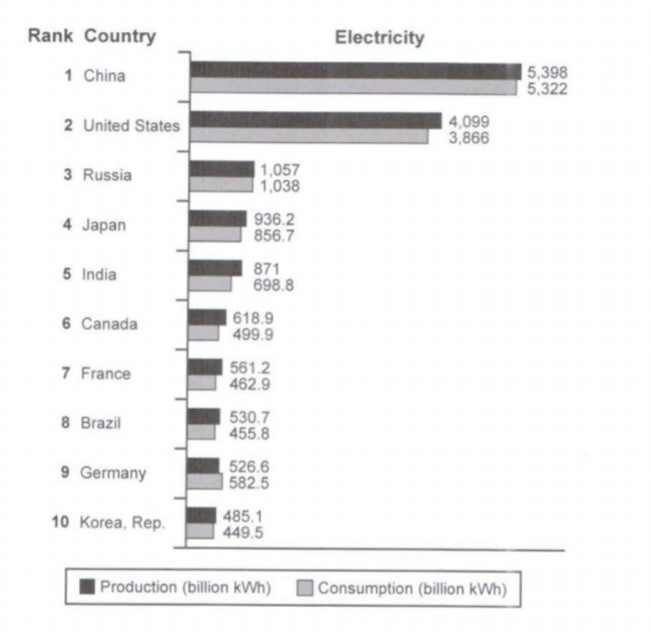
The bar chart below shows the top ten countries for the production and consumption of electricity in 2014.
Summarise the information by selecting and reporting the main features, and make comparisons where relevant.
IELTS Writing Task 1: Electricity Bar Chart (Cambridge 13) by Dave (former IELTS examiner)
The chart illustrates electricity consumption and production in the top ten highest countries in 2014. It is clear from the chart that all countries, with the exception of Germany, produce marginally more than they consume. The two top countries, the United States and particularly China, were strong outliers while the remaining countries had similar numbers and lagged far behind in both production and consumption.
China produced and consumed the most, at 5,398 billion and 5,322 kWh, respectively. The next nearest country in terms of both statistics was the US, where residents consumed 3,866 kilowats an hour and produced slightly more at 4,099.
Russian lead the rest of the nations with 1,057 (in production) and 1,038 kWh (consumption) followed by Japan (936.2 for production and 856.7 kWh for consumption). India and Canada ranked 5th and 6th with India producing 871 kWh and consuming 698.8 while Canada was slightly lower in both (618.9 and 499.9 kWh). In the 7th and 8th spots were France (producing 561.2 kWh and consuming 462.9) and Brazil, which recorded numbers at 530.7 and 455.8 for production and consumption, respectively. In the final two positions were Germany and the Republic of Korea with Germany having higher production that Korea (526.6 to 485.1 kWh) as well as consumption (582.5 kWh compared with 449.5).
Sample Answer Analysis
1. The chart illustrates electricity consumption and production in the top ten highest countries in 2014. 2. It is clear from the chart that all countries, with the exception of Germany, produce marginally more than they consume. 3. The two top countries, the United States and particularly China, were strong outliers while the remaining countries had similar numbers and lagged far behind in both production and consumption.
1. This first sentence simply paraphrases the topic – don’t waste a lot of time on this, it’s not really all that important.
2. This is the most important sentence in your whole IELTS test – the overview. Here I include the most general takeaway – which is that most countries produce more electricity than they consume.
3. My third sentence continues the overview by including the ranking for the countries – be sure to include this and aim for around 2 sentences for your overview to make sure you include enough detail
1. China produced and consumed the most, at 5,398 billion and 5,322 kWh, respectively. 2. The next nearest country in terms of both statistics was the US, where residents consumed 3,866 kilowats an hour and produced slightly more at 4,099.
1. The first sentence begins with China, the country at the top of the chart.
2. I then compare with the United States and conclude the paragraph. You should group together and compare the data logically and use paragraphs to build the structure of your essay.
1. Russian lead the rest of the nations with 1,057 (in production) and 1,038 kWh (consumption) followed by Japan (936.2 for production and 856.7 kWh for consumption). 2. India and Canada ranked 5th and 6th with India producing 871 kWh and consuming 698.8 while Canada was slightly lower in both (618.9 and 499.9 kWh). 3. In the 7th and 8th spots were France (producing 561.2 kWh and consuming 462.9) and Brazil, which recorded numbers at 530.7 and 455.8 for production and consumption, respectively. 4. In the final two positions were Germany and the Republic of Korea with Germany having higher production that Korea (526.6 to 485.1 kWh) as well as consumption (582.5 kWh compared with 449.5).
1. My second paragraph contains all the other information so it is much longer. I start with Russia and Japan.
2. Then move on to the next countries and compare them – India and Canada. All these countries have similar statistics so I just list them. If there were more distinct groups I would compare groups, rather than single countries.
3. Next are France and Brazil. Notice that I use different ways to include the data (sometimes parenthesis, sometimes just listing it). Don’t worry too much about varying it every time but you also shouldn’t use the exact same grammar and vocabulary for each sentence or it will be clear that you are reliant on a few simple structures and that will limit you to around band 6 for vocabulary and grammar.
4. My final sentence details the last two countries and compares them: Germany and Korea. You should always be comparing – every single sentence is some kind of comparision for IELTS Writing Task 1.
Vocabulary Practice
Can you think of a paraphrase or a synonym for each of the words in bold below?
The chart illustrates electricity consumption and production in the top ten highest countries in 2014. It is clear from the chart that all countries, with the exception of Germany, produce marginally more than they consume. The two top countries, the United States and particularly China, were strong outliers while the remaining countries had similar numbers and lagged far behind in both production and consumption.
China produced and consumed the most, at 5,398 billion and 5,322 kWh, respectively. The next nearest country in terms of both statistics was the US, where residents consumed 3,866 kilowats an hour and produced slightly more at 4,099.
Russian lead the rest of the nations with 1,057 (in production) and 1,038 kWh (consumption) followed by Japan (936.2 for production and 856.7 kWh for consumption). India and Canada ranked 5th and 6th with India producing 871 kWh and consuming 698.8 while Canada was slightly lower in both (618.9 and 499.9 kWh). In the 7th and 8th spots were France (producing 561.2 kWh and consuming 462.9) and Brazil, which recorded numbers at 530.7 and 455.8 for production and consumption, respectively. In the final two positions were Germany and the Republic of Korea with Germany having higher production that Korea (526.6 to 485.1 kWh) as well as consumption (582.5 kWh compared with 449.5).
Answers
consumption: usage
top ten highest: among the ten largest producers and consumers
It is clear from the chart: it is readily apparent that
exception: except for, with only ____ bucking this trend, showing a different trend
marginally: slightly, barely
particularly: especially
outliers: standing out, well beyond, leading/far behind
I put some simple grammar mistakes with articles and tense in it this time – can you find and correct the grammar mistakes?
The chart illustrated (illustrates) electricity consumption and production in top ten highest countries in 2014. It is clear from a chart that all countries, with the exception of Germany, are producing marginally more than they consume. The two top countries, United States and particularly China, were strong outliers while the remaining countries had had similar numbers and lagged far behind in both production and consumption.
China produced and consumed the most, at 5,398 billion and 5,322 kWh, respectively. The next nearest country in terms of both statistics was the US, where residents have consumed 3,866 kilowats an hour and produced slightly more at the 4,099.
Russian lead the rest of nations with 1,057 (in production) and 1,038 kWh (consumption) followed by Japan (936.2 for production and 856.7 kWh for consumption). India and Canada rank 5th and 6th with India producing 871 kWh and consuming 698.8 while Canada was slightly lower in both (618.9 and 499.9 kWh). In a 7th and 8th spots were France (producing 561.2 kWh and consuming 462.9) and Brazil, which recorded numbers at 530.7 and 455.8 for production and consumption, respectively. In the final two positions was were Germany and Republic of Korea with Germany having higher production that Korea (526.6 to 485.1 kWh) as well as consumption (582.5 kWh compared with 449.5).
Answers
The chart illustrates electricity consumption and production in the top ten highest countries in 2014. It is clear from the chart that all countries, with the exception of Germany, produce marginally more than they consume. The two top countries, the United States and particularly China, were strong outliers while the remaining countries had similar numbers and lagged far behind in both production and consumption.
China produced and consumed the most, at 5,398 billion and 5,322 kWh, respectively. The next nearest country in terms of both statistics was the US, where residents consumed 3,866 kilowats an hour and produced slightly more at 4,099.
Russian lead the rest of the nations with 1,057 (in production) and 1,038 kWh (consumption) followed by Japan (936.2 for production and 856.7 kWh for consumption). India and Canada ranked 5th and 6th with India producing 871 kWh and consuming 698.8 while Canada was slightly lower in both (618.9 and 499.9 kWh). In the 7th and 8th spots were France (producing 561.2 kWh and consuming 462.9) and Brazil, which recorded numbers at 530.7 and 455.8 for production and consumption, respectively. In the final two positions were Germany and the Republic of Korea with Germany having higher production that Korea (526.6 to 485.1 kWh) as well as consumption (582.5 kWh compared with 449.5).
1. If you don’t understand the question, you can ask for clarification of specific words but you can’t ask ‘Can you explain that?’ The examiner will just repeat the question and then move on if you don’t understand.
2. There’s no task achievement for speaking so if you are not 100% sure about the question you can try answering it anyway as long as you get the topic.
3. Don’t talk forever or too little! Aim for about 10 – 30 seconds per answer and 2 – 4 sentences.
What did you enjoy the most about your school in the past?
Well, if you _______________ – if you’re talking about my primary school – the _______________ I liked were my teachers. I don’t know if it was just because I was a kid at the time but they were really warm and friendly – and it was some of my teachers _______________ – that inspired me to have a life-long passion for reading. I remember in particular one teacher – I can’t remember her name – it was Mrs. Riley or something – and she would always encourage me to read books, _______________ me books, talk about books with me. And that really got me _______________ books at a time when I was really _______________ .
Answers:
What did you enjoy the most about your school in the past?
Well, if you put me on the spot – if you’re talking about my primary school – the number one thing I liked were my teachers. I don’t know if it was just because I was a kid at the time but they were really warm and friendly – and it was some of my teachers back then – that inspired me to have a life-long passion for reading. I remember in particular one teacher – I can’t remember her name – it was Mrs. Riley or something – and she would always encourage me to read books, loan me books, talk about books with me. And that really got me into books at a time when I was really impressionable.
Listen and correct the mistakes:
Do you stay in touch with school classmates?
Not really, I’ve got one better friend back in the United States, but we don’t actually walk all that much anymore. He recently got married and we used to be best buddies, we would hang out as school, we’d go buy pizza together, we’d ride around together, we chatted about girls and about school and about our future – all this stuff – but since I’ve moved to Vietnam we’ve kind of known apart and we’re not really as closely as we used to been.
Answers:
Do you stay in touch with school classmates?
Not really, I’ve got one best friend back in the States, but we don’t actually talk all that much anymore. He recently got married and we used to be best buds, we would hang out after school, we’d go get pizza together, we’d drive around together, we chatted about girls and about school and about out future – all that stuff – but since I’ve moved to Vietnam we’ve kind of grown apart and we’re not really as close as we used to be.
Listen and add in the grammar:
What were your best subjects when you were in school?
I – (donot have) that many good subjects at all but I – (is) really good in literature because I – (read) a lot so it just – (come) naturally to me. I – (is) also good in history. I never – (study) but I – (listen) in class and I – (have) like a, like a brilliant memory, almost like a photographic memory but not quite. And I – (can) just – (remember) dates and names and everything – simple! So I never – (have) to study but I always – (get) top marks in history. And besides that I – (is) good in gym because I – (is) very athletic but even if – (you are) not athletic – (it is) easy to get good marks when – (you are) in gym. I – (is not) good at math or the sciences or anything like that – things where you actually – (have) to – (put) in real work, I – (is) bad at those things.
Answers:
What were your best subjects when you were in school?
I didn’t have that many good subjects at all but I was really good in literature because I read a lot so it just came naturally to me. I was also good in history. I never studied but I listened in class and I had – like a – like a brilliant memory – almost like a photographic memory but not quite. And I could just remember dates and names and everything – simple! So I never had to study but I always got top marks in history. And besides that I was good in gym because I was very athletic but even if you’re not athletic it’s easy to get good marks when you’re in gym. I wasn’t good at math or the sciences or anything like that – things where you actually had to put in real work – I was bad at those things.
Choose the correct options:
What do most students in your nation do after school ends?
It’s a big country/county so I can’t really answer for everyone but the school I used to go to – most kids would play sport/sports after school. So girls used to/usually played soccer and depending on the season/reason guys would play basketball or soccer or hockey. If you weren’t doing that, there was like an after-school recreational community ‘club’ where a lot of outcasts in High School could/would go to play computer games or do art or something like that. Some kids would just head/lead home – that’s what I did most of the time. I wanted to get home, play computer games – be alone. So I’d just head home if I wasn’t hanging out with a friend or something like this/that. I think there might have also been some after-school classes but they’re actually not that commonplace/common in America. Most people when they finish school, they’re done with school and they’re moving on to do something fun/funny after school.
Answers:
What do most students in your nation do after school ends?
It’s a big country so I can’t really answer for everyone but the school I used to go to – most kids would play sport after school. So girls usually played soccer and depending on the season guys would play basketball or soccer or hockey. If you weren’t doing that, there was like an after-school recreational community ‘club’ where a lot of outcasts in High School would go to play computer games or do art or something like that. Some kids would just head home – that’s what I did most of the time. I wanted to get home, play computer games – be alone. So I’d just head home if I wasn’t hanging out with a friend or something like that. I think there might have also been some after-school classes but they’re actually not that common in America. Most people when they finish school, they’re done with school and they’re moving on to do something fun after school.
Key IELTS Speaking Vocabulary:
put me on the spot – make me say
at the time – back then
back then – then
inspired me – got me into
life-long passion – interest in
in particular – especially
loan me books – let me borrow
impressionable – easily influenced
stay in contact – keep in touch
the States – America, the USA
best buds – best friends
chatted about – talked about
grown apart – drifted apart
came naturally to me – was easy
photographic memory – n/a
not quite – almost
got top marks – straight As
put in real work – work hard
can’t really answer for everyone – can’t speak for everyone
depending on the season – if it was…
outcasts – loners, social outcasts
head home – go home
Grammar relative clauses with ‘where’:
‘There was like an after-school recreational community ‘club’ where a lot of outcasts in High School would go to play computer games’
If you want to get a band 6 and above for grammar you should include at least one relative clause in your IELTS speaking.
Luckily, the rules for relative clauses are simple and you probably use some already.
There are two main kinds: defining and non-defining.
A defining one is super important for the meaning of the sentence: ‘The place where I met him was really crowded.’
A non-defining one just gives extra information (and uses commas) and is less important – just an extra detail: ‘The club, where my friend also works by the way, was where I met him.’
Some words that you can use for relative clauses include: where, who, what, that, and which
Write some examples of the places you remember well from your childhood:
‘There was a library, where people mainly went to use the internet, and I….’
Full Sample Answers
What did you enjoy the most about your school in the past?
Well, if you put me on the spot – if you’re talking about my primary school – the number one thing I liked were my teachers. I don’t know if it was just because I was a kid at the time but they were really warm and friendly – and it was some of my teachers back then – that inspired me to have a life-long passion for reading. I remember in particular one teacher – I can’t remember her name – it was Mrs. Riley or something – and she would always encourage me to read books, loan me books, talk about books with me. And that really got me into books at a time when I was really impressionable.
Do you stay in touch with old school classmates?
Not really, I’ve got one best friend back in the States, but we don’t actually talk all that much anymore. He recently got married and we used to be best buds, we would hang out after school, we’d go get pizza together, we’d drive around together, we chatted about girls and about school and about out future – all that stuff – but since I’ve moved to Vietnam we’ve kind of grown apart and we’re not really as close as we used to be.
What were your best subjects when you were in school?
I didn’t have that many good subjects at all but I was really good in literature because I read a lot so it just came naturally to me. I was also good in history. I never studied but I listened in class and I had – like a – like a brilliant memory – almost like a photographic memory but not quite. And I could just remember dates and names and everything – simple! So I never had to study but I always got top marks in history. And besides that I was good in gym because I was very athletic but even if you’re not athletic it’s easy to get good marks when you’re in gym. I wasn’t good at math or the sciences or anything like that – things where you actually had to put in real work – I was bad at those things.
What do most students in your nation do after school ends?
It’s a big country so I can’t really answer for everyone but the school I used to go to – most kids would play sport after school. So girls usually played soccer and depending on the season guys would play basketball or soccer or hockey. If you weren’t doing that, there was like an after-school recreational community ‘club’ where a lot of outcasts in High School would go to play computer games or do art or something like that. Some kids would just head home – that’s what I did most of the time. I wanted to get home, play computer games – be alone. So I’d just head home if I wasn’t hanging out with a friend or something like that. I think there might have also been some after-school classes but they’re actually not that common in America. Most people when they finish school, they’re done with school and they’re moving on to do something fun after school.
This is an IELTS Writing Task 1 Sample answer from the IELTS Cambridge books and it’s one of the easiest task 1s that I have ever seen on IELTS. But that’s a great opportunity for you to do an amazing job on it!
To impress the examiner on Task 1 writing, you not only need to describe all the data well but you need to use really strong vocabulary and grammar in a clear structure.
This graph is simple but it is a real challenge to describe it well. Even if you know what you have to do, it is always a challenge to actually do it.
Read on for analysis of what I did with it as well as some vocabulary that you can easily apply to your writing, links and more!
Here are some of my other writing samples for Task 2 and Task 1.
Enjoy!
Dave
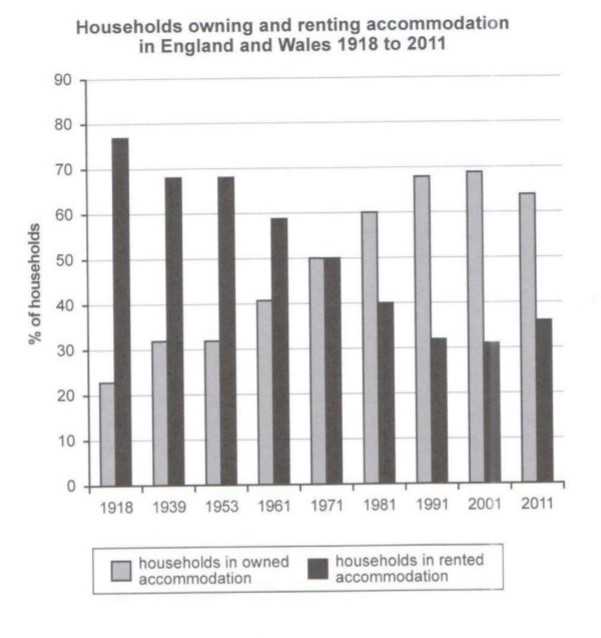
IELTS Writing Task 1: Bar Chart Owned and Rented Households (IELTS Cambridge 13) by Dave (former IELTS examiner)
The chart below shows the percentage of households in owned and rented accomodation in England and Wales between 1918 and 2011.
Summarise the information by selecting and reporting the main features, and make comparisons where relevant.
IELTS Cambrdige 13 Writing Task 1: Households England and Wales
The presented bar chart illustrates percentages of owned and rented English and Welsh accomodation from 1918 to 2011. Overall, owning and renting showed opposite trends with a sharp increase in ownership and a reciprocal decline in the percentage of renters. By the end of the period, overall ownership had overtaken renting by a wide margin.
In 1918, household ownership stood at around 23% compared to rentals, which were at nearly 80%. From that point there was a steady rise in ownership and decline in rentals. Rentals reached 69% in 1939 and held steady until 1953 before falling to 59% in 1961. Ownership rose to 31% in 1939, remained there in 1953 before becoming even with rentals at 50% each in 1971.
This trend continued for both percentages with rentals declining sharply to 40% and 31% in 1981 and 1991, respectively. Likewise, ownership rose to 60% and 69% in the same years. In 2001, the falling rate of rentals slackened to 31% (69% for ownership) and there was a small rebound that bucked the trend at the end of period with rented houses rising to nearly 40% and owned houses dipping to just over 60%.
Analysis
1. The presented diagram illustrates percentages of owned and rented English and Welsh accomodation from 1918 to 2011. 2. Overall, owning and renting showed opposite trends with a sharp increase in ownership and a reciprocal decline in the percentage of renters. 3. By the end of the period, overall ownership had overtaken renting by a wide margin.
1. The first sentence simply paraphrases (changes some of the words) from the task question. Don’t waste time on this sentence – write it as fast as your hand will move and the pencil will write without setting the paper on fire!
2. The second sentence is the most important sentence of the whole task, the whole writing test, all of IELTS and your entire life! My general overview covers the main trend (for both categories). You can read more about how to write an overview here.
3. The third sentence finishes my overview. Overviews should only be about 2, maximum 3 sentences, long. Do not mention any specific data or give any opinion/speculation.
1. In 1918, household ownership stood at around 23% compared to rentals, which were at nearly 80%. 2. From that point there was a steady rise in ownership and decline in rentals. 3. Rentals reached 69% in 1939 and held steady until 1953 before falling to 59% in 1961. 4. Ownership rose to 31% in 1939, remained there in 1953 before becoming even with rentals at 50% each in 1971.
1. I start with the logical place – the first year. I compare the rentals and ownership in that year. Every single sentence you write should have some sort of comparision. No exceptions!
2. My second sentence summarises the trend that I will continue to detail.
3. My third sentence gives the specific data and years. Always, always include the year and the key data or you could end up with a 5 for task achievement!
4. My fourth sentence continues the comparision of specific data.
1. This trend continued for both percentages with rentals declining sharply to 40% and 31% in 1981 and 1991, respectively. 2. Likewise, ownership rose to 60% and 69% in the same years. 3. In 2001, the falling rate of rentals slackened to 31% (69% for ownership) and there was a small rebound that bucked the trend at the end of period with rented houses rising to nearly 40% and owned houses dipping to just over 60%.
1. My first sentence continues to describe them as ownership overtakes rentals in the middle of the period.
2. The second sentence compares ownership’s data with rentals.
3. My final sentence includes all the data from the graph.
Vocabulary Practice
I put some mistakes into the writing below – can you find and correct the vocabulary mistakes? Some are too informal, others are just incorrect vocabulary…
The describedpresented bar chart illustrates percentages of owned and rented English and Welsh accomodation from 1918 to 2011. Overall, owning and renting showed opposites with a sharper increase in ownership and a reflecting decline in the percentage of renters. By the end of all the period, overall ownership had overcome renting by a big margin.
In 1918, household ownership witnessed at around 23% compared to rentals, which were at near 80%. From that point it was a steady jump in ownership and disaster in rentals. Rentals climbed 69% in 1939 and held straight until 1953 before dying to 59% in 1961. Ownership flew upwards to 31% in 1939, stayed put there in 1953 before equal with rentals at 50% each in 1971.
This trend continued for both percentages with rentals very down to 40% and 31% in 1981 and 1991, respectively. Likewise, ownership rose to 60% and 69% in the same years. In 2001, the ungrowing rate of rentals recovered to 31% (69% for ownership) and there was a upwards that went against at the end of period with rented houses rising to nearly 40% and owned houses going under to way over 60%.
Answers
The presented bar chart illustrates percentages of owned and rented English and Welsh accomodation from 1918 to 2011. Overall, owning and renting showed opposite trends with a sharp increase in ownership and a reciprocal decline in the percentage of renters. By the end of the period, overall ownership had overtaken renting by a wide margin.
In 1918, household ownership stood at around 23% compared to rentals, which were at nearly 80%. From that point there was a steady rise in ownership and decline in rentals. Rentals reached 69% in 1939 and held steady until 1953 before falling to 59% in 1961. Ownership rose to 31% in 1939, remained there in 1953 before becoming even with rentals at 50% each in 1971.
This trend continued for both percentages with rentals declining sharply to 40% and 31% in 1981 and 1991, respectively. Likewise, ownership rose to 60% and 69% in the same years. In 2001, the falling rate of rentals slackened to 31% (69% for ownership) and there was a small rebound that bucked the trend at the end of period with rented houses rising to nearly 40% and owned houses dipping to just over 60%.
Vocabulary Definitions
presented: illustrated or shown
opposite trends: reverse movement
sharp increase: increased quickly
reciprocal decline: decreasing in the opposite direction
by the end of the period: at the end of the graph
overtaken: to beat or go in front of or outrank
wide margin: by a lot
stood: were at
nearly: almost
from that point there was: from then on
steady rise: increasing slowly but at the same rate
decline: decrease
reached: were at
held steady: stayed the same
falling: decreasing
rose: increased
remained there: stayed there
becoming even: were level with/equal with
declining sharply: decreasing quickly
falling rate: decreasing trend
slackened: slowed
small rebound: came back up
bucked the trend: reverse the movement/momentum
dipping: decreasing
just over: more than
Grammar Practice
I put some grammar mistakes in it this time – can you find and correct the grammar mistakes? Check your answers with the original answer above.
The presented bar chart illustratingillustrates percentages of owned and rented English and Welsh accomodation by 1918 to 2011. Overall, owning and renting had showed opposite trends with the sharp increase in ownership and a reciprocal decline in the percentage of renters. By the end of the period, overall ownership has overtaken renting with a wide margin.
In 1918, household ownership stand at around 23% compared to rentals, who were at nearly 80%. From that point there was a steady rise in ownership and decline in rentals. Rentals reaching 69% in 1939 and held steady until 1953 before falls to 59% in 1961. Ownership rose to 31% in 1939, remained there by 1953 before becoming even with the rentals at 50% each at 1971.
This trend continuing for both percentages with rentals decline sharply to 40% and 31% in 1981 and 1991, respectively. Likewise, ownership rise to 60% and 69% in the same years. In 2001, the falling rate of rentals was slackened to 31% (69% for ownership) and there is a small rebound that bucked the trend at the end of period with rented houses rising to nearly 40% and owned houses has dipping to just over 60%.
Answers
The presented bar chart illustrates percentages of owned and rented English and Welsh accomodation from 1918 to 2011. Overall, owning and renting showed opposite trends with a sharp increase in ownership and a reciprocal decline in the percentage of renters. By the end of the period, overall ownership had overtaken renting by a wide margin.
In 1918, household ownership stood at around 23% compared to rentals which were at nearly 80%. From that point there was a steady rise in ownership and decline in rentals. Rentals reached 69% in 1939 and held steady until 1953 before falling to 59% in 1961. Ownership rose to 31% in 1939, remained there in 1953 before becoming even with rentals at 50% each in 1971.
This trend continued for both percentages with rentals declining sharply to 40% and 31% in 1981 and 1991, respectively. Likewise, ownership rose to 60% and 69% in the same years. In 2001, the falling rate of rentals slackened to 31% (69% for ownership) and there was a small rebound that bucked the trend at the end of period with rented houses rising to nearly 40% and owned houses dipping to just over 60%.
This topic will almost definitely come up on the test. In IELTS Speaking Part 1 the examiner will either ask you about your work/study or about where you live.
So there is a 50% chance that it will come up at the beginning of the speaking test and a pretty good chance after that it will come up in part 2 or 3 of IELTS speaking.
My #1 tip for the speaking test is to be as specific as you can. Real places, people and experience. That will help your fluency and bring out more good vocabulary.
Avoid giving general, easy answers where you repeat the same vocabulary and ideas. Those answers will bore the examiner to death and lower your vocabulary and fluency scores.
Read below for some sample question and answers based on my experience as an examiner as well as a video of me answering the questions as best I can!
Can the Examiner Answer the Questions? Listen and find out!
In my answers, I tried to be as specific and natural as possible, while still showing off a little bit.
Don’t give general, weak answers – name specific places, talk about real situations, give great examples.
This will help to improve your fluency because your speaking will have clear points and structure.
It will also improve your vocabulary score by expanding the range of subjects that you talk about.
IELTS Speaking Model Answer: Where you Live
Let’s talk about where you live.
Do you live in a house or in an apartment?
Right now I just moved into a brand new apartment on the outskirts of the city to save some money so I can afford the fee for this test. It’s a cozy studio and I share it with a family of 5 so it ends up being a bit too cramped for my liking. It’s only temporary and I expect I’ll move out as soon as I win the lottery or get hitched with someone rich. I don’t really fancy living in a big house but this living situation is also far from perfect.
What kind of home would you like to live in in the future?
I’m not that bothered about the type of home I’ll have in the future as long as it’s stuffed full of the things I like. It would be great to have a robot on hand to help with the cleaning up and lots of windows with decent views. The location is key too. Somewhere central would be ideal for me because I don’t like lazing around the house. I like having lots of things to get up to at night.
What do you most like about where you live now?
Where I’m living at the moment I really appreciate the convenience. There’s a supermarket just below my apartment that I can pop into quickly if I run out of something. It’s also a fairly quiet area – lots of families and older people live around there so I don’t have to deal with loud music or difficult neighbours. The other thing that suits me is the gorgeous views. From my balcony I look out over a river, nearby villas, a working-class neighbourhood, and some high-rises in the distance.
How long have you been living here?
Yeah, a bit longer than I’d like to be honest. I’ve been here the last 8 years. I’m keen on moving to a new city, somewhere with a touch of culture where I can integrate fully with the locals. I feel isolated now even though my life here is very comfortable. I reckon I’ll try out a new spot in the next few years if I get the chance.
What would you like to change about your current city?
There’s a lot of room for improvement where I live. Traffic drives me up the walls. The streets are packed during rush hour so I’d get rid of all the cars if I could. People could still get around by motorbikes, bicycles and on foot. And more music venues. There isn’t much of a music scene so I’d open some small theaters where promoters can bring in the live acts that we lack now.
Which neighborhood are you living in?
My neighbourhood is a mix of foreign expats, primarily from Korea, Japan and the West, and the local Vietnamese. It’s a good deal in the end – lots of different cuisine from all over the world but nothing too pricey. It’s also relatively quiet for a big city because my area is outside the hub of the city. Like many neighbourhoods in Vietnam, there is a lot of contrast – grotesque, tastelessmansions living side by side with cramped family homes.
Vocabulary:
brand new apartment new place
outskirts of the city suburbs, outer districts
afford the fee be able to pay
cozy studio small apartment
share it live with
bit too cramped not enough space
temporary impermanent
get hitched get married
don’t really fancy don’t like
living situation where you live
far from perfect not ideal
I’m not that bothered don’t care about
stuffed full of got lots of
on hand available
cleaning up tidying up
decent views good views/scenery
key important
central in the middle of
lazing being lazy
get up to do
I really appreciate am grateful full
convenience easy
pop into quickly go to
run out of something not have anymore
fairly decently
deal with handle
difficult neighbours annoying neighbours
suits fits
gorgeous views spectacular views
look out over can see
villas small mansion
working-class neighbourhood poorer neighbourhood
high-rises in the distance syscrapers far away
bit small
to be honest frankly
I’m keen on I like
a touch of culture some culture
integrate fully part of
locals local people/residents
isolated alone
try out try
new spot new location/place
if I get the chance get the opportunity
room for improvement space to get better
drives me up the walls makes me crazy
packed full of
rush hour traffic heavy period
get rid lose
get around go around
music venues music spaces
music scene the culture around music in a location
promoters advertisers
bring in find
live acts live bands
lack don’t have
mix combine
expats immigrants
good deal good opportunity
nothing too pricey cheap
relatively quiet fairly calm/quiet
hub central area
a lot of contrast lots of differences
grotesque ugly
tastelessmansions ugly big homes
cramped crowded
One Last Thing…
There’s one other point I want to make about IELTS speaking. A lot of students ask me about moving up to band 7 or 8 for vocabulary.
Let’s take a look at exactly what that means. In the band desriptors, to get to band 7+ you need to have lots of nuanced, specific, flexible meaning (in terms of both vocabulary and grammar).
Take a look at this answer again:
I’ve been here the last 8 years. I’m keen on moving to a new city, somewhere with a touch of culture where I can integrate fully with the locals.
That phrase is really flexible because I don’t just say that it has culture. I say a touch of culture, which means a little bit and is a very specific phrase.
I don’t just say integrate – I say integrate fully, which means completely.
If you use simpler vocabulary you might say something like this:
I’m keen on moving to a new city, somewhere with more culture where I can integrate with the locals.
This does not communicate the same depth of meaning and you will not be able to get band 7+.
"The highest quality materials anywhere on the internet! Dave improved my writing and vocabulary so much. Really affordable options you don't want to miss out on!"