Regardless of the country where you are currently living, this is probably a really pertinent question. It seems that everyone wants their own business – me included!
Read on to see how I dealt with it as well as for some vocabulary, pronunciation, grammar activities and more!
Nowadays many people choose to be self-employed, rather than to work for a company or organisation. Why might this be the case? What could be the disadvantages of being self-employed?
An increasing number of people today are opting to start their own companies instead of working for a company mainly because of the increased support for young entrepreneurs. In my opinion, the main disadvantages of not having an employer are lack of expertise and its overall effect on businesses.
The number of self-employed is related to young entrepreneurs and has its origin in widespread angel investment across a variety of industries. One well-known example of this can be seen on the popular show ‘Shark Tank,’ where a panel of investors and executives hear product pitches and compete to purchase stakes in budding entrepreneurs’ businesses. This show has launched a number of successful products by securing initial funding, which has led to a trickle down effect from this show: not only has it turned specific dreams into realities but it also encourages viewers in general to be more ambitious and has therefore been one of the main catalysts for the frenzy of self-run businesses popping up in recent years.
Though there are undoubtedly positives to all these start-up companies, I think that the overall impact is negative because it results in many poorly run businesses. For example, in recent years a number of ride-sharing apps including Uber, Grab, Lyft, Be, Go-Viet and countless others have sprung up. The established companies provide a functioning app with high-quality service to meet the growing demands of this industry. However, the majority of small start-ups find themselves in over their heads with apps that barely function and driver shortages that specialise in inconveniencing customers. It would be better for the people starting these derivative businesses to either work in companies, gain valuable experience, look for gaps in the market, and then develop develop worthy competitors or simply be content to have a good job in a good company that they do not own.
In conclusion, I feel that the rising number of new companies has led to a cult of overconfidence. If more people were satisfied working for others rather than pursuing unrealisable ambitions, this would likely lead to better consumer products across the board as well as increased national economic prosperity.
IELTS Examiner Sample Answer Analysis
1. An increasing number of people today are opting to start their own companies instead of working for a company mainly because of the increased support for young entrepreneurs. 2. In my opinion, the main disadvantages of not having an employer are lack of expertise and its overall effect on businesses.
1. The first sentence paraphrases the essay topic. This sentence is relatively unimportant so write it as fast your pen/pencil can fly!
2. My second sentence states my opinion – always have a CLEAR opinion or you risk getting band 5 for task achievement…
1. The number of self-employed is related to young entrepreneurs and has its origin in widespread angel investment across a variety of industries. 2. One well-known example of this can be seen on the popular show ‘Shark Tank,’ where a panel of investors and executives hear product pitches and compete to purchase stakes in budding entrepreneurs’ businesses. 3. This show has launched a number of successful products by securing initial funding, which has led to a trickle down effect from this show: not only has it turned specific dreams into realities but it also encourages viewers in general to be more ambitious and has therefore been one of the main catalysts for the frenzy of self-run businesses popping up in recent years.
1. My first sentence is a topic sentence that gives the main idea for the paragraph: investment has led to more entrepreneurs.
2. My second sentence begins my example. Don’t waste any time getting to your example as it is all that really matters for your task achievement score!
3. The third sentence further develops and connects the example to my main idea. Usually I write longer paragraphs (and shorter sentences) but there are always exceptions! Aim for about 4 – 5 sentences per paragraph for your writing.
1. Though there are undoubtedly positives to all these start-up companies, I think that the overall impact is negative because it results in many poorly run businesses. 2. For example, in recent years a number of ride-sharing apps including Uber, Grab, Lyft, Be, Go-Viet and countless others have sprung up. 3. The established companies provide a functioning app with high-quality service to meet the growing demands of this industry. 4. However, the majority of small start-ups find themselves in over their heads with apps that barely function and driver shortages that specialise in inconveniencing customers. 5. It would be better for the people starting these derivative businesses to either work in companies, gain valuable experience, look for gaps in the market, and then develop develop worthy competitors or simply be content to have a good job in a good company that they do not own.
1. The first sentence is another topic sentence with the idea for the paragraph: this development is bad because it results in bad businesses.
2. My second sentence again begins my example right away.
3. The third sentence continues to develop the example. Don’t run away from your examples – take some time to date them!
4. My fourth sentence also continues the same example. Notice all the great vocabulary that comes out of a specific, detailed example!
5. My fifth sentence focuses on the effect of the example and relates it back to my main idea.
1. In conclusion, I feel that the rising number of new companies has led to a cult of overconfidence. 2. If more people were satisfied working for others rather than pursuing unrealisable ambitions, this would likely lead to better consumer products across the board as well as increased national economic prosperity.
1. My first sentence states my opinion for the second time and my main reason why: overconfidence.
2. I finish the essay with a suggestion for how to encourage this in the future. Be sure to have some extra detail/suggestion at the end of your writing beyond just a summary of your opinion!
Sample Answer Vocabulary
Try to figure out what the words in bold below mean. Don’t use a dictionary at first! See if you can write your own definition based on the sentence and then check in a dictionary. Guess if you have to but don’t cheat even if you want to!
An increasing number of people today are opting to start their own companies instead of working for a company mainly because of the increased support for young entrepreneurs. In my opinion, the main disadvantages of not having an employer are lack of expertise and its overall effect on businesses.
The number of self-employed is related to young entrepreneurs and has its origin in widespread angel investment across a variety of industries. One well-known example of this can be seen on the popular show ‘Shark Tank,’ where a panel of investors and executives hear product pitches and compete to purchase stakes in budding entrepreneurs’ businesses. This show has launched a number of successful products by securing initial funding, which has led to a trickle down effect from this show: not only has it turned specific dreams into realities but it also encourages viewers in general to be more ambitious and has therefore been one of the main catalysts for the frenzy of self-run businesses popping up in recent years.
Though there are undoubtedly positives to all these start-up companies, I think that the overall impact is negative because it results in many poorly run businesses. For example, in recent years a number of ride-sharing apps including Uber, Grab, Lyft, Be, Go-Viet and countless others have sprung up. The established companies provide a functioning app with high-quality service to meet the growing demands of this industry. However, the majority of small start-ups find themselves in over their heads with apps that barely function and driver shortages that specialise in inconveniencing customers. It would be better for the people starting these derivative businesses to either work in companies, gain valuable experience, look for gaps in the market, and then develop develop worthy competitors or simply be content to have a good job in a good company that they do not own.
In conclusion, I feel that the rising number of new companies has led to a cult of overconfidence. If more people were satisfied working for others rather than pursuing unrealisable ambitions, this would likely lead to better consumer products across the board as well as increased national economic prosperity.
Answers:
opting: choosing
entrepreneurs: people who start their own business
lack of expertise: not experts/skilled in an area
overall effect: the main impact of something
origin: cause/where it comes from
widespread: common
angel investment: early investment in a start-up company
panel of investors: group of people giving money to a product or service
product pitches: making a case/proposing a service or product
securing initial funding: getting early money for something
trickle down effect: domino effect/effects other areas indirectly
dreams into realities: makes hopes/dreams comes true
main catalysts: primary causes
frenzy: lots of activity
popping up: appearing
Though there are undoubtedly positives: despite the fact there are advantages
start-up companies: companies that are just beginning
poorly run: not well managed
ride-sharing apps: applications on your phone to call a ride like Uber
established companies: well-known companies with good reputations
meet the growing demands: be able to provide a service for people who want it
in over their heads: beyond what they are capable of
barely function: hardly works at all
driver shortages: not enough drivers
specialise: focus on/become an expert in one area of
derivative: unoriginal
gain valuable experience: learn a lot
gaps in the market: areas where no company is meeting current demand/need
cult of overconfidence: lots of people being arrogant
unrealisable: impossible to make into a reality
across the board: everywhere/in all areas or industries
prosperity: wealth
Vocabulary Practice
Remember and fill in the blanks:
An increasing number of people today are _______________ to start their own companies instead of working for a company mainly because of the increased support for young _______________. In my opinion, the main disadvantages of not having an employer are_______________ and its _______________ on businesses.
The number of self-employed is related to young entrepreneurs and has its _______________ in _______________ across a variety of industries. One well-known example of this can be seen on the popular show ‘Shark Tank,’ where a _______________ and executives hear _______________ and compete to_______________ in _______________ entrepreneurs’ _______________. This show has _______________ a number of successful _______________ by _______________, which has led to a _______________ from this show: not only has it turned specific _______________ but it also encourages viewers in general to be more ambitious and has therefore been one of the _______________ for the _______________of self-run businesses _______________ in recent years.
_______________ to all these _______________, I think that the overall impact is negative because it results in many _______________ businesses. For example, in recent years a number of _______________ including Uber, Grab, Lyft, Be, Go-Viet and countless others have sprung up. The _______________ provide a functioning app with high-quality service to _______________ of this industry. However, the majority of small start-ups find themselves _______________ with apps that _______________ and _______________ that _______________in inconveniencing customers. It would be better for the people starting these _______________businesses to either work in companies, _______________, look for _______________, and then develop develop worthy competitors or simply be content to have a good job in a good company that they do not own.
In conclusion, I feel that the rising number of new companies has led to a _______________. If more people were satisfied working for others rather than pursuing _______________ ambitions, this would likely lead to better consumer products _______________ as well as increased national economic _______________.
This is an IELTS Writing Task 2 sample answer related to railway lines from the IELTS Cambridge 12 book of past practice tests.
The question itself isn’t very tricky – should cities invest more in new railway lines or update existing public transport?
But it’s probably not a topic that you have thought a lot about or have very strong opinions on.
No problem, you can still write about it! The key, as always, is to focus on one main idea per paragraph and fully developed support for that one main idea.
If you have more than one main idea, then it will be harder to fully support your answer!
In a number of countries, some people think it is necessary to spend large sums of money on constructing new railway lines for very fast trains between cities. Others believe the money should be spent on improving existing public transport.
Discuss both these views and give your own opinion.
Cambridge IELTS 12
Governments must always balance demands for newer modes of transport, including newer railway lines to connect cities, with maintaining current transportation infrastructure. In my opinion, the maintanence of current transport has a greater overall impact although the importance of fast trains will make life more convenient for commuters in the short-term.
The rationale for investing in newer, faster railway lines is that they will make it easier for people to travel between cities. Recent examples of this can be seen in Japan, which is famous for its ‘bullet trains’ that allow residents to traverse the country in a matter of hours. This provides an economic boon by allowing businessmen to travel easily from city to city. Moreover, tourists can also use these trains for convenient transnational travel, thereby making the country more tourist-friendly and helping to expand the industry.
Although I concede the above advantages, the majority of people are served by already existing forms of public transportation. Tourists and businessmen travelling between cities are the exception compared with those travelling inside cities. These travellers rely on buses, subways and city streets to get around. Simple improvements or additions to a subway line impacts millions of people. A new bus route can help workers get to and from work more easily. Even the lowering of fares is a reform that would benefit less affluent travellers.
In conclusion, cities that are more concerned with actual improvements, rather than publicity grabbing headlines, should focus on the most-used forms of public transport. In the future high speed rails may even become redundant as people commute less and transition to jobs based primarily online.
Analysis
1. Governments must always balance demands for newer modes of transport, including newer railway lines to connect cities, with maintaining current transportation infrastructure. 2. In my opinion, the maintenance of current transport has a greater overall impact although the importance of fast trains will make life more convenient for commuters in the short-term.
1. My first sentence repeats the overall topic. Change some words and write this sentence quickly.
2. The second sentence is my opinion – make sure that you opinion is 100% clear!
1. The rationale for investing in newer, faster railway lines is that they will make it easier for people to travel between cities. 2. Recent examples of this can be seen in Japan, which is famous for its ‘bullet trains’ that allow residents to traverse the country in a matter of hours. 3. This provides an economic boon by allowing businessmen to travel easily from city to city. 4. Moreover, tourists can also use these trains for convenient transnational travel, thereby making the country more tourist-friendly and helping to expand the industry.
1. My first sentence is a topic sentence that gives my main idea for this paragraph – it is easier to travel.
2. The second sentence begins my example. Start your example as soon as possible!
3. My third sentence develops the example.
4. The fourth sentence adds how this can help tourists as well as businessmen.
1. Although I concede the above advantages, the majority of people are served by already existing forms of public transportation. 2. Tourists and businessmen travelling between cities are the exception compared with those travelling inside cities. 3. These travellers rely on buses, subways and city streets to get around. 4. Simple improvements or additions to a subway line impacts millions of people. 5. A new bus route can help workers get to and from work more easily. 6. Even the lowering of fares is a reform that would benefit less affluent travellers.
1. My first sentence is a topic sentence explaining that current transport is more important.
2. The second sentence compares this to the main idea from the paragraph below to show contrast.
3. My third sentence supports my main idea by detailing the transport that people in cities use. Be as specific as you can!
4. My fourth sentence explains how improving subways can help.
5. The fifth sentence describes how bus routes can also be helpful – specific!
6. My last sentence adds an additional reform to existing infrastructure that would have a large impact.
1. In conclusion, cities that are more concerned with actual improvements, rather than publicity grabbing headlines, should focus on the most-used forms of public transport. 2. In the future high speed rails may even become redundant as people commute less and transition to jobs based primarily online.
1. My first sentence restates my overall opinion – be sure that you are very clear and don’t sit in the middle!
2. The second sentence gives an extra detail that many IELTS examiners require for band 7 and up.
Sample Answer Vocabulary
What do the phrases highlighted below mean in your own words? Is there a translation in your language?
Governments must always balance demands for newer modes of transport, including newer railway lines to connect cities, with maintaining current transportation infrastructure. In my opinion, the maintenance of current transport has a greater overall impact although the importance of fast trains will make life more convenient for commuters in the short-term.
The rationale for investing in newer, faster railway lines is that they will make it easier for people to travel between cities. Recent examples of this can be seen in Japan, which is famous for its ‘bullet trains‘ that allow residents to traverse the country in a matter of hours. This provides an economic boon by allowing businessmen to travel easily from city to city. Moreover, tourists can also use these trains for convenient transnational travel, thereby making the country more tourist-friendly and helping to expand the industry.
Although I concede the above advantages, the majority of people are served by already existing forms of public transportation. Tourists and businessmen travelling between cities are the exception compared with those travelling inside cities. These travellers rely on buses, subways and city streets to get around. Simple improvements or additions to a subway line impacts millions of people. A new bus route can help workers get to and from work more easily. Even the lowering of fares is a reform that would benefit less affluent travellers.
In conclusion, cities that are more concerned with actual improvements, rather than publicity grabbing headlines, should focus on the most-used forms of public transport. In the future high speed rails may even become redundant as people commute less and transition to jobs based primarily online.
Answers:
balance demands make concessions to make everyone happy
newer modes of transport more recent developments in transportation
maintaining keeping up with
infrastructure roads, buildings, etc.
greater overall impact more effect on
commuters people who travel in to work
short-term in the next few years
rationale reason for
investing putting money into
bullet trains super fast trains
traverse go across
a matter of hours just a short time
economic boon help the economy
transnational across the country
thereby causing
tourist-friendly easy for tourists
concede admit
existing currently available
exception not including
rely depend on
get around travel
subway line the route for the subway
get to and from go to
fares money for travelling on the bus/subway
reform change
less affluent poor
publicity grabbing headlines solely for the good press
Governments must always _______________ for _______________, including newer railway lines to connect cities, with _______________ current transportation ______________. In my opinion, the maintenance of current transport has a _______________ although the importance of fast trains will make life more convenient for _______________ in the ______________.
The _______________ for _______________ in newer, faster railway lines is that they will make it easier for people to travel between cities. Recent examples of this can be seen in Japan, which is famous for its ‘______________‘ that allow residents to _______________ the country in ______________. This provides an _______________ by allowing businessmen to travel easily from city to city. Moreover, tourists can also use these trains for convenient _______________ travel, _______________ making the country more _______________ and helping to expand the industry.
Although I _______________ the above advantages, the majority of people are _______________ by already _______________ forms of public transportation. Tourists and businessmen travelling between cities are the _______________ compared with those travelling inside cities. These travellers _______________ on buses, subways and city streets to ______________. Simple improvements or additions to a _______________ impacts millions of people. A new bus route can help workers _______________ work more easily. Even the lowering of _______________ is a _______________ that would benefit _______________ travellers.
In conclusion, cities that are more concerned with actual improvements, rather than _______________ , should focus on the _______________ forms of public transport. In the future high speed rails may even become _______________ as people commute less and _______________ to _______________ online.
Listen and check:
Listening Practice
Watch the video below and review the vocabulary and notes from my sample answer. Here are some activities you can use to improve your listening while watching the videos: Improve your Listening.
Reading Practice
Read the article below to review more about Japanese bullet trains:
Some people say that the main environmental problem of our time is the loss of particular species of plants and animals. Others say that there are more important environmental problems.
Discuss both these views and give your own opinion.
I think this question is really tricky. The topic itself is simple: environmental problems.
Some IELTS questions have tough topics – like space tourism – but this one is easy enough for most people to write about.
The tricky part is related to the question itself. It is not asking you to just write about environmental problems.
You must have a clear reason why losing animals and plants is the most important problem.
And then a different reason, not related to plants or animals, that a different problem is more important!
It’s tough! So read below on how I handled this tentacled question…
Some people say that the main environmental problem of our time is the loss of particular species of plants and animals. Others say that there are more important environmental problems.
Discuss both these views and give your own opinion.
Many are of the opinion that the risks for endangered plants and wildlife are the most severe consequences of our worsening environment while others would argue that other problems are more pressing. While I consider the impact of recurring natural disasters to be important, in my opinion the loss of wildlife is the most serious threat to the environment.
The rise in recent catastrophic natural disasters has been strongly linked to climate change. Many scientists have made the case that incremental rises in temperature, specifically involving the oceans, has increased the frequency and potency of hurricanes, tsunamis, and blizzards. There are countless instances of these from the last two decades but the tsunami affecting mainly Indonesia, Malaysia and Thailand in 2004 is a particularly striking example. This was the largest natural disaster this century and resulted in thousands of deaths, injuries and billions of dollars in damages, the effects of which set these developing nations back economically for years. People lost their lives, homes, and livelihood in many cases.
The main reason that many people including myself are so focused on plant and animal life is because of the rising number of endangered animals in recent decades. One of the most well-known examples of this is the often cited case of polar bears. Polar bears live mainly in the Arctic and recent melting of the polar ice caps has resulted in reduced ice for polar bears to hunt on. Polar bears have become an endangered species and it is often forecast that by 2100 they will be entirely extinct in the wild. Their extinction will likely have a domino effect on the fragile ecosystems of the arctic and other endangered animals like seals and narwhales. This is just one example of the impact of global warming on animals and plants of our planet. Extinction is irreversible and there is no more lasting impression we can leave than to deplete the world entirely of a species.
In my opinion, the loss of ecological diversity trumps any other environmental concerns. In order to remedy this problem governments and individuals need to take serious steps to not only invest more in conservation efforts for endangered animals but also work towards long term reforms related to fossil fuels, carbon emissions and the other apparent catalysts for climate change.
IELTS Examiner Sample Answer Analysis
1. Many are of the opinion that the risks for endangered plants and wildlife are the most severe consequences of our worsening environment while others would argue that other problems are more pressing. 2. While I consider the impact of recurring natural disasters to be important, in my opinion the loss of wildlife is the most serious threat to the environment.
1. The first sentence states the topic – write this sentence very quickly because it’s not that important.
2. Next is my opinion, be sure that this is clear and include it in both your introduction and conclusion.
1. The rise in recent catastrophic natural disasters has been strongly linked to climate change. 2. Many scientists have made the case that incremental rises in temperature, specifically involving the oceans, has increased the frequency and potency of hurricanes, tsunamis, and blizzards. 3. There are countless instances of these from the last two decades but the tsunami affecting mainly Indonesia, Malaysia and Thailand in 2004 is a particularly striking example. 4. This was the largest natural disaster this century and resulted in thousands of deaths, injuries and billions of dollars in damages, the effects of which set these developing nations back economically for years. 5. People lost their lives, homes, and livelihood in many cases.
1. The first sentence is a topic sentence with the main idea for the whole paragraph – natural disasters are important and linked to climate change.
2. My second sentence provides specific evidence of this and support from researchers. Try not to use research that it is too specific (like a 1992 study by the University of Michigan showed…) because it is obviously made up. That technically shouldn’t hurt your score but some examiners may take exception.
3. The third sentence focuses on a specific example of a tsunami in Southeast Asia.
4. The fourth sentence develops the example by talking about the implications of the tsunami. This question is all about how important the environmental problem is so be sure to focus on the effects to show the importance!
5. The fifth sentence continues with the effects of the disasters.
1. The main reason that many people including myself are so focused on plant and animal life is because of the rising number of endangered animals in recent decades. 2. One of the most well-known examples of this is the often cited case of polar bears. 3. Polar bears live mainly in the Arctic and recent melting of the polar ice caps has resulted in reduced ice for polar bears to hunt on. 4. Polar bears have become an endangered species and it is often forecast that by 2100 they will be entirely extinct in the wild. 5. Their extinction will likely have a domino effect on the fragile ecosystems of the arctic and other endangered animals like seals and narwhales. 6. This is just one example of the impact of global warming on animals and plants of our planet. 7. Extinction is irreversible and there is no more lasting impression we can leave than to deplete the world entirely of a species.
1. The first sentence is another topic sentence stating why I think the less of plants and animals is more important – because animals may go extinct.
2. My second sentence starts my example. Try to get to your examples as fast as possible – they are like life-preservers tossed to the struggling IELTS student in the water!
3. The third sentence focuses more closely on the example.
4. My fourth sentence focuses more closely on the example
5. The fifth sentence continues the example by describing the effect on the entire arctic ecosystem.
6. The sixth sentence makes the example more general by extending it to other animal species around the world.
7. The final sentence gives more support for my opinion that animal extinction is the most important problem.
1. In my opinion, the loss of ecological diversity trumps any other environmental concerns. 2. In order to remedy this problem governments and individuals need to take serious steps to not only invest more in conservation efforts for endangered animals but also work towards long term reforms related to fossil fuels, carbon emissions and the other apparent catalysts for climate change.
1. My first sentence restates my overall opinion and the main reason for it.
2. The last sentence gives some suggestions about what people can do to combat this problem. Be sure to have an extra detail in your final sentence because many examiners require it for band 7+ for task achievement.
Sample Answer Vocabulary
Try to figure out what the vocabulary in bold means from the context of the whole sentence. Don’t worry if you are not 100% sure – over time you will become more sure of the meaning (don’t use a dictionary in your native language because you will most likely learn the wrong word).
Many are of the opinion that the risks for endangered plants and wildlife are the most severe consequences of our worsening environment while others would argue that other problems are more pressing. While I consider the impact of recurring natural disasters to be important, in my opinion the loss of wildlife is the most serious threat to the environment.
The rise in recent catastrophic natural disasters has been strongly linked to climate change. Many scientists have made the case that incremental rises in temperature, specifically involving the oceans, has increased the frequency and potency of hurricanes, tsunamis, and blizzards. There are countless instances of these from the last two decades but the tsunami affecting mainly Indonesia, Malaysia and Thailand in 2004 is a particularly striking example. This was the largest natural disaster this century and resulted in thousands of deaths, injuries and billions of dollars in damages, the effects of which set these developing nations back economically for years. People lost their lives, homes, and livelihood in many cases.
The main reason that many people including myself are so focused on plant and animal life is because of the rising number of endangered animals in recent decades. One of the most well-known examples of this is the often cited case of polar bears. Polar bears live mainly in the Arctic and recent melting of the polar ice caps has resulted in reduced ice for polar bears to hunt on. Polar bears have become an endangered species and it is often forecast that by 2100 they will be entirely extinct in the wild. Their extinction will likely have a domino effect on the fragile ecosystems of the arctic and other endangered animals like seals and narwhales. This is just one example of the impact of global warming on animals and plants of our planet. Extinction is irreversible and there is no more lasting impression we can leave than to deplete the world entirely of a species.
In my opinion, the loss of ecological diversitytrumps any other environmental concerns. In order to remedy this problem governments and individuals need to take serious steps to not only invest more in conservation efforts for endangered animals but also work towards long term reforms related to fossil fuels, carbon emissions and the other apparent catalysts for climate change.
Answers:
of the opinion: in my opinion/I think
endangered: not many left, close to extinction
severe consequences: very bad results
worsening environment: environment getting worse
pressing: important
recurring natural disasters: natural disasters like hurricanes, earthquakes, etc. happening again and again
serious threat: could really hurt something/someone
strongly linked: strong evidence to suggest a relationship
climate change: global warming
incremental rises: small increases
potency: strength of
hurricanes: lots of wind and rain in a powerful storm
tsunamis: big waves after an earthquake
blizzards: snowy storms
countless instances: many examples of
particularly striking example: very strong/good example
set back: hinder/hold back/hurt
livelihood: jobs/making money
well-known examples: famous examples
often cited case: frequently mentioned
polar ice caps: icebergs at the top of the Earth
forecast: predicted
in the wild: not in captivity, living naturally outside
domino effect: cause more related problems
fragile ecosystems: easily hurt food chains/relationships in nature
lasting impression: long-term impact
deplete: decrease/lesson/make less of
ecological diversity: lots of different plants/animals
trumps: is more important than/outweighs
remedy: fix/heal
conservation efforts: attempts to save
long term reforms: lasting changes
fossil fuels: oil, gas, etc. taken from the Earth
carbon emissions: the amount of gas/pollusion put into the air
Many are ______________ that the risks for ______________ plants and wildlife are the most ______________ of our ______________ while others would argue that other problems are more ______________. While I consider the impact of ______________ to be important, in my opinion the loss of wildlife is the most ______________ to the environment.
The rise in recent catastrophic natural disasters has been ______________ to ______________. Many scientists have made the case that ______________ in temperature, specifically involving the oceans, has increased the frequency and ______________ of ______________, ______________, and______________. There are ______________ of these from the last two decades but the tsunami affecting mainly Indonesia, Malaysia and Thailand in 2004 is a ______________. This was the largest natural disaster this century and resulted in thousands of deaths, injuries and billions of dollars in damages, the effects of which ______________ these developing nations ______________ economically for years. People lost their lives, homes, and ______________ in many cases.
The main reason that many people including myself are so focused on plant and animal life is because of the rising number of endangered animals in recent decades. One of the most ______________ of this is the ______________ of polar bears. Polar bears live mainly in the Arctic and recent melting of the ______________ has resulted in reduced ice for polar bears to hunt on. Polar bears have become an endangered species and it is often ______________ that by 2100 they will be entirely extinct______________. Their extinction will likely have a ______________ on the ______________ of the arctic and other endangered animals like seals and narwhales. This is just one example of the impact of global warming on animals and plants of our planet. Extinction is irreversible and there is no more ______________ we can leave than to ______________ the world entirely of a species.
In my opinion, the loss of ______________ any other environmental concerns. In order to ______________ this problem governments and individuals need to take serious steps to not only invest more in ______________ for endangered animals but also work towards ______________ related to ______________, ______________ and the other apparent ______________ for climate change.
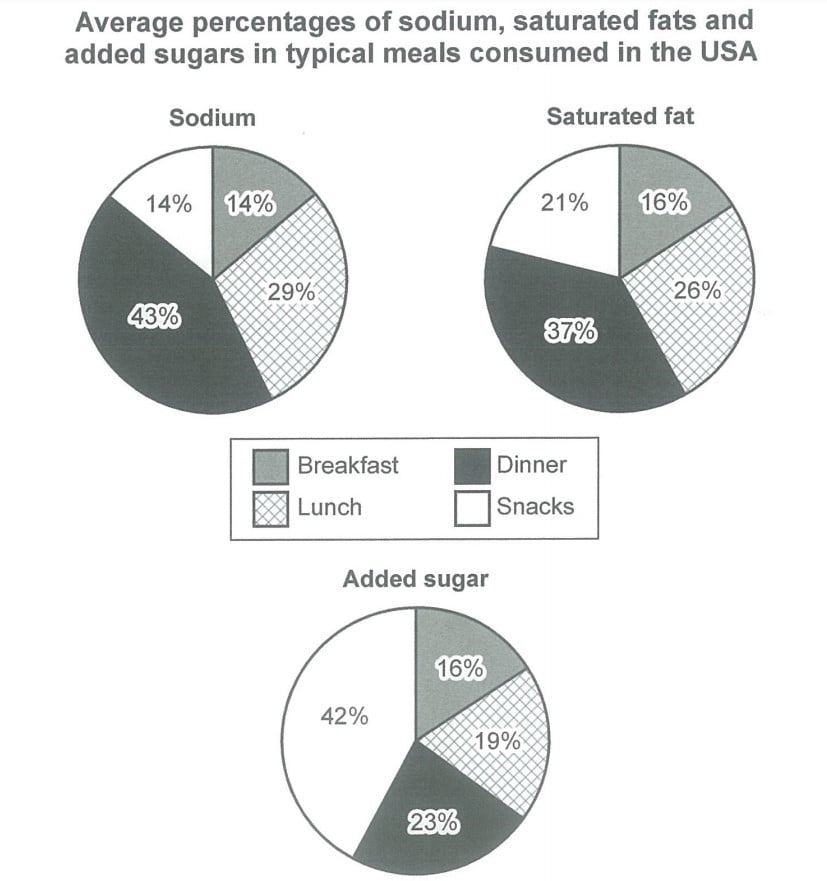
This is an IELTS Writing Task 1 Sample Answer from IELTS Cambridge 14 showing pie charts of what makes up breakfast, lunch, dinner and snacks in the average meal in the USA.
IELTS Writing Task 1 Sample Answer: Percentages of Sodium, Saturated Fats, Sugars in Meals (IELTS Cambridge 14)
The charts below show the average percentages in typical meals of three types of nutrients, all of which may be unhealthy if eaten too much.
Summarise the information by selecting and reporting the main features, and make comparisons where relevant.
IELTS Cambridge 14 Pie Charts
The graph shows how much sodium, saturated fat and added sugars were consumed in the average meal in the United States. Looking from an overall perspective, it is readily apparent that the majority of sodium and fat were consumed at dinner, while most sugar was eaten in snacks. Lunch also tended to be salty and have a lot of fat while breakfast had the lowest percentages for all three nutrients.
Dinner and lunch had roughly similar, large proportions for both sodium (43% for dinner and 29% for lunch) and saturated fat (37% for dinner and 26% for lunch). The amount of sugar in an average meal for dinner and lunch was much lower at 23% and 19%, respectively.
Turning to breakfast and snacks, which also had comparable percentages, they were both made up of 14% sodium. For saturated fats, snacks contained 21% and breakfast was slightly lower at 16%. In terms of sugar, there was the greatest disparity with 42% of snacks being sugary and just 16% of breakfasts being made up of sugar.
IELTS Examiner Sample Answer Analysis
1. The graph shows how much sodium, saturated fat and added sugars were consumed in the average meal in the United States. 2. Looking from an overall perspective, it is readily apparent that the majority of sodium and fat were consumed at dinner, while most sugar was eaten in snacks. 3. Lunch also tended to be salty and have a lot of fat while breakfast had the lowest percentages for all three nutrients.
1. The first sentence of the essay should just paraphrase the topic – don’t waste too much time on this sentence.
2-3. Next is the most most important sentence of your essay – your general overview. For this type of graph just make a comparision of ALL the different areas. Read more about overviews here.
1. Dinner and lunch had roughly similar, large proportions for both sodium (43% for dinner and 29% for lunch) and saturated fat (37% for dinner and 26% for lunch). 2. The amount of sugar in an average meal for dinner and lunch was much lower at 23% and 19%, respectively.
1. The first sentence contains the meals I will talk about. I chose to focus on lunch and dinner first and then in the next paragraph breakfast and snacks because they have more similar numbers. It would have been harder to write about the ingredients instead of the meals. But it is possible! Just make sure you have some kind of a logical structure for your paragraphs!
2. The second sentence finishes givin the data. Always include the data or you will get band 5 for task achievement!
1. Turning to breakfast and snacks, which also had comparable percentages, they were both made up of 14% sodium. 2. For saturated fats, snacks contained 21% and breakfast was slightly lower at 16%. 3. In terms of sugar, there was the greatest disparity with 42% of snacks being sugary and just 16% of breakfasts being made up of sugar.
1. The first sentence focuses on the other meals, gives my reason for focusing on them and describes the data.
2. My next sentence continues to describe and compare the data for lunch and snacks.
3. My final sentence finishes the data. You don’t need a conclusion! You can include one if you feel that your overview needs a bit more detail though…
Sample Answer Vocabulary
Try to figure out what the words in bold mean from the sentences. Write down your guesses and then check your answers below.
The graph shows how much sodium, saturated fat and added sugars were consumed in the average meal in the United States. Looking from an overall perspective, it is readily apparent that the majority of sodium and fat were consumed at dinner, while most sugar was eaten in snacks. Lunch also tended to be salty and have a lot of fat while breakfast had the lowest percentages for all three nutrients.
Dinner and lunch had roughlysimilar, large proportions for both sodium (43% for dinner and 29% for lunch) and saturated fat (37% for dinner and 26% for lunch). The amount of sugar in an average meal for dinner and lunch was much lower at 23% and 19%, respectively.
Turning to breakfast and snacks, which also had comparable percentages, they were both made up of 14% sodium. For saturated fats, snacks contained 21% and breakfast was slightly lower at 16%. In terms of sugar, there was the greatest disparity with 42% of snacks being sugary and just 16% of breakfasts being made up of sugar.
The graph shows how much sodium, saturated fat and added sugars were ___________ in the ___________ in the United States. Looking from an overall perspective, it is___________ that the ___________ of sodium and fat were consumed at dinner, while most sugar was eaten in snacks. Lunch also ___________ salty and have a lot of fat while breakfast had the lowest percentages for all three ___________.
Dinner and lunch had ___________, large proportions for both sodium (43% for dinner and 29% for lunch) and saturated fat (37% for dinner and 26% for lunch). The amount of sugar in an average meal for dinner and lunch was much lower at 23% and 19%, ___________.
___________ breakfast and snacks, which also had ___________percentages, they were both ___________ 14% sodium. For saturated fats, snacks contained 21% and breakfast was___________ at 16%. In terms of sugar, there was the ___________ with 42% of snacks being ___________and just 16% of breakfasts being made up of sugar.
This is an IELTS Writing Task 2 Sample Answer from IELTS Cambridge 14 and it is an interesting question.
It seems to me that it is really only possible to take one side with this one – that people should try to improve their situation.
But maybe you disagree!
Regardless, you have to write about both sides. Do one paragraph on one view and the other on the opposite view. Make sure that by the end (and in the introduction) you have chosen a side. Be crystal clear!
One tricky part of this question that you should notice is that the question itself includes two examples of unsatisfactory situations. You don’t have to focus on those examples in your answer though – I didn’t!
IELTS Writing Task 2 Sample Answer: Acceptance / Unsatisfactory (IELTS Cambridge 14) by Dave
Some people believe that it is best to accept a bad situation, such as an unsatisfactory job or shortage of money. Others argue that it is better to try and improve such situations.
Discuss both these views and give your own opinion.
Many people find themselves in situations where they must either accept what life has given them or find a way to move up in the world. In my opinion, although accepting your situation in life may be pragmatic in some cases, it is still better to at least strive to improve your situation as it can usually be bettered to some degree.
On the one hand, the vast majority of people are unable to drastically change their situation and acceptance of this fact will make them feel more satisfied with their lives. The best example of this would be those people living in dire economic conditions. Recent research puts the Democratic Republic of Congo as one of the poorest nations on Earth, both due to a lack of developed infrastructure and internal strife in recent years. For a person living in a small village, ravaged by war or famine, it would be cruel to suggest that they should find a way to improve their lives when it might simply be impossible. Instead, such people may feel they are better off accepting that they cannot make any changes to their situation at the present moment and just focus on their own survival and that of their family. These situations are rare but do exist around the world in various countries, particularly if they are at war or experiencing a severe economic downturn.
On the other hand, few would dispute the fact that in even the most difficult situations people can make their lives better through continued effort. Instances of people who worked hard and became successful abound in both developed and developing nations. Some relevant examples of this are the postwar situations of countries like Germany, Japan, and South Korea. All those countries were devastated by war to greater and lesser degrees yet they are all currently economic powerhouses. In Japan, World War 2 left their population depleted of workers, a deep national debt due to reparations and infrastructure reduced to rubble. By not accepting their situation they were able to become leaders in technology through notable companies like Sony, Nokia and Toyota. The efficacy of the individuals who had to work hard to improve their lives is reflected in the overall progress of the country and should serve as an example to all war-torn nations.
To conclude, there are very few situations where it would be advisable to simply accept an unhappy situation because hard work over a long period will pay off to some degree in the vast majority of cases. By having a more positive attitude it is also more likely that your efforts to make a better life will be rewarded, while a more defeatist attitude is likely to reduce your chances to make changes in life.
IELTS Examiner Sample Answer Analysis
1. Many people find themselves in situations where they must either accept what life has given them or find a way to move up in the world. 2. In my opinion, although accepting your situation in life may be pragmatic in some cases, it is still better to at least strive to improve your situation as it can usually be bettered to some degree.
1. The first sentence states the topic – write this sentence very quickly because it’s not that important.
2. Next is my opinion, be sure that this is clear and include it in both your introduction and conclusion.
1. On the one hand, the vast majority of people are unable to drastically change their situation and acceptance of this fact will make them feel more satisfied with their lives. 2. The best example of this would be those people living in dire economic conditions. 3. Recent research puts the Democratic Republic of Congo as one of the poorest nations on Earth, both due to a lack of developed infrastructure and internal strife in recent years. 4. For a person living in a small village, ravaged by war or famine, it would be cruel to suggest that they should find a way to improve their lives when it might simply be impossible. 5. Instead, such people may feel they are better off accepting that they cannot make any changes to their situation at the present moment and just focus on their own survival and that of their family. 6. These situations are rare but do exist around the world in various countries, particularly if they are at war or experiencing a severe economic downturn.
1. My first sentence is the topic sentence and clearly states what the paragraph will be about – some people will feel more satisfied by accepting their situation.
2. The second sentence start my example by focusing on countries where the economy is bad.
3. My third sentence focus more specifically on the Congo as my main example.
4. The fourth sentence further develops this example of the Congo.
5. The fifth sentence pulls out some general conclusions related to this example.
6. My sixth sentence makes the example more general by relating it to similar countries.
1. On the other hand, few would dispute the fact that in even the most difficult situations people can make their lives better through continued effort. 2. Instances of people who worked hard and became successful abound in both developed and developing nations. 3. Some relevant examples of this are the postwar situations of countries like Germany, Japan, and South Korea. 4. All those countries were devastated by war to greater and lesser degrees yet they are all currently economic powerhouses. 5. In Japan, World War 2 left their population depleted of workers, a deep national debt due to reparations and infrastructure reduced to rubble. 6. By not accepting their situation they were able to become leaders in technology through notable companies like Sony, Nokia and Toyota. 7. The efficacy of the individuals who had to work hard to improve their lives is reflected in the overall progress of the country and should serve as an example to all war-torn nations.
1. My first sentence is the topic sentence that again says the main topic for the whole paragraph – people can change their lives through effort. It’s a simple main idea but make sure that you develop your simple, obvious main ideas with clear, extended examples!
2. My second sentence begins to introduce the example of countries impacted by wars.
3. The third sentence makes those examples more specific by focusing on some real countries.
4. My fourth sentence describes why those countries are good examples of countries making changes.
5. The fifth sentence focuses specifically on Japan.
6. The sixth sentence talks about the people and companies of Japan because this is more relevant to the question.
7. The sixth sentence continues to focus on how individuals making an effort can change their lives and how this will be reflected in the overall progress/condition of a nation.
1. To conclude, there are very few situations where it would be advisable to simply accept an unhappy situation because hard work over a long period will pay off to some degree in the vast majority of cases. 2. By having a more positive attitude it is also more likely that your efforts to make a better life will be rewarded, while a more defeatist attitude is likely to reduce your chances to make changes in life.
1. The first sentence states my opinion for the second time and my main reason why.
2. My second sentence adds an extra detail that many examiners will require for band 7 and above.
Sample Answer Vocabulary
What do the words in bold mean? If you’re not sure, don’t use a dictionary – try to figure out the meaning from the whole sentence then check your answers below!
Many people find themselves in situations where they must either accept what life has given them or find a way to move up in the world. In my opinion, although accepting your situation in life may be pragmatic in some cases, it is still better to at least strive to improve your situation as it can usually be bettered to some degree.
On the one hand, the vast majority of people are unable to drastically change their situation and acceptance of this fact will make them feel more satisfied with their lives. The best example of this would be those people living in dire economic conditions. Recent research puts the Democratic Republic of Congo as one of the poorest nations on Earth, both due to a lack of developed infrastructure and internal strife in recent years. For a person living in a small village, ravaged by war or famine, it would be cruel to suggest that they should find a way to improve their lives when it might simply be impossible. Instead, such people may feel they are better off accepting that they cannot make any changes to their situation at the present moment and just focus on their own survival and that of their family. These situations are rare but do exist around the world in various countries, particularly if they are at war or experiencing a severe economic downturn.
On the other hand, few would dispute the fact that in even the most difficult situations people can make their lives better through continued effort. Instances of people who worked hard and became successful abound in both developed and developing nations. Some relevant examples of this are the postwar situations of countries like Germany, Japan, and South Korea. All those countries were devastated by war to greater and lesser degrees yet they are all currently economic powerhouses. In Japan, World War 2 left their population depleted of workers, a deep national debt due to reparations and infrastructure reduced to rubble. By not accepting their situation they were able to become leaders in technology through notable companies like Sony, Nokia and Toyota. The efficacy of the individuals who had to work hard to improve their lives is reflected in the overall progress of the country and should serve as an example to all war-torn nations.
To conclude, there are very few situations where it would be advisable to simply accept an unhappy situation because hard work over a long period will pay off to some degree in the vast majority of cases. By having a more positive attitude it is also more likely that your efforts to make a better life will be rewarded, while a more defeatist attitude is likely to reduce your chances to make changes in life.
Answers:
find themselves in situations: are in situations (that weren’t their fault)
move up in the world: improve your standing in life
pragmatic: dealing with the world realistically and sensibly
strive: try hard
bettered to some degree: get a little bit better
drastically change: change a lot
acceptance of this fact: believe something is true
dire economic conditions: severe economic problems
developed infrastructure: good roads, buildings, etc.
internal strife: deep problems in a country
ravaged by war or famine: destroyed by war and hunger
at the present moment: right now
severe economic downturn: the economy getting much worse
dispute: disagree with
continued effort: keep trying
instances abound: lots of examples
relevant examples: examples that are related to this issue
devastated: destroyed or greatly weakened
to greater and lesser degrees: to some extent
depleted of: empty of
deep national debt: a country owing a lot of money
reparations: paying money back for wrong-doing
reduced to rubble: made into ruins
notable companies: prominent companies
efficacy: the ability to make something happen/accomplish something
reflected: mirrored
war-torn nations: countries with wars hurting them
advisable: recommended
to some degree: to some extent
rewarded: get a reward/something back
defeatist attitude: thinking that everything will turn out badly/you will always lose
Vocabulary Practice
Remember and fill in the blanks:
Many people _________________ where they must either accept what life has given them or find a way to _____________. In my opinion, although accepting your situation in life may be _____________ in some cases, it is still better to at least ____________ to improve your situation as it can usually be ____________.
On the one hand, the vast majority of people are unable to ____________ their situation and ____________ will make them feel more satisfied with their lives. The best example of this would be those people living in ____________. Recent research puts the Democratic Republic of Congo as one of the poorest nations on Earth, both due to a lack of ____________ and ____________ in recent years. For a person living in a small village, ____________, it would be cruel to suggest that they should find a way to improve their lives when it might simply be impossible. Instead, such people may feel they are better off accepting that they cannot make any changes to their situation ____________ and just focus on their own survival and that of their family. These situations are rare but do exist around the world in various countries, particularly if they are at war or experiencing a ____________.
On the other hand, few would ____________ the fact that in even the most difficult situations people can make their lives better through ____________. ____________ of people who worked hard and became successful ____________ in both developed and developing nations. Some ____________ of this are the postwar situations of countries like Germany, Japan, and South Korea. All those countries were ____________ by war ____________ yet they are all currently economic powerhouses. In Japan, World War 2 left their population ____________ workers, a ____________ due to ____________ and infrastructure ____________. By not accepting their situation they were able to become leaders in technology through ____________ like Sony, Nokia and Toyota. The ____________ of the individuals who had to work hard to improve their lives i____________ in the overall progress of the country and should serve as an example to all____________.
To conclude, there are very few situations where it would be ____________ to simply accept an unhappy situation because hard work over a long period will pay off ____________ in the vast majority of cases. By having a more positive attitude it is also more likely that your efforts to make a better life will be ____________, while a more ____________ is likely to reduce your chances to make changes in life.
"The highest quality materials anywhere on the internet! Dave improved my writing and vocabulary so much. Really affordable options you don't want to miss out on!"