This is an IELTS Writing Task 2 Sample Answer from Cambridge 14 (a book of real past tests) about the topic of music and how that can bring together people of different generations.
Some questions are really boring and a tough slog to write about but not this one! I think this topic is actually interesting and lends itself to some fun examples.
Keep reading to see exactly how I (a former IELTS examiner) handled it as well as vocabulary activities, pronunciation and more!
IELTS Writing Task 2 Sample Answer: Music Bringing People Together (IELTS Cambridge 14)
Some people say that music is a good way of bringing people of different cultures and ages together.
To what extent do you agree or disagree with this opinion?
Music has always been a key distinguisher of culture but many believe that it can also bridge cultural gaps and differences in age. Though I think some people overstate the impact of music leveling the differences between generations, I strongly believe that it brings people of different cultures together by expressing universal sentiments.
The main reason that I believe music is not a particularly good unifier in terms of generational disparity is that people tend to enjoy the music from their formative years and disdain whatever is currently relevant. Though there are of course exceptions, most people would recognise the mostly accurate stereotype of an old person complaining about the music that youths listen to nowadays. For example, in America some of the most popular artists today include Kanye West, Taylor Swift, and Rihanna. These artists differ greatly from past musicians. Kanye is a brash rapper with controversial opinions whose music constantly shifts and redefines genre. Taylor Swift and Rihanna write sugary pop songs that become ubiquitous in cafes and on the radio. Older people prefer what they used to listen to, whether that be intricate melodies and insightful writing of The Beatles or the raw sincerity of old school rap. The differences between the generations are reflected and augmented rather than mediated due to the different personalities and styles of modern music.
Although music does little to alleviate generational barriers, it does help cultures relate through universal, human perspectives. What I mean by this is that even though people may not understand another culture they can still understand the messages of the music. One great example of this is the music of Bob Marley. Bob Marley is from a small Carribbean country called Jamaica, a country whose culture has become influential around the world. This is because he expressed universal feelings of love, empathy, and positivity against the backdrop of a nation experiencing political and economic upheaval. His resilience against this pulses through his infectious music and has translated across cultural divides. An Asian person, who might not have any firsthand experience with different races or cultures, can still identify with Bob Marley and enjoy his music. This connection based entirely on music brings together people of disparate cultures through an emotional and intellectual bonding on common issues.
In conclusion, although music may actually do more to divide the young and old it definitely uses its universality to bring together different cultures. It is especially important at a time when the world appears to be more divided than ever that we find common ground to build cross-cultural relationships upon.
IELTS Examiner Sample Answer Analysis
1. Music has always been a key distinguisher of culture but many believe that it can also bridge cultural gaps and differences in age. 2. Though I think some people overstate the impact of music leveling the differences between generations, I strongly believe that it brings people of different cultures together by expressing universal sentiments.
1. The first sentence says the topic for the essay. Keep it simple for this one – it’s not a very important sentence.
2. Then write your opinion – make it 100% clearn – don’t sit in the middle unless if you want to risk band 5 for task achievement! (Note: I kind of sat in the middle but I did it very carefully – read on to see how…)
1. The main reason that I believe music is not a particularly good unifier in terms of generational disparity is that people tend to enjoy the music from their formative years and disdain whatever is currently relevant. 2. Though there are of course exceptions, most people would recognise the mostly accurate stereotype of an old person complaining about the music that youths listen to nowadays. 3. For example, in America some of the most popular artists today include Kanye West, Taylor Swift, and Rihanna. 4. These artists differ greatly from past musicians. 5. Kanye is a brash rapper with controversial opinions whose music constantly shifts and redefines genre. 6. Taylor Swift and Rihanna write sugary pop songs that become ubiquitous in cafes and on the radio. 7. Older people prefer what they used to listen to, whether that be intricate melodies and insightful writing of The Beatles or the raw sincerity of old school rap. 8. The differences between the generations are reflected and augmented rather than mediated due to the different personalities and styles of modern music.
1. My first sentence is a topic sentence for the paragraph with my relevant main idea: music doesn’t really bring people together.
2. The second sentence explains my main idea and references a common example.
3. My third sentence begins a more specific example of artists today.
4. The fourth sentence continues to the example by contrasting them to past artists.
5. The fifth sentence focuses on Kanye to show the differences between generations.
6. My sixth sentence focuses on Rihanna and Taylor Swift. In hindsight this essay might be getting too long…
7. The seventh sentence contrasts it with the specific examples of older musicians.
8. Finally I conclude by relating it to my main idea. This paragraph is a bit too long – try to stick to about 5 sentences.
1. Although music does little to alleviate generational barriers, it does help cultures relate through universal, human perspectives. 2. What I mean by this is that even though people may not understand another culture they can still understand the messages of the music. 3. One great example of this is the music of Bob Marley. Bob Marley is from a small Carribbean country called Jamaica, a country whose culture has become influential around the world. 4. This is because he expressed universal feelings of love, empathy, and positivity against the backdrop of a nation experiencing political and economic upheaval. 5. His resilience against this pulses through his infectious music and has translated across cultural divides. 6. An Asian person, who might not have any firsthand experience with different races or cultures, can still identify with Bob Marley and enjoy his music. 7. This connection based entirely on music brings together people of disparate cultures through an emotional and intellectual bonding on common issues.
1. My first sentence is another topic sentence that states a main idea for the other viewpoint: people can relate to different cultures through music.
2. The second sentence clarifies my main idea. You don’t always need to do this – sometimes you can just start on your example (and not end up with a seven sentence paragraph).
3. The third sentence begins another specific, detailed example (about Bob Marley this time).
4. My fourth sentence describes how he has managed to bridge cultural divides.
5. The fifth sentence further develops the example.
6. The sixth sentence describes specifically how he could connect with someone from another culture.
7. My sixth sentence concludes the paragraph by summarising the impact across cultures of his music.
1. In conclusion, although music may actually do more to divide the young and old it definitely uses its universality to bring together different cultures. 2. It is especially important at a time when the world appears to be more divided than ever that we find common ground to build cross-cultural relationships upon.
1. The first sentence restates my opinion. Even though I agree with half and disagree with the other half this is not sitting in the middle. I have clear opinions about how music impacts generations and cultures. Sitting in the middle would just be saying that it is good for some reasons and not good for other ones without a clear chosen side – that would be band 5!
2. My second sentence adds an extra detail that a lot of examiners require for band 7 and above.
Sample Answer Vocabulary
What do the words in bold mean? If you’re not sure, don’t use a dictionary – try to figure out the meaning from the whole sentence then check your answers below!
Music has always been a key distinguisher of culture but many believe that it can also bridge cultural gaps and differences in age. Though I think some people overstate the impact of music leveling the differences between generations, I strongly believe that it brings people of different cultures together by expressing universal sentiments.
The main reason that I believe music is not a particularly good unifier in terms of generational disparity is that people tend to enjoy the music from their formative years and disdain whatever is currently relevant. Though there are of course exceptions, most people would recognise the mostly accurate stereotype of an old person complaining about the music that youths listen to nowadays. For example, in America some of the most popular artists today include Kanye West, Taylor Swift, and Rihanna. These artists differ greatly from past musicians. Kanye is a brash rapper with controversial opinions whose music constantly shifts and redefines genre. Taylor Swift and Rihanna write sugary pop songs that become ubiquitous in cafes and on the radio. Older people prefer what they used to listen to, whether that be intricate melodies and insightful writing of The Beatles or the raw sincerity of old school rap. The differences between the generations are reflected and augmented rather than mediated due to the different personalities and styles of modern music.
Although music does little to alleviate generational barriers, it does help cultures relate through universal, human perspectives. What I mean by this is that even though people may not understand another culture they can still understand the messages of the music. One great example of this is the music of Bob Marley. Bob Marley is from a small Carribbean country called Jamaica, a country whose culture has become influential around the world. This is because he expressed universal feelings of love, empathy, and positivity against the backdrop of a nation experiencing political and economic upheaval. His resilience against this pulses through his infectious music and has translated across cultural divides. An Asian person, who might not have any firsthand experience with different races or cultures, can still identify with Bob Marley and enjoy his music. This connection based entirely on music brings together people of disparate cultures through an emotional and intellectual bonding on common issues.
In conclusion, although music may actually do more to divide the young and old it definitely uses its universality to bring together different cultures. It is especially important at a time when the world appears to be more divided than ever that we find common ground to build cross-cultural relationships upon.
Answers:
key distinguisher: main way to separate/define
bridge cultural gaps: bring together different countries/cultures
overstate: make something sound more important than it really is
leveling the differences: getting rid of what is different – making more similar
universal sentiments: ideas that people all over the world feel/believe in
unifier: brings together
generational disparity: differences between generations/ages
formative years: impressionable ages
disdain: look down on
currently relevant: important now
stereotype: a common belief often incorrect about a group of people
differ greatly: not at all the same
brash: overconfident
controversial opinions: views that many people would disagree with
constantly shifts: always changes
redefines genre: innovates the type of music/film
sugary pop songs: pop music that sounds good to the ear
ubiquitous: common
intricate melodies: complicated musical rhythm
insightful writing: meaningful lyrics
raw sincerity: very honest
old school rap: hip-hop from the 90s
augmented: made better/stronger
mediated: filtered through
alleviate generational barriers: improve differences between age groups
universal, human perspectives: beliefs common to all humanity
empathy: the ability to understand other people’s feelings
against the backdrop: in the context of
political and economic upheaval: lots of changes related to the government and economy
resilience: able to bounce back, strong
pulses: moves through
infectious music: music that you can’t get out of your head
translated across cultural divides: can be understood by different cultures
firsthand experience: what you see yourself (not reported by someone else)
disparate cultures: different cultures
emotional and intellectual bonding: connecting in terms of feeling and thinking
universality: applies to the whole world
common ground: related/relevant to everyone
Vocabulary Practice
Remember and fill in the blanks:
Music has always been a __________________ of culture but many believe that it can also __________________ and differences in age. Though I think some people __________________ the impact of music __________________ between generations, I strongly believe that it brings people of different cultures together by expressing __________________.
The main reason that I believe music is not a particularly good __________________ in terms of __________________ is that people tend to enjoy the music from their __________________ and __________________ whatever is __________________. Though there are of course exceptions, most people would recognise the mostly accurate __________________ of an old person complaining about the music that youths listen to nowadays. For example, in America some of the most popular artists today include Kanye West, Taylor Swift, and Rihanna. These artists __________________ from past musicians. Kanye is a __________________ rapper with __________________ whose music __________________ and __________________. Taylor Swift and Rihanna write __________________ that become __________________ in cafes and on the radio. Older people prefer what they used to listen to, whether that be __________________ and __________________ of The Beatles or the __________________ of __________________. The differences between the generations are reflected and __________________ rather than __________________ due to the different personalities and styles of modern music.
Although music does little to __________________, it does help cultures relate through __________________. What I mean by this is that even though people may not understand another culture they can still understand the messages of the music. One great example of this is the music of Bob Marley. Bob Marley is from a small Carribbean country called Jamaica, a country whose culture has become influential around the world. This is because he expressed universal feelings of love, __________________, and positivity __________________ of a nation experiencing __________________. His __________________ against this __________________ through his __________________ and has __________________. An Asian person, who might not have any __________________ with different races or cultures, can still identify with Bob Marley and enjoy his music. This connection based entirely on music brings together people of __________________ through an __________________ on common issues.
In conclusion, although music may actually do more to divide the young and old it definitely uses its __________________ to bring together different cultures. It is especially important at a time when the world appears to be more divided than ever that we find __________________ to build cross-cultural relationships upon.
My name is Dave and I’m a former IELTS examiner and below you can read a complete guide to prepare for IELTS and get a high score – above band 7!
I took some of the questions that I get on my Facebook, my Instagram and on YouTube everyday and put them together along with the best links to get you started and help you along your IELTS journey.
Follow those links and you will have the right mindset for the job ahead. If you are not ready for IELTS, you will end up wasting a lot of time and money.
‘I have problems with listening – can you help me?’
There are two main issues that you might have: test strategy and improving your listening.
If you need to improve your actual listening skills, read about that here: the 3 keys to improving your listening skills.
One thing that is really important is that all the listening practice in the world won’t help if you don’t improve your grammar and especially vocabulary.
You need to work on your listening skills but you really need to improve your vocabulary. Once you do that, listening will become much easier!
‘My reading is weak – how can I improve my reading?’
Reading is the best way to improve your vocabulary and if you are serious about IELTS then you should be reading for at least a few hours everyday.
Task 1 writing is particularly difficult becuase there are so many different question types: charts with time, with no time, maps, processes – enough to make your head spin!
Make sure you practice with each one at least once and refer to my sample answers above!
‘I don’t have anyone to practice speaking with. What can I do to speak English more naturally?’
There are a number of ways to do this. You can find a friend or teacher to practice with. You can sign up for my online courses.
I often recommend that students combine self-study with a tutor. Study at home and then hire a foreigner to do speaking practice with a few times a week.
I want to prepare for the IELTS speaking topics. What is the best way to do that?
A lot of websites will present ‘forecasts’ of the questions on IELTS. That is absolute nonsense – it makes no sense that the test would allow that, no one would trust IELTS!
But they do use the same speaking questions for about a year before changing booklets and new questions. That means there are 30 possible part 1 speaking topics and a ton of possible part 2 and 3.
It’s a good idea to use those as a source of preparation while you are improving for IELTS.
But don’t think that you can just memorise answers and deliver them on the test – it won’t work and you will just annoy the examiner!
‘My speaking is good but my pronunciation is terrible and it never improves. What can I do about my pronunciation?’
This is one of the most common problems that I hear about. In Vietnam, where I live and work, the most common score for pronunciation is band 5. If you get 6s for fluency, vocabulary, and grammar then you will get an overall 5.5 if your pron is only 5!
I know many students who study for years and years and improve their other skills but their pronunciation seems to be glued in place.
I have developed a method that has been very effective over the last 10 years for thousands of students. You can read all about my method here.
‘It’s so hard for me to think of ideas on IELTS. How can I think of ideas?’
This has to become a consistent habit just like any other skill that you study for IELTS.
This is an IELTS Writing Task 1 Sample Answer from IELTS Cambridge 14 about the map of a public park. It’s a nice break from graphs to write about a map!
It does present some challenges, though. The overview is really tough – so is the structure of the paragraphs and some of the vocabulary!
IELTS Writing Task 1 Sample Answer: Public Park Map (IELTS Cambridge 14)
The plans below show a public park when it first opened in 1920 and the samepark today.
Summarise the information by selecting and reporting the main features, and make comparisons where relevant.
IELTS Cambridge 14 Map
The maps detail the changes since 1920 to today of Grand Park. Looking from an overall perspective, it is readily apparent that the park added and expanded areas mainly related to entertainment including a larger stage and various areas for recreation. There was also significant relocation in terms of seating and the only areas that remained the same were the entrances and one minor garden.
The most striking change is in the center of the park where the fountain has been removed in favour of a rose garden with full seating around it. To the left of the new garden, the previous stage for musicians has been turned into a much larger ampitheatre facing the opposite direction that will allow for concerts in the park. This change has necessitated the removal of both seating on the far left side as well as the rose garden in the bottom left corner of the map.
The entrances at the top and bottom in the middle have remained unchanged but on the right side a cafe has replaced the rose garden and where there was a pond for water plants in the top right corner, there is now a children’s play area. Instead of the pond, a water feature has been built occupying the bottom right corner (replacing a glasshouse and some seats). Finally, leading to the water park is a new entrance for an underground car park.
IELTS Examiner Sample Answer Analysis
1. The maps detail the changes since 1920 to today of Grand Park. 2. Looking from an overall perspective, it is readily apparent that the park added and expanded areas mainly related to entertainment including a larger stage and various areas for recreation. 3. There was also significant relocation in terms of seating and the only areas that remained the same were the entrances and one minor garden.
1. The first sentence paraphrases what map is showing – write this sentence very quickly because it hardly effects your score at all!
2-3. Then is my overview for the map. For a map, don’t list all the changes and don’t include any opinion. Instead, try to group and describe/define the changes. It is very similar to the overview for a process.
1. The most striking change is in the center of the park where the fountain has been removed in favour of a rose garden with full seating around it. 2. To the left of the new garden, the previous stage for musicians has been turned into a much larger ampitheatre facing the opposite direction that will allow for concerts in the park. 3. This change has necessitated the removal of both seating on the far left side as well as the rose garden in the bottom left corner of the map.
1. The first sentence focuses on the fountain in the centre. Try to choose a logical area to start and then expand from there so that your writing has a natural structure and it helps your cohesion/coherence store.
2. My second sentence describes the major changes next to the fountain.
3. The third sentence concludes the paragraph by describing some other related areas of the map.
1. The entrances at the top and bottom in the middle have remained unchanged but on the right side a cafe has replaced the rose garden and where there was a pond for water plants in the top right corner, there is now a children’s play area. 2. Instead of the pond, a water feature has been built occupying the bottom right corner (replacing a glasshouse and some seats). 3. Finally, leading to the water park is a new entrance for an underground car park.
1. My first sentence looks at the areas that didn’t change and the areas next to those that did change. Always compare the two maps!
2. The second sentence describes the water feature in the corner and what it replaced.
3. My final sentence talks about the only other areas I didn’t mention. Be sure to talk about everying on the map.
Sample Answer Vocabulary
What do the words in bold mean? If you’re not sure, don’t use a dictionary – try to figure out the meaning from the whole sentence then check your answers below!
The maps detail the changes since 1920 to today of Grand Park. Looking from an overall perspective, it is readily apparent that the park added and expanded areas mainly related to entertainment including a larger stage and various areas for recreation. There was also significant relocationin terms of seating and the only areas that remained the same were the entrances and one minor garden.
The most striking change is in the center of the park where the fountain has been removed in favour of a rose garden with full seating around it. To the left of the new garden, the previous stage for musicians has been turned into a much larger ampitheatre facing the opposite direction that will allow for concerts in the park. This change has necessitated the removal of both seating on the far left side as well as the rose garden in the bottom left corner of the map.
The entrances at the top and bottom in the middle have remained unchanged but on the right side a cafe has replaced the rose garden and where there was a pond for water plants in the top right corner, there is now a children’s play area. Instead of the pond, a water feature has been built occupying the bottom right corner (replacing a glasshouse and some seats). Finally, leading to the water park is a new entrance for an underground car park.
Answers:
detail: describes/illustrates
expanded: make larger
mainly related to: mostly about
significant relocationin terms of: big move to
minor: small
The most striking change: biggest difference
in favour of: in order to have
previous: prior
turned into: becomes
facing the opposite direction: looking the other way
allow for: makes it possible for
necessitated: makes it possible
as well as: and
replaced: takes the place of
occupying: in the place of
leading to: going towards
Pronunciation:
ˈdiːteɪl
ɪksˈpændɪd
ˈmeɪnlirɪˈleɪtɪdtuː
sɪgˈnɪfɪkəntˌriːləʊˈkeɪʃənɪntɜːmzɒv
ˈmaɪnə
ðəməʊstˈstraɪkɪŋʧeɪnʤ
ɪnˈfeɪvər ɒv
ˈpriːviəs
tɜːndˈɪntuː
ˈfeɪsɪŋðiˈɒpəzɪtdɪˈrɛkʃən
əˈlaʊfɔː
nɪˈsɛsɪteɪtɪd
æzwɛlæz
rɪˈpleɪst
ˈɒkjʊpaɪɪŋ
ˈliːdɪŋtuː
Vocabulary Practice
Remember and fill in the blanks:
The maps _____________ the changes since 1920 to today of Grand Park. Looking from an overall perspective, it is readily apparent that the park added and _____________ areas _____________ entertainment including a larger stage and various areas for recreation. There was also _____________ seating and the only areas that remained the same were the entrances and one _____________ garden.
_____________ is in the center of the park where the fountain has been removed _____________ a rose garden with full seating around it. To the left of the new garden, the _____________ stage for musicians has been_____________ a much larger ampitheatre_____________ that will_____________ concerts in the park. This change has _____________ the removal of both seating on the far left side _____________ the rose garden in the bottom left corner of the map.
The entrances at the top and bottom in the middle have remained unchanged but on the right side a cafe has _____________ the rose garden and where there was a pond for water plants in the top right corner, there is now a children’s play area. Instead of the pond, a water feature has been built _____________ the bottom right corner (replacing a glasshouse and some seats). Finally,_____________ the water park is a new entrance for an underground car park.
Learn about the World’s Most Famous Park: NYC’s Central Park
Comment below – Is there a park near where you live?
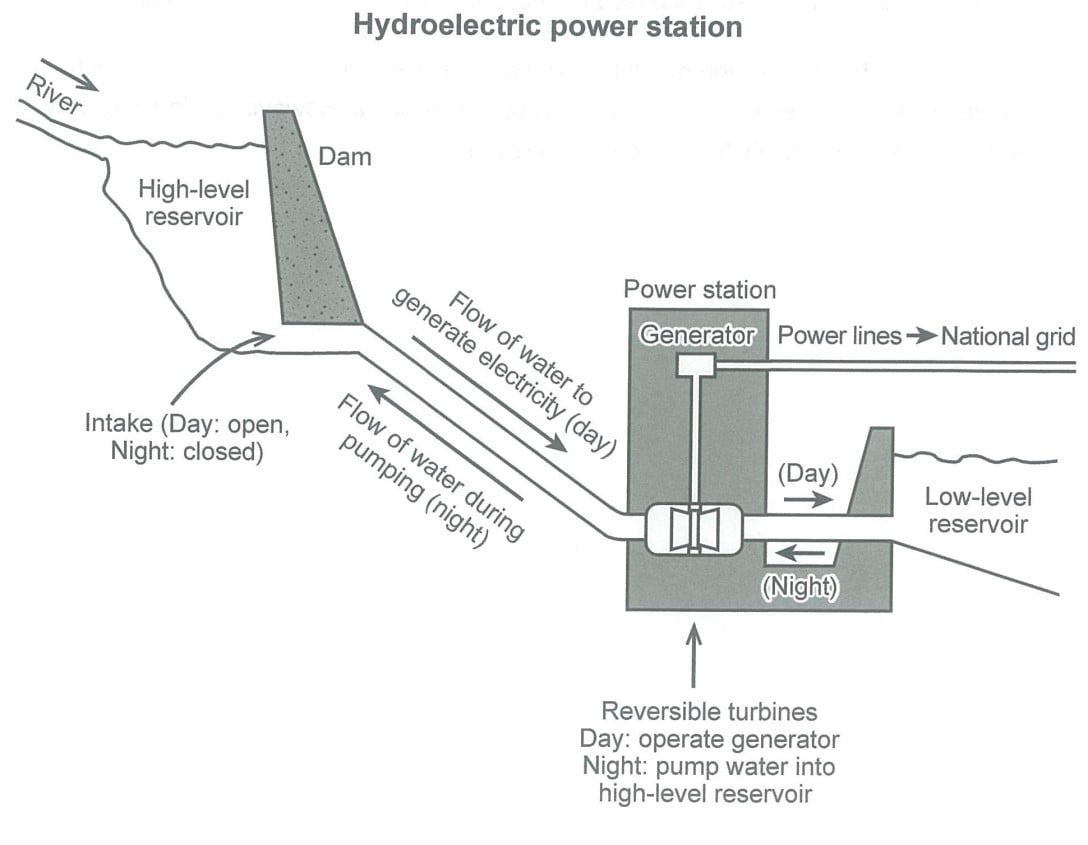
This is an IELTS Writing Task 2 Sample Answer from the IELTS Cambridge 14 book of past sample tests and it is a process describing a hydroelectric power station.
Interesting stuff…
Processes are a bit tricky both in terms of the general overview and the structure of the writing.
I find it really hard to write enough words about a process. They are really simple to describe and you can often end up short of the word count.
Your writing might also sound mechanical if you just follow it step by step without giving an overall picture of the process.
For most processes, you will also need to use more of the passive voice than you are used to.
There are a lot of complex moving parts in a process – just like in a hydroelectric power station!
IELTS Writing Task 1 Sample Answer: Map Hydroelectric Power Station (IELTS Cambridge 14)
IELTS Cambridge 14 Process
The diagram below shows how electricity is generated in a hydroelectric power station. Summarise the information by selecting and reporting the main features, and make comparisons where relevant.
The process shows how electricity is generated in a hydroelectric power station. In general, the diagram can be broadly separated into day and night stages with the daylight stages involving the generation of electricity from a river and storage of water in a reservoir. At night the water flows back in the other direction towards an initial reservoir and the river.
The first stage of the process involves channelling the river into a high-level reservoir backed up by a dam. There is an intake area leading to the power station that is open during the day and closes at night. Water flows during the day to generate electricity through the power station turbines and the resulting electricity is sent to a national grid through power lines while the water then continues to a low-level reservoir.
The reversible turbines that operate the generator during the day allow the station to pump the water in the low-level reservoir back into the high-level reservoir for use the next day.
IELTS Examiner Sample Answer Analysis
1. The process shows how electricity is generated in a hydroelectric power station. 2. In general, the diagram can be broadly separated into day and night stages with the daylight stages involving the generation of electricity from a river and storage of water in a reservoir. 3. At night the water flows back in the other direction towards an initial reservoir and the river.
1. The first sentence states the topic – write this sentence very quickly because it’s not that important.
2-3. The next two sentences are my overview. This is the key sentence for your whole writing. For a process, don’t just list all the steps- try to groups and describe them somehow. Careful not to include any opinion!
1. The first stage of the process involves channelling the river into a high-level reservoir backed up by a dam. 2. There is an intake area leading to the power station that is open during the day and closes at night. 3. Water flows during the day to generate electricity through the power station turbines and the resulting electricity is sent to a national grid through power lines while the water then continues to a low-level reservoir.
1. My first sentence focuses on the first stage of the process. This is the natural place to start.
2. The second sentence continues with the water flow through the process.
3. My third sentence describes the effect of the water going through the power station.
1. The reversible turbines that operate the generator during the day allow the station to pump the water in the low-level reservoir back into the high-level reservoir for use the next day.
1. My final sentence concludes by summarising where the water goes at night. Usually a paragraph should have at least two sentences but this one was simple enough to write so it works!
Sample Answer Vocabulary
What do the words in bold mean? If you’re not sure, don’t use a dictionary – try to figure out the meaning from the whole sentence then check your answers below!
The process shows how electricity is generated in a hydroelectric power station. In general, the diagram can be broadly separated into day and night stages with the daylight stages involving the generation of electricity from a river and storage of water in a reservoir. At night the water flows back in the other direction towards an initial reservoir and the river.
The first stage of the process involves channelling the river into a high-level reservoir backed up by a dam. There is an intake area leading to the power station that is open during the day and closes at night. Water flows during the day to generate electricity through the power station turbines and the resulting electricity is sent to a national grid through power lines while the water then continues to a low-level reservoir.
The reversible turbines that operate the generator during the day allow the station to pump the water in the low-level reservoir back into the high-level reservoir for use the next day.
Answers:
hydroelectric power station: a place that produces electricity by using water
The process shows how electricity is generated in a ____________________. In general, the diagram can be
____________________ into day and night stages with the daylight stages
____________________ the generation of electricity from a river and storage of water in a resevoir. At night the water
____________________ in the other direction towards an initial resevoir and the river.
The first stage of the process involves ____________________ the river into a high-level resevoir ____________________ a dam. There is an intake area ____________________ the power station that is ____________________ and closes at night. Water ____________________ during the day to generate electricity ____________________ the power station turbines and the ____________________ electricity is sent to a national grid through power lines while the ____________________ to a low-level resevoir.
The reversible turbines that ____________________ the generator during the day allow the station to ____________________ the water in the low-level resevoir ____________________ into the high-level resevoir ____________________ the next day.
Comment your own writing below for some feedback from me!
This is an IELTS Writing Task 1 Sample Answer from IELTS Cambridge 14 about exports and it is a bar graph (and a table!).
Most students struggle with questions that include two different kinds of graphs. In some ways this can be tricky, especially if the graphs are not really related to each other.
Luckily for these two the graphs are closely related and fairly simple.
It is still a challenge to write a clear over – keep reading to see how I did it!
IELTS Writing Task 1 Sample Answer: Exports in Various Categories (IELTS Cambridge 14)
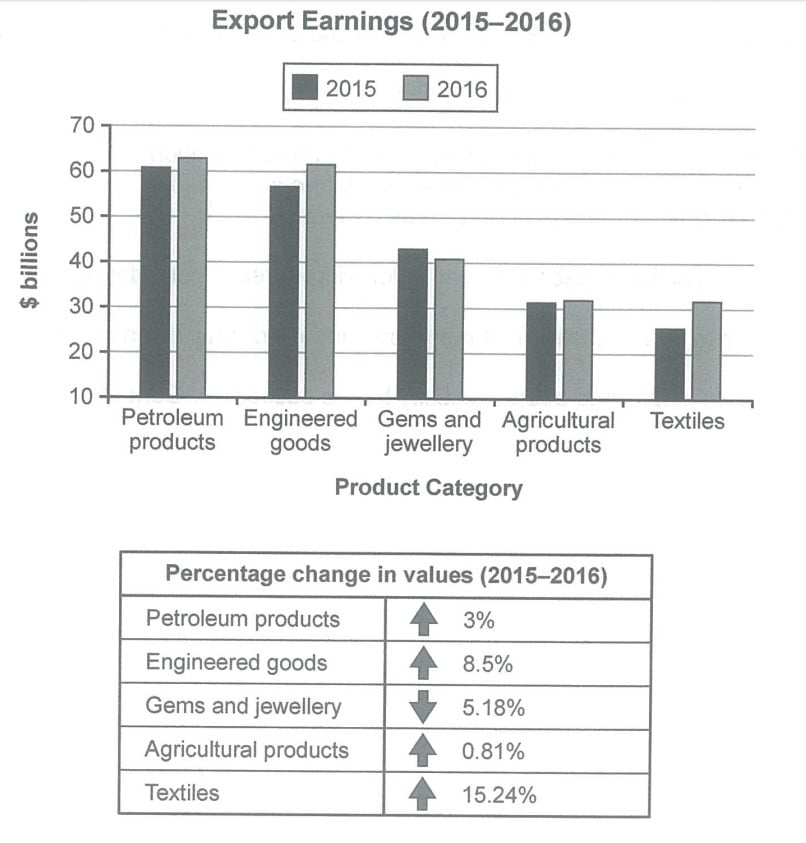
The chart below shows the value of one country’s exports in various categories during 2015 and 2016. The table shows the percentage change in each category of exports in 2016 compared with 2015.
Summarise the information by selecting and reporting the main features, and make comparisons where relevant.
IELTS Cambrdige 14 Bar Chart and Table
The given graph and table illustrate the changes in export earnings for a country across several industries from 2015 to 2016 measured in billions of dollars. Looking from an overall perspective, it is readily apparent that all earnings experienced rises except for gems and jewellery, which experienced a moderate drop. The majority of earnings came from petroleum and engineered goods, while textiles and engineered goods made the largest percentile jumps.
The two main exports were petroleum products, which went from just over $61 billion in 2015 to around $63 billion by 2016, and engineered goods ($58 billion to $62 billion). That translates to a 3% rise for petroleum and a more sizeable increase of 8.5% for engineered products.
Compared to these two exports, the other products were much lower. Gems and jewellery, the only export to decrease, went down 5.18% from $43 billion to $41 billion. Despite this drop, agricultural goods were lower throughout the period at around $31 and just over $31 billion in 2015 and 2016, respectively. Textiles were the lowest in 2015 at around $26 billion but had pulled approximately level with agriculture by 2016.
IELTS Examiner Sample Answer Analysis
1. The given graph and table illustrate the changes in export earnings for a country across several industries from 2015 to 2016 measured in billions of dollars. 2. Looking from an overall perspective, it is readily apparent that all earnings experienced rises except for gems and jewellery, which experienced a moderate drop. 3. The majority of earnings came from petroleum and engineered goods, while textiles and engineered goods made the largest percentile jumps.
1. The first sentence is just a simple paraphrase of the topic – don’t waste time on this sentence because it has very little impact on your score!
1. The two main exports were petroleum products, which went from just over $61 billion in 2015 to around $63 billion by 2016, and engineered goods ($58 billion to $62 billion). 2. That translates to a 3% rise for petroleum and a more sizeable increase of 8.5% for engineered products.
1. My first sentence focuses on the two most common areas and includes the data. Make sure that you include the data for every sentence!
2. The second sentence relates that same data to the percentage increases in the table. For these types of two chart questions, there isn’t always a strong relationship between the charts. But for this one there is so I wrote about them in the same paragraph!
1. Compared to these two exports, the other products were much lower. 2. Gems and jewellery, the only export to decrease, went down 5.18% from $43 billion to $41 billion. 3. Despite this drop, agricultural goods were lower throughout the period at around $31 and just over $31 billion in 2015 and 2016, respectively. 4. Textiles were the lowest in 2015 at around $26 billion but had pulled approximately level with agriculture by 2016.
1. My first sentence focuses on the other exports. I grouped them this way just to give my paragraphs some structure and help my cohesion and coherence score.
2. My second sentence focuses on the data for the only export to decrease over the period.
3. The third sentence includes all the data for agricultural goods and compares it to gems and jewellery – always compare!
4. The fourth sentence finishes describing the last area with all the data.
Sample Answer Vocabulary
What do the words in bold mean? If you’re not sure, don’t use a dictionary – try to figure out the meaning from the whole sentence then check your answers below!
The given graph and table illustrate the changes in export earnings for a country across several industries from 2015 to 2016 measured in billions of dollars. Looking from an overall perspective, it is readily apparent that all earnings experienced rises except for gems and jewellery, which experienced a moderate drop. The majority of earnings came from petroleum and engineered goods, while textiles and engineered goods made the largest percentile jumps.
The two main exports were petroleum products, which went from just over $61 billion in 2015 to around $63 billion by 2016, and engineered goods ($58 billion to $62 billion). That translates to a 3% rise for petroleum and a more sizeable increase of 8.5% for engineered products.
Compared to these two exports, the other products were much lower. Gems and jewellery, the only export to decrease, went down 5.18% from $43 billion to $41 billion. Despite this drop, agricultural goods were lower throughout the period at around $31 and just over $31 billion in 2015 and 2016, respectively. Textiles were the lowest in 2015 at around $26 billion but had pulled approximately level with agriculture by 2016.
Answers:
across: through all the areas
overall perspective: in general
readily apparent: clear
moderate drop: small decrease
made the largest percentile jumps: the largest increases (by percentage)
just over: a little bit above
translates: means
more sizeable increase: larger jumps
were much lower: a lot less
despite this drop: even though it decreased
respectively: in turn/for each
pulled approximately level with: was almost equal
Pronunciation
Try to remember and correctly pronounce the vocabulary from above:
ˈəʊvərɔːlpəˈspɛktɪv
ˈrɛdɪliəˈpærənt
ˈmɒdərɪtdrɒp
meɪdðəˈlɑːʤɪstpercentileʤʌmps
ʤʌstˈəʊvə
trænsˈleɪts
mɔːˈsaɪzəblˈɪnkriːs
wɜːmʌʧˈləʊə
dɪsˈpaɪtðɪsdrɒp
rɪsˈpɛktɪvli
pʊldəˈprɒksɪmɪtliˈlɛvlwɪð
Vocabulary Practice
Remember and fill in the blanks:
The given graph and table illustrate the changes in export earnings for a country ______________ several industries from 2015 to 2016 measured in billions of dollars. Looking from an ______________, it is ______________ that all earnings experienced rises except for gems and jewellery, which experienced a ______________. The majority of earnings came from petroleum and engineered goods, while textiles and engineered goods ______________.
The two main exports were petroleum products, which went from______________ $61 billion in 2015 to around $63 billion by 2016, and engineered goods ($58 billion to $62 billion). That ______________ to a 3% rise for petroleum and a ______________ of 8.5% for engineered products.
Compared to these two exports, the other products ______________. Gems and jewellery, the only export to decrease, went down 5.18% from $43 billion to $41 billion. ______________, agricultural goods were lower throughout the period at around $31 and just over $31 billion in 2015 and 2016, ______________. Textiles were the lowest in 2015 at around $26 billion but had ______________ agriculture by 2016.
"The highest quality materials anywhere on the internet! Dave improved my writing and vocabulary so much. Really affordable options you don't want to miss out on!"