
by Dave | Aug 2, 2019 | Real Past Tests
This is an IELTS Writing Task 2 Sample Answer from the real IELTS exam concerned with the topic of family and moving out of the home.
Questions about family are fairly common on IELTS and could come up in listening, reading, writing, or (most likely) speaking.
Read my sample answer below and practice some of the vocabulary related to family!
Dave
IELTS Writing Task 2 Sample Answer (Family and the Home)
Many parents encourage young people to leave home when they become older, while others think they should stay at home with the family. Discuss both views and give your own opinion.
It has become increasingly prevalent for young adults to leave home before getting married. In my opinion, this is a positive trend taken as a whole because it fosters independence but it can have rare debilitating financial drawbacks.
The main drawback to moving out early is losing a parental safety net that safeguards financial stability. In large cities such as New York, real estate prices are so high that without a high-paying job you will struggle to contend with rent, food, transportation costs, and allowances for leisure activities. It is even possible that these hardships could prove overwhelming and pride may prevent your from going back to your parents. These individuals might end up taking a job with a low salary or that is not their passion.
The aforementioned drawbacks are the exceptions; the majority of people who move out are successful because they become self-reliant. A standout example of this is the typical American university student. Most students leave their parental home at 18 and never look back. These students take their first baby steps towards looking after themselves by doing their own laundry, managing their finances to an extent, and taking on campus employment. Once they graduate from university they will likely take over their entire financial outlay. This means they must find a good job and spend more responsibly. These qualities, of frugality and responsibility, will serve them well in their lives and increase their odds of future success.
In conclusion, the majority benefit from the added responsibility that leaving home brings. To encourage more people to move out parents should provide a degree of financial support when necessary but focus moreso on fostering their children’s independence.
IELTS Examiner Sample Answer Analysis (Family and the Home)
1. It has become increasingly prevalent for young adults to leave home before getting married. 2. In my opinion, this is a positive trend taken as a whole because it fosters independence but it can have rare debilitating financial drawbacks.
1. My first sentence simple restates the main topic for the whole essay. If you misunderstand the question and write about the wrong topic you will end up with a band 3, 4, or 5 maximum for task achievement! Spend some time carefully reading the question but then write this sentence fast because you are simply paraphrasing.
2. The next sentence is my opinion. Make your opinion 100% clear or you could get a task achievement band 5! (And repeat it again in the conclusion later.)
1. The main drawback to moving out early is losing a parental safety net that safeguards financial stability. 2. In large cities such as New York, real estate prices are so high that without a high-paying job you will struggle to contend with rent, food, transportation costs, and allowances for leisure activities. 3. It is even possible that these hardships could prove overwhelming and pride may prevent your from going back to your parents. 4. These individuals might end up taking a job with a low salary or that is not their passion.
1. The first sentence is the topic sentence for the paragraph that contains my main idea (financial stability). My whole paragraph will focus on this one idea!
2. My second sentence explains some of the costs that can come up in life.
3. The third sentence describes the possible results of financial hardships.
4. My final sentence describes the results. Don’t make statements that are too strong – for example, don’t say ‘People will then turn to crime’ because this is both factually incorrect and much too strong of a statement for a short essay!
1. The aforementioned drawbacks are the exceptions; the majority of people who move out are successful because they become self-reliant. 2. A standout example of this is the typical American university student. 3. Most students leave their parental home at 18 and never look back. 4. These students take their first baby steps towards looking after themselves by doing their own laundry, managing their finances to an extent, and taking on campus employment. 5. Once they graduate from university they will likely take over their entire financial outlay. 6. This means they must find a good job and spend more responsibly. 7. These qualities, of frugality and responsibility, will serve them well in their lives and increase their odds of future success.
1. The first sentence is another topic sentence with my new main idea: moving out makes young adults more self-reliant.
2. My second sentence starts my example.
3. The third sentence continues to develop this example.
4. My fourth sentence also further develops the example by describing the tasks they must do independently.
5. The fifth sentence also continues this example by introducing finances.
6. My sixth sentence focuses on what they must do to meet their financial obligations.
7. The final sentence concludes how these qualities will help them in a more general sense.
1. In conclusion, the majority benefit from the added responsibility that leaving home brings. 2. To encourage more people to move out parents should provide a degree of financial support when necessary but focus moreso on fostering their children’s independence.
1. My first sentence repeats my overall opinion. Be crystal clear – don’t sit in the middle!
2. The final sentence adds an extra detail to the paragraph that many examiners will require for at least band 7 for task achievement.
Sample Answer Vocabulary
What do the words in bold mean? If you’re not sure, don’t use a dictionary – try to figure out the meaning from the whole sentence then check your answers below!
It has become increasingly prevalent for young adults to leave home before getting married. In my opinion, this is a positive trend taken as a whole because it fosters independence but it can have rare debilitating financial drawbacks.
The main drawback to moving out early is losing a parental safety net that safeguards financial stability. In large cities such as New York, real estate prices are so high that without a high-paying job you will struggle to contend with rent, food, transportation costs, and allowances for leisure activities. It is even possible that these hardships could prove overwhelming and pride may prevent your from going back to your parents. These individuals might end up taking a job with a low salary or that is not their passion.
The aforementioned drawbacks are the exceptions; the majority of people who move out are successful because they become self-reliant. A standout example of this is the typical American university student. Most students leave their parental home at 18 and never look back. These students take their first baby steps towards looking after themselves by doing their own laundry, managing their finances to an extent, and taking on campus employment. Once they graduate from university they will likely take over their entire financial outlay. This means they must find a good job and spend more responsibly. These qualities, of frugality and responsibility, will serve them well in their lives and increase their odds of future success.
In conclusion, the majority benefit from the added responsibility that leaving home brings. To encourage more people to move out parents should provide a degree of financial support when necessary but focus moreso on fostering their children’s independence.
Answers:
increasingly prevalent: more and more common
young adults: young people
taken as a whole: considered overall
fosters independence: encourages them to be self-reliant
rare debilitating financial drawbacks: uncommon very bad consequences for their money
safety net: something to protect you in bad times
safeguards: protects from
financial stability: regular income
high-paying job: making a lot of money in your work
struggle: have difficulty with
contend: deal with
allowances: exceptions/money set aside
hardships: difficult times
prove overwhelming: be too much to get past
pride: feelings of self-worth
end up: finally be
passion: love for something
aforementioned drawback: previously stated negative
self-reliant: don’t need help from others
A standout example of this is the typical: A good example of this is the average
parental home: their parent’s home
never look back: do no return
first baby steps: early, basic stages
to an extent: not fully/somewhat
taking on: assuming responsibility for
take over: be in charge of
financial outlay: the amount of money you have to spend
spend more responsibly: spend your money more wisely
frugality: not spending a lot of money
serve them well: work well for them
increase their odds of: make it more likely that
provide a degree of financial support: help out with money somewhat
focus moreso: instead concentrate on
fostering their children’s independence: encouraging their children to be more responsible
Pronunciation
ɪnˈkriːsɪŋli ˈprɛvələnt
jʌŋ ˈædʌlts
ˈteɪkən æz ə həʊl
ˈfɒstəz ˌɪndɪˈpɛndəns
reə dɪˈbɪlɪteɪtɪŋ faɪˈnænʃəl ˈdrɔːbæks
ˈseɪfti nɛt
ˈseɪfgɑːdz
faɪˈnænʃəl stəˈbɪlɪti:
haɪ–ˈpeɪɪŋ ʤɒb
ˈstrʌgl
kənˈtɛnd
əˈlaʊənsɪz
ˈhɑːdʃɪps
pruːv ˌəʊvəˈwɛlmɪŋ
praɪd
ɛnd ʌp
ˈpæʃən
əˌfɔːˈmɛnʃənd ˈdrɔːbæk
sɛlf–rɪˈlaɪənt
ə ˈstændaʊt ɪgˈzɑːmpl ɒv ðɪs ɪz ðə ˈtɪpɪk(ə)l
pəˈrɛntl həʊm
ˈnɛvə lʊk bæk
fɜːst ˈbeɪbi stɛps
tuː ən ɪksˈtɛnt
ˈteɪkɪŋ ɒn
teɪk ˈəʊvə
spɛnd mɔː rɪsˈpɒnsəbli
fru(ː)ˈgælɪti
sɜːv ðɛm wɛl
prəˈvaɪd ə dɪˈgriː ɒv faɪˈnænʃəl səˈpɔːt
ˈfəʊkəs mɔːsəʊ
ˈfɒstərɪŋ ðeə ˈʧɪldrənz ˌɪndɪˈpɛndəns
Vocabulary Practice
Remember and fill in the blanks:
It has become _________________ for _________________ to leave home before getting married. In my opinion, this is a positive trend _________________ because it _________________ but it can have _________________.
The main drawback to moving out early is losing a parental _________________ that _________________. In large cities such as New York, real estate prices are so high that without a _________________ you will _________________ to _________________ with rent, food, transportation costs, and _________________ for leisure activities. It is even possible that these _________________ could _________________ and _________________ may prevent your from going back to your parents. These individuals might _________________ taking a job with a low salary or that is not their _________________.
The _________________ are the exceptions; the majority of people who move out are successful because they become _________________. _________________ American university student. Most students leave their _________________ at 18 and _________________. These students take their _________________ towards looking after themselves by doing their own laundry, managing their finances _________________, and _________________ campus employment. Once they graduate from university they will likely _________________ their entire _________________. This means they must find a good job and _________________. These qualities, of _________________ and responsibility, will _________________ in their lives and _________________ future success.
In conclusion, the majority benefit from the added responsibility that leaving home brings. To encourage more people to move out parents should _________________ when necessary but _________________ on _________________.
Family Links from YouTube and Articles
Comment below – write your own essay and I will give you some feedback!
If you want more helpful resources check out my private Facebook group, my YouTube channel and my Instagram – keep up to date with your English and your IELTS!

by Dave | Jul 23, 2019 | Real Past Tests
This is an IELTS Writing Task 2 Sample Answer from the real IELTS exam about the topic of crime, which comes up frequently on the test.
These questions are really common in the writing test and can come up on IELTS speaking as well.
Read my sample answer below and practice some of the vocabulary related to crime!
Dave
IELTS Writing Task 2 Sample Answer (Crime and the Police)
Some countries are struggling with increases in crime rates. Some believe that having more police on the streets is best way to reduce and combat crime. To what extent do you agree or disagree?
Many countries today are grappling with the best ways to curb rising crime rates and some have suggested that increased police presence on the streets is the optimal solution. Although I think this would have a positive effect for obvious reasons, the best solution is more nuanced and requires a deeper understanding of the sources underlying crime.
There is little doubt that employing greater numbers of police officers will have an adverse affect on criminality. One of the best examples of this would be in New York City under Mayor Rudy Giuliani during the late 1980s and early 90s. At that time, New York was a haven for criminals and many areas of the city were deemed too dangerous by residents to safely live in or walk through at night. One of the many measures that Giuliani used to reduce crime was significantly increasing the number of police officers during his time in office. This led to a reciprocal decline in crime and made the tourist-heavy neighbourhoods almost entirely safe and the rougher districts at least passably crime-free.
The above-mentioned measures were only effective because administrators also tackled the root causes of crime. It is generally agreed upon that the principle causes of crime are related to education indirectly and poverty more directly. If you look at countries with extremely low poverty and unemployment rates, such as Japan, you will see correspondingly low rates of crime. In Japan, this begins with one of the world’s most renowned educational systems. Students graduate from high school and university with immediately employable skills and most are employed throughout their lifetimes. Since they have money to afford a good standard of living there is little incentive for criminal behaviour and the crime rate is among the lowest in the world.
In conclusion, the best way to reduce crime in the long-term is to invest more in education and the economy to stimulate job growth and address the catalysts spurring on crime. Any government that is serious about making their country a safer place must first take steps to improve their educational system as that will have the largest impact on creating the stable jobs that discourage criminality in all its forms.
IELTS Examiner Sample Answer Analysis (Crime and the Police)
1. Many countries today are grappling with the best ways to curb rising crime rates and some have suggested that increased police presence on the streets is the optimal solution. 2. Although I think this would have a positive effect for obvious reasons, the best solution is more nuanced and requires a deeper understanding of the sources underlying crime.
1. My first sentence quickly restates the topic for the essay – spend a lot of time understanding the question correctly but don’t waste time writing this sentence – it isn’t that important!
2. Next is my opinion. State your opinion 100% clearly or you could get a task achievement band 5!
1. There is little doubt that employing greater numbers of police officers will have an adverse affect on criminality. 2. One of the best examples of this would be in New York City under Mayor Rudy Giuliani during the late 1980s and early 90s. 3. At that time, New York was a haven for criminals and many areas of the city were deemed too dangerous by residents to safely live in or walk through at night. 4. One of the many measures that Giuliani used to reduce crime was significantly increasing the number of police officers during his time in office. 5. This led to a reciprocal decline in crime and made the tourist-heavy neighbourhoods almost entirely safe and the rougher districts at least passably crime-free.
1. The first sentence is my topic sentence with the topic (police on the street) and my main idea (negative effect on crime).
2. My second sentence already begins my example. Don’t waste time – run right to your example as fast as you can!
3. The third sentence further develops the same example – don’t run away from the example – stick with it!
4. My fourth sentence continues to develop the same example.
5. Even my fifth sentence develops this same example! You can also include a conclusion sentence for the paragraph if you have time.
1. The above-mentioned measures were only effective because administrators also tackled the root causes of crime. 2. It is generally agreed upon that the principle causes of crime are related to education indirectly and poverty more directly. 3. If you look at countries with extremely low poverty and unemployment rates, such as Japan, you will see correspondingly low rates of crime. 4. In Japan, this begins with one of the world’s most renowned educational systems. 5. Students graduate from high school and university with immediately employable skills and most are employed throughout their lifetimes. 6. Since they have money to afford a good standard of living there is little incentive for criminal behaviour and the crime rate is among the lowest in the world.
1. The first sentence is again the topic sentence for the paragraph with my main idea – tackling the root causes of crime.
2. My second sentence explains my main idea before I get to my example.
3. The third sentence begins my example by mentioning Japan and why its crime is so low.
4. My fourth sentence continues to develop the answer about Japan.
5. The fifth sentence still continues describing the example of Japan.
6. My sixth sentence concludes the example and paragraph.
1. In conclusion, the best way to reduce crime in the long-term is to invest more in education and the economy to stimulate job growth and address the catalysts spurring on crime. 2. Any government that is serious about making their country a safer place must first take steps to improve their educational system as that will have the largest impact on creating the stable jobs that discourage criminality in all its forms.
1. My first sentence says my opinions for the second time. Be clear! Don’t sit in the middle with your opinion, you must choose a side!
2. The second sentence adds an extra detail to the paragraph that many examiners will require for at least band 7 for task achievement.
Sample Answer Vocabulary
What do the words in bold mean? If you’re not sure, don’t use a dictionary – try to figure out the meaning from the whole sentence then check your answers below!
Many countries today are grappling with the best ways to curb rising crime rates and some have suggested that increased police presence on the streets is the optimal solution. Although I think this would have a positive effect for obvious reasons, the best solution is more nuanced and requires a deeper understanding of the sources underlying crime.
There is little doubt that employing greater numbers of police officers will have an adverse effect on criminality. One of the best examples of this would be in New York City under Mayor Rudy Giuliani during the late 1980s and early 90s. At that time, New York was a haven for criminals and many areas of the city were deemed too dangerous by residents to safely live in or walk through at night. One of the many measures that Giuliani used to reduce crime was significantly increasing the number of police officers during his time in office. This led to a reciprocal decline in crime and made the tourist-heavy neighbourhoods almost entirely safe and the rougher districts at least passably crime-free.
The above-mentioned measures were only effective because administrators also tackled the root causes of crime. It is generally agreed upon that the principle causes of crime are related to education indirectly and poverty more directly. If you look at countries with extremely low poverty and unemployment rates, such as Japan, you will see correspondingly low rates of crime. In Japan, this begins with one of the world’s most renowned educational systems. Students graduate from high school and university with immediately employable skills and most are employed throughout their lifetimes. Since they have money to afford a good standard of living there is little incentive for criminal behaviour and the crime rate is among the lowest in the world.
In conclusion, the best way to reduce crime in the long-term is to invest more in education and the economy to stimulate job growth and address the catalysts spurring on crime. Any government that is serious about making their country a safer place must first take steps to improve their educational system as that will have the largest impact on creating the stable jobs that discourage criminality in all its forms.
Answers:
grappling with: strugglling with/fighting
curb: slow down
crime rates: the level of crime
increased police presence: more police on the streets
optimal solution: best way of dealing with
obvious reasons: clear, definite justifications
nuanced: complex
requires a deeper understanding: needs more study/analysis
underlying: root causes/foundation
There is little doubt that: no question that
adverse effect: negative impact
criminality: crime
under: while someone serves in office (under Obama, Trump, Napoleon, etc.)
haven: safe place for
deemed: considered/thought to be
measures: methods
reciprocal decline: related decrease
tourist-heavy neighbourhoods: areas where tourists frequent
rougher districts at least passably crime-free: dangerous areas at least mostly free of crime
above-mentioned: said before
administrators: people working in offices/government
tackled: combatted
root causes: sources
principle causes: main reasons
indirectly: not directly
poverty: being poor
directly: from a clearly identified source
unemployment rates: the number of people without jobs
correspondingly: related
most renowned educational systems: good schools
employable skills: skills that help you to get a job
lifetimes: as long as you live
good standard of living: good quality of life
little incentive: no reason for
long-term: over a long period of time
stimulate job growth: increase the number of jobs for people
catalysts spurring on: causes leading to
take steps: take action towards
stable jobs: good jobs that don’t go away easily
discourage criminality in all its forms: decrease all crimes
Pronunciation
ˈgræplɪŋ wɪð
kɜːb
kraɪm reɪts
ɪnˈkriːst pəˈliːs ˈprɛzns
ˈɒptɪməl səˈluːʃən
ˈɒbvɪəs ˈriːznz
nju(ː)ˈɑːnst
rɪˈkwaɪəz ə ˈdiːpər ˌʌndəˈstændɪŋ
ˌʌndəˈlaɪɪŋ
ðeər ɪz ˈlɪtl daʊt ðæt
ˈædvɜːs ɪˈfɛkt
ˌkrɪmɪˈnælɪti
ˈʌndə
ˈheɪvn
diːmd
ˈmɛʒəz
rɪˈsɪprəkəl dɪˈklaɪn
ˈtʊərɪst–ˈhɛvi ˈneɪbəhʊdz
ˈrʌfə ˈdɪstrɪkts æt liːst ˈpɑːsəbli kraɪm–friː
əˈbʌvˈmɛnʃ(ə)nd
ədˈmɪnɪstreɪtəz
ˈtækld
ruːt ˈkɔːzɪz
ˈprɪnsəpl ˈkɔːzɪz
ˌɪndɪˈrɛktli
ˈpɒvəti
dɪˈrɛktli
ˌʌnɪmˈplɔɪmənt reɪts
ˌkɒrɪsˈpɒndɪŋli
məʊst rɪˈnaʊnd ˌɛdju(ː)ˈkeɪʃənl ˈsɪstɪmz
ɪmˈplɔɪəbl skɪlz
ˈlaɪftaɪmz
gʊd ˈstændəd ɒv ˈlɪvɪŋ
ˈlɪtl ɪnˈsɛntɪv
ˈlɒŋtɜːm
ˈstɪmjʊleɪt ʤɒb grəʊθ
ˈkætəlɪsts ˈspɜːrɪŋ ɒn
teɪk stɛps
ˈsteɪbl ʤɒbz
dɪsˈkʌrɪʤ ˌkrɪmɪˈnælɪti ɪn ɔːl ɪts fɔːmz
Vocabulary Practice
Remember and fill in the blanks:
Many countries today are _____________ the best ways to _____________ rising _____________ and some have suggested that _____________ on the streets is the _____________. Although I think this would have a positive effect for _____________, the best solution is more _____________ and _____________ of the sources _____________ crime.
_____________ employing greater numbers of police officers will have an _____________ on _____________. One of the best examples of this would be in New York City _____________ Mayor Rudy Giuliani during the late 1980s and early 90s. At that time, New York was a _____________ for criminals and many areas of the city were _____________ too dangerous by residents to safely live in or walk through at night. One of the many _____________ that Giuliani used to reduce crime was significantly increasing the number of police officers during his time in office. This led to a _____________ in crime and made the _____________ almost entirely safe and the _____________.
The _____________ measures were only effective because _____________ also _____________ the _____________ of crime. It is generally agreed upon that the _____________ of crime are related to education _____________ and _____________ more _____________. If you look at countries with extremely low poverty and _____________, such as Japan, you will see _____________ low rates of crime. In Japan, this begins with one of the world’s _____________. Students graduate from high school and university with immediately _____________ and most are employed throughout their _____________. Since they have money to afford a _____________ there is _____________ for criminal behaviour and the crime rate is among the lowest in the world.
In conclusion, the best way to reduce crime in the _____________ is to invest more in education and the economy to _____________ and address the _____________ crime. Any government that is serious about making their country a safer place must first _____________ to improve their educational system as that will have the largest impact on creating the _____________ that _____________.
Crime Links from YouTube and Articles
Comment below – Have you ever committed a crime?
Lots of times! I remember once I …
Just the once …
Yeah, a few times…
What?! I’d never…
If you want more helpful resources check out my private Facebook group, my YouTube channel and my Instagram – keep up to date with your English and your IELTS (and up to date with me)!

by Dave | Jul 6, 2019 | Real Past Tests
This is an IELTS Writing Task 2 Sample Answer from the real IELTS exam about the topic of health, governments and individuals.
It is really common to get questions that show the conflict between individuals and the government/society/companies.
Keep reading to see how I deal with it and practice some useful grammar and vocabulary.
If you want to get over your IELTS fears and achieve your dreams (of going abroad or getting a better job), I now offer online lessons complete with feedback, videos, workbooks and more – you can learn more here!
Get your writing marked here and learn about my new Patreon here.
Dave
IELTS Writing Task 2 Sample Answer: Health Problems Individuals/Governments (Real IELTS Exam)
Many people believe that every individual is responsible for his/her own healthy lifestyle. Others believe that governments should take care of it. Discuss both these views and give your own opinion.
There has been much recent policy advocacy related to what the proper role of governments in healthcare should be. Although I believe governments have begun to treat this issue with the seriousness it merits, the responsibility for taking care of one’s health should ultimately rest with individuals as they are more likely to stick with habits that they themselves have cultivated.
Those who favour strong governmental intervention often point out the role of the state in forming healthy eating habits through early intervention at public schools. In the United States, the vast majority of students attend state schools and in recent years the government has been implementing new policies aimed at curbing addiction to unhealthy foods. This means that they have reduced the total intake of saturated fats in school lunches and drastically cut down on sugar not only in prepared lunches but also in the ubiquitous vending machines placed around most schools. In the short term this has led to improved health for students but its true effect will be over the next several decades when these children grow up and are more likely to eschew fast food for the healthier alternatives now opening up to meet the growing demands of an increasingly health-conscious nation.
While there are clear benefits to governmental action, individuals are better at regulating their own behaviour in the long-term. People have always found ways to get around rules in order to satisfy their most basic desires, including those related to food. No matter what steps governments take, people will always crave unhealthy, delicious foods as our brains are hardwired to feel pleasure from saturated fats, carbohydrates, and sugar. For example, even a country like France, which has imposed strict rules over the food that children are served, is still facing an obesity crises. Therefore the only way for people to consistently combat poor health is to develop the discipline on their own. Individuals who make the choice to eat healthier are more likely to stick with this habit having worked out the reasons for themselves, rather than simply following a rule imposed by their schools at the behest of the government.
In conclusion, governments have a large role to play in public health but only individuals can take control of their own lives and make decisions that will truly benefit them in the future. In this case, the best solution is simply no solution. Standing back and allowing people to become more self-reliant will not only have more long-lasting effects but will also empower individuals in various other areas of their life to be more responsible.
IELTS Examiner Sample Answer Analysis
1. There has been much recent policy advocacy related to what the proper role of governments in healthcare should be. 2. Although I believe governments have begun to treat this issue with the seriousness it merits, the responsibility for taking care of one’s health should ultimately rest with individuals as they are more likely to stick with habits that they themselves have cultivated.
1. My first sentence quickly states the topic for the essay – spend a lot of time understanding the question correctly but don’t waste time writing this sentence – it isn’t that important!
2. Next is my opinion. State your opinion 100% clearly or you risk getting band 5 for task achievement!
1. Those who favour strong governmental intervention often point out the role of the state in forming healthy eating habits through early intervention at public schools. 2. In the United States, the vast majority of students attend state schools and in recent years the government has been implementing new policies aimed at curbing addiction to unhealthy foods. 3. This means that they have reduced the total intake of saturated fats in school lunches and drastically cut down on sugar not only in prepared lunches but also in the ubiquitous vending machines placed around most schools. 4. In the short term this has led to improved health for students but its true effect will be over the next several decades when these children grow up and are more likely to eschew fast food for the healthier alternatives now opening up to meet the growing demands of an increasingly health-conscious nation.
1. The first sentence is a topic sentence with my main idea for the whole paragraph (governments had a large impact in schools). Write a short, simple topic sentence to make your writing clear to the examiner!
2. My second sentence starts my example. Don’t waste any time – get right to your example and start to develop it for a really high task achievement score.
3. The third sentence continues to develop my example by talking about the specific effects of healthy foods at school.
4. My fourth sentence concludes the examples by further talking about the impact later in life for students who develop healthy eating habits from a young age due to government intervention.
1. While there are clear benefits to governmental action, individuals are better at regulating their own behaviour in the long-term. 2. People have always found ways to get around rules in order to satisfy their most basic desires, including those related to food. 3. No matter what steps governments take, people will always crave unhealthy, delicious foods as our brains are hardwired to feel pleasure from saturated fats, carbohydrates, and sugar. 4. For example, even a country like France, which has imposed strict rules over the food that children are served, is still facing an obesity crises. 5. Therefore the only way for people to consistently combat poor health is to develop the discipline on their own. 6. Individuals who make the choice to eat healthier are more likely to stick with this habit having worked out the reasons for themselves, rather than simply following a rule imposed by their schools at the behest of the government.
1. My first sentence is the topic sentence for this paragraph – again, keep it short, simple and clear as this will help both your cohesion/coherence and task achievement scores!
2. The second sentence begins to develop my main idea by explaining why unhealthy eating is so common.
3. The third sentence develops my idea by giving a counter-example: even with government intervention people still eat unhealthily.
4. My fourth sentence gives a more specific example to support my argument.
5. The fifth sentence suggests that people need to develop their own habits.
6. The sixth sentence argues that people who develop their own habits are more likely to stick to them because they understand the reasoning behind them well.
1. In conclusion, governments have a large role to play in public health but only individuals can take control of their own lives and make decisions that will truly benefit them in the future. 2. In this case, the best solution is simply no solution. 3. Standing back and allowing people to become more self-reliant will not only have more long-lasting effects but will also empower individuals in various other areas of their life to be more responsible.
1. The first sentence repeats my opinion. Be sure to have a clear opinion (choose a side) and say it in both your introduction and conclusion for full task achievement and cohesion/coherence marks.
2. My second sentence adds further support for my opinion.
3. The third sentence adds an extra detail that many examiners require for band 7+ and above for task achievement. You only need 2 sentences in your conclusion – maximum 3!
Sample Answer Vocabulary
What do the words in bold mean? If you’re not sure, don’t use a dictionary – try to figure out the meaning from the whole sentence then check your answers below!
There has been much recent policy advocacy related to what the proper role of governments in healthcare should be. Although I believe governments have begun to treat this issue with the seriousness it merits, the responsibility for taking care of one’s health should ultimately rest with individuals as they are more likely to stick with habits that they themselves have cultivated.
Those who favour strong governmental intervention often point out the role of the state in forming healthy eating habits through early intervention at public schools. In the United States, the vast majority of students attend state schools and in recent years the government has been implementing new policies aimed at curbing addiction to unhealthy foods. This means that they have reduced the total intake of saturated fats in school lunches and drastically cut down on sugar not only in prepared lunches but also in the ubiquitous vending machines placed around most schools. In the short term this has led to improved health for students but its true effect will be over the next several decades when these children grow up and are more likely to eschew fast food for the healthier alternatives now opening up to meet the growing demands of an increasingly health-conscious nation.
While there are clear benefits to governmental action, individuals are better at regulating their own behaviour in the long-term. People have always found ways to get around rules in order to satisfy their most basic desires, including those related to food. No matter what steps governments take, people will always crave unhealthy, delicious foods as our brains are hardwired to feel pleasure from saturated fats, carbohydrates, and sugar. For example, even a country like France, which has imposed strict rules over the food that children are served, is still facing an obesity crises. Therefore the only way for people to consistently combat poor health is to develop the discipline on their own. Individuals who make the choice to eat healthier are more likely to stick with this habit having worked out the reasons for themselves, rather than simply following a rule imposed by their schools at the behest of the government.
In conclusion, governments have a large role to play in public health but only individuals can take control of their own lives and make decisions that will truly benefit them in the future. In this case, the best solution is simply no solution. Standing back and allowing people to become more self-reliant will not only have more long-lasting effects but will also empower individuals in various other areas of their life to be more responsible.
Answers:
policy advocacy: supporting a policy
proper role: what you should be responsible for
the seriousness it merits: how important it really is
ultimately rest: finally must be responsible for
stick with: continue/maintain/keep up
cultivated: grown/made themselves
strong governmental intervention: the government making strong laws/policies
point out: argue/think
early intervention: taking action at an early stage
public schools: state funded schools
vast majority: most
implementing new policies: introducing new laws/rules
curbing: slowing down
total intake: the amount consumed
drastically cut down: decreased a lot
ubiquitous: common/everywhere
short term: not too far in the future
true effect: actual impact
eschew: avoid
healthier alternatives: more healthy options
meet the growing demands: supply the desires of consumers
increasingly health-conscious nation: a country more and more concerned with health
clear benefits: definite advantages
regulating: controlling
long-term: in the distant future
get around rules: avoid mandates
most basic desires: what people desire as humans
no matter what steps governments take: regardless of what governments try to do
crave: desire
hardwired: biologically fixed
imposed strict rules: enact harsh laws
served: given
facing an obesity crises: lots of fat people
consistently combat poor health: often unhealthy
discipline: punish
worked out: figure out
imposed: force
at the behest of the government: at the government’s request
large role: big part in
take control: be in charge
truly benefit: actual positive impact on
standing back: doing nothing
self-reliant: depending on only yourself
long-lasting effects: impact in the future
empower: give power
Pronunciation
ˈpɒlɪsi ˈædvəkəsi
ˈprɒpə rəʊl
ðə ˈsɪərɪəsnɪs ɪt ˈmɛrɪts
ˈʌltɪmɪtli rɛst
stɪk wɪð
ˈkʌltɪveɪtɪd
strɒŋ ˌgʌvənˈmɛntl ˌɪntə(ː)ˈvɛnʃən
pɔɪnt aʊt
ˈɜːli ˌɪntə(ː)ˈvɛnʃən
ˈpʌblɪk skuːlz
vɑːst məˈʤɒrɪti
ˈɪmplɪmɛntɪŋ njuː ˈpɒlɪsiz
ˈkɜːbɪŋ
ˈtəʊtl ˈɪnteɪk
ˈdræstɪk(ə)li kʌt daʊn
ju(ː)ˈbɪkwɪtəs
ʃɔːt tɜːm
truː ɪˈfɛkt
ɪsˈʧuː
ˈhɛlθɪər ɔːlˈtɜːnətɪvz
miːt ðə ˈgrəʊɪŋ dɪˈmɑːndz
ɪnˈkriːsɪŋli hɛlθ–ˈkɒnʃəs ˈneɪʃən
klɪə ˈbɛnɪfɪts
ˈrɛgjʊleɪtɪŋ
ˈlɒŋtɜːm
gɛt əˈraʊnd ruːlz
məʊst ˈbeɪsɪk dɪˈzaɪəz
nəʊ ˈmætə wɒt stɛps ˈgʌvnmənts teɪk
kreɪv
hɑːdˈwaɪəd
ɪmˈpəʊzd strɪkt ruːlz
sɜːvd
ˈfeɪsɪŋ ən əʊˈbiːsɪti ˈkraɪsiːz
kənˈsɪstəntli ˈkɒmbæt pʊə hɛlθ
ˈdɪsɪplɪn
wɜːkt aʊt
ɪmˈpəʊzd
æt ðə bɪˈhɛst ɒv ðə ˈgʌvnmənt
lɑːʤ rəʊl
teɪk kənˈtrəʊl
ˈtruːli ˈbɛnɪfɪt
ˈstændɪŋ bæk
sɛlf–rɪˈlaɪənt
lɒŋ–ˈlɑːstɪŋ ɪˈfɛkts
ɪmˈpaʊə
Vocabulary Practice
Remember and fill in the blanks:
There has been much recent ___________________ related to what the ___________________ of governments in healthcare should be. Although I believe governments have begun to treat this issue with ___________________, the responsibility for taking care of one’s health should ___________________ with individuals as they are more likely to ___________________ habits that they themselves have ___________________.
Those who favour ___________________ often ___________________ the role of the state in forming healthy eating habits through ___________________ at ___________________. In the United States, the ___________________ of students attend state schools and in recent years the government has been ___________________ aimed at ___________________ addiction to unhealthy foods. This means that they have reduced the ___________________ of saturated fats in school lunches and ___________________ on sugar not only in prepared lunches but also in the ___________________ vending machines placed around most schools. In the ___________________ this has led to improved health for students but its ___________________ will be over the next several decades when these children grow up and are more likely to ___________________ fast food for the ___________________ now opening up to ___________________ of an ___________________.
While there are ___________________ to governmental action, individuals are better at ___________________ their own behaviour in the ___________________. People have always found ways to ___________________ in order to satisfy their ___________________, including those related to food. ___________________, people will always ___________________ unhealthy, delicious foods as our brains are ___________________ to feel pleasure from saturated fats, carbohydrates, and sugar. For example, even a country like France, which has ___________________ over the food that children are ___________________, is still ___________________. Therefore the only way for people to ___________________ is to develop the discipline on their own. Individuals who make the choice to eat healthier are more likely to stick with this habit having ___________________ the reasons for themselves, rather than simply following a rule ___________________ by their schools ___________________.
In conclusion, governments have a ___________________ to play in public health but only individuals can ___________________ of their own lives and make decisions that will ___________________ them in the future. In this case, the best solution is simply no solution. ___________________ and allowing people to become more ___________________ will not only have more ___________________ but will also ___________________ individuals in various other areas of their life to be more responsible.
Links from YouTube and Articles
Comment below – What are your most unhealthy habits?
I can’t resist …
My weak spot is …
I’m an absolute addict when it comes to …
I’ve got a real sweet tooth and I’m especially keen on …

by Dave | Jun 19, 2019 | Sample Answers
This is an IELTS Writing Task 1 Sample Answer from IELTS Cambridge 13 about the map of a city hospital.
This map presents some challenges because there aren’t a ton of changes and the overview is a little bit tricky.
Read on to see how I dealt with those challenges…
Dave
IELTS Writing Task 1: Map of a City Hospital (IELTS Cambridge 13)
The two maps below show road access to a city hospital in 2007 and in 2010.
Summarise the information by selecting and reporting the main features, and make comparisons where relevant.
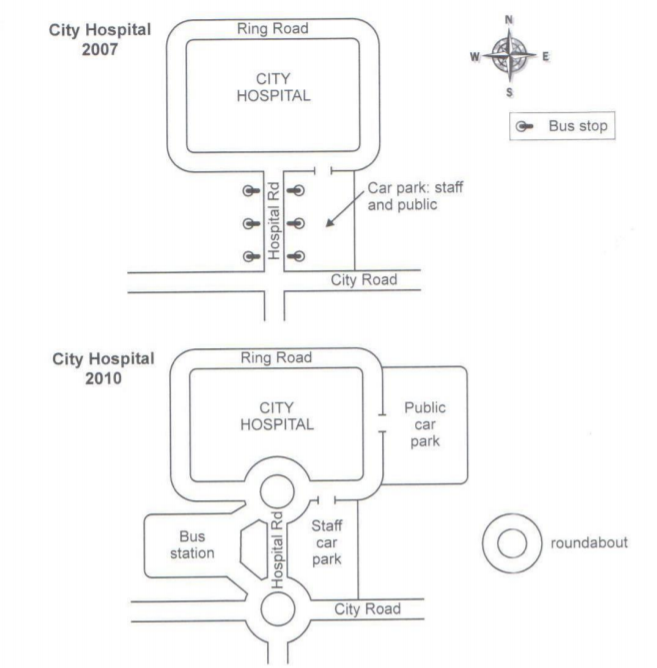
The two presented maps describe the changes that took place at a city hospital from 2007 to 2010. Looking from an overall perspective, it is readily apparent that the largest changes involved transportation, including additional public parking, the construction of a nearby bus station and new roundabouts.
The majority of the hospital underwent very little change. The roads (Ring, City, and Hospital road) all remained largely the same, though two small lanes were built off of hospital road to link up with the new bus station and roundabouts on either end of Hospital road (where it bisects with Ring and City road) were added. The city hospital building itself was unaltered.
The changes were mainly around the hospital and the largest of these was related to parking. In 2007, there was a small parking lot along Hospital road for both staff and the public. By 2010 they had decided to separate the public and staff parking by adding an exclusively public parking area running along the east side of the city hospital.
IELTS Examiner Sample Answer Analysis
1. The two presented maps describe the changes that took place at a city hospital from 2007 to 2010. 2. Looking from an overall perspective, it is readily apparent that the largest changes involved transportation, including additional public parking, the construction of a nearby bus station and new roundabouts.
1. My first sentence rephrases what the map is showing – write this sentence as fast as possible because it has very little impact on your score!
2. This is my overview. For a map, try to group and describe the biggest changes. Be careful not to add any opinion – for example, don’t say that the hospital is more convenient or more interesting. Just group and describe it, no opinion!
1. The majority of the hospital underwent very little change. 2. The roads (Ring, City, and Hospital Road) all remained largely the same, though two small lanes were built off of hospital road to link up with the new bus station and roundabouts on either end of Hospital road (where it bisects with Ring and City road) were added. 3. The city hospital building itself was unaltered.
1. The first sentence describes what didn’t change much.
2. My second sentence details how the roads around the hospital didn’t change, though lanes and roundabouts were added.
3. The final sentence of this paragraph states that the hospital itself was unchanged.
1. The changes were mainly around the hospital and the largest of these was related to parking. 2. In 2007, there was a small parking lot along Hospital road for both staff and the public. 3. By 2010 they had decided to separate the public and staff parking by adding an exclusively public parking area running along the east side of the city hospital.
1. The first sentence is a topic sentence that gives my writing some structure. In this paragraph I will look at the areas related to parking.
2. The second sentence describes the parking situation in the past.
3. My third sentence describes how the parking situation has changed.
Sample Answer Vocabulary
Figure out what the words in bold mean by reading the sentences around them. Write down the meaning and then check your answers below.
The two presented maps describe the changes that took place at a city hospital from 2007 to 2010. Looking from an overall perspective, it is readily apparent that the largest changes involved transportation, including additional public parking, the construction of a nearby bus station and new roundabouts.
The majority of the hospital underwent very little change. The roads (Ring, City, and Hospital road) all remained largely the same, though two small lanes were built off of Hospital road to link up with the new bus station and roundabouts on either end of hospital road (where it bisects with Ring and City road) were added. The city hospital building itself was unaltered.
The changes were mainly around the hospital and the largest of these was related to parking. In 2007, there was a small parking lot along Hospital road for both staff and the public. By 2010 they had decided to separate the public and staff parking by adding an exclusively public parking area running along the east side of the city hospital.
Answers:
readily apparent: very clear
additional: more
roundabouts: rotaries/circular intersections that help ease traffic congestion
underwent: changed
largely the same: mostly unchanged
lanes: where cars and motorbikes drive on streets
built off of: added on to
link up with: join together
on either end of: on both sides of
bisects: cuts through/across
unaltered: unchanged
parking lot: where cars can park
the public: people who do not work at the hospital
separate: distinct from
exclusively public: only for the public
running along: next to
Pronunciation:
əˈdɪʃənl
ˈraʊndəbaʊts
ˌʌndəˈwɛnt
ˈlɑːʤli ðə seɪm
leɪnz
bɪlt ɒf ɒv
lɪŋk ʌp wɪð
ɒn ˈaɪðər ɛnd ɒv
baɪˈsɛkts
ʌnˈɔːltəd
ˈpɑːkɪŋ lɒt
ðə ˈpʌblɪk
ɪksˈkluːsɪvli ˈpʌblɪk
ˈrʌnɪŋ əˈlɒŋ
Vocabulary Practice
Remember and fill in the blanks:
The two presented maps describe the changes that took place at a city hospital from 2007 to 2010. Looking from an overall perspective, it is ____________________ that the largest changes involved transportation, including ____________________ public parking, the construction of a nearby bus station and new ____________________.
The majority of the hospital ____________________ very little change. The roads (Ring, City, and Hospital road) all remained ____________________, though two small ____________________ were ____________________ hospital road to ____________________ the new bus station and roundabouts ____________________ Hospital road (where it ____________________ with Ring and City road) were added. The city hospital building itself was ____________________.
The changes were mainly around the hospital and the largest of these was related to parking. In 2007, there was a small ____________________ along Hospital road for both staff and ____________________. By 2010 they had decided to ____________________the public and staff parking by adding an ____________________ parking area ____________________ the east side of the city hospital.
Learn More about Hospitals and Medicine:

by Dave | Jun 14, 2019 | Cambridge 14
IELTS Cambridge 14 Writing Task 2
IELTS Cambridge 14 Writing Task 1
Here are some more task 1 and task 2 sample answers from other past tests.
Dave
Tips for Using IELTS Cambridge 14
I’ve got some important tips for how to use these Cambridge books. Too many students don’t know the best ways to practice with the Cambridge books.
A lot of students waste a lot of time doing too many practice tests. They believe that this is a good way to prepare for the test and improve their English.
Practice tests are an awful way to improve your English and only an average way to prepare for the test.
They are not good for improving your English because they are just focused on testing your skills. Of course your English may improve over time but that is not their aim.
Contrast these books with books for learning English that focus on grammar and vocabulary and guide you through with exercises. The process of improving your English is completely different from testing your English – so don’t waste time and money confusing the two!
The biggest mistake that that most students make is they only do these practice tests and don’t find better ways to improve their English.
What are better ways? These ways involve finding something interesting (a movie, music, book, etc.) and keeping your motiviation high with quality content.
You might also decide to take a course in English or hire a tutor. This will improve your English – practice tests will not!
But there are some ways in which these books are good for preparation. First, you can become more familiar with the format of the test and the different questions types.
That makes them decent preparation for the test question types.
Secondly, they are also good tests. Duh.
That means that you can measure your progress with them. If you are planning on taking IELTS in the next month or two you should probably do a weekly test to measure your progress.
If you have several months to a year (or more) then you should do a practice test once a month to measure your progress.
This is the proper way to use practice tests – don’t rely on them to improve your English.
Many students lazily believe that doing test after test will improve their score – they are searching for an overly simple solution when the real solution is staring them right in the face: improve your English and your IELTS score will follow you like your shadow!
Simple Steps for Using IELTS Cambridge 14 to Test your English
1. Start with the listening test. Do the listening test fully but don’t check your answers! Read the tapescript carefully after you finish and underline the distractors and paraphrases. This way you learn about how IELTS listening works.
2. Do the reading test. When you check your answers, figure out the reason why you got each one wrong. Because of a paraphrase? Because of vocabulary? Grammar? This way you can improve your weaknesses.
3. Do the writing tests. Time yourself and be strict. Read my samples answers for task 1 and task 2 writing.
4. Practice doing the speaking test yourself or with a partner. If you have a friend who can help, try to do a mock speaking test that feels like the real test. Read here about what will really happen in your IELTS speaking test.
Simple Steps for Using IELTS Cambridge 14 to Improve your English
1. Start with a listening test but don’t do the full test. Just listen to part 1. Listen to it at least 3 times. Repeat this for every part of the test. Read here about how this will improve your listening. Again, check your answers with the tapescript and try to figure out why you got each answer wrong. Usually it will be because of vocabulary – so learn more vocab!
2. Do the reading test. Don’t worry so much about the timing. Review the basic reading steps here and afterwards check why you got each answer wrong.
3. Do both writing tests but don’t worry about the timing. After you finish you can compare with my sample answers and do the practice activities for task 1 and task 2. The next day, do the same sample answer again but try to improve your ideas, vocabulary, and grammar. Keep doing this until you are happy with your writing.
4. Do the practice speaking test by yourself or with a friend/teacher. Don’t move on to a new test. Keep learning new vocabulary related to the same topics and od the test over and over again. If you get bored, try varying or writing slightly new questions related to the questions. Don’t try to give exactly the same answer each time. Vary it a little bit so that your speaking doesn’t become too robotic.
If you have any questions about the book, you can comment them below and I will reply as soon as possible!
