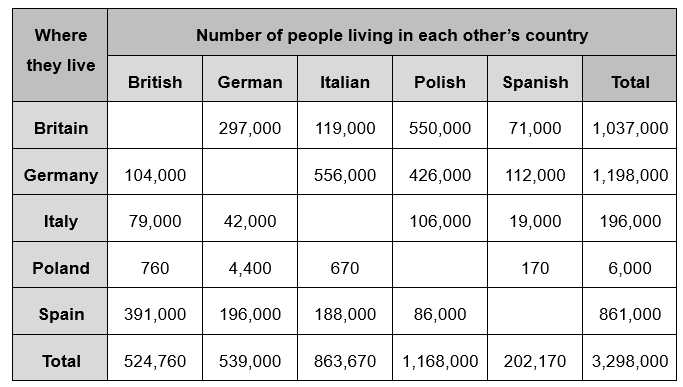
This is my IELTS writing task 2 sample answer essay on the topic of the number of people living in each other’s country. It’s a really tough one for sure!
If you sign up for my Patreon below, you will get access to many years’ worth of past EBook and PDFs – that are only available on Patreon here:
IELTS Task 1 Essay: Number of People Living in Each Other’s Country
The table details the number of individuals from other countries residing in 5 different European nations in 2011. Overall, Polish individuals were most likely to emigrate, followed by Italians, Germans, the English and the Spanish more distantly. The preferred country for most nationalities to reside in was Germany with the exception of the British and Germans who lived in Spain and Britain respectively.
In terms of the totals, 1,168,000 Polish residents reside abroad, notably higher than the figure for Italians (863,670), Germans (539,000), British (524,760), and especially Spanish (202,170). Polish immigrants were most likely to live in Great Britain and Germany (near 500,000 in each nation), a trend mirroring the Spanish (close to 100,000 in the UK and Germany). Notably few individuals from all nations opted to live in Poland with figures ranging from 170 from Spain up to 4,400 from neighboring Germany.
Germany and Britain displayed comparable patterns with the English preferring to reside in Spain (391,000) and Germans opting for the UK at 297,000 and Spain slightly lower at 196,000 living abroad. Lastly, Italians were overwhelmingly more likely to relocate to Germany with the highest figure for immigration at 556,000 and still significant totals for Spain and the UK (188,000 and 119,000 in turn).
Analysis
1. The table details the number of individuals from other countries residing in 5 different European nations in 2011. 2. Overall, Polish individuals were most likely to emigrate, followed by Italians, Germans, the English and the Spanish more distantly. 3. The preferred country for most nationalities to reside in was Germany with the exception of the British and Germans who lived in Spain and Britain respectively.
Paraphrase the overall essay topic.
Write a clear overview summarising the differences and the overall trend.
This one is a little complex so it needs a second sentence for the overview.
1. In terms of the totals, 1,168,000 Polish residents reside abroad, notably higher than the figure for Italians (863,670), Germans (539,000), British (524,760), and especially Spanish (202,170). 2. Polish immigrants were most likely to live in Great Britain and Germany (near 500,000 in each nation), a trend mirroring the Spanish (close to 100,000 in the UK and Germany). 3. Notably few individuals from all nations opted to live in Poland with figures ranging from 170 from Spain up to 4,400 from neighboring Germany.
Begin writing about the data for the first categories.
Compare between each sentence.
Use parenthesis to mention everything.
1. Germany and Britain displayed comparable patterns with the English preferring to reside in Spain (391,000) and Germans opting for the UK at 297,000 and Spain slightly lower at 196,000 living abroad. 2. Lastly, Italians were overwhelmingly more likely to relocate to Germany with the highest figure for immigration at 556,000 and still significant totals for Spain and the UK (188,000 and 119,000 in turn).
Write about the final other parts of the graph – include everything!
Include all the data.
Vocabulary
What do the words in bold below mean?Make some notes on paper to aid memory and then check below.
The table details the number of individuals from other countries residing in 5 different European nations. Overall, Polish individuals were most likely to emigrate, followed by Italians, Germans, the English and the Spanish more distantly. The preferred country for most nationalities to reside in was Germany with the exception of the British and Germans who lived in Spain and Britain respectively.
In terms of the totals, 1,168,000 Polish residents reside abroad, notably higher than the figure for Italians (863,670), Germans (539,000), British (524,760), and especially Spanish (202,170). Polish immigrants were most likely to live in Great Britain and Germany (near 500,000 in each nation), a trend mirroring the Spanish (close to 100,000 in the UK and Germany). Notably few individuals from all nations opted to live in Poland with figures ranging from 170 from Spain up to 4,400 from neighboring Germany.
Germany and Britain displayed comparable patterns with the English preferring to reside in Spain (391,000) and Germans opting for the UK at 297,000 and Spain slightly lower at 196,000 living abroad. Lastly, Italians were overwhelmingly more likely to relocate to Germany with the highest figure for immigration at 556,000 and still significant totals for Spain and the UK (188,000 and 119,000 in turn).
Answers
For extra practice, write an antonym (opposite word) on a piece of paper to help you remember the new vocabulary:
Here are synonym phrases for each line:
Details – shows
Residing in – Living in
Overall – On the whole
Most likely to emigrate – Highly inclined to move abroad
More distantly – Further away
Preferred country – Favored destination
Most nationalities – The majority of ethnic groups
With the exception of – Excluding
In terms of the totals – Regarding the overall numbers
Reside abroad – Live overseas
Notably higher than – Significantly greater than
The figure for – The number relating to
Especially – Particularly
Most likely – Highly probable
Near – Close to
In each nation – Within every country
A trend mirroring the – A pattern reflecting the
Close to – Approximately
Notably few – Remarkably scarce
Figures ranging from – Numbers spanning from
Up to – As high as
Neighboring – Adjacent
Displayed comparable patterns with – Showed similar trends to
Slightly lower at – Marginally less, at
Overwhelmingly more likely – Far more inclined
Relocate – Move
Highest figure for immigration – Peak number of arrivals
Still significant totals – Nonetheless considerable numbers
I recommend getting a pencil and piece of paper because that aids memory. Then write down the missing vocabulary from my sample answer in your notebook:
The table d______s the number of individuals from other countries r_______n 5 different European nations. O________l, Polish individuals were m____________e, followed by Italians, Germans, the English and the Spanish m________y. The p______________y for m_____________s to reside in was Germany w_________________f the British and Germans who lived in Spain and Britain respectively.
I__________________s, 1,168,000 Polish residents r_________d, n_________________n t_____________r Italians (863,670), Germans (539,000), British (524,760), and e_________y Spanish (202,170). Polish immigrants were m__________y to live in Great Britain and Germany (n____r 500,000 i__________n), a_____________________e Spanish (c_______o 100,000 in the UK and Germany). N___________w individuals from all nations opted to live in Poland with f_________________m 170 from Spain u____o 4,400 from n__________g Germany.
Germany and Britain d_______________________________h the English preferring to reside in Spain (391,000) and Germans opting for the UK at 297,000 and Spain s_____________t 196,000 living abroad. Lastly, Italians were o_______________________y to r________e to Germany with the h_________________________________n at 556,000 and s__________________________s for Spain and the UK (188,000 and 119,000 i_______n).
Listening Practice
Learn more about this topic by watching from YouTube below and practice with these activities:
These days, there is increasing disconnect among neighbors, leading to a situation where many individuals are unfamiliar with those living nearby. In my opinion, this is largely a result of advanced technologies and the optimal solution relates to fostering community interaction.
One primary reason for this lack of acquaintance is the rise of technology and social media. In today’s digital age, many people prefer to interact online rather than face-to-face. Platforms such as Facebook, Instagram, and Twitter allow individuals to connect with friends and family from a distance, often at the expense of local relationships. For instance, a person may spend hours engaging in online discussions while neglecting the opportunity to engage with their neighbors over a cup of coffee. This virtual interaction, while beneficial in certain respects, can lead to social isolation in physical neighborhoods. There is supporting statistical data that evidences the contention that more time spent on addictive digital devices fulfills a human’s social needs to a bare minimum and discourages in-person meetings.
One effective solution for this modern phenomenon would be organizing community events. Local councils or neighborhood associations could host gatherings such as block parties, picnics, or holiday celebrations. For example, a community could set up a monthly potluck dinner, where residents bring a dish to share. This not only provides an opportunity for neighbors to meet but also fosters a spirit of cooperation and camaraderie. Another related example would be community gardening, which could serve to encourage collaboration among residents, as they work together to cultivate plants and vegetables. This type of initiative not only enhances a neighborhood’s aesthetic appeal but also instills a sense of responsibility and ownership among its members. A community garden can become a focal point where neighbors meet regularly, share gardening tips, and even exchange produce, further strengthening local bonds.
In conclusion, the disconnect among neighbors is a multifaceted issue stemming largely from technological reliance. However, by implementing community-oriented initiatives such as social events and gardening projects, it is possible to cultivate a more connected and engaged neighborhood. In doing so, we can foster a sense of belonging that enriches the lives of individuals and enhances communal well-being.
Analysis
1. These days, there is increasing disconnect among neighbors, leading to a situation where many individuals are unfamiliar with those living nearby. 2. In my opinion, this is largely a result of advanced technologies and the optimal solution relates to fostering community interaction.
Paraphrase the overall essay topic.
Write a clear opinion. Read more about introductions here.
1. One primary reason for this lack of acquaintance is the rise of technology and social media. 2. In today’s digital age, many people prefer to interact online rather than face-to-face. 3. Platforms such as Facebook, Instagram, and Twitter allow individuals to connect with friends and family from a distance, often at the expense of local relationships. 4. For instance, a person may spend hours engaging in online discussions while neglecting the opportunity to engage with their neighbors over a cup of coffee. 5. This virtual interaction, while beneficial in certain respects, can lead to social isolation in physical neighborhoods. 6. There is supporting statistical data that evidences the contention that more time spent on addictive digital devices fulfills a human’s social needs to a bare minimum and discourages in-person meetings.
Write a topic sentence with a clear main idea at the end.
Explain your main idea.
Develop it with specific or hypothetical examples.
Keep developing it fully.
Better to have more detail.
Don’t write too long.
1. One effective solution for this modern phenomenon would be organizing community events. 2. Local councils or neighborhood associations could host gatherings such as block parties, picnics, or holiday celebrations. 3. For example, a community could set up a monthly potluck dinner, where residents bring a dish to share. 4. This not only provides an opportunity for neighbors to meet but also fosters a spirit of cooperation and camaraderie. 5. Another related example would be community gardening, which could serve to encourage collaboration among residents, as they work together to cultivate plants and vegetables. 6. This type of initiative not only enhances a neighborhood’s aesthetic appeal but also instills a sense of responsibility and ownership among its members. 7. A community garden can become a focal point where neighbors meet regularly, share gardening tips, and even exchange produce, further strengthening local bonds.
Write a new topic sentence with a new main idea at the end.
Explain your new main idea.
Include specific details and examples.
Add as much information as you can and make sure it links logically.
Keep adding detail.
Be specific instead of general.
This essay is a bit long – aim for about 275 words.
1. In conclusion, the disconnect among neighbors is a multifaceted issue stemming largely from technological reliance. 2. However, by implementing community-oriented initiatives such as social events and gardening projects, it is possible to cultivate a more connected and engaged neighborhood. 3. In doing so, we can foster a sense of belonging that enriches the lives of individuals and enhances communal well-being.
Summarise your main ideas.
Include a final thought. Read more about conclusions here.
No more than 3 sentences.
Vocabulary
What do the words in bold below mean?Make some notes on paper to aid memory and then check below.
These days, there is increasing disconnect among neighbors, leading to a situation where many individuals are unfamiliar with those living nearby. In my opinion, this is largely a result of advanced technologies and the optimal solution relates tofostering community interaction.
One primary reason for this lack of acquaintance is the rise of technology and social media. In today’s digital age, many people prefer to interact online rather than face-to-face. Platforms such as Facebook, Instagram, and Twitter allow individuals to connect with friends and family from a distance, often at the expense of local relationships. For instance, a person may spend hours engaging in online discussions while neglecting the opportunity to engage with their neighbors over a cup of coffee. This virtual interaction, while beneficial in certain respects, can lead to social isolation in physical neighborhoods. There is supporting statistical data that evidences the contention that more time spent on addictive digital devices fulfills a human’s social needs to a bare minimum and discourages in-person meetings.
One effective solution for this modern phenomenon would beorganizing community events. Local councils or neighborhood associations could host gatherings such as block parties, picnics, or holiday celebrations. For example, a community could set up a monthly potluck dinner, where residents bring a dish to share. This not only provides an opportunity for neighbors to meet but also fosters a spirit of cooperation and camaraderie. Another related example would be community gardening, which could serve to encourage collaboration among residents, as they work together to cultivate plants and vegetables. This type of initiative not only enhances a neighborhood’s aesthetic appeal but also instills a sense of responsibility and ownership among its members. A community garden can become a focal point where neighbors meet regularly, share gardening tips, and even exchange produce, further strengthening local bonds.
In conclusion, the disconnect among neighbors is a multifaceted issue stemming largely from technological reliance. However, by implementing community-oriented initiatives such as social events and gardening projects, it is possible to cultivate a more connected and engaged neighborhood. In doing so, we can foster a sense of belonging that enriches the lives of individuals and enhances communal well-being.
Answers
For extra practice, write an antonym (opposite word) on a piece of paper to help you remember the new vocabulary:
Original and Synonymous Rewrite
Original: These days Synonymous: Nowadays
Original: Increasing disconnect among Synonymous: Growing detachment among people
Original: Leading to a situation where Synonymous: Resulting in circumstances where
Original: Unfamiliar Synonymous: Unknown to one another
Original: Living nearby Synonymous: Residing in proximity
Original: This is largely a result of advanced technologies Synonymous: This is primarily due to modern technological advancements
Original: Optimal solution relates to fostering community interaction Synonymous: The best approach involves promoting community connections
Original: One primary reason for this lack of acquaintance Synonymous: A key factor behind this unfamiliarity
Original: The rise of technology and social media Synonymous: The proliferation of digital tools and social networks
Original: In today’s digital age Synonymous: In the current era of technology
Original: Interact online rather than face-to-face Synonymous: Engage online rather than meeting in person
Original: Platforms Synonymous: Applications
Original: Connect with friends and family from a distance Synonymous: Stay in touch with distant friends and relatives
Original: Often at the expense of local relationships Synonymous: Often at the cost of local bonds
Original: Engaging in online discussions Synonymous: Participating in virtual conversations
Original: Neglecting the opportunity to engage with their neighbors over a cup of coffee Synonymous: Ignoring the chance to connect with neighbors over a casual chat
Original: Virtual interaction Synonymous: Online communication
Original: While beneficial in certain respects Synonymous: Though advantageous in some ways
Original: Social isolation in physical neighborhoods Synonymous: Physical isolation within neighborhoods
Original: There is supporting statistical data Synonymous: Statistical evidence supports the claim
Original: Evidences Synonymous: Proves the argument
Original: Time spent on addictive digital devices fulfills a human’s social needs to a bare minimum and discourages in-person meetings Synonymous: Time spent on engrossing digital platforms barely satisfies social needs and discourages face-to-face interaction
Original: One effective solution for this modern phenomenon would be organizing community events Synonymous: A practical remedy for this contemporary challenge could be arranging community activities
Original: Local councils Synonymous: Municipal authorities
Original: Neighborhood associations Synonymous: Local groups
Original: Host gatherings Synonymous: Organize events
I recommend getting a pencil and piece of paper because that aids memory. Then write down the missing vocabulary from my sample answer in your notebook:
These days, there is increasing disconnect among neighbors, leading to a situation where many individuals are unfamiliar with those living nearby. In my opinion, this is largely a result of advanced technologies and the optimal solution relates tofostering community interaction.
One primary reason for this lack of acquaintance is the rise of technology and social media. In today’s digital age, many people prefer to interact online rather than face-to-face. Platforms such as Facebook, Instagram, and Twitter allow individuals to connect with friends and family from a distance, often at the expense of local relationships. For instance, a person may spend hours engaging in online discussions while neglecting the opportunity to engage with their neighbors over a cup of coffee. This virtual interaction, while beneficial in certain respects, can lead to social isolation in physical neighborhoods. There is supporting statistical data that evidences the contention that more time spent on addictive digital devices fulfills a human’s social needs to a bare minimum and discourages in-person meetings.
One effective solution for this modern phenomenon would beorganizing community events. Local councils or neighborhood associations could host gatherings such as block parties, picnics, or holiday celebrations. For example, a community could set up a monthly potluck dinner, where residents bring a dish to share. This not only provides an opportunity for neighbors to meet but also fosters a spirit of cooperation and camaraderie. Another related example would be community gardening, which could serve to encourage collaboration among residents, as they work together to cultivate plants and vegetables. This type of initiative not only enhances a neighborhood’s aesthetic appeal but also instills a sense of responsibility and ownership among its members. A community garden can become a focal point where neighbors meet regularly, share gardening tips, and even exchange produce, further strengthening local bonds.
In conclusion, the disconnect among neighbors is a multifaceted issue stemming largely from technological reliance. However, by implementing community-oriented initiatives such as social events and gardening projects, it is possible to cultivate a more connected and engaged neighborhood. In doing so, we can foster a sense of belonging that enriches the lives of individuals and enhances communal well-being.
Listening Practice
Learn more about this topic by watching from YouTube below and practice with these activities:
With growing populations in cities, many people are living in small homes that do not do not have adequate outdoor spaces.
Is this a positive or negative development?
As urban populations continue to grow at unprecedented rates, many city dwellers find themselves living in small homes without adequate outdoor spaces. While this development has enabled more people to reside in urban centers, it engenders a host of challenges that make it a negative trend overall.
Critics might argue that small homes and a lack of outdoor spaces are a necessary trade-off for living in active urban centers with abundant job opportunities and cultural amenities. In the vast majority of major cities today, real estate prices are soaring and most individuals can only afford city life by renting or purchasing a smaller home. If there were a law that mandated all homes needed to have outdoor spaces, this would make real estate in cities prohibitively expensive and exacerbate existing social divisions. The result for those such a bill would intend to protect would be that they would have to relocate to areas outside of cities and suffer through long commutes or move to the countryside where standards of living are lower in most nations.
The significant downsides of living in small homes without outdoor spaces concern physical and mental health. When residents lack access to private gardens or balconies, they are less likely to engage in outdoor activities, which are crucial for maintaining a healthy lifestyle. For instance, consider families with young children. In the absence of a backyard, children may spend more time indoors on electronic devices rather than playing outside, running, or engaging in physical exercise. Over time, a sedentary lifestyle can lead to an increased risk of obesity and other health problems. Natural environments, such as gardens or even small patios with greenery, have also been shown to reduce stress and improve mental health. During the COVID-19 pandemic, many urban residents without outdoor spaces reported feeling trapped and overwhelmed, as they lacked a private area to relax or disconnect from their indoor environment. In contrast, those with access to a small balcony or garden often described these spaces as sanctuaries that provided much-needed relief.
In conclusion, while small homes may seem like a practical solution to urban overcrowding, the long-term consequences render it a largely negative development. To ensure the well-being of urban populations, cities must innovate and invest in creating accessible outdoor spaces for all residents.
Analysis
1. As urban populations continue to grow at unprecedented rates, many city dwellers find themselves living in small homes without adequate outdoor spaces. 2. While this development has enabled more people to reside in urban centers, it engenders a host of challenges that make it a negative trend overall.
Paraphrase the overall essay topic.
Write a clear opinion. Read more about introductions here.
1. Critics might argue that small homes and a lack of outdoor spaces are a necessary trade-off for living in active urban centers with abundant job opportunities and cultural amenities. 2. In the vast majority of major cities today, real estate prices are soaring and most individuals can only afford city life by renting or purchasing a smaller home. 3. If there were a law that mandated all homes needed to have outdoor spaces, this would make real estate in cities prohibitively expensive and exacerbate existing social divisions. 4. The result for those such a bill would intend to protect would be that they would have to relocate to areas outside of cities and suffer through long commutes or move to the countryside where standards of living are lower in most nations.
Write a topic sentence with a clear main idea at the end.
Explain your main idea.
Develop it with specific or hypothetical examples.
Keep developing it fully.
1. The significant downsides of living in small homes without outdoor spaces concern physical and mental health. 2. When residents lack access to private gardens or balconies, they are less likely to engage in outdoor activities, which are crucial for maintaining a healthy lifestyle. 3. For instance, consider families with young children. 4. In the absence of a backyard, children may spend more time indoors on electronic devices rather than playing outside, running, or engaging in physical exercise. 5. Over time, a sedentary lifestyle can lead to an increased risk of obesity and other health problems. 6. Natural environments, such as gardens or even small patios with greenery, have also been shown to reduce stress and improve mental health. 7. During the COVID-19 pandemic, many urban residents without outdoor spaces reported feeling trapped and overwhelmed, as they lacked a private area to relax or disconnect from their indoor environment. 8. In contrast, those with access to a small balcony or garden often described these spaces as sanctuaries that provided much-needed relief.
Write a new topic sentence with a new main idea at the end.
Explain your new main idea.
Include specific details and examples.
Add as much information as you can and make sure it links logically.
This paragraph can be longer since it is the side I agree with.
The more development, the better.
Be sure to be very specific.
This essay is a bit long – aim for about 275 words.
1. In conclusion, while small homes may seem like a practical solution to urban overcrowding, the long-term consequences render it a largely negative development. 2. To ensure the well-being of urban populations, cities must innovate and invest in creating accessible outdoor spaces for all residents.
Summarise your main ideas.
Include a final thought. Read more about conclusions here.
Vocabulary
What do the words in bold below mean?Make some notes on paper to aid memory and then check below.
As urban populations continue to grow at unprecedented rates, many city dwellers find themselves living in small homes without adequate outdoor spaces. While this development has enabled more people to reside in urban centers, it engenders a host of challenges that make it a negative trend overall.
Critics might argue that small homes and a lack of outdoor spaces are a necessary trade-off for living in active urban centers with abundant job opportunities and cultural amenities. In the vast majority of major cities today, real estate prices are soaring and most individuals can only afford city life by renting or purchasing a smaller home. If there were a law that mandated all homes needed to have outdoor spaces, this would make real estate in cities prohibitively expensive and exacerbate existing social divisions. The result for those such a bill would intend to protect would be that they would have to relocate to areas outside of cities and suffer through long commutes or move to the countryside where standards of living are lower in most nations.
The significant downsides of living in small homes without outdoor spaces concern physical and mental health. When residents lack access to private gardens or balconies, they are less likely to engage in outdoor activities, which are crucial for maintaining a healthy lifestyle. For instance, consider families with young children. In the absence of a backyard, children may spend more time indoors on electronic devices rather than playing outside, running, or engaging in physical exercise. Over time, a sedentary lifestyle can lead to an increased risk of obesity and other health problems. Natural environments, such as gardens or even small patios with greenery, have also been shown to reduce stress and improve mental health. During the COVID-19 pandemic, many urban residents without outdoor spaces reported feeling trapped and overwhelmed, as they lacked a private area to relax or disconnect from their indoor environment. In contrast, those with access to a small balcony or garden often described these spaces as sanctuaries that provided much-needed relief.
In conclusion, while small homes may seem like a practical solution to urban overcrowding, the long-term consequences render it a largely negative development. To ensure the well-being of urban populations, cities must innovate and invest in creating accessible outdoor spaces for all residents.
Answers
For extra practice, write an antonym (opposite word) on a piece of paper to help you remember the new vocabulary:
Synonymous Phrases
Urban populations
City inhabitants
Grow at unprecedented rates
Expand at unparalleled speeds
City dwellers
Urban residents
Without adequate outdoor spaces
Lacking sufficient green areas
Enabled
Permitted
Reside in urban centers
Live in metropolitan areas
Engenders a host of challenges
Brings about numerous issues
A negative trend overall
A broadly unfavorable pattern
Critics might argue that
Opponents may claim that
A necessary trade-off for living in active urban centers with abundant job opportunities and cultural amenities
An inevitable compromise for thriving cities offering employment and cultural attractions
In the vast majority of major cities today
Across most large metropolitan areas today
Real estate prices are soaring
Property values are skyrocketing
Afford city life
Sustain an urban lifestyle
Mandated
Compelled
Prohibitively expensive
Excessively costly
Exacerbate existing social divisions
Deepen current societal inequalities
The result for
The outcome for
Bill
Invoice
Relocate
Move elsewhere
Suffer through long commutes
Endure extended travel times
Move to the countryside
Relocate to rural areas
Standards of living
Quality of life
Lower in most nations
Inferior across many countries
The significant downsides of
Major drawbacks of
Concern physical and mental health
Affect both body and mind
Lack access to private gardens or balconies
Are deprived of personal outdoor spaces
Less likely to engage in outdoor activities
Unlikely to participate in open-air recreation
Crucial for maintaining a healthy lifestyle
Essential for sustaining overall wellness
Consider
Take into account
In the absence of a backyard
Without a personal outdoor area
On electronic devices
Using digital gadgets
Engaging in physical exercise
Participating in fitness activities
Over time
Gradually
Sedentary lifestyle
Inactive way of living
Increased risk of obesity
Greater likelihood of weight-related issues
Natural environments
Outdoor settings
Small patios with greenery
Compact terraces featuring plants
Have also been shown to reduce stress and improve mental health
Are proven to alleviate stress and enhance psychological well-being
During the COVID-19 pandemic
Amid the global health crisis
Reported feeling trapped and overwhelmed
Expressed experiencing confinement and distress
Lacked a private area to relax or disconnect from their indoor environment
Did not have personal space to unwind or escape their interiors
I recommend getting a pencil and piece of paper because that aids memory. Then write down the missing vocabulary from my sample answer in your notebook:
As u_________________s continue to g_______________________s, many c____________s find themselves living in small homes w_________________________s. While this development has e________d more people to r__________________s, it e_______________________s that make it a____________________l.
C_______________________t small homes and a lack of outdoor spaces are a_______________________________________________________________________________s. I__________________________________y, r________________________________g and most individuals can only a_____________e by renting or purchasing a smaller home. If there were a law that m_________d all homes needed to have outdoor spaces, this would make real estate in cities p____________________e and e_____________________s. T_____________r those such a b___l would intend to protect would be that they would have to r________e to areas outside of cities and s____________________________s or m______________________________e where s_____________________g are l________________s.
T________________________________f living in small homes without outdoor spaces c________________________________h. When residents l______________________________________s, they are l____________________________________s, which are c___________________________________e. For instance, c________r families with young children. I_______________________d, children may spend more time indoors o__________________s rather than playing outside, running, or e_____________________e. O_________e, a s__________________e can lead to an i_______________________y and other health problems. N_______________________s, such as gardens or even s_________________y, h___________________________________________________h. D___________________c, many urban residents without outdoor spaces r_________________________________d, as they l________________________________________________________t. I______________t, those with access to a small balcony or garden often d____________d these spaces as s___________s that p________________________f.
In conclusion, while small homes may seem like a p_______________n to u_______________g, the l____________________________r it a l______________________________t. T_________________f urban populations, cities must i_______e and i______t in creating a___________________________________s.
Listening Practice
Learn more about this topic by watching from YouTube below and practice with these activities:
One big difference you will see between my sample answers for speaking and other ones is that mine are more natural – like real speaking.
Writing is different from speaking. In English, we don’t speak in formal sentences like an essay.
For example, many sample answers might write and answer like: “Yes, I really love to eat ice. Ice cream is one of my favorite foods and when I have the time to go get ice cream, I will go with my friends.”
But that is unnatural – it is too much like writing.
A more natural way of saying the same answer would be:
“Sure, sure, I’ve been known to grab the occasional ice cream – with friends most of the time – when we’re already out – maybe after getting coffee or grabbing a bite to eat. Why not?”
Enjoy and you can get the full EBook here with natural answers for these questions and many more (including the IELTS writing exam) on Patreon: Patreon.com/howtodoielts
Dave
Full IELTS Speaking Exam October 2024
Speaking Part 1
Where You Live
Do you live in an apartment or house?
What views can you see through the windows?
What kind of apartment or house do you want to have in the future?
Friends
Question 1: What do you do together with your friends?
Question 2: Do you prefer to have a big or small group of friends?
Question 3: What kinds of people do you like to have as friends?
Question 4: Do you prefer to spend time alone or with friends?
Favourite Days
Question 1: Which day is your favourite day of the week?
Question 2: Which day is your least favourite day?
Question 3: How do you usually spend your time on your favourite day?
Question 4: Which day of the week is least busy in your country?
Speaking Part 2
Describe someone you know who recently moved to new accommodation.
You should say:
When and where this person moved
How you know this person
What kind of accommodation he/she moved to
And how this person felt about moving
Speaking Part 3
Question 1: How does moving to a new home impact a person’s sense of belonging and community?
Question 2: What are some potential challenges that individuals or families may face when moving to a new home, especially in terms of adjusting to a new neighborhood or city?
Question 3: In what ways can moving to a new home positively or negatively affect an individual’s social life and relationships?
Question 4: What factors should people consider when deciding whether to move to a new home, particularly in terms of their career prospects and job opportunities?
Question 5: How can moving to a new home contribute to personal growth and development, and what are some steps individuals can take to make the transition smoother?
IELTS Essay: The Main Benefit of International Cooperation
Some people think that the main benefit of international cooperation is in the protection of the environment, while others believe that businesses mainly benefit.
Discuss both these views and give your own opinion.
Many today argue that international collaboration mainly serves to benefit businesses while others feel there are greater advantages overall for the environment. I would side with the former viewpoint due to the concrete and tangible outcomes.
Proponents of the environmental benefits of international cooperation emphasize the global challenges now being met by collective action. Climate change, for instance, is a quintessential example of an issue transcending national borders. The 2015 Paris Agreement, which saw nearly 200 countries commit to limiting global temperature rise, illustrates how international cooperation tackles environmental crises. This agreement, borne out of multilateral negotiations, demonstrates how countries now work together to implement emission reduction targets, promote sustainable development, and support climate resilience efforts in vulnerable regions. These efforts along with various wildlife protection treaties, underscore the reality of cross-border efforts to conserve natural habitats and endangered species.
Conversely, the global economy is intricately linked through trade agreements, investment treaties, and multinational corporations. Free trade agreements, such as the North American Free Trade Agreement (NAFTA) and the European Union’s Single Market, demonstrate how countries collaborate to facilitate trade, reduce tariffs, and stimulate economic growth. These agreements benefit businesses by opening new markets, enhancing supply chain efficiencies, and fostering innovation. As a result, international business partnerships can drive technological and economic development. For instance, collaborations between tech giants and global firms enable the sharing of resources, knowledge, and technology, accelerating progress in various sectors, from information technology to renewable energy. Such partnerships illustrate how business interests have been a significant driver of international cooperation, with economic gains often translating into tangible improved living standards.
In conclusion, while international cooperation undoubtedly benefits both the environment and the business world, the latter, unfortunately, enjoys the greatest general advantages. Nonetheless, balancing economic interests with environmental stewardship is crucial for fostering a sustainable and equitable future.
Analysis
1. Many today argue that international collaboration mainly serves to benefit businesses while others feel there are greater advantages overall for the environment. 2. I would side with the former viewpoint due to the concrete and tangible outcomes.
Paraphrase the overall essay topic.
Write a clear opinion. Read more about introductions here.
1. Proponents of the environmental benefits of international cooperation emphasize the global challenges now being met by collective action. 2. Climate change, for instance, is a quintessential example of an issue transcending national borders. 3. The 2015 Paris Agreement, which saw nearly 200 countries commit to limiting global temperature rise, illustrates how international cooperation tackles environmental crises. 4. This agreement, borne out of multilateral negotiations, demonstrates how countries now work together to implement emission reduction targets, promote sustainable development, and support climate resilience efforts in vulnerable regions. 5. These efforts along with various wildlife protection treaties, underscore the reality of cross-border efforts to conserve natural habitats and endangered species.
Write a topic sentence with a clear main idea at the end.
Explain your main idea.
Develop it with specific or hypothetical examples.
Keep developing it fully.
Better to have more detail.
1. Conversely, the global economy is intricately linked through trade agreements, investment treaties, and multinational corporations. 2. Free trade agreements, such as the North American Free Trade Agreement (NAFTA) and the European Union’s Single Market, demonstrate how countries collaborate to facilitate trade, reduce tariffs, and stimulate economic growth. 3. These agreements benefit businesses by opening new markets, enhancing supply chain efficiencies, and fostering innovation. 4. As a result, international business partnerships can drive technological and economic development. For instance, collaborations between tech giants and global firms enable the sharing of resources, knowledge, and technology, accelerating progress in various sectors, from information technology to renewable energy. 5. Such partnerships illustrate how business interests have been a significant driver of international cooperation, with economic gains often translating into tangible improved living standards.
Write a new topic sentence with a new main idea at the end.
Explain your new main idea.
Include specific details and examples.
Add as much information as you can and make sure it links logically.
This essay is a bit long – aim for about 275 words.
1. In conclusion, while international cooperation undoubtedly benefits both the environment and the business world, the latter, unfortunately, enjoys the greatest general advantages. 2. Nonetheless, balancing economic interests with environmental stewardship is crucial for fostering a sustainable and equitable future.
Summarise your main ideas.
Include a final thought. Read more about conclusions here.
Vocabulary
What do the words in bold below mean?Make some notes on paper to aid memory and then check below.
Many today argue that international collaboration mainly serves to benefit businesses while others feel there are greater advantages overall for the environment. I would side with the former viewpoint due to the concrete and tangible outcomes.
Proponents of the environmental benefits of international cooperation emphasize the global challenges now being met by collective action. Climate change, for instance, is a quintessential example of an issue transcending national borders. The 2015 Paris Agreement, which saw nearly 200 countries commit to limiting global temperature rise, illustrates how international cooperation tackles environmental crises. This agreement, borne out of multilateral negotiations, demonstrates how countries now work together to implement emission reduction targets, promote sustainable development, and support climate resilience efforts in vulnerable regions. These efforts along with various wildlife protection treaties, underscore the reality of cross-border efforts to conserve natural habitats and endangered species.
Conversely, the global economy is intricately linked through trade agreements, investment treaties, and multinational corporations. Free trade agreements, such as the North American Free Trade Agreement (NAFTA) and the European Union’s Single Market, demonstrate how countries collaborate to facilitate trade, reduce tariffs, and stimulate economic growth. These agreements benefit businesses by opening new markets, enhancing supply chain efficiencies, and fostering innovation. As a result, international business partnerships can drive technological and economic development. For instance, collaborations between tech giants and global firms enable the sharing of resources, knowledge, and technology, accelerating progress in various sectors, from information technology to renewable energy. Such partnerships illustrate how business interests have been a significant driver of international cooperation, with economic gains often translating into tangible improved living standards.
In conclusion, while international cooperation undoubtedly benefits both the environment and the business world, the latter, unfortunately, enjoys the greatest general advantages. Nonetheless, balancing economic interests with environmental stewardship is crucial for fostering a sustainable and equitable future.
Answers
For extra practice, write an antonym (opposite word) on a piece of paper to help you remember the new vocabulary:
International collaboration mainly serves to benefit businesses while others feel there are greater advantages overall for the environment. International collaboration primarily aims to benefit enterprises, while others perceive greater overall advantages for the environment.
I would side with the former viewpoint due to concrete and tangible outcomes. I lean toward the former perspective due to clear and measurable results.
Proponents of the environmental benefits of international cooperation emphasize global challenges now being met by collective action. Advocates of the ecological advantages of global cooperation highlight that collective action is now addressing worldwide challenges.
A quintessential example of an issue transcending national borders. A prime illustration of an issue that surpasses national boundaries.
Commit to limiting global temperature rise. Commit to restricting the increase in global temperatures.
Support climate resilience efforts in vulnerable regions. Aid climate resilience initiatives in at-risk areas.
Along with various wildlife protection treaties. In conjunction with various wildlife conservation agreements.
Underscore the reality of cross-border efforts to conserve natural habitats and endangered species. Highlight the truth of transnational efforts to protect natural environments and endangered species.
Conversely. On the other hand,
The global economy. The worldwide economy.
Intricately linked through trade agreements. Closely interconnected through trade agreements.
International business partnerships. Global business alliances.
Drive technological and economic development. Propel technological and economic advancement.
Tech giants. Technology giants.
Global firms. International companies.
Sharing of resources. Resource sharing.
Accelerating progress in various sectors. Speeding up progress across diverse sectors.
From information technology to renewable energy. From information technology to renewable energy.
Business interests. Business motivations.
Significant driver of international cooperation. A significant force behind international collaboration.
Economic gains often translating into tangible improved living standards. Economic benefits frequently lead to noticeable improvements in living standards.
Undoubtedly. Undeniably,
The latter. The latter perspective.
Unfortunately. Regrettably,
Enjoys the greatest general advantages. Reaps the most substantial overall benefits.
Nonetheless. Nevertheless,
Balancing economic interests with environmental stewardship is crucial for fostering a sustainable and equitable future. Balancing economic goals with environmental responsibility is vital for cultivating a sustainable and just future.
I recommend getting a pencil and piece of paper because that aids memory. Then write down the missing vocabulary from my sample answer in your notebook:
Many today argue that i________________________________________s to benefit businesses while others feel there are g_________________________________________________t. I__________________________________________o the c_____________________________________s.
P________________________________________________________________________________e the g_____________________________________________________________n. Climate change, for instance, is a_________________________f an i___________________________________s. The 2015 Paris Agreement, which saw nearly 200 countries c__________________________________e, illustrates how international cooperation t______________________s. This agreement, b__________________________________s, demonstrates how countries now work together to i__________________________________s, p_________________________t, and s___________________________________________________s. These efforts a_______________________________s, u_______________________________________________________________________________s.
C____________y, t__________________y is i__________________________________________s, i____________________s, and m______________________________s. Free trade agreements, such as the North American Free Trade Agreement (NAFTA) and the European Union’s Single Market, demonstrate how countries collaborate to f________________e, r_______________s, and s______________________________h. These agreements benefit businesses by o__________________s, e_______________________________s, and f__________________n. A___________t, i__________________________________s can d____________________________________________t. For instance, collaborations between t________s and g__________s enable the sh_____________s, knowledge, and technology, a______________________________________s, f_______________________________________y. Such partnerships illustrate how b_______________s have been a s________________________________________________________n, with e________________________________________________s.
In conclusion, while international cooperation u___________y benefits both the environment and the business world, t________r, u_____________y, e______________________________________s. N_________s, b____________________________________________________________g a s___________________________e.
Listening Practice
Learn more about this topic by watching from YouTube below and practice with these activities:
"The highest quality materials anywhere on the internet! Dave improved my writing and vocabulary so much. Really affordable options you don't want to miss out on!"