Long distance flight consumes the amount of fuel that a car uses for many years and pollutes the air. Some people think that we should discourage non-essential flights, such as tourists travel, rather than limit the use of cars.
To what extent do you agree or disagree?
Air travel consumes enormous amounts of fuel, especially long-haul flights, and contributes significantly to pollution. Some argue that instead of restricting car usage, we should discourage unnecessary air travel. I believe this contention possesses merit and should be pursued by the relevant authorities.
Critics argue that private cars are also a major source of pollution. Unlike airplanes, which carry hundreds of passengers at once, most cars contain just one or two people. In cities like Los Angeles, traffic congestion causes vehicles to idle for hours, producing tons of CO2 daily. Relatedly, urban sprawl encourages excessive car dependency, leading to chronic air pollution and health issues such as asthma and lung disease. In fact, the World Health Organization (WHO) reports that over 4 million premature deaths per year are linked to air pollution, much of it from vehicles. Given these facts, it seems unfair to blame flights alone while ignoring the impact of car travel. This is particularly the case as flights connect families and cultures in ways that cars never could. A grandmother in India can visit her grandchildren in Canada within a day. A student from Brazil can study abroad in Australia, broadening their educational and career opportunities. If flights were severely restricted, it would not only damage economies but also isolate people from loved ones and life-changing experiences.
However, it is undeniable that long-distance flights burn an extraordinary amount of fuel. A single trip from London to Sydney, for instance, uses many thousands of liters of fuel, equivalent to what an average car would consume over many years. Airplanes release emissions directly into the upper atmosphere, where they linger longer and contribute disproportionately to climate change. This makes non-essential air travel a major contributor to carbon footprints. Many nations, such as Thailand for example, amass over 20% of the GDP comes from tourism. If international tourists were discouraged from flying, although millions of jobs in hotels, restaurants, and transportation would disappear, it would encourage the growth of sustainable industries outside of tourism. Such a pivot would be a negative in the short-term but yield long-term benefits not only for any nation dependent on tourism, but more importantly, for the global health of the environment.
In conclusion, flights contribute significantly to pollution and should be targeted to reduce emissions generally. Investing in better transport infrastructure, promoting electric vehicles, and implementing sustainable tourism policies would also help address the issue without harming economies or restricting essential travel.
Analysis
1. Air travel consumes enormous amounts of fuel, especially long-haul flights, and contributes significantly to pollution. Some argue that instead of restricting car usage, we should discourage unnecessary air travel. 2. I believe this contention possesses merit and should be pursued by the relevant authorities.
Paraphrase the overall essay topic.
Write a clear opinion. Read more about introductions here.
1. Critics argue that private cars are also a major source of pollution. 2. Unlike airplanes, which carry hundreds of passengers at once, most cars contain just one or two people. 3. In cities like Los Angeles, traffic congestion causes vehicles to idle for hours, producing tons of CO2 daily. 4. Relatedly, urban sprawl encourages excessive car dependency, leading to chronic air pollution and health issues such as asthma and lung disease. 5. In fact, the World Health Organization (WHO) reports that over 4 million premature deaths per year are linked to air pollution, much of it from vehicles. 6. Given these facts, it seems unfair to blame flights alone while ignoring the impact of car travel. 7. This is particularly the case as flights connect families and cultures in ways that cars never could. 8. A grandmother in India can visit her grandchildren in Canada within a day. 9. A student from Brazil can study abroad in Australia, broadening their educational and career opportunities. 10. If flights were severely restricted, it would not only damage economies but also isolate people from loved ones and life-changing experiences.
Write a topic sentence with a clear main idea at the end.
Explain your main idea.
Develop it with specific or hypothetical examples.
Keep developing it fully.
Better to have more detail.
You can vary long and short sentences.
I did some research for this essay, so yours can be more general.
Avoid over-generalizing.
Or making claims that are too strong.
This essay is a bit long – aim more for 275 words.
1. However, it is undeniable that long-distance flights burn an extraordinary amount of fuel. 2. A single trip from London to Sydney, for instance, uses many thousands of liters of fuel, equivalent to what an average car would consume over many years. 3. Airplanes release emissions directly into the upper atmosphere, where they linger longer and contribute disproportionately to climate change. 4. This makes non-essential air travel a major contributor to carbon footprints. 5. Many nations, such as Thailand for example, amass over 20% of the GDP comes from tourism. 6. If international tourists were discouraged from flying, although millions of jobs in hotels, restaurants, and transportation would disappear, it would encourage the growth of sustainable industries outside of tourism. 7. Such a pivot would be a negative in the short-term but yield long-term benefits not only for any nation dependent on tourism, but more importantly, for the global health of the environment.
Write a new topic sentence with a new main idea at the end.
Explain your new main idea.
Include specific details and examples.
Add as much information as you can and make sure it links logically.
This is the side I agree with so the ideas should be stronger.
Keep adding detail.
Remember this essay is a bit long – aim for about 275 words.
1. In conclusion, flights contribute significantly to pollution and should be targeted to reduce emissions generally. 2. Investing in better transport infrastructure, promoting electric vehicles, and implementing sustainable tourism policies would also help address the issue without harming economies or restricting essential travel.
Summarise your main ideas.
Include a final thought. Read more about conclusions here.
Vocabulary
What do the words in bold below mean?Make some notes on paper to aid memory and then check below.
Air travel consumes enormous amounts of fuel, especially long-haul flights, and contributes significantly to pollution. Some argue that instead of restricting car usage, we should discourage unnecessary air travel. I believe this contention possesses merit and should be pursued by the relevant authorities.
Critics argue that private cars are also a major source of pollution. Unlike airplanes, which carry hundreds of passengers at once, most cars contain just one or two people. In cities like Los Angeles, traffic congestion causes vehicles to idle for hours, producing tons of CO2 daily. Relatedly, urban sprawl encourages excessive car dependency, leading to chronic air pollution and health issues such as asthma and lung disease. In fact, the World Health Organization (WHO) reports that over 4 million premature deaths per year are linked to air pollution, much of it from vehicles. Given these facts, it seems unfair to blame flights alone while ignoring the impact of car travel. This is particularly the case as flights connect families and cultures in ways that cars never could. A grandmother in India can visit her grandchildren in Canada within a day. A student from Brazil can study abroad in Australia, broadening their educational and career opportunities. If flights were severely restricted, it would not only damage economies but also isolate people from loved ones and life-changing experiences.
However, it is undeniable that long-distance flights burn an extraordinary amount of fuel. A single trip from London to Sydney, for instance, uses many thousands of liters of fuel, equivalent to what an average car would consume over many years. Airplanes release emissions directly into the upper atmosphere, where they linger longer and contribute disproportionately to climate change. This makes non-essential air travel a major contributor to carbon footprints. Many nations, such as Thailand for example, amass over 20% of the GDP comes from tourism. If international tourists were discouraged from flying, although millions of jobs in hotels, restaurants, and transportation would disappear, it would encourage the growth of sustainable industries outside of tourism. Such a pivot would be a negative in the short-term but yield long-term benefits not only for any nation dependent on tourism, but more importantly, for the global health of the environment.
In conclusion, flights contribute significantly to pollution and should be targeted to reduce emissions generally. Investing in better transport infrastructure, promoting electric vehicles, and implementing sustainable tourism policies would also help address the issue without harming economies or restricting essential travel.
Answers
For extra practice, write an antonym (opposite word) on a piece of paper to help you remember the new vocabulary:
Air travel → Aviation
Consumes enormous amounts of fuel → Uses vast quantities of fuel
Long-haul flights → Extended-distance air journeys
Contributes significantly to → Plays a major role in
Instead of restricting car usage → Rather than limiting automobile use
Discourage unnecessary air travel → Reduce non-essential flying
I believe this contention possesses merit → I find this argument valid
Should be pursued by the relevant authorities → Must be implemented by responsible agencies
Critics argue that private cars → Detractors claim personal vehicles
A major source of pollution → A significant contributor to environmental degradation
Unlike → In contrast to
Carry hundreds of passengers at once → Transport large numbers of people simultaneously
Contain → Include
Traffic congestion causes vehicles to idle for hours → Gridlock results in cars sitting idle for extended periods
Producing tons of CO2 daily → Emitting vast amounts of carbon dioxide every day
Relatedly → Similarly
Urban sprawl encourages excessive car dependency → Expanding cities promote overreliance on automobiles
Leading to chronic air pollution and health issues → Resulting in persistent smog and medical conditions
Asthma and lung disease → Respiratory illnesses such as bronchitis and emphysema
In fact → Indeed
Reports → Studies indicate
Over 4 million premature deaths per year are linked to air pollution → More than 4 million early fatalities annually are attributed to poor air quality
Much of it from → A large portion stemming from
Given these facts → Considering this evidence
Unfair → Unjustified
Blame flights alone → Solely hold air travel responsible
Ignoring the impact of car travel → Overlooking the role of road transport
This is particularly the case as flights connect families and cultures in ways that → This is especially true as air travel bridges loved ones and global communities
Within a day → In mere hours
Study abroad → Pursue education overseas
Broadening their educational and career opportunities → Expanding academic and professional prospects
If flights were severely restricted → Were air travel to be heavily limited
Damage economies → Harm financial systems
Isolate people from loved ones and life-changing experiences → Cut individuals off from family and transformative opportunities
It is undeniable that → There is no doubt that
Burn an extraordinary amount of fuel → Consume an immense quantity of energy
A single trip from → One journey between
Liters of fuel → Gallons of aviation fuel
An average car → A typical vehicle
Release emissions directly into the upper atmosphere → Discharge pollutants high in the sky
Linger longer and contribute disproportionately to climate change → Persist in the atmosphere and accelerate global warming
Major contributor to carbon footprints → Significant driver of greenhouse gas emissions
Amass → Accumulate
Disappear → Fade away
Encourage the growth of sustainable industries outside of tourism → Support the expansion of eco-friendly sectors beyond travel
Address the issue without harming economies or restricting essential travel → Tackle the problem while preserving financial stability and necessary mobility
I recommend getting a pencil and piece of paper because that aids memory. Then write down the missing vocabulary from my sample answer in your notebook:
Air _______l consumes ________________________l, especially long-haul ____s, and contributes _________________o pollution. Some argue that instead __________________e, we should discourage ____________________l. I ___________________________________t and should ___________________________s.
Critics _____________________s are also a ___________________n. U_____e airplanes, which carry _____________________e, most cars contain just one or two people. In cities like Los Angeles, traffic _______________________________s, producing ___________y. R________y, urban _____________________________________y, leading __________________________s such as asthma ___________e. I_______t, the World Health Organization (WHO) r_____s that over __________________________________________________n, much _______m vehicles. Given __________s, it seems u_____r to blame ___________e while ignoring ______________________l. This ______________________________________________________________________________t cars never could. A grandmother in India can visit her grandchildren in Canada within _y. A_____ student from Brazil can study ______d in Australia, broadening ________________________________________s. If ____________________d, it would not only damage __________s but also isolate _______________________s.
However, it ________________t long-distance flights burn _____________________________l. A ______________m London to Sydney, for instance, uses many thousands of liters _______l, equivalent to what an _________r would consume over many years. Airplanes release _____________________________________e, where they linger __________________________________________________e. This makes non-essential air travel a major ___________________________s. Many nations, such as Thailand for example, a_______s over 20% of the GDP comes from tourism. If international tourists were discouraged from flying, although millions of jobs in hotels, restaurants, and transportation would d__________r, it would encourage ________________________________________________m. Such a p_____t would be a negative in ________m but yield ___________s not only for any nation _________________m, but _________________y, for the _____________________t.
In conclusion, flights contribute significantly to pollution and should be t________d to reduce emissions g_______y. Investing _____________________________e, promoting ____________s, and implementing _________________s would also help address ____________________________________________________l.
Listening Practice
Learn more about this topic by watching from YouTube below and practice with these activities:
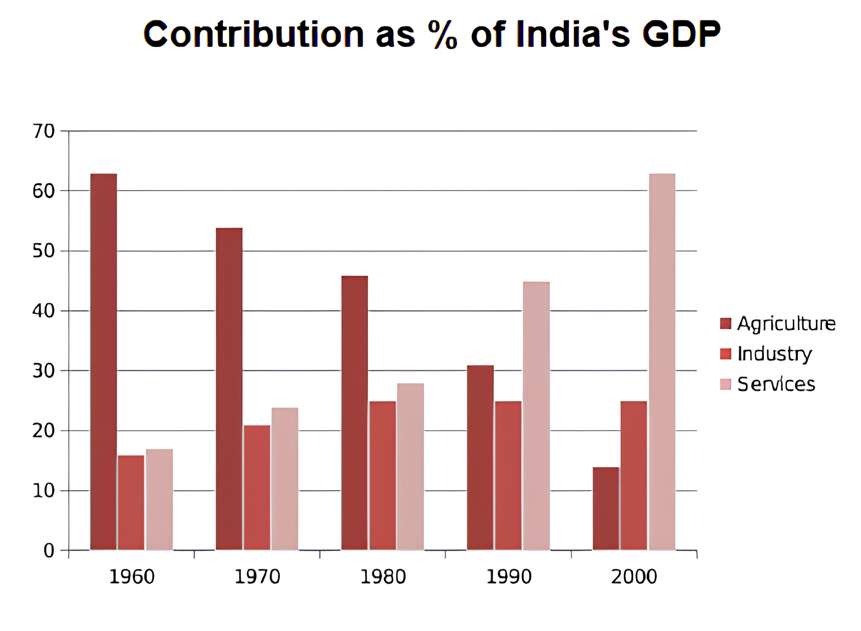
The bar chart details the constituent elements of India’s GDP divided into the agriculture, industry, and service sectors from 1960 to 2000. Looking from an overall perspective, it is readily apparent that services became by far the dominant field over the time surveyed, overtaking agriculture, which declined considerably. Industry increased but displayed a far less extreme trend, ending the period above agriculture.
In 1960, agriculture represented the overwhelming majority of India’s total GDP at near 63%, noticeably higher than industry and services at around 18% each. Over the next two decades, agriculture declined by 10% each year to fall to 45% in 1980 while there were reciprocal rises for industry and services, with both reaching just under 30% by the same year.
From 1980, agriculture continued a consistent decline that terminated at 25% in 2000. The trends for the remaining sectors then diverged with industry plateauing and remaining relatively stable around 23%. In contrast, the contribution of services to overall GDP more than doubled with near 20% surges over the ensuing decades to finish at 63%, a figure identical to the data point for agriculture 40 years prior.
Analysis
1. The bar chart details the constituent elements of India’s GDP divided into the agriculture, industry, and service sectors from 1960 to 2000. 2. Looking from an overall perspective, it is readily apparent that services became by far the dominant field over the time surveyed, overtaking agriculture, which declined considerably. 3. Industry increased but displayed a far less extreme trend, ending the period above agriculture.
Paraphrase the overall essay topic.
Write a clear overview summarising the differences and the overall trend.
This one is a little complex so it needs a second sentence for the overview.
1. In 1960, agriculture represented the overwhelming majority of India’s total GDP at near 63%, noticeably higher than industry and services at around 18% each. 2. Over the next two decades, agriculture declined by 10% each year to fall to 45% in 1980 while there were reciprocal rises for industry and services, with both reaching just under 30% by the same year.
Begin writing about the data for the first categories.
Compare between each sentence.
1. From 1980, agriculture continued a consistent decline that terminated at 25% in 2000. 2. The trends for the remaining sectors then diverged with industry plateauing and remaining relatively stable around 23%. 3. In contrast, the contribution of services to overall GDP more than doubled with near 20% surges over the ensuing decades to finish at 63%, a figure identical to the data point for agriculture 40 years prior.
Write about the final other parts of the graph – include everything!
The paragraphs should be about equal length.
Include all the data.
Vocabulary
What do the words in bold below mean?Make some notes on paper to aid memory and then check below.
The bar chart details the constituent elements of India’s GDP divided into the agriculture, industry, and service sectors from 1960 to 2000. Looking from an overall perspective, it is readily apparent that services became by far the dominant field over the time surveyed, overtaking agriculture, which declined considerably. Industry increased but displayed a far less extreme trend, ending the period above agriculture.
In 1960, agriculture represented the overwhelming majority of India’s total GDP at near 63%, noticeably higher than industry and services at around 18% each. Over the next two decades, agriculture declined by 10% each year to fall to 45% in 1980 while there were reciprocal rises for industry and services, with both reaching just under 30% by the same year.
From 1980, agriculture continued a consistent decline that terminated at 25% in 2000. The trends for the remaining sectors then diverged with industry plateauing and remaining relatively stable around 23%. In contrast, the contribution of services to overall GDP more than doubled with near 20% surges over the ensuing decades to finish at 63%, a figure identical tothe data point for agriculture 40 years prior.
Answers
For extra practice, write an antonym (opposite word) on a piece of paper to help you remember the new vocabulary:
Details the constituent elements of → Outlines the key components of
Divided into → Categorized into
Agriculture → Farming and cultivation
Industry → Manufacturing and production
Service → Tertiary sector
Looking from an overall perspective, it is readily apparent that → From a broad viewpoint, it is clear that
Became by far the dominant field → Emerged as the leading sector
Over the time surveyed → Throughout the analyzed period
Overtaking → Surpassing
Declined considerably → Dropped significantly
Displayed a far less extreme trend → Exhibited a more moderate pattern
Ending the period above → Concluding the timeframe higher than
Represented the overwhelming majority of → Accounted for the vast bulk of
Noticeably higher than → Substantially greater than
Each → Every individual
Over the next two decades → Across the following 20 years
Fall to → Decrease to
There were reciprocal rises for → Corresponding increases occurred for
Reaching just under → Approaching slightly below
By the same year → In the corresponding year
Continued a consistent decline that terminated at → Maintained a steady decrease, ending at
The trends for the remaining sectors then diverged → The patterns for the other categories then shifted in different directions
I recommend getting a pencil and piece of paper because that aids memory. Then write down the missing vocabulary from my sample answer in your notebook:
The bar chart d____________________________f India’s GDP d_________o the a_______e, i_______y, and s____________s from 1960 to 2000. L______________________________________________t services b__________________________________________________d, o_________g agriculture, which d______________________y. Industry increased but d_________________________d, e___________________e agriculture.
In 1960, agriculture r_________________________________f India’s total GDP at near 63%, n______________________n industry and services at around 18% e____h. O___________________s, agriculture declined by 10% each year to f_____o 45% in 1980 while t___________________________________r industry and services, with both r_______________r 30% b________________r.
From 1980, agriculture c___________________________________________t 25% in 2000. T_____________________________________________d with industry p___________g and r______________________e around 23%. In contrast, the c___________n of services to o______________________________________h near 20% s_______________________________________t 63%, a_______________________________________________r agriculture 40 years p______r.
Listening Practice
Learn more about this topic by watching from YouTube below and practice with these activities:
Question 1: What kinds of jobs do young people not want to do in your country?
Question 2: Who is best at advising young people about choosing a job: teachers or parents?
Question 3: Is money always the most important thing when choosing a job?
Question 4: Do you agree that most people nowadays are under pressure to work longer hours and take less holiday?
Question 5: What is the impact on society of people having a poor work-life balance?
Question 6: Could you recommend some effective strategies for governments and employers to ensure people have a good work-life balance?
Writing Practice
Practice with the related IELTS essay topic:
Many governments think that economic progress is their most important goal. Some people, however, think that other types of progress are equally important for a country.
Discuss both these views and give your own opinion.
Some believe that the government should support artists like musicians, painters, and poets, while others argue that this is a misuse of funds.
Discuss both views and give your own opinion
Some argue that government support for artists is vital for cultural and artistic development, while others believe that it constitutes a misuse of public funds. In my opinion, allocating resources for creatively-minded individuals is justifiable.
On the one hand, opponents of government support for the arts contend that this money could be better spent elsewhere, particularly on more pressing social issues such as healthcare, education, and poverty alleviation. Critics make the point that the arts, while valuable, are a luxury that should not take precedence over basic public services. For example, during times of economic hardship, when governments are faced with budget deficits, many believe that funding for arts programs should be reduced or eliminated to prioritize more immediate needs. This is evident in countries like Greece, where austerity measures have forced significant cuts to public services. These critics argue artists should seek funding through private means or market-based initiatives, such as sponsorships or crowdfunding, rather than straining taxpayers.
On the other hand, those in favor of government support for artists argue that the arts are an essential part of society’s cultural heritage and identity. Without funding, many artists would struggle to create their work, which could lead to a decline in cultural production. For instance, state funding has been crucial for the preservation and development of various art forms. In the United Kingdom, the National Lottery Fund allocates money to arts projects, helping to support everything from local theatre productions to international art exhibitions. These investments can stimulate creativity, enrich society, and attract tourists. In fact, art often generates substantial revenue through tourism, as visitors flock to cities known for their cultural institutions and festivals. Therefore, government funding is a means to promote national pride and economic growth.
In conclusion, while both sides present valid arguments, I believe that government support for artists is crucial for the long-term cultural and economic health of society, provided that it is managed prudently and in conjunction with other societal priorities. A well-balanced allocation of funds can ensure that both the arts and essential public services are adequately supported.
Analysis
1. Some argue that government support for artists is vital for cultural and artistic development, while others believe that it constitutes a misuse of public funds. 2. In my opinion, allocating resources for creatively-minded individuals is justifiable.
Paraphrase the overall essay topic.
Write a clear opinion. Read more about introductions here.
1. On the one hand, opponents of government support for the arts contend that this money could be better spent elsewhere, particularly on more pressing social issues such as healthcare, education, and poverty alleviation. 2. Critics make the point that the arts, while valuable, are a luxury that should not take precedence over basic public services. 3. For example, during times of economic hardship, when governments are faced with budget deficits, many believe that funding for arts programs should be reduced or eliminated to prioritize more immediate needs. 4. This is evident in countries like Greece, where austerity measures have forced significant cuts to public services. 5. These critics argue artists should seek funding through private means or market-based initiatives, such as sponsorships or crowdfunding, rather than straining taxpayers.
Write a topic sentence with a clear main idea at the end.
Explain your main idea.
Develop it with specific or hypothetical examples.
Keep developing it fully.
Better to have more detail.
1. On the other hand, those in favor of government support for artists argue that the arts are an essential part of society’s cultural heritage and identity. 2. Without funding, many artists would struggle to create their work, which could lead to a decline in cultural production. 3. For instance, state funding has been crucial for the preservation and development of various art forms. 4. In the United Kingdom, the National Lottery Fund allocates money to arts projects, helping to support everything from local theatre productions to international art exhibitions. 5. These investments can stimulate creativity, enrich society, and attract tourists. 6. In fact, art often generates substantial revenue through tourism, as visitors flock to cities known for their cultural institutions and festivals. 7. Therefore, government funding is a means to promote national pride and economic growth.
Write a new topic sentence with a new main idea at the end.
Explain your new main idea.
Include specific details and examples.
Add as much information as you can and make sure it links logically.
This essay is a bit long – aim for about 275 words.
This paragraph can be longer since I agree with this side.
State a final conclusion.
1. In conclusion, while both sides present valid arguments, I believe that government support for artists is crucial for the long-term cultural and economic health of society, provided that it is managed prudently and in conjunction with other societal priorities. 2. A well-balanced allocation of funds can ensure that both the arts and essential public services are adequately supported.
Summarise your main ideas.
Include a final thought. Read more about conclusions here.
Vocabulary
What do the words in bold below mean?Make some notes on paper to aid memory and then check below.
Some argue that government support for artists is vital for cultural and artistic development, while others believe that it constitutes a misuse of public funds. In my opinion, allocating resources for creatively-minded individuals is justifiable.
On the one hand, opponents of government support for the arts contend that this money could be better spent elsewhere, particularly on more pressing social issues such as healthcare, education, and poverty alleviation. Critics make the point that the arts, while valuable, are a luxury that should not take precedence over basic public services. For example, during times of economic hardship, when governments are faced with budget deficits, many believe that funding for arts programs should be reduced or eliminated to prioritize more immediate needs. This is evident in countries like Greece, where austerity measures have forced significant cuts to public services. These critics argue artists should seek funding through private means or market-based initiatives, such as sponsorships or crowdfunding, rather than straining taxpayers.
On the other hand, those in favor of government support for artists argue that the arts are an essential part of society’s cultural heritage and identity. Without funding, many artists would struggle to create their work, which could lead to a decline in cultural production. For instance, state funding has been crucial for the preservation and development of various art forms. In the United Kingdom, the National Lottery Fund allocates money to arts projects, helping to support everything from local theatre productions to international art exhibitions. These investments can stimulate creativity, enrich society, and attract tourists. In fact, art often generates substantial revenue through tourism, as visitors flock to cities known for their cultural institutions and festivals. Therefore, government funding is a means to promote national pride and economic growth.
In conclusion, while both sides present valid arguments, I believe that government support for artists is crucial for the long-term cultural and economic health of society, provided that it is managed prudently and in conjunction with other societal priorities. A well-balanced allocation of funds can ensure that both the arts and essential public services are adequately supported.
Answers
For extra practice, write an antonym (opposite word) on a piece of paper to help you remember the new vocabulary:
Government support State assistance
Vital Crucial
Cultural and artistic development Advancement of culture and the arts
Constitutes Represents
Misuse of public funds Improper allocation of taxpayer money
Allocating resources for creatively-minded individuals Distributing funds to support artistic talents
Justifiable Defensible
Opponents of Critics of
Contend Argue
Better spent elsewhere Put to better use in other areas
Particularly on more pressing social issues Especially on urgent societal concerns
Healthcare Medical services
Poverty alleviation Reducing financial hardship
Critics make the point Opponents argue
Valuable Important
Luxury Non-essential indulgence
Take precedence over basic public services Be prioritized over fundamental community needs
During times of economic hardship In periods of financial strain
Faced with budget deficits Dealing with financial shortfalls
Funding for arts programs should be reduced or eliminated Support for artistic initiatives should be cut back or discontinued
Prioritize more immediate needs Focus on addressing urgent necessities
This is evident in This is demonstrated by
Austerity measures Economic cutbacks
Forced significant cuts to public services Led to major reductions in essential services
Seek funding through private means or market-based initiatives Rely on private investments or commercial opportunities
Sponsorships Corporate funding
Crowdfunding Community-based fundraising
Rather than straining taxpayers Instead of burdening citizens financially
Those in favor of Supporters of
An essential part of A fundamental component of
Cultural heritage and identity Traditions and collective identity
Without funding In the absence of financial support
Struggle to create their work Face challenges in producing art
Decline in cultural production Reduction in creative output
Crucial Essential
Preservation Protection
Various art forms Diverse creative expressions
Allocates money to arts projects Designates funds for artistic endeavors
Local theatre productions Community stage performances
International art exhibitions Global showcases of artwork
Investments Funding initiatives
Stimulate creativity Encourage innovation
Enrich society Enhance communal well-being
Attract tourists Draw visitors
Generates substantial revenue Produces significant income
Visitors flock to cities known for their cultural institutions and festivals Tourists gather in areas celebrated for their artistic attractions and events
Government funding is a means to promote national pride and economic growth Public financing fosters patriotism and boosts the economy
Present valid arguments Offer reasonable points
Long-term cultural and economic health of society Sustained well-being of culture and economy
Provided that it is managed prudently If handled wisely
In conjunction with Together with
A well-balanced allocation of funds A fair distribution of resources
I recommend getting a pencil and piece of paper because that aids memory. Then write down the missing vocabulary from my sample answer in your notebook:
Some argue that g_______________t for artists is v____l for c_________________________t, while others believe that it c________s a m______________________s. In my opinion, a____________________________________________________s is j_________e.
On the one hand, o_____________f government support for the arts c_________d that this money could be b______________________________e, p_______________________________s such as h_________e, education, and p_______________n. C______________________t that the arts, while v__________e, are a l_______y that should not t______________________________________s. For example, d_____________________________p, when governments are f__________________s, many believe that f________________________________________________d to p________________________s. T_____________n countries like Greece, where a________________s have f___________________________________s. These critics argue artists should s_____________________________________________s, such as s____________s or c___________g, r__________________________s.
On the other hand, t_________________f government support for artists argue that the arts are a________________f society’s c______________________________y. W______________g, many artists would s_____________________________k, which could lead to a d___________________________n. For instance, state funding has been c______l for the p__________n and development of v________________s. In the United Kingdom, the National Lottery Fund a_____________________________s, helping to support everything from l______________________s to i_________________________s. These i__________s can s__________________y, e____________y, and a_____________s. In fact, art often g_______________________e through tourism, as v____________________________________________________________s. Therefore, g______________________________________________________________________h.
In conclusion, while both sides p________________________s, I believe that government support for artists is crucial for the l___________________________________________________y, p_______________________________________y and i__________________h other societal priorities. A_____________________________s can e________e that both the arts and essential public services are a________________________d.
Listening Practice
Learn more about this topic by watching from YouTube below and practice with these activities:
The increasing frequency of satellite launches and space debris is becoming a threat to the Earth.
What are the main causes of this phenomenon?
What measures can be taken to address the issue?
The growing frequency of satellite launches and the resulting increase in space debris is a pressing issue that has become a major concern for both scientists and policymakers. In my opinion, the primary causes of this phenomenon concern modern technological demands, and there are governmental measures that can be taken to mitigate the issue.
The origins of the increase in satellite launches are significant advancements in technology and a growing demand for global connectivity. Technological progress has reduced the cost of satellite launches, leading to an explosion in the number of satellites sent into orbit. For example, companies like SpaceX and Amazon have made plans to launch constellations of thousands of satellites into low Earth orbit to provide global internet coverage. As a result, this increase in the number of satellites in orbit has drastically contributed to the rise in space debris. The collisions between satellites and space junk further exacerbate the situation, generating even more debris, all of which is a result of the demand on Earth for more convenient internet access.
To tackle the growing threat posed by space debris, several measures must be taken at national and international levels. First and foremost, governments and space agencies must impose stricter regulations on the disposal of defunct satellites and debris. One potential solution is to require satellite operators to include de-orbiting mechanisms in their designs. For example, the European Space Agency Recently launched a mission called “ClearSpace-1,” which aims to demonstrate the capability of removing space debris by capturing and de-orbiting defunct satellites using a robotic arm. In addition to the European Space Agency’s initiative, many nations are collaborating on creating spacecraft that can capture and remove space junk. These efforts, if scaled up and integrated into global space policy, could significantly help in clearing up space debris, safeguarding both satellites and future space missions.
In conclusion, the main causes of more satellites and debris in space include technological advances and to address these challenges, strict state management must be prioritized. By taking such measures seriously, one can ensure that space remains a safe and sustainable environment for future generations.
Analysis
1. The growing frequency of satellite launches and the resulting increase in space debris is a pressing issue that has become a major concern for both scientists and policymakers. 2. In my opinion, the primary causes of this phenomenon concern modern technological demands, and there are governmental measures that can be taken to mitigate the issue.
Paraphrase the overall essay topic.
Write a clear opinion. Read more about introductions here.
1. The origins of the increase in satellite launches are significant advancements in technology and a growing demand for global connectivity. 2. Technological progress has reduced the cost of satellite launches, leading to an explosion in the number of satellites sent into orbit. 3. For example, companies like SpaceX and Amazon have made plans to launch constellations of thousands of satellites into low Earth orbit to provide global internet coverage. 4. As a result, this increase in the number of satellites in orbit has drastically contributed to the rise in space debris. 5. The collisions between satellites and space junk further exacerbate the situation, generating even more debris, all of which is a result of the demand on Earth for more convenient internet access.
Write a topic sentence with a clear main idea at the end.
Explain your main idea.
Develop it with specific or hypothetical examples.
Keep developing it fully.
Better to have more detail.
1. To tackle the growing threat posed by space debris, several measures must be taken at national and international levels. 2. First and foremost, governments and space agencies must impose stricter regulations on the disposal of defunct satellites and debris. 3. One potential solution is to require satellite operators to include de-orbiting mechanisms in their designs. 4. For example, the European Space Agency Recently launched a mission called “ClearSpace-1,” which aims to demonstrate the capability of removing space debris by capturing and de-orbiting defunct satellites using a robotic arm. 5. In addition to the European Space Agency’s initiative, many nations are collaborating on creating spacecraft that can capture and remove space junk. 6. These efforts, if scaled up and integrated into global space policy, could significantly help in clearing up space debris, safeguarding both satellites and future space missions.
Write a new topic sentence with a new main idea at the end.
Explain your new main idea.
Include specific details and examples.
Add as much information as you can and make sure it links logically.
This essay is a bit long – aim for about 275 words.
1. In conclusion, the main causes of more satellites and debris in space include technological advances and to address these challenges, strict state management must be prioritized. 2. By taking such measures seriously, one can ensure that space remains a safe and sustainable environment for future generations.
Summarise your main ideas.
Include a final thought. Read more about conclusions here.
Vocabulary
What do the words in bold below mean?Make some notes on paper to aid memory and then check below.
The growing frequency of satellite launches and the resulting increase in space debris is a pressing issue that has become a major concern for both scientists and policymakers. In my opinion, the primary causes of this phenomenon concern modern technological demands, and there are governmental measures that can be taken to mitigate the issue.
The origins of the increase in satellite launches are significant advancements in technology and a growing demand for global connectivity. Technological progress has reduced the cost of satellite launches, leading to an explosion in the number of satellites sent into orbit. For example, companies like SpaceX and Amazon have made plans to launch constellations of thousands of satellites into low Earth orbit to provide global internet coverage. As a result, this increase in the number of satellites in orbit has drastically contributed to the rise in space debris. The collisions between satellites and space junk further exacerbate the situation, generating even more debris, all of which is a result of the demand on Earth for more convenient internet access.
To tackle the growing threat posed by space debris, several measures must be taken at national and international levels. First and foremost, governments and space agencies must impose stricter regulations on the disposal of defunct satellites and debris. One potential solution is to require satellite operators to include de-orbiting mechanisms in their designs. For example, the European Space Agency Recently launched a mission called “ClearSpace-1,” which aims to demonstrate the capability of removing space debris by capturing and de-orbiting defunct satellites using a robotic arm. In addition to the European Space Agency’s initiative, many nations are collaborating on creating spacecraft that can capture and remove space junk. These efforts, if scaled up and integrated into global space policy, could significantly help in clearing up space debris, safeguarding both satellites and future space missions.
In conclusion, the main causes of more satellites and debris in space include technological advances and to address these challenges, strict state management must be prioritized. By taking such measures seriously, one can ensure that space remains a safe and sustainable environment for future generations.
Answers
For extra practice, write an antonym (opposite word) on a piece of paper to help you remember the new vocabulary:
Growing frequency of satellite launches – Increasing rate of satellite deployments
Resulting increase in space debris – Corresponding surge in orbital debris
Pressing issue – Urgent challenge
A major concern for both scientists and policymakers – A critical issue for researchers and decision-makers
The primary causes of this phenomenon concern modern technological demands – The main drivers of this trend stem from contemporary technological needs
Governmental measures – Official actions
Mitigate the issue – Alleviate the problem
Origins – Causes
Significant advancements in technology – Notable progress in innovation
Growing demand for global connectivity – Rising necessity for worldwide connectivity
Technological progress – Scientific development
Reduced the cost of – Lowered the expense of
Leading to an explosion in the number of satellites sent into orbit – Resulting in a rapid growth in satellite deployments
Have made plans to launch constellations of thousands of satellites – Have proposed initiatives to deploy networks with thousands of satellites
Low Earth orbit – Near-Earth orbit
Provide global internet coverage – Deliver worldwide internet access
As a result – Consequently
Drastically contributed to the rise in space debris – Significantly escalated the accumulation of orbital waste
Collisions – Impacts
Space junk further exacerbate the situation – Orbital debris worsens the problem
Generating even more debris – Creating additional fragments
Demand on Earth for more convenient internet access – Increasing need for seamless global connectivity
Tackle – Address
Growing threat posed by – Rising danger from
National and international levels – Both domestic and global scales
First and foremost – Primarily
Space agencies – Aerospace organizations
Impose stricter regulations on – Enforce tighter rules regarding
Disposal of defunct satellites and debris – Management of inactive satellites and orbital waste
One potential solution is – A feasible approach could be
Require satellite operators – Mandate that satellite providers
Include de-orbiting mechanisms in their designs – Integrate re-entry technologies into their models
Which aims to demonstrate – Intended to showcase
Capability – Competence
Capturing and de-orbiting defunct satellites using a robotic arm – Securing and removing inactive satellites with automated tools
Collaborating – Partnering
Capture and remove space junk – Retrieve and eliminate orbital debris
Scaled up and integrated into global space policy – Expanded and incorporated into worldwide space regulations
Significantly help – Greatly assist
Safeguarding both satellites and future space missions – Protecting orbital assets and upcoming explorations
Technological advances – Innovations in technology
Address these challenges – Overcome these obstacles
Strict state management – Rigorous governmental oversight
Prioritized – Given precedence
By taking such measures seriously – Through earnest implementation of these steps
Ensure – Guarantee
Remains a safe and sustainable environment for future generations – Continues to be a secure and viable space for posterity
I recommend getting a pencil and piece of paper because that aids memory. Then write down the missing vocabulary from my sample answer in your notebook:
The g__________________________________s and the r_______________________________________s is a pressing issue that has become a_________________________________________________s. In my opinion, t_____________________________________________________s, and there are g____________________________s that can be taken to m______________________e.
The o____s of the increase in satellite launches are s____________________________________y and a g___________________________________________y. T____________________s has r__________________f satellite launches, l_______________________________________________________________t. For example, companies like SpaceX and Amazon h___________________________________________________________s into l__________________t to p__________________________e. A_________t, this increase in the number of satellites in orbit has d___________________________________________________s. The c___________s between satellites and s_______________________________________n, g________________________________s, all of which is a result of the d_____________________________________________________s.
To t_______e the g___________________y space debris, several measures must be taken at n___________________________s. F_____________________t, governments and s____________s must i___________________n the d_________________________s. O__________________________s to r____________________s to i______________________________s. For example, the European Space Agency Recently launched a mission called “ClearSpace-1,” w_________________________e the c___________y of removing space debris by c____________________________________________m. In addition to the European Space Agency’s initiative, many nations are collaborating on creating spacecraft that can c__________________________k. These efforts, if s_______________________________________________y, could s___________________p in clearing up space debris, s__________________________________________________s.
In conclusion, the main causes of more satellites and debris in space include t_____________________s and to a____________________________s, s___________________________t must be p_____________d. B________________________y, one can e__________________________________________________________________________________s.
Listening Practice
Learn more about this topic by watching from YouTube below and practice with these activities:
IELTS Essay: Performance-Enhancing Drugs in Sports
In recent years, there has been a rise in the use of performance-enhancing drugs in sports.
What are the consequences of doping for athletes?
What measures should be taken to combat this issue?
There has been a considerable rise in detections for performance-enhancing substances in athletic competitions recently. In my opinion, the most likely consequences for athletes concern their careers and this infraction is best tackled through more sophisticated screening tests.
In the majority of cases, athletes risk lasting career repercussions when caught doping. The first and most obvious consequences are financial. An athlete who tests positive for a banned substance will certainly be banned for a defined amount of time, potentially permanently in serious cases, and will forfeit salary and prize money over this period. Beyond raw salary, most athletes receive endorsements and a worsening public image will undoubtedly damage those business relationships as well. Relatedly, an athlete’s legacy is also at stake. A well-known example of this would be the baseball player Barry Bonds who not only lost the final years of an illustrious career to suspensions but has also not been inducted into the Baseball Hall of Fame due to his past transgressions and numerous failed tests.
In order to combat the pervasiveness of performance-enhancing drugs, sporting authorities must invest in modernized testing procedures. The most complex testing is currently utilized in the Olympics, however there are flaws in this system as it is often compromised by corruption and the equally sophisticated doping methods of certain nations. A more pertinent case study would be in sports such as boxing and MMA where testing can literally mean the difference between life and death. In boxing, athletes often agree to their own testing procedures contractually. This method is inferior to vesting power in an authority, such as the UFC, that can ensure tests are modern and fairly conducted. Most UFC athletes are tested at random points throughout the year as well as prior to and immediately after bouts. Applying such a policy across various sports would not only catch the vast majority of infractions but also, more importantly, deter abuse from even beginning.
In conclusion, athletes risk reputational and financial damage by doping and this can be prevented as testing becomes more comprehensive and potent. These measures are necessary to safeguard the integrity of sporting competitions around the world.
Analysis
1. There has been a considerable rise in detections for performance-enhancing substances in athletic competitions recently. 2. In my opinion, the most likely consequences for athletes concern their careers and this infraction is best tackled through more sophisticated screening tests.
Paraphrase the overall essay topic.
Write a clear opinion. Read more about introductions here.
1. In the majority of cases, athletes risk lasting career repercussions when caught doping. 2. The first and most obvious consequences are financial. 3. An athlete who tests positive for a banned substance will certainly be banned for a defined amount of time, potentially permanently in serious cases, and will forfeit salary and prize money over this period. 4. Beyond raw salary, most athletes receive endorsements and a worsening public image will undoubtedly damage those business relationships as well. 5. Relatedly, an athlete’s legacy is also at stake. 6. A well-known example of this would be the baseball player Barry Bonds who not only lost the final years of an illustrious career to suspensions but has also not been inducted into the Baseball Hall of Fame due to his past transgressions and numerous failed tests.
Write a topic sentence with a clear main idea at the end.
Explain your main idea.
Develop it with specific or hypothetical examples.
Keep developing it fully.
Better to have more detail.
The more specific an example, the better.
1. In order to combat the pervasiveness of performance-enhancing drugs, sporting authorities must invest in modernized testing procedures. 2. The most complex testing is currently utilized in the Olympics, however there are flaws in this system as it is often compromised by corruption and the equally sophisticated doping methods of certain nations. 3. A more pertinent case study would be in sports such as boxing and MMA where testing can literally mean the difference between life and death. 4. In boxing, athletes often agree to their own testing procedures contractually. 5. This method is inferior to vesting power in an authority, such as the UFC, that can ensure tests are modern and fairly conducted. 6. Most UFC athletes are tested at random points throughout the year as well as prior to and immediately after bouts. 7. Applying such a policy across various sports would not only catch the vast majority of infractions but also, more importantly, deter abuse from even beginning.
Write a new topic sentence with a new main idea at the end.
Explain your new main idea.
Include specific details and examples.
Add as much information as you can and make sure it links logically.
Include short and long sentences.
This essay is a bit long – aim for about 275 words.
Finish the paragraph strong.
1. In conclusion, athletes risk reputational and financial damage by doping and this can be prevented as testing becomes more comprehensive and potent. 2. These measures are necessary to safeguard the integrity of sporting competitions around the world.
Summarise your main ideas.
Include a final thought. Read more about conclusions here.
Vocabulary
What do the words in bold below mean?Make some notes on paper to aid memory and then check below.
There has been a considerable rise indetections for performance-enhancing substances in athletic competitions recently. In my opinion, the most likely consequences for athletes concern their careers and this infraction is best tackled through more sophisticated screening tests.
In the majority of cases, athletes risk lasting career repercussions when caught doping. The first and most obvious consequences are financial. An athlete who tests positive for a banned substance will certainly be banned for a defined amount of time, potentially permanently in serious cases, and will forfeit salary and prize money over this period. Beyond raw salary, most athletes receive endorsements and a worsening public image will undoubtedly damage those business relationships as well. Relatedly, an athlete’s legacy is also at stake. A well-known example of this would be the baseball player Barry Bonds who not only lost the final years of an illustrious career to suspensions but has also not been inducted into the Baseball Hall of Famedue to his past transgressions and numerous failed tests.
In order to combat the pervasiveness of performance-enhancing drugs, sporting authorities must invest in modernized testing procedures. The most complex testing is currently utilized in the Olympics, however there are flaws in this system as it is often compromised by corruption and the equally sophisticated doping methods of certain nations. A more pertinent case study would be in sports such as boxing and MMA where testing can literally mean the difference between life and death. In boxing, athletes often agree to their own testing procedures contractually. This method is inferior to vesting power in an authority, such as the UFC, that can ensure tests are modern and fairly conducted. Most UFC athletes are tested at random points throughout the year as well as prior to and immediately after bouts. Applying such a policy across various sports would not only catch the vast majority of infractions but also, more importantly, deter abuse from even beginning.
In conclusion, athletes risk reputational and financial damage by doping and this can be prevented as testing becomes more comprehensive and potent. These measures are necessary to safeguard the integrity of sporting competitions around the world.
Answers
For extra practice, write an antonym (opposite word) on a piece of paper to help you remember the new vocabulary:
There has been a considerable rise in detections
There has been a significant increase in identifications
performance-enhancing substances
performance-boosting substances
athletic competitions
sporting events
most likely consequences for
probable outcomes for
concern t
worry regarding
infraction
violation
best tackled through more sophisticated screening tests
most effectively addressed by advanced screening techniques
In the majority of cases
In most instances
caught doping
caught using banned substances
The first and most obvious consequences
The primary and most evident repercussions
financial
monetary
tests positive for a banned substance
returns a positive result for a prohibited substance
certainly be banned for a defined amount of time
will undoubtedly face a suspension for a specified period
potentially permanently in serious cases
possibly indefinitely in extreme situations
forfeit salary
lose wages
prize money
winnings
Beyond raw salary
Apart from basic salary
receive endorsements
obtain sponsorship deals
worsening public image
deteriorating public perception
undoubtedly damage those business relationships
will certainly harm professional connections
Relatedly
In connection with this
legacy is also at stake
reputation is also at risk
A well-known example of this would be
A famous illustration of this is
lost the final years of an illustrious career to suspensions
forfeited the final years of a distinguished career due to bans
inducted into the Baseball Hall of Fame due to his past transgressions and numerous failed tests
excluded from the Baseball Hall of Fame because of his previous offenses and repeated failures in drug tests
In order to combat
To counteract
pervasiveness
widespread nature
sporting authorities
sports governing bodies
invest in modernized testing procedures
allocate resources to advanced testing systems
most complex testing
the most intricate testing
currently utilized in the Olympics
presently employed in the Olympic Games
flaws in this system
weaknesses in this system
compromised by corruption and the equally sophisticated doping methods of certain nations
undermined by corruption and equally advanced doping techniques used by certain countries
A more pertinent case study would be in
A more relevant example would be in
literally mean the difference between life and death
could truly determine life or death
agree to their own testing procedures contractually
contractually consent to their own testing protocols
This method is inferior to vesting power in an authority
This approach is less effective than empowering an authority
UFC
Ultimate Fighting Championship
ensure tests are modern and fairly conducted
guarantee that tests are up-to-date and conducted impartially
tested at random points throughout the year
randomly tested throughout the year
prior to and immediately after bouts
before and right after matches
Applying such a policy across various sports would
Implementing this policy across different sports would
catch the vast majority of infractions
identify the overwhelming majority of violations
more importantly
more significantly
deter abuse from even beginning
prevent misuse from starting in the first place
risk reputational and financial damage
incur potential harm to reputation and finances
prevented
avoided
comprehensive and potent
thorough and effective
measures
strategies
safeguard the integrity of sporting competitions around the world
I recommend getting a pencil and piece of paper because that aids memory. Then write down the missing vocabulary from my sample answer in your notebook:
T__________________________________________s for p____________________________s in a________________________s recently. In my opinion, the m____________________________r athletes c________n their careers and this i____________n is b______________________________________s.
I______________________s, athletes risk lasting career repercussions when c___________g. T_________________________________s are f_______________l. An athlete who t_______________________e will c___________________________________________e, p___________________________________s, and will f_______________y and p____________y over this period. B___________________y, most athletes r_______________________s and a w_____________________e will u___________________________________s as well. R___________y, an athlete’s l______________________e. A__________________________________e the baseball player Barry Bonds who not only l___________________________________________________s but has also not been i_________________________________ed_____________________________________________________-s.
I______________t the p_____________s of performance-enhancing drugs, s______________s must i___________________________________-s. The m_________________g is c__________________________s, however there are f_______________m as it is often c___________________________________________________________________________s. A____________________________n sports such as boxing and MMA where testing can l________________________________h. In boxing, athletes often a______________________________________y. T________________________________________________y, such as the U__C, that can e________________________________________________d. Most UFC athletes are t____________________________________________r as well as p___________________________________________s. A_____________________________________d not only c______________________________________s but also, m____________y, d______________________g.
In conclusion, athletes r_________________________________________e by doping and this can be p____________d as testing becomes more c____________________________________t. These m__________s are necessary to s_______________________________________________________________d.
Listening Practice
Learn more about this topic by watching from YouTube below and practice with these activities:
"The highest quality materials anywhere on the internet! Dave improved my writing and vocabulary so much. Really affordable options you don't want to miss out on!"