Here are 10 excellent college/university application essays.
The way I prefer for these essays to stand out is through storytelling.
These stories below need a bit more detail to be a full college application essay – a little preface or part at the end with some generalities about why you want to go to such-and-such a school.
But I’ve deliberately taken that part out to make the point that that is very standard. That the focus should be on something that grabs your attention, that is specific, that is memorable and makes you stand out head and shoulders above other candidates.
Lots of essays are too general, vague, sentimental, and full of cliches.
The solution to that is to tell a specific, concrete story.
It’s better to use understated, subtle language, and not try to teach some grand lesson at the end of your story – that comes off sounding pretentious and a bit arrogant. Or even sentimental, like a Disney fairytale movie.
Keep it subtle to impress more: someone who brags a lot, doesn’t actually impress anyone.
But someone who shows they are good at a skill, impresses and persuades.
And that’s your goal with these essays: subtle persuasion.
Dave
1. The Ticking Stopwatch
I learned to measure time by the sound of my grandfather’s stopwatch. Click. I held my breath before my name was called. Click. Fierce seconds before I stepped onto the mat. Click. A flurry of muscle pushing until it meets bone and can’t push any further – then twisting and straining to gain leverage, to press my opponent down onto the floor.
My maternal grandfather was precision. He carried his stopwatch everywhere, clicking it open and shut like a metronome to the rhythm of his life, the way some people unconsciously finger a cigarette or roll and unroll their sleeves. He had been a wrestler in his youth, a man who believed in effort over outcome, process over product. “Seconds matter,” he would say, though he never meant it in the way I thought. To him, the act of counting was a reminder to be present, to make each second count—not to fear them, as I often did.
I signed up the wrestling team in eighth grade, following in his footsteps. My dad wasn’t around much then. I took to it right away. The weight of an opponent on my back, the sweat pooling at my temples, the echo of my own breath as I strained against the mat— overwhelming, disorienting. I was neither the strongest nor the fastest, and I lost just about every match my first year. But each time, my grandfather was in the stands, stopwatch in hand, clicking it at the start and stop of every round. This sort of response felt impersonal and constructive to me.
One day, after a particularly humiliating loss, I slumped onto the bleachers beside him. “You never win,” I muttered, fishing for sympathy. He simply clicked the stopwatch and said, “What did you learn in the last six minutes?”
I shrugged. “That I lose.”
He chuckled, shaking his head. “You learned where you were weak. Where you hesitated. Where you let fear take over.” He handed me the stopwatch. “Just count the seconds and don’t think about anything else.”
The next morning, I arrived at practice early. I set the stopwatch on the gym floor and timed my drills, not to rush through them but to see how long I could push myself before exhaustion. I started to think less about winning and more about endurance. When I finally won my first match—a narrow victory, a single point gained in the final seconds—I heard the click from the stands before the referee even raised my hand.
Years later, my grandfather’s stopwatch sits on my desk, its surface scratched from use. I quit wrestling my junior year, but I still hear its rhythm in my head. Click. The moment before I walk onto a stage to present. Click. The hesitation before submitting a college application. Click. Doubt. Click.
2. The Five-Dollar Bill
Every Sunday morning, my father gave me a five-dollar bill and told me to “make it count.” I never asked what that meant. He never explained. That was kind of our thing.
The first time, I spent it on a used book from a street vendor. It was missing pages, its spine cracked, but I carried it everywhere, filling in the missing words with my own. Another week, I gave the bill to a street musician, his violin case open at his feet. He nodded, kept playing. Most times, I filled a less altruistic craving – for junk food or a coffee. I’m lazy by nature.
Some weeks, I forgot about the bill until late Sunday night and ended up buying something meaningless—a nice drawing pen, a magazine I didn’t read. Those times, I felt like I had failed, as if there was an unspoken test I hadn’t passed, that someone marked me down and eventually I’d find out my GPA from an omniscient, disappointed observor.
One week, I saved the bill. Then another. And another. When I had fifty dollars, I walked into a bookstore and bought the most expensive journal they had. Heavy, bound in deep brown leather, permanent. I wrote in it every now and then, recording not what I did that day, but what I noticed—overheard conversations, the color of the sky before it rained, the way people’s faces changed when they thought no one was looking.
When my father stopped giving me this weekly allowance in High School, because I had part-time work by then, I felt I had learned an important lesson.
The things I bought and used – the snacks and books and so on – didn’t create any lasting value for me. I used them up and often felt worse for it.
But the journal encouraged me to be active: to write and think and improve a skill.
This mindset has influenced other areas of my life and now I seek out experiences, purchases, and services that foster a more active life.
And I look at essential items like my phone as potential vehicles for action – and do my best to avoid the vulnerable parts of my psychology that look for a passive crevice to get lost in.
3. The Blue Sweater
It had a small hole near the cuff, a loose thread along the collar, and a scent I could never quite place. My mother called it worn out nearly every time she saw me throwing it on on my way out the door.
I found the sweater at a thrift store when I was twelve, buried beneath a stack of scratchy wool pullovers. It wasn’t the color that caught my attention—faded navy, gray in places—but the softness, the way it felt like it had passed through hands already, been the soft cushion against many hard benches. I paid three dollars and wore it home, sleeves bunched at my wrists, the hem falling just past the hips I was becoming more and more self-conscious of.
I wore it through the rest of middle school and into high school, through seasons it should have sat out – sharp autumns and sweaty summers. It followed me to bonfires, bus rides, late-night anxious walks when I needed air. In the winter, I stuffed my hands into the sleeves when my gloves weren’t enough defense. In the spring, I tied it around my waist, waiting for a cold enough breeze as an excuse to slip it back on.
People started to recognize me by it. “Still wearing that thing?” my friend Mark joked one afternoon, tugging at the sleeve. I don’t know how to explain that it has become part of my routine, like carrying my house keys or checking the sky before I step outside. It’s an anchor, a blanket I can wear out of the house. A self-soother.
One afternoon, I left it at school, stretched over the back of a chair. I didn’t notice until I got home, until the air felt different against my skin.
When I opened my closet the next morning, I felt the cool air rushing out, remembered it wasn’t there and rummaged through my clothes looking for it anyway.
I checked the lost-and-found at school, ran my hands over piles of forgotten scarves and mismatched mittens – it wasn’t there.
I went back to classroom and found it lying on the floor.
4. The Unfinished Puzzle
When I was eight, my mother bought a thousand-piece puzzle. It was an image of a lighthouse standing against a storm, waves crashing against the rocks below. We spread the pieces across the dining table and started sorting: edges first, then the sky, then the ocean.
We worked on it for weeks. After dinner, before school, late at night when I was supposed to be asleep. It became part of our rhythm, filling the quiet spaces between us. We never talked much while we worked, just the occasional “I think this one fits” or “Try turning it the other way.”
One day, we lost a piece. A single, small section of sky near the top. We searched the floor, checked under the rug, sifted through the box. Gone. My mother sighed, pressing her fingers to the empty space. “Sometimes things stay unfinished,” she said.
We never took the puzzle apart. It stayed on the table for months, the missing piece like a pause in a sentence that was never completed. It bothered me a lot more than it bothered her. She seemed to move on in a way that seemed heartless and inattentive to me at the time.
Years later, after we moved, I found the puzzle box in storage. I lifted the lid, half-expecting the missing piece to have reappeared. It hadn’t. But I ran my fingers over the image, remembering the hours spent stitching it together.
How important it seemed then to make it whole. How unimportant it seems now.
5. The Overturned Canoe
The first time I tipped a canoe, I hoped I might drown. One second, I was rolling across the lake, my paddle cutting through the placid surface, and the next, I was underwater, arms doing their utmost, lungs stressed out. When I finally kicked my way to the surface, the canoe was upside down, my life jacket scratching against my neck, and my uncle was laughing from his boat a few yards away. “Looks like you found the hard way to cool off,” he called out.
I was ten years old and spent every summer at my uncle’s cabin by the lake. Canoeing was supposed to be easy—a quiet glide over smiling water, the kind of thing I’d seen in postcards. But the lake wasn’t still that day, and I wasn’t graceful and the lake wore no expression at all. My paddle had skimmed the surface at the wrong angle, my weight had shifted too far left, and suddenly, the canoe had turned against me.
I gripped the side of the boat, my fingers slipping on the wet aluminum. My uncle rowed over and showed me how to flip it back over, how to hoist myself up without sending it toppling over again. “Try again,” he said. I didn’t want to. My arms ached, my throat was raw from swallowing lake water, and my heart was still humming. But I climbed back in, because I didn’t want to sit in the boat with him, listening to him tell self-congratulatory stories about how he used to flip his canoe “on purpose” just to practice getting back in.
I paddled slower after that. I let the water tell me how it moved before I moved with it. The next time I wobbled, I adjusted my balance without thinking. I stayed dry.
Years later, my uncle and I took the same canoe out again, but this time, the lake was calm. I was sixteen. He sat in the back, letting me steer. We didn’t talk much (thankfully), just moved through the water, the dip and pull of our paddles the only sound.
Pausing, he asked, “Still afraid of tipping?”
I pretended to think about it. “Not really.”
“Then let’s see how fast you can go.”
I dug my paddle into the lake, the canoe following, cutting open the clear sky. The old fear wasn’t there anymore. Just the rhythm. Just the movement.
Just the water, just shadowing it.
6. The Grocery List
When my mother first handed me a grocery list, I was seven. “Just the essentials,” she said, placing a ten-dollar bill in my palm. I took the list like a treasure map, the handwriting looping and precise, the corners of the paper softened from being folded and unfolded for convenience.
At the small store down the block, I wandered the aisles, squinting at the list. Bread. Milk. Eggs. Cliche. I picked out each item self-consciously, afraid I’d reveal an undiscerning eye. At the checkout, cradling the carton of eggs in both hands, sure one would crack through an act of God, I counted out the money slowly, making sure I had enough before sliding the bills across the counter. When I returned home, my mother nodded: “You did good.”
Over time, the lists got longer, the instructions more complicated. Sometimes, my mother added notes in the margins—“Get the ripe avocados, not the hard ones, no black spots, no soft (squishy) spots” or “The yogurt your dad likes, blue and white brand.” I learned the way a ripe avocado should feel, how to check eggs for cracks before putting them in the cart. I honed my ability to choose a checkout line – to spot the most disaffected teenage cashier, to seek out the ones with lightning quick hands and half-liffed eyes.
By the time I was twelve, I could have stocked the shelves. I knew which products were just out of reach, which ones a growth spurt would propel me towards soon enough, where they kept the extra bags of rice when the main aisle was empty. I no longer needed to ask for help.
Then, one evening, my mother handed me the list with a different look in her eyes. “I need you to get everything,” she said. “Not just the essentials.” She gave me a longer list, a twenty-dollar bill instead of ten. I nodded like it was no big deal, but as I walked to the store, I read over the list twice, then again. There were things on there I’d never had to pick before—seasonings, a specific brand of rice, something called shallots. I pushed the cart slowly, reading labels, second-guessing myself. The store was louder that day, the lights brighter, the aisles longer.
I made it home with everything except the shallots. “They were out,” I said quickly, not wanting her to know I hadn’t known what they looked like.
She nodded, unpacking the bags. “Good.”
That night, I looked up shallots. The next time they were on the list, I got them.
I was happy I’d have nothing to hide this time.
7. The Sound of Typing
The first thing I hear every morning is the sound of my father’s keyboard. Before the sun rises, before anyone else grits themself awake, he’s away at his desk, typing. The rhythm is steady, concrete. A few words, a pause. More words. A longer pause. Some mornings, he sighs, leans back, cracks, and starts again.
I used to think he was writing stories. When I was little, I’d climb onto his lap and ask what the words meant, imagining characters coming to life behind the glowing screen. Fairy tales and children’s stories like Peter Pan and Dr. Seuss. He never corrected me. He’d just smile and read a sentence aloud, letting me believe it was something magical.
It wasn’t until I was older that I realized my father wasn’t writing fiction—he was writing emails. Reports. Plans. Things that made the house run, that kept the lights on, that made sure there was always food on the table. It’s disappointing. I had wanted him to be a storyteller. I noticed the way his fingers moved, the same secret rhythm every morning, like a pianist practicing scales.
When I started writing my own stories, I tried to match that rhythm. Type. Pause. Adjust. Type again. I learned that writing, no matter the kind, requires the same patience, the same doggedness to erase and begin again.
When I read back my work, it’s often disappointing too. I often read and reread it over and over again until it becomes good from familiarity.
The way I feel when I hear a pop song I’ve heard a hundred times before in cafes and restaurants. I might not like the song, but when it comes on, I recognize it and feel hyped up to listen to it for the first minute or so until I remember I don’t even like that song.
8. The Bus Ride
The bus ride home from school was always loud. Kids shouted across the aisles, backpacks unstuck from seats, the windows fogged up to reflect the snow. But my seat was almost always the same—third row from the back, by the window. Assigned to me by me.
Most days, I watched the houses blur past, counting mailboxes, wondering about the people inside. Back then I didn’t know I was near-sighted so sometimes I’d look at the scenery and wonder what it would be like to have bad vision. On rainy days, I traced shapes and words into the condensation on the glass. Once, I saw my reflection in the window and hardly recognized myself—the world outside moving so fast, my face still and bloated.
One afternoon, the bus hit a pothole, and a kid in front of me spilled his bag. I helped him gather his things. But the next day, he sat next to me. We never really talked, just watched the houses go by together.
9. The Old Piano
The piano in the corner of our living room was never quite in tune. Some keys stuck, a few let out muted thuds instead of clear notes, and the sustain pedal wobbled under my foot. But it got us by.
I grew up watching my older sister play it. She sat straight-backed and haughty, fingers moving across the keys, never looking down. I envied how arrogantly the music seemed to flow from her hands, how she could play without stopping to fumble or restart. When I turned eight, my mother signed me up for lessons too.
I didn’t take to it the way my sister had. The scales felt stiff, the sheet music unreadable. My fingers tripped over the keys. I was clumsy in a way I’ve never been playing sports. I wanted to quit. “Just practice,” mom said. “It’ll come.”
I did. Every afternoon, I sat on the wooden bench, forcing every lesson. I played the same songs over and over, each mistake like a pebble in my shoe. My sister, passing by and catching on, would hum the tune I was struggling with, effortlessly on pitch.
One day, disporportionately frustrated, I slammed the lid shut. “I don’t have a musical bone in my body,” I muttered.
My mother looked up from the couch. “Not everything comes easy.”
I didn’t respond to her platitude, just lifted the lid again.
The next time my sister passed, she stopped. Instead of humming, she sat beside me. “Try this,” she said, demonstrating a passage slowly. I mimicked her movements, and for once, the notes fell into place. She nodded condescendingly. “See?”
The piano is still out of tune today. Some keys still stick. But sometimes I’ll play when no one else is home. Now that those skills have had some time to simmer, I’m really not all that bad at it I think.
10. The Garden Hose
The garden hose was always tangled. No matter how carefully we coiled it, by the next afternoon, it had twisted itself into impossible knots. My grandfather never seemed to mind. He just shook his head, untangled it with the patient steady energy of a retired person, and turned the water on.
In the summers, I followed him around the yard, barefoot on the warm concrete, watching as he watered the plants. He never rushed. He moved the hose slowly from one flower bed to the next, letting the soil soak in the water before moving on. “No use drowning them,” he’d say. Make sure you water all around so all the roots get some. Some plants don’t want too much water. Better to water in the early morning or early evening for some reason I forget. Pat the soil to see how wet it is. Check for budding bugs and prune the leaves on the more delicate ones.
When he let me hold the hose, I always got carried away, sending arcs of water high into the air, drenching my feet. He never scolded me for wasting water. He just chuckled, then showed me how to angle the spray lower, closer to the roots.
One evening, after he had finished watering, he handed me the hose. “Your turn,” he said, and went inside.
I stood there, alone in the quiet yard, the hose heavy in my hands. I walked slowly from plant to plant, squinting to see water disappear into the soil. When I turned the spigot off, I coiled the hose carefully, pulling it into a neat loop. It had still tangled itself up by the next afternoon.
I don’t live in that house anymore, but sometimes, when I water the plants on our new balcony, I think about the way he moved the hose, the way he never rushed.
And I take my time too.
Practice
If you want to write your own essays based on these basic prompts, you can start with the summaries below and write them in your own style.
1. The Ticking Stopwatch I learned to measure time by the sound of my grandfather’s stopwatch. Click. The moment I held my breath before my name was called. Click. The silent seconds before I stepped onto the mat. Click. The instant I realized winning wasn’t everything, but learning to fight for something was.
2. The Five-Dollar Bill Every Sunday morning, my father gave me a five-dollar bill and told me to “make it count.” One week, I bought a used book. Another, I gave it to a street musician. Once, I left it on a bench with a note: “This is yours now.” It was a small experiment in agency, in generosity, in meaning.
3. A Crack in the Sidewalk Walking home, I tripped over a crack in the sidewalk. It was a reminder of the time I refused to read aloud in class. Of the missed soccer goal. Of the fear of failing a calculus test. But I stepped forward. The crack stayed behind me.
4. The Radio in My Grandmother’s Kitchen The same station played every morning—classical music, though she never called it that. “It’s just music,” she’d say, stirring soup, humming. I learned that some things don’t need labels to be understood.
5. The Worn Deck of Cards My uncle taught me poker at age eight. Not just the game, but the way to read people, the patience of waiting for the right hand, the art of folding even when I wanted to play.
6. The Paper Swan on My Desk I spent a summer perfecting origami. My first swan was lopsided, the second worse. By the end, my fingers folded paper with precision. My desk held a fleet of swans, each one a lesson in quiet perseverance.
7. The Library Basement I found solace in a basement filled with dusty books, in the company of stories older than my grandparents. There, I learned to listen, to observe, to piece together history from yellowed pages.
8. The Echo in the Empty Pool I swam before I could walk. Then the pool closed, and my strokes became memories. But echoes in empty places remind me that what we lose often lingers.
9. The Recipe Card Stained with Vanilla My mother’s handwriting, smudged with flour and vanilla, held secrets. “A pinch of patience. A dash of courage.” I learned that recipes, like stories, are meant to be passed down.
10. The Chessboard in My Backpack Each piece had a name, a purpose. The knight moved in L-shapes, the bishop cut diagonally. I found comfort in the logic, the certainty, until I learned that the best players embrace the unpredictable.
11. The Bus Ride with Strangers An old man spoke of his youth. A woman shared a poem. A child laughed at the raindrops. We were strangers, but for thirty minutes, we were a story in motion.
12. The Dictionary with Torn Pages I kept a list of words I loved: petrichor, serendipity, susurrus. Words that held weight, even when whispered.
13. The Kite That Never Flew I built it with my brother, but the wind wasn’t strong enough. We ran anyway, dragging it behind us, laughing. Failure never felt so light.
14. The Concert I Couldn’t Afford I stood outside, listening through the cracks in the walls. Music has no barriers; neither does passion.
15. The Letter I Never Sent I wrote it on a cold night, filled with words I was too afraid to say. I never sent it, but I never threw it away either. Some truths are meant to be held, not given.
16. The Blinking Cursor The essay began as a blank screen, a blinking cursor. One word, then another. That’s how all stories begin.
17. The Night Without Electricity No screens, no distractions—just candlelight and conversation. I learned that silence isn’t empty; it’s full of meaning.
18. The First Snowfall I was five when I first saw snow. I caught flakes on my tongue, convinced I was tasting the sky.
19. The Sea Glass on the Shore Waves tumbled sharp glass into smooth gems. I wondered if time could do the same for people.
20. The Morning I Forgot My Name For ten minutes, I was nobody. Then I remembered. And in that remembering, I realized identity is both fragile and unshakable.
21. The Polaroid of a Stranger I found it at a flea market. A frozen moment from someone else’s life, a story untold but deeply felt.
22. The Clock That Ticked Too Fast I raced time for years, until I learned to walk instead, to savor each second rather than chase it.
23. The House That Stood Empty My childhood home, abandoned. I peered through the windows and saw ghosts of my past selves.
24. The Whisper in the Wind Somewhere in the mountains, the wind carried a whisper. Maybe it was my own voice, learning to listen.
25. The Unfinished Puzzle One piece was missing, but the picture still made sense. Imperfection doesn’t always mean incompleteness.
FAQ on Writing a College Application Essay: Your Ultimate Guide
Writing a college or university application essay can be a tough part of the application process.
It’s your opportunity to showcase who you are beyond grades and test scores.
To help clear up any confusion, I’m answering the most common questions students have asked me over the years about writing their college and university application essays.
1. What is the purpose of a college application essay?
The college application essay is your chance to tell admissions committees more about you. It allows you to go beyond your grades, extracurricular activities, and test scores. Through the essay, you can highlight your personality, values, and experiences in a way that shows why you’re a good fit for the college or university. It’s your opportunity to make your application stand out.
2. How do I choose a topic for my essay?
Choosing a topic can feel overwhelming, but remember, the best topics are often those that are personal and meaningful to you. Think about moments that have shaped you, challenges you’ve overcome, or experiences that demonstrate your values or aspirations. Try to avoid overly common topics like “winning an award” or “the time I helped someone,” unless you can provide a fresh perspective.
Some useful brainstorming strategies include:
Reflecting on key moments in your life (e.g., a pivotal trip, a relationship with a mentor, an academic project).
Asking yourself: What has made me who I am today?
3. Should I write about a personal struggle or failure?
Yes, writing about a personal struggle or failure can be effective, but only if you focus on how you learned and grew from the experience. Colleges want to see how you handle challenges, not just that you’ve had them. Make sure to emphasize what you learned, how it shaped your character, and how it prepared you for future success.
Be honest, but avoid making the essay too negative or focused on the problem. Shift the focus to how you overcame the struggle and what you gained from it.
4. How long should my college application essay be?
Most college essays typically range from 250 to 650 words, depending on the specific prompt or school. Make sure to carefully read the instructions, as some schools may have specific word count limits.
If you’re unsure, aim for around 500 words—this is usually the sweet spot where you have enough space to tell a compelling story without overwhelming the reader.
5. Should I focus on academics, or is it okay to write about other aspects of my life?
While your grades and academic achievements are important, your essay doesn’t have to focus on them. Admissions committees are looking for well-rounded individuals. It’s okay to write about your personal interests, hobbies, or extracurricular activities, as long as you tie them back to your growth, character, or future ambitions.
For example, if you’re passionate about a hobby like photography or volunteering, you can write about how those activities have shaped your view of the world or developed your leadership skills.
6. Can I use humor in my essay?
Humor can be a great way to stand out if done right. A touch of humor can make your essay feel more authentic and help admissions officers connect with you on a personal level. However, be cautious not to overdo it or make the essay sound forced. Keep the humor light, respectful, and aligned with the overall tone of the essay.
Make sure your humor doesn’t distract from the main message or come across as inappropriate. It should always enhance, not detract, from your story.
7. How do I avoid sounding clichéd or too generic?
Admissions officers read hundreds, if not thousands, of essays. To avoid sounding clichéd, try to focus on your unique experiences and how they’ve shaped you. Instead of focusing on generic topics like “I want to change the world” or “I learned so much from my volunteer work,” focus on specific anecdotes that illustrate your personal growth.
Also, avoid overused phrases like “I overcame adversity” or “It was a life-changing moment” unless you can provide a concrete example that explains why it was significant to you.
8. Should I write my essay in the first or third person?
You should definitely write your college essay in the first person. This allows you to connect with the reader and showcase your personal thoughts, feelings, and experiences. Writing in the first person also helps make your voice come through more naturally, which is exactly what admissions officers are looking for.
9. How much time should I spend on writing my college application essay?
It’s crucial to give yourself plenty of time to write, revise, and perfect your essay. Ideally, you should start the process at least 6–8 weeks before your application deadline. This gives you time to brainstorm, write several drafts, seek feedback, and revise the essay until it’s the best version of yourself.
Avoid rushing through the process at the last minute. Quality essays take time to develop, so be patient and give yourself time for reflection and revision.
10. Should I get someone to review my essay?
Yes, it’s always helpful to get feedback from others. Ask teachers, family members, or trusted friends to read your essay and provide constructive criticism. They can help point out areas for improvement, offer suggestions, and catch any errors you may have missed.
However, make sure the feedback you receive doesn’t change your voice or the essence of your story. You want the essay to reflect who you are, not who someone else thinks you should be.
11. What are some common mistakes to avoid?
Here are a few mistakes to avoid when writing your college application essay:
Being too generic or vague: Admissions officers want to hear your story, not a general story anyone could tell.
Ignoring the prompt: Make sure to answer the question asked. Sometimes students write essays that don’t address the prompt fully, which can hurt their application.
Overloading your essay with achievements: The essay is not the place to list accomplishments. Use the space to showcase your personality and reflect on meaningful experiences.
Using inappropriate language or tone: Be mindful of your tone. Avoid slang or anything too casual, but also don’t make it overly formal. Find a balance that reflects who you are.
Submitting without proofreading: Always review your essay multiple times. Typos and grammatical mistakes can detract from your message and hurt your chances.
12. What if I’m not a strong writer?
If you don’t consider yourself a strong writer, don’t worry. The college application essay is about telling your story, not about showcasing perfect writing skills. Focus on expressing your thoughts clearly and authentically. The most important thing is to be yourself.
If you’re unsure about your writing, seek help from a teacher or counselor, or consider working with a professional editor to help you polish the final draft. But always ensure the final product is true to your voice.
13. What should I do if I’m not sure I have a “great” story to tell?
Every student has a unique story to tell. Don’t feel pressured to write about something extraordinary. What matters most is how you frame your experiences and what you learned from them. Sometimes the most powerful essays come from simple moments that had a significant impact on your life.
Focus on what you learned and how your experiences have shaped who you are. Your story doesn’t need to be flashy—it just needs to be genuine.
Conclusion
Writing your college application essay can seem like a big task, but it’s really just an opportunity for you to share your personal journey and reflect on your growth. Keep the process simple by being honest, thoughtful, and true to yourself. Use the FAQ above as a guide to help you stay on track, and remember—your unique perspective is exactly what will make your essay stand out.
Over the years, I’ve helped a lot of students writing and editing their college and university application essays.
It’s a really tricky balance to strike with these essays.
On the one hand, you don’t want to sound like you’re bragging or showing off.
At the same time, you want to show off. Just in a subtle way…
I’m writing this post to give you some direction based on my experiences over the years with the students that have been most successful with their applications.
The key is to stand out and impress the admissions officers – without seeming like you are trying too hard to impress!
Admissions officers read thousands of essays every year, and the quickest way to get lost in the shuffle is by writing something vague and generic. Phrases like “I have always had a passion for helping others” or “This experience taught me the value of hard work” don’t actually say much about who you are. Instead, focus on specific details and concrete moments that bring your story to life.
How to Do This:
Tell a story. Instead of saying, “I love science,” describe the time you accidentally turned your kitchen into a chemistry experiment gone wrong.
Use sensory details. What did the moment look, sound, or feel like? Instead of “I felt proud,” describe the adrenaline rush in your chest when your project won first place.
Avoid sweeping statements. Instead of “This changed my life,” explain exactly how it changed you—maybe it made you more patient, more curious, or even more skeptical.
Bragging Without Sounding Like You’re Bragging
It’s a college application—you have to talk about yourself. But there’s a fine line between confidence and arrogance. The trick? Show your accomplishments through actions, not empty declarations.
How to Do This:
Give credit to others. Instead of “I led my team to victory,” try “My team and I spent weeks strategizing, and in the final moments of the game, our plan paid off.”
Let the impact speak for itself. Instead of “I am an incredible problem solver,” tell a story about a time you found a creative solution to an unexpected challenge.
Use humor or humility. If you’re writing about winning a debate championship, you might mention the time you tripped over your own shoelaces on stage before delivering the winning argument.
Keep Your Language Simple and Unpretentious
Big words won’t impress admissions officers if they make your essay sound unnatural. Writing with clarity and personality is far more effective than stuffing your essay with fancy vocabulary.
How to Do This:
Write how you talk (but cleaner). If you wouldn’t say “heretofore” in real life, don’t put it in your essay.
Use short, punchy sentences. A sentence like “I froze. My mind went blank. And then—I remembered.” is much more engaging than “I suddenly experienced a mental lapse before recovering my train of thought.”
Read it out loud. If you stumble over a sentence, chances are it’s too complicated.
A Few Final Tips
Start early. A rushed essay is an obvious essay.
Edit mercilessly. The best essays go through multiple drafts. Get rid of anything that doesn’t add value.
Be yourself. If your essay sounds like it could have been written by anyone, rewrite it until it sounds like you.
Writing a great college application essay isn’t about using the biggest words or listing every achievement. It’s about telling a compelling story that only you can tell. Be specific, be honest, and most of all—be you.
Authenticity shines through.
Bad Examples
Here are some examples of bad college application essays that are too general, clichéd, and full of platitudes and vague statements. These essays lack the depth and personal touch needed to stand out.
Example 1: The “I Love Helping People” Essay
Prompt: “Describe a significant experience or accomplishment that has shaped who you are today.”
Essay: “I have always been passionate about helping others. From volunteering at my local food bank to tutoring younger students, I believe that giving back to my community is one of the most important things a person can do. Helping others has taught me the value of kindness, generosity, and the importance of making a difference in the world. I know that these values will guide me through college and beyond, and I hope to continue serving others for the rest of my life.”
Why it’s bad:
Vagueness: The essay is extremely general and doesn’t provide specific examples of how the applicant has helped others or what they learned from these experiences.
Lack of Depth: It sounds like a platitude that could apply to anyone, and it doesn’t offer any real insight into the applicant’s personality or growth.
No Personal Connection: The essay doesn’t discuss why these experiences were meaningful to the applicant, making it difficult for the reader to connect with the writer.
Example 2: The “Overcoming Adversity” Essay
Prompt: “Describe a challenge you have overcome and how it has shaped you.”
Essay: “Life is full of challenges, and I believe that overcoming adversity is what makes people stronger. I have faced many obstacles in my life, but I never give up. Every challenge, whether it’s personal or academic, has taught me resilience and perseverance. I know that these traits will help me succeed in college and in life. Overcoming difficulties makes us better people, and I am proud of the way I have grown through each experience.”
Why it’s bad:
Cliché: The essay uses a tired, generic theme about overcoming adversity without offering any real, specific details or examples.
Lack of Personalization: There’s no explanation of the specific challenge faced, how it was overcome, or what the applicant learned in the process. It could apply to any applicant and doesn’t showcase anything unique about the writer.
No Reflection: The essay doesn’t demonstrate self-reflection or show how the applicant has changed or developed. It simply states general ideas about resilience and growth.
Example 3: The “I Want to Change the World” Essay
Prompt: “What are your academic interests and goals for the future?”
Essay: “I want to change the world. I am passionate about making a difference, whether through science, technology, or community service. My goal is to find a way to solve the world’s problems, like hunger, poverty, and environmental destruction. I believe that with hard work and dedication, I can make an impact and help improve the lives of others. College is the next step in my journey to becoming a change-maker, and I can’t wait to see what the future holds.”
Why it’s bad:
Vague: The essay lacks concrete examples of how the applicant plans to change the world. The statement is aspirational, but it’s not grounded in any real actions or specifics.
Too Broad: The essay is filled with grandiose statements like “change the world” and “solve the world’s problems,” but without any details on how the applicant intends to do that. It’s unclear what the applicant is actually interested in.
Lack of Depth: There’s no personal insight into why the applicant is passionate about these issues, nor is there any discussion of their specific academic interests. It sounds like a generic, overly ambitious statement without real substance.
Example 4: The “My Family is Amazing” Essay
Prompt: “Describe an influential person in your life.”
Essay: “My family has always been there for me. They have supported me through thick and thin, and I am so grateful for everything they’ve done for me. My parents have taught me the importance of hard work, dedication, and kindness. They always encourage me to pursue my dreams and never give up. Because of them, I know that I can do anything I set my mind to. I wouldn’t be the person I am today without their constant love and support.”
Why it’s bad:
Cliché: This essay is filled with generic, overly sentimental statements about family that don’t add any depth or new perspective.
Lack of Specificity: It doesn’t provide any concrete examples of how the family supported the applicant or what the applicant specifically learned from them.
No Personal Insight: It doesn’t explain how the applicant has grown or been influenced by their family in any unique or meaningful way. It’s simply a thank-you note rather than an insightful narrative.
Example 5: The “I’m a Leader” Essay
Prompt: “What leadership qualities do you possess, and how have they influenced your life?”
Essay: “I am a natural leader. Throughout high school, I have taken on leadership roles in clubs, sports teams, and student organizations. I am always the one to step up and take charge. I believe that leadership is about being responsible, making decisions, and motivating others. My experiences have taught me how to manage people and work in teams. I know that these skills will help me succeed in college and beyond.”
Why it’s bad:
Overuse of Generalities: The essay doesn’t offer any specific examples or stories to demonstrate the applicant’s leadership abilities. It’s full of vague statements like “natural leader” and “motivating others.”
Lack of Evidence: The applicant says they have taken on leadership roles, but doesn’t explain what challenges they faced, how they grew, or how they impacted others.
No Reflection: The essay doesn’t show any personal growth or reflection on the leadership experience. It simply states that the applicant is a leader without explaining how or why that matters.
Key Takeaways:
Avoid clichés: Steer clear of overused phrases like “helping others,” “overcoming adversity,” or “changing the world.”
Be specific: Use concrete examples to illustrate your experiences, traits, and growth.
Show, don’t tell: Rather than making sweeping statements, use specific moments to demonstrate your qualities and achievements.
Reflect: Show how your experiences have shaped you and helped you grow, not just what you’ve done.
Good Example
Prompt: Describe a significant experience or accomplishment that has shaped who you are today.
Essay:
I sat cross-legged on the cracked pavement outside our school building, hands trembling as I held the damp, worn-out tennis racket. The summer heat of Houston wrapped itself around me like a suffocating blanket, but I barely noticed. I was focused on the ball that lay before me on the cracked asphalt court. It was a Tuesday, the day of the annual student tennis tournament, and for the first time, I was about to play on a team.
For years, I had watched from the sidelines. My school’s tennis team had always been dominated by students with years of experience, the ones who had been to tennis camps or had private coaches. I had none of that. Growing up, we couldn’t afford tennis lessons or fancy equipment. But my dad had picked up a racket when he was younger, and he would take me to the local park every Saturday morning to practice. Those weekends weren’t about winning or competition; they were about bonding. He taught me the mechanics, but more than that, he taught me patience.
I didn’t expect to be good. In fact, I fully anticipated being the weak link on the team. But what I hadn’t expected was the rush of vulnerability that hit me the moment I stepped onto the court for the first match. I was a small, shy kid who hated attention, and here I was, expected to hit a ball over a net in front of my teammates and a crowd of students. My heart pounded. I glanced at my teammates: Aaliyah, who had been playing since she was five, and Sam, who, despite being taller than me by a few inches, was also new to tennis but a natural athlete.
We were paired against the school’s best team that year. I could already see the looks of doubt on some of the more experienced players’ faces when they saw me holding my racket.
The match started. My hands were still trembling, and my first serve sent the ball flying so far off course it barely skimmed the edge of the sideline. I apologized, but Sam gave me a quick nod. “You got this,” he said, as if he believed it.
The first few games were a blur. I missed more than I hit, and Aaliyah and Sam did most of the heavy lifting. But with every serve and every rally, I started to find my rhythm. I remembered my dad’s advice: “It’s about consistency, not power.” By the final set, I was more focused than I had been all afternoon, even if I still wasn’t technically good. But it didn’t matter. I wasn’t just playing for myself anymore. I was playing for my teammates, for the bond we had built over those 30 minutes.
We won that match. Not because we were the better team, but because we worked together. We knew each other’s strengths and weaknesses, and that’s where we found our advantage. Aaliyah’s serve and Sam’s agility were the perfect complement to my steady volleys. By the end, we had each other’s backs in a way that transcended skill.
Later, when I was sitting with my teammates in the locker room, still processing the win, Aaliyah turned to me. “You know, we all thought we were just here to play tennis,” she said, her face still flushed from the match. “But it’s not just about hitting the ball. We make each other better.”
It hit me then. I wasn’t just playing tennis anymore; I was part of something bigger than myself. I had spent so much time thinking that my lack of experience would hold me back, but in reality, it was my willingness to contribute in whatever small way I could that made the difference. It wasn’t about being the best player on the court—it was about how we worked together and pushed each other to improve, regardless of skill level.
That match taught me something I still carry with me today: It’s not always about the outcome or how perfect your skills are. What matters is your ability to show up, support the people around you, and give your best effort, no matter the odds.
Since that day, I’ve learned not to be afraid of stepping outside of my comfort zone. I’ve become more involved in my school community, taking on leadership roles in clubs and projects, even when I felt like I wasn’t the “perfect” candidate. I’ve also been able to mentor younger students who are just starting to explore tennis, showing them the same patience and perseverance my dad once showed me.
I’ll never forget the feeling of walking off that court, still in disbelief that we had won. More than the match, I realized that overcoming my own self-doubt had been the biggest victory. And every time I face a new challenge—whether in tennis, academics, or life—I remember that it’s not about being perfect. It’s about showing up, pushing through, and believing in the process. And for that, I’ll always be grateful to that hot Tuesday afternoon on the tennis courts.
Why is this essay good?
This essay presents a specific, relatable experience that demonstrates personal growth and reflection. It avoids clichés and vague statements, focusing on a meaningful moment of vulnerability and teamwork, and it reveals how this experience shaped the applicant’s perspective on leadership and self-confidence. The use of a simple, yet powerful anecdote makes the story feel authentic and grounded in reality.
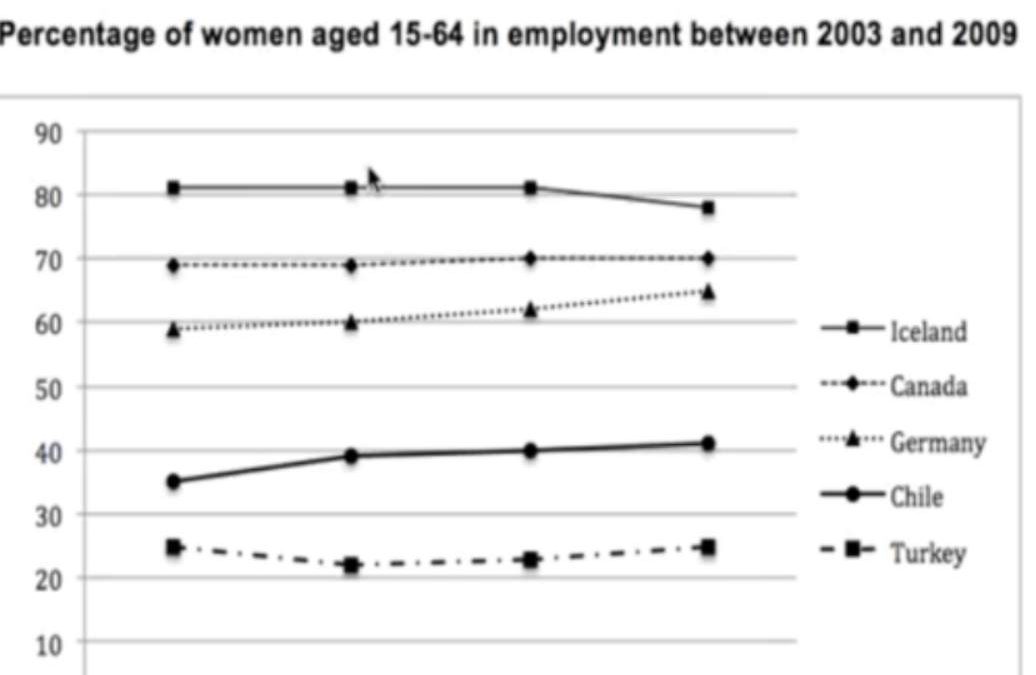
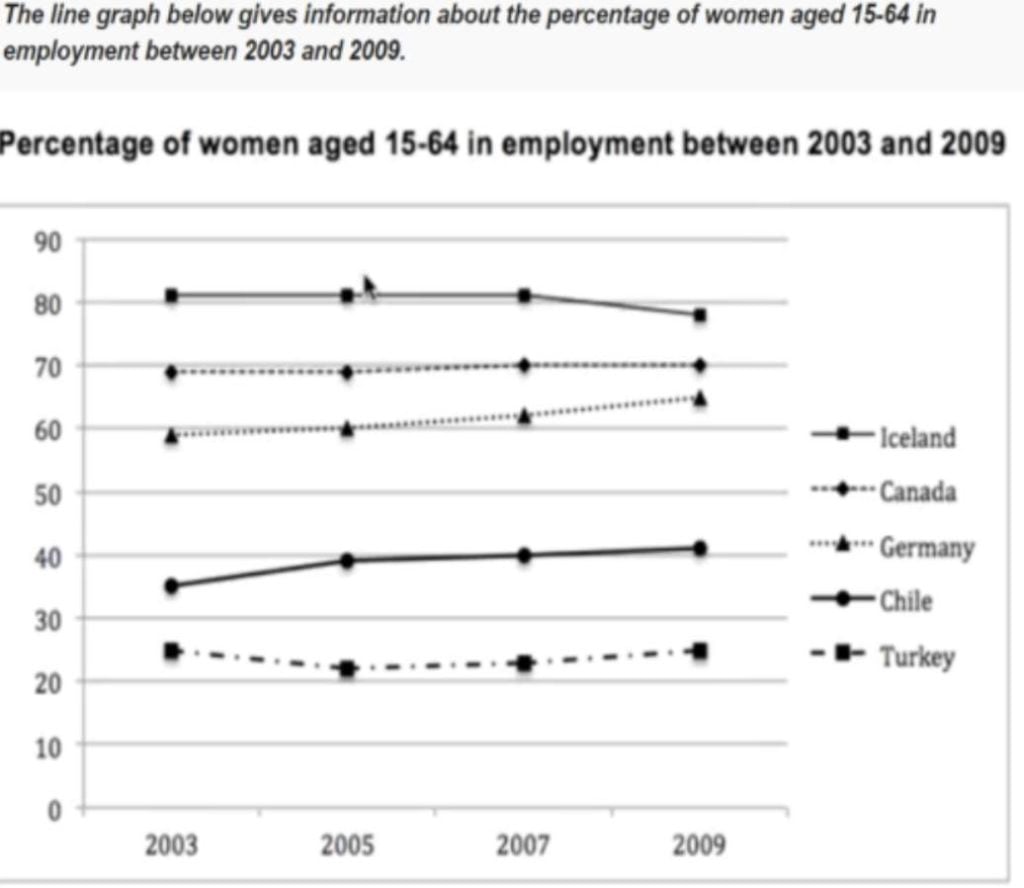
The line chart details the percentages for females working in various countries around the world from ages of 15 to 64. Looking from a general perspective, it is readily apparent that employment rose in all nations except for Iceland, where there was a marginal decline, and Turkey, where the percentage was stable overall. The three more developed nations also generally registered higher employment percentages compared to Chile and Turkey.
In 2003, there were approximately 10% differences in the figures for female employment in Iceland, Canada and Germany at 81%, 69%, and 59%, respectively. Over the next 4 years, these percentages were generally stable before Canadian employment began to diverge upwards to finish at 65% in 2009 and Iceland experienced the inverse trend dropping to end at 78%. Canada was more stable and concluded the period at precisely 70%.
In contrast, Chile and Turkeys’ female employment ratios were lower throughout with the former beginning at 35% and plateauing just above 40% for the remainder of the surveyed timeframe. The latter, in comparison, fell from 25% in 2003 to near 20% in the middle years of the period, before a full recovery in the final year.
Analysis
1. The line chart details the percentages for females working in various countries around the world from ages of 15 to 64. 2. Looking from a general perspective, it is readily apparent that employment rose in all nations except for Iceland, where there was a marginal decline, and Turkey, where the percentage was stable overall. 3. The three more developed nations also generally registered higher employment percentages compared to Chile and Turkey.
Paraphrase the overall essay topic.
Write a clear overview summarising the differences and the overall trend.
This one is a little complex so it needs a second sentence for the overview.
1. In 2003, there were approximately 10% differences in the figures for female employment in Iceland, Canada and Germany at 81%, 69%, and 59%, respectively. 2. Over the next 4 years, these percentages were generally stable before Canadian employment began to diverge upwards to finish at 65% in 2009 and Iceland experienced the inverse trend dropping to end at 78%. 3. Canada was more stable and concluded the period at precisely 70%.
Begin writing about the data for the first categories.
Compare between each sentence.
Vary short and long sentences.
1. In contrast, Chile and Turkeys’ female employment ratios were lower throughout with the former beginning at 35% and plateauing just above 40% for the remainder of the surveyed timeframe. 2. The latter, in comparison, fell from 25% in 2003 to near 20% in the middle years of the period, before a full recovery in the final year.
Write about the final other parts of the graph – include everything!
The paragraphs should be about equal length.
Vocabulary
What do the words in bold below mean?Make some notes on paper to aid memory and then check below.
The line chart details the percentages for females working in various countries around the world from ages of 15 to 64. Looking from a general perspective, it is readily apparent that employment rose in all nations except for Iceland, where there was a marginal decline, and Turkey, where the percentage was stable overall. The three more developed nations also generally registered higher employment percentages compared to Chile and Turkey.
In 2003, there were approximately 10% differences in the figures for female employment in Iceland, Canada and Germany at 81%, 69%, and 59%, respectively. Over the next 4 years, these percentages were generally stable before Canadian employment began to diverge upwards to finish at 65% in 2009 and Iceland experienced the inverse trend dropping to end at 78%. Canada was more stable and concluded the period at precisely 70%.
In contrast, Chile and Turkeys’ female employment ratios were lower throughout with the former beginning at 35% and plateauing just above 40% for the remainder of the surveyed timeframe. The latter, in comparison, fell from 25% in 2003 to near 20% in the middle years of the period, before a full recovery in the final year.
Answers
For extra practice, write an antonym (opposite word) on a piece of paper to help you remember the new vocabulary:
Here are synonymous phrases for each line:
Details the percentages for various countries around the world from
Provides the distribution of percentages across different nations globally from
Looking from a general perspective, it is readily apparent that
From a broader viewpoint, it is clear that
Rose in all nations except for
Increased in every country except for
A marginal decline
A slight decrease
The percentage was stable overall
The proportion remained consistent overall
More developed nations
Economically advanced countries
Generally registered higher employment percentages compared to
Typically showed greater employment rates in comparison to
Approximately
Around
The figures for
The data for
Respectively
In the same order
Generally stable
Largely consistent
Diverge upwards to finish at
Increase and conclude at
Experienced the inverse trend, dropping to end at
Followed the opposite pattern, falling to conclude at
I recommend getting a pencil and piece of paper because that aids memory. Then write down the missing vocabulary from my sample answer in your notebook:
The line chart d_________________________r females working in v________________________________m ages of 15 to 64. L_____________________________________________________t employment r________________________________r Iceland, where there was a________________________________e, and Turkey, where t____________________________l. The three m______________________s also g______________________________________________________________________o Chile and Turkey.
In 2003, there were a___________y 10% differences in t_____________r female employment in Iceland, Canada and Germany at 81%, 69%, and 59%, r____________y. Over the next 4 years, these percentages were g____________e before Canadian employment began to d_____________________t 65% in 2009 and Iceland e___________________________________________________t 78%. Canada was more stable and c____________________________y 70%.
I_____________t, Chile and Turkeys’ female employment r______s were l_________________________________________________t 35% and p__________________e 40% for t______________________________________e. T_________r, i___________n, fell from 25% in 2003 to n____r 20% i__________________________________d, b_________________________________r.
Listening Practice
Learn more about this topic by watching from YouTube below and practice with these activities:
Some people think that when recruiting, companies should aim to take on people who are innovative and able to work independently while others consider they should recruit people who are able to work in a team and follow instructions.
Discuss both views and give your opinion.
When hiring employees, companies face a crucial decision: should they prioritize individuals who are creative and capable of working independently, or should they focus on candidates who excel at teamwork and following instructions? While both types of employees bring unique strengths, I believe that companies should aim for a workforce with good team-working skills.
On the one hand, prioritizing innovative and independent workers drives progress. Take, for example, Elon Musk’s SpaceX. The company is known for hiring highly independent engineers who think laterally and devise groundbreaking solutions, such as the reusable rocket system. If SpaceX had only employed individuals who simply followed instructions, it is unlikely that they would have achieved such technological advancements. In the adjacent tech industry, companies like Google and Apple thrive because they recruit employees who do not just wait to be told what to do but instead take the initiative to develop new ideas, products, and solutions. Therefore, in industries where innovation is key, hiring independent thinkers is essential.
However, in the vast majority of contexts teamwork and the ability to follow instructions are crucial. In the fast-food industry, companies such as McDonald’s depend on employees who can strictly adhere to set procedures to ensure consistency in service and food quality. A worker at McDonald’s does not need to reinvent the way a burger is made; they need to follow standardized guidelines to maintain consistency. In large-scale manufacturing, such as automobile assembly lines at Toyota or Ford, efficiency is achieved when workers collaborate and follow instructions meticulously. If each employee tried to introduce their own methods, production would become chaotic and inefficient. This highlights the fact that teamwork and compliance with established procedures are necessary for smooth operations. Another example of this would be hospitals where doctors, nurses, and administrative staff must collaborate efficiently under strict protocols to provide effective patient care.
In conclusion, both independent and innovative employees and those who excel at teamwork and following instructions have their place in the workforce. Teamwork and adherence to protocols, in my opinion, are more generally applicable and therefore valuable characteristics.
Analysis
1. When hiring employees, companies face a crucial decision: should they prioritize individuals who are creative and capable of working independently, or should they focus on candidates who excel at teamwork and following instructions? 2. While both types of employees bring unique strengths, I believe that companies should aim for a workforce with good team-working skills.
Paraphrase the overall essay topic.
Write a clear opinion. Read more about introductions here.
1. On the one hand, prioritizing innovative and independent workers drives progress. 2. Take, for example, Elon Musk’s SpaceX. 3. The company is known for hiring highly independent engineers who think laterally and devise groundbreaking solutions, such as the reusable rocket system. 4. If SpaceX had only employed individuals who simply followed instructions, it is unlikely that they would have achieved such technological advancements. 5. In the adjacent tech industry, companies like Google and Apple thrive because they recruit employees who do not just wait to be told what to do but instead take the initiative to develop new ideas, products, and solutions. 6. Therefore, in industries where innovation is key, hiring independent thinkers is essential.
Write a topic sentence with a clear main idea at the end.
Explain your main idea.
Develop it with specific or hypothetical examples.
Keep developing it fully.
Better to have more detail.
This essay is a bit long.
1. However, in the vast majority of contexts teamwork and the ability to follow instructions are crucial. 2. In the fast-food industry, companies such as McDonald’s depend on employees who can strictly adhere to set procedures to ensure consistency in service and food quality. 3. A worker at McDonald’s does not need to reinvent the way a burger is made; they need to follow standardized guidelines to maintain consistency. 4. In large-scale manufacturing, such as automobile assembly lines at Toyota or Ford, efficiency is achieved when workers collaborate and follow instructions meticulously. 5. If each employee tried to introduce their own methods, production would become chaotic and inefficient. 6. This highlights the fact that teamwork and compliance with established procedures are necessary for smooth operations. 7. Another example of this would be hospitals where doctors, nurses, and administrative staff must collaborate efficiently under strict protocols to provide effective patient care.
Write a new topic sentence with a new main idea at the end.
Explain your new main idea.
Include specific details and examples.
Add as much information as you can and make sure it links logically.
Keep extending your ideas.
Include further results to extend fully.
This essay is maybe too long – aim for about 275 words.
1. In conclusion, both independent and innovative employees and those who excel at teamwork and following instructions have their place in the workforce. 2. Teamwork and adherence to protocols, in my opinion, are more generally applicable and therefore valuable characteristics.
Summarise your main ideas.
Include a final thought. Read more about conclusions here.
Vocabulary
What do the words in bold below mean?Make some notes on paper to aid memory and then check below.
When hiring employees, companies face a crucial decision: should they prioritize individuals who are creative and capable of working independently, or should they focus on candidates who excel at teamwork and following instructions? While both types of employees bring unique strengths, I believe that companies should aim for a workforce with good team-working skills.
On the one hand, prioritizing innovative and independent workers drives progress. Take, for example, Elon Musk’s SpaceX. The company is known for hiring highly independent engineers who think laterally and devise groundbreaking solutions, such as the reusable rocket system. If SpaceX had only employed individuals who simply followed instructions, it is unlikely that they would have achieved such technological advancements. In the adjacent tech industry, companies like Google and Apple thrive because they recruit employees who do not just wait to be told what to do but instead take the initiative to develop new ideas, products, and solutions. Therefore, in industries where innovation is key, hiring independent thinkers is essential.
However, in the vast majority of contexts teamwork and the ability to follow instructions are crucial. In the fast-food industry, companies such as McDonald’s depend on employees who can strictly adhere to set procedures to ensure consistency in service and food quality. A worker at McDonald’s does not need to reinvent the way a burger is made; they need to follow standardized guidelines to maintain consistency. In large-scale manufacturing, such as automobile assembly lines at Toyota or Ford, efficiency is achieved when workers collaborate and follow instructions meticulously. If each employee tried to introduce their own methods, production would become chaotic and inefficient. This highlights the fact that teamwork and compliance with established procedures are necessary for smooth operations. Another example of this would be hospitals where doctors, nurses, and administrative staff must collaborate efficiently under strict protocols to provide effective patient care.
In conclusion, both independent and innovative employees and those who excel at teamwork and following instructions have their place in the workforce. Teamwork and adherence to protocols, in my opinion, are more generally applicable and therefore valuable characteristics.
Answers
For extra practice, write an antonym (opposite word) on a piece of paper to help you remember the new vocabulary:
Hiring employees → Recruiting staff
Face a crucial decision → Make a pivotal choice
Prioritize → Emphasize
Creative and capable of working independently → Inventive and self-sufficient
Focus on candidates who excel at teamwork and following instructions → Seek candidates who thrive in collaborative environments and follow directions well
I recommend getting a pencil and piece of paper because that aids memory. Then write down the missing vocabulary from my sample answer in your notebook:
When hiring e__________s, companies face a___________________n: should they p__________e individuals who are creative a_________________________________________________y, or should they focus o____________________________________________________________s? While both types of employees bring u_________________s, I believe that companies should aim f________________________________________________________s.
On t______________d, prioritizing i______________________________s. Take, for example, Elon Musk’s SpaceX. The company is known for hiring h__________________________s who think l__________y and devise g_________________s, such as the reusable r_________________m. If SpaceX had only employed individuals who simply f________________s, it is unlikely that they would have achieved s_____________________________s. In t_______________________y, companies like Google and Apple t_______e because they recruit e___________s who do not just wait to be told what to do but instead take t___________________________________________________________s. Therefore, in industries where innovation is k___y, hiring i___________________________________________________l.
However, in t_________________________s teamwork and the ability to follow instructions are c_______l. In t________________y, companies such as McDonald’s depend ____n employees who can strictly a_s to ensure c____________________________________________________y. A worker at McDonald’s does not need to reinvent the way a burger is made; they need to follow s____________________________________________y. In l____________________g, such as automobile assembly l_____s at Toyota or Ford, efficiency i_______________n workers c_________e and follow i__________________y. If each employee tried to introduce t_____________________s, production w________________________________t. This h_____________________t teamwork and compliance w____________________s are necessary for smooth o_________s. Another example of this would be hospitals where doctors, nurses, and administrative s_____f must collaborate efficiently under s_______________________________________________________________e.
In conclusion, both independent and innovative employees and those who e_____l at teamwork and following instructions have t____________________e. Teamwork and a_________e to protocols, in my opinion, are more g____________________e and therefore valuable c____________s.
Listening Practice
Learn more about this topic by watching from YouTube below and practice with these activities:
"The highest quality materials anywhere on the internet! Dave improved my writing and vocabulary so much. Really affordable options you don't want to miss out on!"