This is an IELTS writing task 1 sample answer essay on the topic of a floorplan/map of a theatre.
Please consider supporting my efforts to creative high quality IELTS materials for students around the world by signing up for my Patreon (and so you won’t miss out on any of my exclusive IELTS Ebooks)!
Dave
IELTS Essay Task 1: Floorplan of a Theatre
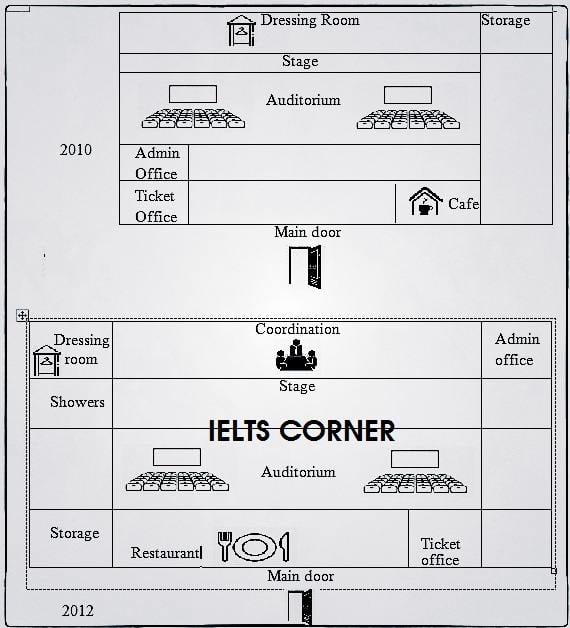
The plans below show a theatre in 2010 and 2012. Summarise the information by selecting and reporting the main features and making comparisons where relevant.
The above floor plan delineates a theatre in 2010 and in 2012 after renovations. Looking from an overall perspective, it is readily apparent that there was a general expansion of facilities allowing for both more customer-oriented business and staff activity.
In 2010, the smaller theater was centred around a large auditorium (unchanged in 2012) with a large dressing room space behind it and a storage area in the top right corner. By 2012, the storage room had moved to the bottom left corner in favour of an administration office, while the dressing room was repositioned to a smaller room in a new wing of the building on the left side, which also includes a room for showers. Replacing the long dressing room is a coordination area.
Near to the entrance, there is now a large restaurant occupying previously empty space and requiring the relocation of the admin and ticket offices (the former is now to the right of the office, displacing a cafe). The main door has remained the same and there are no other alterations since 2010.
Analysis
1. The above floor plan delineates a theatre in 2010 and in 2012 after renovations. 2. Looking from an overall perspective, it is readily apparent that there was a general expansion of facilities allowing for both more customer-oriented business and staff activity.
Paraphrase what the map or floorplan shows.
Write a clear overview summarising the major trends and differences.
1. In 2010, the smaller theater was centred around a large auditorium (unchanged in 2012) with a large dressing room space behind it and a storage area in the top right corner. 2. By 2012, the storage room had moved to the bottom left corner in favour of an administration office, while the dressing room was repositioned to a smaller room in a new wing of the building on the left side, which also includes a room for showers. 3. Replacing the long dressing room is a coordination area.
Begin writing about the changes.
Compare as much as possible.
Vary some long and short sentences.
1. Near to the entrance, there is now a large restaurant occupying previously empty space and requiring the relocation of the admin and ticket offices (the former is now to the right of the office, displacing a cafe). 2. The main door has remained the same and there are no other alterations since 2010.
Write about the rest of the floorplan.
Make sure you have detailed all the information, even what has not changed.
Vocabulary
What do the words in bold below mean?
The above floor plan delineates a theatre in 2010 and in 2012 after renovations. Looking from an overall perspective, it is readily apparent that there was a general expansion of facilities allowing for both more customer-oriented business and staff activity.
In 2010, the smaller theater was centred around a large auditorium (unchanged in 2012) with a large dressing room space behind it and a storage area in the top right corner. By 2012, the storage room had moved to the bottom left corner in favour of an administration office, while the dressing room was repositioned to a smaller room in a new wing of the building on the left side, which also includes a room for showers. Replacing the long dressing room is a coordination area.
Near to the entrance, there is now a large restaurant occupying previously empty space and requiring the relocation of the admin and ticket offices (the former is now to the right of the office, displacing a cafe). The main door has remained the same and there are no other alterations since 2010.
Answers
floor plan blueprint
delineates shows
renovations changes
Looking from an overall perspective, it is readily apparent that overall
general expansion got bigger
facilities allowing for places where they can…
customer-oriented business services/products to sell
staff activity for people working there
centred around related to
auditorium place to watch
unchanged still the same
in the top right corner towards to top on the right side
The above f__________n d_____________s a theatre in 2010 and in 2012 after r_____________________s. L_________________________________________________t there was a g__________________n of f____________________r both more c______________________________s and s______________y.
In 2010, the smaller theater was c______________d a large a_______________m (u______________d in 2012) with a large dressing room space behind it and a storage area i_____________________________r. By 2012, the storage room had moved to the bottom left corner i_______________f an a______________________e, while the dressing room was r_________________d to a smaller room in a new w____g of the building on the left side, which also includes a room for showers. R_____________g the long dressing room is a coordination area.
N__________________________e, there is now a large restaurant o___________________________y empty space and r____________g the r_____________n of the admin and ticket offices (t___________________r is now to the right of the office, d_______________g a cafe). The main door has r______________________e and there are no other a____________s since 2010.
Listening Practice
Listen to the related topic below and practice with these activities:
This is an IELTS writing task 2 sample answer essay on the topic of robots and jobs from the real IELTS general training exam.
Please consider supporting my efforts to creative high quality IELTS materials for students around the world by signing up for my Patreon (and don’t miss any of my exclusive IELTS Ebooks)!
Dave
IELTS Essay: Robots and Jobs
Machines are taking over more and more jobs previously done by humans.
Discuss the advantages and disadvantages and give your own opinion.
There has been growing concern in recent years related to the number of positions robots now occupy in the workforce. In my opinion, though this has clear disadvantages for the average worker, it is a positive overall.
Those who decry this trend towards automation point out its impact on unskilled labourers. The most affected live in poorer, predominately rural areas rather than cities where there are more white collar workers. For example, in the United States in the primarily agrarian economies of the Midwest, the number of jobs for farmers and factory workers has been in steep decline. The result is either than many families now struggle to make ends meet and are embittered towards the current economic model or they leave their homes to earn subsistence wages in the city. This migrations brings its own negatives as cities become overcrowded and the consumer class in the countryside dwindles.
Nonetheless, the forward progress of technology is a positive sign for the future. There is little doubt that the transitional period will be rife with unrest among working class people; however, this will be more than compensated for by future generations. In the future, workers will be free to pursue their passions rather than having to toil in manual jobs better done by robots. This could lead to a concomitant rise in the number of scientists, artists, researchers, artisans, and other skilled positions. There is even consideration these days of a universal basic wage that would sever individuals from the necessity of work and open up a range of leisure options for the average citizen.
In conclusion, though the dominance of robotic technologies has short-term downsides, it will ultimately lead to a flourishing of human creativity and innovation. It is therefore important for governments to capably manage this transition.
Analysis
1. There has been growing concern in recent years related to the number of positions robots now occupy in the workforce. 2. In my opinion, though this has clear disadvantages for the average worker, it is a positive overall.
Paraphrase the overall essay topic.
Write a clear opinion. Read more about introductions here.
1. Those who decry this trend towards automation point out its impact on unskilled labourers. 2. The most affected live in poorer, predominately rural areas rather than cities where there are more white collar workers. 3. For example, in the United States in the primarily agrarian economies of the Midwest, the number of jobs for farmers and factory workers has been in steep decline. 4. The result is either than many families now struggle to make ends meet and are embittered towards the current economic model or they leave their homes to earn subsistence wages in the city. 5. This migrations brings its own negatives as cities become overcrowded and the consumer class in the countryside dwindles.
Write a topic sentence with a clear main idea at the end.
Explain your main idea.
Develop it with specific examples.
Continue to develop it.
State the resultor develop the idea fully.
1. Nonetheless, the forward progress of technology is a positive sign for the future. 2. There is little doubt that the transitional period will be rife with unrest among working class people; however, this will be more than compensated for by future generations. 3. In the future, workers will be free to pursue their passions rather than having to toil in manual jobs better done by robots. 4. This could lead to a concomitant rise in the number of scientists, artists, researchers, artisans, and other skilled positions. 5. There is even consideration these days of a universal basic wage that would sever individuals from the necessity of work and open up a range of leisure options for the average citizen.
Write a new topic sentence with a new main idea at the end.
Explain your new main idea.
Include specific details and examples.
The more specific, the better.
Add more detail but don’t add in a new main idea.
1. In conclusion, though the dominance of robotic technologies has short-term downsides, it will ultimately lead to a flourishing of human creativity and innovation. 2. It is therefore important for governments to capably manage this transition.
Summarise your main ideas.
Include a final thought. Read more about conclusions here.
Vocabulary
What do the words in bold below mean?
There has been growing concern in recent years related to the number of positions robots now occupy in the workforce. In my opinion, though this has clear disadvantages for the average worker, it is a positive overall.
Those who decry this trend towards automation point out its impact on unskilled labourers. The most affected live in poorer, predominately rural areas rather than cities where there are more white collar workers. For example, in the United States in the primarily agrarian economies of the Midwest, the number of jobs for farmers and factory workers has been in steep decline. The result is either than many families now struggle to make ends meet and are embittered towards the current economic model or they leave their homes to earn subsistence wages in the city. This migrations brings its own negatives as cities become overcrowded and the consumer class in the countryside dwindles.
Nonetheless, the forward progress of technology is a positive sign for the future. There is little doubt that the transitional period will be rife with unrest among working class people; however, this will be more than compensated for by future generations. In the future, workers will be free to pursue their passions rather than having to toil in manual jobs better done by robots. This could lead to a concomitant rise in the number of scientists, artists, researchers, artisans, and other skilled positions. There is even consideration these days of a universal basic wage that would sever individuals from the necessity of work and open up a range of leisure options for the average citizen.
In conclusion, though the dominance of robotic technologies has short-term downsides, it will ultimately lead to a flourishing of human creativity and innovation. It is therefore important for governments to capably manage this transition.
Answers
growing concern increasing worry
positions jobs
occupy take
clear disadvantages definite negatives
average worker normal person with a job
positive overall good in general
decry argue against
trend pattern
automation things being done automatically/by robots
unskilled labourers work that doesn’t require much skill
most affected impacted greatly
predominately rural areas mostly just in the countryside
white collar workers people with better jobs
primarily agrarian economies mostly based on farming
Midwest the middle and Western area of the United States
steep decline going down a lot
result effect
struggle to make ends meet have a tough time making enough money
embittered angry towards
current economic model the way the economy is now
earn subsistence wages just make enough to survive
There has been g_______________n in recent years related to the number of p___________s robots now o_________y in the workforce. In my opinion, though this has c_________________s for the a_________________r, it is a p___________________l.
Those who d________y this t_________d towards a_________________n point out its impact on u________________________s. The m_____________d live in poorer, p_________________________s rather than cities where there are more w__________________________s. For example, in the United States in the p_____________________________s of the M_________t, the number of jobs for farmers and factory workers has been in s_____________e. The r______t is either than many families now s__________________________t and are e__________________d towards the c________________________l or they leave their homes to e___________________________s in the city. This m___________s brings its own n_____________s as cities become o_______________d and the c___________________s in the countryside d____________s.
N______________s, the f_______________s of technology is a p_______________n for the future. T________________________t the t______________________d will be r___e with u____________t among working class people; however, this will be m______________________________r by future generations. In the future, workers will be free to p________________________s rather than having to t_____l in m___________________s better done by robots. This could lead to a c________________________e in the number of scientists, artists, researchers, a_____________s, and other skilled positions. There is even c________________n these days of a u_______________________e that would s______r individuals from the n__________________k and o___________p a r_________e of l_________e options for the average citizen.
In conclusion, though the d_______________e of robotic technologies has s_______________________s, it will u_____________y lead to a f____________g of human creativity and i______________n. It is therefore important for governments to c___________________e this transition.
Listening Practice
Learn more about this topic in the video below and practice with these activities:
This is an IELTS writing task 2 sample answer essay on the topic of whether or countries should invest in hosting the Olympic games from the real IELTS exam.
I wrote about a very similar topic a few years back – the same questions can come up again and again on IELTS!
Please consider supporting my efforts to creative high quality IELTS materials for students around the world by signing up for my Patreon (and don’t miss any of my exclusive IELTS Ebooks)!
Dave
IELTS Essay: The Olympic Games
Some believe that the Olympic games help bring people from different nations together, while others claim that holding the Olympics wastes money which could be used for important issues.
Discuss both sides and give your own opinion.
There are many who claim hosting the Olympics unproductively diverts money from more essential areas. In my opinion, despite these valid objections, there is still great value in the unifying impact of the Olympics.
Critics argue there are urgent needs that should be prioritised over a sporting event. This applies to every nation but particularly developing ones. For example, the Olympics in Brazil in 2016 led to mass unrest and protests as locals felt too much money was being spent on the event and not enough on helping to alleviate worsening conditions among underprivileged segments of society. The government could have instead improved the infrastructure used by millions daily, invested more in education, or built more hospitals. These allocations of the federal budget would not only serve an immediate purpose but also have a longer lasting effect than the Olympics.
Nonetheless, most Olympic games are sponsored by developed nations and they occur very rarely which justifies their efforts to unify. The countries competing in the Olympics often have fraught international relationships and competition can counter-intuitively decrease tensions. Supporters may root against other countries at specific instances, such as when watching a football match, but they are united in their love of sports and the shared viewing experience. This has the subtle but powerful unconscious result of fostering greater empathy between diverse ethnic and national groups. When an individual roots for their country and their athletes, and sees other individuals partaking in the same ritual, they will realise that association within a larger tribe is an essential, common human trait.
In conclusion, despite the seemingly inefficient allocation of funds, the Olympics are a mass, cooperative effort that has tremendous value. Therefore, countries should consider hosting the games a great honor.
Analysis
1. There are many who claim hosting the Olympics unproductively diverts money from more essential areas. 2. In my opinion, despite these valid objections, there is still great value in the unifying impact of the Olympics.
Paraphrase the overall essay topic.
Write a clear opinion. Read more about introductions here.
1. Critics argue there are urgent needs that should be prioritised over a sporting event. 2. This applies to every nation but particularly developing ones. 3. For example, the Olympics in Brazil in 2016 led to mass unrest and protests as locals felt too much money was being spent on the event and not enough on helping to alleviate worsening conditions among underprivileged segments of society. 4. The government could have instead improved the infrastructure used by millions daily, invested more in education, or built more hospitals. 5. These allocations of the federal budget would not only serve an immediate purpose but also have a longer lasting effect than the Olympics.
Write a topic sentence with a clear main idea at the end.
Explain your main idea.
Develop it with specific examples.
Continue to develop it.
State the result.
Develop it fully.
1. Nonetheless, most Olympic games are sponsored by developed nations and they occur very rarely which justifies their efforts to unify. 2. The countries competing in the Olympics often have fraught international relationships and competition can counter-intuitively decrease tensions. 3. Supporters may root against other countries at specific instances, such as when watching a football match, but they are united in their love of sports and the shared viewing experience. 4. This has the subtle but powerful unconscious result of fostering greater empathy between diverse ethnic and national groups. 5. When an individual roots for their country and their athletes, and sees other individuals partaking in the same ritual, they will realise that association within a larger tribe is an essential, common human trait.
Write a new topic sentence with a new main idea at the end.
Explain your new main idea.
Include specific details and examples.
The more specific, the better.
Develop the example fully by stating the result.
1. In conclusion, despite the seemingly inefficient allocation of funds, the Olympics are a mass, cooperative effort that has tremendous value. 2. Therefore, countries should consider hosting the games a great honor.
Summarise your main ideas.
Include a final thought. Read more about conclusions here.
Vocabulary
What do the words in bold below mean?
There are many who claim hosting the Olympicsunproductively diverts money from more essential areas. In my opinion, despite these valid objections, there is still great value in the unifying impact of the Olympics.
Critics argue there are urgent needs that should be prioritised over a sporting event. This applies to every nation but particularly developing ones. For example, the Olympics in Brazil in 2016 led to mass unrest and protests as locals felt too much money was being spent on the event and not enough on helping to alleviate worsening conditions among underprivileged segments of society. The government could have instead improved the infrastructure used by millions daily, invested more in education, or built more hospitals. These allocations of the federal budget would not only serve an immediate purpose but also have a longer lasting effect than the Olympics.
Nonetheless, most Olympic games are sponsored by developed nations and they occur very rarely which justifies their efforts to unify. The countries competing in the Olympics often have fraught international relationships and competition can counter-intuitively decrease tensions. Supporters may root against other countries at specific instances, such as when watching a football match, but they are united in their love of sports and the shared viewing experience. This has the subtle but powerful unconscious result of fostering greater empathy between diverse ethnic and national groups. When an individual roots for their country and their athletes, and sees other individuals partaking in the same ritual, they will realise that association within a larger tribe is an essential, common human trait.
In conclusion, despite the seemingly inefficient allocation of funds, the Olympics are a mass, cooperative effort that has tremendous value. Therefore, countries should consider hosting the games a great honor.
Answers
claim argue
hosting the Olympics being in charge of the games
unproductively diverts uselessly takes away
more essential areas more important parts
despite regardless of
valid objections legitimate concerns
still great value continues to be worth it
unifying impact keeps people together
critics those who are against this
urgent needs necessary now
prioritised over made more important than
sporting event Olympics, games, matches, etc.
applies is relevant to
particularly especially
mass unrest people unhappy
protests unrest
locals those who live in a country
alleviate worsening conditions make things better
underprivileged segments of society poorer parts of a country
instead improved better choice to help
infrastructure streets, roads, buildings, etc.
allocations how money is assigned
federal budget government’s money to spend
serve an immediate purpose useful now
longer lasting effect more helpful in the future
sponsored by hosted by
efforts to unify try to bring people together
fraught international relationships conflicts between countries
counter-intuitively decrease tensions against expectations help pacify
root against be against the other side
specific instances isolated moments
united brought together
shared viewing experience everyone watching at the same time
subtle less obvious
unconscious result without meaning to the effect
fostering greater empathy increasing understanding between peoples
diverse ethnic and national groups different races, nationalities
There are many who c_______m h____________________su______________________s money from m_______________________s. In my opinion, d_________e these v_______________________s, there is s_______________________e in the u_________________t of the Olympics.
C________s argue there are u_______________s that should be p_________________r a s_________________t. This a_________s to every nation but p__________________y developing ones. For example, the Olympics in Brazil in 2016 led to m_____________t and p_________s as l________s felt too much money was being spent on the event and not enough on helping to a__________________________________s among u______________________________________y. The government could have i________________________d the i____________________e used by millions daily, invested more in education, or built more hospitals. These a______________s of the f___________________t would not only s_____________________________e but also have a l______________________________t than the Olympics.
Nonetheless, most Olympic games are s____________________y developed nations and they occur very rarely which justifies their e__________________y. The countries competing in the Olympics often have f_____________________________s and competition can c___________________________________s. Supporters may r__________________t other countries at s_____________________s, such as when watching a football match, but they are u_________d in their love of sports and the s_______________________________e. This has the s____________e but powerful u________________________t of f______________________________y between d_______________________________________s. When an individual roots for their country and their athletes, and sees other individuals p______________g in the same r__________l, they will realise that a________________n within a larger t_______e is an e_______________l, c___________________t.
In conclusion, despite the seemingly i______________________n of funds, the Olympics are a m______s, c______________________t that has t_________________________e. Therefore, countries should c___________r hosting the games a____________________r.
Listening Practice
Learn more about this topic in the video below and practice with these activities:
Practice with the related topic below and then check with my sample answer:
Some people think that it is a waste of money for countries to host big sporting events like the world cup, and that the money would be better spent on other things. However, others think that hosting large sporting events has a clear, positive impact on a country.
"The highest quality materials anywhere on the internet! Dave improved my writing and vocabulary so much. Really affordable options you don't want to miss out on!"