This is my IELTS writing task 2 sample answer essay from the newly released Cambridge 19 book of past IELTS tests on the topic of the working week and longer weekends.
If you sign up for my Patreon below, you will get access to many years’ worth of past EBook and PDFs – that are only available on Patreon here:
The working week should be shorter and workers should have a longer weekend.
Do you agree or disagree?
Many today make the argument that the average work week should be shortened in order to allow for longer weekends. In my opinion, though there would be potential economic drawbacks, this approach is both sensible and advisable.
Critics of reduced working days point to the repercussions for productivity. Shortening the number of workdays in a week would logically entail a decline in the amount of work a person can complete. In the majority of industries, this would result in lower sales and earnings figures. The result for the entire economy of such a drastic step could be potentially disastrous as companies would have to reduce profit forecasts and revisit investment models. In developed nations, such a sacrifice for the sake of more free time might be feasible but developing countries would certainly struggle to compete on a global scale.
Nonetheless, there are more significant advantages to a longer weekend related to quality of life. Current weekends make it challenging for individuals to enjoy enough free time to take trips, engage in long-term projects outside of work, and spend enough time with family. An additional day would allow for greater flexibility in all these respects. For instance, the average worker who is occupied at an office or company for the majority of the week, might only think of resting and relaxing on the weekend. Given an extra day on the weekend, this person might be more encouraged to take a more active role in family life or develop an interest outside of work, such as making art or playing a sport, that requires more energy and commitment.
In conclusion, despite the possible implications for productivity, a shorter working week would engender a variety of significant benefits for the average person and should therefore be considered by policymakers. In an age of increased automation, longer weekends are becoming a more realistic possibility.
Analysis
1. Many today make the argument that the average work week should be shortened in order to allow for longer weekends. 2. In my opinion, though there would be potential economic drawbacks, this approach is both sensible and advisable.
Paraphrase the overall essay topic.
Write a clear opinion. Read more about introductions here.
1. Critics of reduced working days point to the repercussions for productivity. 2. Shortening the number of workdays in a week would logically entail a decline in the amount of work a person can complete. 3. In the majority of industries, this would result in lower sales and earnings figures. 4. The result for the entire economy of such a drastic step could be potentially disastrous as companies would have to reduce profit forecasts and revisit investment models. 5. In developed nations, such a sacrifice for the sake of more free time might be feasible but developing countries would certainly struggle to compete on a global scale.
Write a topic sentence with a clear main idea at the end.
Explain your main idea.
Develop it with specific or hypothetical examples.
Keep developing it fully.
Better to have more detail.
1. Nonetheless, there are more significant advantages to a longer weekend related to quality of life. 2. Current weekends make it challenging for individuals to enjoy enough free time to take trips, engage in long-term projects outside of work, and spend enough time with family. 3. An additional day would allow for greater flexibility in all these respects. 4. For instance, the average worker who is occupied at an office or company for the majority of the week, might only think of resting and relaxing on the weekend. 5. Given an extra day on the weekend, this person might be more encouraged to take a more active role in family life or develop an interest outside of work, such as making art or playing a sport, that requires more energy and commitment.
Write a new topic sentence with a new main idea at the end.
Explain your new main idea.
Include specific details and examples.
Add as much information as you can and make sure it links logically.
This essay is a bit long – aim for about 275 words.
1. In conclusion, despite the possible implications for productivity, a shorter working week would engender a variety of significant benefits for the average person and should therefore be considered by policymakers. 2. In an age of increased automation, longer weekends are becoming a more realistic possibility.
Summarise your main ideas.
Include a final thought. Read more about conclusions here.
Vocabulary
What do the words in bold below mean?Make some notes on paper to aid memory and then check below.
Many today make the argument that the average work week should be shortened in order to allow for longer weekends. In my opinion, though there would be potential economic drawbacks, this approach is both sensible and advisable.
Critics of reduced working days point to the repercussions for productivity. Shortening the number of workdays in a week would logically entail a decline in the amount of work a person can complete. In the majority of industries, this would result in lower sales and earnings figures. The result for the entire economy of such a drastic step could be potentially disastrous as companies would have to reduce profit forecasts and revisit investment models. In developed nations, such a sacrifice for the sake of more free time might be feasible but developing countries would certainly struggle to compete on a global scale.
Nonetheless, there are more significant advantages to a longer weekend related to quality of life. Current weekends make it challenging for individuals to enjoy enough free time to take trips, engage in long-term projects outside of work, and spend enough time with family. An additional day would allow for greater flexibility in all these respects. For instance, the average worker who is occupied at an office or company for the majority of the week, might only think of resting and relaxing on the weekend. Given an extra day on the weekend, this person might be more encouraged to take a more active role in family life or develop an interest outside of work, such as making art or playing a sport, that requires more energy and commitment.
In conclusion, despite the possible implications for productivity, a shorter working week would engender a variety of significant benefits forthe average person and should therefore be considered by policymakers. In an age of increased automation, longer weekends are becoming a more realistic possibility.
Answers
For extra practice, write an antonym (opposite word) on a piece of paper to help you remember the new vocabulary:
the average work – typical workload
shortened – reduced
in order to allow for – to facilitate
longer weekends – extended weekends
potential economic drawbacks – possible economic disadvantages
sensible – reasonable
advisable – recommended
Critics of – Opponents of
reduced working days – shortened workdays
point to – highlight
repercussions – consequences
productivity – efficiency
Shortening – Trimming
logically entail – logically result in
decline in the amount of work – decrease in workload
complete – accomplish
In the majority of industries – In most sectors
lower sales and earnings figures – decreased sales and earnings numbers
The result for the entire economy – The impact on the overall economy
I recommend getting a pencil and piece of paper because that aids memory. Then write down the missing vocabulary from my sample answer in your notebook:
Many today make the argument that t___________________k week should be s_____________d _____________________r l_______________________s. In my opinion, though there would be p___________________________s, this approach is both s_________e and a______e.
C________________________________o the r______________s for p___________y. S__________g the number of workdays in a week would l_____________l a d_________________________k a person can c__________e. I______________________s, this would result in l_________________________s. T___________________________y of such a d___________p could be p____________________s as companies would have to r____________________________s and r___________________s. In d_______________s, such a s_________________________f more free time might be f_________e but developing countries would c______________________________________e.
N_________s, there are more s_____________________o a longer weekend r______________________e. Current weekends make it challenging for individuals to enjoy enough free time to t_______s, e____________________________________k, and spend enough time with family. An additional day would allow for g_________________________s. For instance, the average worker who is o_________d at an office or company for the m________y of the week, might only think of resting and relaxing on the weekend. G________________________________d, this person might be more e___________d to t______________________________e or d__________________________________k, such as making art or playing a sport, that r_______s more e_______y and c_______t.
In conclusion, d________e the p___________s for productivity, a shorter working week would e__________________________________________________n and should therefore be c___________________s. I_____________f increased a____________n, longer weekends are becoming a m________________________y.
Listening Practice
Learn more about this topic by watching from YouTube below and practice with these activities:
The newest book of past IELTS tests for IELTS Cambridge 19 is out – here are links to all of my sample answers and essays from the book!
You can get early previews and other Ebooks by signing up for my Patreon.
IELTS Cambridge 19 Test 1
Task 1
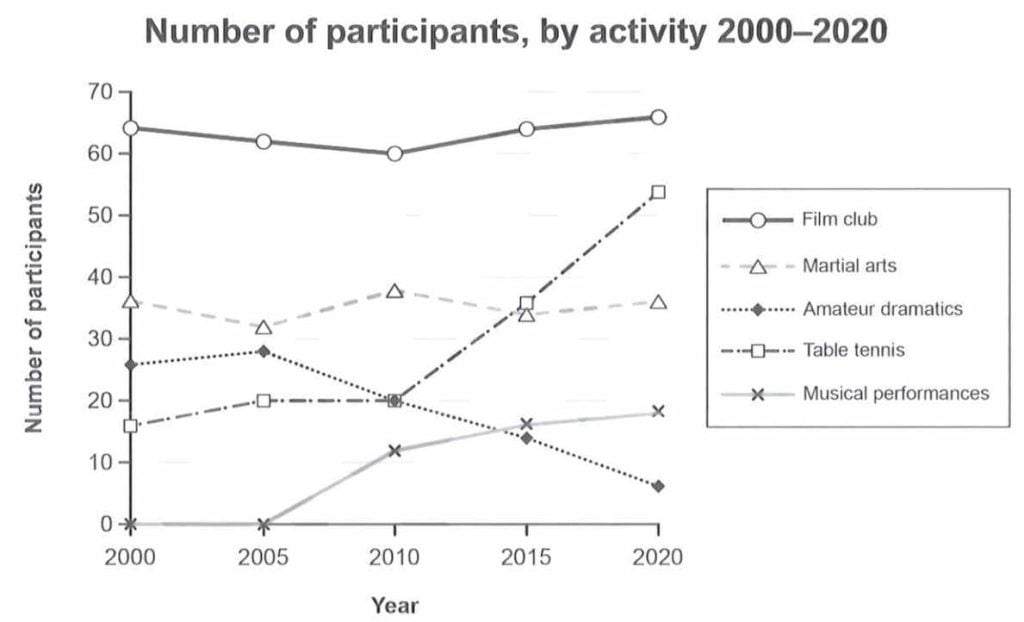
The line graph below gives information on the numbers of participants for different activities at one social centre in Melbourne, Australia for the period 2000 to 2020.
Summarise the information by selecting and reporting the main features, and make comparisons where relevant.
Some people think that competition at work, at school and in daily life is a good thing. Others believe that we should try to cooperate more, rather than competing against each other.
Discuss both these views and give your own opinion.
If you are interested in some study strategies for using the book, you can read the guides below – all the tips and strategies apply for IELTS Cambridge 19 as well:
Some people think that competition at work, at school and in daily life is a good thing. Others believe that we should try to cooperate more, rather than competing against each other.
Discuss both these views and give your own opinion.
Many argue that competing in a variety of daily environments is a positive, while others feel a focus on cooperation would be ideal. In my opinion, although competition can yield transformational results, it is more valuable to embrace cooperation as a guiding principle.
Those who argue in favor of competition contend that it serves as powerful motivation. Examples of the impact of competition exend to many segments of life, including school and work. In schools, the desire to compete can lead a student to study harder than their classmates in order to achieve better grades and secure esteem from teachers and family members. At work, competition for promotions and higher compensation packages is the entire reason that individuals work diligently in the majority of company contexts. However, at home, competition rarely has positive ramifications. Family members that are consistently competing for admiration and recoginition are likely to suffer from some degree of poor mental health.
Indeed, there is greater value in fostering a cooperative environment. When individuals work together in teams, whether it be at school, work, or in the home, they are more likely to experience high levels of motivation, and more crucially, enjoyment. Competition can serve as a catalyst for achievement but is unlikely to engender the same heights of unifying satisfaction. A standout example of this would be the dynamics present on a sports team at any level of competition. Even though the players on the team are engaged in a competition, the most memorable and lasting memories of their experiences are more likely to come from small moments of comradery shared with teammates. This is the reason that many cite times spent working in groups towards a common goal as the highlights of life.
In conclusion, although competition can encourage innovation, cooperation provides a more vital environment of mutual respect and enjoyment of life. Depending on the situation, it is therefore imperative to seek cooperative understanding.
Analysis
1. Many argue that competing in a variety of daily environments is a positive, while others feel a focus on cooperation would be ideal. 2. In my opinion, although competition can yield transformational results, it is more valuable to embrace cooperation as a guiding principle.
Paraphrase the overall essay topic.
Write a clear opinion. Read more about introductions here.
1. Those who argue in favor of competition contend that it serves as powerful motivation. 2. Examples of the impact of competition extend to many segments of life, including school and work. 3. In schools, the desire to compete can lead a student to study harder than their classmates in order to achieve better grades and secure esteem from teachers and family members. 4. At work, competition for promotions and higher compensation packages is the entire reason that individuals work diligently in the majority of company contexts. 5. However, at home, competition rarely has positive ramifications. 6. Family members that are consistently competing for admiration and recognition are likely to suffer from some degree of poor mental health.
Write a topic sentence with a clear main idea at the end.
Explain your main idea.
Develop it with specific or hypothetical examples.
Keep developing it fully.
Better to have more detail.
This paragraph has a concession because I agree with the other side.
1. Indeed, there is greater value in fostering a cooperative environment. 2. When individuals work together in teams, whether it be at school, work, or in the home, they are more likely to experience high levels of motivation, and more crucially, enjoyment. 3. Competition can serve as a catalyst for achievement but is unlikely to engender the same heights of unifying satisfaction. 4. A standout example of this would be the dynamics present on a sports team at any level of competition. 5. Even though the players on the team are engaged in a competition, the most memorable and lasting memories of their experiences are more likely to come from small moments of comradery shared with teammates. 6. This is the reason that many cite times spent working in groups towards a common goal as the highlights of life.
Write a new topic sentence with a new main idea at the end.
Explain your new main idea.
Include specific details and examples.
Add as much information as you can and make sure it links logically.
This essay is a bit long – aim for about 275 words.
Finish the paragraph strong.
1. In conclusion, although competition can encourage innovation, cooperation provides a more vital environment of mutual respect and enjoyment of life. 2. Depending on the situation, it is therefore imperative to seek cooperative understanding.
Summarise your main ideas.
Include a final thought. Read more about conclusions here.
Vocabulary
What do the words in bold below mean?Make some notes on paper to aid memory and then check below.
Many argue that competing in a variety of daily environments is a positive, while others feel a focus oncooperation would be ideal. In my opinion, although competition can yield transformational results, it is more valuable to embrace cooperationas a guiding principle.
Those who argue in favor of competition contend that it serves as powerful motivation. Examples of the impact of competition extend to many segments of life, including school and work. In schools, the desire to compete can lead a student to study harder than their classmates in order to achieve better grades and secure esteem from teachers and family members. At work, competition for promotions and higher compensation packages is the entire reason that individuals work diligently in the majority of company contexts. However, at home, competition rarely has positive ramifications. Family members that are consistently competing for admiration and recoginition are likely to suffer fromsome degree of poor mental health.
Indeed, there is greater value in fostering a cooperative environment. When individuals work together in teams, whether it be at school, work, or in the home, they are more likely to experience high levels of motivation, and more crucially, enjoyment. Competition can serve as a catalyst for achievement but is unlikely to engender the same heights of unifying satisfaction. A standout example of this would be the dynamics present on a sports team at any level of competition. Even though the players on the team are engaged in a competition, the most memorable and lasting memories of their experiences are more likely to come from small moments of comradery shared with teammates. This is the reason that many cite times spent working in groups towards a common goal as the highlights of life.
In conclusion, although competition can encourage innovation, cooperation provides a more vital environment of mutual respect and enjoyment of life. Depending on the situation, it is therefore imperative to seek cooperative understanding.
Answers
For extra practice, write an antonym (opposite word) on a piece of paper to help you remember the new vocabulary:
competing – contending a variety of daily environments – diverse range of daily settings focus on cooperation – prioritize collaborative efforts ideal – optimal yield transformational results – produce revolutionary outcomes more valuable – of greater worth embrace cooperation as a guiding principle – adopt collaboration as a core belief in favor of – supportive of serves as powerful motivation – acts as a strong driving force impact – influence extend to many segments of life – reach various aspects of life desire – aspiration study harder than – put in extra effort compared to in order to achieve better grades – to attain improved academic performance secure esteem from teachers and family members – gain recognition from educators and relatives higher compensation packages – increased salary offerings entire reason – sole purpose diligently in the majority of company contexts – consistently in most corporate scenarios rarely has positive ramifications – seldom has positive consequences consistently competing – continuously vying admiration – respect recognition – acknowledgment likely to suffer from some degree of poor mental health – prone to experience certain levels of mental distress Indeed – unquestionably greater value in fostering a cooperative environment – enhanced significance in cultivating a collaborative atmosphere whether it be at – whether it occurs in experience high levels of motivation – encounter elevated levels of drive more crucially – of greater importance enjoyment – pleasure serve as a catalyst for – act as a catalyst to unlikely to engender – improbable to generate heights of unifying satisfaction – pinnacle of unified contentment A standout example of this would be – An exceptional instance of this can be seen in dynamics present on – interactions existing within at any level of competition – regardless of the competition level engaged in a competition – involved in a contest memorable – unforgettable lasting memories – enduring recollections come from small moments of comradery shared with teammates – arise from small instances of camaraderie among teammates cite times spent working in groups towards a common goal – mention instances of collaborating in groups toward a shared objective highlights – emphasizes provides a more vital environment – offers a more dynamic setting mutual respect and enjoyment of life – shared respect and delight in life Depending on the situation – Depending on the circumstances imperative – crucial seek cooperative understanding – strive for collaborative comprehension
I recommend getting a pencil and piece of paper because that aids memory. Then write down the missing vocabulary from my sample answer in your notebook:
Many argue that c__________g in a________________________________s is a positive, while others feel a_________________________n would be ideal. In my opinion, although competition can y_______________________________s, it is m_____________e to e____________________________________e.
Those who argue i_____________f competition c__________d that it s________________________n. Examples of the i_______t of cooperation e__________________________e, including school and work. In schools, the d_______e to compete can lead a student to s__________________n their classmates i_______________________________________s and s______________________________________________s. At work, competition for p__________-__s and h______________________________s is the e______________n that individuals work d_________________________________________________-s. However, at home, competition r_______________________s. Family members that are c__________________-g for a_____________n and r_____________n are l_________________________________________________________________h.
I_________d, there is g________________________________________________t. When individuals work together in teams, w__________________t school, work, or in the home, they are more likely to e_________________________n, and m_____________y, e____________-t. Competition can s_______________________r achievement but is u____________________r the same h___________________________n. A___________________________________e the d_____________-n a sports team a__________________________n. Even though the players on the team are e________________-_n, the most m__________e and l______________________s of their experiences are more likely to c__________________________________________________________s. This is the reason that many c____________________________________________________l as the h__________-s of life.
In conclusion, although competition can encourage innovation, cooperation p_________________________________t of m________________________________________________e. D______________________________n, it is therefore i___________e to s_________________________________________g.
Listening Practice
Learn more about this topic by watching from YouTube below and practice with these activities:
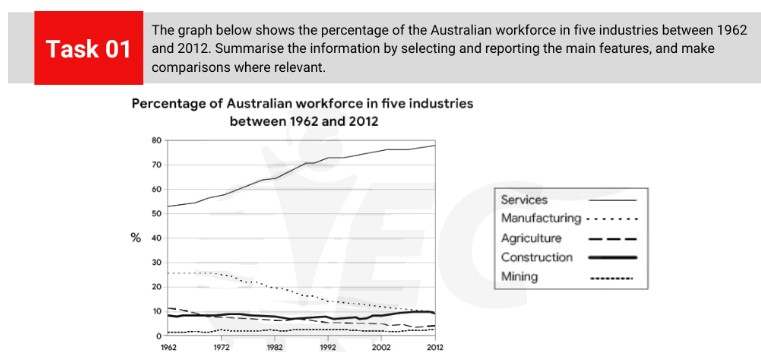
The line chart details the percentage of workers in Australia according to 5 different industries from 1962 to 2012. Looking from an overall perspective, it is readily apparent that the most noticeable growth and the vast majority of jobs was concentrated in the services industry. There was decline in the workforce for jobs in agriculture and manufacturing, and slight rises for the remaining two industries.
In 1962, approximately 52% of Australians worked in services, a figure far above the next closest sector, manufacturing (27%). From that point onwards, service jobs grew rapidly to reach 72% by 1992 and then growth tapered off and rose more moderately to finish the period at just under 80%. In contrast, manufacturing as an employment option was stable over the first decade before a consistent decline led to a final figure of 10% in 2012.
In terms of the less common jobs, agricultural workers declined at steady intervals from just above 10% in 1962 to a low of 4% in 2012. In comparison, mining and construction jobs were generally stable with minor growth, rising from 9% and 1% to 10% and 2%, respectively.
Analysis
1. The line chart details the percentage of workers in Australia according to 5 different industries from 1962 to 2012. 2. Looking from an overall perspective, it is readily apparent that the most noticeable growth and the vast majority of jobs was concentrated in the services industry. 3. There was decline in the workforce for jobs in agriculture and manufacturing, and slight rises for the remaining two industries.
Paraphrase what the bar chart shows.
Write a clear overview summarising the differences and the overall trend.
This one is a little complex so it needs a second sentence for the overview.
1. In 1962, approximately 52% of Australians worked in services, a figure far above the next closest sector, manufacturing (27%). 2. From that point onwards, service jobs grew rapidly to reach 72% by 1992 and then growth tapered off and rose more moderately to finish the period at just under 80%. 3. In contrast, manufacturing as an employment option was stable over the first decade before a consistent decline led to a final figure of 10% in 2012.
Begin writing about the data for the first categories.
Compare between each sentence.
Add in all the data.
1. In terms of the less common jobs, agricultural workers declined at steady intervals from just above 10% in 1962 to a low of 4% in 2012. 2. In comparison, mining and construction jobs were generally stable with minor growth, rising from 9% and 1% to 10% and 2%, respectively.
Write about the final other parts of the graph – include everything!
Include all the data.
Vocabulary
What do the words in bold below mean?Make some notes on paper to aid memory and then check below.
The line chart details the percentage of workers in Australia according to 5 different industries from 1962 to 2012. Looking from an overall perspective, it is readily apparent that the most noticeable growth and the vast majority of jobs was concentrated in the services industry. There was decline in the workforce for jobs in agriculture and manufacturing, and slight rises for the remaining two industries.
In 1962, approximately 52% of Australians worked in services, a figure far above the next closest sector, manufacturing (27%). From that point onwards, service jobs grew rapidly to reach 72% by 1992 and then growth tapered off and rose more moderately to finish the period at just under 80%. In contrast, manufacturing as an employment option was stable over the first decadebefore a consistent decline led to a final figure of 10% in 2012.
In terms of the less common jobs, agricultural workers declined at steady intervals from just above 10% in 1962 to a low of 4% in 2012. In comparison, mining and construction jobs were generally stable with minor growth, rising from 9% and 1% to 10% and 2%, respectively.
Answers
For extra practice, write an antonym (opposite word) on a piece of paper to help you remember the new vocabulary:
according to – as per, in accordance with, based on industries – sectors, fields, trades most noticeable growth – significant expansion, prominent increase, marked development the vast majority of – the overwhelming majority of, the lion’s share of, the bulk of concentrated in – focused in, centered on, predominantly located in decline – decrease, drop, downturn workforce – labor force, employees, personnel agriculture – farming, cultivation, agronomy manufacturing – production, fabrication, assembly slight rises for – marginal increases in, modest growth for, minor upturns in remaining two industries – the other two sectors, the rest of the industries approximately – roughly, about, around a figure far above – a number significantly higher than, a value well beyond next closest sector – nearest industry, adjacent sector, the following closest field From that point onwards – From then on, from that moment forward, starting from that point grew rapidly to reach – expanded swiftly to attain, experienced rapid growth to achieve, developed quickly and reached growth tapered off – expansion leveled off, increase gradually slowed down, growth decelerated rose more moderately to finish the period at – increased at a more moderate pace to conclude the period at, grew more steadily and ended the timeframe at In contrast – On the other hand, conversely, in opposition employment option – job opportunity, career choice, work alternative stable – steady, consistent, unchanging first decade – initial ten years, opening period, the initial phase before a consistent decline – prior to a continuous decrease, preceding a steady downturn, before a sustained drop led to – resulted in, caused, brought about a final figure of – a concluding number of, a last value of, a ultimate figure of In terms of – With regard to, concerning, regarding In comparison – By comparison, when comparing, contrasted with mining – extraction, excavation, mining industry construction – building, erection, construction sector generally stable – mostly consistent, predominantly steady, largely unchanging minor growth – slight expansion, modest increase, marginal development rising from – increasing from, ascending from, going up from
I recommend getting a pencil and piece of paper because that aids memory. Then write down the missing vocabulary from my sample answer in your notebook:
The line chart details the percentage of workers in Australia a_____________o 5 different i_________s from 1962 to 2012. L______________________________________________________________t the m__________________h and t____________________f jobs was c__________________n the services industry. There was d_________e in the w_________e for jobs in a_________e and m____________g, and s______________________r the r________________s.
In 1962, a_________________y 52% of Australians worked in services, a___________________e the n_________________r, manufacturing (27%). F__________________________s, service jobs g_____________________h 72% by 1992 and then g____________________f and r_______________________________________________t just under 80%. I___________t, manufacturing as an e_________________n was stable over the f_______________eb_________________________e l_________________________f 10% in 2012.
I____________f the less common jobs, agricultural workers declined at steady intervals from just above 10% in 1962 to a low of 4% in 2012. I_______________n, m______g and c_____________n jobs were g_______________e with m_______________h, r____________m 9% and 1% to 10% and 2%, respectively.
Listening Practice
Learn more about this topic by watching from YouTube below and practice with these activities:
In many cities, planners tend to arrange shops, schools, offices and homes in specific areas and separate them from each other.
Do you think the advantages of this policy outweigh the disadvantages?
One common approach employed by city planners involves the separation of various establishments such as shops, schools, offices, and homes into distinct areas. While this zoning policy offers certain advantages, the notable drawbacks outweigh the positives.
One significant advantage of zoning is the promotion of efficient land use. By grouping similar establishments together, cities can optimize the allocation of resources and infrastructure. For instance, commercial areas can be designed with adequate parking spaces and easy access to transportation, making it convenient for both shoppers and business owners. Zoning similarly allows for the creation of specialized zones, such as industrial areas, which can enhance productivity and economic growth. This is the case in many newer cities such as Shenzhen in China where urban planners had the opportunity to fashion a more efficient and livable environment for residents due to the lack of previous development in the area.
However, a notable concern is the potential lack of vibrancy and diversity in strictly zoned cities. When different establishments are mixed within neighborhoods, it fosters a sense of community and generates vibrant social spaces. Mixing residential and commercial areas can lead to the development of lively streets with a variety of shops, cafes, galleries, and parks, creating a more engaging and inclusive urban experience. This is evidenced in contrast to newer cities like Shenzhen with older cities throughout the world that are famed for their cultural vibrancy. The list of such cities is innumerable but includes some of the most well-known and desirable urban areas on the globe such as London, New York, Paris, Kyoto, and Barcelona.
In conclusion, zoning policies that group areas by their purpose can lead to efficient land use though the likelihood of a lack of vibrancy within neighborhoods is a more significant factor. To strike a balance, city planners must carefully consider the specific context and needs of their communities, adopting a flexible approach that combines the benefits of zoning with the promotion of mixed-use areas.
Analysis
1. One common approach employed by city planners involves the separation of various establishments such as shops, schools, offices, and homes into distinct areas. 2. While this zoning policy offers certain advantages, the notable drawbacks outweigh the positives.
Paraphrase the overall essay topic.
Write a clear opinion. Read more about introductions here.
1. One significant advantage of zoning is the promotion of efficient land use. 2. By grouping similar establishments together, cities can optimize the allocation of resources and infrastructure. 3. For instance, commercial areas can be designed with adequate parking spaces and easy access to transportation, making it convenient for both shoppers and business owners. 4. Zoning similarly allows for the creation of specialized zones, such as industrial areas, which can enhance productivity and economic growth. 5. This is the case in many newer cities such as Shenzhen in China where urban planners had the opportunity to fashion a more efficient and livable environment for residents due to the lack of previous development in the area.
Write a topic sentence with a clear main idea at the end.
Explain your main idea.
Develop it with specific or hypothetical examples.
Keep developing it fully.
Better to have more detail.
1. However, a notable concern is the potential lack of vibrancy and diversity in strictly zoned cities. 2. When different establishments are mixed within neighborhoods, it fosters a sense of community and generates vibrant social spaces. 3. Mixing residential and commercial areas can lead to the development of lively streets with a variety of shops, cafes, galleries, and parks, creating a more engaging and inclusive urban experience. 4. This is evidenced in contrast to newer cities like Shenzhen with older cities throughout the world that are famed for their cultural vibrancy. 5. The list of such cities is innumerable but includes some of the most well-known and desirable urban areas on the globe such as London, New York, Paris, Kyoto, and Barcelona.
Write a new topic sentence with a new main idea at the end.
Explain your new main idea.
Include specific details and examples.
Add as much information as you can and make sure it links logically.
This essay is a bit long – aim for about 275 words.
1. In conclusion, zoning policies that group areas by their purpose can lead to efficient land use though the likelihood of a lack of vibrancy within neighborhoods is a more significant factor. 2. To strike a balance, city planners must carefully consider the specific context and needs of their communities, adopting a flexible approach that combines the benefits of zoning with the promotion of mixed-use areas.
Summarise your main ideas.
Include a final thought. Read more about conclusions here.
Vocabulary
What do the words in bold below mean?Make some notes on paper to aid memory and then check below.
One common approach employed by city planners involves the separation of various establishments such as shops, schools, offices, and homes into distinct areas. While this zoning policyoffers certain advantages, the notable drawbacks outweigh the positives.
One significant advantage of zoning is the promotion of efficient land use. By grouping similar establishments together, cities can optimize the allocation of resources and infrastructure. For instance, commercial areas can be designed with adequate parking spaces and easy access to transportation, making it convenient for both shoppers and business owners. Zoning similarly allows for the creation of specialized zones, such as industrial areas, which can enhance productivity and economic growth. This is the case in many newer cities such as Shenzhen in China where urban planners had the opportunity to fashion a more efficient and livable environment for residents due to the lack of previous development in the area.
However, a notable concern is the potential lack of vibrancy and diversity in strictly zoned cities. When different establishments are mixed within neighborhoods, it fosters a sense of community and generates vibrant social spaces. Mixing residential and commercial areas can lead to the development of lively streets with a variety of shops, cafes, galleries, and parks, creating a more engaging and inclusive urban experience. This is evidenced in contrast to newer cities like Shenzhen with older cities throughout the world that are famed for their cultural vibrancy. The list of such cities is innumerable but includes some of the most well-known and desirable urban areason the globe such as London, New York, Paris, Kyoto, and Barcelona.
In conclusion, zoning policies that group areas by their purpose can lead to efficient land use though the likelihood of a lack of vibrancy within neighborhoods is a more significant factor. To strike a balance, city planners must carefully consider the specific context and needs of their communities, adopting a flexible approach that combines the benefits of zoning with the promotion of mixed-use areas.
Answers
For extra practice, write an antonym (opposite word) on a piece of paper to help you remember the new vocabulary:
One common approach: A frequently used method employed by: utilized by city planners: urban planning authorities separation: segregation establishments: businesses distinct: separate zoning policy: zoning regulations offers certain advantages: provides specific benefits the notable drawbacks outweigh the positives: the significant disadvantages surpass the advantages One significant advantage of: One notable benefit of promotion: promotion efficient land use: effective land utilization grouping: clustering optimize: optimize allocation of resources: distribution of resources infrastructure: physical framework commercial areas: business districts designed with adequate parking spaces: equipped with sufficient parking facilities easy access to transportation: convenient transportation access convenient for: suitable for business owners: entrepreneurs similarly: similarly creation of specialized zones: establishment of specialized areas industrial areas: manufacturing zones enhance productivity: improve productivity economic growth: financial growth This is the case in: This is evident in urban planners: city planners fashion: style livable: habitable residents: inhabitants notable concern: significant concern potential lack of vibrancy and diversity: possible absence of vibrancy and diversity strictly: stringently fosters a sense of community: nurtures a sense of community generates vibrant social spaces: creates dynamic social spaces lively streets: vibrant streets a variety of: a range of engaging: captivating inclusive urban experience: inclusive urban experience This is evidenced in contrast to: This is demonstrated in contrast to throughout the world: across the globe famed for: renowned for cultural vibrancy: cultural vibrancy innumerable: countless well-known: well-established desirable urban areas: desirable urban areas on the globe: worldwide purpose: intention likelihood: probability more significant factor: more significant aspect To strike a balance: To achieve equilibrium specific context: particular circumstances needs of their communities: requirements of their communities adopting a flexible approach: adopting an adaptable approach promotion of mixed-use areas: advancement of mixed-use areas
I recommend getting a pencil and piece of paper because that aids memory. Then write down the missing vocabulary from my sample answer in your notebook:
O________________________________________________s involves the s__________n of various e____________s such as shops, schools, offices, and homes into d________t areas. While this z__________yo_______________________s, t_________________________s o___________________________s.
O_____________________f zoning is the p___________n of e___________________e. By g_________g similar establishments together, cities can o______e the a__________________s and i_______________e. For instance, c______________s can be d_____________________________________________s and e__________________________n, making it c______________r both shoppers and b_____________s. Zoning s_________y allows for the c__________________________s, such as i_________________s, which can e__________________________y and e____________________h. T_____________n many newer cities such as Shenzhen in China where u____________________s had the opportunity to f__________n a more efficient and l______e environment for r__________s due to the lack of previous development in the area.
However, a n______________n is the p__________________________________y in s________y zoned cities. When different establishments are mixed within neighborhoods, it f_______________________________y and g______________________________s. Mixing residential and commercial areas can lead to the development of l_____________s with a__________f shops, cafes, galleries, and parks, creating a more e__________g and i______________________e. T_____________________________o newer cities like Shenzhen with older cities t________________________d that are f____________r their c_______________y. The list of such cities is i___________e but includes some of the most w____________n and d____________________so_______e such as London, New York, Paris, Kyoto, and Barcelona.
In conclusion, zoning policies that group areas by their p__________e can lead to efficient land use though the l____________d of a lack of vibrancy within neighborhoods is a m_____________________r. T________________e, city planners must carefully consider the s________________t and n_________________________s, a________________________h that combines the benefits of zoning with the p________________________________s.
Listening Practice
Learn more about this topic by watching from YouTube below and practice with these activities:
"The highest quality materials anywhere on the internet! Dave improved my writing and vocabulary so much. Really affordable options you don't want to miss out on!"