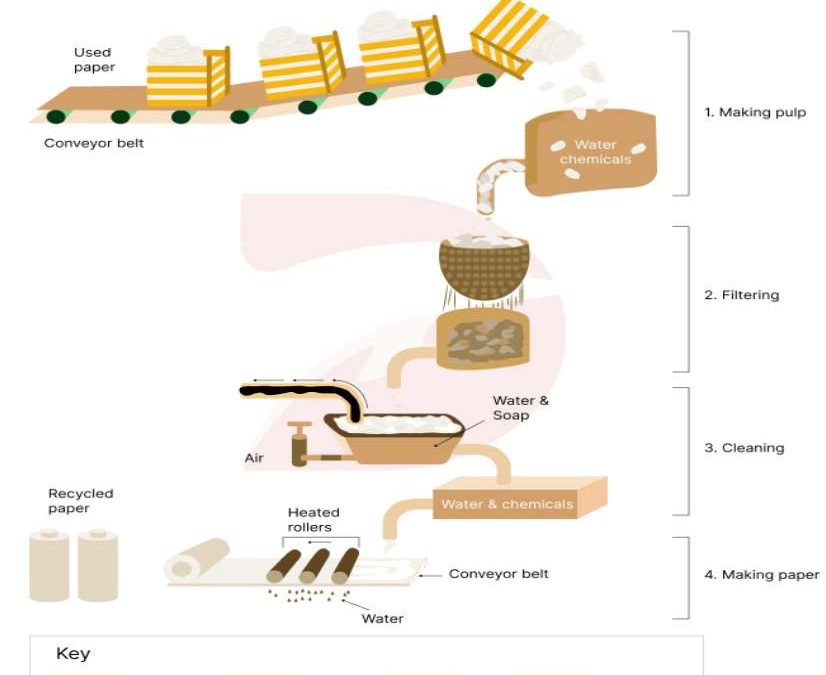
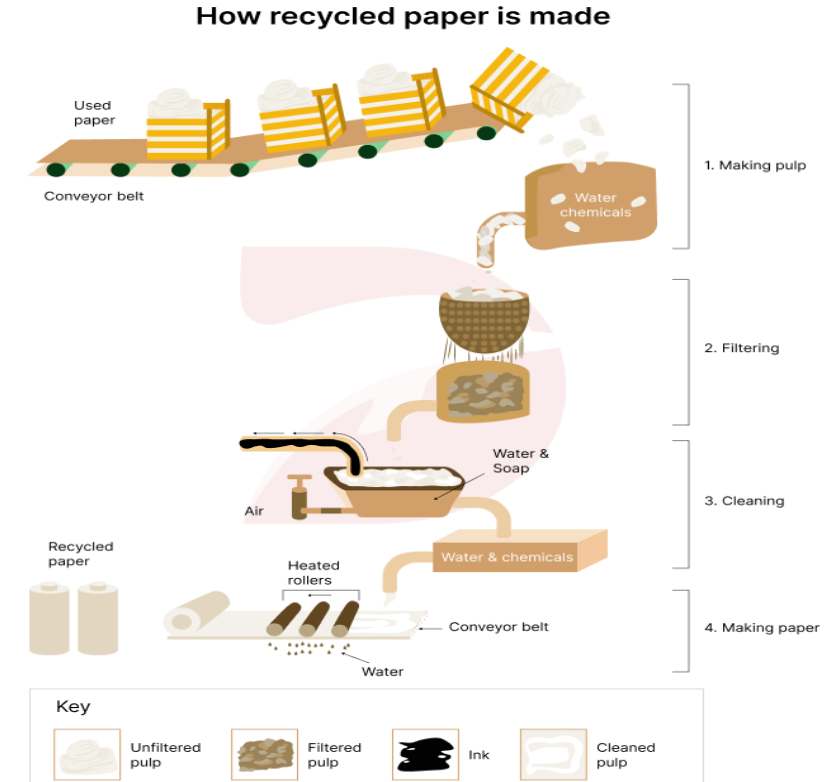
The diagram details how recycled paper is made. Looking from an overall perspective, it is readily apparent that the process involves three main stages beginning with initial collection and transportation, followed by cleaning and processing, and lastly the rolling of the final product. The process is entirely man-made.
In order to produce recycled paper, used paper is first sourced and transported by conveyer belt to a processing plant. The used paper is then made into unfiltered pulp by using water and various chemicals. The pulp must then be filtered with water being removed.
After filtering is complete, the filtered paper pulp is sent by a tube to a container with water and soap to be further cleaned. Air is pumped into the container and ink is removed. There is then additional cleaning with water and chemicals before the final rolling stages commence. To create useable recycled paper rolls, the cleaned and filtered pulp is placed on a conveyor belt where heated rollers flatten the paper and remove excess water.
Analysis
1. The diagram details how recycled paper is made. 2. Looking from an overall perspective, it is readily apparent that the process involves three main stages beginning with initial collection and transportation, followed by cleaning and processing, and lastly the rolling of the final product. 3. The process is entirely man-made.
Paraphrase what the bar chart shows.
Write a clear overview summarising the differences and the overall trend.
This one is a little complex so it needs a second sentence for the overview.
1. In order to produce recycled paper, used paper is first sourced and transported by conveyer belt to a processing plant. 2. The used paper is then made into unfiltered pulp by using water and various chemicals. 3. The pulp must then be filtered with water being removed.
Begin writing about the data for the first categories.
Compare between each sentence.
1. After filtering is complete, the filtered paper pulp is sent by a tube to a container with water and soap to be further cleaned. 2. Air is pumped into the container and ink is removed. 3. There is then additional cleaning with water and chemicals before the final rolling stages commence. 4. To create useable recycled paper rolls, the cleaned and filtered pulp is placed on a conveyor belt where heated rollers flatten the paper and remove excess water.
Write about the final other parts of the graph – include everything!
Include all the data.
Mention any exceptions.
Make sure your essay is long enough.
Vocabulary
What do the words in bold below mean?Make some notes on paper to aid memory and then check below.
The diagram details how recycled paper is made. Looking from an overall perspective, it is readily apparent that the process involves three main stages beginning with initial collection and transportation, followed by cleaning and processing, and lastly the rolling of the final product. The process is entirely man-made.
In order to produce recycled paper, used paper is first sourced and transported by conveyer belt to a processing plant. The used paper is then made into unfiltered pulp by using water and various chemicals. The pulp must then be filtered with water being removed.
After filtering is complete, the filtered paper pulp is sent by a tube to a container with water and soap to be further cleaned. Air is pumped into the container and ink is removed. There is then additional cleaning with water and chemicals before the final rolling stages commence. To create useable recycled paper rolls, the cleaned and filtered pulp is placed on a conveyor belt where heated rollers flatten the paper and remove excess water.
Answers
For extra practice, write an antonym (opposite word) on a piece of paper to help you remember the new vocabulary:
details shows
recycled paper paper from used products/paper
Looking from an overall perspective, it is readily apparent that overall
main stages beginning with initial collection big steps start with finding it first
followed by after that
lastly finally
rolling making into a roll
final product product in the end
entirely man-made totally done by people
In order to so that
first sourced found in the beginning
by conveyer belt to a processing plant along a flat surface to a place to make it
various chemicals different substances
removed taken out
After filtering is complete once it is done being cleaned
filtered paper pulp cleaned clumps of paper
tube cylinder
container place to hold it
further cleaned additional filtering
pumped into goes to
ink black substance for writing
additional extra
commence start
placed on a conveyor belt put on the transport belt
I recommend getting a pencil and piece of paper because that aids memory. Then write down the missing vocabulary from my sample answer in your notebook:
The diagram d_____s how r__________r is made. L_____________________________________________________________t the p___________s three m__________________________________________n and transportation, f_________y cleaning and processing, and l____y the r_______g of the f_____________t. The process is e_____________e.
I____________o produce recycled paper, used paper is f___________d and transported b________________________________t. The used paper is then made into unfiltered pulp by using water and v_________________s. The pulp must then be filtered with water being r_______d.
A_______________________e, the f________________p is sent by a t_____e to a c__________r with water and soap to be f______________d. Air is p___________o the container and i__k is removed. There is then a__________l cleaning with water and chemicals before the final rolling stages c_______e. To create useable recycled paper rolls, the cleaned and filtered pulp is p________________________t where h______________________n the paper and r________________r.
Listening Practice
Learn more about this topic by watching from YouTube below and practice with these activities:
The world has many towns and cities constructed in previous centuries that were more suitable and livable for people in those times than they are now.
What problems will this cause?
What can be done to solve these problems?
There now exist numerous towns and cities that were constructed centuries ago. While these places were once considered livable, they often face challenges in meeting the needs and expectations of contemporary society that can only realistically be resolved by local authorities.
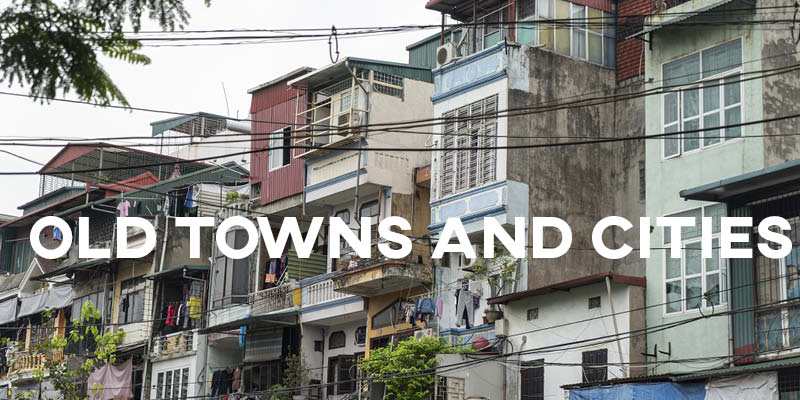
One of the primary challenges associated with old towns and cities is outdated infrastructure and limited accessibility. Many of these places were designed before the advent of private vehicles and modern transportation systems. Consequently, narrow streets, lack of parking facilities, and insufficient public transportation options pose significant challenges for mobility and convenience. Similarly, outdated sewage and waste management systems may not be equipped to handle the needs of a larger population, leading to environmental and health hazards. One well-known example of this would be in developing cities such as Ho Chi Minh city in Vietnam where older buildings that collapse are common and there are geographical challenges that limit the development of other areas. Since local authorities have few options, this means many less privileged residents must live in conditions that are not ideal.
To overcome these challenges, a comprehensive revitalization plan is crucial. Local governments should invest in infrastructure upgrades, such as widening roads, improving public transportation networks, and implementing smart traffic management systems. Additionally, the integration of sustainable solutions, including renewable energy sources and eco-friendly waste management systems, can contribute to the long-term livability of these areas. By prioritizing infrastructure development and accessibility enhancements, old towns and cities can adapt to modern demands without compromising their historical integrity. Local governments can also, in collaboration with residents and stakeholders, organize cultural events, festivals, and initiatives to celebrate the heritage of these areas. This holistic support will prolong and support revitalization efforts long-term.
In conclusion, by adopting a balanced approach to preservation, investing in infrastructure and accessibility, and fostering local engagement, older cities can overcome inherent challenges and regain their livability. Only through such concerted efforts can old towns and cities be restored and cherished for generations to come.
Analysis
1. There now exist numerous towns and cities that were constructed centuries ago. 2. While these places were once considered livable, they often face challenges in meeting the needs and expectations of contemporary society that can only realistically be resolved by local authorities.
Paraphrase the overall essay topic.
Write a clear opinion. Read more about introductions here.
1. One of the primary challenges associated with old towns and cities is outdated infrastructure and limited accessibility. 2. Many of these places were designed before the advent of private vehicles and modern transportation systems. 3. Consequently, narrow streets, lack of parking facilities, and insufficient public transportation options pose significant challenges for mobility and convenience. 4. Similarly, outdated sewage and waste management systems may not be equipped to handle the needs of a larger population, leading to environmental and health hazards. 5. One well-known example of this would be in developing cities such as Ho Chi Minh city in Vietnam where older buildings that collapse are common and there are geographical challenges that limit the development of other areas. 6. Since local authorities have few options, this means many less privileged residents must live in conditions that are not ideal.
Write a topic sentence with a clear main idea at the end.
Explain your main idea.
Develop it with specific or hypothetical examples.
Keep developing it fully.
Better to have more detail.
Close with as many specifics as possible.
1. To overcome these challenges, a comprehensive revitalization plan is crucial. 2. Local governments should invest in infrastructure upgrades, such as widening roads, improving public transportation networks, and implementing smart traffic management systems. 3. Additionally, the integration of sustainable solutions, including renewable energy sources and eco-friendly waste management systems, can contribute to the long-term livability of these areas. 4. By prioritizing infrastructure development and accessibility enhancements, old towns and cities can adapt to modern demands without compromising their historical integrity. 5. Local governments can also, in collaboration with residents and stakeholders, organize cultural events, festivals, and initiatives to celebrate the heritage of these areas. 6. This holistic support will prolong and support revitalization efforts long-term.
Write a new topic sentence with a new main idea at the end.
Explain your new main idea.
Include specific details and examples.
Add as much information as you can and make sure it links logically.
This essay is a bit long – aim for about 275 words.
Finish the paragraph strong.
1. In conclusion, by adopting a balanced approach to preservation, investing in infrastructure and accessibility, and fostering local engagement, older cities can overcome inherent challenges and regain their livability. 2. Only through such concerted efforts can old towns and cities be restored and cherished for generations to come.
Summarise your main ideas.
Include a final thought. Read more about conclusions here.
Vocabulary
What do the words in bold below mean?Make some notes on paper to aid memory and then check below.
There now existnumerous towns and cities that were constructed centuries ago. While these places were once considered livable, they often face challenges in meeting the needs and expectations of contemporary society that can only realistically be resolved by local authorities.
One of the primary challenges associated with old towns and cities is outdated infrastructure and limited accessibility. Many of these places were designed before the advent of private vehicles and modern transportation systems. Consequently, narrow streets, lack of parking facilities, and insufficient public transportation options pose significant challenges formobility and convenience. Similarly, outdated sewage and waste management systems may not be equipped to handle the needs of a larger population, leading to environmental and health hazards. One well-known example of this would be in developing cities such as Ho Chi Minh city in Vietnam where older buildings that collapse are common and there are geographical challenges that limit the development of other areas. Since local authorities have few options, this means many less privileged residents must live in conditions that are not ideal.
To overcome these challenges, a comprehensive revitalization plan is crucial. Local governments should invest in infrastructure upgrades, such as widening roads, improving public transportation networks, and implementing smart traffic management systems. Additionally, the integration of sustainable solutions, including renewable energy sources and eco-friendly waste management systems, can contribute to the long-term livability of these areas. By prioritizing infrastructure development and accessibility enhancements, old towns and cities can adapt to modern demands without compromising their historical integrity. Local governments can also, in collaboration with residents and stakeholders, organize cultural events, festivals, and initiatives to celebrate the heritage of these areas. This holistic support will prolong and support revitalization efforts long-term.
In conclusion, by adopting a balanced approach to preservation, investing in infrastructure and accessibility, and fostering local engagement, older cities can overcome inherent challenges and regain their livability. Only through such concerted efforts can old towns and cities be restored and cherished for generations to come.
Answers
For extra practice, write an antonym (opposite word) on a piece of paper to help you remember the new vocabulary:
There now exist: There are now numerous constructed centuries ago: Built ages ago once considered livable: Formerly deemed habitable face challenges in meeting the needs and expectations of contemporary society: Encounter difficulties in fulfilling the requirements and aspirations of modern society realistically: Practically resolved: Solved local authorities: Municipal authorities One of the primary challenges associated with: One of the main obstacles related to outdated infrastructure: Obsolete infrastructure limited accessibility: Restricted availability advent: Arrival private vehicles: Personal vehicles modern transportation systems: Contemporary transport networks Consequently: As a result narrow streets: Narrow roadways lack of parking facilities: Insufficient parking amenities insufficient public transportation options pose significant challenges for mobility: Inadequate public transportation choices present significant mobility obstacles convenience: Convenience outdated sewage: Obsolete sewage waste management systems: Garbage disposal systems equipped to handle the needs of a larger population, leading to environmental and health hazards: Capable of accommodating the requirements of a larger population, resulting in environmental and health risks One well-known example of this would be: An eminent instance of this is collapse: Collapse geographical challenges: Geographical obstacles limit the development of: Restrict the growth of local authorities: Local administrations less privileged residents: Underprivileged inhabitants live in conditions that are not ideal: Reside in unfavorable conditions overcome these challenges: Surmount these challenges comprehensive revitalization plan: Extensive rejuvenation scheme crucial: Vital invest in infrastructure upgrades: Allocate funds for infrastructure improvements widening roads: Expanding roads improving public transportation networks: Enhancing public transport networks implementing smart traffic management systems: Deploying intelligent traffic management systems Additionally: Moreover integration: Incorporation sustainable solutions: Environmentally friendly solutions including renewable energy sources: Involving renewable energy sources eco-friendly waste management systems: Environmentally friendly waste management systems contribute to the long-term livability of these areas: Contribute to the long-term habitability of these regions prioritizing: Giving priority to accessibility enhancements: Improvements in accessibility adapt to modern demands: Adjust to contemporary demands compromising: Jeopardizing historical integrity: Historical authenticity in collaboration with: In cooperation with organize cultural events: Arrange cultural events festivals: Celebrations initiatives: Projects heritage: Cultural heritage holistic support: Comprehensive support prolong: Prolong support revitalization efforts long-term: Sustain revitalization efforts in the long run adopting a balanced approach to preservation: Embracing a balanced approach to conservation fostering: Cultivating inherent: Intrinsic regain their livability: Regain their habitability concerted efforts: Joint efforts restored: Renewed cherished for generations to come: Treasured for future generations
I recommend getting a pencil and piece of paper because that aids memory. Then write down the missing vocabulary from my sample answer in your notebook:
T______________________tn__________s towns and cities that were c_____________________o. While these places were o_____________________________e, they often f________________________________________________________________________y that can only r______________y be r__________d by l____________s.
O_______________________________________h old towns and cities is o______________________e and l________________y. Many of these places were designed before the a______t of p_______________s and m______________________s. C___________y, n___________s, l___________________________________s, and i___________________________________________________________________________rm________y and c__________e. Similarly, o________________e and w________________________________s may not be e___________________________________________________n, l_______________________________________________s. O________________________________________e in developing cities such as Ho Chi Minh city in Vietnam where older buildings that c__________e are common and there are g___________________________s that l___________________f other areas. Since l____________s have few options, this means many l___________________s must l_________________________________l.
To o________________________s, a c______________________________n is c_________l. Local governments should i________________________________________s, such as w______________s, i___________________s, and i_______________________________________s. A____________y, the i__________n of s______________s, i___________________________s and e_________________________________________s, can c_______________________________________s. By p_____________g infrastructure development and a____________________s, old towns and cities can a______________________s without c_____________g their h_____________________y. Local governments can also, i____________h residents and stakeholders, o______________________s, f________s, and i____________s to celebrate the h______e of these areas. This h_____________t will p_______g and s____________________________________________m.
In conclusion, by a________________________________n, investing in infrastructure and accessibility, and f__________g local engagement, older cities can overcome i________t challenges and r______________y. Only through such c______________s can old towns and cities be r_________d and c_______________________e.
Listening Practice
Learn more about this topic by watching from YouTube below and practice with these activities:
In your opinion, what are the benefits of preserving historic buildings in a city or community?
Does preserving historic buildings cost too much?
How do you think preserving historic buildings can contribute to the cultural identity of a city or region?
In some cases, historic buildings may not be well-maintained or may be at risk of demolition due to safety concerns. What measures do you think should be taken to balance preservation with public safety?
What would you say to those who prioritize development over the preservation of historic architecture?
Writing Practice
Practice with the related IELTS essay topic:
Around the world, rural people are moving to cities and urban areas, so populations in the countryside are decreasing.
Fewer and fewer people today write by hand using a pen or pencil.
What are the reasons for this?
Is this a positive or a negative development?
Today, the act of writing by hand using a pen or pencil has become increasingly uncommon. This essay will delve into the reasons behind this trend and evaluate whether it is a positive or negative development for individuals and society as a whole.
One primary reason for the dwindling use of handwriting is the pervasive presence of technology. In an age dominated by computers, smartphones, and tablets, individuals find it more convenient to type their thoughts and ideas rather than engaging in the laborious process of writing by hand. The speed and efficiency offered by digital devices have made it easier to edit, store, and share written content, rendering handwriting seemingly obsolete. To illustrate this, consider the rapid rise of communication platforms such as email, instant messaging apps, and social media. These platforms provide users with the ability to effortlessly send and receive messages, eliminating the need for handwritten letters or notes. This convenience extends to practical considerations for professionals in various fields, such as journalists, researchers, and writers, who often rely on digital platforms and word processors for their work. The ease of editing, revising, and sharing digital content outweighs the traditional pen-and-paper approach.
While the decline of handwriting may offer certain advantages, it also brings forth potential negative consequences. Handwriting is an essential skill that fosters cognitive development, improves memory retention, and allows for creative expression. The act of physically forming letters and words engages different areas of the brain, promoting better comprehension and critical thinking skills. Losing this skill may hinder individuals’ ability to think and express themselves effectively. Most importantly, the personal touch and emotional connection associated with handwritten letters or cards cannot be replicated by digital alternatives. Handwritten messages convey sincerity, thoughtfulness, and a sense of intimacy. Losing the art of handwriting may irrevocably erode these meaningful human connections.
In conclusion, the decline of handwriting can be attributed to the prevalence of technology and practical considerations. While there are advantages to digital communication and typing, the negative implications for cognitive development and personal connections are more significant and must be mitigated by the relevant authorities.
Analysis
1. Today, the act of writing by hand using a pen or pencil has become increasingly uncommon. 2. This essay will delve into the reasons behind this trend and evaluate whether it is a positive or negative development for individuals and society as a whole.
Paraphrase the overall essay topic.
Write a clear opinion. Read more about introductions here.
1. One primary reason for the dwindling use of handwriting is the pervasive presence of technology. 2. In an age dominated by computers, smartphones, and tablets, individuals find it more convenient to type their thoughts and ideas rather than engaging in the laborious process of writing by hand. 3. The speed and efficiency offered by digital devices have made it easier to edit, store, and share written content, rendering handwriting seemingly obsolete. 4. To illustrate this, consider the rapid rise of communication platforms such as email, instant messaging apps, and social media. 5. These platforms provide users with the ability to effortlessly send and receive messages, eliminating the need for handwritten letters or notes. 6. This convenience extends to practical considerations for professionals in various fields, such as journalists, researchers, and writers, who often rely on digital platforms and word processors for their work. 7. The ease of editing, revising, and sharing digital content outweighs the traditional pen-and-paper approach.
Write a topic sentence with a clear main idea at the end.
Explain your main idea.
Develop it with specific or hypothetical examples.
Keep developing it fully.
Better to have more detail.
Close with as many specifics as possible.
5 sentences is enough for a paragraph usually.
1. While the decline of handwriting may offer certain advantages, it also brings forth potential negative consequences. 2. Handwriting is an essential skill that fosters cognitive development, improves memory retention, and allows for creative expression. 3. The act of physically forming letters and words engages different areas of the brain, promoting better comprehension and critical thinking skills. 4. Losing this skill may hinder individuals’ ability to think and express themselves effectively. 5. Most importantly, the personal touch and emotional connection associated with handwritten letters or cards cannot be replicated by digital alternatives. 6. Handwritten messages convey sincerity, thoughtfulness, and a sense of intimacy. Losing the art of handwriting may irrevocably erode these meaningful human connections.
Write a new topic sentence with a new main idea at the end.
Explain your new main idea.
Include specific details and examples.
Add as much information as you can and make sure it links logically.
This essay is a bit long – aim for about 275 words.
Finish the paragraph strong.
1. In conclusion, the decline of handwriting can be attributed to the prevalence of technology and practical considerations. 2. While there are advantages to digital communication and typing, the negative implications for cognitive development and personal connections are more significant and must be mitigated by the relevant authorities.
Summarise your main ideas.
Include a final thought. Read more about conclusions here.
Vocabulary
What do the words in bold below mean?Make some notes on paper to aid memory and then check below.
Today, the act of writing by hand using a pen or pencil has become increasingly uncommon. This essay will delve into the reasons behind this trend and evaluate whether it is a positive or negative development for individuals and society as a whole.
One primary reason for the dwindling use of handwriting is the pervasive presence of technology. In an age dominated by computers, smartphones, and tablets, individuals find it more convenient to type their thoughts and ideas rather than engaging in the laborious process of writing by hand. The speed and efficiency offered by digital devices have made it easier to edit, store, and share written content, rendering handwriting seemingly obsolete. To illustrate this, consider the rapid rise of communication platforms such as email, instant messaging apps, and social media. These platforms provide users with the ability to effortlessly send and receive messages, eliminating the need for handwritten letters or notes. This convenience extends to practical considerations for professionals in various fields, such as journalists, researchers, and writers, who often rely on digital platforms and word processors for their work. The ease of editing, revising, and sharing digital content outweighs the traditional pen-and-paper approach.
While the decline of handwriting may offer certain advantages, it also brings forth potential negative consequences. Handwriting is an essential skill that fosters cognitive development, improves memory retention, and allows for creative expression. The act of physically forming letters and words engages different areas of the brain, promoting better comprehension and critical thinking skills. Losing this skill may hinder individuals’ ability to think and express themselves effectively. Most importantly, the personal touch and emotional connection associated with handwritten letters or cards cannot be replicated by digital alternatives. Handwritten messages convey sincerity,thoughtfulness, and a sense of intimacy. Losing the art of handwriting may irrevocably erode these meaningful human connections.
In conclusion, the decline of handwriting can be attributed to the prevalence of technology and practical considerations. While there are advantages to digital communication and typing, the negative implications for cognitive development and personal connections are more significant and must be mitigated by the relevant authorities.
Answers
For extra practice, write an antonym (opposite word) on a piece of paper to help you remember the new vocabulary:
the act of writing by hand: penning
increasingly uncommon: rarefied
delve into the reasons behind this trend: explore
evaluate: assess
society as a whole: the collective
dwindling use of: diminishing utilization of
pervasive presence of: ubiquitous prevalence of
In an age dominated by: in a era ruled by
convenient: handy
type: input
engaging in the laborious process of writing by hand: embarking on the laborious task of manual writing
efficiency offered by digital devices: productivity provided by electronic gadgets
edit: modify
store: archive
share written content: disseminate textual material
rendering handwriting seemingly obsolete: making handwriting appear seemingly outdated
consider: contemplate
rapid rise of: swift upsurge of
platforms: online platforms
provide users with the ability to effortlessly send and receive messages: empower users to effortlessly exchange messages
eliminating the need for: obviating the necessity of
extends to practical considerations: encompasses practical factors as well
professionals in various fields: experts in diverse domains
I recommend getting a pencil and piece of paper because that aids memory. Then write down the missing vocabulary from my sample answer in your notebook:
Today, t__________________________d using a pen or pencil has become i______________________n. This essay will d_________________________________d and e__________e whether it is a positive or negative development for individuals and s_______________e.
One primary reason for the d___________________f handwriting is the p___________________________y. I________________y computers, smartphones, and tablets, individuals find it more c________t to t_____e their thoughts and ideas rather than e_______________________________________________d. The speed and e_____________________________s have made it easier to edit, store, and s_______________________t, r_____________________________________e. To illustrate this, c_______r the r___________f communication p__________s such as email, instant messaging apps, and social media. These platforms p_________________________________________________________________________s, e_____________________r handwritten letters or notes. This convenience e__________________________s for p_________________________s, such as journalists, researchers, and writers, who often r__________n digital platforms and w_____________s for their work. The e_____e of editing, r_________g, and sharing digital content o____________s the traditional pen-and-paper approach.
While the decline of handwriting may offer certain advantages, it also b___________________________________________________s. Handwriting is an essential skill that f_________________________________t, i_______________________n, and allows for c_____________________n. The act of physically f______________s and words e__________________________________n, p_________g better comprehension and c______________________s. Losing this skill may h______r individuals’ ability to think and express themselves effectively. M____________________y, the p________________h and e______________________________________h handwritten letters or cards cannot be r__________________________________s. Handwritten messages c_____________y,t______________s, and a sense of i_________y. Losing the art of handwriting may i__________________________e these meaningful human connections.
In conclusion, the d_________e of handwriting c________________o the p__________________________s. While there are advantages to d____________________n and typing, the n___________________________________t and p__________________________s are m_______________t and must be m______________________________________s.
Listening Practice
Learn more about this topic by watching from YouTube below and practice with these activities:
How are educational systems in your country changing at the moment?
Should teachers use more technology in the classroom?
Will it be possible in the future for classes to be taught by robots?
What are the drawbacks on learning online?
Are teachers well respected in your country?
Writing Practice
Practice with the related IELTS essay topic:
Advanced technology has brought many beneficial changes to the world. However, some old people today struggle with the use of technologies such as mobile phones and the Internet.
How can the elderly benefit from using advanced technologies?
How can the elderly be encouraged to use consumer electronics more often?
Some people believe that in a city, the best way to travel is by car, while other people argue that bicycles are a better way of travelling in a city.
Discuss both views and give your opinion.
While some argue that cars are the superior solution for urban travel, others firmly believe that bicycles are preferrable. In my opinion, although cars are convenient in certain circumstances, bicycles are by far a better option due to their flexibility.
Cars are undeniably useful in particular instances. Firstly, they provide convenience and comfort, especially during adverse weather conditions or when carrying heavy loads. Individuals commuting to work or transporting groceries are likely to find cars more practical and efficient. During these trips cars also offer greater privacy by allowing commuters to enjoy personal space and listen to their preferred music or podcasts during the journey. If a person is making a longer journey or lives in an area where the weather is often inhospitable, then traveling by car is essentially a necessity. Those who suffer from medical conditions that prevent the use of a bicycles will require a private vehicle to an even greater extent.
However, the overriding concern in most urban areas today is traffic congestion. Cars, although comfortable for individual commuters, contribute to increased traffic volume and gridlock. These long traffic queues not only waste valuable time but also result in heightened stress levels among drivers and potentially can exacerbate pre-existing medical conditions. Relatedly, cars require ample parking space, which poses a significant challenge in densely populated cities. The scarcity of parking spots often leads to illegal parking and traffic violations, contributing to congestion problems. Bicycles, in contrast, not only offer health benefits by promoting physical activity, but also greatly reduce traffic issues due to their flexibility on streets and the relative ease of parking.
In conclusion, despite the minor conveniences engendered by cars, bicycles make city life more livable generally. By prioritizing cycling infrastructure and promoting a cycling culture, cities can create a greener, healthier, and more efficient urban environment for all residents.
Analysis
1. While some argue that cars are the superior solution for urban travel, others firmly believe that bicycles are preferrable. 2. In my opinion, although cars are convenient in certain circumstances, bicycles are by far a better option due to their flexibility.
Paraphrase the overall essay topic.
Write a clear opinion. Read more about introductions here.
1. Cars are undeniably useful in particular instances. 2. Firstly, they provide convenience and comfort, especially during adverse weather conditions or when carrying heavy loads. 3. Individuals commuting to work or transporting groceries are likely to find cars more practical and efficient. 4. During these trips cars also offer greater privacy by allowing commuters to enjoy personal space and listen to their preferred music or podcasts during the journey. 5. If a person is making a longer journey or lives in an area where the weather is often inhospitable, then traveling by car is essentially a necessity. 6. Those who suffer from medical conditions that prevent the use of a bicycles will require a private vehicle to an even greater extent.
Write a topic sentence with a clear main idea at the end.
Explain your main idea.
Develop it with specific or hypothetical examples.
Keep developing it fully.
Use hypothetical examples too.
Finish the paragraph strong.
1. However, the overriding concern in most urban areas today is traffic congestion. 2. Cars, although comfortable for individual commuters, contribute to increased traffic volume and gridlock. 3. These long traffic queues not only waste valuable time but also result in heightened stress levels among drivers and potentially can exacerbate pre-existing medical conditions. 4. Relatedly, cars require ample parking space, which poses a significant challenge in densely populated cities. 5. The scarcity of parking spots often leads to illegal parking and traffic violations, contributing to congestion problems. 6. Bicycles, in contrast, not only offer health benefits by promoting physical activity, but also greatly reduce traffic issues due to their flexibility on streets and the relative ease of parking.
Write a new topic sentence with a new main idea at the end.
Explain your new main idea.
Include specific details and examples.
Add as much information as you can and make sure it links logically.
Finish the paragraph strong.
The more development, the better.
1. In conclusion, despite the minor conveniences engendered by cars, bicycles make city life more livable generally. 2. By prioritizing cycling infrastructure and promoting a cycling culture, cities can create a greener, healthier, and more efficient urban environment for all residents.
Summarise your main ideas.
Include a final thought. Read more about conclusions here.
Vocabulary
What do the words in bold below mean?Make some notes on paper to aid memory and then check below.
While some argue that cars are the superior solution for urban travel, others firmly believe that bicycles are preferrable. In my opinion, although cars are convenient in certain circumstances, bicycles are by far a better option due to their flexibility.
Cars are undeniably useful in particular instances. Firstly, they provide convenience and comfort, especially during adverse weather conditions or when carrying heavy loads. Individuals commuting to work or transporting groceries are likely to find cars more practical and efficient. During these trips cars also offer greater privacy by allowing commuters to enjoy personal space and listen to their preferred music or podcasts during the journey. If a person is making a longer journey or lives in an area where the weather is often inhospitable, then traveling by car is essentially a necessity. Those who suffer from medical conditions that prevent the use of a bicycles will require a private vehicle to an even greater extent.
However, the overriding concern in most urban areas today is traffic congestion. Cars, although comfortable for individual commuters, contribute to increased traffic volume and gridlock. These long traffic queues not only waste valuable time but also result in heightened stress levels among drivers and potentially can exacerbate pre-existing medical conditions. Relatedly, cars require ample parking space, which poses a significant challenge in densely populated cities. The scarcity of parking spots often leads to illegal parking and traffic violations, contributing to congestion problems. Bicycles, in contrast, not only offer health benefits by promoting physical activity, but also greatly reduce traffic issues due to their flexibility on streets and the relative ease of parking.
In conclusion, despite the minor conveniences engendered by cars, bicycles make city life more livable generally. By prioritizing cycling infrastructure and promoting a cycling culture, cities can create a greener, healthier, and more efficient urban environment for all residents.
Answers
For extra practice, write an antonym (opposite word) on a piece of paper to help you remember the new vocabulary:
superior solution – optimal solution for urban travel – for city commuting others firmly believe that – others are convinced that preferred – favored convenient in certain circumstances – handy in specific situations by far a better option – significantly superior choice due to – owing to flexibility – adaptability undeniably useful in particular instances – unquestionably valuable in specific cases provide convenience and comfort – offer convenience and comfort especially during adverse weather conditions – particularly in inclement weather carrying heavy loads – transporting heavy items commuting – traveling to and from work groceries – food shopping practical – pragmatic offer greater privacy by – provide more privacy through personal space – individual space preferred music – favorite music podcasts – audio shows inhospitable – unwelcoming essentially a necessity – essentially a requirement suffer from medical conditions – experience medical conditions prevent – hinder to an even greater extent – to a further degree overriding concern – primary concern traffic congestion – traffic jams contribute – contribute to increased traffic volume – higher traffic volume gridlock – traffic gridlock long traffic queues – lengthy traffic lines waste valuable time – squander precious time result in heightened stress levels – lead to increased stress levels potentially can exacerbate pre-existing medical conditions – potentially worsen existing medical conditions Relatedly – Similarly require ample parking space – need sufficient parking space poses a significant challenge in densely populated cities – presents a major challenge in densely populated cities scarcity – shortage illegal parking – unauthorized parking traffic violations – traffic offenses contributing to congestion problems – adding to congestion issues in contrast – on the other hand health benefits – advantages for health promoting physical activity – encouraging physical exercise greatly reduce traffic issues – significantly decrease traffic problems flexibility – versatility relative ease of parking – relatively easy parking despite – notwithstanding minor conveniences engendered by – small conveniences brought about by livable – habitable prioritizing – giving priority to infrastructure – public infrastructure promoting – fostering cycling culture – bicycle culture greener – more environmentally friendly efficient urban environment – effective city environment residents – inhabitants
I recommend getting a pencil and piece of paper because that aids memory. Then write down the missing vocabulary from my sample answer in your notebook:
While some argue that cars are the s_____________________r u__________l, o________________t bicycles are p____________e. In my opinion, although cars are c_______________________________s, bicycles are b_______________________n d_______o their f____________y.
Cars are u___________________________________________s. Firstly, they p________________________________t, e______________________________________________s or when c______________________________s. Individuals c____________g to work or transporting g_________s are likely to find cars more p_______l and efficient. During these trips cars also o______________________y allowing commuters to enjoy p_______________e and listen to their p_________________c or p________s during the journey. If a person is making a longer journey or lives in an area where the weather is often i____________e, then traveling by car is e__________________________y. Those who s_____________________________s that p________t the use of a bicycles will require a private vehicle t_______________________t.
However, the o___________________n in most urban areas today is t_______________n. Cars, although comfortable for individual commuters, c_______________e to i_________________________e and g__________k. These l_____________s not only w____________________e but also r___________________________________s among drivers and p___________________________________________________________s. R__________y, cars r____________________e, which p_____________________________________________________s. The s_________y of parking spots often leads to i___________g and t______________s, c_____________________________________________s. Bicycles, i__________t, not only offer h________________s by p___________________y, but also g__________________________s due to their f____________y on streets and the r____________________g.
In conclusion, d__________e the m_________________________y cars, bicycles make city life more livable generally. By p_______________g cycling i_____________e and p___________g a c____________e, cities can create a g____________r, healthier, and more e_____________________________________t for all r__________s.
Listening Practice
Learn more about this topic by watching from YouTube below and practice with these activities:
Everybody should donate a fixed amount of their income to support charity.
To what extent do you agree or disagree?
The concept of philanthropy and charitable giving has gained significant attention in recent years. One prominent viewpoint suggests that everyone should contribute a fixed portion of their income to support charitable causes, although I would side with those holding the opposite opinion.
Charitable donations play a pivotal role in addressing poverty. When individuals allocate a fixed portion of their income, it ensures a steady flow of resources to organizations dedicated to poverty alleviation. For example, groups like Oxfam and UNICEF rely on public donations to implement projects that provide food, clean water, and healthcare services to impoverished communities. The consistent support from individuals enables these organizations to make a lasting impact, uplifting vulnerable populations and offering them a chance for a better future.
While the recommendation of mandatory donations has its merits, it is essential to acknowledge that individuals have diverse financial situations and priorities. Forcing every individual to donate a fixed portion of their income can be seen an infringement on personal freedom. In placing this burden on citizens, there may be a resultant backlash that does more harm than the originally intended good. Relatedly, it is important to recognize that there are alternative ways of supporting charitable causes, such as volunteering time and skills. Encouraging a culture of giving without imposing strict regulations may allow individuals to better choose the method that aligns with their personal circumstances and values.
In conclusion, the contention that everyone should donate a fixed amount of their income to support charity aligns with the ideal of an equitable society. However, it is crucial to consider individual circumstances and preferences, ensuring that the act of giving remains a voluntary and personally meaningful endeavor.
Analysis
1. The concept of philanthropy and charitable giving has gained significant attention in recent years. 2. One prominent viewpoint suggests that everyone should contribute a fixed portion of their income to support charitable causes, although I would side with those holding the opposite opinion.
Paraphrase the overall essay topic.
Write a clear opinion. Read more about introductions here.
1. Charitable donations play a pivotal role in addressing poverty. 2. When individuals allocate a fixed portion of their income, it ensures a steady flow of resources to organizations dedicated to poverty alleviation. 3. For example, groups like Oxfam and UNICEF rely on public donations to implement projects that provide food, clean water, and healthcare services to impoverished communities. 4. The consistent support from individuals enables these organizations to make a lasting impact, uplifting vulnerable populations and offering them a chance for a better future.
Write a topic sentence with a clear main idea at the end.
Explain your main idea.
Develop it with specific or hypothetical examples.
Keep developing it fully.
1. While the recommendation of mandatory donations has its merits, it is essential to acknowledge that individuals have diverse financial situations and priorities. 2. Forcing every individual to donate a fixed portion of their income can be seen an infringement on personal freedom. 3. In placing this burden on citizens, there may be a resultant backlash that does more harm than the originally intended good. 4. Relatedly, it is important to recognize that there are alternative ways of supporting charitable causes, such as volunteering time and skills. 5. Encouraging a culture of giving without imposing strict regulations may allow individuals to better choose the method that aligns with their personal circumstances and values.
Write a new topic sentence with a new main idea at the end.
Explain your new main idea.
Include specific details and examples.
Add as much information as you can and make sure it links logically.
Finish the paragraph strong.
1. In conclusion, the contention that everyone should donate a fixed amount of their income to support charity aligns with the ideal of an equitable society. 2. However, it is crucial to consider individual circumstances and preferences, ensuring that the act of giving remains a voluntary and personally meaningful endeavor.
Summarise your main ideas.
Include a final thought. Read more about conclusions here.
Vocabulary
What do the words in bold below mean?Make some notes on paper to aid memory and then check below.
The concept of philanthropy and charitable giving has gained significant attention in recent years. One prominent viewpoint suggests that everyone should contribute a fixed portion of their income to support charitable causes, although I would side with those holding the opposite opinion.
Charitable donations play a pivotal role in addressing poverty. When individuals allocate a fixed portion of their income, it ensures a steady flow of resources to organizations dedicated to poverty alleviation. For example, groups like Oxfam and UNICEF rely on public donations to implement projects that provide food, clean water, and healthcare services to impoverished communities. The consistent support from individuals enables these organizations to make a lasting impact, uplifting vulnerable populations and offering them a chance for a better future.
While the recommendation of mandatory donations has its merits, it is essential to acknowledge that individuals have diverse financial situations and priorities. Forcing every individual to donate a fixed portion of their income can be seen an infringement on personal freedom. In placing this burden on citizens, there may be a resultant backlash that does more harm than the originally intended good. Relatedly, it is important to recognize that there are alternative ways of supporting charitable causes, such as volunteering time and skills. Encouraging a culture of giving without imposing strict regulations may allow individuals to better choose the method that aligns with their personal circumstances and values.
In conclusion, the contention that everyone should donate a fixed amount of their income to support charity aligns with the ideal of an equitable society. However, it is crucial to consider individual circumstances and preferences, ensuring that the act of giving remains a voluntary and personally meaningful endeavor.
Answers
For extra practice, write an antonym (opposite word) on a piece of paper to help you remember the new vocabulary:
concept: notion philanthropy: benevolence charitable giving: altruistic donations gained significant attention: garnered substantial interest One prominent viewpoint suggests that: One prevailing perspective posits that contribute a fixed portion of their income: donate a predetermined percentage of their earnings support charitable causes: endorse philanthropic endeavors I would side with those holding the opposite opinion: I would align myself with those advocating a different standpoint play a pivotal role in addressing poverty: play a crucial part in tackling poverty allocate: distribute ensures: guarantees steady flow of resources: consistent supply of resources organizations dedicated to poverty alleviation: institutions committed to alleviating poverty rely on public donations: depend on contributions from the public implement projects: execute initiatives healthcare services: medical assistance impoverished communities: underprivileged populations consistent support: unwavering assistance make a lasting impact: create a durable impression uplifting vulnerable populations: empowering disadvantaged groups offering them a chance for a better future: providing them an opportunity for a brighter tomorrow recommendation: suggestion mandatory donations: obligatory contributions merits: advantages acknowledge: recognize diverse financial situations: varied economic circumstances priorities: preferences Forcing: compelling infringement: violation personal freedom: individual liberty In placing this burden on: By imposing this responsibility on resultant backlash: consequent negative response harm: damage originally intended good: initially envisioned benefit Relatedly: In a related vein recognize: acknowledge alternative ways of: other means of volunteering time and skills: offering one’s time and expertise Encouraging: Promoting culture of giving: atmosphere of generosity imposing strict regulations: enforcing stringent rules method: approach aligns with: corresponds to personal circumstances and values: individual situations and principles contention: disagreement aligns with the ideal of an equitable society: corresponds to the vision of a fair society crucial: vital consider: contemplate preferences: inclinations ensuring: guaranteeing act of giving: gesture of generosity personally meaningful endeavor: personally significant undertaking
I recommend getting a pencil and piece of paper because that aids memory. Then write down the missing vocabulary from my sample answer in your notebook:
The c_______ of p___________y and c________________g has g________________________n in recent years. O__________________________________________t everyone should c______________________________________e to s_____________________________s, although I w_______________________________n.
Charitable donations p_______________________________y. When individuals a_________e a fixed portion of their income, it e____s a s_________________________s to o______________________________n. For example, groups like Oxfam and UNICEF r__________________________s to i_______________s that provide food, clean water, and h_________________s to i_________________________________s. The c_____________________t from individuals enables these organizations to m___________________________t, u___________________________s and o_______________________________________e.
While the r____________________n of m__________________s has its m__________s, it is essential to a______________e that individuals have d_______________________________s and p____________s. F________g every individual to donate a fixed portion of their income can be seen an i_____________________t on p___________________m. I______________________n citizens, there may be a r__________________h that does more h____m than the o__________________d. R_________y, it is important to r________e that there are a__________________________f supporting charitable causes, such as v__________________s. E_____________g a c______________g without i______________________s may allow individuals to better choose the m_________d that a_________h their p_______________________________________s.
In conclusion, the c_____________n that everyone should donate a fixed amount of their income to support charity a_________________________________________________y. However, it is c________l to c________r individual circumstances and p_____________s, e__________g that the a___________g remains a voluntary and p_________________________________r.
Listening Practice
Learn more about this topic by watching from YouTube below and practice with these activities:
Is charity always altruistic or can it be selfish?
What kinds of charities are there in your country?
Do corporations in your country contribute to charity?
Should charities be allowed to make a profit?
Writing Practice
Practice with the related IELTS essay topic:
Some people think that famous people can help international aid organizations to draw attention to important problems. Others believe that the celebrities can make the problems seem less important.
"The highest quality materials anywhere on the internet! Dave improved my writing and vocabulary so much. Really affordable options you don't want to miss out on!"