This is an IELTS writing task 2 sample answer essay from the real IELTS exam on the topic of taking a year off to travel also known as a gap year in the UK.
It is an interesting topic and I tried to come up with a unique opinion (not that you need to do that on IELTS!).
Before reading, listen to the audio for some extra practice:
IELTS Writing Task 2 Sample Answer Essay: Gap Year (Real Past IELTS Exam)
After graduation many students take a year to travel. Some think that it would be more useful to work for a year.
To what extent do you agree or disagree?
Real Past IELTS Exam
It is very common for privileged students from developed nations to take a year for travel between the end of high school and beginning of university in lieu of working part-time. In my opinion, it is much better to develop your capacity for leisure activity rather than getting a job in this interim period.
The main reason many advocate employment during a gap year is the cultivation of a strong work ethic. When someone begins working, their bad habits necessarily subside. For example, a worker has to be on time, work diligently, follow orders, get along with co-workers, show initiative, have a positive attitude, endure long days, and make ends meet with little pay. This is the molding process of adulthood which entails reconciling your personal desires with the expectations of the community at large. The individual who opts to spend their gap year working, will enter university more well-rounded, disciplined, and humble.
However, a strong work ethic is bound to develop later while the ability to enjoy one’s leisure while traveling is a far more valuable skill. Most people acclimate to work with a part-time job during high school or in unversity. At worst, they develop these qualities after graduation. Since they have been either working or studying their entire lives they have neglected the ability to enjoy leisure that distinguishes higher classes. The average person who has been working their entire life goes on holiday or retires and feels restless. To enjoy your leisure time traveling you must be able to set aside future worries, live in the moment, get outside your comfort zone, have a wide range of hobbies and skills, and be active for a full day without a workday. Chances to cultivate these habits will see far less light with a career and family so it is best to nourish them before university.
In conclusion, the gap year is a crucial space for individuals to develop a personal relationship to their leisure time. This is important as an ever-advancing career can become an undesirable transformational experience.
Analysis
1. It is very common for privileged students from developed nations to take a year for travel between the end of high school and beginning of university in lieu of working part-time. 2. In my opinion, it is much better to develop your capacity for leisure activity rather than getting a job in this interim period.
Paraphrase the overall topic.
Write a clear opinion.
1. The main reason many advocate employment during a gap year is the cultivation of a strong work ethic. 2. When someone begins working, their bad habits necessarily subside. 3. For example, a worker has to be on time, work diligently, follow orders, get along with co-workers, show initiative, have a positive attitude, endure long days, and make ends meet with little pay. 4. This is the molding process of adulthood which entails reconciling your personal desires with the expectations of the community at large. 5. The individual who opts to spend their gap year working, will enter university more well-rounded, disciplined, and humble.
Write a topic sentence with a clear main idea at the end.
Begin to support your main idea.
Give a specific example or details.
State the results or develop your example.
Continue with the overall results of your example.
1. However, a strong work ethic is bound to develop later while the ability to enjoy one’s leisure while traveling is a far more valuable skill. 2. Most people acclimate to work with a part-time job during high school or in unversity. 3. At worst, they develop these qualities after graduation. 4. Since they have been either working or studying their entire lives they have neglected the ability to enjoy leisure that distinguishes higher classes. 5. The average person who has been working their entire life goes on holiday or retires and feels restless. 6. To enjoy your leisure time traveling you must be able to set aside future worries, live in the moment, get outside your comfort zone, have a wide range of hobbies and skills, and be active for a full day without a workday. 7. Chances to cultivate these habits will see far less light with a career and family so it is best to nourish them before university.
Write another topic sentence with a main idea at the end. Notice that this paragraph is longer because this is the idea that I agree with.
Here I start by disparaging the argument from the paragraph before.
This sentence is also about the last paragraph.
Here I shift back to the main idea of this paragraph.
I develop it with a hypothetical example.
I give specific details of what it means to develop your leisure abilities.
I conclude by relating this back to the overall essay question.
1. In conclusion, the gap year is a crucial space for individuals to develop a personal relationship to their leisure time. 2. This is important as an ever-advancing career can become an undesirable transformational experience.
Repeat your opinion.
Add a final thought/detail to end the essay.
Vocabulary
What do the words in bold below mean?
It is very common for privileged students from developed nations to take a year for travel between the end of high school and beginning of university in lieu of working part-time. In my opinion, it is much better to develop your capacity for leisure activity rather than getting a job in this interim period.
The main reason many advocate employment during a gap year is the cultivation of a strong work ethic. When someone begins working, their bad habits necessarily subside. For example, a worker has to be on time, work diligently, follow orders, get along with co-workers, show initiative, have a positive attitude, endure long days, and make ends meet with little pay. This is the molding process of adulthood which entails reconciling your personal desires with the expectations of the community at large. The individual who opts to spend their gap year working, will enter university more well-rounded, disciplined, and humble.
However, a strong work ethic is bound to develop later while the ability to enjoy one’s leisure while traveling is a far more valuable skill. Most people acclimate to work with a part-time job during high school or in unversity. At worst, they develop these qualities after graduation. Since they have been either working or studying their entire lives they have neglected the ability to enjoy leisure that distinguishes higher classes. The average person who has been working their entire life goes on holiday or retires and feels restless. To enjoy your leisure time traveling you must be able to set aside future worries, live in the moment, get outside your comfort zone, have a wide range of hobbies and skills, and be active for a full day without a workday. Chances to cultivate these habits will see far less light with a career and family so it is best to nourish them before university.
In conclusion, the gap year is a crucial space for individuals to develop a personal relationship to their leisure time. This is important as an ever-advancing career can become an undesirable transformational experience.
Answers
privileged lucky, rich, born in a developed country
developed nations rich countries
in lieu of instead of
part-time hourly paid, not full-time
capacity ability
leisure activity not having to work
interim period time in between
advocate argue for
gap year year before university in the UK
cultivation development
strong work ethic hard worker, disciplined
necessarily subside have to decrease/get weaker
on time not late
diligently focused, not lazy
get along with co-workers on good terms with other employees
show initiative ambitious
positive attitude good outlook
endure get through
make ends meet with little pay pay their bills without a high salary
molding process maturing
adulthood becoming an adult
entails reconciling involved balancing
personal desires what an individual wants
expectations of the community at large what the world wants
gap year year before uni
well-rounded all around
disciplined hard-working
humble not arrogant
strong work ethic disciplined
bound to will inevitably
far more much more
acclimate get used to
at worst in the worst situation
neglected don’t pay attention to
distinguishes higher classes separates the best from the worst
retires stop working
restless not content
set aside future worries forget about future problems
live in the moment present in the here and now
get outside your comfort zone be willing to try new things
wide range of hobbies and skills lots of interests
workday 9-5 job
cultivate these habits develop these qualities
far less much less
nourish feed
crucial space important place/time
personal relationship to their leisure time understand well how to use free time
ever-advancing career ambition
undesirable transformational experience not wanted change in yourself
It is very common for p_____________d students from d___________________s to take a year for travel between the end of high school and beginning of university i________f working p__________e. In my opinion, it is much better to develop your c___________y for l__________________y rather than getting a job in this i______________d.
The main reason many a______________e employment during a g___________r is the c______________n of a s___________________c. When someone begins working, their bad habits n__________________e. For example, a worker has to be o_________e, work d_____________y, follow orders, g________________________s, s__________________e, have a p________________e, e__________e long days, and m___________________________y. This is the m_______________s of a________________d which e__________________g your p______________________s with the e____________________________________________e. The individual who opts to spend their gap year working, will enter university more w________________d, d______________d, and h___________e.
However, a s__________________c is b_____________o develop later while the ability to enjoy one’s leisure while traveling is a f__________e valuable skill. Most people a___________e to work with a part-time job during high school or in unversity. A_________t, they develop these qualities after graduation. Since they have been either working or studying their entire lives they have n____________d the ability to enjoy leisure that d___________________________s. The average person who has been working their entire life goes on holiday or r_________s and feels r__________s. To enjoy your leisure time traveling you must be able to s______________________s, l_________________t, g_____________________________e, have a w________________________________s, and be active for a full day without a w___________y. Chances to c__________________________s will see f___________s light with a career and family so it is best to n____________h them before university.
In conclusion, the gap year is a c___________e for individuals to develop a p______________________________________e. This is important as an e________________________________r can become an u_________________________________________e.
Listen and check:
Listening Practice
Learn more about taking a gap year with BBC6 Minute English:
Reading Practice
Learn about some gap-year work opportunities here:
Before reading, listen to the audio and takes notes on the key words:
IELTS Writing Task 2 Sample Answer Essay: An International Language
Some believe that we should invent a new language for international communication.
Do the advantages of this outweigh the disadvantages?
Real Past IELTS Exam
There have been recent calls for the implementation of a novel language to facilitate global communication. In my opinion, though this would make for a more level playing field economically, it is impractical.
Those who support an international language rely on its economic advantages. The salient argument is that it would remove barriers to success currently in place. English is close to a universal language at the moment and those born in English-speaking countries have a clear headstart while those from non-English countries, who cannot afford private instruction, begin life at a disadvantage. A new language would reset these disparities. An added advantage of minimising the value of English would be that developing countries could integrate more deeply with the global market and be better able to extend services, entertainment and products to a wider audience.
However, the disadvantages of this proposal all relate to its feasibility. In an ideal world, we would have a global language but for the time and money required. The best evidence of this is the progress of the world’s current dominant language, English. Countries all around the world pour money and time into funding English education but the majority of the world still cannot attain mastery. A new language would be even more difficult not only because everyone in the world would have to learn it but also because there would be little incentive if you can already communicate with your compatriots and English allows you to talk to a large segment of the world population. The money and time resources required are staggering, unrealistic, and would be detrimental to both individuals and society.
In conclusion, the drawbacks to an international language far outweigh any perceived gains. Instead, countries should continue to fund English education in the hopes of establishing it as a lingua franca.
Analysis
1. There have been recent calls for the implementation of a novel language to facilitate global communication. 2. In my opinion, though this would make for a more level playing field economically, it is impractical.
Paraphrase the overall topic for the essay.
Give a clear opinion. You don’t need to include your main ideas now (though I do).
1. Those who support an international language rely on its economic advantages. 2. The salient argument is that it would remove barriers to success currently in place. 3. English is close to a universal language at the moment and those born in English-speaking countries have a clear headstart while those from non-English countries, who cannot afford private instruction, begin life at a disadvantage. 4. A new language would reset these disparities. 5. An added advantage of minimising the value of English would be that developing countries could integrate more deeply with the global market and be better able to extend services, entertainment and products to a wider audience.
Write a clear topic sentence – notice that I mention advantageS because I will have to detail 2 in this paragraph.
Begin with one of the advantages.
Develop it with a strong argument or example.
Continue to develop it.
Here I mention the second, related advantage. My strategy is to write about related advantages instead of completely different ones. This way I can develop them both at the same time and have a higher task achievement score.
1. However, the disadvantages of this proposal all relate to its feasibility. 2. In an ideal world, we would have a global language but for the time and money required. 3. The best evidence of this is the progress of the world’s current dominant language, English. 4. Countries all around the world pour money and time into funding English education but the majority of the world still cannot attain mastery. 5. A new language would be even more difficult not only because everyone in the world would have to learn it but also because there would be little incentive if you can already communicate with your compatriots and English allows you to talk to a large segment of the world population. 6. The money and time resources required are staggering, unrealistic, and would be detrimental to both individuals and society.
Another topic sentence with a clear main idea at the end.
Support or explain your main idea.
Here I use a specific example.
I develop it fully.
Focus on developing your main idea with examples/results.
Conclude by mentioning both of your disadvantages.
1. In conclusion, the drawbacks to an international language far outweigh any perceived gains. 2. Instead, countries should continue to fund English education in the hopes of establishing it as a lingua franca.
Repeat your opinion.
Add a final detail/thought.
Vocabulary
What do the words in bold below mean?
There have been recent calls for the implementation of a novel language to facilitate global communication. In my opinion, though this would make for a more level playing field economically, it is impractical.
Those who support an international language rely on its economic advantages. The salient argument is that it would remove barriers to success currently in place. English is close to a universal language at the moment and those born in English-speaking countries have a clear headstart while those from non-English countries, who cannot afford private instruction, begin life at a disadvantage. A new language would reset these disparities. An added advantage of minimising the value of English would be that developing countries could integrate more deeply with the global market and be better able to extend services, entertainment and products to a wider audience.
However, the disadvantages of this proposal all relate to its feasibility. In an ideal world, we would have a global language but for the time and money required. The best evidence of this is the progress of the world’s current dominant language, English. Countries all around the world pour money and time into funding English education but the majority of the world still cannot attain mastery. A new language would be even more difficult not only because everyone in the world would have to learn it but also because there would be little incentive if you can already communicate with your compatriots and English allows you to talk to a large segment of the world population. The money and time resources required are staggering, unrealistic, and would be detrimental to both individuals and society.
In conclusion, the drawbacks to an international language far outweigh any perceived gains. Instead, countries should continue to fund English education in the hopes of establishing it as alingua franca.
Answers
recent calls people now asking for
implementation putting in place
novel new
facilitate global communication help people from different countries talk
make for allow for
level playing field economically equal opportunity for making money
impractical can’t happen
rely need
salient argument important point
remove barriers take away difficulties
currently in place now happening
clear headstart definite advantage
afford private instruction pay for tutoring
begin life at a disadvantage start behind
reset these disparities make everything even again
minimising making less
integrate more deeply combine more
global market world economy
extend services branch out what they offer
wider audience more people
proposal plan, program
feasibility possibility
ideal world best possible scenario
progress development
current dominant language now the most common language
pour add lots to
funding money
majority most of
attain mastery become really good at
little incentive no reason/motivation
compatriots people from your country
large segment good percentage of
staggering huge
unrealistic not likely to happen
detrimental hurts
outweigh more valuable
perceived gains ostensible benefits
establishing making permanent
lingua franca language that non-native speakers agree to speak with each other
There have been r______________s for the i________________n of a n_______l language to f_______________________________n. In my opinion, though this would m________r a more l____________________________y, it is i______________l.
Those who support an international language r______y on its economic advantages. The s_____________________t is that it would r_________________s to success c___________________e. English is close to a universal language at the moment and those born in English-speaking countries have a c_____________________t while those from non-English countries, who cannot a_______________________n, b___________________________e. A new language would r________________________s. An added advantage of m_____________g the value of English would be that developing countries could i__________________________y with the g_________________t and be better able to e_________________s, entertainment and products to a w____________________e.
However, the disadvantages of this p____________l all relate to its f______________y. In an i_____________d, we would have a global language but for the time and money required. The best evidence of this is the p_____________s of the world’s c_________________________e, English. Countries all around the world p________r money and time into f_____________g English education but the m_____________y of the world still cannot a________________y. A new language would be even more difficult not only because everyone in the world would have to learn it but also because there would be l_________________e if you can already communicate with your c___________________s and English allows you to talk to a l___________________t of the world population. The money and time resources required are s_______________g, u_______________c, and would be d_______________l to both individuals and society.
In conclusion, the drawbacks to an international language far o______________h any p________________s. Instead, countries should continue to fund English education in the hopes of e_________________g it as a l__________________a.
Listen and check:
Listening Practice
Listen about an attempt to create a universal language that failed:
Before reading, listen to the sample answer and try to draw the process from my answer:
IELTS Writing Task 1 Sample Answer Essay: Ceramic Pots Process
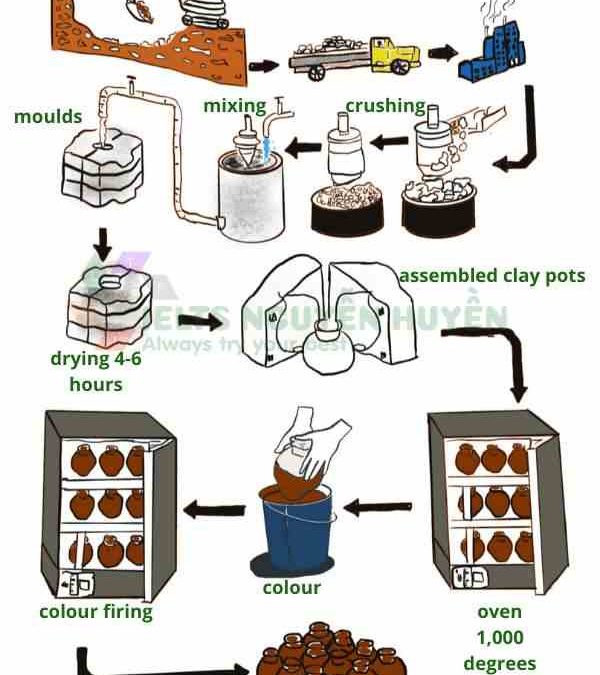
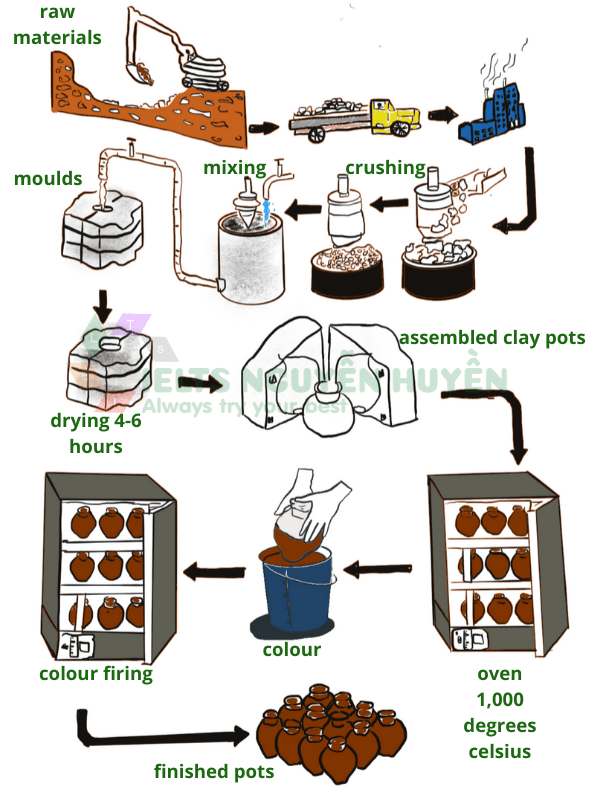
The diagram below shows one method of manufacturing ceramic pots.
The diagram outlines one particular way of creating ceramic pots. Looking from an overall perspective, it is readily apparent that this chemical process can be grouped into three main stages: collecting the raw materials, forming those materials into pots, and finishing the process by heating and colouring them.
The first stage of the process is to dig up and transport the raw materials to factories where they are then crushed and mixed with water to make them into a clay-like substance that can be molded into the shape of a pot. From there, they must dry for 4-6 hours in moulds in order to fix them into their final shape.
They are then placed in an oven and heated to over 1000 degrees celsius. Following this, the pots are colored and a ‘firing’ stage in the oven sets the paint pigments in place, finalising the process.
Analysis
1. The diagram outlines one particular way of creating ceramic pots. 2. Looking from an overall perspective, it is readily apparent that this chemical process can be grouped into three main stages: collecting the raw materials, forming those materials into pots, and finishing the process by heating and colouring them.
1. The first stage of the process is to dig up and transport the raw materials to factories where they are then crushed and mixed with water to make them into a clay-like substance that can be molded into the shape of a pot. 2. From there, they must dry for 4-6 hours in moulds in order to fix them into their final shape.
Try to describe a lot of steps in one sentence to show off your grammar.
Mix up long and shorter sentences.
1. They are then placed in an oven and heated to over 1000 degrees celsius. 2. Following this, the pots are colored and a ‘firing’ stage in the oven sets the paint pigments in place, finalising the process.
Continue with the next part of the process. You can make a new paragraph when you get on to a new section of the process.
Finish describing all the steps.
Vocabulary
What do the words in bold below mean?
The diagram outlines one particular way of creating ceramic pots. Looking from an overall perspective, it is readily apparent that this chemical process can be grouped into three main stages: collecting the raw materials, forming those materials into pots, and finishing the process by heating and colouring them.
The first stage of the process is to dig up and transport the raw materials to factories where they are then crushed and mixed with water to make them into a clay-like substance that can be molded into the shape of a pot. From there, they must dry for 4-6 hours in moulds in order to fix them into their final shape.
They are then placed in an oven and heated to over 1000 degrees celsius. Following this, the pots are colored and a ‘firing’ stage in the oven sets the paint pigments in place, finalising the process.
Answers
outlines describes
particular way one method
ceramic pots pots/buckets made from a clay-type substance
looking from an overall perspective, it is readily apparent that overall
chemical process involves the transformation of materials
grouped into combined
raw materials original source
finishing ending
dig up mine
transport send to
crushed ground up
mixed combined
clay-like substance similar to clay/mud
molded shaped
dry not wet
moulds holders to shape something
fix set in place
placed put in
celsius measurement of temperature
following this after this
‘firing’ stage setting in place the colour
sets the paint pigments in place making the colour stay
The diagram o_________s one p_____________y of creating c______________s. L__________________________________________________________t this c_________________s can be g______________o three main stages: collecting the r________________s, forming those materials into pots, and f_____________g the process by heating and colouring them.
The first stage of the process is to d_______p and t_____________t the raw materials to factories where they are then c________d and m_________d with water to make them into a c____________________e that can be m___________d into the shape of a pot. From there, they must d___y for 4-6 hours in m_________s in order to f___x them into their final shape.
They are then p_________d in an oven and heated to over 1000 degrees c_________s. F_______________s, the pots are colored and a ‘f______________e in the oven s__________________________________e, f___________g the process.
Before reading, listen to the audio to improve your listening skills:
IELTS Writing Task 2 Sample Answer Essay: Traveling to Other Countries
Many people today are choosing to travel to other countries.
Why is this happening?
Is this a positive or negative development?
Real Past IELTS Exam
More and more people today are choosing to travel internationally. This positive development is mainly because of a rise in middle class income coupled with advances in aviation.
People today can afford to travel as it has become more convenient. The last half century has seen wages in both developed and developing companies climb with the concomitant expansion of the global middle class. Workers have the disposable income to travel that they lacked in the past. This has been complemented with safer airplanes so individuals are not afraid to fly. Airfares have also become cheaper as companies like Boeing produce more efficient planes, competition intensifies between competing airlines, and the supply more than meets demand for flights. These factors combined have spawned a golden age of international travel.
Looking at the opportunity in perspective, it is hard to see the advent of international travel as anything less than one of mankind’s greatest achievements. For the entirety of human history, most people lived and died near to where they were born. Anyone who wanted to travel to another country had to possess enourmous wealth, time, and courage. Today, the average employee can save up and travel to see the wonders of the Rennaissance in Southern Europe, the vast monuments to history and modernity in China, or explore any other corner of Earth that has piqued their interest. This is an unprecedented opportunity unavailable to past generations.
In conclusion, international travel is a byproduct of the modern age and we should all be grateful for its possibility. There are clear environmental drawbacks but those should not blind people to its benefits taken as a whole.
Analysis
1. More and more people today are choosing to travel internationally. 2. This positive development is mainly because of a rise in middle class income coupled with advances in aviation.
Paraphrase the overall topic for the essay.
Write your opinion.
1. People today can afford to travel as it has become more convenient. 2. The last half century has seen wages in both developed and developing companies climb with the concomitant expansion of the global middle class. 3. Workers have the disposable income to travel that they lacked in the past. 4. This has been complemented with safer airplanes so individuals are not afraid to fly. 5. Airfares have also become cheaper as companies like Boeing produce more efficient planes, competition intensifies between competing airlines, and the supply more than meets demand for flights. 6. These factors combined have spawned a golden age of international travel.
Write a clear topic sentence with your opinion at the end.
Begin to develop your main idea. I start with a further explanation.
Continue developing that idea.
Here I add another reason that is related.
I include another related reason – try to make your reasons build to support your main idea for the whole paragraph.
Conclude the paragraph by relating it back to the main question.
1. Looking at the opportunity in perspective, it is hard to see the advent of international travel as anything less than one of mankind’s greatest achievements. 2. For the entirety of human history, most people lived and died near to where they were born. 3. Anyone who wanted to travel to another country had to possess enourmous wealth, time, and courage. 4. Today, the average employee can save up and travel to see the wonders of the Rennaissance in Southern Europe, the vast monuments to history and modernity in China, or explore any other corner of Earth that has piqued their interest. 5. This is an unprecedented opportunity unavailable to past generations.
Write another topic sentence with another clear main idea at the end.
Here I compare with the past to make my point stronger.
I then develop the comparison.
Use specific examples.
Conclude the paragraph with a strong statement.
1. In conclusion, international travel is a byproduct of the modern age and we should all be grateful for its possibility. 2. There are clear environmental drawbacks but those should not blind people to its benefits taken as a whole.
Repeat your opinion to be 100% clear.
Include a final detail or thought at the end for full marks from the IELTS examiner.
Vocabulary
What do the words in bold below mean?
More and more people today are choosing to travel internationally. This positive development is mainly because of a rise in middle class income coupled with advances in aviation.
People today can afford to travel as it has become more convenient. The last half century has seen wages in both developed and developing companies climb with the concomitant expansion of the global middle class. Workers have the disposable income to travel that they lacked in the past. This has been complemented with safer airplanes so individuals are not afraid to fly. Airfares have also become cheaper as companies like Boeing produce more efficient planes, competition intensifies between competing airlines, and the supply more than meets demand for flights. These factors combined have spawned a golden age of international travel.
Looking at the opportunity in perspective, it is hard to see the advent of international travel as anything less than one of mankind’s greatest achievements. For the entirety of human history, most people lived and died near to where they were born. Anyone who wanted to travel to another country had to possess enourmous wealth, time, and courage. Today, the average employee can save up and travel to see the wonders of the Rennaissance in Southern Europe, the vast monuments to history and modernity in China, or explore any other corner of Earth that has piqued their interest. This is an unprecedented opportunity unavailable to past generations.
In conclusion, international travel is a byproduct of the modern age and we should all be grateful for its possibility. There are clear environmental drawbacks but those should not blind people to its benefits taken as a whole.
Answers
more and more ever-increasing
travel internationally go abroad, to another country
middle class income not rich or poor
coupled with combine with
aviation.flying
afford can pay for
convenient easy, suitable
wages salary
climb increase
concomitant expansion related increase
global around the world
disposable income money to spare
lacked didn’t have
complemented with combined with
Boeing a company that makes airplanes
efficient planes planes that don’t use too much fuel, lighter
competition intensifies between competing airlines more and more fighting between companies
supply more than meets demand there are more planes than people wanting to travel so the prices are lower
spawned created
golden age great time
looking at the opportunity in perspective taken as a whole
advent beginning of
mankind’s greatest achievements best thing people have donw
entirety all of
possess have
courage bravery
average employee most people
save up set aside money for
Rennaissance a period of flourishing arts and science from 1400 – 1600 in Europe
Southern Europe Italy, Spain, Greece, France, etc.
vast monuments to history and modernity big works from the past and new ones
M__________________e people today are choosing to t______________________y. This positive development is mainly because of a rise in m___________________________e c__________________h advances in a__________n.
People today can a_________d to travel as it has become more c______________t. The last half century has seen w______s in both developed and developing companies c______b with the c_________________n of the g_________l middle class. Workers have the d__________________e to travel that they l_________d in the past. This has been c___________________________h safer airplanes so individuals are not afraid to fly. Airfares have also become cheaper as companies like B_________g produce more e___________________s, c______________________________________________s, and the s____________________d for flights. These factors combined have s____________d a g_____________e of international travel.
L_______________________________________e, it is hard to see the a___________t of international travel as anything less than one of m________________________________________s. For the e__________y of human history, most people lived and died near to where they were born. Anyone who wanted to travel to another country had to p___________s enourmous wealth, time, and c____________e. Today, the a______________________e can s________p and travel to see the wonders of the R___________________e in S_______________________e, the v_____________________________________y in China, or explore any other c_________________h that has p________________________t. This is an u______________________________y unavailable to p______________________s.
In conclusion, international travel is a b_____________t of the modern age and we should all be g___________l for its possibility. There are clear environmental d_____________s but those should not b_________d people to its benefits t____________________e.
Listen and check:
Listening Practice
Watch the travel guide for London below:
Reading Practice
You can also read about the environmental cost of international travel below, which would also make for a strong argument:
Listen to the audio first for some extra listening practice:
IELTS Writing Task 2 Sample Answer Essay: Planning for the Future (Real Past IELTS Exam/Test)
Some feel that it is a waste of time to plan for the future and it is more important to focus on the present.
To what extent do you agree or disagree?
Real Past IELTS Exam
There is growing sentiment today that making plans for the future can take one out of the present moment. Although it is important to have some general future goals, individuals ought to prioritise right now.
The clear advantage of having goals is that they dictate and align your actions. A good counter-example to support this comes from aimless individuals without any fixed aspirations. It is not uncommon for recent university graduates to feel lost and drift from job to job. This can be a rewarding experience but if it continues too long then one will likely remain in low-paying positions and fall behind one’s peers. A clear goal can motivate a decision on long-term vocation and force one to put in the hard work required to excel.
Despite the general advantages of having some long-term goals listed above, obsessing over the future can impair connection with the present. There are many famous literary examples of this that reveal underlying tensions between capitalist striving and individual contentment, such as in the famous novel Babbitt by Sinclair Lewis. The titular character Babbitt has spent most of his life looking to the future and accomplishing middle class goals. He grows dissatisfied with this life because he no longer feels a vibrant connection to the present moment and his true feelings. His suspension of his deepest desires to meet extrinsic goals set by society alienates him from the present. This is commonly referred to as a mid-life crisis and is very common among driven individuals who reach a pinnacle of success.
In conclusion, emphasis on future goals is one source of modern unhappiness. Individuals must carefully select their goals to distinguish between the life they want and the life they are expected to want.
Analysis
1. There is growing sentiment today that making plans for the future can take one out of the present moment. 2. Although it is important to have some general future goals, individuals ought to prioritise right now.
Paraphrase the overall topic for the essay.
Give a clear opinion.
1. The clear advantage of having goals is that they dictate and align your actions. 2. A good counter-example to support this comes from aimless individuals without any fixed aspirations. 3. It is not uncommon for recent university graduates to feel lost and drift from job to job. 4. This can be a rewarding experience but if it continues too long then one will likely remain in low-paying positions and fall behind one’s peers. 5. A clear goal can motivate a decision on long-term vocation and force one to put in the hard work required to excel.
Write a clear topic sentence with a main idea at the end.
Here I use a counter-example to support my argument.
Develop the example.
Keep developing it.
Bring it back to your overall argument for the paragraph.
1. Despite the general advantages of having some long-term goals listed above, obsessing over the future can impair connection with the present. 2. There are many famous literary examples of this that reveal underlying tensions between capitalist striving and individual contentment, such as in the famous novel Babbitt by Sinclair Lewis. 3. The titular character Babbitt has spent most of his life looking to the future and accomplishing middle class goals. 4. He grows dissatisfied with this life because he no longer feels a vibrant connection to the present moment and his true feelings. 5. His suspension of his deepest desires to meet extrinsic goals set by society alienates him from the present. 6. This is commonly referred to as a mid-life crisis and is very common among driven individuals who reach a pinnacle of success.
Write another clear topic sentence with another main idea at the end.
Use another example to develop your main idea. Here I use an example from a novel.
Explain your example fully.
Keep developing it for the entire paragraph.
Continue developing it…
Conclude with a link back to your overall argument.
1. In conclusion, emphasis on future goals is one source of modern unhappiness. 2. Individuals must carefully select their goals to distinguish between the life they want and the life they are expected to want.
Repeat your opinion.
Add in a final detail/thought.
Vocabulary
What do the words in bold below mean?
There is growing sentiment today that making plans for the future can take one out of the present moment. Although it is important to have some general future goals, individuals ought to prioritise right now.
The clear advantage of having goals is that they dictate and align your actions. A good counter-example to support this comes from aimless individuals without any fixed aspirations. It is not uncommon for recent university graduates to feel lost and drift from job to job. This can be a rewarding experience but if it continues too long then one will likely remain in low-paying positions and fall behind one’s peers. A clear goal can motivate a decision on long-term vocation and force one to put in the hard work required to excel.
Despite the general advantages of having some long-term goals listed above, obsessing over the future can impair connection with the present. There are many famous literary examples of this that reveal underlying tensions between capitalist striving and individual contentment, such as in the famous novel Babbitt by Sinclair Lewis. The titular character Babbitt has spent most of his life looking to the future and accomplishing middle class goals. He grows dissatisfied with this life because he no longer feels a vibrant connection to the present moment and his true feelings. His suspension of his deepest desires to meet extrinsic goals set by society alienates him from the present. This is commonly referred to as a mid-life crisis and is very common among driven individuals who reach a pinnacle of success.
In conclusion, emphasis on future goals is one source of modern unhappiness. Individuals must carefully select their goals to distinguish between the life they want and the life they are expected to want.
Answers
growing sentiment increasing opinion about
take one out of remove from
present moment right now
general future goals some plans for the future
prioritise make more important
dictate force
align keep in order
counter-example example showing the opposite case
aimless individuals people without goals
fixed aspirations clear goals
not uncommon common
recent university graduates people who just got out of university/college
drift from job to job no fixed career
rewarding experience fulfilling
low-paying positions bad jobs
fall behind one’s peers lost ground to
long-term vocation career
excel be the best at
general advantages benefits overall
obsessing fixated on
impair connection hurt the relationship between
literary examples from books
underlying tensions problems beneath the surface
capitalist striving trying to make money
individual contentment how fulfilled you are
Babbitt the main character and name of the novel
Sinclair Lewis a write from the 1920s in the United States
titular character character the book is named after
looking to the future anticipating
accomplishing middle class goals making money, having a family, etc.
dissatisfied unhappy with
vibrant connection strong relationship
suspension stopped, cut
deepest desires what you most want
extrinsic goals set by society what others think you should desire
alienates distanced from, resentful of
commonly referred to usually called
mid-life crisis time in life where you feel lost
driven individuals ambitious people
reach a pinnacle of success become the best
emphasis focus on
modern unhappiness discontent today
carefully select choose wisely
distinguish separate
the life they are expected to want what people think they should desire
There is g__________________t today that making plans for the future can t____________________f the p_____________________t. Although it is important to have some g__________________s, individuals ought to p______________e right now.
The clear advantage of having goals is that they d________e and a______n your actions. A good c__________________e to support this comes from a_______________________s without any f__________________s. It is n______________________n for r_______________________s to feel lost and d___________________________b. This can be a r________________________e but if it continues too long then one will likely remain in l______________________s and f________________________s. A clear goal can motivate a decision on l__________________________n and force one to put in the hard work required to e_______l.
Despite the g______________________s of having some long-term goals listed above, o______________g over the future can i_____________________n with the present. There are many famous l______________________s of this that reveal u______________________s between c_____________________g and i____________________________t, such as in the famous novel B___________t by S________________s. The t__________________r Babbitt has spent most of his life l________________________e and a______________________________________s. He grows d______________d with this life because he no longer feels a v_______________________n to the present moment and his true feelings. His s_______________n of his d_______________s to meet e___________________________y a______________s him from the present. This is c_____________________o as a m__________________s and is very common among d___________________s who r___________________________s.
In conclusion, e____________s on future goals is one source of m______________________s. Individuals must c_______________t their goals to d___________________h between the life they want and t_______________________________t.
Listen and check:
Listening Practice
Learn more about connecting with the present moment below:
Reading Practice
Here’s an interesting New York Times article on the same topic:
"The highest quality materials anywhere on the internet! Dave improved my writing and vocabulary so much. Really affordable options you don't want to miss out on!"