IELTS Writing Task 2 Sample Answer Essay General Training: Private & Work Life
Some people like to spend their leisure time after work with co-workers while others prefer to keep their private life separate from their work life.
Discuss both sides and give your own opinion.
Real Past IELTS Exam
After finishing work, many people strive to carve out an independent private life and therefore eschew meeting colleagues socially. In my opinion, strong bonds with co-workers are justifiably common but it is more important to have a stable network of friends outside work.
The main advantage of fraternising with other employees after work is convenience. Employees get off work at the same time and it is easy to make plans. Most workers chat with each about their plans for the evening and then invite each other to get a drink, go to dinner, play sport or catch a movie. Since colleagues work together all day, they have a good idea of each other’s personality and will naturally congregate with the characters and groups they are predisposed towards. This organic process of meeting up with their close friends at work can quickly become an entrenched habit to look forward to at the end of the workday.
Nonetheless, a varied social life is crucial in order to maintain better mental health. Conversations with co-workers inevitably turn to office related gossip and gripes about work. These self-serving and repetitive dialogues do little more than weakly reinforce one’s self-esteem. When talking with an old school friend or former co-worker one is more likely to forget about work and delve into other subjects. The result is relief of work-related stress and freedom from reinforcement of your inner drives to compare, belittle, gossip, and complain. Over time, the mental toll of being immersed in work the entire day can lead to feelings of depression and frustration, while the opposite is true of those who compartmentalise work and social life.
In conclusion, spending one’s leisure time with a wider sphere of friends is key to good mental health. As people today become increasingly isolated, it is especially important to have a secure group of friends beyond the workplace.
Anaylsis
1. After finishing work, many people strive to carve out an independent private life and therefore eschew meeting colleagues socially. 2. In my opinion, strong bonds with co-workers are justifiably common but it is more important to have a stable network of friends outside work.
Paraphrase the overall essay topic.
Write a clear opinion by choosing one side overall.
1. The main advantage of fraternising with other employees after work is convenience. 2. Employees get off work at the same time and it is easy to make plans. 3. Most workers chat with each about their plans for the evening and then invite each other to get a drink, go to dinner, play sport or catch a movie. 4. Since colleagues work together all day, they have a good idea of each other’s personality and will naturally congregate with the characters and groups they are predisposed towards. 5. This organic process of meeting up with their close friends at work can quickly become an entrenched habit to look forward to at the end of the workday.
Use specific details – notice how specific and not general my ideas are.
Continue developing your main idea with a logical argument or an example.
Draw conclusions or state the final result to finish the paragraph.
1. Nonetheless, a varied social life is crucial in order to maintain better mental health. 2. Conversations with co-workers inevitably turn to office related gossip and gripes about work. 3. These self-serving and repetitive dialogues do little more than weakly reinforce one’s self-esteem. 4. When talking with an old school friend or former co-worker one is more likely to forget about work and delve into other subjects. 5. The result is relief of work-related stress and freedom from reinforcement of your inner drives to compare, belittle, gossip, and complain. 6. Over time, the mental toll of being immersed in work the entire day can lead to feelings of depression and frustration, while the opposite is true of those who compartmentalise work and social life.
Write another topic sentence with a main idea at the end.
Begin to develop your main idea.
Continue developing the same main idea – don’t switch to a new one.
State the results of your arguments/points.
Continue drawing out the results and be very specific.
Here I draw the reults out as far as I can.
1. In conclusion, spending one’s leisure time with a wider sphere of friends is key to good mental health. 2. As people today become increasingly isolated, it is especially important to have a secure group of friends beyond the workplace.
Repeat your opinion.
Add a final detail/thought for full marks from the IELTS examiner.
Vocabulary
What do the words in bold below mean?
After finishing work, many people strive to carve out an independent private life and therefore eschew meeting colleagues socially. In my opinion, strong bonds with co-workers are justifiably common but it is more important to have a stable network of friends outside work.
The main advantage of fraternising with other employees after work is convenience. Employees get off work at the same time and it is easy to make plans. Most workers chat with each about their plans for the evening and then invite each other to get a drink, go to dinner, play sport or catch a movie. Since colleagues work together all day, they have a good idea of each other’s personality and will naturally congregate with the characters and groups they are predisposed towards. This organix process of meeting up with their close friends at work can quickly become an entrenched habit to look forward to at the end of the workday.
Nonetheless, a varied social life is crucial in order to maintain better mental health. Conversations with co-workers inevitably turn to office related gossip and gripes about work. These self-serving and repetitive dialogues do little more than weakly reinforce one’s self-esteem. When talking with an old school friend or former co-worker one is more likely to forget about work and delve into other subjects. The result is relief of work-related stress and freedom from reinforcement of your inner drives to compare, belittle, gossip, and complain. Over time, the mental toll of being immersed in work the entire day can lead to feelings of depression and frustration, while the opposite is true of those who compartmentalise work and social life.
In conclusion, spending one’s leisure time with a wider sphere of friends is key to good mental health. As people today become increasingly isolated, it is especially important to have a secure group of friends beyond the workplace.
Answers
strive try for
carve out separate
independent private life separate personal life/time
eschew avoid
socially not work-related
strong bonds good relationships with
justifiably common a good reason for people doing it
stable network secure group
fraternising be friendly with
convenience easy
get off work when your work ends
make plans arrange to meet
chat talk to
invite each other ask
get a drink go to a bar
catch a movie watch a movie
colleagues co-workers
personality temperament/character
naturally congregate group with the people you like
characters temperaments
predisposed towards likely to like
organic process happens naturally
meeting up with hanging out with
close friends people you like a lot, best friends
entrenched habit habit you can’t stop
look forward to are hopeful for
workday your time at work
varied social life lots of different friends, activities
crucial essential
maintain better mental health stay sane
inevitably turn always go to
office related gossip rumours at work
gripes complaints
self-serving for your own pleasure/advantage
repetitive dialogues saying the same thing over and over
weakly reinforce barely help with
self-esteem how you feel about yourself
old school friend friends from when you were in school
former co-worker someone you used to work with
delve into talk about
relief of work-related stress de-stress, not feel so much pressure
reinforcement supports
inner drives desires
compare contrast or look at to see what is the same/different
belittle make feel small, condescend
gossip talk rumours about
complain whine
mental toll more stress
immersed fully part of
depression feeling sad
frustration feeling angry
opposite is true of the contrary case holds for
compartmentalise work and social life keep work and private life separate
After finishing work, many people s_______e to c_________t an i_____________________e and therefore e_________w meeting colleagues s___________y. In my opinion, s______________s with co-workers are j_______________________n but it is more important to have a s________________k of friends outside work.
The main advantage of f_________________g with other employees after work is c_______________e. Employees g__________________k at the same time and it is easy to m_______________s. Most workers c______t with each about their plans for the evening and then i____________________r to g_____________k, go to dinner, play sport or c_______________e. Since c______________s work together all day, they have a good idea of each other’s p_______________y and will n_______________________e with the c_______________s and groups they are p________________________s. This o_________________s of m___________________h their c_________________s at work can quickly become an e____________________t to l__________________o at the end of the w____________y.
Nonetheless, a v____________________e is c____________l in order to m_______________________________h. Conversations with co-workers i___________________n to o__________________________p and g_____________s about work. These s__________________g and r______________________s do little more than w_______________________e one’s s___________________m. When talking with an o____________________d or f_________________r one is more likely to forget about work and d_______________o other subjects. The result is r______________________s and freedom from r__________________t of your i___________________s to c________________e, b____________e, g__________p, and c________________n. Over time, the m___________________l of being i_________________d in work the entire day can lead to feelings of d________________n and f________________n, while the o________________________f those who c_______________________________________e.
In conclusion, spending one’s l__________________e with a w________________e of friends is k___y to good mental health. As people today become i______________________d, it is e___________________t to have a s__________________p of friends b_______________________e.
Listen and check:
Listening Practice
Watch a scene about friends from work from the movie Thor:
This is an IELTS writing task 2 sample answer essay on the topic of parents spending less and less time with their children today.
You can also find my exclusive IELTS PDFs here on Patreon.
Dave
IELTS Writing Task 2 Sample Answer Essay: Parents Spending Time with Kids
Many parents today do not spend much time with their children.
Why is this?
Does this affect parents or children more?
Real Past IELTS Exam
These days it is becoming increasingly common for parents to spend less and less time with their children. In my opinion, this is because of some distinctly modern distractions and has a far greater effect on children.
Both parents and children are vulnerable to today’s consumer electronics. In the past, parents and children might have been distracted by television or a good book but they were also likely to play a board game together or go for a walk. This started to change with the advent of the internet and portable devices. Many children only care about using their phone or tablet to play games or watch Netflix. Parents are similarly addicted to games, entertainment and the allure of social media. This inclination towards passive entertainment persists even when taking their children out because though parents are physically present, phones often demand most of their attention.
This primarily impacts children as they are more impressionable. Research has shown that the majority of an individual’s personality and habits are formed early in life. If a parent neglects a child in favour of their own desires then they are likely to either act out seeking attention or withdraw into their own shell. The child in question might lack not only the supportive and unconditional love that is essential for a healthy upbringing, but also assume and repeat the negative behaviours of their role models. Many children overcompensate for their parent’s implicit rejection by numbing themselves by retreating into books, television, YouTube, social media or whatever will give them the attention they crave. This long-cultivated trauma can even follow them throughout adulthood.
In conclusion, the growth of consumer electronics is the source of parental neglect and it mainly impairs the mental health of children. Parents must take it on themselves today to find ways to counter the injurious implications of trading their children’s well-being for a sustained glance at a screen.
Analysis
1. These days it is becoming increasingly common for parents to spend less and less time with their children. 2. In my opinion, this is because of some distinctly modern distractions and has a far greater effect on children.
Paraphrase the overall essay topic.
Write a clear opinion.
1. Both parents and children are vulnerable to today’s consumer electronics. 2. In the past, parents and children might have been distracted by television or a good book but they were also likely to play a board game together or go for a walk. 3. This started to change with the advent of the internet and portable devices. 4. Many children only care about using their phone or tablet to play games or watch Netflix. 5. Parents are similarly addicted to games, entertainment and the allure of social media. 6. This inclination towards passive entertainment persists even when taking their children out because though parents are physically present, phones often demand most of their attention.
Write a clear topic sentence with your main idea at the end.
I begin to develop my main idea with a comparison to the past.
Use specific details to support your main idea.
Continue to support your main idea with clear examples.
Here I switch to deal with how it affects both children and parents.
Draw conclusions/state the results.
1. This primarily impacts children as they are more impressionable. 2. Research has shown that the majority of an individual’s personality and habits are formed early in life. 3. If a parent neglects a child in favour of their own desires then they are likely to either act out seeking attention or withdraw into their own shell. 4. The child in question might lack not only the supportive and unconditional love that is essential for a healthy upbringing, but also assume and repeat the negative behaviours of their role models. 5. Many children overcompensate for their parent’s implicit rejection by numbing themselves by retreating into books, television, YouTube, social media or whatever will give them the attention they crave. 6. This long-cultivated trauma can even follow them throughout adulthood.
Write another topic sentence with another clear main idea at the end.
You can quote general research to support your ideas.
I try to include the very specific effects.
Continue developing the same main idea and don’t switch to a new one.
Keep stating the full results.
Conclude with further results – summary isn’t very important.
1. In conclusion, the growth of consumer electronics is the source of parental neglect and it mainly impairs the mental health of children. 2. Parents must take it on themselves today to find ways to counter the injurious implications of trading their children’s well-being for a sustained glance at a screen.
Repeat your opinion.
Include a final thought/detail.
Vocabulary
What do the words in bold below mean?
These days it is becoming increasingly common for parents to spend less and less time with their children. In my opinion, this is because of some distinctly modern distractions and has a far greater effect on children.
Both parents and children are vulnerable to today’s consumer electronics. In the past, parents and children might have been distracted by television or a good book but they were also likely to play a board game together or go for a walk. This started to change with the advent of the internet and portable devices. Many children only care about using their phone or tablet to play games or watch Netflix. Parents are similarly addicted to games, entertainment and the allure of social media. This inclination towards passive entertainment persists even when taking their children out because though parents are physically present, phones often demand most of their attention.
This primarily impacts children as they are more impressionable. Research has shown that the majority of an individual’s personality and habits are formed early in life. If a parent neglects a child in favour of their own desires then they are likely to either act out seeking attention or withdraw into their own shell. The child in question might lack not only the supportive and unconditional love that is essential for a healthy upbringing, but also assume and repeat the negative behaviours of their role models. Many children overcompensate for their parent’s implicit rejection by numbing themselves by retreating into books, television, YouTube, social media or whatever will give them the attention they crave. This long-cultivated trauma can even follow them throughout adulthood.
In conclusion, the growth of consumer electronics is the source of parental neglect and it mainly impairs the mental health of children. Parents must take it on themselves today to find ways to counter the injurious implications of trading their children’s well-being for a sustained glance at a screen.
Answers
these days nowadays
increasingly common more and more popular
less and less time not as much time with
distinctly modern distractions new ways of grabbing your attention
far greater effect much larger impact
vulnerable can be exploited
consumer electronics phones, tables, TVs, etc.
distracted not paying attention
good book a book you like
board game games like Monopoly
advent beginning of
portable devices phones, tablets
similarly addicted also can’t stop using
allure attraction
inclination towards passive entertainment persists tendency to watch things and not be active continues
though despite
physically present there in person
demand most of their attention take most of their time
primarily impacts mostly effects
impressionable easily influenced
majority most of
formed early in life starts from childhood
neglects not pay attention to
in favour of preferring
desires wants
act out seeking attention have bad behaviour to get attention
withdraw into their own shell become passive, less open/active
lack don’t have
supportive helpful
unconditional love caring without conditions
healthy upbringing supporting environment
assume take on
repeat do again
negative behaviours bad actions
overcompensate go to far in reacting to
implicit rejection not explicitly stated dissaproval of
numbing not feeling
retreating hiding away from
crave want
long-cultivated trauma long period of neglect/hurt
follow them throughout adulthood stay with them forever
consumer electronics phones, TVs, etc.
parental neglect parents not paying attention/caring
mainly impairs mostly hurts
counter the injurious implications fight back against the hurtful effects
trading swapping
children’s well-being mental/physical health
sustained glance at a screen looking a long time at your device
T____________s it is becoming i_____________________________n for parents to spend l_____________________e with their children. In my opinion, this is because of some d_______________________________s and has a f________________________t on children.
Both parents and children are v________________e to today’s c_____________________s. In the past, parents and children might have been d_______________d by television or a g_____________k but they were also likely to play a b________________e together or go for a walk. This started to change with the a___________t of the internet and p__________________s. Many children only care about using their phone or tablet to play games or watch Netflix. Parents are s_________________d to games, entertainment and the a__________e of social media. This i___________________________________________________s even when taking their children out because t__________h parents are p___________________t, phones often d_________________________________n.
This p_________________________s children as they are more i__________________e. Research has shown that the m___________y of an individual’s personality and habits are f_______________________e. If a parent n___________s a child i____________f their own d___________s then they are likely to either a_____________________________n or w___________________________________l. The child in question might l_______k not only the s__________________e and u____________________e that is essential for a h_____________________g, but also a_____________e and r___________t the n________________________s of their role models. Many children o_______________________e for their parent’s i____________________n by n_______________g themselves by r________________g into books, television, YouTube, social media or whatever will give them the attention they c________e. This l_____________________________a can even f______________________________d.
In conclusion, the growth of c___________________s is the source of p__________________________t and it m__________________s the mental health of children. Parents must take it on themselves today to find ways to c_________________________________s of t_______________g their c_________________________g for a s______________________________n.
Listen and check:
Listening Practice
Learn more about emotional abuse from parents here:
Reading Practice
Read more about how screen time affects parenting here:
IELTS Writing Task 2 Sample Answer Essay General Training: Group and One-on-one Lessons
Some people believe that one-on-one lessons are better for learning while others think that group lessons are superior.
Discuss both views and give your own opinion.
Real Past IELTS Exam
Many concerned parties feel that education is best done in private sessions while others feel that group lessons are better. In my opinion, the pacing of individual lessons is an advantage but a classroom setting is superior as it allows for a wider range of skills to develop.
On the one hand, one-on-one lessons enable learners to work at an individualised pace. In the classroom, students either fall behind or get bored because they understand the lessons too easily. A tutor can observe their student’s progress and tailor lessons accordingly. This could result in a situation where a student who is gifted at math progresses well beyond their grade level. If they struggle in another subject, such as English, a Grade 5 aged student could effectively be studying Grade 4 English and Grade 8 math at the same time. This kind of pacing is only possible with one-on-one lessons.
On the other hand, group lessons open up opportunities for collaboration in and outside the classroom. Groups foster a classroom dynamic of debate. Students and teachers can exchange views and learn more from a plurality of perspectives. This is further exemplified in the project work that is commonplace in high schools and university classrooms in the United States. The rationale for assigning these projects is that students must improve their teamwork skills by getting along with classmates, taking on responsibility for given tasks, learning to compromise, and managing different temperaments. Many schools today assign roles within teams, such as team leader, presenter, primary researcher, and so on. These collaborative projects can then be brought into a group lesson and debated.
In conclusion, group lessons are a better way to learn. It is important that educators do not blindly follow the latest academic fads and instead carefully analyse the consequences before making drastic reforms to established educational practices.
Analysis
1. Many concerned parties feel that education is best done in private sessions while others feel that group lessons are better. 2. In my opinion, the pacing of individual lessons is an advantage but a classroom setting is superior as it allows for a wider range of skills to develop.
Paraphrase the overall essay topic.
Give a clear opinion by choosing an overall side.
1. On the one hand, one-on-one lessons enable learners to work at an individualised pace. 2. In the classroom, students either fall behind or get bored because they understand the lessons too easily. 3. A tutor can observe their student’s progress and tailor lessons accordingly. 4. This could result in a situation where a student who is gifted at math progresses well beyond their grade level. 5. If they struggle in another subject, such as English, a Grade 5 aged student could effectively be studying Grade 4 English and Grade 8 math at the same time. 6. This kind of pacing is only possible with one-on-one lessons.
Write a topic sentence with a clear main idea at the end.
I begin developing this idea by stating a counter-example.
Explain your main idea.
Give an example. Here my example is hypothetical.
Develop the example – be specific, not general!
Conclude by relating back to the essay topic.
1. On the other hand, group lessons open up opportunities for collaboration in and outside the classroom. 2. Groups foster a classroom dynamic of debate. 3. Students and teachers can exchange views and learn more from a plurality of perspectives. 4. This is further exemplified in the project work that is commonplace in high schools and university classrooms in the United States. 5. The rationale for assigning these projects is that students must improve their teamwork skills by getting along with classmates, taking on responsibility for given tasks, learning to compromise, and managing different temperaments. 6. Many schools today assign roles within teams, such as team leader, presenter, primary researcher, and so on. 7. These collaborative projects can then be brought into a group lesson and debated.
Write another topic sentence with a new main idea. Now I’m writing about the other side, the side that I agree with (so my argument is stronger and the paragraph is a little longer).
Explain or support your main idea.
Use specific ideas – don’t be general.
Give an example.
Develop the example.
Keep developing it as much as possible
Finish your development. No need to conclude the paragraph.
1. In conclusion, group lessons are a better way to learn. 2. It is important that educators do not blindly follow the latest academic fads and instead carefully analyse the consequences before making drastic reforms to established educational practices.
Repeat your opinion.
Add in a final thought/detail for full marks from the examiner.
Vocabulary
What do the words in bold below mean?
Many concerned parties feel that education is best done in private sessions while others feel that group lessons are better. In my opinion, the pacing of individual lessons is an advantage but a classroom setting is superior as it allows for a wider range of skills to develop.
On the one hand, one-on-one lessonsenable learners to work at an individualised pace. In the classroom, students either fall behind or get bored because they understand the lessons too easily. A tutor can observe their student’s progress and tailor lessons accordingly. This could result in a situation where a student who is gifted at math progresses well beyond their grade level. If they struggle in another subject, such as English, a Grade 5 aged student could effectively be studying Grade 4 English and Grade 8 math at the same time. This kind of pacing is only possible with one-on-one lessons.
On the other hand, group lessons open up opportunities for collaboration in and outside the classroom. Groups foster a classroom dynamic of debate. Students and teachers can exchange views and learn more from a plurality of perspectives. This is further exemplified in the project work that is commonplace in high schools and university classrooms in the United States. The rationale for assigning these projects is that students must improve their teamwork skills by getting along with classmates, taking on responsibility for given tasks, learning to compromise, and managing different temperaments. Many schools today assign roles within teams, such as team leader, presenter, primary researcher, and so on. These collaborative projects can then be brought into a group lesson and debated.
In conclusion, group lessons are a better way to learn. It is important that educators do not blindly follow the latest academic fads and instead carefully analyse the consequences before making drastic reforms to established educational practices.
Answers
concerned parties those who are interested in this issue
best done better accomplished
private sessions one-on-one lessons
group lessons classroom lessons
pacing speed of learning
an advantage a positive
classroom setting in the classroom
superior better
allows for opens up the possibility of
wider range more variety
one-on-one lessons tutoring
enable learners makes it possible for students to
individualised pace at their own speed
fall behind can’t catch up with their work
tutor one-on-one teacher
observe watch
progress advancing in a skill/subject
tailor lessons accordingly make the lessons fit the student’s ability
This could result in a situation where it is possible the effect will be
gifted talented
progresses well beyond advances far faster
grade level how far they are in school
effectively essentially
at the same time simultaneously
open up opportunities allow for the possiblity of
collaboration working together
foster encourage
classroom dynamic of debate exchanging views with other students
exchange views debating
plurality of perspectives many different opinions
exemplified verb of example
commonplace ubiquitous
rationale reason for
assigning giving to
teamwork skills working with others
getting along with classmates be friendly with each other
taking on responsibility for given tasks having duties
learning to compromise not being stubborn, listening to other ideas
managing different temperaments dealing with other personalities
assign roles give jobs
team leader boss
presenter person who presents
primary researcher person who looks up the information
and so on etc.
brought into taken to
debated ideas discussed
blindly without thinking/looking
latest academic fads what’s new in education
carefully analyse the consequences look deeply into the effects
drastic reforms big changes
established educational practices how people have been teaching for a long time
Many c______________________s feel that education is b_________e in p____________________s while others feel that g_________________s are better. In my opinion, the p___________g of individual lessons is an a______________e but a c__________________g is s_____________r as it a_____________r a w_____________e of skills to develop.
On the one hand, o_________________se___________________s to work at an i________________________e. In the classroom, students either f_______________d or get bored because they understand the lessons too easily. A t________r can o____________e their student’s p_____________s and t__________________________y. T________________________________e a student who is g__________d at math p_______________________d their g_____________l. If they struggle in another subject, such as English, a Grade 5 aged student could e__________________y be studying Grade 4 English and Grade 8 math a_____________________e. This kind of pacing is only possible with one-on-one lessons.
On the other hand, group lessons o_________________________s for c__________________n in and outside the classroom. Groups f__________r a c_____________________________________e. Students and teachers can e__________________s and learn more from a p________________________s. This is further e__________________d in the project work that is c_________________e in high schools and university classrooms in the United States. The r______________e for a______________g these projects is that students must improve their t___________________s by g___________________________s, t_______________________________s, l___________________________e, and m___________________________________s. Many schools today a______________s within teams, such as t________________r, p______________r, p______________________r, a_______________n. These collaborative projects can then be b_______________o a group lesson and d____________d.
In conclusion, group lessons are a better way to learn. It is important that educators do not b____________y follow the l______________________s and instead c__________________________________s before making d___________________s to e_____________________________________s.
Listen and check:
Listening Practice
Watch an interesting short documentary from The New York Times on this topic below:
Write about the following related educational topic and then check with my sample answer:
In many schools and universities today, women have a tendency to study the humanities (such as the arts and languages) while men more often major in science related subjects. Some believe this tendency should be changed.
IELTS Writing Task 1 Sample Answer Essay: Concerts Line Chart
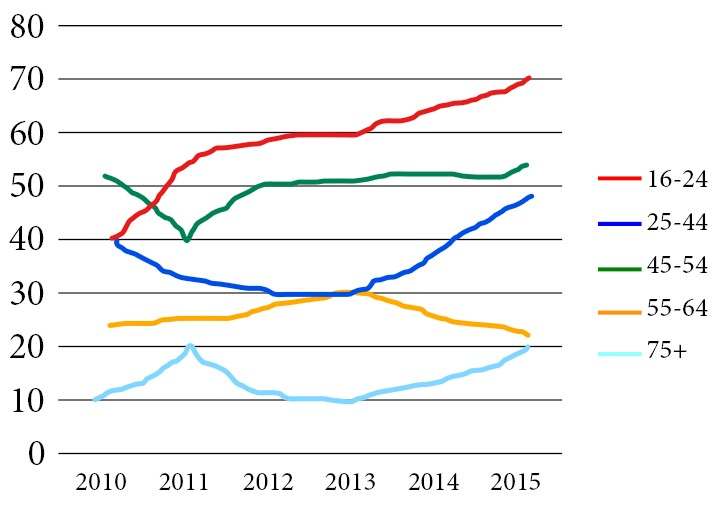
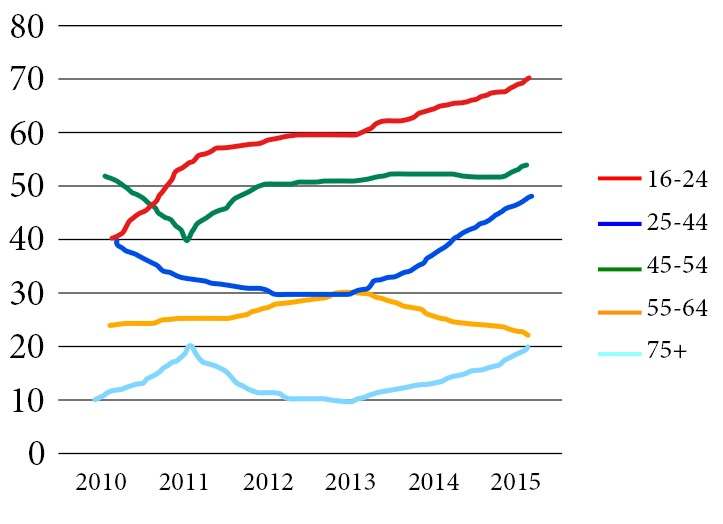
The graph below shows the percentage of people in different age groups in one city who attended music concerts between 2010 and 2015.
The given line chart details the percentages of people attending concerts from 2010 to 2015 across various age groups. Looking from an overall perspective, it is readily apparent that all ages showed increasing trends except for 55-64 and that younger people tended to go to concerts more often.
52% of those between the ages of 45 and 54 went to concerts in 2010, leading all age brackets, but there was a dip to 40% in 2011 which allowed the 16-24 group to rise 15% to 55% and lead all concert-goers. From there, both groups increased with broadly similar trends as the 16-24 year olds had risen to 70% by 2015 and the former group had grown to 54%.
The 25-44 and 55-64 groups showed inverse trends with the former group dipping from 40% in 2010 to a low of 30% in 2013 before sloping upwards to nearly 50% by the end of the period. The latter group rose steadily from a starting point of 20% to intersect with the younger group at 30% in 2013 and then fell to just over 20% in 2015. The final group, aged 75+, doubled to 20% in the first year, had surrendered those gains by 2013, before undergoing a stable increase and reaching 20% to finish the period.
Analysis
1. The given line chart details the percentages of people attending concerts from 2010 to 2015 across various age groups. 2. Looking from an overall perspective, it is readily apparent that all ages showed increasing trends except for 55-64 and that younger people tended to go to concerts more often.
Paraphrase what the graph shows.
Write an overview that includes whether or not the categories went up or down and the general overall ranking of each.
1. 52% of those between the ages of 45 and 54 went to concerts in 2010, leading all age brackets, but there was a dip to 40% in 2011 which allowed the 16-24 group to rise 15% to 55% and lead all concert-goers. 2. From there, both groups increased with broadly similar trends as the 16-24 year olds had risen to 70% by 2015 and the former group had grown to 54%.
Begin to describe the data by comparing different groups.
Continue comparing and list all the groups. You don’t need all the data but make sure the start and end point is clear and how quickly/slowly it rose/fell.
1. The 25-44 and 55-64 groups showed inverse trends with the former group dipping from 40% in 2010 to a low of 30% in 2013 before sloping upwards to nearly 50% by the end of the period. 2. The latter group rose steadily from a starting point of 20% to intersect with the younger group at 30% in 2013 and then fell to just over 20% in 2015. 3. The final group, aged 75+, doubled to 20% in the first year, had surrendered those gains by 2013, before undergoing a stable increase and reaching 20% to finish the period.
Begin to compare the other data.
Continue comparing it listing all the data.
Include any areas that you didn’t talk about at the end as I do here.
Vocabulary
What do the words in bold below mean?
The given line chart details the percentages of people attending concerts from 2010 to 2015 across various age groups. Looking from an overall perspective, it is readily apparent that all ages showed increasing trends except for 55-64 and that younger people tended to go to concerts more often.
52% of those between the ages of 45 and 54 went to concerts in 2010, leading all age brackets, but there was a dip to 40% in 2011 which allowed the 16-24 group to rise 15% to 55% and lead all concert-goers. From there, both groups increased with broadly similar trends as the 16-24 year olds had risen to 70% by 2015 and the former group had grown to 54%.
The 25-44 and 55-64 groups showed inverse trends with the former group dipping from 40% in 2010 to a low of 30% in 2013 before sloping upwards to nearly 50% by the end of the period. The latter group rose steadily from a starting point of 20% to intersect with the younger group at 30% in 2013 and then fell to just over 20% in 2015. The final group, aged 75+, doubled to 20% in the first year, had surrendered those gains by 2013, before undergoing a stable increase and reaching 20% to finish the period.
Answers
given presented
details describes
attending concerts going to music shows
across various age groups at different ages
Looking from an overall perspective, it is readily apparent that Overall
increasing trends more and more
tended were more likely to
leading in front of
age brackets age groups
dip fall
rise increase
concert-goers people who go to concerts
broadly similar trends in general had the same pattern
former one mentioned first
showed inverse trends had opposite patterns
dipping from falling from
a low of the minimum point
sloping upwards gently increasing
latter more recent one
steadily at regular intervals
starting point beginning with
intersect with cross each other at
just over a little above
doubled increased by 2x
surrendered gave up
undergoing experiencing
stable increase regular rise
reaching getting to
to finish the period at the end of the surveyed time
The g______n line chart d__________s the percentages of people a______________________s from 2010 to 2015 a____________________________s. L___________________________________________________________t all ages showed i________________________s except for 55-64 and that younger people t_________d to go to concerts more often.
52% of those between the ages of 45 and 54 went to concerts in 2010, l____________g all a______________s, but there was a d____p to 40% in 2011 which allowed the 16-24 group to r_____e 15% to 55% and lead all c______________s. From there, both groups increased with b___________________________s as the 16-24 year olds had risen to 70% by 2015 and the f_______r group had grown to 54%.
The 25-44 and 55-64 groups s________________________s with the former group d_____________m 40% in 2010 to a________f 30% in 2013 before s_____________________s to nearly 50% by the end of the period. The l________r group rose s____________y from a s___________________t of 20% to i_____________________h the younger group at 30% in 2013 and then fell to j____________r 20% in 2015. The final group, aged 75+, d___________d to 20% in the first year, had s___________________d those gains by 2013, before u________________g a s_______________e and r______________g 20% t____________________________d.
This is an IELTS writing task 2 sample answer essay from the real IELTS exam on the topic of demand for consumer goods and the effect on the environment.
It’s a two-part question so you simply need to answer each question.
The increase in the production of consumer goods results in damage to the natural environment.
What are the causes of this?
What can be done to solve this problem?
Real Past IELTS Exam
The increasing desire for consumer goods today has accelerated industrial production and this poses a threat to the environment. This essay will delineate the reasons for this and also propose solutions for these concomitant environmental risks.
Environmental degradation due to the production of consumer goods can be traced back to governmental shortcomings. Competition between countries makes it nearly impossible to agree on a cohesive global policy. There are attempts, like the recent Paris accords, but many powerful countries, chiefly the United States and China, fear losing their competitive advantages and are unwilling to sign over their autonomy. Developing countries also feel that protecting the environment handicaps them and is a lower priority than rising standards of living. This is coupled with the rise of corporate lobbying groups and corruption in governments around the world. Powerful companies can fund studies for bills that support their efforts to ramp up production and downplay the environmental costs.
The environmental implications of a consumer economy can be mitigated through an array of strict governmental regulations. The best examples of these laws come from environmentally conscious nations in Europe. The European Union has signed every global accord put before them and are making great strides in enforcing among its constituent members the agreed upon limits set forth in these charters. These include allowing countries to buy carbon credits, banning plastic bags and controlling the disposal of toxic waste. There are also more proactive solutions that entail encouraging renewable energies such as solar and wind power. The rest of the world can learn from these European reforms how to wean themselves off an unhealthy dependence on the fossil fuels that underpin consumerism.
In conclusion, government is to blame for the impact of a consumer economy on the environment and they also hold the keys to averting future catastrophe. However, it is unlikely governments will opt to act until the situation is already beyond a tipping point.
Analysis
1. The increasing desire for consumer goods today has accelerated industrial production and this poses a threat to the environment. 2. This essay will delineate the reasons for this and also propose solutions for these concomitant environmental risks.
Paraphrase the overall essay topic.
State a clear overall opinion – don’t sit in the middle!
1. Environmental degradation due to the production of consumer goods can be traced back to governmental shortcomings. 2. Competition between countries makes it nearly impossible to agree on a cohesive global policy. 3. There are attempts, like the recent Paris accords, but many powerful countries, chiefly the United States and China, fear losing their competitive advantages and are unwilling to sign over their autonomy. 4. Developing countries also feel that protecting the environment handicaps them and is a lower priority than rising standards of living. 5. This is coupled with the rise of corporate lobbying groups and corruption in governments around the world. 6. Powerful companies can fund studies for bills that support their efforts to ramp up production and downplay the environmental costs.
Write a topic sentence with a clear main idea at the end.
Begin to develop or explain your main idea.
Give a specific example.
Develop the example.
This question asks for more than 1 cause so include a second cause.
Develop that cause as well.
1. The environmental implications of a consumer economy can be mitigated through an array of strict governmental regulations. 2. The best examples of these laws come from environmentally conscious nations in Europe. 3. The European Union has signed every global accord put before them and are making great strides in enforcing among its constituent members the agreed upon limits set forth in these charters. 4. These include allowing countries to buy carbon credits, banning plastic bags and controlling the disposal of toxic waste. 5. There are also more proactive solutions that entail encouraging renewable energies such as solar and wind power. 6. The rest of the world can learn from these European reforms how to wean themselves off an unhealthy dependence on fossil fuels that underpin consumerism.
Write another topic sentence with a clear main idea at the end.
Begin another specific example.
Develop the example.
Continue developing it – don’t switch to another example.
This one asks for more than 1 solution, so add a second solution.
Develop that solution as well.
1. In conclusion, government is to blame for the impact of a consumer economy on the environment and they also hold the keys to averting future catastrophe. 2. However, it is unlikely governments will opt to act until the situation is already beyond a tipping point.
Repeat your opinion.
Add in a final thought/detail.
Vocabulary
What do the words in bold below mean?
The increasing desire for consumer goods today has accelerated industrial production and this poses a threat to the environment. This essay will delineate the reasons for this and also propose solutions for these concomitant environmental risks.
Environmental degradation due to the production of consumer goods can be traced back to governmental shortcomings. Competition between countries makes it nearly impossible to agree on a cohesive global policy. There are attempts, like the recent Paris accords, but many powerful countries, chiefly the United States and China, fear losing their competitive advantages and are unwilling to sign over their autonomy. Developing countries also feel that protecting the environment handicaps them and is a lower priority than rising standards of living. This is coupled with the rise of corporate lobbying groups and corruption in governments around the world. Powerful companies can fund studies for bills that support their efforts to ramp up production and downplay the environmental costs.
The environmental implications of a consumer economy can be mitigated through an array of strict governmental regulations. The best examples of these laws come from environmentally conscious nations in Europe. The European Union has signed every global accord put before them and are making great strides in enforcing among its constituent members the agreed uponlimits set forth in these charters. These include allowing countries to buy carbon credits, banning plastic bags and controlling the disposal of toxic waste. There are also more proactive solutions that entail encouraging renewable energies such as solar and wind power. The rest of the world can learn from these European reforms how to wean themselves off an unhealthy dependence on the fossil fuels that underpin consumerism.
In conclusion, government is to blame for the impact of a consumer economy on the environment and they also hold the keys to averting future catastrophe. However, it is unlikely governments will opt to act until the situation is already beyond a tipping point.
Answers
increasing desire wanting more and more
consumer goods products
accelerated industrial production faster creation of products
poses a threat is a problem
delineate describe
propose solutions suggest fixes
concomitant environmental risks resultant problems for the environment
degradation getting worse
traced back has its source in
governmental shortcomings government failing to
nearly impossible almost can’t be done
cohesive global policy consistent regulations for all countries
attempts tries
recent Paris accords not long ago agreements about the environment from a conference in Paris
chiefly mainly
fear scared of
competitive advantages ahead of other countries
unwilling don’t want to
sign over allow
autonomy control
handicaps holds them back
lower priority not as important
rising standards of living people living better lives
coupled combined with
rise increase
corporate lobbying groups people who work for companies to convince/bribe politicians
fund studies give money for research
bills legislation
ramp up increase
downplay make lesser
implications results
mitigated lessened
array lots of kinds
strict governmental regulations tough laws
environmentally conscious caring about the environment
European Union countries in Europe working together
every global accord put before them all agreements presented to them
making great strides getting better at
enforcing making sure the laws are followed
constituent members countries in the E.U.
agreed uponlimits set forth what they have decided to follow, the rules laid out
charters agreements
buy carbon credits purchase the right to pollute
banning plastic bags not allowing single-use plastic bags
controlling the disposal of toxic waste regulating how waste is gotten rid of
proactive solutions active measures
entail encouraging renewable energies include helping clean energy
solar from the sun
wind power wind turbines generating power
reforms changes
wean themselves off stop using
unhealthy dependence have to use, can’t stop
fossil fuels oil, gas
underpin consumerism the foundation for capitalism
is to blame the fault of
hold the keys are in charge of
averting future catastrophe preventing disasters later
unlikely probably not going to happen
beyond a tipping point won’t be able to reverse it
The i______________________e for c____________________s today has a___________________________________n and this p____________________t to the environment. This essay will d______________e the reasons for this and also p____________________s for these c___________________________________s.
Environmental d___________________n due to the production of consumer goods can be t______________k to g____________________________s. Competition between countries makes it n___________________e to agree on a c______________________y. There are a_______________s, like the r________________________s, but many powerful countries, c__________y the United States and China, f______r losing their c_______________________s and are u_______________g to s______________r their a_______________y. Developing countries also feel that protecting the environment h______________s them and is a l____________________y than r____________________________g. This is c__________d with the r_____e of c_____________________________s and corruption in governments around the world. Powerful companies can f_________________s for b________s that support their efforts to r______________p production and d_________________y the environmental costs.
The environmental i_______________________s of a consumer economy can be m______________d through an a_______y of s________________________________s. The best examples of these laws come from e____________________________s nations in Europe. The E________________________n has signed e___________________________________m and are m____________________s in e________________g among its c________________________s the a_____________________________________h in these c______________s. These include allowing countries to b___________________________s, b__________________________s and c_____________________________________e. There are also more p___________________s that e__________________________________s such as s_____________r and w___________________r. The rest of the world can learn from these European r_____________s how to w____________________________f an u___________________________e on the f_____________s that u__________________m.
In conclusion, government i________________e for the impact of a consumer economy on the environment and they also h________________s to a_______________________________e. However, it is u___________y governments will opt to act until the situation is already b_____________________________t.
Listen and check:
Listening Practice
Learn more here about the impact of consumer goods on the environment:
"The highest quality materials anywhere on the internet! Dave improved my writing and vocabulary so much. Really affordable options you don't want to miss out on!"