This is an IELTS writing task 2 sample answer essay on the topic of focusing in single subjects in school after the age of 15 or studying a more diverse curriculum.
This one was tricky for me because I knew what I wanted to write but it was hard to structure it and make the ideas clear.
IELTS Writing Task 2 Sample Answer Essay: Focus on Single Subjects
Some educational systems make students study specialised subjects from the age of fifteen while others require students to study a wide range.
Discuss both sides and give your own opinion.
Real Past IELTS Exam
Many educational reformers today incline towards a narrower curriculum for students 15 and older. In my opinion, while this is part of a decidedly modern movement for early specialisation, a wide range of knowledge serves as a basis for more well-adjusted adults.
Limiting subjects from the age of 15 onwards can allow for greater focus. It is not uncommon for many children to choose one musical instrument or participate in a single sport from the beginning of grade school. The rationale is that more time spent in one domain inevitably leads to mastery and this is supported by research into the importance of practice for elite performers. There are many famous examples of individuals who focused from their teenage years onwards and found success such as The Beatles’ band members with music and Steve Jobs with computer technology. Fewer subjects after age 15 is therefore one way to safeguard a child’s future.
However, the famous examples above are belied by the bulk of research that shows, for the majority of individuals, a wide range of skills and interests is a better predictor of future success. Studies have overwhelmingly shown that varied skills allow for increased creativity and a more even temperament. The average high school student must study obviously useful subjects such as math and various disciplines of science but also take music, art, home economics, and choose their own electives. They may never become professional musicians but opening up that side of their brain can help them be more creative in another field and feel their education is well-rounded. Without dabbling in these allegedly useless subjects they might feel harnessed to a single career and purpose, unable to exercise autonomy over their own life.
In conclusion, studying a range of subjects after the age of 15 leads to better results in general. A complete syllabus furnishes happier individual citizens and contributes to a richer overall society.
Analysis
1. Many educational reformers today incline towards a narrower curriculum for students 15 and older. 2. In my opinion, while this is part of a decidedly modern movement for early specialisation, a wide range of knowledge serves as a basis for more well-adjusted adults.
Paraphrase the overall topic of the essay.
Write a clear opinion.
1. Limiting subjects from the age of 15 onwards can allow for greater focus. 2. It is not uncommon for many children to choose one musical instrument or participate in a single sport from the beginning of grade school. 3. The rationale is that more time spent in one domain inevitably leads to mastery and this is supported by research into the importance of practice for elite performers. 4. There are many famous examples of individuals who focused from their teenage years onwards and found success such as The Beatles’ band members with music and Steve Jobs with computer technology. 5. Fewer subjects after age 15 is therefore one way to safeguard a child’s future.
Write a topic sentence with a single main idea at the end.
Explain your main idea.
Develop the argument – focus on the one main idea.
Use examples for further support.
Relate back to the overall topic.
1. However, the famous examples above are belied by the bulk of research that shows, for the majority of individuals, a wide range of skills and interests is a better predictor of future success. 2. Studies have overwhelmingly shown that varied skills allow for increased creativity and a more even temperament. 3. The average high school student must study obviously useful subjects such as math and various disciplines of science but also take music, art, home economics, and choose their own electives. 4. They may never become professional musicians but opening up that side of their brain can help them be more creative in another field and feel their education is well-rounded. 5. Without dabbling in these allegedly useless subjects they might feel harnessed to a single career and purpose, unable to exercise autonomy over their own life.
Another topic sentence with a new main idea.
Explain your main idea – here I use research as support.
Begin an example – my example here is hypothetical.
Develop that example.
Finish developing that example and state any results.
1. In conclusion, studying a range of subjects after the age of 15 leads to better results in general. 2. A complete syllabus furnishes happier individual citizens and contributes to a richer overall society.
Repeat your opinion.
Add in a final thought/detail for full marks from the IELTS examiner.
Vocabulary
What do the words in bold below mean?
Many educational reformers today incline towards a narrower curriculum for students 15 and older. In my opinion, while this is part of a decidedly modern movement for early specialisation, a wide range of knowledge serves as a basis for more well-adjusted adults.
Limiting subjects from the age of 15 onwards can allow for greater focus. It is not uncommon for many children to choose one musical instrument or participate in a single sport from the beginning of grade school. The rationale is that more time spent in one domain inevitably leads to mastery and this is supported by research into the importance of practice for elite performers. There are many famous examples of individuals who focused from their teenage years onwards and found success such as The Beatles’ band members with music and Steve Jobs with computer technology. Fewer subjects after age 15 is therefore one way to safeguard a child’s future.
However, the famous examples above are belied by the bulk of research that shows, for the majority of individuals, a wide range of skills and interests is a better predictor of future success. Studies have overwhelmingly shown that varied skills allow for increased creativity and a more even temperament. The average high school student must study obviously useful subjects such as math and various disciplines of science but also take music, art, home economics, and choose their own electives. They may never become professional musicians but opening up that side of their brain can help them be more creative in another field and feel their education is well-rounded. Without dabbling in these allegedly useless subjects they might feel harnessed to a single career and purpose, unable to exercise autonomy over their own life.
In conclusion, studying a range of subjects after the age of 15 leads to better results in general. A complete syllabus furnishes happier individual citizens and contributes to a richer overall society.
Answers
educational reformers people who want to make changes to schools
incline towards are in favour of
narrower curriculum fewer subjects
decidedly modern movement clearly new thinking about
early specialisation focusing on one/a few subjects from a young age
wide range lots of different, variety
serves as a basis a foundation for
well-adjusted adults normal people
limiting narrowing
onwards from then to the future
greater focus more emphasis
It is not uncommon for it is common for
grade school from grades 1 -12
rationale reason for
one domain one subject/area
inevitably leads to mastery always will result in becoming an expert
elite performers experts, masters
found success be successful
The Beatles’ band members Paul, John, George, and Ringo
safeguard guarantee
belied undermined
bulk most of
majority most of
better predictor shows more accurate predictions/estimates
overwhelmingly shown clearly evidenced
increased creativity can think of more ideas
more even temperament not too emotional
obviously useful subjects clearly practical areas of study
various disciplines of science biology, physics, chemistry, etc.
home economics learning about cooking, sewing, etc.
electives subjects you can choose
opening up making possible
side of their brain part of their mind
field subject/occupation
well-rounded overall balanced
dabbling playing around with
allegedly useless subjects supposedly not important
Many e________________________s today i_________________s a n______________________m for students 15 and older. In my opinion, while this is part of a d______________________________t for e______________________n, a w___________________e of knowledge s____________________s for more w__________________________s.
L______________g subjects from the age of 15 o_______________s can allow for g_________________s. I_________________________r many children to choose one musical instrument or participate in a single sport from the beginning of g_________________l. The r________________e is that more time spent in o_____________________n i________________________y and this is supported by research into the importance of practice for e____________________s. There are many famous examples of individuals who focused from their teenage years onwards and f__________________s such as T_____________________s with music and Steve Jobs with computer technology. Fewer subjects after age 15 is therefore one way to s________________d a child’s future.
However, the famous examples above are b__________d by the b________k of research that shows, for the m_____________y of individuals, a wide range of skills and interests is a b___________________r of future success. Studies have o__________________________n that varied skills allow for i______________________y and a m_________________________t. The average high school student must study o_________________________s such as math and v_____________________________e but also take music, art, h__________________s, and choose their own e______________s. They may never become professional musicians but o__________________p that s______________________n can help them be more creative in another f__________d and feel their education is w__________________d. Without d_______________g in these a________________________s they might feel h_______________d to a single career and p_____________e, unable to e__________________________y over their own life.
In conclusion, studying a range of subjects after the age of 15 l____________________s i_________________l. A c_______________________________s happier individual citizens and c________________s to a r__________________________y.
Listen and check:
Listening Practice
Listen about this topic here:
Reading Practice
Here is an interesting book review on the subject as well:
IELTS Writing Task 2 Sample Answer Essay General Training: School Age
Some people argue children should stay in school until the age of 18 while others think that 14 years is long enough.
Discuss both views and give your opinion.
Real Past IELTS Exam
Many feel that compulsory schooling should extend to the age of 18, while others feel 14 is sufficient. In my opinion, there are good reasons to prioritise starting work but it is more important for one’s future to at least graduate high school.
Those who support parental rights argue that if college is not a realistic option, dropping out of school at 14 gives one a better chance of learning a valuable trade. In an ideal world, every student would go to university and become a great success but in the real world the majority of individuals do not enroll in higher education. The years spent cramming in high school are wasted on subjects like algebra and history, having no tangible impact on their future livelihood. Give these students the opportunity to enter the workforce earlier and they will someday be able to master a craft and become a skilled electrician, plumber, or chef. Those jobs might, in the final analysis, pay better than positions open to many university graduates.
Regardless, the value of finishing high school is in the world of infinite possibilities it affords. Not every graduate goes on to university but even a high school diploma makes it both easier to land a quality job and eventually get a promotion. Depending on the country and the government funding available, many high school graduates will be able to attend university regardless of their socioeconomic status and may be the first generation in their family to do so. Even if they opt to enter the workforce after the age of 18, they will have the possibility of later returning to higher education with a clearer understanding of what vocation they want to study. This opportunity alone is enough to justify mandatory attendance until age 18.
In conclusion, it is a privilege that should be enforced to attend school until age 18. There will be cases where school is a waste of time but there will be more instances where a basic level of education makes the difference between a mean and an elevated existence.
Analysis
1. Many feel that compulsory schooling should extend to the age of 18, while others feel 14 is sufficient. 2. In my opinion, there are good reasons to prioritise starting work but it is more important for one’s future to at least graduate high school.
Paraphrase the overall topic of the essay. You don’t have to change all words, just some.
Give a clear opinion. You can include your main ideas like I do, but it is not necessary.
1. Those who support parental rights argue that if college is not a realistic option, dropping out of school at 14 gives one a better chance of learning a valuable trade. 2. In an ideal world, every student would go to university and become a great success but in the real world the majority of individuals do not enroll in higher education. 3. The years spent cramming in high school are wasted on subjects like algebra and history, having no tangible impact on their future livelihood. 4. Give these students the opportunity to enter the workforce earlier and they will someday be able to master a craft and become a skilled electrician, plumber, or chef. 5. Those jobs might, in the final analysis, pay better than positions open to many university graduates.
Write a topic sentence with a clear main idea at the end.
Explain your main idea.
Give specific examples to develop your main idea.
Continue to develop your main idea with more examples or by explaining the results.
Conclude the paragraph.
1. Regardless, the value of finishing high school is in the world of infinite possibilities it affords. 2. Not every graduate goes on to university but even a high school diploma makes it both easier to land a quality job and eventually get a promotion. 3. Depending on the country and the government funding available, many high school graduates will be able to attend university regardless of their socioeconomic status and may be the first generation in their family to do so. 4. Even if they opt to enter the workforce after the age of 18, they will have the possibility of later returning to higher education with a clearer understanding of what vocation they want to study. 5. This opportunity alone is enough to justify mandatory attendance until age 18.
Write another topic sentence with a simple reason at the end.
Explain your main idea.
Here I shift to describe the benefit for higher education of studying until age 18.
I full explain and support my previous sentence.
Conclude with a strong overall statement.
1. In conclusion, it is a privilege that should be enforced to attend school until age 18. 2. There will be cases where school is a waste of time but there will be more instances where a basic level of education makes the difference between a mean and an elevated existence.
Repeat your opinion.
Add in a final thought/extra detail.
Vocabulary
What do the words in bold below mean?
Many feel that compulsory schooling should extend to the age of 18, while others feel 14 is sufficient. In my opinion, there are good reasons to prioritise starting work but it is more important for one’s future to at least graduate high school.
Those who support parental rights argue that if college is not a realistic option, dropping out of school at 14 gives one a better chance of learning a valuable trade. In an ideal world, every student would go to university and become a great success but in the real world the majority of individuals do not enroll in higher education. The years spent cramming in high school are wasted on subjects like algebra and history, having no tangible impact on their future livelihood. Give these students the opportunity to enter the workforce earlier and they will someday be able to master a craft and become a skilled electrician, plumber, or chef. Those jobs might, in the final analysis, pay better than positions open to many university graduates.
Regardless, the value of finishing high school is in the world of infinite possibilities it affords. Not every graduate goes on to university but even a high school diploma makes it both easier to land a quality job and eventually get a promotion. Depending on the country and the government funding available, many high school graduates will be able to attend university regardless of their socioeconomic status and may be the first generationin their family to do so. Even if they opt to enter the workforce after the age of 18, they will have the possibility of later returning to higher education with a clearer understanding of what vocation they want to study. This opportunity alone is enough to justify mandatory attendance until age 18.
In conclusion, it is a privilege that should be enforced to attend school until age 18. There will be cases where school is a waste of time but there will be more instances where a basic level of educationmakes the difference between a mean and an elevated existence.
Answers
compulsory schooling mandatory going to school
extend make longer
sufficient enough
prioritise consider more important
at least at minimum
high school age 14-18 school in the U.S
parental rights what parents are allowed to control
realistic option most likely scenario
dropping out of school quitting school
gives one a better chance allows for greater possibility
trade job
ideal world best case scenario
a great success be wealthy
majority most
enroll join
higher education university/college
cramming studying hard
wasted not a good use of time
algebra a type of math
no tangible impact no real effect
future livelihood later job
enter the workforce earlier start working from a younger age
someday eventually
master a craft get good at a job
electrician person who works with wiring and electricity
plumber person who works with pipes, toilets
chef cook
in the final analysis in the end
positions open to jobs available for
regardless nonetheless
value of finishing high school is in the reason HS is important
infinite possibilities many different ways of living
affords allows for
diploma certificate for graduation
land a quality job get a good job
eventually someday
promotion move up to a better job
depending on the country it varies from country to country
government funding available money that governments have to give
regardless of their socioeconomic status no matter the family background
first generationin their family no one in their family did it before
opt choose
possibility chance
clearer understanding better understanding, more mature
Many feel that c______________________g should e___________d to the age of 18, while others feel 14 is s_______________t. In my opinion, there are good reasons to p_________________e starting work but it is more important for one’s future to a___________t graduate h________________l.
Those who support p_____________________s argue that if college is not a r___________________n, d___________________l at 14 g_______________________e of learning a valuable t__________e. In an i___________________d, every student would go to university and become a___________________s but in the real world the m_____________y of individuals do not e_________l in h__________________n. The years spent c_______________g in high school are w__________d on subjects like a________________a and history, having n_____________________t on their f________________________d. Give these students the opportunity to e__________________________r and they will s______________y be able to m___________________t and become a skilled e_________________n, p_______________r, or c________f. Those jobs might, i____________________________s, pay better than p______________________o many university graduates.
R___________________s, the v____________________________n the world of i______________________s it a________________s. Not every graduate goes on to university but even a high school d_________________a makes it both easier to l________________________b and e____________________y get a p_________________n. D_______________________y and the g_______________________________e, many high school graduates will be able to attend university r________________________________________________s and may be the f____________________________________y to do so. Even if they o___t to enter the workforce after the age of 18, they will have the p_________________y of later returning to higher education with a c_______________________________g of what v_____________________n they want to study. This opportunity alone is enough to j_______________y mandatory attendance until age 18.
In conclusion, it is a p__________________e that should be e_________________d to attend school until age 18. There will be c_____________s where school is a w____________________e but there will be more i__________________s where a b___________________________nm________________________e between a m_________n and an e__________________________e.
Listen and check:
Listening Practice
Learn about some famous high school dropouts here:
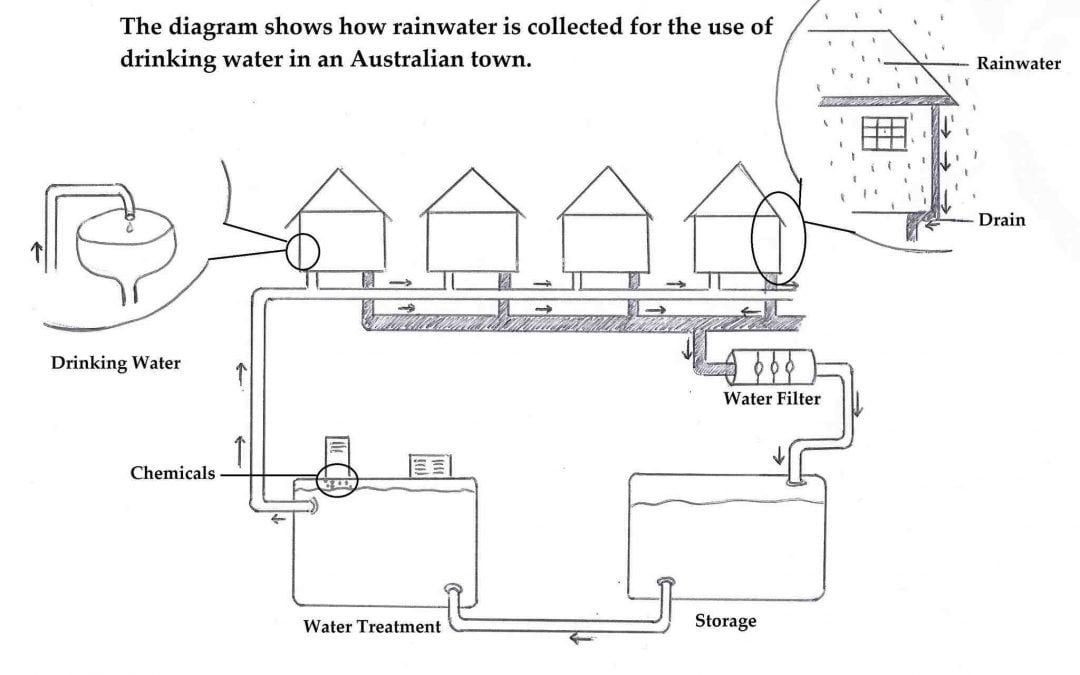
This is an IELTS writing task 1 sample answer essay of a diagram/process showing how rainwater is collected and used for drinking water in an Australian town.
This one was really challenging for a strange reason… there wasn’t enough to write about!
I had to add in more words just so that it made the word count!
Read it below in case you get a simple process on your exam.
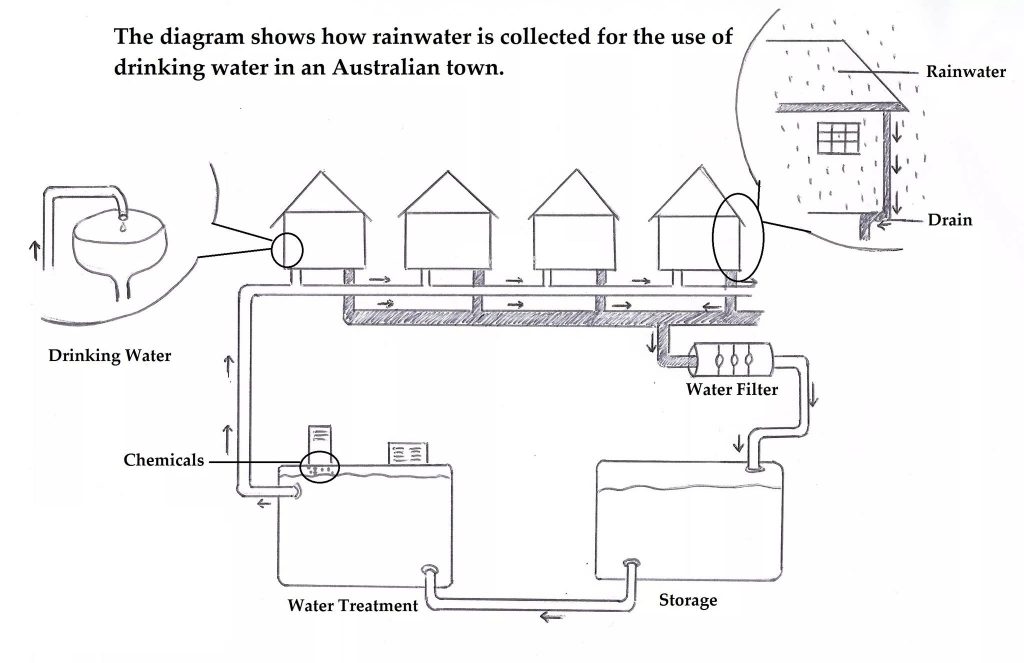
The above diagram details the process by which precipitation is stored and sent for household use in a given town in Australia. Overall, there are 3 main stages that involve the collection of water through drains, its repeated transportation and treatment underground and finally reuse as drinking water in homes.
Rainwater distribution begins with collection through gutters and drains attached to houses. The water seeping into the ground is not collected according to the diagram. The drain water is carried through a system of pipes into a water filter and then a storage tank.
From the storage tank, it next flows by more piping to a water treatment tank where a chemical process makes the water clean enough for residents to drink. After the water has been processed, it is sent through pipes, different from the drain water pipes that originally collected the water, back into homes to be used for drinking water.
Analysis
1. The above diagram details the process by which precipitation is stored and sent for household use in a given town in Australia. 2. Overall, there are 3 main stages that involve the collection of water through drains, its repeated transportation and treatment underground and finally reuse as drinking water in homes.
Paraphrase what the process shows.
Give an overview of the process. Try to divide it into two or three main stages and summarise what happens.
1. Rainwater distribution begins with collection through gutters and drains attached to houses. 2. The water seeping into the ground is not collected according to the diagram. 3. The drain water is carried through a system of pipes into a water filter and then a storage tank.
Begin descripting the process.
I included this sentence because there wasn’t enough to write about otherwise. Do not include opinion or speculation.
Use the passive when you continue the process since it is not being done by a specific person.
1. From the storage tank, it next flows by more piping to a water treatment tank where a chemical process makes the water clean enough for residents to drink. 2. After the water has been processed, it is sent through pipes, different from the drain water pipes that originally collected the water, back into homes to be used for drinking water.
Continue with the rest of the process. I added in extra words to reach the word limit here.
Conclude the diagram and state the end result.
Vocabulary
What do the words in bold below mean?
The above diagram details the process by which precipitation is stored and sent for household use in a given town in Australia. Overall, there are 3 main stages that involve the collection of water through drains, its repeated transportation and treatment underground and finally reuse as drinking water in homes.
Rainwater distribution begins with collection through gutters and drains attached to houses. The water seeping into the ground is ignored according to the diagram. The drain water is carried through a system of pipes into a water filter and then a storage tank.
From the storage tank, it next flows by more piping to a water treatment tank where a chemical process makes the water clean enough for residents to drink. After the water has been processed, it is sent through pipes, different from the drain water pipes that originally gathered the water, back into homes to be used for drinking water.
Answers
above diagram details process shown describes
by which precipitation the way in which rain
stored kept
household use for homes/people to use
a given town in some town
main stages biggest parts
involve have to do with
collection gathering, storage
repeated transportation more than one time sent
treatment underground being filtered under the ground
reuse used again
drinking water water that is safe to drink
rainwater distribution water sent out
gutters on houses to channel rain into pipes
drains attached to houses pipes on the side of homes to collect water
The a______________________s the process b______________________n is s_________d and sent for h_______________e in a_______________n in Australia. Overall, there are 3 m________________s that i_____________e the c______________n of water through drains, its r_________________n and t__________________________d and finally r____________e as d________________r in homes.
R_____________________n begins with collection through g____________s and d_______________________s. The water s________________o the ground is i________________d according to the diagram. The d__________________r is carried t______________________________s into a w____________r and then a s________________k.
From the storange tank, it n_________________s by more piping to a w_________________________k where a c___________________s makes the water c____________________h for r____________________s to drink. After the water has been p__________________d, it is sent through pipes, different from the drain water pipes that o_________________________d the water, b______________________s to be used for drinking water.
Listen and check:
Listening Practice
Learn more in detail about the process of filtering and treating water in this video:
Reading Practice
Read the facts here about how much water you should really drink a day:
This is an IELTS writing task 2 sample answer essay on the topic of whether governments should direct more funding towards medical or environmental research.
It’s a good topic to practice with because it focuses on two common IELTS topics: medicine and the environment.
IELTS Writing Task 2 Sample Answer Essay: Medical Research
Governments should spend more money on medical research and less on researching the environment.
To what extent do you agree or disagree?
Many believe governments today should prioritise funding for medicine over environmental studies. In my opinion, learning more about the environment is one way to inform policy regarding climate change but more money should be directed towards medical research.
Those advocating for increased focus on the environment are eager to understand and counter the effects of climate change. There is arguably no greater threat facing the future of human civilisation than a degrading natural world. At the moment, billions are being poured into studies to understand how fast the polar ice caps are melting, what the impact will be, the damage to ecosystems, the interrelation between humans and these delicate ecosystems as well as the role of fossil fuels in aggravating climate change. There are wildly different theories about all these areas and some think the best utilisation of research grants is to give scientists free rein to study and collaborate in the hope of coming to a stronger consensus, which can then shape international accords and domestic policy decisions.
Despite the force of the above argument, I believe health is a more tangible and pressing concern. There is constant disagreement from climate scientists and it is unclear if increased funding would be a remedy or injury. Health research is unequivocally positive. Some of the many advances in health from the last several decades include increased understanding of mental illness, less invasive procedures for surgery, better vaccines, and countless new iterations of advanced medical equipment. These are all put into practice immediately and save or better lives in every country around the world. More money for research now would open up possibilities for new medical innovations that could involve experimentation with genetic modification and greater understanding of disease prevention.
In conclusion, making sense of climate change is important but nothing is more essential than one’s health. Governments ought to find ways to balance these competing interests but also be mindful of what most benefits their present citizenry.
Analysis
1. Many believe governments today should prioritise funding for medicine over environmental studies. 2. In my opinion, learning more about the environment is one way to inform policy regarding climate change but more money should be directed towards medical research.
Paraphrase the overall topic for the whole essay.
Write a clear opinion.
1. Those advocating for increased focus on the environment are eager to understand and counter the effects of climate change. 2. There is arguably no greater threat facing the future of human civilisation than a degrading natural world. 3. At the moment, billions are being poured into studies to understand how fast the polar ice caps are melting, what the impact will be, the damage to ecosystems, the interrelation between humans and these delicate ecosystems as well as the role of fossil fuels in aggravating climate change. 4. There are wildly different theories about all these areas and some think the best utilisation of research grants is to give them free rein to study and collaborate in the hope of coming to a stronger consensus, which can then shape international accords and domestic policy decisions.
Write a clear topic sentence with your main idea at the end of it.
Explain/develop the idea.
Make your support as specific and clear as possible.
State the results and the reasons to support your original main idea.
1. Despite the force of the above argument, I believe health is a more tangible and pressing concern. 2. There is constant disagreement from climate scientists and it is unclear if increased funding would be a remedy or injury. 3. Health research is unequivocally positive. 4. Some of the many advances in health from the last several decades include increased understanding of mental illness, less invasive procedures for surgery, better vaccines, and countless new iterations of advanced medical equipment. 5. These are all put into practice immediately and save or better lives in every country around the world. 6. More money for research now would open up possibilities for new medical innovations that could involve experimentation with genetic modification and greater understanding of disease prevention.
Write a new topic sentence with a main idea at the end.
Here I start with a counter-example to make it clear why this is my opinion.
I transition to why health is important.
I inclue a lot of specific detail related to health advances.
Then I state why these advances are so important.
Conclude your paragraph with more support – no need for summary.
1. In conclusion, making sense of climate change is important but nothing is more essential than one’s health. 2. Governments ought to find ways to balance these competing interests but also be mindful of what most benefits their present citizenry.
Repeat your opinion.
Include a final thought/detail for full marks from the examiner.
Vocabulary
What do the words in bold below mean?
Many believe governments today should prioritise funding for medicine over environmental studies. In my opinion, learning more about the environment is one way to inform policy regarding climate change but more money should be directed towards medical research.
Those advocating for increased focus on the environment are eager to understand and counter the effects of climate change. There is arguably no greater threat facing the future of human civilisation than a degrading natural world. At the moment, billions are being poured into studies to understand how fast the polar ice caps are melting, what the impact will be, the damage to ecosystems, the interrelation between humans and these delicateecosystems as well as the role of fossil fuels in aggravating climate change. There are wildly different theories about all these areas and some think the best utilisation of research grants is to give researchersfree rein to study and collaborate in the hope of coming to a stronger consensus, which can then shape international accords and domestic policy decisions.
Despite the force of the above argument, I believe health is a more tangible and pressing concern. There is constant disagreement among climate scientists and it is unclear if increased funding would be a remedy or injury. Health research is unequivocally positive. Some of the many advances in health from the last several decades include increased understanding of mental illness, less invasive procedures for surgery, better vaccines, and countless new iterations of advanced medical equipment. These are all put into practice immediately and save or better lives in every country around the world. More money for research now would open up possibilities for new medical innovations that could involve experimentation with genetic modification and greater understanding of disease prevention.
In conclusion, making sense of climate change is important but nothing is more essential than one’s health. Governments ought to find ways to balance these competing interests but also be mindful of what most benefits their present citizenry.
Answers
prioritise make more important
medicine health related study
environmental studies learning about the natural world
inform policy regarding climate change help shape/make better decisions about global warming
directed towards focused on
advocating in favour of
increased focus more emphasis
eager excited for
counter argue against
arguably no greater threat facing probably nothing more pressing
degrading natural world hurting the environment
poured put into
how fast the polar ice caps are melting the speed with which icebergs are disappearing
damage injury
ecosystems plants and animals interacting with their environment
interrelation interaction
delicateecosystems fragile environments
role part to play in
fossil fuels oil, gas
aggravating climate change making the environment worse
wildly different theories many different ideas
utilisation use
research grants money to study
give researchersfree rein allow them to study whatever they want
collaborate work together
in the hope of with the goal of
coming to a stronger consensus agreeing on
shape international accords influence international agreements
domestic policy decisions a country’s laws
Despite the force of the above argument nonetheless
tangible real impact
pressing concern important problem
constant disagreement never agree on
climate scientists researchers looking into global warming
unclear equivocal
increased funding more money for
remedy fix
injury hurt
unequivocally positive definitely good
last several decades 30 or so years
increased understanding of mental illness more knowledge on mental disorders
less invasive procedures for surgery not have to cut into a person as much
vaccines shot to make you immune to a disease
countless new iterations many new versions
put into practice immediately used right away
open up possibilities allow for
new medical innovations new ideas in health
experimentation trying out ideas
genetic modification changing your genes/biology
disease prevention stopping illnesses
making sense of understanding
nothing is more essential than the most important thing is
balance equality
competing interests forces in conflict
mindful aware of
what most benefits their present citizenry the biggest advantage for all people of a country
Many believe governments today should p_____________e funding for m_____________e over e_________________________s. In my opinion, learning more about the environment is one way to i____________________________________e but more money should be d________________________s medical research.
Those a___________________g for i_______________________s on the environment are e______________r to understand and c_____________r the effects of climate change. There is a_______________________________g the future of human civilisation than a d__________________________d. At the moment, billions are being p__________________d into studies to understand h_____________________________________g, what the impact will be, the d____________e to e________________s, the i______________________n between humans and these d_____________________s as well as the r________e of f___________________s in a____________________________e. There are w________________________s about all these areas and some think the best u__________________n of r_____________________s is to g_____________________________n to study and c_______________e i_______________f c_______________________s, which can then s__________________________s and d________________________s.
D_______________________________________t, I believe health is a more t____________e and p______________________n. There is c___________________________t among c_____________________s and it is u_____________r if i____________________g would be a r_____________y or i__________y. Health research is u_______________________e. Some of the many advances in health from the l________________________s include i__________________________________s, l_______________________________y, better v____________s, and c_______________________s of advanced medical equipment. These are all p____________________________________y and save or better lives in every country around the world. More money for research now would o_______________________s for n___________________________s that could involve e_____________________n with g_________________________n and greater understanding of d_______________________n.
In conclusion, m________________________f climate change is important but n_________________________n one’s health. Governments ought to find ways to b_____________e these c_____________________s but also be m___________l of w______________________________________________y.
Listen and check:
Listening Practice
Learn about some real-life medical researchers at Mass General:
Many people think that zoos are cruel. Others think they are helpful in protecting rare animals.
Discuss both sides and give your own opinion.
Real Past IELTS Exam
Some concerned groups feel that zoos are cruelly exploitative while others argue they serve the vital function of protecting endangered animals. In my opinion, though zoos are inherently unnatural, their efforts are laudable overall.
Those activists who decry the existence of zoos often point out how animals live in the wild. A lion in the African Serengeti, one of the few remaining preserves for lions in their natural habitat, roams over miles of grassland, hunts for meals and competes with rival prides. This is how lions have lived for thousands of years and is the natural byproduct of a generational process of evolution. The same lion placed in a zoo paces a small cage, is tossed already dead meat to eat, and rarely has other lions to interact or mate with. The evidence for zoos as a cruel institution lies in the contrasting of a natural and unnatural lifestyle and turning proud beasts into scavengers.
Regardless, zoos are essential for the preservation and cultivation of endangered species. There are countless animals ranging from various big cats (lions, tigers, leopards, and other sub-species), to pandas, rhinoceros, gorillas, pangolins and many more that depend on zoos for protection and safe breeding grounds. These animals have been driven to the brink of extinction either by loss of habitat due to rampant development and climate change or hunted for their fur or alleged medicinal properties. Responsible zoos are tasked with breeding them in order to stabilise falling populations and then re-introducing them into the wild. Without these zoos, many species would likely already have gone extinct.
In conclusion, zoos are fundamentally artificial but also a net positive because of their conservation efforts. To ensure this remains the case, these refuges must be well-regulated and governments should enact complementary solutions such as anti-poaching laws.
Analysis
1. Some concerned groups feel that zoos are cruelly exploitative while others argue they serve the vital function of protecting endangered animals. 2. In my opinion, though zoos are inherently unnatural, their efforts are laudable overall.
Paraphrase the topic for the essay.
Give a clear opinion.
1. Those activists who decry the existence of zoos often point out how animals live in the wild. 2. A lion in the African Serengeti, one of the few remaining preserves for lions in their natural habitat, roams over miles of grassland, hunts for meals and competes with rival prides. 3. This is how lions have lived for thousands of years and is the natural byproduct of a generational process of evolution. 4. The same lion placed in a zoo paces a small cage, is tossed already dead meat to eat, and rarely has other lions to interact or mate with. 5. The evidence for zoos as a cruel institution lies in the contrasting of a natural and unnatural lifestyle and turning proud beasts into scavengers.
Write a topic sentence with a clear main idea/reason at the end of the sentence.
Begin a specific example.
Develop the example.
Continue developing it – here I switch to contrast the life of a lion in a zoo.
Finish developing it and make an overall statement to relate back to the overall question.
1. Regardless, zoos are essential for the preservation and cultivation of endangered species. 2. There are countless animals ranging from various big cats (lions, tigers, leopards, and other sub-species), to pandas, rhinoceros, gorillas, pangolins and many more that depend on zoos for protection and safe breeding grounds. 3. These animals have been driven to the brink of extinction either by loss of habitat due to rampant development and climate change or hunted for their fur or alleged medicinal properties. 4. Responsible zoos are tasked with breeding them in order to stabilise falling populations and then re-introducing them into the wild. 5. Without these zoos, many species would likely already have gone extinct.
Another topic sentence with a clear main idea.
Explain your main idea.
Here I state the causes for animals to be in zoos because that supports the need for zoos.
I further develop the main purpose of zoos.
Conclude your paragraph with a strong sentence.
1. In conclusion, zoos are fundamentally artificial but also a net positive because of their conservation efforts. 2. To ensure this remains the case, these refuges must be well-regulated and governments should enact complementary solutions such as anti-poaching laws.
Repeat your opinion.
Add a final thought/detail to get full marks from the IELTS examiner.
Vocabulary
What do the words in bold below mean?
Some concerned groups feel that zoos are cruelly exploitative while others argue they serve the vital function of protecting endangered animals. In my opinion, though zoos are inherently unnatural, their efforts are laudable overall.
Those activists who decry the existence of zoos often point out how animals live in the wild. A lion in the African Serengeti, one of the few remaining preserves for lions in their natural habitat, roams over miles of grassland, hunts for meals and competes with rival prides. This is how lions have lived for thousands of years and is the natural byproduct of a generational process of evolution. The same lion placed in a zoo paces a small cage, is tossed already dead meat to eat, and rarely has other lions to interact or mate with. The evidence for zoos as a cruel institutionlies in the contrasting of a natural and unnatural lifestyle and turning proud beasts into scavengers.
Regardless, zoos are essential for the preservation and cultivation of endangered species. There are countless animals ranging from various big cats (lions, tigers, leopards, and other sub-species), to pandas, rhinoceros, gorillas, pangolins and many more that depend on zoos for protection and safe breeding grounds. These animals have been driven to the brink of extinction either by loss of habitat due to rampant development and climate change or hunted for their fur or alleged medicinal properties. Responsible zoos are tasked with breeding them in order to stabilise falling populations and then re-introducing them into the wild. Without these zoos, many species would likely already have gone extinct.
In conclusion, zoos are fundamentally artificial but also a net positive because of their conservation efforts. To ensure this remains the case, these refuges must be well-regulated and governments should enact complementary solutions such as anti-poaching laws.
Answers
concerned groups people who care
cruelly exploitative take advantage of badly
serve the vital function are important because of
protecting endangered animals keeping animals safe with low population numbers
inherently unnatural fundamentally artificial
laudable overall good in general
activists people who care about a specific issue
decry denounce
point out argue
African Serengeti grassland preserve in Africa
preserves conservation lands
natural habitat where they normally live
roams over miles of grassland walks around lots of fields
competes fights with
rival prides other groups of lions
natural byproduct the normal result of
generational process of evolution many years of adaptation
placed in put in
paces walks around
cage enclosure
tossed thrown
rarely sometimes
interact be around other lions
mate with breed, have children with
evidence support
cruel institutionlies in evil zoos comes from
contrasting different
natural and unnatural lifestyle what are normal and artifical ways of living
proud beasts animals with dignity
scavengers animals that pick up already dead food
regardless nonetheless
preservation keeping safe
cultivation developing
endangered species animal at risk of going extinct
countless many
sub-species species within a species such as types of frogs, cats, etc.
pangolins a scaly mammal that rolls itself into a ball
depend on rely on
protection conservation
safe breeding grounds places where they can mate and have offspring
driven to the brink of extinction nearly all gone
loss of habitat no more home
rampant development changing a lot, industrialisation
climate change global warming
alleged medicinal properties supposed medical effects
responsible zoos good zoos
tasked with breeding have the duty of helping them mate
stabilise falling populations stop the numbers from decreasing
re-introducing them into the wild letting them go free
extinct all gone
fundamentally artificial at base not natural
net positive overall good
conservation efforts trying to keep them safe
To ensure this remains the case so that this is true
refuges places to be safe
well-regulated lots of oversight
enact complementary solutions pass laws to also protect animals
Some c______________________s feel that zoos are c_______________________e while others argue they s________________________n of p________________________________s. In my opinion, though zoos are i_________________________l, their efforts are l________________________l.
Those a______________s who d__________y the existence of zoos often p__________________t how animals live in the wild. A lion in the A______________________________i, one of the few remaining p________________s for lions in their n__________________t, r_____________________________d, hunts for meals and c_____________s with r_________________s. This is how lions have lived for thousands of years and is the n____________________t of a g____________________________________________n. The same lion p______________n a zoo p____________s a small c__________e, is t__________d already dead meat to eat, and r_____________y has other lions to i____________t or m_____________h. The e______________e for zoos as a c___________________________n the c________________g of a n___________________________________e and turning p__________________s into s____________________s.
R________________s, zoos are essential for the p__________________n and c_____________________n of e_____________________s. There are c_________________s animals ranging from various big cats (lions, tigers, leopards, and other s_________________s), to pandas, rhinoceros, gorillas, p_________________s and many more that d_______________n zoos for p________________n and s______________________s. These animals have been d______________________________________n either by l_____________t due to r_______________________t and c__________________e or hunted for their fur or a_______________________________s. R_________________________s are t________________________g them in order to s___________________________s and then r______________________________d. Without these zoos, many species would likely already have gone e_____________t.
In conclusion, zoos are f_________________________l but also a n________________e because of their c__________________________s. T_____________________________________e, these r_________________s must be w_______________________d and governments should e_____________________________________s such as a__________________________s.
Write about the related question below and then check with my sample answer:
Some people say that the main environmental problem of our time is the loss of particular species of plants and animals. Others say that there are more important environmental problems.
Discuss both these views and give your own opinion.
"The highest quality materials anywhere on the internet! Dave improved my writing and vocabulary so much. Really affordable options you don't want to miss out on!"