This is an IELTS writing task 2 sample answer essay on the topic of rewarding students for success from the real IELTS exam.
It’s an interesting topic and I had a lot of fun writing about it!
My structure is a little bit different from my normal essays – it is fine to write with a different structure if you are fully supporting your main ideas.
Some think schools should rewards students who have the best academic results, while others think it’s more important to reward students who achieve other types of success (such as sports, music, and good behaviour).
Discuss both views and give your own opinion.
Real Past IELTS Exam
It is common to reward students for their academic success but many today believe schools should also recognise other areas of excellence such as athletics and behaviour. In my opinion, rewarding academic results is more important as it is a powerful motivator and should not be replicated for other pursuits.
Rewarding academic success is part of an historic system of control. The purpose is self-evident: to psychologically compel continued positive results. For example, in many East Asian countries such as Vietnam where good marks are highly valued, it is not uncommon for parents to offer financial incentives to students, schools to regularly hand out certificates of excellence, and teachers to highlight individuals for praise. All these distinctions are powerful extrinsic motivators that draw students away from the, often monotonous, subject being studied itself to monetary gains, public recognition and the esteem of one’s teachers, respectively. This effectively exploits basic desires for respect and reinforces a pattern of academic excellence.
However, despite the benefits listed above, other types of activities contain their own rewards already. A student who behaves well in class will typically earn the appreciation of teachers or simply do it out of their natural temperament and therefore not require compensation. Students with athletic prowess enjoy the reverence of their peers and the sports themselves. These built-in rewards apply to a variety of fields of success outside traditional school subjects. In fact, rewarding behaviours that students already enjoy doing in themselves might actually hinder motivation. Students could potentially become more focused on the reward than the experience itself and an intrinsic drive will become extrinsic, ironically now requiring tangible reinforcement to continue.
In conclusion, rewarding academics is a proven method of reinforcement that could have the opposite effect of decreasing intrinsic motivation when applied to other areas. Teachers and parents should be wary of the subtle difference between encouraging children and establishing a near-Pavlovian relationship.
Analysis
1. It is common to reward students for their academic success but many today believe schools should also recognise other areas of excellence such as athletics and behaviour. 2. In my opinion, rewarding academic results is more important as it is a powerful motivator and should not be replicated for other pursuits.
Paraphrase the overall topic.
Answer the question with a direct opinion.
1. Rewarding academic success is part of an historic system of control. 2. The purpose is self-evident: to psychologically compel continued positive results. 3. For example, in many East Asian countries such as Vietnam where good marks are highly valued, it is not uncommon for parents to offer financial incentives to students, schools to regularly hand out certificates of excellence, and teachers to highlight individuals for praise. 4. All these distinctions are powerful extrinsic motivators that draw students away from the, often monotonous, subject being studied itself to monetary gains, public recognition and the esteem of one’s teachers, respectively. 5. This effectively exploits basic desires for respect and reinforces a pattern of academic excellence.
Write a clear topic sentence. In this essay, I first argue that academic rewards are positive in this paragraph. The next paragraph focuses on why they would not be positive for other areas. Typically these paragraphs would be switched but in this essay I felt the next paragraph is a stronger argument so that is why I put them in this order.
Explain your main idea, if necessary.
Give a specific example.
Develop your example.
Conclude your paragraph by generalising.
1. However, despite the benefits listed above, other types of activities contain their own rewards already. 2. A student who behaves well in class will typically earn the appreciation of teachers or simply do it out of their natural temperament and therefore not require compensation. 3. Students with athletic prowess enjoy the reverence of their peers and the sports themselves. 4. These built-in rewards apply to a variety of fields of success outside traditional school subjects. 5. In fact, rewarding behaviours that students already enjoy doing in themselves might actually hinder motivation. 6. Students could potentially become more focused on the reward than the experience itself and an intrinsic drive will become extrinsic, ironically now requiring tangible reinforcement to continue.
Write a new topic sentence with another main idea at the end.
Begin a hypothetical example.
Here I shift to a related example.
Then I generalise to other examples.
Finally, I explain the importance of these example.
I conclude my paragraph with a strong statement and the final results of my opinion.
1. In conclusion, rewarding academics is a proven method of reinforcement that could have the opposite effect of decreasing intrinsic motivation when applied to other areas. 2. Teachers and parents should be wary of the subtle difference between encouraging children and establishing a near-Pavlovian relationship.
Repeat your opinion clearly.
Add in an extra detail or finish summarising your opinion.
Vocabulary
What do the words in bold below mean? Try to figure out the meaning from the sentence and then check below:
It is common to reward students for their academic success but many today believe schools should also recognise other areas of excellence such as athletics and behaviour. In my opinion, rewarding academic results is more important as it is a powerful motivator and should not be replicated for other pursuits.
Rewarding academic success is part of an historic system of control. The purpose is self-evident: to psychologically compel continued positive results. For example, in many East Asian countries such as Vietnam where good marks are highly valued, it is not uncommon for parents to offer financial incentives to students, schools to regularly hand out certificates of excellence, and teachers to highlight individuals for praise. All these distinctions are powerful extrinsic motivators that draw students away from the, often monotonous, subject being studied itself to monetary gains, public recognition and the esteem of one’s teachers, respectively. This effectively exploits basic desires for respect and reinforces a pattern of academic excellence.
However, despite the benefits listed above, other types of activities contain their own rewards already. A student who behaves well in class will typically earn the appreciation of teachers or simply do it out of their natural temperament and therefore not require compensation. Students with athletic prowess enjoy the reverence of their peers and the sports themselves. These built-in rewards apply to a variety of fields of success outside traditional school subjects. In fact, rewarding behaviours that students already enjoy doing in themselves might actually hinder motivation. Students could potentially become more focused on the reward than the experience itself and an intrinsic drive will become extrinsic, ironically now requiring tangible reinforcement to continue.
In conclusion, rewarding academics is a proven method of reinforcement that could have the opposite effect of decreasing intrinsic motivation when applied to other areas. Teachers and parents should be wary of the subtle difference between encouraging children and establishing a near-Pavlovian relationship.
Answers
common all around
reward students give something to students in appreciation
academic success doing well in school subjects
recognise acknowledge
excellence doing really well
athletics sports
behaviour how you act in class
powerful motivator good source of motivation
replicated repeated
pursuits areas
historic system of control been used a long time to enforce behaviour
self-evident needs no explanation
psychologically compel force to do
continued positive results keep getting good marks
highly valued very important
not uncommon common
financial incentives money
regularly hand out certificates of excellence give awards
highlight individuals for praise single out students to say they did well
distinctions separations, elevations
powerful extrinsic motivators something outside the activity itself that makes you want to do it
draw take from
often monotonous usually boring
monetary gains financial incentives
public recognition respect of others
esteem of one’s teachers admiration from teachers
respectively in turn
effectively exploits basic desires does a good job taking advantage of human psychology
reinforces supports
pattern trend
despite the benefits listed above regardless of the mentioned advantages
contain have within them
behaves well in class a good student, not naughty
earn gain
appreciation reverence
natural temperament your personality
compensation getting something back
athletic prowess ability with sports
reverence admiration
peers other students
built-in already there
outside traditional school subjects not just what you study in school
hinder hold back
potentially possible
more focused care more about
experience itself the activity in itself
intrinsic drive not for outside rewards
extrinsic for outside rewards
ironically coincidentally
tangible reinforcement physical reward
proven method working way of doing something
opposite effect reverse impact
applied to other areas transferred to non-academics
wary careful of
subtle difference hard to see distinction
encouraging children praising kids
establishing a near-Pavlovian relationship making them require your praise/reinforcement
It is c____________n to r_________________s for their a__________________s but many today believe schools should also r___________e other areas of e_____________e such as a______________s and b________________r. In my opinion, rewarding academic results is more important as it is a p__________________________r and should not be r_____________d for other p____________s.
Rewarding academic success is part of an h______________________________l. The purpose is s________________t: to p___________________________l c_________________________s. For example, in many East Asian countries such as Vietnam where good marks are h_________________d, it is n__________________n for parents to offer f__________________s to students, schools to r___________________________________________e, and teachers to h_____________________________________e. All these d________________s are p_____________________s that d_____w students away from the, o______________________s, subject being studied itself to m_________________s, p_____________________n and the e_______________________s, r________________y. This e_______________________________s for respect and r_____________s a p____________n of academic excellence.
However, d_______________________________e, other types of activities c__________n their own rewards already. A student who b________________________s will typically e________n the a_________________n of teachers or simply do it out of their n______________________t and therefore not require c_____________________n. Students with a____________________s enjoy the r_________________e of their p________s and the sports themselves. These b__________n rewards apply to a variety of fields of success o_______________________________s. In fact, rewarding behaviours that students already enjoy doing in themselves might actually h__________r motivation. Students could p_______________y become m________________d on the reward than the e__________________f and an i______________e will become e_____________c, i______________y now requiring t___________________________t to continue.
In conclusion, rewarding academics is a p_________________d of reinforcement that could have the o_______________t of decreasing intrinsic motivation when a______________________s. Teachers and parents should be w________y of the s_____________________e between e_______________________n and e_______________________________________p.
Listen and check:
Listening Practice
Watch a well-known animation related to this topic:
This is an IELTS writing task 2 sample answer essay on the topic of researching medical treatments from the real IELTS exam.
The structure of the question is a little bit strange for IELTS but you can write your essay the same way: answer the question with a clear opinion and talk about 2 sides – that’s what I did.
IELTS Writing Task 2 Sample Answer Essay: Researching Medical Treatments
Research into medical treatments are essential to improve health and fight disease.
Who do you think should fund this research: individuals, private companies or governments?
Real Past IELTS Exam
It is indisputably important for researchers to develop new medical treatments in the battle against poor health and disease. In my opinion, this research should be funded primarily by governments and well-regulated private companies.
Governments are able to concentrate solely on public interests. They are indebted to tax-payers and have a responsibility to direct that money back into various services benefitting the nation at large. A good example of the important role governments play in medical services and treatments is the theory of disease originated by Louis Pasteur while working for the publicly funded University of Lille in France. It is unlikely he would have had the time or resources to conduct his experiments on his own and questionable if a private company would have recognised the commercial value of his work. Government funding functions much the same way today to fund medical projects without a clear path to profits but enormous importance for public health.
However, governments are notoriously slow-moving, under-funded and less innovative than private corporations. Companies are motivated to generate a profit, which pushes them to compete, innovate, and pay for the best minds in the field. Evidence for this is numerous and includes advances in surgical procedures, stem cell therapy, nutrition, pharmaceuticals, cancer research, and emergency medicine. Government funded projects and hospitals have a tendency to become complacent while private companies must innovate to excel. The risk, naturally, is that these companies will charge exorbitant costs and reserve the best medicine for select, wealthy clientele. Government regulation is therefore needed to keep these corporations in check.
In conclusion, the government plays a key role in medical research both as a creative body and a regulator. Private companies should not be vilified for their exploitation of health problems but they should be kept within clear limits.
Analysis
1. It is indisputably important for researchers to develop new medical treatments in the battle against poor health and disease. 2. In my opinion, this research should be funded primarily by governments and well-regulated private companies.
Paraphrase the overall topic for the essay.
Write your opinion – directly answer the question.
1. Governments are able to concentrate solely on public interests. 2. They are indebted to tax-payers and have a responsibility to direct that money back into various services benefitting the nation at large. 3. A good example of the important role governments play in medical services and treatments is the theory of disease originated by Louis Pasteur while working for the publicly funded University of Lille in France. 4. It is unlikely he would have had the time or resources to conduct his experiments on his own and questionable if a private company would have recognised the commercial value of his work. 5. Government funding functions much the same way today to fund medical projects without a clear path to profits but enormous importance for public health.
Write a topic sentence with a main idea at the end.
Explain your main idea.
Begin a specific example.
Develop the example.
Generalise and relate back to the overall question.
1. However, governments are notoriously slow-moving, under-funded and less innovative than private corporations. 2. Companies are motivated to generate a profit, which pushes them to compete, innovate, and pay for the best minds in the field. 3. Evidence for this is numerous and includes advances in surgical procedures, stem cell therapy, nutrition, pharmaceuticals, cancer research, and emergency medicine. 4. Government funded projects and hospitals have a tendency to become complacent while private companies must innovate to excel. 5. The risk, naturally, is that these companies will charge exorbitant costs and reserve the best medicine for select, wealthy clientele. 6. Government regulation is therefore needed to keep these corporations in check.
Write your topic sentence with a new main idea at the end.
Explain your main idea.
Give specific examples or support – the more specific the better.
Continue to develop your main idea.
Here I qualify the importance to be consistent with my overall opinion.
Finish with a strong statement.
1. In conclusion, the government plays a key role in medical research both as a creative body and a regulator. 2. Private companies should not be vilified for their exploitation of health problems but they should be kept within clear limits.
Repeat your opinion and summarise your arguments.
Finish summarising and conclude with a strong statement.
Vocabulary
What do the words in bold below mean?
It is indisputably important for researchers to develop new medical treatments in the battle against poor health and disease. In my opinion, this research should be funded primarily by governments and well-regulated private companies.
Governments are able to concentrate solely on public interests. They are indebted to tax-payers and have a responsibility to direct that money back into various services benefitting the nation at large. A good example of the important role governments play in medical services and treatments is theory of disease originated by Louis Pasteur while working for the publicly funded University of Lille in France. It is unlikely he would have had the time or resources to conduct his experiments on his own and questionable if a private company would have recognised the commercial value of his work. Government funding functions much the same way today to fund medical projects without a clear path to profits but enormous importance for public health.
However, governments are notoriously slow-moving, under-funded and less innovative than private corporations. Companies are motivated to generate a profit, which pushes them to compete, innovate, and pay for the best minds in the field. Evidence for this is numerous and includes advances in surgical procedures, stem cell therapy, nutrition, pharmaceuticals, cancer research, and emergency medicine. Government funded projects and hospitals have a tendency to become complacent while private companies must innovate to excel. The risk, naturally, is that these companies will charge exorbitant costs and reserve the best medicine for select, wealthy clientele. Government regulation is therefore needed to keep these corporations in check.
In conclusion, the government plays a key role in medical research both as a creative body and a regulator. Private companies should not be vilified for their exploitation of health problems but they should be kept within clear limits.
Answers
indisputably important definitely crucial
new medical treatments important medicine
battle fight
funded primarily by given money from
well-regulated private companies corporations limited by laws
concentrate solely focus only
public interests what citizens all need
indebted owing money to
tax-payers citizens
direct focus towards
back into returned to
benefitting for the good of
nation at large the whole country
important role crucial part
play (play a role is a collocation meaning to ‘have a role’)
medical services and treatments medicine to help/treat sicknesses and diseases
originated comes from
Louis Pasteur French scientist who created a theory of germs and made many important discoveries
publicly funded money from the government
unlikely probably won’t happen
conduct his experiments do his experiments/research
questionable dubious
recognised know about, realised
commercial value can make a profit
functions much the same way today works in the same method
without a clear path to profits no way to make money
enormous importance for public health a lot of value for everyone
notoriously slow-moving famously not fast
under-funded not enough money
innovative new ideas and products/services
generate a profit make money
pushes them to compete motivates rivalry
innovate revolutionise
best minds in the field smartest people in a subject
evidence support
numerous lots of
advances progress
surgical procedures operations
stem cell therapy a type of regenerative medicine
nutrition eating healthy
pharmaceuticals prescribed drugs
cancer research study into cancer
emergency medicine medicine for accidents or fast-acting medicine
tendency inclination
complacent settled, lazy
excel do really well
naturally organically
charge exorbitant costs must pay a lot of money
reserve hold for
select chosen (adjective)
wealthy clientele people with a lot of money
keep these corporations in check control companies
plays a key role has a lot to do with
creative body institutions that think of ideas
regulator controller
vilified turned to villains
exploitation take advantage of
kept within clear limits not allowed complete freedom
It is i_________________________t for researchers to develop n_________________________s in the b__________e against poor health and disease. In my opinion, this research should be f_______________________y governments and w_______________________________s.
Governments are able to c___________________y on p___________________s. They are i______________d to t_______________s and have a responsibility to d______________t that money b_____________o various services b_____________g the n_________________e. A good example of the i_________________e governments p______y in m_______________________________s is the theory of disease o__________________d by L________________r while working for the p_____________________d University of Lille in France. It is u______________y he would have had the time or resources to c_________________________s on his own and q_________________e if a private company would have r_______________d the c___________________e of his work. Government funding f_________________________________y to fund medical projects w______________________________s but e______________________________________h.
However, governments are n________________________g, u________________d and less i_________________e than private corporations. Companies are motivated to g____________________t, which p______________________e, i_____________e, and pay for the b______________________d. E____________e for this is n______________s and includes a_____________s in s___________________s, s__________________y, n____________n, p______________________s, c___________________h, and e________________________e. Government funded projects and hospitals have a t_______________y to become c_______________t while private companies must innovate to e_______l. The risk, n____________y, is that these companies will c_________________________s and r_____________e the best medicine for s__________t, w__________________e. Government regulation is therefore needed to k___________________________k.
In conclusion, the government p____________________e in medical research both as a c________________y and a r______________r. Private companies should not be v___________d for their e__________________n of health problems but they should be k_______________________s.
Listen and check:
Listening Practice
Listen more about Louis Pasteur below:
Reading Practice
Read a story about research funding from The New York Times below:
IELTS Writing Task 2 Sample Answer Essay: Old People & Exercise (Real Past IELTS Exam)
Even though doctors advise old people to get more exercise, many old people do not get enough.
What are the reasons for this?
What are some possible solutions for this?
Real Past IELTS Exam
Many elderly people today, despite recommendations from doctors, do not get adequate exercise. I believe this is largely related to their upbringing and simple psychology, while the best solutions augment existing remedies.
The most basic sources of this problem are historical and psychological. Many old people today grew up in a period when exercise was not ubiquitous. Gyms in schools and as private businesses are a more recent development so they have not become ingrained habits for past generations. Moreover, men may have experience playing a sport but female athletics were historically underfunded and even banned in many nations, which has an effect on elderly women in particular. This history intermingles with normal human psychology. People are naturally embarrassed to stand out or appear foolish in public. Feeling self-conscious is an initial barrier that prevents many elderly from taking up a new sport or going to the gym for the first time.
The most efficacious solutions involve better accommodating the elderly. One way to do this would be to build more parks for exercise. In some East Asian countries such as Vietnam and South Korea, they have been building both small and large, rural and urban parks with basic exercise equipment for decades. They are easy to use, common and the elderly have become acclimated to them. Many more elderly would exercise if there was an expansion and replication of these successful policies. Another related fix would be to build more fitness centres. This may not have a huge impact at the moment, because gym members tend to be younger, but as a new generation of old people rises up, these centres will become more important and allow governments to take a proactive, rather than reactive, approach.
In conclusion, there are both historic and fundamentally human reasons for why old people do not exercise today. In my opinion, the solutions are not novel but would clearly lead to improved health for the elderly.
Analysis
1. Many elderly people today, despite recommendations from doctors, do not get adequate exercise. 2. I believe this is largely related to their upbringing and simple psychology, while the best solutions augment existing remedies.
Paraphrase the overall topic of the essay.
Clearly answer both questions. My answers are complete but you don’t have to fully include your main ideas here.
1. The most basic sources of this problem are historical and psychological. 2. Many old people today grew up in a period when exercise was not ubiquitous. 3. Gyms in schools and as private businesses are a more recent development so they have not become ingrained habits for past generations. 4. Moreover, men may have experience playing a sport but female athletics were historically underfunded and even banned in many nations, which has an effect on elderly women in particular. 5. This history intermingles with normal human psychology. 6. People are naturally embarrassed to stand out or appear foolish in public. 7. Feeling self-conscious is an initial barrier that prevents many elderly from taking up a new sport or going to the gym for the first time.
Write a topic sentence with your main ideas at the end. This question asks for reasons (plural) so you must have at least 2. More than 2 would be difficult to develop fully.
Explain or give background on your main idea.
Develop your main idea.
Fully extend or add a related idea.
Transition to your second reason.
Explain your second reason.
Develop it as much as possible.
1. The most efficacious solutions involve better accommodating the elderly. 2. One way to do this would be to build more parks for exercise. 3. In some East Asian countries such as Vietnam and South Korea, they have been building both small and large, rural and urban parks with basic exercise equipment for decades. 4. They are easy to use, common and the elderly have become acclimated to them. 5. Many more elderly would exercise if there was an expansion and replication of these successful policies. 6. Another related fix would be to build more fitness centres. 7. This may not have a huge impact at the moment, because gym members tend to be younger, but as a new generation of old people rises up, these centres will become more important and allow governments to take a proactive, rather than reactive, approach.
Write another topic sentence with a new clear main idea at the end. You also need 2 solutions because the question asks for solutions (plural).
Explain your main idea.
Use specific examples to support your opinion fully.
Draw out the results of your examples.
Make your point fully clear and relate it back to overall question.
Transition to your other solution.
Develop that solution as fully as possible too.
1. In conclusion, there are both historic and fundamentally human reasons for why old people do not exercise today. 2. In my opinion, the solutions are not novel but would clearly lead to improved health for the elderly.
Repeat your opinion.
Fully summarise your opinion and make a strong concluding statement.
Vocabulary
What do the words in bold below mean? Figure them out from the context of the sentence:
Many elderly people today, despite recommendations from doctors, do not get adequate exercise. I believe this is largely related to their upbringing and simple psychology, while the best solutions augment existing remedies.
The most basic sources of this problem are historical and psychological. Many old people today grew up in a period when exercise was not ubiquitous. Gyms in schools and as private businesses are a more recent development so they have not become ingrained habits for past generations. Moreover, men may have experience playing a sport but female athletics were historically underfunded and even banned in many nations, which has an effect on elderly women in particular. This history intermingles with normal human psychology. People are naturally embarrassed to stand out or appear foolish in public. Feeling self-conscious is an initial barrier that prevents many elderly from taking up a new sport or going to the gym for the first time.
The most efficacious solutions involve better accommodating the elderly. One way to do this would be to build more parks for exercise. In some East Asian countries such as Vietnam and South Korea, they have been building both small and large, rural and urban parks with basic exercise equipment for decades. They are easy to use, common and the elderly have become acclimated to them. Many more elderly would exercise if there was an expansion and replication of these successful policies. Another related fix would be to build more fitness centres. This may not have a huge impact at the moment, because gym members tend to be younger, but as a new generation of old people rises up, these centres will become more important and allow governments to take a proactive, rather than reactive, approach.
In conclusion, there are both historic and fundamentally human reasons for why older people do not exercise today. In my opinion, the solutions are not novel but would clearly lead to improved health for the elderly.
Answers
elderly people old people
despite recommendations from doctors regardless of what doctor’s advise
Many e___________________e today, d______________________________________s, do not get a______________e exercise. I believe this is l_____________y related to their u______________g and s_____________________y, while the best solutions a_________________________s.
The m______________________s of this problem are h_______________l and psychological. Many old people today g____________p in a p____________d when exercise was not u_______________s. Gyms in schools and as private businesses are a m_______________________t so they have not become i______________________s for p___________________s. Moreover, men may have experience playing a sport but f______________________s were historically u_____________________d and even b_____________d in many nations, which has an effect on elderly women i__________________r. This history i__________________s with normal human psychology. People are n_____________________d to s______________t or a____________________c. F_____________________s is an i__________________r that p__________s many elderly from t______________p a new sport or going to the gym f____________________e.
The most e________________________s involve b________________________g the elderly. O______________________________e to build more parks for exercise. In some East Asian countries such as Vietnam and South Korea, they have been building both small and large, r________l and u________n parks with b_________________________________t for d_____________s. They are easy to use, c___________n and the elderly have become a_______________d to them. Many more elderly would exercise if there was an e________________n and r___________________n of these s________________________s. Another r______________x would be to build more f____________________s. This may not have a h_________________t at the moment, because gym members t________d to be younger, but as a new generation of old people r__________p, these centres will become more important and allow governments to take a p_______________e, rather than r_____________e, a________________h.
In conclusion, there are both historic and f____________________s for why older people do not exercise today. In my opinion, the solutions are not n__________l but would c____________________________h for the elderly.
Listen and check:
Listening Practice
Watch below about some of the parks I reference in Vietnam:
In some countries, governments provide payments for unemployed people.
How does this impact people?
Is this a positive or negative development?
Real Past IELTS Test
In many nations, the government gives unemployment benefits to its citizens in need. This allows people to make ends meet during difficult times and is largely a positive development.
The effect of unemployment is that struggling individuals and families are able to survive challenging periods. A good recent example of this would be the record unemployment rates in the wake of the 2020 Covid-19 pandemic. In the United States alone, millions of workers lost their jobs. Many families live paycheck to paycheck and without government support they might lose their homes or struggle to put food on the table every day. Government money allowed them to persevere in a difficult period and use their time to look for a new job. Depending on the conditions of the payments, they can try to find a quality job rather than settling for the first position offered by a company trying to exploit the leverage of an historic jobless rate.
This is largely a positive development because it has wide-reaching effects in society. The one qualification to unemployment benefits is that some individuals will try to take advantage of them and remain jobless while living off government charity. These rare instances aside, society benefits from lifting its most vulnerable citizens out of poverty. Without aid some individuals may turn to illegitimate means of supporting themselves. It is unlikely most would become criminals, but the greater effect would be economic. The unemployed cannot buy products and stimulate the consumer economy. The money the government hands out allows them to keep buying food, going shopping, and props up both large and small businesses. A good economy in turn increases the chances that businesses will begin hiring again and unemployment will decline.
In conclusion, unemployment payments are a great boon for those without jobs and benefit the whole of society as well. It is important that unemployment agencies are well-run and strictly regulated to ensure continuance of the crucial social service they provide.
Analysis
1. In many nations, the government gives unemployment benefits to its citizens in need. 2. This allows people to make ends meet during difficult times and is largely a positive development.
Paraphrase the topic for the whole essay.
Give a clear overall opinion.
1. The effect of unemployment is that struggling individuals and families are able to survive challenging periods. 2. A good recent example of this would be the record unemployment rates in the wake of the 2020 Covid-19 pandemic. 3. In the United States alone, millions of workers lost their jobs. 4. Many families live paycheck to paycheck and without government support they might lose their homes or struggle to put food on the table every day. 5. Government money allowed them to persevere in a difficult period and use their time to look for a new job. 6. Depending on the conditions of the payments, they can try to find a quality job rather than settling for the first position offered by a company trying to exploit the leverage of an historic jobless rate.
Write a topic sentence with a clear and simple main idea.
Start an example.
Begin to develop it and vary with long/short sentences.
Develop your example more.
Keep developing by detailing the results.
Finish developing your example.
1. This is largely a positive development because it has wide-reaching effects in society. 2. The one qualification to unemployment benefits is that some individuals will try to take advantage of them and remain jobless while living off government charity. 3. These rare instances aside, society benefits from lifting its most vulnerable citizens out of poverty. 4. Without aid some individuals may turn to illegitimate means of supporting themselves. 5. It is unlikely most would become criminals, but the greater effect would be economic. 6. The unemployed cannot buy products and stimulate the consumer economy. 7. The money the government hands out allows them to keep buying food, going shopping, and props up both large and small businesses. 8. A good economy in turn increases the chances that businesses will begin hiring again and unemployment will decline.
Write another topic sentence with a new main idea.
Here I qualify my argument – this isn’t necessary and if you don’t have time, you don’t need a sentence like this.
Explain your main idea.
Develop the idea.
Continue developing the main idea.
Draw out the results as far as possible.
Remember to include specific details for support.
Conclude with the further possible results/implications.
1. In conclusion, unemployment payments are a great boon for those without jobs and benefit the whole of society as well. 2. It is important that unemployment agencies are well-run and strictly regulated to ensure continuance of the crucial social service they provide.
Repeat your opinion.
Add a final detail/thought.
Vocabulary
What do the words in bold below mean?
In many nations, the government gives unemployment benefits to its citizens in need. This allows people to make ends meet during difficult times and is largely a positive development.
The effect of unemployment is that struggling individuals and families are able to survive challenging periods. A good recent example of this would be the record unemployment rates in the wake of the 2020 Covid-19 pandemic. In the United States alone, millions of workers lost their jobs. Many families live paycheck to paycheck and without government support they might lose their homes or struggle to put food on the table every day. Government money allowed them to persevere in a difficult period and use their time to look for a new job. Depending on the conditions of the payments, they can try to find a quality job rather than settling for the first position offered by a company trying to exploit the leverage of an historic jobless rate.
This is largely a positive development because it has wide-reaching effects in society. The one qualification to unemployment benefits is that some individuals will try to take advantage of them and remain jobless while living off government charity. These rare instances aside, society benefits from lifting its most vulnerable citizens out of poverty. Without aid some individuals may turn to illegitimate means of supporting themselves. It is unlikely most would become criminals, but the greater effect would be economic. The unemployed cannot buy products and stimulate the consumer economy. The money the government hands out allows them to keep buying food, going shopping, and props up both large and small businesses. A good economy in turn increases the chances that businesses will begin hiring again and unemployment will decline.
In conclusion, unemployment payments are a great boon for those without jobs and benefit the whole of society as well. It is important that unemployment agencies are well-run and strictly regulated to ensure continuance of the crucial social service they provide.
Answers
gives unemployment benefits pays money for people without work
citizens in need people who require help
make ends meet have enough money to live
difficult times hard periods
largely mostly
struggling individuals people in need
survive challenging periods get through difficult times
record new high/low
in the wake of following
Covid-19 pandemic the Coronavirus spread
alone just by itself
lost their jobs unemployed
paycheck to paycheck living just month to month
government support money from the government
lose their homes must move out
struggle have a hard time
put food on the table every day being able to feed yourself/family daily
persevere get through
conditions situation
quality job good job
settling accepting a bad/lesser offer
first position offered first job they get
exploit take advantage of
leverage power over
historic jobless rate most unemployed people in history
wide-reaching effects impact across many areas
one qualification one exception
take advantage exploit
remain jobless still have no job
living off government charity getting by with welfare
rare instances aside ignoring some examples
lifting out of poverty not being desperately poor
vulnerable at risk
illegitimate means illegal methods
greater effect more of an impact
the unemployed people without jobs
stimulate help/encourage
consumer economy the free market
hands out gives out
props up supports
in turn consequently
begin hiring again start employing people again
great boon big help
benefit the whole of society give a lot to everyone in society
unemployment agencies institutions that help people find jobs/get benefits
well-run organised
strictly regulated closely monitored
ensure continuance make sure it continues
crucial social service they provide important help for society
In many nations, the government g____________________________s to its c_____________________d. This allows people to m_____________t during d______________________s and is l____________y a positive development.
The effect of unemployment is that s_________________________s and families are able to s______________________________s. A good recent example of this would be the r___________d unemployment rates i_________________f the 2020 C_______________________c. In the United States a__________e, millions of workers l______________s. Many families live p__________________k and without g_______________________t they might l__________________s or s___________e to p_____________________________________y. Government money allowed them to p______________e in a difficult period and use their time to look for a new job. Depending on the c_________________s of the payments, they can try to find a q_______________b rather than s_____________g for the f_________________________d by a company trying to e______________t the l_______________e of an h_____________________e.
This is largely a positive development because it has w_____________________s in society. The o______________________n to unemployment benefits is that some individuals will try to t_____________________e of them and r_____________________s while l______________________________y. These r___________________________e, society benefits from l__________g its most v_______________e citizens o_________________y. Without aid some individuals may turn to i_________________________s of supporting themselves. It is unlikely most would become criminals, but the g__________________t would be economic. T______________________d cannot buy products and s______________e the c_______________________y. The money the government h_____________t allows them to keep buying food, going shopping, and p______________p both large and small businesses. A good economy i_____________n increases the chances that businesses will b_____________________n and unemployment will decline.
In conclusion, unemployment payments are a g______________n for those without jobs and b__________________________y as well. It is important that u__________________________s are w_______________n and s___________________d to e____________________e of the c________________________________e.
Listen and check:
Listening Practice
Listen here from the BBC about unemployment in America:
This is an IELTS writing task 1 sample answer essay related to the number of people living in households in the UK (a bar chart).
My exclusive IELTS Ebooks are only available here on my Patreon.
Dave
IELTS Writing Task 1 Sample Answer Essay: UK Households Bar Chart
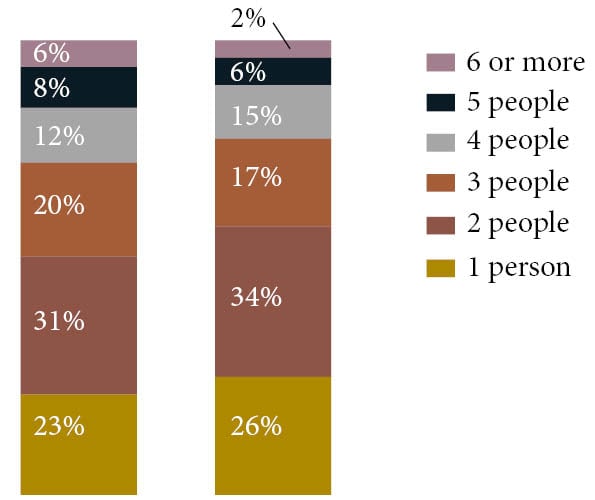
The chart compares the number of people per household by percentage in the UK in 1981 and 2001.
The bar chart details percentages for the number of people living in households across a twenty year period beginning in 1981 in the UK. Looking from an overall perspective, it is readily apparent that the households with more people declined and the reverse was true of smaller homes. The middle groups were the only exceptions to this with increases for 4 people homes and declines for 3 person homes.
The overall leaders in both time periods belonged to 1 and 2 people households. Both increased by 3%, finishing the time surveyed at 26% for the former and 34% for the latter. This contrasted with 5 person households (falling by a quarter to 6%) and 6 or more people in a home, which plummeted from 6% to 2%.
The middle groups showed divergent trends with 4 people homes rising by 3% to 15% and 3 people homes declining by the same margin to 17%.
Analysis
1. The bar chart details percentages for the number of people living in households across a twenty year period beginning in 1981 in the UK. 2. Looking from an overall perspective, it is readily apparent that the households with more people declined and the reverse was true of smaller homes. 3. The middle groups were the only exceptions to this with increases for 4 people homes and declines for 3 person homes.
Paraphrase what the chart shows.
Write a general overview. Include whether each category increased/decreased.
Be sure to mention any possible exceptions.
1. The overall leaders in both time periods belonged to 1 and 2 people households. 2. Both increased by 3%, finishing the time surveyed at 26% for the former and 34% for the latter. 3. This contrasted with 5 person households (falling by a quarter to 6%) and 6 or more people in a home, which plummeted from 6% to 2%.
Begin to compare and describe the data.
Include the starting and ending points (or imply them as I do).
Make sure you include all the data.
1. The middle groups showed divergent trends with 4 people homes rising by 3% to 15% and 3 people homes declining by the same margin to 17%.
Don’t forget to write about all the categories on the chart.
Vocabulary
What do the words in bold below mean?
The bar chart details percentages for the number of people living in households across a twenty year period beginning in 1981 in the UK. Looking from an overall perspective, it is readily apparent that the households with more people declined and the reverse was true of smaller homes. The middle groups were the only exceptions to this with increases for 4 people homes and declines for 3 person homes.
The overall leaders in both time periods belonged to 1 and 2 people households. Both increased by 3%, finishing the time surveyed at 26% for the former and 34% for the latter. This contrasted with 5 person households (falling by a quarter to 6%) and 6 or more people in a home, which plummeted from 6% to 2%.
The middle groups showed divergent trends with 4 people homes rising by 3% to 15% and 3 people homes declining by the same margin to 17%.
Answers
details illustrates, describes, gives information about
across over
twenty year period 10 years
Looking from an overall perspective, it is readily apparent that Overall
declined decreased
the reverse was true of the opposite was the case for
only exceptions cases that don’t fit the pattern
declines noun for decreases
belonged to owned by
finishing the time surveyed at at the end of the period stood at
the former the first mentioned category
the latter the last mentioned category from the sentence before
The bar chart d_________s percentages for the number of people living in households a__________s a t____________________d beginning in 1981 in the UK. L____________________________________________________t the households with more people d_____________d and t_________________________f smaller homes. The middle groups were the o____________________s to this with increases for 4 people homes and d_____________s for 3 person homes.
The overall leaders in both time periods b_______________o 1 and 2 people households. Both increased by 3%, f___________________________t 26% for t__________________r and 34% for t_______________r. This c__________________h 5 person households (f_________________________o 6%) and 6 or more people in a home, which p______________________m 6% to 2%.
The middle groups s______________________s with 4 people homes r_____________g by 3% to 15% and 3 people homes d______________g by the same m___________n to 17%.
Listen and check:
Listening Practice
Learn more about overcrowding here:
Reading Practice
See some more charts here about people living alone:
"The highest quality materials anywhere on the internet! Dave improved my writing and vocabulary so much. Really affordable options you don't want to miss out on!"