IELTS Writing Task 2 Sample Answer Essay General Training: Pocket Money for Children
Giving children and adolescents pocket money is common throughout the world.
Discuss the advantages and disadvantages of this practice and give your own opinion.
Real Past IELTS Exam
In most countries, it is common for children to be given an allowance. This can lead to problems in extreme cases but the advantages are stronger and relate to maturation.
There are two main drawbacks to this practice if parents are irresponsible. Firstly, a parent might give their child too much spending money. There are many well-known cases of children who become pampered socialites, incapable of contributing positively to society because they have little incentive to work or grow as human beings. The second related scenario involves parents who do not monitor their children’s spending habits. For example, young children might buy candy and parents need to try to counter this by encouraging healthier eating. As they get older, parents must continue to monitor closely misuses ranging from relatively benign videogames to decidedly harmful narcotics.
Nonetheless, the advantages in the majority of cases make allowances a positive. An important part of engaging with society is transactions. The first time a child pays at a shop, they enter into the wider economy and begin to understand their role in it. As they grow up, they will have to make decisions about their pocket money. They might opt to save it thereby cultivating discipline and self-control. The purchase itself will also take on increased relevance. Instead of wasting money on something superfluous or actively injurious to them, such as unhealthy foods or a new gaming console, they might begin to realise independently the importance of healthy habits and choose to buy more books, art supplies, or invest in an extracurricular.
In conclusion, allowances without clear checks can in rare instances lead children down a dark path but, in general, spending money fosters greater independence and better decision making. It is therefore paramount for parents to set clear boundaries for their children.
Analysis
1. In most countries, it is common for children to be given an allowance. 2. This can lead to problems in extreme cases but the advantages are stronger and relate to maturation.
Paraphrase the overall topic.
State your main ideas and your overall opinion.
1. There are two main drawbacks to this practice if parents are irresponsible. 2. Firstly, a parent might give their child too much spending money. 3. There are many well-known cases of children who become pampered socialites, incapable of contributing positively to society because they have little incentive to work or grow as human beings. 4. The second related scenario involves parents who do not monitor their children’s spending habits. 5. For example, young children might buy candy and parents need to try to counter this by encouraging healthier eating. 6. As they get older, parents must continue to monitor closely misuses ranging from relatively benign videogames to decidedly harmful narcotics.
Write a topic sentence with a clear main idea at the end.
Begin to talk about the first disadvantage.
Develop it fully.
Switch to the second disadvantage.
Use a specific example to develop your idea.
Finish developing your second idea.
1. Nonetheless, the advantages in the majority of cases make allowances a positive. 2. An important part of engaging with society is transactions. 3. The first time a child pays at a shop, they enter into the wider economy and begin to understand their role in it. 4. As they grow up, they will have to make decisions about their pocket money. 5. They might opt to save it thereby cultivating discipline and self-control. 6. The purchase itself will also take on increased relevance. 7. Instead of wasting money on something superfluous or actively injurious to them, such as unhealthy foods or a new gaming console, they might begin to realise independently the importance of healthy habits and choose to buy more books, art supplies, or invest in an extracurricular.
Write another topic sentence with a new main idea at the end.
Begin to explain your main idea.
Develop that idea.
Move on to the second advantage.
Develop it with specific ideas/examples.
Continue developing.
Conclude with a strong statement with the full results.
1. In conclusion, allowances without clear checks can in rare instances lead children down a dark path but, in general, spending money fosters greater independence and better decision making. 2. It is therefore paramount for parents to set clear boundaries for their children.
Summarise your main ideas and repeat your opinion.
Conclude with a final thought.
Vocabulary
What do the words in bold below mean?
In most countries, it is common for children to be given an allowance. This can lead to problems in extreme cases but the advantages are stronger and relate to maturation.
There are two main drawbacks to this practice if parents are irresponsible. Firstly, a parent might give their child too much spending money. There are many well-known cases of children who become pampered socialites, incapable of contributing positively to society because they have little incentive to work or grow as human beings. The second related scenario involves parents who do not monitor their children’s spending habits. For example, young children might buy candy and parents need to try to counter this by encouraging healthier eating. As they get older, parents must continue to monitor closely misuses ranging from relatively benign videogames to decidedly harmful narcotics.
Nonetheless, the advantages in the majority of cases make allowances a positive. An important part of engaging with society is transactions. The first time a child pays at a shop, they enter into the wider economy and begin to understand their role in it. As they grow up, they will have to make decisions about their pocket money. They might opt to save it thereby cultivating discipline and self-control. The purchase itself will also take on increased relevance. Instead of wasting money on something superfluous or actively injurious to them, such as unhealthy foods or a new gaming console, they might begin to realise independently the importance of healthy habits and choose to buy more books, art supplies, or invest in an extracurricular.
In conclusion, allowances without clear checks can in rare instances lead children down a dark path but, in general, spending money fosters greater independence and better decision making. It is therefore paramount for parents to set clear boundaries for their children.
Answers
given an allowance give pocket money
lead to problems result in issues
extreme cases outliers
maturation growing up
two main drawbacks two big takeaways
practice convention/thing people do
irresponsible not taking care of themselves/others
spending money pocket money/allowance
well-known cases famous instances
pampered socialites spoiled rich kids
incapable can’t do
contributing positively to society giving back to the world
In most countries, it is common for children to be g____________________e. This can l______________________s in e____________________s but the advantages are stronger and relate to m__________________n.
There are t_____________________________s to this p_____________e if parents are i_______________________e. Firstly, a parent might give their child too much s_____________________y. There are many w___________________s of children who become p______________________s, i_________________e of c______________________________________y because they have l____________________e to work or g_______________________________s. The second r______________________o involves parents who do not m_______________r their children’s s______________________s. For example, young children might buy candy and parents need to try to c___________r this by e________________________________g. As they get older, parents must continue to m____________________y m_____________s r____________________m r____________________________________s to d______________________________s.
N__________________s, the advantages in the m_____________________s make allowances a p_______________e. An important part of e_________________________y is t__________________s. The first time a child pays at a shop, they e______________o the w___________________y and begin to understand their r_______e in it. As they grow up, they will have to m_____________________s about their p___________________y. They might o___t to save it t_____________________________________e and s_________________l. The purchase itself will also take on i_________________________e. Instead of w_______________g money on something s__________________s or a________________________s to them, such as unhealthy foods or a n_____________________________e, they might begin to r__________________________y the importance of h_____________________s and choose to buy more books, art supplies, or i___________t in an e_________________________r.
In conclusion, allowances without c___________________s can in r_____________________________________________h but, in general, spending money f________________________________e and b____________________________g. It is therefore p____________________t for parents to s__________________________s for their children.
Listen and check:
Listening Practice
Listen about this topic here:
Reading Practice
Read about some young adults who still receive an allowance here:
IELTS Writing Task 2 Sample Answer Essay: Modern Electronics
Some old people today struggle with the use of modern technologies such as smartphones and computers.
What is the cause of this?
What are some possible solutions?
Real Past IELTS Exam
Many older people today have difficulty acclimating to new technology. The main cause of this is the novel nature of the computer revolution and the best solutions involve education.
The elderly have trouble catching up with new developments in technology because computers and the internet are fundamentally novel. Computers require a skill set that is completely foreign to individuals who did not grow up in the last 30 years. To use a computer, one must be able to type, set up online accounts, remember passwords, troubleshoot IT problems and navigate both the internet and various internet-based apps. For those born into the internet era, this is all second nature but for others the learning curve is often too steep. The simple process of turning on a computer and locating programs using an unfamiliar interface can be overwhelming and serves as the principle, initial barrier.
The best solutions for this relate to education. Older people who are still working require special training programs and patience from their employers and themselves. Competence is likely given detailed instructions and enough time to practice. Moreover, many retired older people want to spend more time with their children, grandchildren and old friends but it can be difficult to travel, particularly if they live far apart. Old people would be extremely motivated to make video calls and stay in touch with loved ones with applications like Skype, Facetime and Facebook Messenger. Through simple instructions from family members, it is possible video-conferencing could become a routine task.
In conclusion, old people today often cannot understand technology because it is a seismic shift in perspective and the solutions involve patient training at work and home. In this way, the benefits of technology can be extended to a generation that missed out on them in their youth.
Analysis
1. Many older people today have difficulty acclimating to new technology. 2. The main cause of this is the novel nature of the computer revolution and the best solutions involve education.
Paraphrase the overall essay topic.
Answer both questions directly and clearly. You need to have 1 or more causes and at least 2 solutions.
1. The elderly have trouble catching up with new developments in technology because computers and the internet are fundamentally novel. 2. Computers require a skill set that is completely foreign to individuals who did not grow up in the last 30 years. 3. To use a computer, one must be able to type, set up online accounts, remember passwords, troubleshoot IT problems and navigate both the internet and various internet-based apps. 4. For those born into the internet era, this is all second nature but for others the learning curve is often too steep. 5. The simple process of turning on a computer and locating programs using an unfamiliar interface can be overwhelming and serves as the principle, initial barrier.
Write a clear topic sentence with your main idea at the end.
Begin to develop or explain your main idea.
Give specific instances – the more specific the better!
State the results of your examples.
Draw final conclusions and answer the cause directly.
1. The best solutions for this relate to education. 2. Older people who are still working require special training programs and patience from their employers and themselves. 3. Competence is likely given detailed instructions and enough time to practice. 4. Moreover, many retired older people want to spend more time with their children, grandchildren and old friends but it can be difficult to travel, particularly if they live far apart. 5. Old people would be extremely motivated to make video calls and stay in touch with loved ones with applications like Skype, Facetime and Facebook Messenger. 6. Through simple instructions from family members, it is possible video-conferencing could become a routine task.
Write another clear and simple topic sentence with your main idea in the second half of the sentence.
Begin writing about your first solution.
Finish developing your first solution.
Switch to your second solution.
Develop it fully with specific examples.
Conclude the paragraph with the end result of your solution.
1. In conclusion, old people today often cannot understand technology because it is a seismic shift in perspective and the solutions involve patient training at work and home. 2. In this way, the benefits of technology can be extended to a generation that missed out on them in their youth.
Repeat your answer to both questions.
Finish summarising and add a final thought.
Vocabulary
What do the words in bold below mean?
Many older people today have difficulty acclimating to new technology. The main cause of this is the novel nature of the computer revolution and the best solutions involve education.
The elderly have trouble catching up with new developments in technology because computers and the internet are fundamentally novel. Computers require a skill set that is completely foreign to individuals who did not grow up in the last 30 years. To use a computer, one must be able to type, set up online accounts, remember passwords, troubleshoot IT problems and navigate both the internet and various internet-based apps. For those born into the internet era, this is all second nature but for others the learning curve is often too steep. The simple process of turning on a computer and locating programs using an unfamiliar interface can be overwhelming and serves as the principle, initial barrier.
The best solutions for this relate to education. Older people who are still working require special training programs and patience from their employers and themselves. Competence is likely given detailed instructions and enough time to practice. Moreover, many retired older people want to spend more time with their children, grandchildren and old friends but it can be difficult to travel, particularly if they live far apart. Old people would be extremely motivated to make video calls and stay in touch with loved ones with applications like Skype, Facetime and Facebook Messenger. Through simple instructions from family members, it is possible video-conferencing could become a routine task.
In conclusion, old people today often cannot understand technology because it is a seismic shift in perspective and the solutions involve patient training at work and home. In this way, the benefits of technology can be extended to a generation that missed out on them in their youth.
Answers
difficulty acclimating trouble getting used to
main cause primary source
novel nature new kind
computer revolution advent of computers, internet, digital tech
best solutions involve better remedies relate to
have trouble catching up are having a tough time learning
new developments in technology changes in technology
fundamentally novel basically new
require a skill set need new skills/abilities
completely foreign totally different
grow up be raised
type write on a computer
set up online accounts join sites and apps
remember passwords recall your login/password
troubleshoot IT problems fix issues with your computer
navigate find their way through
various internet-based apps applications like Instagram, Messenger, etc.
born into were raised during
second nature natural
learning curve is often too steep too hard to pick up something new
simple process easy way to
locating programs find applications
unfamiliar interface confusing layout
overwhelming too much to handle
serves as the principle is the main
initial barrier first thing stopping people
relate to involve
require special training programs need assistance/guidance
competence ability to do something
detailed instructions clear guides
retired no longer working
particularly if they live far apart especially if they don’t live near each other
extremely motivated very interested in, really wanting to
stay in touch keep in contact
loved ones family, friends
simple instructions clear guides
video-conferencing talking with smartphones/cameras
routine task normal activity
seismic shift in perspective huge change in how you see the world
Many older people today have d_________________________g to new technology. The m______________e of this is the n______________e of the c__________________________n and the b___________________________e education.
The elderly h______________________________p with n_________________________________y because computers and the internet are f___________________________l. Computers r_______________________t that is c___________________________n to individuals who did not g______________p in the last 30 years. To use a computer, one must be able to t______e, s______________________________s, r__________________________s, t_____________________________s and n________________e both the internet and v__________________________________s. For those b_______________o the internet era, this is all s____________________e but for others the l____________________________________p. The s_____________________s of turning on a computer and l_______________________s using an u__________________________e can be o_____________________g and s__________________________e, i_______________________r.
The best solutions for this r_______________o education. Older people who are still working r__________________________________s and patience from their employers and themselves. C__________________e is likely given d___________________________s and enough time to practice. Moreover, many r______________d older people want to spend more time with their children, grandchildren and old friends but it can be difficult to travel, p____________________________t. Old people would be e_____________________d to make video calls and s_______________h with l_______________s with applications like Skype, Facetime and Facebook Messenger. Through s_________________________s from family members, it is possible v_________________________g could become a r________________k.
In conclusion, old people today often cannot understand technology because it is a s______________________________e and the solutions involve patient training at work and home. In this way, the b__________________________y can be e____________________d to a generation that m__________________t on them in their y____________h.
Listen and check:
Listening Practice
Watch a trailer for a documentary about cyber-seniors here:
IELTS Writing Task 1 Sample Answer Essay Line Chart: Temperature & Sunshine
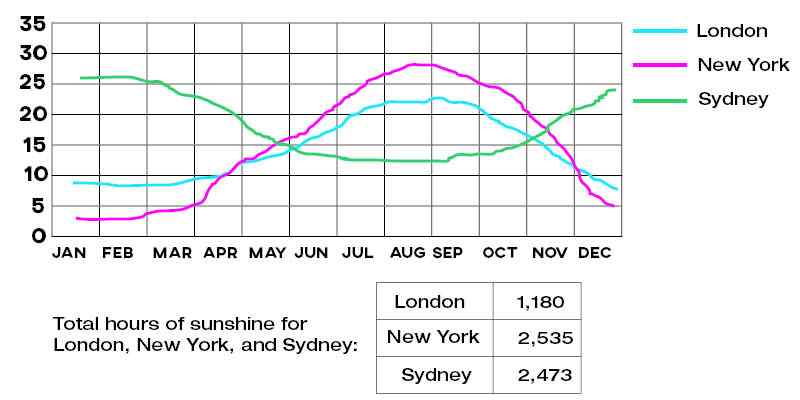
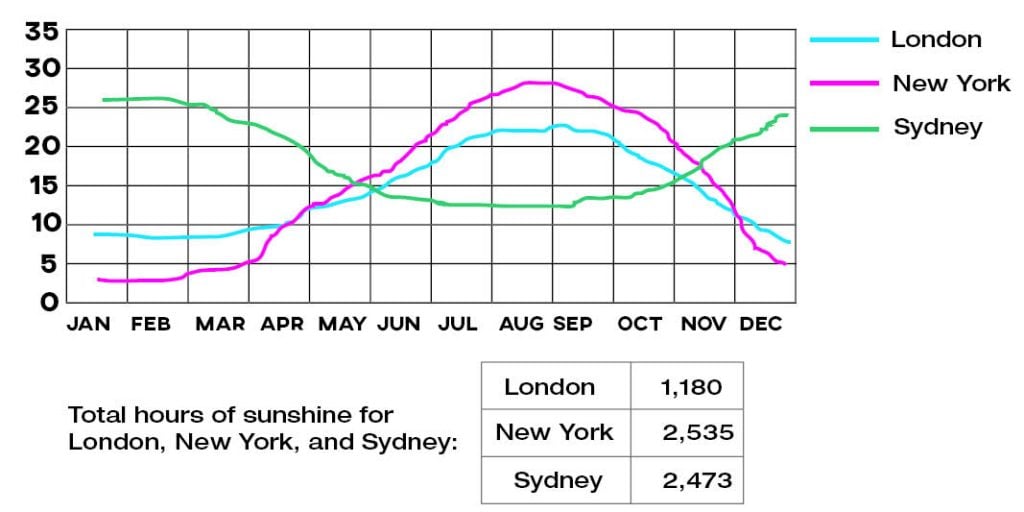
The charts below give information about the typical temperatures in London, New York, and Sydney as well as total hours of sunshine for each city.
The line chart and table detail both average annual temperatures and total hours of sunshine in a given year in London, New York, and Sydney. Overall, London and New York display broadly similar four-season climates, though the extremes are more pronounced in New York while Sydney has a reverse weather pattern with milder overall temperatures. In terms of overall sunshine, New York leads, followed closely by Sydney and distantly by London.
Looking first of all at London and New York, both undergo serious drops in temperature beginning in November as the former falls to just over 10 degrees Celsius, intersecting the latter at the same point. From there, temperatures in New York plummet throughout the winter with a low of under 5°C in January and February, while London bottoms out at around 9 degrees. Both rise steadily in the spring and peak in summer at around 23°C for London and nearly 30°C for New York. In contrast, Sydney is warmest from December to February (plateauing at over 25 degrees) and cools steadily to under 15 degrees from June to October.
Overall sunshine shows a different pattern with New York (2,535 hours) and Sydney (2,473) proximate and London much lower at 1,180.
Analysis
1. The line chart and table detail both average annual temperatures and total hours of sunshine in a given year in London, New York, and Sydney. 2. Overall, London and New York display broadly similar four-season climates, though the extremes are more pronounced in New York while Sydney has a reverse weather pattern with milder overall temperatures. 3. In terms of overall sunshine, New York leads, followed closely by Sydney and distantly by London.
Paraphrase what the graph or chart shows.
Write a general overview that covers all areas – don’t leave anything out but don’t be too specific by including data.
Make sure that you mention the table as well.
1. Looking first of all at London and New York, both undergo serious drops in temperature beginning in November as the former falls to just over 10 degrees Celsius, intersecting the latter at the same point. 2. From there, temperatures in New York plummet throughout the winter with a low of under 5°C in January and February, while London bottoms out at around 9 degrees. 3. Both rise steadily in the spring and peak in summer at around 23°C for London and nearly 30°C for New York. 4. In contrast, Sydney is warmest from December to February (plateauing at over 25 degrees) and cools steadily to under 15 degrees from June to October.
Begin to compare the data.
Finish comparing the data.
Shift to the last area and describe all the data there.
1. Overall sunshine shows a different pattern with New York (2,535 hours) and Sydney (2,473) proximate and London much lower at 1,180.
Describe the table fully as well. Sometimes the table and graph will relate to each other closely but these ones don’t so you don’t have to compare them.
Vocabulary
What do the words in bold below mean?
The line chart and table detail both average annual temperatures and total hours of sunshine in a given year in London, New York, and Sydney. Overall, London and New York display broadly similar four-season climates, though the extremes are more pronounced in New York while Sydney has a reverse weather pattern with milder overall temperatures. In terms of overall sunshine, New York leads, followed closely by Sydney and distantly by London.
Looking first of all at London and New York, both undergo serious drops in temperature beginning in November as the former falls to just over 10 degrees Celsius, intersecting the latter at the same point. From there, temperatures in New York plummet throughout the winter with a low of under 5°C in January and February, while London bottoms out at around 9 degrees. Both rise steadily in the spring and peak in summer at around 23°C for London and nearly 30°C for New York. In contrast, Sydney is warmest from December to February (plateauing at over 25 degrees) and cools steadily to under 15 degrees from June to October.
Overall sunshine shows a different pattern with New York (2,535 hours) and Sydney (2,473) proximate and London much lower at 1,180.
Answers
detail describe
average annual temperatures how hot/cold it usually is
The line chart and table d________l both a___________________________s and t_____________________________e in a g______________r in London, New York, and Sydney. Overall, London and New York d______________________r f___________________________s, though the e_____________s are more p___________________d in New York while Sydney has a r______________________n with m____________r overall temperatures. In terms of overall sunshine, New York l_______s, f____________________y by Sydney and d_____________y by London.
L__________________________t London and New York, both u__________________________s in temperature beginning in November as the f____________r falls to just over 10 degrees Celsius, i________________g the l___________r at the s________________t. From there, temperatures in New York p________________________________r with a____________f under 5°C in January and February, while London b________________t at around 9 degrees. Both r___________________y in the spring and p_________k in summer at around 23°C for London and n____________y 30°C for New York. I__________________t, Sydney is w_______________t from December to February (p__________________g at over 25 degrees) and c_______________y to under 15 degrees from June to October.
Overall sunshine shows a d____________________n with New York (2,535 hours) and Sydney (2,473) p______________e and London m______________r at 1,180.
Practice with the following questions from the real speaking exam:
Skies
Do you often look at the sky?
Do you prefer to look at the sky during the day or at night?
Have you ever taken a course about stars?
Where is the best view of the sky where you live?
Real Past IELTS Speaking Exam
Writing Practice
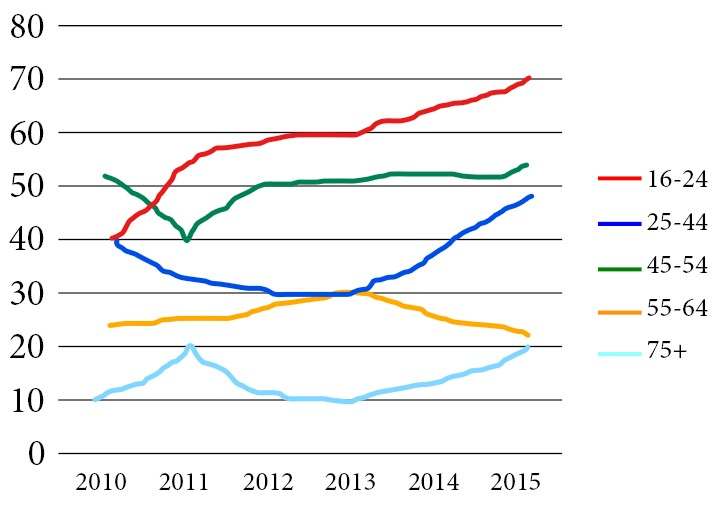
Write about the following graph then check with my sample answer. The graph below shows the percentage of people in different age groups in one city who attended music concerts between 2010 and 2015.
ielts writing task 1 sample answer essay line chart
IELTS Writing Task 2 General Training Sample Answer Essay: Unpaid Student Work
Many schools today require students to work without pay for companies as part of their education.
Is this more advantageous to students or companies?
Real Past IELTS Exam
An increasing number of schools are forcing students to do unpaid internships with companies as a graduation requirement. In my opinion, this measure generally benefits students more than companies.
On the one hand, companies receive free labour. Every company, whether it is an international conglomerate or a small local business, must balance expenses against revenue in hopes of turning a profit. One of the largest operating expenses is labour and having unpaid volunteers from a nearby school helps companies carve out a larger profit margin. For example, a local supermarket could use high school students to help with bagging groceries, collecting carts, stocking shelves and potentially even manning the cash registers. The savings from this labour can make a sizeable difference for companies as long as they have simple, manual positions that require little training and schools are willing to offer up students for these monotonous jobs.
On the other hand, students will generally not want to do simple, manual labour but work in a more interesting field, where they might be more of a hindrance than a help. A hypothetical example of this would be a student who has a keen interest in a given field, such as film-making, landing an internship with a local television station. In this high-pressured, skilled environment, an experienced employee will have to be charged with training and supervising a student who is unlikely to remain long with the company. This unpaid trainee will probably struggle to make much of a positive difference since the learning curve on skilled work is steep and the consequences for making mistakes can be serious. The student will learn a lot of useful skills but the company should see this as a form of charity, rather than a boon for their bottom line.
In conclusion, compulsory unpaid work for companies usually benefits students as they have a lot to learn and companies must invest in training. These positions are chances for students to become acclimated to the working world and not simply free manual labour.
Analysis
1. An increasing number of schools are forcing students to do unpaid internships with companies as a graduation requirement. 2. In my opinion, this measure generally benefits students more than companies.
Paraphrase what the overall topic is.
Write a clear opinion.
1. On the one hand, companies receive free labour. 2. Every company, whether it is an international conglomerate or a small local business, must balance expenses against revenue in hopes of turning a profit. 3. One of the largest operating expenses is labour and having unpaid volunteers from a nearby school helps companies carve out a larger profit margin. 4. For example, a local supermarket could use high school students to help with bagging groceries, collecting carts, stocking shelves and potentially even manning the cash registers. 5. The savings from this labour can make a sizeable difference for companies as long as they have simple, manual positions that require little training and schools are willing to offer up students for these monotonous jobs.
Write a topic sentence with a clear main idea at the end.
Explain your main idea.
Develop your ideas by being very specific.
Give a clear example.
Conclude the paragraph by relating back to the overall essay topic.
1. On the other hand, students will generally not want to do simple, manual labour but work in a more interesting field, where they might be more of a hindrance than a help. 2. A hypothetical example of this would be a student who has a keen interest in a given field, such as film-making, landing an internship with a local television station. 3. In this high-pressured, skilled environment, an experienced employee will have to be charged with training and supervising a student who is unlikely to remain long with the company. 4. This unpaid trainee will probably struggle to make much of a positive difference since the learning curve on skilled work is steep and the consequences for making mistakes can be serious. 5. The student will learn a lot of useful skills but the company should see this as a form of charity, rather than a boon for their bottom line.
Write another topic sentence with another clear main idea at the end.
Give an example. I use a hypothetical one because it is difficult to think of a real world one but if you know one, use a specific person.
Develop the example.
Keep developing the same example – don’t switch to a new main idea or a new example.
Conclude the paragraph with a strong statement.
1. In conclusion, compulsory unpaid work for companies usually benefits students as they have a lot to learn and companies must invest in training. 2. These positions are chances for students to become acclimated to the working world and not simply free manual labour.
Summarise your ideas and repeat your opinion.
Finish summarising and add a final thought.
Vocabulary
What do the words in bold below mean?
An increasing number of schools are forcing students to do unpaid internships with companies as a graduation requirement. In my opinion, this measure generally benefits students more than companies.
On the one hand, companies receive free labour. Every company, whether it is an international conglomerate or a small local business, must balance expenses against revenuein hopes of turning a profit. One of the largest operating expenses is labour and having unpaid volunteers from a nearby school helps companies carve out a larger profit margin. For example, a local supermarket could use high school students to help with bagging groceries, collecting carts, stocking shelves and potentially even manning the cash registers. The savings from this labour can make a sizeable difference for companies as long as they have simple, manual positions that require little training and schools are willing to offer up students for these monotonous jobs.
On the other hand, students will generally not want to do simple, manual labour but work in a more interesting field, where they might be more of a hindrance than a help. A hypothetical example of this would be a student who has a keen interest in a given field, such as film-making, landing an internship with a local television station. In this high-pressured, skilled environment, an experienced employee will have to be charged with training and supervising a student who is unlikely to remain long with the company. This unpaid trainee will probably struggle to make much of a positive difference since the learning curve on skilled work is steep and the consequences for making mistakes can be serious. The student will learn a lot of useful skills but the company should see this as a form of charity, rather than a boon for their bottom line.
In conclusion, compulsory unpaid work for companies usually benefits students as they have a lot to learn and companies must invest in training. These positions are chances for students to become acclimated to the working world and not simply free manual labour.
Answers
increasing number more and more
forcing have to do
unpaid internships working for free
graduation requirement have to do to leave high school/graduate
measure generally development usually
receive free labour get unpaid workers
international conglomerate multinational company
small local business neighborhood store/shop/business
balance expenses against revenue balance the books, earn a profit
in hopes of turning a profit in order to make money
operating expenses labour, rent, etc. (set costs)
unpaid volunteers interns
carve out find a way to make
profit margin the amount of money made after expenses
bagging groceries putting food in bags at the supermarket
collecting carts rounding up supermarket carts
stocking shelves putting food on the shelf at a supermarket
manning in charge of
cash registers where you pay in a shop
savings money saved
sizeable difference really important
as long as assuming that
manual positions jobs where you don’t have to think much
little training not much teaching
willing open to
offer up give
monotonous boring
hindrance holds one back
hypothetical imaginary
keen interest very interested in
given field some area
landing an internship getting to be an intern/trainee
local television station small TV studio
high-pressured intense
experienced employee veteran worker
charged with tasked with
supervising watch over
remain long stay there a while
unpaid trainee intern
struggle have difficulty
make much of a positive difference have a good impact on
learning curve on skilled work is steep hard to pick up the job/get good at it
An i________________________r of schools are f______________g students to do u_______________________s with companies as a g__________________________t. In my opinion, this m_______________________y benefits students more than companies.
On the one hand, companies r____________________r. Every company, whether it is an i_____________________________e or a s_______________________s, must b______________________________________ei_____________________________t. One of the largest o______________________s is labour and having u_______________________s from a nearby school helps companies c_____________t a larger p__________________n. For example, a local supermarket could use high school students to help with b___________________s, c__________________s, s___________________s and potentially even m___________g the c_________________s. The s_____________s from this labour can make a s____________________e for companies a________________s they have simple, m___________________s that require l________________________g and schools are w_____________g to o____________p students for these m__________________s jobs.
On the other hand, students will generally not want to do simple, manual labour but work in a more interesting field, where they might be more of a h________________e than a help. A h_________________l example of this would be a student who has a k______________t in a g______________d, such as film-making, l_____________________p with a l________________________n. In this h_________________d, skilled environment, an e________________________e will have to be c________________h training and s_________________g a student who is unlikely to r______________g with the company. This u_______________e will probably s_______________e to m_________________________________e since the l______________________________________p and the c__________________s for m____________________s can be s____________s. The student will learn a lot of useful skills but the company should see this as a form of c___________y, rather than a b_______n for their b_________________e.
In conclusion, c____________________________k for companies usually benefits students as they have a lot to learn and companies must i______________n training. These positions are chances for students to become a______________d to the w____________________d and not simply free manual labour.
Listen and check:
Listening Practice
Listen to Shivali Sharma talk about getting an internship at Johnson and Johnson:
Reading Practice
Read an argument against unpaid internships from The Atlantic here:
IELTS Writing Task 2 Sample Answer Essay: Researching Other Planets
In the future, people may have to live on other planets. Some think that it is therefore important to spend money researching other planets such as Mars.
To what extent do you agree or disagree?
Real Past IELTS Exam/Test
It is becoming increasingly likely that humanity will have to someday resort to the colonisation of other planets. Though some suggest that we should divert important resources towards research of other planets now, I believe it is more pragmatic to focus on our current planet.
Advocates of increased funding for interplanetary research hold that leaving Earth is inevitable. This conclusion is underpinned by studies showing the potentially irreversible and undoubtedly catastrophic effects of climate change. So far the habitats devastated have belonged to remote polar regions and the fragile ecosystems of already vulnerable animals. Climate scientists believe this degradation will rapidly extend to the lives of ordinary people and result in a global scarcity of natural resources and more intense natural disasters. If these predictions are accurate then we need a backup plan involving the evacuation of Earth to ensure human survival and prosperity for future generations.
However, the best safeguard against the doomsday scenarios laid out above is to salvage the planet we currently inhabit. It would require an immense amount of time, money, and resources to colonise even the nearest neighbor to Earth, Mars. Instead of directing those energies towards a fantastical plan to terraform an alien planet, the easier option is to invest more in protecting Earth’s environment. Governments could enact stricter regulations on individuals and private companies to cut carbon emissions, while also funding clean energy initiatives. By collectively signing the numerous international accords, policymakers could strike a balance between economic development and environmental conservation. These solutions are both more realistic in terms of the sacrifices entailed and have a much better chance of actual success.
In conclusion, investing in colonising other planets should not be a priority when there are better solutions to current global problems. Interplanetary dreams should be left to private companies or wealthy individuals who are passionate about humanity’s future in space.
Analysis
1. It is becoming increasingly likely that humanity will have to someday resort to the colonisation of other planets. 2. Though some suggest that we should divert important resources towards research of other planets now, I believe it is more pragmatic to focus on our current planet.
Paraphrase the overall topic for the whole essay.
Write a clear opinion and include your main ideas if you can.
1. Advocates of increased funding for interplanetary research hold that leaving Earth is inevitable. 2. This conclusion is underpinned by studies showing the potentially irreversible and undoubtedly catastrophic effects of climate change. 3. So far the habitats devastated have belonged to remote polar regions and the fragile ecosystems of already vulnerable animals. 4. Climate scientists believe this degradation will rapidly extend to the lives of ordinary people and result in a global scarcity of natural resources and more intense natural disasters. 5. If these predictions are accurate then we need a backup plan involving the evacuation of Earth to ensure human survival and prosperity for future generations.
Write a clear topic sentence with a main idea at the end.
Explain your main idea or give some background.
Develop your main idea with specific details.
Continue to develop it specifically.
Tie your conclusions back to the main idea.
1. However, the best safeguard against the doomsday scenarios laid out above is to salvage the planet we currently inhabit. 2. It would require an immense amount of time, money, and resources to colonise even the nearest neighbor to Earth, Mars. 3. Instead of directing those energies towards a fantastical plan to terraform an alien planet, the easier option is to invest more in protecting Earth’s environment. 4. Governments could enact stricter regulations on individuals and private companies to cut carbon emissions, while also funding clean energy initiatives. 5. By collectively signing the numerous international accords, policymakers could strike a balance between economic development and environmental conservation. 6. These solutions are both more realistic in terms of the sacrifices entailed and have a much better chance of actual success.
Write another clear topic sentence with a clear main idea at the end.
I start here with a counter-example…
Then move on to explaining my main idea.
Use specific examples – the more specific the better.
Draw out your examples fully and don’t switch to a new main idea.
Conclude with a strong statement and the final results.
1. In conclusion, investing in colonising other planets should not be a priority when there are better solutions to current global problems. 2. Interplanetary dreams should be left to private companies or wealthy individuals who are passionate about humanity’s future in space.
Summarise your opinion and arguments.
Finish summarising and add in an extra detail.
Vocabulary
What do the words in bold below mean? Use the sentences to try to figure out the meaning of difficult words:
It is becoming increasingly likely that humanity will have to someday resort to the colonisation of other planets. Though some suggest that we should divert important resources towards research of other planets now, I believe it is more pragmatic to focus on our current planet.
Advocates of increased funding for interplanetary research hold that leaving Earth is inevitable. This conclusion is underpinned by studies showing the potentially irreversible and undoubtedly catastrophic effects of climate change. So far the habitats devastated have belonged to remote polar regions and the fragile ecosystems of already vulnerable animals. Climate scientists believe this degradation will rapidly extend to the lives of ordinary people and result in a global scarcity of natural resources and more intense natural disasters. If these predictions are accurate then we need a backup plan involving the evacuation of Earth to ensure human survival and prosperity for future generations.
However, the best safeguard against the doomsday scenarios laid out above is to salvage the planet we currently inhabit. It would require an immense amount of time, money, and resources to colonise even the nearest neighbor to Earth, Mars. Instead of directing those energies towards a fantastical plan to terraform an alien planet, the easier option is to invest more in protecting Earth’s environment. Governments could enact stricter regulations on individuals and private companies to cut carbon emissions, while also funding clean energy initiatives. By collectively signing the numerous international accords, policymakers could strike a balance between economic development and environmental conservation. These solutions are both more realistic in terms of the sacrifices entailed and have a much better chance of actual success.
In conclusion, investing in colonising other planets should not be a priority when there are better solutions to current global problems. Interplanetary dreams should be left to private companies or wealthy individuals who are passionate about humanity’s future in space.
Answers
increasingly likely more and more possible it will happen
resort have to do
colonisation taking over/living on other planets
suggest propose
divert redirect
pragmatic useful
current right now
advocates supporters
interplanetary research learning about other planets
inevitable definitely going to happen
underpinned sourced, the foundation of
potentially irreversible maybe can’t be fixed
undoubtedly catastrophic effects definitely really bad impact
climate change global warming
so far to this point
habitats devastated homes hurt
belonged to were part of
remote polar regions far away cold places like Antarctica
fragile ecosystems delivate habitats
vulnerable easily hurt, weak
degradation getting worse
rapidly extend quickly move to
ordinary people everyday citizens
result in the effect will be
global scarcity of natural resources running out of oil, gas, trees, water, etc.
intense natural disasters powerful hurricanes, tsunamis, etc.
backup plan another option just in case
evacuation escape from
ensure human survival safeguard humanity’s future
prosperity growth
future generations people in the future
best safeguard against top way to protect
doomsday scenarios laid out worst case situations explained before
salvage save what is left of
currently inhabit where we live now
require need
immense amount a lot of
nearest neighbor closest planet
directing those energies focusing on
fantastical plan delusional ideas
terraform make more like Earth
easier option feasible solution
invest more put more money into
enact stricter regulations pass tougher laws
cut carbon emissions reduce reliance on fossil fuels
funding clean energy initiatives giving money for wind, solar, etc.
collectively signing the numerous international accords all together agree on the same laws/regulations
policymakers politicians
strike a balance find the middle ground
economic development jobs, companies doing well
environmental conservation saving the environment
realistic possible, may actually happen
sacrifices entailed what must be given up
actual success could really work
investing putting money into
priority more important
interplanetary dreams desire to go to other planets
It is becoming i_____________________y that humanity will have to someday r________t to the c_________________n of other planets. Though some s_________t that we should d_________t important resources towards research of other planets now, I believe it is more p______________c to focus on our c____________t planet.
A_______________s of increased funding for i________________________h hold that leaving Earth is i_____________e. This conclusion is u________________d by studies showing the p_______________________e and u____________________________s of c__________________e. S_________r the h______________________d have b________________o r___________________s and the f__________________________s of already v_______________e animals. Climate scientists believe this d___________________n will r____________________d to the lives of o_____________________e and r___________n a g___________________________s and more i_____________________________s. If these predictions are accurate then we need a b_________________n involving the e_________________n of Earth to e_________________________l and p_______________y for f______________________s.
However, the b_________________________t the d____________________________t above is to s_____________e the planet we c____________________t. It would r____________e an i___________________t of time, money, and resources to colonise even the n____________________r to Earth, Mars. Instead of d________________________s towards a f______________________n to t_____________m an alien planet, the e_______________n is to i_______________e in protecting Earth’s environment. Governments could e________________________s on individuals and private companies to c_____________________________s, while also f_______________________________s. By c____________________________________________________________s, p____________________s could s__________________e between e_____________________t and e________________________n. These solutions are both more r_____________________c in terms of the s___________________d and have a much better chance of a____________________s.
In conclusion, i___________________g in colonising other planets should not be a p______________y when there are better solutions to current global problems. I____________________________s should be left to private companies or w________________________s who are p___________________e about humanity’s future in space.
"The highest quality materials anywhere on the internet! Dave improved my writing and vocabulary so much. Really affordable options you don't want to miss out on!"