Some think that governments should support retired people financially while others believe they should take care of themselves.
Discuss both views and give your own opinion.
Real Past IELTS Tests/Exams
Many today have come to the conclusion that retired seniors should be supported by the government and not left to their own meagre resources. While I agree there are certain cases where governments are liable, citizens ought to be incentivised to handle their own finances.
The main reason many support a government backed retirement plan is the dire condition of many seniors. There are a number of possible causes deserving due attention. Some seniors are without family, others may be war veterans and have trouble finding work due to physical or psychological impairments, and still others may be victims of economic downturns. Without support they must fall on the mercy of society and will wind up at soup kitchens and seeking out chronic charity or even begging. Simply put, governments are their last refuge and in the best position to lend a helping hand.
Despite the rare instances mentioned above, nations ought to encourage ownership of one’s own future. If all citizens knew the government would provide a decent retirement fund for them, they would have little incentive to work hard, save money and make wise investments. Governments deal with large sample sizes and, granted this would not happen with many responsible adults, it still poses a sizeable national risk. An analogous example of this is the way parents raise their children. They provide for them early on, much like how governments offer free schooling, but then children are expected to grow up and take responsibility for their own lives. Parents that coddle their children for too long end up spoiling them in the same way that a national retirement fund would deprive individuals of the opportunity to become self-reliant.
In conclusion, the advantages of a more self-assured, mature citizenry outweigh the odd unavoidable case of desperation. There should be a degree of balance to allow for these exceptions while still nurturing more life-affirming values.
Word Count: 315
Analysis
1. Many today have come to the conclusion that retired seniors should be supported by the government and not left to their own meagre resources. 2. While I agree there are certain cases where governments are liable, citizens ought to be incentivised to handle their own finances.
The first sentence simply restates the overall topic for the essay.
In my next sentence, I give an overall opinion. You don’t have to include your main ideas but it can help your cohesion and coherence score if you do.
1. The main reason many support a government backed retirement plan is the dire condition of many seniors. 2. There are a number of possible causes deserving due attention. 3. Some seniors are without family, others may be war veterans and have trouble finding work due to physical or psychological impairments, and still others may be victims of economic downturns. 4. Without support they must fall on the mercy of society and will wind up at soup kitchens and seeking out chronic charity or even begging. 5. Simply put, governments are their last refuge and in the best position to lend a helping hand.
Write a topic sentence with a clear main idea at the end.
Begin to develop your main idea. Notice how I mix long and short sentences.
Include specifics! Don’t be general!
State the result to further develop your arguments.
Summarise your argument by relating it back to the main topic.
1. Despite the rare instances mentioned above, nations ought to encourage ownership of one’s own future. 2. If all citizens knew the government would provide a decent retirement fund for them, they would have little incentive to work hard, save money and make wise investments. 3. Governments deal with large sample sizes and, granted this would not happen with many responsible adults, it still poses a sizeable national risk. 4. An analogous example of this is the way parents raise their children. 5. They provide for them early on, much like how governments offer free schooling, but then children are expected to grow up and take responsibility for their own lives. 6. Parents that coddle their children for too long end up spoiling them in the same way that a national retirement fund would deprive individuals of the opportunity to become self-reliant.
Here I lay out exactly why this is important for governments – because of the large population they must deal with.
I argue here by analogy, which is a kind of example.
This sentence continues my analogy.
I conclude the paragraph by finishing the analogy.
1. In conclusion, the advantages of a more self-assured, mature citizenry outweigh the odd unavoidable case of desperation. 2. There should be a degree of balance to allow for these exceptions while still nurturing more life-affirming values.
Repeat your opinion.
Add in an extra detail or final thought for full marks for task achievement from the IELTS examiner.
Vocabulary
Many today have come to the conclusion that retired seniors should be supported by the government and not left to their own meagre resources. While I agree there are certain cases where governments are liable, citizens ought to be incentivised to handle their own finances.
The main reason many support a government backed retirement plan is the dire condition of many seniors. There are a number of possible causes deserving due attention. Some seniors are without family, others may be war veterans and have trouble finding work due to physical or psychological impairments, and still others may be victims of economic downturns. Without support they must fall on the mercy of society and will wind up at soup kitchens and seeking out chronic charity or even begging. Simply put, governments are their last refuge and in the best position to lend a helping hand.
Despite the rare instances mentioned above, nations ought to encourage ownership of one’s own future. If all citizens knew the government would provide a decent retirement fund for them, they would have little incentive to work hard, save money and make wise investments. Governments deal with large sample sizes and, granted this would not happen with many responsible adults, it still poses a sizeable national risk. An analogous example of this is the way parents raise their children. They provide for them early on, much like how governments offer free schooling, but then children are expected to grow up and take responsibility for their own lives. Parents that coddle their children for too long end up spoiling them in the same way that a national retirement fund would deprive individuals of the opportunity to become self-reliant.
In conclusion, the advantages of a more self-assured, mature citizenry outweigh the odd unavoidable case of desperation. There should be a degree of balance to allow for these exceptions while still nurturing more life-affirming values.
Answers
come to the conclusion now believe
retired seniors old people no longer working
left to their own meagre resources have to survive with little
liable responsible/at fault
incentivised encouraged
handle their own finances be in charge of their own money
government backed retirement plan pension/national retirement funds
dire condition difficult situation
deserving due attention worth thinking about
war veterans people who fought in wars/battles
physical or psychological impairments injured in their body or mind
Many today have c______________ that r______________ should be supported by the government and not l______________. While I agree there are certain cases where governments are l______________, citizens ought to be i______________ to h______________.
The main reason many support a g______________ is the d______________ of many seniors. There are a number of possible causes d______________. Some seniors are without family, others may be w______________ and have trouble finding work due to p______________, and still others may be v______________ of e______________. Without support they must f______________ and will w______________ at s______________ and s______________ or even b______________. Simply put, governments are their l______________ and in the b______________ to l______________.
Despite the rare instances mentioned above, nations ought to encourage o______________. If all citizens knew the government would provide a d______________ for them, they would have l______________ to work hard, save money and m______________. Governments deal with l______________ and, g______________ this would not happen with many responsible adults, it still p______________ a s______________. An a______________ of this is the way parents raise their children. They p______________, much like how governments offer free schooling, but then children are expected to grow up and t______________. Parents that c______________ their children for too long end up s______________ in the same way that a national retirement f______________ would d______________ individuals of the opportunity to become s______________.
In conclusion, the advantages of a more s______________, m______________ citizenry outweigh the o______________. There should be a______________ to a______________ these e______________ while still n______________ more l______________.
Listen and check:
Listening Practice
Listen to the Ted Talk below and use these ideas to practice:
Reading Practice
Here is a relevant article on the same topic as the essay above:
Studying the vocabulary and ideas below could be really helpful if a similar question comes up on your exam!
Please consider signing up for my Patreon here in order to support my efforts and receive exclusive Ebooks and materials related to IELTS!
Dave
Before reading, listen to my answer and take notes on the ideas and vocabulary. Then read and check.
IELTS Writing Task 2 General Training: Internet & Phone Dependence (Real Past IELTS Tests/Exams)
More and more people today are becoming overly dependent on the internet and phones.
Is this a positive or negative development?
Real Past IELTS Tests/Exams
The advent of smartphones has led to widespread internet addiction. Although this shift has its conveniences, it signals a decline in healthy activity.
Those who contend that the overall value of phones and the internet is a net positive can easily point to its versatility. The vast majority of people today would either reluctantly or enthusiastically admit they cannot live without their phones. If you are on a road trip or meeting a friend at a new cafe, you will need Google maps to find your way. The best method of booking a restaurant or researching online and offline businesses is through Facebook. All that only touches the surface of what the internet allows for ranging from sending emails, trading stocks online, posting on social media, to binge watching videos on streaming sites.
Despite the pile of advantages listed above, phones and the internet take up more time than they merit. The reason for this is that people get stuck in feedback loops, exchanging their time for momentary bursts of dopamine, no different from any other drug addict. Before the internet an individual might waste time watching television but still engage in a greater proportion of healthy habits like hanging out with friends, reading books, making art, exercising or taking up another worthwhile hobby. The healthy rush from those activities is chemically identical to scrolling through an algorithm mindlessly. The only distinction is that some distractions have more value in terms of physical and mental health than others.
In conclusion, the ubiquity of an internet living in your pocket has led to a decrease in engagement with healthy activities. In order to remedy this, people must take it on themselves to break their dependence as no government will ever regulate this drug properly.
Analysis
1. The advent of smartphones has led to widespread internet addiction. 2. Although this shift has its conveniences, it signals a decline in healthy activity.
Paraphrase the overall topic of the whole essay.
Give your opinion – choose a side and make it clear!
1. Those who contend that the overall value of phones and the internet is a net positive can easily point to its versatility. 2. The vast majority of people today would either reluctantly or enthusiastically admit they cannot live without their phones. 3. If you are on a road trip or meeting a friend at a new cafe, you will need Google maps to find your way. 4. The best method of booking a restaurant or researching online and offline businesses is through Facebook. 5. All that only touches the surface of what the internet allows for ranging from sending emails, trading stocks online, posting on social media, to binge watching videos on streaming sites.
Write a topic sentence with a clear main idea at the end of the sentence.
Explain your main idea.
Begin to develop it with specific examples.
Keep developing it and be as specific as possible – real companies, real situations.
Add in more support. For the internet, there are so many areas to touch on so I listed a lot of them at the end.
1. Despite the pile of advantages listed above, phones and the internet take up more time than they merit. 2. The reason for this is that people get stuck in feedback loops, exchanging their time for momentary bursts of dopamine, no different from any other drug addict. 3. Before the internet an individual might waste time watching television but still engage in a greater proportion of healthy habits like hanging out with friends, reading books, making art, exercising or taking up another worthwhile hobby. 4. The healthy rush from those activities is chemically identical to scrolling through an algorithm mindlessly. 5. The only distinction is that some distractions have more value in terms of physical and mental health than others.
Another topic sentence with a clear main idea.
Explain your main idea.
Again – be as specific as you can with your supporting ideas and examples.
Continue developing the same main idea and don’t swtich to a new main idea.
Conclude your paragraph by drawing conclusions/results from your main idea.
1. In conclusion, the ubiquity of an internet living in your pocket has led to a decrease in engagement with healthy activities. 2. In order to remedy this, people must take it on themselves to break their dependence as no government will ever regulate this drug properly.
Repeat your opinion.
Add in an extra detail/final thought to finish the essay.
Vocabulary
What do the words in bold below mean?
The advent of smartphones has led to widespread internet addiction. Although this shift has its conveniences, it signals a decline in healthy activity.
Those who contend that the overall value of phones and the internet is a net positive can easily point to its versatility. The vast majority of people today would either reluctantly or enthusiastically admit they cannot live without their phones. If you are on a road trip or meeting a friend at a new cafe, you will need Google maps to find your way. The best method of booking a restaurant or researching online and offline businesses is through Facebook. All that only touches the surface of what the internet allows for ranging from sending emails, trading stocks online, posting on social media, to binge watching videos on streaming sites.
Despite the pile of advantages listed above, phones and the internet take up more time than they merit. The reason for this is that people get stuck in feedback loops, exchanging their time for momentary bursts of dopamine, no different from any other drug addict. Before the internet an individual might waste time watching television but still engage in a greater proportion of healthy habits like hanging out with friends, reading books, making art, exercising or taking up another worthwhile hobby. The healthy rush from those activities is chemically identical to scrolling through an algorithm mindlessly. The only distinction is that some distractions have more value in terms of physical and mental health than others.
In conclusion, the ubiquity of an internet living in your pocket has led to a decrease in engagement with healthy activities. In order to remedy this, people must take it on themselves to break their dependence as no government will ever regulate this drug properly.
Answers
advent start of
widespread ubiquitous
addiction can’t stop using/dependent on
shift change to
conveniences useful
signals is indicative of
contend argue
net positive overall good
easily point to not hard to argue that
versatility flexible
vast majority most of
reluctantly don’t want to
enthusiastically admit happy to say
cannot live without need
road trip holiday
Google maps app for finding where you’re going
find your way follow directions
booking a restaurant reserve a seat
offline businesses real world shop
touches the surface superficial
ranging from including
trading stocks online selling shares in companies
posting on social media sharing
binge watching watching multiple episodes in a row
streaming sites YouTube, Netflix, Hulu, etc.
pile list/stack up
take up occupy
merit deserve
stuck can’t escape
feedback loops addiction cycle
exchanging trading
momentary bursts small surges
dopamine neurochemical that makes you feel happy
drug addict user
waste time fritter away your life
engage in do/use
greater proportion large percentage of
taking up occupying
worthwhile hobby good use of time
healthy rush sense of accomplishment
chemically identical the same in terms of what you feel from it
scrolling looking through
algorithm mindlessly thoughtlessly scrolling through feeds
The a_____________ of smartphones has led to w_____________ internet a_____________. Although this s_____________ has its c_____________, it s_____________ a decline in healthy activity.
Those who c_____________ that the overall value of phones and the internet is a n_____________ can e_____________ its v_____________. The v_____________ of people today would either r_____________ or e_____________ they c_____________ their phones. If you are on a r_____________ or meeting a friend at a new cafe, you will need G_____________ to f_____________. The best method of b_____________ or researching online and o_____________ is through Facebook. All that only t_____________ of what the internet allows for r_____________ sending emails, t_____________, p_____________, to b_____________ videos on s_____________.
Despite the p_____________ of advantages listed above, phones and the internet t_____________ more time than they m_____________. The reason for this is that people get s_____________ in f_____________, e_____________ their time for m_____________ of d_____________, no different from any other d_____________. Before the internet an individual might w_____________ watching television but still e_____________ a g_____________ of healthy habits like hanging out with friends, reading books, making art, exercising or t_____________ another w_____________. The h_____________ from those activities is c_____________ to s_____________ through an a_____________. The only d_____________ is that some distractions have more v_____________ in terms of physical and mental health than others.
In conclusion, the u_____________ of an internet living in your pocket has led to a decrease in engagement with healthy activities. In order to r_____________ this, people must t_____________ to break their d_____________ as no government will ever r_____________ this drug p_____________.
Listen and check:
Listening Practice
Watch the video below to improve your listening. Some tips for how to listen are here:
Reading Practice
Read the article below and use these tips to improve your reading:
Before reading, listen to my audio of the answer and try to draw the bar chart as accurately as you can to improve your listening skills. Listen to it more than once if you have to:
IELTS Writing Task 1 Sample Answer: Organisations Bar Chart (Real Past IELTS Tests/Exams)
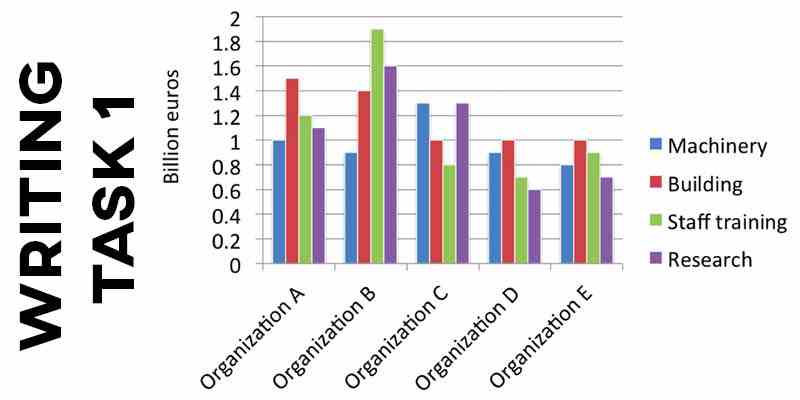
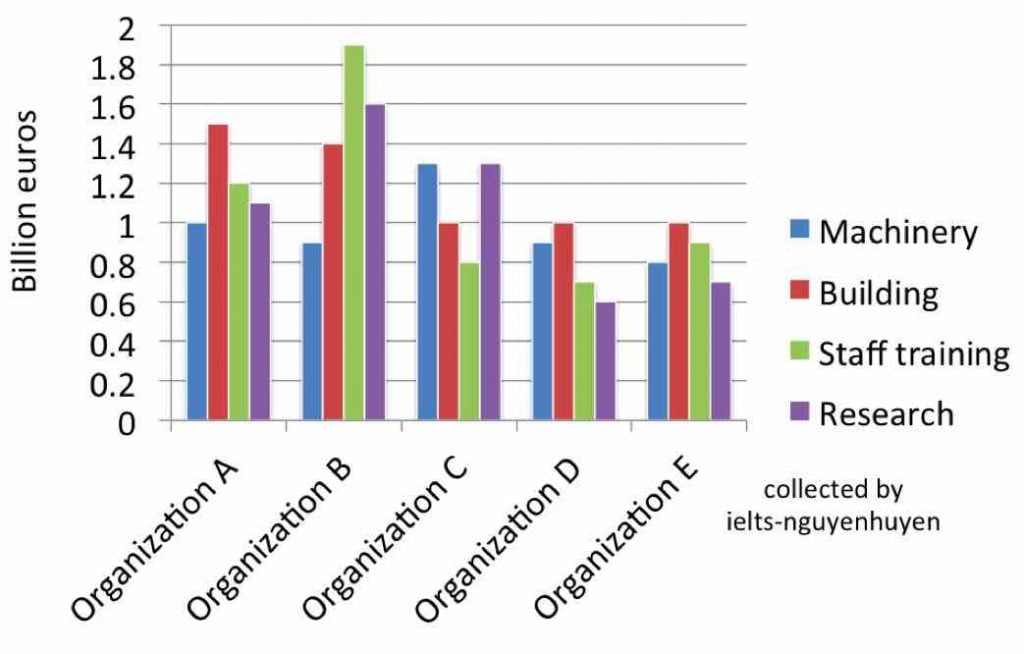
The chart below gives information about billions of euros invested in four areas by various organisations.
The bar chart details funding to four sectors by organisation A-E in a given time period. What stands out most is that overall expenditure is highest for organisation B, in particular staff training and research are outliers compared to the other organisations, while organisations D and E were much lower in overall funding and A and C were in the middle. There were varying trends for all organisations though building tended to be near the top for most of them.
Looking first of all at the funding for organisations A and B, machinery received €1 billion and just under a billion euros respectively, while building was the most funded for organisation A (€1.5 billion) and €.1 billion lower for B, trailing staff training (€1.9 billion) and research (€1.6 billion). Organisation A invested less in both areas with €1.2 for training and €1.1 for research.
The numbers for organisation C, D, and E were much lower with machinery at €1.1 billion for C, €.9 billion for D and €.8 billion for E. All three organisations invested equally in building (an even €1 billion), while staff training was between €.7 and €.9 billion for all groups. Research showed more divergent numbers with organisations C contributing €1.3 billion, organisation D €.6 billion and organisation E €.7billion.
Analysis
1. The bar chart details funding to four sectors by organisation A-E in a given time period. 2. What stands out most is that overall expenditure is highest for organisation B, in particular staff training and research are outliers compared to the other organisations, while organisations D and E were much lower in overall funding and A and C were in the middle. 3. There were varying trends for all organisations though building tended to be near the top for most of them.
Paraphrase very simply what the graph shows – don’t waste time on this sentence.
Write a general overview. It must touch on all areas but not include specific data.
Usually you will need 2 sentences for your overview. 3 is too many.
1. Looking first of all at the funding for organisations A and B, machinery received €1 billion and just under a billion euros respectively, while building was the most funded for organisation A (€1.5 billion) and €.1 billion lower for B, trailing staff training (€1.9 billion) and research (€1.6 billion). 2. Organisation A invested less in both areas with €1.2 for training and €1.1 for research.
Begin to talk about some of the organisations and include all the data. There is a lot of data here so I use parenthesis (…) to include some of it.
Finish and make sure you wrote about all the data and it is accurate.
1. The numbers for organisation C, D, and E were much lower with machinery at €1.1 billion for C, €.9 billion for D and €.8 billion for E. 2. All three organisations invested equally in building (an even €1 billion), while staff training was between €.7 and €.9 billion for all groups. 3. Research showed more divergent numbers with organisations C contributing €1.3 billion, organisation D €.6 billion and organisation E €.7billion.
Talk about the other areas – again with all the data.
Compare the data as much as possible.
Double check to make sure that you included all the data and your overview also includes all the organisations.
Vocabulary
Can you think of any synonyms for the words in bold below?
The bar chart details funding to four sectors by organisation A-E in a given time period. What stands out most is that overall expenditure is highest for organisation B, in particular staff training and research are outliers compared to the other organisations, while organisations D and E were much lower in overall funding and A and C were in the middle. There were varying trends for all organisations though building tended to be near the top for most of them.
Looking first of all at the funding for organisations A and B, machinery received €1 billion and just under a billion euros respectively, while building was the most funded for organisation A (€1.5 billion) and €.1 billion lower for B, trailing staff training (€1.9 billion) and research (€1.6 billion). Organisation A invested less in both areas with €1.2 for training and €1.1 for research.
The numbers for organisation C, D, and E were much lower with machinery at €1.1 billion for C, €.9 billion for D and €.8 billion for E. All three organisations invested equally in building (an even €1 billion), while staff training was between €.7 and €.9 billion for all groups. Research showed more divergent numbers with organisation C contributing €1.3 billion, organisation D €.6 billion and organisation E €.7billion.
Answers
details funding shows the money spend on
sectors areas
in a given time period over the period surveyed
what stands out most is the most striking feature is
The bar chart d___________ to four s___________ by organisation A-E i___________. W___________ that o___________ is highest for organisation B, i___________ staff training and research are o___________ compared to the other organisations, while organisations D and E were much lower in overall funding and A and C were in the middle. There were v___________ for all organisations though building t___________ to be n___________ for most of them.
Looking first of all at the funding for organisations A and B, machinery r___________ €1 billion and j___________ a billion euros r___________, while building was the most funded for organisation A (€1.5 billion) and €.1 billion lower for B, t___________ staff training (€1.9 billion) and research (€1.6 billion). Organisation A i___________ less in both areas with €1.2 for training and €1.1 for research.
The numbers for organisation C, D, and E were m___________ with machinery at €1.1 billion for C, €.9 billion for D and €.8 billion for E. All three organisations i___________ in building (an e___________ €1 billion), while staff training was between €.7 and €.9 billion for all groups. Research showed more d___________ with organisations C c___________ €1.3 billion, organisation D €.6 billion and organisation E €.7billion.
Some believe that people are naturally born as leaders while others feel that leadership skills can develop.
Discuss both views and give your own opinion.
Many are of the view that leadership is innate, rather than cultivated through time and experience. In my opinion, leadership is largely developed rather than gifted.
Those who believe that there are naturally born leaders point out the character of a person as a fixed quantity. There are certain individuals who display a natural charisma and inimitable capacity for command. A recent example of this would be Barack Obama. He is a naturally eloquent, stately, physically imposing presence and perfectly walks a fine line between warmth and firmness. Researchers have long identitified common natural characteristics of leadership such as height, a deep voice, a strong chin and natural grace of movement. These cannot be developed to a significant degree and therefore support the claim that leadership is intrinsic.
However, great leadership is more deliberate than spontaneous. There are countless examples of individuals possessing all the physical characteristics of leaders who fall well short of inspiring people. An instructive example of this is Steve Jobs. Early in his career he inspired people with his exceptional talent but that had its limits as he pushed and demeaned employees ultimately leading to his ouster from Apple. This humbling experience led him to soften the sharper edges of his personality in the ensuing decade by considering other viewpoints and giving up more control to competent employees. These learned traits served him well when he become CEO of Apple again and reached what many regard as the pinnacle of leadership.
In conclusion, though the endpoint may obscure the origins, all leaders must cultivate their hubris to become great leaders. The long-standing assumptions about leadership must be challenged in order to put in place better institutional practices to mold future pioneers of industry and politics.
Word Count: 289
Analysis
1. Many are of the view that leadership is innate, rather than cultivated through time and experience. 2. In my opinion, leadership is largely developed rather than gifted.
Paraphrase the overall topic in your first sentence.
Give your opinion – make it clear!
1. Those who believe that there are naturally born leaders point out the character of a person as a fixed quantity. 2. There are certain individuals who display a natural charisma and inimitable capacity for command. 3. A recent example of this would be Barack Obama. 4. He is a naturally eloquent, stately, physically imposing presence and perfectly walks a fine line between warmth and firmness. 5. Researchers have long identitified common natural characteristics of leadership such as height, a deep voice, a strong chin and natural grace of movement. 6. These cannot be developed to a significant degree and therefore support the claim that leadership is intrinsic.
Write a topic sentence with a clear main idea at the end.
Begin to develop/explain your main idea.
Give a specific example.
Develop the example with specific details.
Here I quote (fake) research to further support my main idea.
Tie it back to your main idea for the paragraph/the overall essay question.
1. However, great leadership is more deliberate than spontaneous. 2. There are countless examples of individuals possessing all the physical characteristics of leaders who fall well short of inspiring people. 3. An instructive example of this is Steve Jobs. 4. Early in his career he inspired people with his exceptional talent but that had its limits as he pushed and demeaned employees ultimately leading to his ouster from Apple. 5. This humbling experience led him to soften the sharper edges of his personality in the ensuing decade by considering other viewpoints and giving up more control to competent employees. 6. These learned traits served him well when he become CEO of Apple again and reached what many regard as the pinnacle of leadership.
Write a new main idea.
Begin to develop that main idea by explaining it first.
Start another specific example of a person that you know a lot about.
Go into great detail in your example.
Continue developing the example.
Finish developing your example to fully support your main idea.
1. In conclusion, though the endpoint may obscure the origins, all leaders must cultivate their hubris to become great leaders. 2. The long-standing assumptions about leadership must be challenged in order to put in place better institutional practices to mold future pioneers of industry and politics.
Repeat your opinion.
Add in a final thought/extra detail for full points from the IELTS examiner.
Vocabulary
What do the words in below in bold mean?
Many are of the view that leadership is innate, rather than cultivated through time and experience. In my opinion, leadership is largely developed rather thangifted.
Those who believe that there are naturally born leaders point out the character of a person as a fixed quantity. There are certain individuals who display a natural charisma and inimitable capacity for command. A recent example of this would be Barack Obama. He is a naturally eloquent, stately, physically imposing presence and perfectly walks a fine line between warmth and firmness. Researchers have long identitified common natural characteristics of leadership such as height, a deep voice, a strong chin and natural grace of movement. These cannot be developed to a significant degree and therefore support the claim that leadership is intrinsic.
However, great leadership is more deliberate than spontaneous. There are countless examples of individuals possessing all the physical characteristics of leaders who fall well short of inspiring people. An instructive example of this is Steve Jobs. Early in his career he inspired people with his exceptional talent but that had its limits as he pushed and demeaned employees ultimately leadingto his ouster from Apple. This humbling experience led him to soften the sharper edges of his personality in the ensuing decade by considering other viewpoints and giving up more control to competent employees. These learned traits served him well when he become CEO of Apple again and reached what many regard as the pinnacle of leadership.
In conclusion, though the endpoint may obscure the origins, all leaders must cultivate their hubris to become great leaders. The long-standing assumptions about leadership must be challenged in order to put in place better institutional practices to mold future pioneers of industry and politics.
Answers
innate intrinsic
cultivated developed
largely mostly
rather thangifted instead of given
naturally born leaders innate leaders
point out argue
character temperament
fixed quantity unchangeable
display show
natural charisma personality
inimitable capacity for command can’t be repeated ability to lead
naturally eloquent speaks well
stately presidential
physically imposing presence looks like a leader
perfectly walks a fine line balances well
between warmth and firmness being friendly and strong
natural characteristics your character
deep voice manly voice
natural grace of movement refined manners
to a significant degree much
support the claim give evidence for
intrinsic innate
deliberate intentional
spontaneous without intent
countless examples many instances
fall well short nowhere near
inspiring people leading
instructive example instance that shows well
inspired visionary
exceptional talent standout ability
limits boundaries
pushed forced
demeaned condescended to
ultimately leadingto in the end resulting in
ouster kicked out
humbling experience brough him down to Earth
soften the sharper edges of his personality mature
ensuing decade over the next 10 years
considering other viewpoints listening to others
giving up more control empowering others
competent employees able staff
learned traits served him well experiences benefited him later
what many regard as lots of people think
pinnacle of leadership height of leadership
endpoint final destination
obscure hide
origins where it started
cultivate develop
hubris ego/pride
long-standing assumptions unquestioned
challenged rethink
put in place implement
institutional practices schools, companies, etc. how they operate
Many are of the view that leadership is i____________, rather than c____________ through time and experience. In my opinion, leadership is l____________ developed r____________.
Those who believe that there are n____________p____________ the c____________ of a person as a f____________. There are certain individuals who d____________ a n____________ and i____________. A recent example of this would be Barack Obama. He is a n____________ , s____________, p____________ and w____________ b____________. Researchers have long i____________ common n____________ of leadership such as height, a d____________, a strong chin and n____________. These cannot be developed t____________ and therefore s____________ that leadership is i____________.
However, great leadership is more d____________ than s____________. There are c____________ of individuals possessing all the physical characteristics of leaders who f____________ of i____________. An i____________ of this is Steve Jobs. Early in his career he i____________ people with his e____________ but that had its l____________ as he p____________ and d____________ employees u____________ his o____________ from Apple. This h____________ led him to s____________ in the e____________ by c____________ and g____________ to c____________. These l____________ when he become CEO of Apple again and reached ____________ the p____________.
In conclusion, though the e____________ may o____________ the o____________, all leaders must c____________ their h____________ to become great leaders. The l____________ about leadership must be c____________ in order to p____________ better i____________ to m____________ future p____________ of industry and politics.
Listen and check:
Listening Practice
Listen to Tony Robbins below on leadership:
Reading Practice
Here is a fascinating article on leadership from research that Google conducted:
This is an IELTS Writing Task 2 sample essay on the topic of unhealthy foods from the real exam on the topic of unhealthy foods and whether or not governments should tax them.
It’s a very common topic – health and government regulations.
Read it below in case something similar comes up on your test!
Some think that governments should tax unhealthy foods to encourage people to eat healthier.
To what extent do you agree or disagree?
Real Past IELTS Tests/Exams
Some think that heavy-handed governmental taxation is the only way to compel healthier eating. In my opinion, while this makes rational sense, its actual effectiveness is questionable.
Those that argue in favour of these taxes can point to a logical chain of suppositions. Though taxes on unhealthy foods are rare, there is the occasional mandated price hike for sugary drinks and fast food, smoking is an instructive corollary. Several decades after research showed that smoking causes cancer, governments were able to push through legislation to tax cigarettes heavily. The result was that those already addicted to smoking continued to smoke but many people did not pick up the habit to begin with. Proponents argue this would also be the case when it comes to foods known to cause cardiovascular disease, diabetes and cancer. Many would eat them despite higher prices but the next generation would become more health conscious and that would further trickle down to their children.
Though the above argument is well reasoned, people will still buy luxuries. There is strong evidence for this dating back centuries. After the war of independence from Britain, the newly formed United States instituted direly needed taxes on luxuries including whiskey and chocolate. The purpose of the taxes was to raise money, not to lower consumption of those products. The unpopular acts were internally vindicated when people continued to buy luxuries along the same growth trend, enabling them to increase the national budget. Even though cutting down on purely pleasurable products makes disinterested sense, people are more swayed by instant gratification than cold calculation.
In conclusion, taxes on unhealthy foods would not be an effective measure against their consumption. Instead, governments should invest more in healthy school lunches and making healthy products more widely available to attack the problem at its root source.
Word Count: 295
Analysis
1. Some think that heavy-handed governmental taxation is the only way to compel healthier eating. 2. In my opinion, while this makes rational sense, its actual effectiveness is questionable.
Paraphrase the overall topic for the essay.
Write your opinion clearly.
1. Those that argue in favour of these taxes can point to a logical chain of suppositions. 2. Though taxes on unhealthy foods are rare, there is the occasional mandated price hike for sugary drinks and fast food, smoking is an instructive corollary. 3. Several decades after research showed that smoking causes cancer, governments were able to push through legislation to tax cigarettes heavily. 4. The result was that those already addicted to smoking continued to smoke but many people did not pick up the habit to begin with. 5. Proponents argue this would also be the case when it comes to foods known to cause cardiovascular disease, diabetes and cancer. 6. Many would eat them despite higher prices but the next generation would become more health conscious and that would further trickle down to their children.
Write a clear topic sentence with a singly main idea.
Explain your main idea if you need to.
Begin to develop it with research/examples/supporting ideas.
Write about the result if possible.
Continue developing – notice the specific ailments I mention.
Your last sentence can relate back to the question and be more general.
1. Though the above argument is well reasoned, people will still buy luxuries. 2. There is strong evidence for this dating back centuries. 3. After the war of independence from Britain, the newly formed United States instituted direly needed taxes on luxuries including whiskey and chocolate. 4. The purpose of the taxes was to raise money, not to lower consumption of those products. 5. The unpopular acts were internally vindicated when people continued to buy luxuries along the same growth trend, enabling them to increase the national budget. 6. Even though cutting down on purely pleasurable products makes disinterested sense, people are more swayed by instant gratification than cold calculation.
Write another topic sentence with a clear main idea.
Begin to develop it. Vary long/short sentences in your writing.
Your examples should be specific so write about the country/example that you know best.
Continue developing the same example.
Keep developing it – don’t switch to a new example or write generally.
Your last sentence can be more general and relate to the overall question.
1. In conclusion, taxes on unhealthy foods would not be an effective measure against their consumption. 2. Instead, governments should invest more in healthy school lunches and making healthy products more widely available to attack the problem at its root source.
Conclude by repeating your opinion.
Add in a final thought/extra detail at the end.
Vocabulary
What do the words in bold below mean? Try to figure them out based on the sentences:
Some think that heavy-handed governmental taxation is the only way to compel healthier eating. In my opinion, while this makes rational sense, its actual effectiveness is questionable.
Those that argue in favour of these taxes can point to a logical chain of suppositions. Though taxes on unhealthy foods are rare, there is the occasional mandated price hike for sugary drinks and fast food, smoking is an instructive corollary. Several decades after research showed that smoking causes cancer, governments were able to push through legislation to tax cigarettes heavily. The result was that those already addicted to smoking continued to smoke but many people did not pick up the habit to begin with. Proponents argue this would also be the case when it comes to foods known to cause cardiovascular disease, diabetes and cancer. Many would eat them despite higher prices but the next generation would become more health conscious and that would further trickle down to their children.
Though the above argument is well reasoned, people will still buy luxuries. There is strong evidence for this dating back centuries. After the war of independence from Britain, the newly formed United States instituted direly needed taxes on luxuries including whiskey and chocolate. The purpose of the taxes was to raise money, not to lower consumption of those products. The unpopular acts were internally vindicated when people continued to buy luxuries along the same growth trend, enabling them to increase the national budget. Even though cutting down on purely pleasurable products makes disinterested sense, people are more swayed by instant gratification than cold calculation.
In conclusion, taxes on unhealthy foods would not be an effective measure against their consumption. Instead, governments should invest more in healthy school lunches and making healthy products more widely available to attack the problem at its root source.
Answers
heavy-handed strong/over-the-top
compel force
rational sense logical
actual effectiveness whether or not it works
questionable doubtful
argue in favour of support the idea of
point to argue about
logical chain sensible series
suppositions reasons
occasional mandated price hike regulation/tax
instructive corollary useful analogy
push through force
heavily strongly/a lot
addicted can’t stop using
pick up begin
to begin with start
proponents advocates
cardiovascular disease heart attacks
diabetes a disease related to eating too much sugar
cancer a common disease
next generation young people
health conscious caring about what you eat/exercise
Some think that h_____________ governmental taxation is the only way to c_____________ healthier eating. In my opinion, while this makes r_____________ , its a_____________ is q_____________.
Those that a_____________ these taxes can p_____________ a l_____________ of s_____________. Though taxes on unhealthy foods are rare, there is the o_____________ for sugary drinks and fast food, smoking is an i_____________. Several decades after research showed that smoking causes cancer, governments were able to p_____________ legislation to tax cigarettes h_____________. The result was that those already a_____________ to smoking continued to smoke but many people did not p_____________ the habit t_____________. P_____________ argue this would also be the case when it comes to foods known to cause c_____________, d_____________ and c_____________. Many would eat them despite higher prices but the n_____________ would become more h_____________ and that would f_____________ to their children.
Though the above argument is w_____________, people will still buy luxuries. There is s_____________ for this d_____________. After the w_____________ from Britain, the _____________United States instituted d_____________needed taxes on l_____________including whiskey and chocolate. The purpose of the taxes was to raise money, not to l_____________ of those products. The u_____________ were i_____________ when people continued to buy luxuries along the same g_____________, enabling them to increase the n_____________. Even though c_____________ purely pleasurable products m_____________, people are more s_____________ by i_____________ than c_____________.
In conclusion, taxes on unhealthy foods would not be an e_____________ against their c_____________. Instead, governments should invest more in healthy school lunches and making healthy products m_____________ to a_____________ at its r_____________.
Listen and check:
Listening Practice
Listen to the video below to practice your listening and get some ideas about the topic:
Reading Practice
Read here about the success of junk food taxes in Mexico and Hungary:
"The highest quality materials anywhere on the internet! Dave improved my writing and vocabulary so much. Really affordable options you don't want to miss out on!"