Listen to the audio before reading my sample answer to practice your listening:
IELTS Writing Task 2 Sample Answer Essay: Robots at Home (Real Past IELTS Tests/Exams)
Nowadays more tasks at home and work are being performed by robots.
Is this a negative or positive development?
Real Past IELTS Tests/Exams
It is becoming increasingly common for homeowners and businesses to use robots to deal with daily tasks. I believe this trend is wholly positive because it saves individuals time and allows businesses to better allocate resources.
Those who use various advances in robotics in the home have more free time. Fully humanoid robots are rare but more and more families now use robotic vacuums such as the Roomba, mobile webcams for security surveillance, lawn care machines and devices that bridge the gap between robotics and artificial intelligence like Amazon Alexa and Google Home to make life easier. These devices save a lot of time for their users that can be better invested in hobbies, exercise, family, entertainment, and spending time with your significant other.
In the past, a sizeable percentage of operating budgets went to labour but as this number begins to dwindle we will see a concomitant rise in investiture in areas like research and development. Large companies such as Amazon, Google, Apple and automobile manufacturers can now invest in developing artificial intelligence, improving existing products, making safer cars, and so on. Over time, these benefits will add up to hasten both the pace of technological development and the speed with which new advances reach consumers. Robots will replace jobs reliant on manual labour and divert those wasted dollars to more important, creative areas that elevate human endeavours.
The large scale adoption of robotics bodes well for the future as it will streamline both home and work. There are looming risks related to massive unemployment but these can be mitigated with governmental regulation and by encouraging ethical corporate practices.
Word Count: 267
Analysis
1. It is becoming increasingly common for homeowners and businesses to use robots to deal with daily tasks. 2. I believe this trend is wholly positive because it saves individuals time and allows businesses to better allocate resources.
For your first sentence, paraphrase the overall topic of the essay.
Write your opinion, make it clear! I chose in this one to go with one side so that I can talk about robots and home and business in separate paragraphs and develop both ideas fully.
1. Those who use various advances in robotics in the home have more free time. 2. Fully humanoid robots are rare but more and more families now use robotic vacuums such as the Roomba, mobile webcams for security surveillance, lawn care machines and devices that bridge the gap between robotics and artificial intelligence like Amazon Alexa and Google Home to make life easier. 3. These devices save a lot of time for their users that can be better invested in hobbies, exercise, family, entertainment, and spending time with your significant other.
Write a simple topic sentence with your first main idea.
Develop it as specifically as possible – notice my vocabulary and the specific products named.
Continue to develop your main idea. Aim for 4-5 sentences. My paragraph is shorter because the sentences are long and the idea is fairly simple.
1. In the past, a sizeable percentage of operating budgets went to labour but as this number begins to dwindle we will see a concomitant rise in investiture in areas like research and development. 2. Large companies such as Amazon, Google, Apple and automobile manufacturers can now invest in developing artificial intelligence, improving existing products, making safer cars, and so on. 3. Over time, these benefits will add up to hasten both the pace of technological development and the speed with which new advances reach consumers. 4. Robots will replace jobs reliant on manual labour and divert those wasted dollars to more important, creative areas that elevate human endeavours.
Start with another topic sentence with your main idea at the end.
Again, be specific – name real companies and products.
State the result to continue developing your example.
Conclude by answering the overall question of the essay directly.
1. The large scale adoption of robotics bodes well for the future as it will streamline both home and work. 2. There are looming risks related to massive unemployment but these can be mitigated with governmental regulation and by encouraging ethical corporate practices.
Repeat your opinion.
Write an extra detail/final thought at the end to get full points from the IELTS examiner for task achievement.
Vocabulary
What do the words in bold below mean?
It is becoming increasingly common for homeowners and businesses to use robots to deal with daily tasks. I believe this trend is wholly positive because it saves individuals time and allows businesses to better allocate resources.
Those who use various advances in robotics in the home have more free time. Fully humanoid robots are rare but more and more families now use robotic vacuums such as the Roomba, mobile webcams for security surveillance, lawn care machines and devices that bridge the gap between robotics and artificial intelligence like Amazon Alexa and Google Home to make life easier. These devices save a lot of time for their users that can be better invested in hobbies, exercise, family, entertainment, and spending time with your significant other.
In the past, a sizeable percentage of operating budgets went to labour but as this number begins to dwindle we will see a concomitant rise in investiture in areas like research and development. Large companies such as Amazon, Google, Apple and automobile manufacturers can now invest in developing artificial intelligence, improving existing products, making safer cars, and so on. Over time, these benefits will add up to hasten both the pace of technological development and the speed with which new advances reach consumers. Robots will replace jobs reliant on manual labour and divert those wasted dollars to more important, creative areas that elevate human endeavours.
The large scale adoption of robotics bodes well for the future as it will streamline both home and work. There are looming risks related to massive unemployment but these can be mitigated with governmental regulation and by encouraging ethical corporate practices.
Answers
increasingly common more and more often
homeowners people who have houses
deal with handle
wholly positive entirely good
better allocate resources put money into new areas
fully humanoid robots robots that are similar to people
Roomba an electronic vacuum device
mobile webcams cameras on your computer
security surveillance keeping a watch on your home for criminals
lawn care taking care of your yard
bridge the gap shorten the distance/link
artificial intelligence smart computers
better invested allocate resources smarter
significant other girlfriend/boyfriend/husband/wife
sizeable percentage large proportion
operating budgets money to run your business
labour workforce
dwindle disappearing
concomitant rise resultant increase
investiture funding
research and development money spent on coming up with new ideas
existing products what your company already makes
add up combine to
hasten speed up
new advances reach consumers new technology finds its way to customers
reliant on depend on
manual labour physical work
divert take from
elevate human endeavours allow for greater achievements
large scale adoption everyone using
bodes well is a good sign
streamline simplify, speed up
looming risks upcoming problems
massive unemployment lots of people without jobs
mitigated lessen the impact of
encouraging ethical corporate practices incentivising companies to be good
It is becoming ______________ for ______________ and businesses to use robots to ______________ daily tasks. I believe this trend is ______________ because it saves individuals time and allows businesses to ______________.
Those who use various advances in robotics in the home have more free time. ______________ are rare but more and more families now use robotic vacuums such as the ______________, ______________ for ______________, ______________ machines and devices that ______________ between robotics and ______________ like Amazon Alexa and Google Home to make life easier. These devices save a lot of time for their users that can be ______________ in hobbies, exercise, family, entertainment, and spending time with your ______________.
In the past, a ______________ of ______________ went to ______________ but as this number begins to ______________ we will see a ______________ in ______________ in areas like ______________. Large companies such as Amazon, Google, Apple and automobile manufacturers can now invest in developing artificial intelligence, improving ______________, making safer cars, and so on. Over time, these benefits will ______________ to ______________ both the pace of technological development and the speed with which ______________. Robots will replace jobs ____________________________ and ______________ those wasted dollars to more important, creative areas that ______________.
The ______________ of robotics ______________ for the future as it will ______________ both home and work. There are ______________ related to ______________ but these can be ______________ with governmental regulation and by ______________.
Listen and check:
Listening Practice
Watch the video below for more ideas for your examples:
This is an IELTS Writing Task 2 sample answer essay from the real IELTS test/exam related to businesses and whether or not they have social responsibilities.
Topics about business and society are both very common so studying this answer will help you if you get a similar question on the exam.
Before you read the answer, listen to my audio and take some notes on the ideas and vocabulary to improve your listening:
IELTS Writing Task 2 Sample Answer Essay: Businesses Social Responsibility (Real Past IELTS Tests/Exams)
As well as making money, businesses also have a responsibility towards society.
To what extent do you agree or disagree?
Real Past IELTS Test/Exam
Many socially conscious public figures have called on businesses to show greater responsibility to the societies they depend on. In my opinion, the reponsibility of a business towards society extends to ethical management of their own operations but not to areas largely outside their purview.
Large and small businesses are no different from individuals and have the same obligation to be ethical. Every business, conducting themselves in a just manner, will contribute greatly to the betterment of society. A local grocery shop that pays its workers a living wage, charges fair prices, keeps accurate books, and sells quality food taken in the aggregate with stores around the country, produces innumerable benefits for both staff and patrons. Large companies are no exception. If Apple pays employees well and builds quality products while adhering to environmental and economic regulations, they make the world a better place. In contrast, companies without moral compass like Enron, Purdue and Facebook exact a heavy toll on society in exchange for their services.
However, companies should not to be forced to take responsibility for greater societal ills unless they are in some way culpable. A good example of this relates to education. The education of children and adolescents is the foundation of a stable, content society. Responsibility for education lies squarely with governments and parents, notwithstanding some private enterprise schools. If a company comes in direct contact with a school, for example by selling them textbooks, then the company is responsible for the quality of their products. If they pollute nearby land and students get sick, the company should bear full responsibility as well. In all other matters not under their direct influence, parents and governments take on the sole burden of care.
In conclusion, businesses are only in contact with certain aspects of society and they should not be asked to assume a full burden of responsibility. As free market companies become larger and supplant national governments this may require re-examination.
Word Count: 320
Analysis
1. Many socially conscious public figures have called on businesses to show greater responsibility to the societies they depend on. 2. In my opinion, the reponsibility of a business towards society extends to ethical management of their own operations but not to areas largely outside their purview.
Paraphrase the overall topic for the essay. You can change it a lot like I did or just alter it slightly.
Write your opinion. Mine seems like it is sitting in the middle but I have made it very nuanced and complicated – only do this if you are very confident with your English.
1. Large and small businesses are no different from individuals and have the same obligation to be ethical. 2. Every business, conducting themselves in a just manner, will contribute greatly to the betterment of society. 3. A local grocery shop that pays its workers a living wage, charges fair prices, keeps accurate books, and sells quality food taken in the aggregate with stores around the country, produces innumerable benefits for both staff and patrons. 4. Large companies are no exception. 5. If Apple pays employees well and builds quality products while adhering to environmental and economic regulations, they make the world a better place. 6. In contrast, companies without moral compass like Enron, Purdue and Facebook exact a heavy toll on society in exchange for their services.
Write a simple topic sentence with a single, clear main idea.
Explain your main idea if necessary.
Begin a real or hypothetical example with specific evidence.
Vary short and long sentences.
Here I focus on a second example to further develop my opinion.
Finally I use a counter-example to show the ways in which companies have to be ethical and socially responsible.
1. However, companies should not to be forced to take responsibility for greater societal ills unless they are in some way culpable. 2. A good example of this relates to education. 3. The education of children and adolescents is the foundation of a stable, content society. 4. Responsibility for education lies squarely with governments and parents, notwithstanding some private enterprise schools. 5. If a company comes in direct contact with a school, for example by selling them textbooks, then the company is responsible for the quality of their products. 6. If they pollute nearby land and students get sick, the company should bear full responsibility as well. 7. In all other matters not under their direct influence, parents and governments take on the sole burden of care.
Write another main idea with a new main idea to develop.
Start your example right away, if possible.
Begin to develop it with more specifics or more argument. Don’t be repetitive.
Keep developing it. Keep your claims weak – notice how I mention the exception that weakens my argument (private schools).
Be specific with your hypothetical examples.
I include a seond situation to further strengthen my point.
Conclude your paragraph by relating it back to your main idea.
1. In conclusion, businesses are only in contact with certain aspects of society and they should not be asked to assume a full burden of responsibility. 2. As free market companies become larger and supplant national governments this may require re-examination.
Repeat your opinion.
Add in a final detail/thought to get full marks from the IELTS examiner for task achievement.
Vocabulary
Many socially conscious public figures have called on businesses to show greater responsibility to the societies they depend on. In my opinion, the reponsibility of a business towards society extends to ethical management of their own operations but not to areas largely outside their purview.
Large and small businesses are no different from individuals and have the same obligation to be ethical. Every business, conducting themselves in a just manner, will contribute greatly to the betterment of society. A local grocery shop that pays its workers a living wage, charges fair prices, keeps accurate books, and sells quality food taken in the aggregate with stores around the country, produces innumerable benefits for both staff and patrons. Large companies are no exception. If Apple pays employees well and builds quality products while adhering to environmental and economic regulations, they make the world a better place. In contrast, companies without moral compass like Enron, Purdue and Facebook exact a heavy toll on society in exchange for their services.
However, companies should not to be forced to take responsibility for greater societal ills unless they are in some way culpable. A good example of this relates to education. The education of children and adolescents is the foundation of a stable, content society. Responsibility for education lies squarely with governments and parents, notwithstanding some private enterprise schools. If a company comes in direct contact with a school, for example by selling them textbooks, then the company is responsible for the quality of their products. If they pollute nearby land and students get sick, the company should bear full responsibility as well. In all other matters not under their direct influence, parents and governments take on the sole burden of care.
In conclusion, businesses are only in contact with certain aspects of society and they should not be asked to assume a full burden of responsibility. As free market companies become larger and supplant national governments this may require re-examination.
Answers
socially conscious public figures politicians and popular people who care about society
called on asked for
show greater responsibility take on more responsibility
depend on rely on
extends goes to
ethical management moral direction
operations their business
largely outside their purview mostly not what they are involved in
obligation duty
ethical what’s right/wrong
conducting doing/handling
manner way/method
contribute greatly add a lot to
betterment improvement
grocery shop food shop
living wage enough money to live on
charges fair prices not too expensive goods
keeps accurate books do not cheat/conceal money
taken in the aggregate considered altogether
innumerable benefits great gains
patrons customers
no exception includes
adhering following
regulations rules
moral compass ethical/know what is right and wrong
exact a heavy toll take a lot away
in exchange for for
services what a business provides
societal ills hurts society
culpable liable/responsible
stable consistent
content society happy
lies squarely belongs entirely to
notwithstanding regardless of
private enterprise schools schools owned by businesses
direct contact personally
textbooks coursebooks
bear full responsibility take complete responsibility for
direct influence clear source
sole burden of care singly responsible
in contact with interact with
assume a full burden of responsibility take all the responsibility
free market companies capitalist companies
supplant national governments take the place of governments
Many _______________ have _______________ businesses to _______________ to the societies they _______________. In my opinion, the reponsibility of a business towards society _______________ to _______________ of their own _______________ but not to areas _______________.
Large and small businesses are no different from individuals and have the same _______________ to be _______________. Every business, _______________ themselves in a just _______________, will _______________ to the _______________ of society. A local _______________ that pays its workers a _______________, _______________, _______________, and sells quality food _______________ with stores around the country, produces _______________ for both staff and _______________. Large companies are _______________. If Apple pays employees well and builds quality products while _______________ to environmental and economic _______________, they make the world a better place. In contrast, companies without _______________ like Enron, Purdue and Facebook _______________ on society _______________ their _______________.
However, companies should not to be forced to take responsibility for greater _______________ unless they are in some way _______________. A good example of this relates to education. The education of children and adolescents is the foundation of a _______________, _______________. Responsibility for education _______________ with governments and parents, _______________ some _______________. If a company comes in _______________ with a school, for example by selling them _______________, then the company is responsible for the quality of their products. If they pollute nearby land and students get sick, the company should _______________ as well. In all other matters not under their _______________, parents and governments take on the _______________.
In conclusion, businesses are only _______________ certain aspects of society and they should not be asked to _______________. As _______________ become larger and _______________ this may require _______________.
Listen and check:
Listening Practice
Watch the video below and take notes so that you can use it an example if a related topic comes up on your test:
Reading Practice
Here are some other examples of corporate social responsibility:
Before reading my sample essay, listen to the audio to practice your listening skills:
IELTS Writing Task 2 Sample Answer Essay: The Economy & the Environment (Real Past IELTS Exams/Tests)
Developing the economy will always damage the environment.
To what extent do you agree or disagree?
Real Past IELTS Tests/Exams
It is often asserted that economic progress must always come at the expense of environmental. While this is not the case for entrenched economies, it is true for nations trying to gain a foothold in the global marketplace.
Only developed nations have the prerogative of protecting the environment without major economic backlash. The best examples of this can be seen in advanced economies around the world ranging from Japan and South Korea in Asia to France and Germany in Europe and the UAE and Kuwait in the Middle East. All these nations are already dominant in various global economic sectors. Germany leads the world in automobile manufacturing and other high-end goods. Japan is famous for its electronics and entertainments brands. This frees them up to haughtily build more energy efficient factories, tax companies, pass public awareness bans, and regulate pollution far more aggressively than developing nations.
Developing nations have neither the means nor the inclination to protect the environment. A good example of this can be seen in Vietnam, which is a rapidly evolving, populous nation. A good deal of their economic growth has come from offshore drilling, which has resulted in oil spills, as well as factories dotting the countryside, which contribute to growing concerns about air pollution. Many people depend on these businesses for their livelihood and the companies are trying to compete with developed nations from a huge initial, competitive disadvantage. In order to catch up they must cut environmental corners or risk falling further behind globally.
In conclusion, environmental conservation is a privilege for countries that contributed the most to climate change historically. Developed nations ought to make allowances for countries that are still struggling to provide their citizenry with a decent standard of living.
Word Count: 290
Analysis
1. It is often asserted that economic progress must always come at the expense of environmental. 2. While this is not the case for entrenched economies, it is true for nations trying to gain a foothold in the global marketplace.
Paraphrase the main topic of the whole essay in your first sentence.
Give your opinion and make it 100% clear. This one kind of sits in the middle but I can do that because I am very clear about the situation when I believe it is true/not true. Don’t just write ‘both sides are right’ or you will get band 5 for task achievement.
1. Only developed nations have the prerogative of protecting the environment without major economic backlash. 2. The best examples of this can be seen in advanced economies around the world ranging from Japan and South Korea in Asia to France and Germany in Europe and the UAE and Kuwait in the Middle East. 3. All these nations are already dominant in various global economic sectors. 4. Germany leads the world in automobile manufacturing and other high-end goods. 5. Japan is famous for its electronics and entertainments brands. 6. This frees them up to haughtily build more energy efficient factories, tax companies, pass public awareness bans, and regulate pollution far more aggressively than developing nations.
Write a topic sentence with your main idea at the end of the sentence.
Start your example/support or explain your main idea. Mine doesn’t need any explanation so I start the examples.
Here I state why those examples are important to my main idea.
Be as specific as possible – that’s why I write about the products Germany sells.
Same with Japan.
Notice the specific regulations that I mention – be specific!
1. Developing nations have neither the means nor the inclination to protect the environment. 2. A good example of this can be seen in Vietnam, which is a rapidly evolving, populous nation. 3. A good deal of their economic growth has come from offshore drilling, which has resulted in oil spills, as well as factories dotting the countryside, which contribute to growing concerns about air pollution. 4. Many people depend on these businesses for their livelihood and the companies are trying to compete with developed nations from a huge initial, competitive disadvantage. 5. In order to catch up they must cut environmental corners or risk falling further behind globally.
Another topic sentence with a new main idea.
Start your example – use your country or one you know well so that you can write a very specific example.
Develop your example with specific information.
Continue developing it – don’t write a second example!
Finish developing your example or make a general statement relating it to your main idea.
1. In conclusion, environmental conservation is a privilege for countries that contributed the most to climate change historically. 2. Developed nations ought to make allowances for countries that are still struggling to provide their citizenry with a decent standard of living.
Repeat your opinion.
Add in an extra detail/final thought.
Vocabulary
What do the words in bold below mean?
It is often asserted that economic progress must always come at the expense of environmental. While this is not the case for entrenchedeconomies, it is true for nations trying to gain a foothold in the global marketplace.
Only developed nations have the prerogative of protecting the environment without major economic backlash. The best examples of this can be seen in advanced economies around the world ranging from Japan and South Korea in Asia to France and Germany in Europe and the UAE and Kuwait in the Middle East. All these nations are already dominant in various global economic sectors. Germany leads the world in automobile manufacturing and other high-end goods. Japan is famous for its electronics and entertainments brands. This frees them up to haughtily build more energy efficient factories, tax companies, pass public awareness bans, and regulate pollutionfar more aggressively than developing nations.
Developing nations have neither the means nor the inclination to protect the environment. A good example of this can be seen in Vietnam, which is a rapidly evolving, populous nation. A good deal of their economic growth has come from offshore drilling, which has resulted in oil spills, as well as factories dotting the countryside, which contribute to growing concerns about air pollution. Many people depend on these businesses for their livelihood and the companies are trying to compete with developed nations from a huge initial, competitive disadvantage. In order to catch up they must cut environmental corners or risk falling further behind globally.
In conclusion, environmental conservation is a privilege for countries that contributed the most to climate change historically. Developed nations ought to make allowances for countries that are still struggling to provide their citizenry with a decent standard of living.
Answers
asserted claimed
progress moving forward
come at the expense of require
entrenchedeconomies established economies
gain a foothold become part of
global marketplace world economy
prerogative privilege/right/obligation
major economic backlash hurting their economy a lot
advanced economies developed nations
ranging from including
dominant overwhelming/in control
various global economic sectors industries
leads the world sells more than any other country
high-end goods quality products
frees them up allows them to
haughtily arrogantly
energy efficient factories factories that don’t pollute much
pass public awareness bans regulate consumer behaviour
regulate pollution pass laws for the environment
far more aggressively much more stringent
means methods
inclination will
rapidly evolving always changing/getting better
populous lots of people
offshore drilling looking for oil under the water
resulted in caused
spills oil getting into the water
dotting appearing along
contribute to add to
depend rely on
livelihood making a living/jobs
initial first
competitive disadvantage well behind
catch up become equal with
cut environmental corners not care about pollution
risk falling further behind globally might lose ground to other countries
environmental conservation protecting the environment
It is often ____________ that economic ____________ must always ____________ environmental. While this is not the case for ____________, it is true for nations trying to ____________ in the ____________.
Only developed nations have the ____________ of protecting the environment without ____________. The best examples of this can be seen in ____________ around the world ____________ Japan and South Korea in Asia to France and Germany in Europe and the UAE and Kuwait in the Middle East. All these nations are already ____________ in ____________. Germany ____________ in automobile manufacturing and other ____________. Japan is famous for its electronics and entertainments brands. This ____________ to ____________ build more ____________, tax companies, ____________, and ________________________ than developing nations.
Developing nations have neither the ____________ nor the ____________ to protect the environment. A good example of this can be seen in Vietnam, which is a ____________, ____________ nation. A good deal of their economic growth has come from ____________, which has ____________ oil ____________, as well as factories ____________ the countryside, which ____________ growing concerns about air pollution. Many people ____________ on these businesses for their ____________ and the companies are trying to compete with developed nations from a huge ____________ , ____________. In order to ____________ they must ____________ or ____________.
In conclusion, ____________ is a ____________for countries that contributed the most to climate change ____________. Developed nations ought to ____________ for countries that are still ____________ to ____________ their ____________ with a ____________.
Listen and check:
Listening Practice
Practice your listening with this video about th Yamuna in India:
Reading Practice
Read here about air pollution in developing countries:
Before reading the sample answer, you can listen to the audio for some listening practice first:
IELTS Writing Task 2 Sample Answer Essay General Training: Working too Much (Real Past IELTS Tests/Exams)
These days people spend more and more time at work and less time at home.
What are the advantages and disadvantages of this?
Real Past IELTS Test/Exam
These days, most people find themselves working longer hours, cutting into their home time. Though this brings economic stability to a nation, it also deprives people of a rich personal life.
The foundation of economic prosperity is a flourishing middle class unburdened by debts. A good example and counter-example of this can be seen in the changing fortunes of the American model of economics. In the 1950s the economy grew as people worked long hours and had large disposable incomes to feed back into the larger consumer economy by purchasing automobiles, houses, and luxuries. Since the economic crash of 2008, there have been fewer jobs to go around and most people make due with part-time labour. The result of an idle labour force was a long-lasting recession that has only abated in recent years as people began to work more.
When people have less time to spend either on their hobbies or with their family, they rightly feel deprived. Every person should have time for both a fulfilling public and private life. Work constitutes the bulk of public service for most people and home life the private. Those with families feel particularly justifiable anger, which can boil over to general unhappiness or depression at best and neglect or abuse, at worst. Even the childless still have loved ones, hobbies, and a variety of other pursuits. At the end of their lives, everyone strives to be able to look back proudly on their career and fondly on their daily life.
In my opinion, the tilting of work-life balance towards work is primarily a negative because it robs people of some of their most meaningful moments. People must individually find ways to not only survive but also prosper in a world where the private sphere shrinks with each passing year.
Word Count: 299
Analysis
1. These days, most people find themselves working longer hours, cutting into their home time. 2. Though this brings economic stability to a nation, it also deprives people of a rich personal life.
Paraphrase the main topic for the whole essay.
Write your opinion – make it 100% clear.
1. The foundation of economic prosperity is a flourishing middle class unburdened by debts. 2. A good example and counter-example of this can be seen in the changing fortunes of the American model of economics. 3. In the 1950s the economy grew as people worked long hours and had large disposable incomes to feed back into the larger consumer economy by purchasing automobiles, houses, and luxuries. 4. Since the economic crash of 2008, there have been fewer jobs to go around and most people make due with part-time labour. 5. The result of an idle labour force was a long-lasting recession that has only abated in recent years as people began to work more.
Make your example more specific – don’t run away from it.
Continue with the same example. Here I contrast the past with the present day.
State the result of your example.
1. When people have less time to spend either on their hobbies or with their family, they rightly feel deprived. 2. Every person should have time for both a fulfilling public and private life. 3. Work constitutes the bulk of public service for most people and home life the private. 4. Those with families feel particularly justifiable anger, which can boil over to general unhappiness or depression at best and neglect or abuse, at worst. 5. Even the childless still have loved ones, hobbies, and a variety of other pursuits. 6. At the end of their lives, everyone strives to be able to look back proudly on their career and fondly on their daily life.
Another topic sentence with a new main idea for the other side.
Begin to support/explain your main idea.
Here I futher explain my main idea.
I make it more specific by talking about families.
I example it to childless people here.
My last sentence summarises why having a personal life is important.
1. In my opinion, the tilting of work-life balance towards work is primarily a negative because it robs people of some of their most meaningful moments. 2. People must individually find ways to not only survive but also prosper in a world where the private sphere shrinks with each passing year.
Repeat your opinion.
Add in a final thought/extra detail for full points for task achievement from the examiner.
Vocabulary
What do the words in bold below mean?
These days, most people find themselves working longer hours, cutting into their home time. Though this brings economic stability to a nation, it also deprives people of a rich personal life.
The foundation of economic prosperity is a flourishing middle classunburdened by debts. A good example and counter-example of this can be seen in the changing fortunes of the American model of economics. In the 1950s the economy grew as people worked long hours and had large disposable incomes to feed back into the larger consumer economy by purchasing automobiles, houses, and luxuries. Since the economic crash of 2008, there have been fewer jobs to go around and most people make due with part-time labour. The result of an idle labour force was a long-lasting recession that has only abated in recent years as people began to work more.
When people have less time to spend either on their hobbies or with their family, they rightly feel deprived. Every person should have time for both a fulfilling public and private life. Work constitutes the bulk of public service for most people and home life the private. Those with families feel particularly justifiable anger, which can boil over to general unhappiness or depression at best and neglect or abuse, at worst. Even the childless still have loved ones, hobbies, and a variety of other pursuits. At the end of their lives, everyone strives to be able to look back proudly on their career and fondly on their daily life.
In my opinion, the tilting of work-life balance towards work is primarily a negative because it robs people of some of their most meaningful moments. People must individually find ways to not only survive but also prosper in a world where the private sphere shrinks with each passing year.
Answers
these days nowadays
cutting into taking away from
economic stability strong economy
deprives not having
rich personal life fulfilling private life
economic prosperity good economy
flourishing middle class more money for consumers
unburdened by debts not owing any money
changing fortunes varying levels of money
American model of economics capitalism
disposable incomes money to spend
feed back give back
larger consumer economy the economy as a whole/people buying
economic crash when the economy does badly
to go around for all
make due put up with
part-time labour not working full-time
idle labour force not having work
long-lasting recession economy shrinking for a long time
abated stopped/slowed down
rightly correctly
deprived doesn’t have
fulfilling public and private life happy at home and at work
constitutes makes up
bulk most of
public service pulic life
particularly justifiable good reason for/to feel
boil over have an impact on
depression feeling very sad
neglect ignore
abuse hurt
at worst in the worst situation
childless no children
pursuits hobbies
strives tries to
look back proudly feel good about your achievements
fondly warmly
tilting unbalancing
work-life balance time split between work and home
____________, most people find themselves working longer hours, ____________ their home time. Though this brings ____________ to a nation, it also ____________ people of a ____________.
The foundation of ____________ is a ________________________. A good example and counter-example of this can be seen in the ____________ of the ____________. In the 1950s the economy grew as people worked long hours and had large ____________ to ____________ into the ____________ by purchasing automobiles, houses, and luxuries. Since the ____________ of 2008, there have been fewer jobs ____________ and most people ____________ with ____________. The result of an ____________ was a ____________ that has only ____________ in recent years as people began to work more.
When people have less time to spend either on their hobbies or with their family, they ____________ feel ____________. Every person should have time for both a ____________. Work ____________ the ____________ of ____________ for most people and home life the private. Those with families feel ____________ anger, which can ____________ to general unhappiness or ____________ at best and ____________ or ____________, ____________. Even the ____________ still have loved ones, hobbies, and a variety of other ____________. At the end of their lives, everyone ____________ to be able to ____________ on their career and ____________ on their daily life.
In my opinion, the ____________ of ____________ towards work is primarily a negative because it ____________ people of some of their most meaningful moments. People must individually find ways to not only survive but also ____________ in a world where the ____________ with ____________.
Listen and check:
Listening Practice
Listen to this rich guy talk about why there is no such thing as work-life balance:
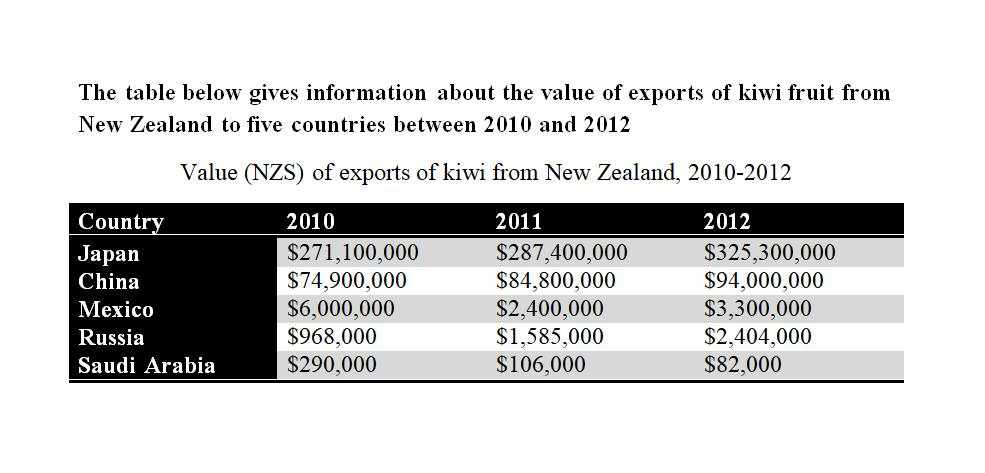
The given table organises the export value of Kiwis sent from New Zealand to five other countries in 2010, 2011, and 2012. The most striking feature of the graph is the overall numbers for Japan, which increased the most and were highest overall by far. Both China and Russia increased their imports and were second and fourth, respectively, while Mexico and Saudi Arabia’s export value declined, with Saudi Arabia importing the least by a significant margin.
Looking first at the countries that increased, Japan led the way going from $271,100,000 in 2010 to $287,400,000 before a surge to $325,300,000 by the end of the period. China showed a similar growth pattern increasing by approximately $10,000,000 a year to end at $94,000,000. Russia imported less, starting under a million at $968,000, nearly doubling to $1,585,000 and importing $2,494,000 worth of Kiwis by 2012.
In contrast, Mexican imports stood at $6,000,000 before falling by more than half to $2,400,000, and then recovering slightly to $3,300,000. Saudia Arabia fell more steadily ($290,000 to $106,000 and finally $82,000).
Word Count: 174
Analysis
1. The given table organises the export value of Kiwis sent from New Zealand to five other countries in 2010, 2011, and 2012. 2. The most striking feature of the graph is the overall numbers for Japan, which increased the most and were highest overall by far. 3. Both China and Russia increased their imports and were second and fourth, respectively, while Mexico and Saudi Arabia’s export value declined, with Saudi Arabia importing the least by a significant margin.
Paraphrase what the graph shows for your first sentence – write it short and simple!
For a table, pick out the biggest area/areas and say whether or not they increased/decreased and if they were the highest overall.
Include all categories in your overview – did they increase or decrease? That is most important. Read more about the mistake 99% of students make with overviews for tables here.
1. Looking first at the countries that increased, Japan led the way going from $271,100,000 in 2010 to $287,400,000 before a surge to $325,300,000 by the end of the period. 2. China showed a similar growth pattern increasing by approximately $10,000,000 a year to end at $94,000,000. 3. Russia imported less, starting under a million at $968,000, nearly doubling to $1,585,000 and importing $2,494,000 worth of Kiwis by 2012.
Begin talking about one area of the table. I group together the countries with increasing imports.
Compare one country to another – notice that I say they had similar growth patterns.
Make sure that you include all date, for all countries (sometimes you may need to group countries or data togethe with more complex tables/graphs).
1. In contrast, Mexican imports stood at $6,000,000 before falling by more than half to $2,400,000, and then recovering slightly to $3,300,000. 2. Saudia Arabia fell more steadily ($290,000 to $106,000 and finally $82,000).
In this paragraph I describe the two countries with declining imports.
Use parenthesis ( … ) sometimes so that your writing doesn’t get too repetitive.
Vocabulary
Can you think of a synonym for each of the words in bold below?
The given table organises the export value of Kiwis sent from New Zealand to five other countries in 2010, 2011, and 2012. The most striking feature of the graph is the overall numbers for Japan, which increased the most and were highest overall by far. Both China and Russia increased their imports and were second and fourth, respectively, while Mexico and Saudi Arabia’s export value declined, with Saudi Arabia importing the least by a significant margin.
Looking first at the countries that increased, Japan led the way going from $271,100,000 in 2010 to $287,400,000 before a surge to $325,300,000 by the end of the period. China showed a similar growth pattern increasing by approximately $10,000,000 a year to end at $94,000,000. Russia imported less, starting under a million at $968,000, nearly doubling to $1,585,000 and importing $2,494,000 worth of Kiwis by 2012.
In contrast, Mexican imports stood at $6,000,000 before falling by more than half to $2,400,000, and then recovering slightly to $3,300,000. Saudia Arabia fell more steadily ($290,000 to $106,000 and finally $82,000).
Answers
given presented
most striking feature what stands out the most
increased the most went up a lot
highest overall by far took up the largest proportion
respectively in turn
the least the lowest amount
by a significant margin by a lot
looking first at firstly
surge increase a lot
end of the period where the table finishes
similar growth pattern same increasing trend
end at finish at
nearly doubling increasing by nearly 100%
in contrast however
stood at was at
falling by more than half decreasing by over 50%
recovering slightly increasing a little
fell more steadily decreased at the same intervals
The _____________ table organises the export value of Kiwis sent from New Zealand to five other countries in 2010, 2011, and 2012. The _____________ of the graph is the overall numbers for Japan, which _____________ and were _____________. Both China and Russia increased their imports and were second and fourth, _____________, while Mexico and Saudi Arabia’s export value declined, with Saudi Arabia importing __________________________.
_____________ the countries that increased, Japan led the way going from $271,100,000 in 2010 to $287,400,000 before a _____________ to $325,300,000 by the _____________. China showed a _____________ increasing by approximately $10,000,000 a year to _____________ $94,000,000. Russia imported less, starting under a million at $968,000, _____________ to $1,585,000 and importing $2,494,000 worth of Kiwis by 2012.
_____________, Mexican imports _____________ $6,000,000 before _____________ to $2,400,000, and then _____________ to $3,300,000. Saudia Arabia _____________ ($290,000 to $106,000 and finally $82,000).
"The highest quality materials anywhere on the internet! Dave improved my writing and vocabulary so much. Really affordable options you don't want to miss out on!"