The increasing availability of low-cost airlines now lets people travel around the world. Some feel this is a positive development while others think it is negative overall.
Discuss both sides and give your own opinion.
The rise of low-cost airlines has made it possible for the public at large to travel abroad with relative ease. In my opinion, despite the advantages this creates for less affluent citizens, it is a net negative given the repercussions of the tourist industry to local nations.
One positive aspect of this development is the increased accessibility of travel. In the past, air travel was mainly reserved for the wealthy and the middle class, however, with the advent of low-cost airlines, even those on a more limited budget can afford to go on vacation domestically or to foreign countries. For example, a round-trip flight from London to Barcelona can now be purchased for as little as £20, making it possible for even students and young adults to explore new places. This equitable phenomenon is particularly valuable in less developed nations where in past generations only the truly wealthy could afford to travel regularly.
Nonetheless, the expansion of low-cost airlines has also led to issues of overcrowding and overtourism in certain destinations. For example, locales like Ha Long Bay in Vietnam and Boracay in the Philippines have struggled to cope with the influx of domestic and international tourists, leading to concerns about the impact on local communities and cultural heritage. Many of these communities now almost exclusively cater to tourism and there is less interest in older means of making a living, such as by producing a local handicraft or traditional garment. This has led to calls for more sustainable tourism practices and greater regulation of the industry to ensure that it benefits and sustains local communities.
In conclusion, although increased accessibility is an equitable development, it has also contributed to issues of overcrowding and overtourism. It is important for the aviation industry and governments to collaborate to address these negative impacts while continuing to make travel available to a wider range of residents.
Analysis
1. The rise of low-cost airlines has made it possible for the public at large to travel abroad with relative ease. 2. In my opinion, despite the advantages this creates for less affluent citizens, it is a net negative given the repercussions of the tourist industry to local nations.
Paraphrase the overall essay topic.
Write a clear opinion. Read more about introductions here.
1. One positive aspect of this development is the increased accessibility of travel. 2. In the past, air travel was mainly reserved for the wealthy and the middle class, however, with the advent of low-cost airlines, even those on a more limited budget can afford to go on vacation domestically or to foreign countries. 3. For example, a round-trip flight from London to Barcelona can now be purchased for as little as £20, making it possible for even students and young adults to explore new places. 4. This equitable phenomenon is particularly valuable in less developed nations where in past generations only the truly wealthy could afford to travel regularly.
Write a topic sentence with a clear main idea at the end.
Explain your main idea.
Develop it with specific or hypothetical examples.
Keep developing it fully.
1. Nonetheless, the expansion of low-cost airlines has also led to issues of overcrowding and overtourism in certain destinations. 2. For example, locales like Ha Long Bay in Vietnam and Boracay in the Philippines have struggled to cope with the influx of domestic and international tourists, leading to concerns about the impact on local communities and cultural heritage. 3. Many of these communities now almost exclusively cater to tourism and there is less interest in older means of making a living, such as by producing a local handicraft or traditional garment. 4. This has led to calls for more sustainable tourism practices and greater regulation of the industry to ensure that it benefits and sustains local communities.
Write a new topic sentence with a new main idea at the end.
Explain your new main idea.
Include specific details and examples.
Add as much information as you can and make sure it links logically.
1. In conclusion, although increased accessibility is an equitable development, it has also contributed to issues of overcrowding and overtourism. 2. It is important for the aviation industry and governments to collaborate to address these negative impacts while continuing to make travel available to a wider range of residents.
Summarise your main ideas.
Include a final thought. Read more about conclusions here.
Vocabulary
What do the words in bold below mean?Make some notes on paper to aid memory and then check below.
The rise of low-cost airlines has made it possible for the public at large to travel abroad with relative ease. In my opinion, despite the advantages this creates for less affluent citizens, it is a net negative given the repercussions of the tourist industry to local nations.
One positive aspect of this development is the increased accessibility of travel. In the past, air travel was mainly reserved for the wealthy and the middle class, however, with the advent of low-cost airlines, even those on a more limited budget can afford to go on vacation domestically or to foreign countries. For example, a round-trip flight from London to Barcelona can now be purchased for as little as £20, making it possible for even students and young adults to explore new places. This equitable phenomenon is particularly valuable in less developed nations where in past generations only the truly wealthy could afford to travel regularly.
Nonetheless, the expansion of low-cost airlines has also led to issues of overcrowding and overtourism in certain destinations. For example, locales like Ha Long Bay in Vietnam and Boracay in the Philippines have struggled to cope with the influx of domestic and international tourists, leading to concerns about the impact on local communities and cultural heritage. Many of these communities now almost exclusively cater to tourism and there is less interest in older means of making a living, such as by producing a local handicraft or traditional garment. This has led to calls for more sustainable tourism practices and greater regulation of the industry to ensure that it benefits and sustains local communities.
In conclusion, although increased accessibility is an equitable development, it has also contributed to issues of overcrowding and overtourism. It is important for the aviation industry and governments to collaborate to address these negative impacts while continuing to make travel available to a wider range of residents.
Answers
For extra practice, write an antonym (opposite word) on a piece of paper to help you remember the new vocabulary:
rise of low-cost airlines increase in the number of cheap flights
made it possible for allow for
public at large people in general
travel abroad with relative ease go to other countries easily
despite regardless of
less affluent citizens poorer people
net negative given the repercussions of bad overall because of the effects on
tourist industry to local nations hotels, restaurants, etc. to other countries
One positive aspect of this development is a good part of this trend is
increased accessibility of travel easier to travel around
In the past before
mainly reserved for the wealthy and the middle class mostly only for rich people
advent beginning
more limited budget can afford not as much money can pay for
vacation domestically or to foreign countries holiday in the country to go abroad
round-trip flight from … to … back and forth flight to … and …
purchased for as little as bought for very little
making it possible for allowing for
explore new places finding new locations
equitable phenomenon is particularly valuable equal situation is especially important
where in past generations in the past
truly wealthy very rich people
regularly usually, often
Nonetheless however
expansion growing
overcrowding too many people there
overtourism in certain destinations too many people visiting some places
locales places
struggled to cope with the influx of domestic and international tourists had a tough time dealing with all the people coming there
leading to concerns about causing issues related to
local communities places nearby
cultural heritage your art, food, clothes, etc.
exclusively cater to only serve
less interest in not as much care for
means of making a living way of earning money
producing a local handicraft or traditional garment making an object or clothes
led to calls for created people asking for
sustainable tourism practices long-term tourist industry
greater regulation of more control over
ensure make sure of
sustains local communities keeps communities alive
although increased accessibility is however more access is
equitable development equal situation
contributed to issues of overcrowding and overtourism added to problems related to too many people and tourists
aviation industry flights
collaborate work with
negative impacts bad effects
make travel available to a wider range of residents allow for more average people to travel
I recommend getting a pencil and piece of paper because that aids memory. Then write down the missing vocabulary from my sample answer in your notebook:
The r____________________________s has m____________________r the p___________e to t_____________________________e. In my opinion, d_______e the advantages this creates for l_____________________s, it is a n___________________________________f the t_______________________________s.
O______________________________________________s the i________________________________l. I____________t, air travel was m_____________________________________________________s, however, with the a________t of low-cost airlines, even those on a m___________________________________d to go on v______________________________________s. For example, a r______________________m London t___ Barcelona can now be p_________________________________s £20, m_______________________r even students and young adults to e___________________________s. This e____________________________e in less developed nations w______________________________s only the t_______________y could afford to travel r__________y.
N______________s, the e_____________n of low-cost airlines has also led to issues of o____________g and o____________________________________s. For example, l________s like Ha Long Bay in Vietnam and Boracay in the Philippines have s______________________________________________________________s, l__________________________t the impact on l___________________s and c_______________e. Many of these communities now almost e_________________o tourism and there is l______________n older m_______________________g, such as by p__________________________________________________________t. This has l___________________r more s_________________________________s and g___________________f the industry to e_________e that it benefits and s__________________________s.
In conclusion, a___________________________________s an e_________________________t, it has also c____________________________________________m. It is important for the a________________y and governments to c________________e to address these n________________s while continuing to m__________________________________________________s.
Listening Practice
Learn more about this topic by watching from YouTube below and practice with these activities:
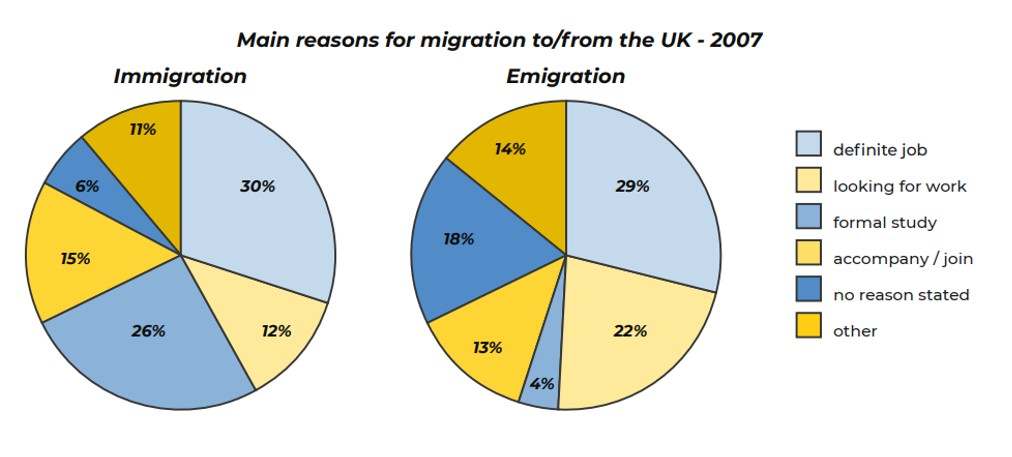
The pie charts detail the rationales for immigration to and emigration from the UK in 2007. Looking from an overall perspective, it is readily apparent that immigration was mainly related to various kinds of work, study, and accompanying someone, with no reasons stated and other less typical. Emigration was similarly focused on work (non-definite work being more prevalent) but formal study was a less likely reason and less defined reasons were more common.
In terms of study and work, 30% of immigrants came to the UK for definite jobs, just 1% above the number emigrating for the same purpose. The disparity regarding looking for work was greater (12% for immigration and 22% for emigration) and even more significant concerning formal study (26% immigrating and just 4% emigrating for school).
There was relative alignment for other reasons with 11% immigrating with another purpose and 14% emigrating, comparable to the figures for accompanying another person (15% and 13%, respectively). Finally, only 6% of individuals immigrate to the United Kingdom without a reason, while three times this figure emigrate lacking a stated purpose.
Analysis
1. The pie charts detail the rationales for immigration to and emigration from the UK in 2007. 2. Looking from an overall perspective, it is readily apparent that immigration was mainly related to various kinds of work, study, and accompanying someone, with no reasons stated and other less typical. 3. Emigration was similarly focused on work (non-definite work being more prevalent) but formal study was a less likely reason and less defined reasons were more common.
Paraphrase what the bar chart shows.
Write a clear overview summarising the differences and the overall trend.
This one is a little complex so it needs a second sentence for the overview.
1. In terms of study and work, 30% of immigrants came to the UK for definite jobs, just 1% above the number emigrating for the same purpose. 2. The disparity regarding looking for work was greater (12% for immigration and 22% for emigration) and even more significant concerning formal study (26% immigrating and just 4% emigrating for school).
Begin writing about the data for the first categories.
Compare between each sentence.
1. There was relative alignment for other reasons with 11% immigrating with another purpose and 14% emigrating, comparable to the figures for accompanying another person (15% and 13%, respectively). 2. Finally, only 6% of individuals immigrate to the United Kingdom without a reason, while three times this figure emigrate lacking a stated purpose.
Write about the final other parts of the graph – include everything!
Compare the categories.
Vocabulary
What do the words in bold below mean?Make some notes on paper to aid memory and then check below.
The pie charts detail the rationales for immigration to and emigration from the UK in 2007. Looking from an overall perspective, it is readily apparent that immigration was mainly related tovarious kinds of work, study, and accompanying someone, with no reasons stated and other less typical. Emigration was similarly focused on work (non-definite work being more prevalent) but formal study was a less likely reason and less defined reasons were more common.
In terms of study and work, 30% of immigrants came to the UK for definite jobs, just 1% above the number emigrating for the same purpose. The disparity regarding looking for work was greater (12% for immigration and 22% for emigration) and even more significantconcerning formal study (26% immigrating and just 4% emigrating for school).
There was relative alignment for other reasons with 11% immigrating with another purpose and 14% emigrating, comparable to the figures for accompanying another person (15% and 13%, respectively). Finally, only 6% of individuals immigrate to the United Kingdom without a reason, while three times this figure emigrate lacking a stated purpose.
Answers
For extra practice, write an antonym (opposite word) on a piece of paper to help you remember the new vocabulary:
detail show
rationales for reasons for
immigration to and emigration from people moving to and away from
Looking from an overall perspective, it is readily apparent that overall
mainly related tovarious kinds of mostly having to do with different types of
accompanying going with someone
no reasons stated didn’t say why
less typical not as common
similarly focused on also cared about
non-definite not clear
more prevalent more common
formal study university
less defined reasons not as clear reasons
common prevalent
In terms of concerning
immigrants people moving to a country
just a little
above over
for the same purpose the same reason
disparity regarding difference concerning
greater more
even more significantconcerning more important having to do with
I recommend getting a pencil and piece of paper because that aids memory. Then write down the missing vocabulary from my sample answer in your notebook:
The pie charts d______l the r________________r i______________________________m the UK in 2007. L___________________________________________________________________t immigration was m_____________________________________f work, study, and a___________g someone, with n______________d and other l____________l. Emigration was s_________________n work (n______________e work being m______________t) but f___________y was a less likely reason and l_________________s were more c__________n.
I__________f study and work, 30% of i_____________s came to the UK for definite jobs, j____t 1% a____e the number emigrating f______________________e. The d_____________________g looking for work was g_______r (12% for immigration and 22% for emigration) and e______________________________g formal study (26% immigrating and just 4% emigrating for school).
There was r______________________r other reasons with 11% immigrating with another purpose and 14% emigrating, c___________________________r accompanying another person (15% and 13%, r_____________y). Finally, only 6% of individuals immigrate to the United Kingdom without a reason, while t________________________e emigrate l________________________e.
Listening Practice
Learn more about this topic by watching from YouTube below and practice with these activities:
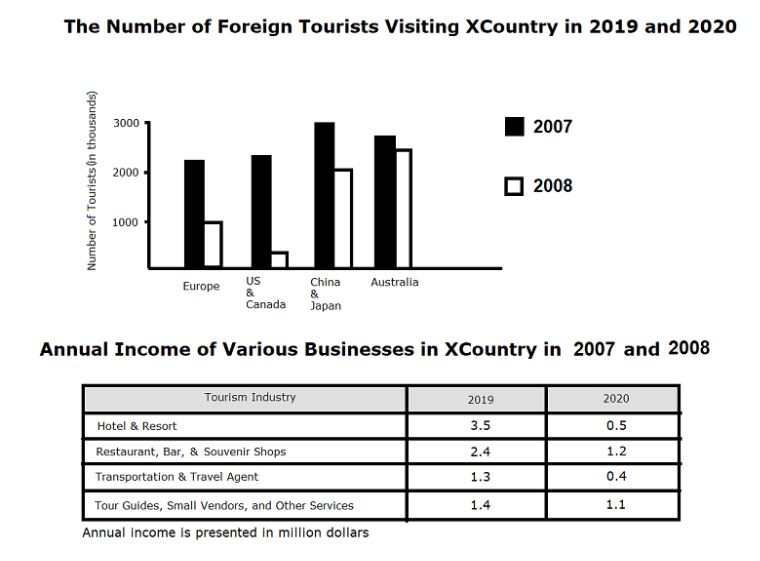
The bar chart details the number of tourists visiting Country X from various parts of the world and the table delineates the income of different businesses in the nation in 2007 and 2008. Overall, tourism from all regions of the world declined, though less noticeably when coming from the main sources of tourists: China, Japan, and Australia. All forms of revenue also fell, with shops and tour services accounting for the majority of revenue by 2008.
In 2007, there were over 200,000 tourists from Europe and the US and Canada, with the North American nations slightly higher. By 2008, both figures had dropped dramatically to 100,000 for the former and approximately 250,000 for the latter. In contrast, the data points for China and Japan began the period much higher (nearly 300,000) and fell less significantly (200,000). Similarly, Australian tourists numbered 275,000 in 2007 and had declined marginally to 250,000 by the following year.
In terms of income in Country X, in 2019 hotels and resorts earned 3.5 million dollars, considerably more than restaurants, bars, and souvenir shops (2.4), transportation and travel agents (1.3), and tour guides, small vendors and other services (1.4). By 2008, hotels and resorts had plunged to just $.5 million, dining options had halved to $1.2 million, and transportation had reduced to $.4 million. The most marginal decline was for tour services ($1.1 million).
Analysis
1. The bar chart details the number of tourists visiting Country X from various parts of the world and the table delineates the income of different businesses in the nation in 2007 and 2008. 2. Overall, tourism from all regions of the world declined, though less noticeably when coming from the main sources of tourists: China, Japan, and Australia. 3. All forms of revenue also fell, with shops and tour services accounting for the majority of revenue by 2008.
Paraphrase what the bar chart shows.
Write a clear overview summarising the differences and the overall trend.
This one is a little complex so it needs a second sentence for the overview.
1. In 2007, there were over 200,000 tourists from Europe and the US and Canada, with the North American nations slightly higher. 2. By 2008, both figures had dropped dramatically to 100,000 for the former and approximately 250,000 for the latter. 3. In contrast, the data points for China and Japan began the period much higher (nearly 300,000) and fell less significantly (200,000). 4. Similarly, Australian tourists numbered 275,000 in 2007 and had declined marginally to 250,000 by the following year.
Begin writing about the data for the first categories.
Compare between each sentence.
One paragraph can be longer than the other.
This one is a bit long…
1. In terms of income in Country X, in 2019 hotels and resorts earned 3.5 million dollars, considerably more than restaurants, bars, and souvenir shops (2.4), transportation and travel agents (1.3), and tour guides, small vendors and other services (1.4). 2. By 2008, hotels and resorts had plunged to just $.5 million, dining options had halved to $1.2 million, and transportation had reduced to $.4 million. 3. The most marginal decline was for tour services ($1.1 million).
Write about the final other parts of the graph – include everything!
Compare the categories.
Add as much detail as possible.
Vocabulary
What do the words in bold below mean?Make some notes on paper to aid memory and then check below.
The bar chart details the number of tourists visiting Country X from various parts of the world and the table delineates the income of different businesses in the nation in 2007 and 2008. Overall, tourism from all regions of the world declined, though less noticeably when coming from the main sources of tourists: China, Japan, and Australia. All forms of revenue also fell, with shops and tour services accounting for the majority of revenue by 2008.
In 2007, there were over 200,000 tourists from Europe and the US and Canada, with the North American nations slightly higher. By 2008, both figures had dropped dramatically to 100,000 for the former and approximately 250,000 for the latter. In contrast, the data points for China and Japan began the period much higher (nearly 300,000) and fell less significantly (200,000). Similarly, Australian tourists numbered 275,000 in 2007 and had declined marginally to 250,000 by the following year.
In terms of income in Country X, in 2019 hotels and resorts earned 3.5 million dollars, considerably more than restaurants, bars, and souvenir shops (2.4), transportation and travel agents (1.3), and tour guides, small vendors and other services (1.4). By 2008, hotels and resorts had plunged tojust $.5 million, dining options had halved to $1.2 million, and transportation had reduced to $.4 million. The most marginal decline was for tour services ($1.1 million).
Answers
For extra practice, write an antonym (opposite word) on a piece of paper to help you remember the new vocabulary:
details shows
various parts of the world different areas globally
delineates shows
income amount of money earned
businesses shops, companies, etc.
nation country
Overall in general
declined went down
though less noticeably but not as much
main sources of tourists primary place visitors came from
All forms of revenue also fell different types of earning money went down too
accounting for the majority of revenue by representing most of the money made by
over higher than
North American nations slightly higher countries near America just about that
had dropped dramatically to had fallen a lot to
the former mentioned first
approximately about
the lattermentioned second
In contrast however
data points numbers
began the period much higher started at a higher point
I recommend getting a pencil and piece of paper because that aids memory. Then write down the missing vocabulary from my sample answer in your notebook:
The bar chart d________s the number of tourists visiting Country X from v________________________d and the table d__________s the i_______e of different b_______________s in the n________n in 2007 and 2008. O______l, tourism from all regions of the world d___________d, t__________________y when coming from the m______________________________s: China, Japan, and Australia. A___________________________l, with shops and tour services a_______________________________________y 2008.
In 2007, there were o___r 200,000 tourists from Europe and the US and Canada, with the N_____________________________r. By 2008, both figures h_______________________o 100,000 for t__________r and a_______________y 250,000 for t_________r. I_____________t, the d___________s for China and Japan b______________________________r (nearly 300,000) and f_____________________y (200,000). S________y, Australian tourists n__________d 275,000 in 2007 and h_________________________________o 250,000 b_____________________r.
I_______________f income in Country X, in 2019 hotels and resorts e______d 3.5 million dollars, c_____________y more than restaurants, bars, and souvenir shops (2.4), transportation and travel agents (1.3), and tour guides, small vendors and other services (1.4). By 2008, hotels and resorts h_____________________t $.5 million, dining options h_____________o $1.2 million, and transportation h________________o $.4 million. The m_______________________e was for tour services ($1.1 million).
Listening Practice
Learn more about this topic by watching from YouTube below and practice with these activities:
In some countries today, children are taught from a young age that competition is important and that winning is everything.
Is this a positive or a negative development?
In some cultures, competition is viewed as an essential part of personal and professional growth, and children are taught from an early age to win. While this approach may have motivational advantages, the drawbacks for morality are concerning.
Firstly, competition can inspire children to strive for excellence. For example, in many Asian countries such as Vietnam and China, academic competition is highly valued and students often participate in national and international competitions to demonstrate their superiority. The National Science Olympiad in China is a prime example of this, with over 4 million students competing for a chance to represent their country in international competitions. Through this process, students learn how to set goals, manage their time effectively, and think critically, all of which are valuable skills for success in the 21st century.
Moreover, a culture of competition can oftentimes lead to a disregard for ethical behavior and foster interpersonal hostility. An illustrative instance of this can be seen in the recent college admissions scandal in the United States, where wealthy parents paid bribes to secure their children’s admission to elite universities. These parents were more concerned with their children’s success and prestige than with their future character, and their actions sent a message that cheating is acceptable as long as it is not discovered. Such behavior can have negative consequences in the long-term, as children may grow up with a skewed sense of values and priorities and a desire to win unconditionally, leading to aggressive behavior and a lack of principles.
In conclusion, while competition can be a powerful motivator for some children, the disadvantages overshadow the benefits. It is important to maintain a balance between fostering a healthy sense of ambition and creating an environment that is supportive, collaborative, and respectful.
Analysis
1. In some cultures, competition is viewed as an essential part of personal and professional growth, and children are taught from an early age to win. 2. While this approach may have motivational advantages, the drawbacks for morality are concerning.
Paraphrase the overall essay topic.
Write a clear opinion. Read more about introductions here.
1. Firstly, competition can inspire children to strive for excellence. 2. For example, in many Asian countries such as Vietnam and China, academic competition is highly valued and students often participate in national and international competitions to demonstrate their superiority. 3. The National Science Olympiad in China is a prime example of this, with over 4 million students competing for a chance to represent their country in international competitions. 4. Through this process, students learn how to set goals, manage their time effectively, and think critically, all of which are valuable skills for success in the 21st century.
Write a topic sentence with a clear main idea at the end.
Explain your main idea.
Develop it with specific or hypothetical examples.
Keep developing it fully.
Make sure your examples are specific
1. Moreover, a culture of competition can oftentimes lead to a disregard for ethical behavior and foster interpersonal hostility. 2. An illustrative instance of this can be seen in the recent college admissions scandal in the United States, where wealthy parents paid bribes to secure their children’s admission to elite universities. 3. These parents were more concerned with their children’s success and prestige than with their future character, and their actions sent a message that cheating is acceptable as long as it is not discovered. 4. Such behavior can have negative consequences in the long-term, as children may grow up with a skewed sense of values and priorities and a desire to win unconditionally, leading to aggressive behavior and a lack of principles.
Write a new topic sentence with a new main idea at the end.
Explain your new main idea.
Include specific details and examples.
Add as much information as you can and make sure it links logically.
1. In conclusion, while competition can be a powerful motivator for some children, the disadvantages overshadow the benefits. 2. It is important to maintain a balance between fostering a healthy sense of ambition and creating an environment that is supportive, collaborative, and respectful.
Summarise your main ideas.
Include a final thought. Read more about conclusions here.
Vocabulary
What do the words in bold below mean?Make some notes on paper to aid memory and then check below.
In some cultures, competition is viewed as an essential part of personal and professional growth, and children are taught from an early age to win. While this approach may have motivational advantages, the drawbacks for morality are concerning.
Firstly, competition can inspire children to strive for excellence. For example, in many Asian countries such as Vietnam and China, academic competition is highly valued and students often participate in national and international competitions to demonstrate their superiority. The National Science Olympiad in China is a prime example of this, with over 4 million students competing for a chance to represent their country in international competitions. Through this process, students learn how to set goals, manage their time effectively, and think critically, all of which are valuable skills for success in the 21st century.
Moreover, a culture of competition can oftentimes lead to a disregard for ethical behavior and foster interpersonal hostility. An illustrative instance of this can be seen in the recent college admissions scandal in the United States, where wealthy parents paid bribes to secure their children’s admission to elite universities. These parents were more concerned with their children’s success and prestige than with their future character, and their actions sent a message that cheating is acceptable as long as it is not discovered. Such behavior can have negative consequences in the long-term, as children may grow up with a skewed sense of values and priorities and a desire to win unconditionally, leading to aggressive behavior and a lack of principles.
In conclusion, while competition can be a powerful motivator for some children, the disadvantages overshadow the benefits. It is important to maintain a balance between fostering a healthy sense of ambition and creating an environment that is supportive, collaborative, and respectful.
Answers
For extra practice, write an antonym (opposite word) on a piece of paper to help you remember the new vocabulary:
In some cultures in many nations
competition rivalry
viewed as seen as
essential part of personal and professional growth necessary element for growth in both personal and professional spheres
taught from an early age instilled from a young age
win succeed
While this approach may have motivational advantages Although this method may offer motivational benefits
drawbacks disadvantages
morality ethics
concerning having to do with
inspire motivate
strive for excellence try really hard
academic competition is highly valued scholastic competition is highly esteemed
participate in national and international competitions take part in national and international contests
demonstrate show
superiority being better than
prime example good instance of
competing for a chance to represent their country in international competitions contending for the chance to take part in international contests on behalf of their country
set goals establish objectives
manage their time effectively utilize their time efficiently
think critically analyze thoughtfully
valuable skills for success in the 21st century crucial abilities for achievement in the 21st century
oftentimes lead to frequently result in
disregard ignore
ethical behavior moral conduct
foster interpersonal hostility breed hostility among people
An illustrative instance of this can be seen in A case in point can be observed in
recent college admissions scandal in the United States people in the USA trying to unfairly get into universities
wealthy rich
paid bribes corruption
secure make sure of
elite universities the best schools
concerned with cared about
success achievement
prestige status
future character personality later on
actions sent a message what they did communicated that
acceptable permissible
discovered found out
negative consequences in the long-term harmful repercussions in the long haul
skewed sense of values and priorities distorted sense of what is important in life
I recommend getting a pencil and piece of paper because that aids memory. Then write down the missing vocabulary from my sample answer in your notebook:
I______________________s, c_____________n is v__________s an e_____________________________________________________h, and children are t____________________e to w__n. W_____________________________________________________s, the d________s for m_______y are c_______g.
Firstly, competition can i_________e children to s______________e. For example, in many Asian countries such as Vietnam and China, a________________________________d and students often p__________________________________________s to d____________e their s_________y. The National Science Olympiad in China is a ____________e of this, with over 4 million students c__________________________________________________________________s. Through this process, students learn how to s_______s, m____________________y, and t_____________y, all of which are v______________________________________y.
Moreover, a culture of competition can o_________________o a d_________d for e__________________r and f___________________________________y. A______________________________________n the r________________________________________________s, where w_______y parents p___________s to s_______e their children’s admission to e____________________s. These parents were more c____________________h their children’s s________s and p_________e than with their f_____________r, and their a__________________e that cheating is a______________e as long as it is not d__________d. Such behavior can have n______________________________________________m, as children may grow up with a s____________________________s and a desire to w________________________y, leading to a___________e behavior and a__________________s.
In conclusion, while competition can be a p_____________________r some children, the disadvantages o_____________w the benefits. It is important to m_____________e between fostering a_____________________________n and creating an environment that is s___________e, c____________e, and r___________l.
Listening Practice
Learn more about this topic by watching from YouTube below and practice with these activities:
In recent years, there has been a significant increase in the number of oil drilling operations in remote locations around the world. This has brought economic benefits to some countries, though it has also raised concerns about the environmental impact of these operations.
Discuss both sides and give your own opinion.
There is ongoing debate about whether or not nations should drill for oil in remote locations. While some argue that it is necessary to meet our ever-increasing energy demands, I would side with those who contend that the potential environmental damage to local communities outweighs any economic benefits.
On the one hand, drilling for oil in remote locations can facilitate energy production. For example, the Arctic National Wildlife Refuge in Alaska is estimated to contain up to 12 billion barrels of oil, which could help to reduce America’s dependence on foreign oil. Other nations have similar reserves that can meet pressing demands for the average person. The drilling operations in these remote locations will simultaneously create jobs and stimulate economic growth in the surrounding area. As economic conditions improve, energy needs will concomitantly rise and increased drilling can potentially create a cycle that benefits both locals and a given country at large.
On the other hand, drilling for oil in remote locations has significant environmental consequences. The process of extracting oil can lead to the release of greenhouse gases and other harmful pollutants into the atmosphere, contributing to climate change. For instance, the Canadian oil sands, which are located in unpopulated areas of Alberta, are one of the largest sources of greenhouse gas emissions in the world. Relatedly, drilling can have negative effects on the health and wellbeing of nearby communities, particularly indigenous populations. In the above-mentioned example, some of the oil has been extracted through the controversial practice of fracking which contaminates local water supplies where native population rates are high.
In conclusion, while drilling for oil in remote locations may provide temporary economic benefits, the long-term costs to the environment and local communities are too significant. Instead, governments should prioritize the development of sustainable energy sources that will help to ensure a cleaner, healthier future for all.
Analysis
1. There is ongoing debate about whether or not nations should drill for oil in remote locations. 2. While some argue that it is necessary to meet our ever-increasing energy demands, I would side with those who contend that the potential environmental damage to local communities outweighs any economic benefits.
Paraphrase the overall essay topic.
Write a clear opinion. Read more about introductions here.
1. On the one hand, drilling for oil in remote locations can facilitate energy production. 2. For example, the Arctic National Wildlife Refuge in Alaska is estimated to contain up to 12 billion barrels of oil, which could help to reduce America’s dependence on foreign oil. 3. Other nations have similar reserves that can meet pressing demands for the average person. 4. The drilling operations in these remote locations will simultaneously create jobs and stimulate economic growth in the surrounding area. 5. As economic conditions improve, energy needs will concomitantly rise and increased drilling can potentially create a cycle that benefits both locals and a given country at large.
Write a topic sentence with a clear main idea at the end.
Explain your main idea.
Develop it with specific or hypothetical examples.
Keep developing it fully.
Make sure your examples are specific.
And you fully detail the results.
1. On the other hand, drilling for oil in remote locations has significant environmental consequences. 2. The process of extracting oil can lead to the release of greenhouse gases and other harmful pollutants into the atmosphere, contributing to climate change. 3. For instance, the Canadian oil sands, which are located in unpopulated areas of Alberta, are one of the largest sources of greenhouse gas emissions in the world. 4. Relatedly, drilling can have negative effects on the health and wellbeing of nearby communities, particularly indigenous populations. 5. In the above-mentioned example, some of the oil has been extracted through the controversial practice of fracking which contaminates local water supplies where native population rates are high.
Write a new topic sentence with a new main idea at the end.
Explain your new main idea.
Include specific details and examples.
Add as much information as you can and make sure it links logically.
Finish the paragraph strong.
1. In conclusion, while drilling for oil in remote locations may provide temporary economic benefits, the long-term costs to the environment and local communities are too significant. 2. Instead, governments should prioritize the development of sustainable energy sources that will help to ensure a cleaner, healthier future for all.
Summarise your main ideas.
Include a final thought. Read more about conclusions here.
Vocabulary
What do the words in bold below mean?Make some notes on paper to aid memory and then check below.
There is ongoing debate about whether or not nations should drill for oil in remote locations. While some argue that it is necessary to meet our ever-increasing energy demands, I would side with those who contend that the potential environmental damage to local communities outweighs any economic benefits.
On the one hand, drilling for oil in remote locations can facilitate energy production. For example, the Arctic National Wildlife Refuge in Alaska is estimated to contain up to 12 billion barrels of oil, which could help to reduce America’s dependence on foreign oil. Other nations have similar reserves that can meet pressing demands for the average person. The drilling operations in these remote locations will simultaneously create jobs and stimulate economic growth in the surrounding area. As economic conditions improve, energy needs will concomitantly rise and increased drilling can potentially create a cycle that benefits both locals and a given country at large.
On the other hand, drilling for oil in remote locations has significant environmental consequences. The process of extracting oil can lead to the release of greenhouse gases and other harmful pollutants into the atmosphere, contributing to climate change. For instance, the Canadian oil sands, which are located in unpopulated areas of Alberta, are one of the largest sources of greenhouse gas emissions in the world. Relatedly, drilling can have negative effects on the health and wellbeing of nearby communities, particularly indigenous populations. In the above-mentioned example, some of the oil has been extracted through the controversial practice of fracking which contaminates local water supplies where native population rates are high.
In conclusion, while drilling for oil in remote locations may provide temporary economic benefits, the long-term costs to the environment and local communities are too significant. Instead, governments should prioritize the development of sustainable energy sources that will help to ensure a cleaner, healthier future for all.
Answers
For extra practice, write an antonym (opposite word) on a piece of paper to help you remember the new vocabulary:
There is ongoing debate about whether or not many people are wondering about if
drill for oil get fuel out of the ground
remote locations far away places
necessary needed
meet our ever-increasing energy demands satisfy the need for more fuel
I would side with those who contend that I agree with the people who say that
potential environmental damage to local communities outweighs possibly hurting nature and people are more significant
economic benefits helping the economy
facilitate energy production help make more energy
estimated to contain up to likely holds
reduce America’s dependence on foreign oil lower need for imported oil
similar reserves comparable deposits
meet pressing demands for the average person fulfill urgent needs of everyday people
drilling operations oil extraction procedures
simultaneously at the same time
stimulate economic growth in the surrounding area foster economic advancement in the neighboring region
As economic conditions improve with an enhancement in the economy
concomitantly rise increase simultaneously
potentially create a cycle could lead to a pattern
benefits advantages
a given country at large the entire nation
significant environmental consequences important environmental effects
The process of extracting oil petroleum retrieval procedure
lead to result in
release of greenhouse gases emission of harmful gases
harmful pollutants detrimental contaminants
atmosphere air
contributing to climate change causing global warming
unpopulated areas deserted regions
largest sources of main origins of
Relatedly similarly
health and wellbeing of nearby communities the welfare of neighboring communities
particularly indigenous populations predominantly original inhabitants
In the above-mentioned example in the earlier mentioned case
extracted through the controversial practice of fracking extracted using the disputed process of fracking
where native population rates are high in areas with elevated indigenous population levels
provide temporary economic benefits supply short-term financial advantages
long-term costs to extended consequences for
Instead as an alternative
prioritize put first
sustainable energy sources eco-friendly energy
ensure a cleaner secure a less polluted
healthier future for all better future for everyone
I recommend getting a pencil and piece of paper because that aids memory. Then write down the missing vocabulary from my sample answer in your notebook:
T______________________________________t nations should d____________l in r_________________s. While some argue that it is n__________y to m___________________________s, I_____________________________________t the p______________________________________________________h any e___________________s.
On the one hand, drilling for oil in remote locations can f______________________n. For example, the Arctic National Wildlife Refuge in Alaska is e________________________o 12 billion barrels of oil, which could help to r____________________________________________l. Other nations have s______________s that can m_______________________________________n. The d____________________s in these remote locations will s___________________y create jobs and s________________________________________a. A__________________________________e, energy needs will c________________e and increased drilling can p__________________________e that b__________s both locals and a______________________________e.
On the other hand, drilling for oil in remote locations has s_____________________________________________s. T__________________________l can l___________o the r___________________________s and other h_________________s into the a_____________e, c_________________________e. For instance, the Canadian oil sands, which are located in u__________________s of Alberta, are one of the l___________________f greenhouse gas emissions in the world. R_________y, drilling can have negative effects on the h______________________________________s, p_____________________________________s. I__________________________e, some of the oil has been e_________________________________________g which contaminates local water supplies w_________________________________________________h.
In conclusion, while drilling for oil in remote locations may p_____________________________________s, the l____________________o the environment and local communities are too significant. I_______d, governments should p___________e the development of s__________________________s that will help to e_________________r, h___________________l.
Listening Practice
Learn more about this topic by watching from YouTube below and practice with these activities:
"The highest quality materials anywhere on the internet! Dave improved my writing and vocabulary so much. Really affordable options you don't want to miss out on!"