Some feel that governments should prioritize healthcare instead of other important areas.
To what extent do you agree or disagree?
In recent years, the issue of whether the government should prioritize funding for healthcare above all other areas has been a topic of debate. I would argue that healthcare should take precedence, as it is a fundamental human right and essential for a healthy and productive population.
Certain interested party contend that there are other areas that are just as important as healthcare. One such area is education. Education is often rightly seen as a key factor in social and economic development. For example, in developing countries, a lack of education can result in high levels of poverty and unemployment. Countries that invest in education have seen the results permeate throughout society, including the well-known examples of Japan after the Second World War and Finland in recent decades. Educational quality can in turn lead to sustained economic growth and higher standards of living for the average citizen.
Despite these valid arguments, I believe that healthcare should still be given priority in terms of state budget allocation. One reason for this is the fact that healthcare is a universal need. Unlike education, which can benefit some people more than others, everyone requires quality healthcare at some point in their lives. For instance, in the United States, the lack of affordable healthcare has resulted in many people from a variety of socioeconomic backgrounds being unable to afford necessary treatments. The consequences of this can be seen in the high number of preventable deaths each year, which could have been avoided if the government had prioritized healthcare funding.
In conclusion, it is clear that healthcare is an essential human right and deserves precedence above other critical areas such as education. Ultimately, the key is to find a sustainable and equitable approach that benefits everyone.
Analysis
1. In recent years, the issue of whether the government should prioritize funding for healthcare above all other areas has been a topic of debate. 2. I would argue that healthcare should take precedence, as it is a fundamental human right and essential for a healthy and productive population.
Paraphrase the overall essay topic.
Write a clear opinion. Read more about introductions here.
1. Certain interested party contend that there are other areas that are just as important as healthcare. 2. One such area is education. 3. Education is often rightly seen as a key factor in social and economic development. 4. For example, in developing countries, a lack of education can result in high levels of poverty and unemployment. 5. Countries that invest in education have seen the results permeate throughout society, including the well-known examples of Japan after the Second World War and Finland in recent decades. 6. Educational quality can in turn lead to sustained economic growth and higher standards of living for the average citizen.
Write a topic sentence with a clear main idea at the end.
Explain your main idea.
Develop it with specific or hypothetical examples.
Keep developing it fully.
Make sure your examples are specific.
And you fully detail the results.
1. Despite these valid arguments, I believe that healthcare should still be given priority in terms of state budget allocation. 2. One reason for this is the fact that healthcare is a universal need. 3. Unlike education, which can benefit some people more than others, everyone requires quality healthcare at some point in their lives. 4. For instance, in the United States, the lack of affordable healthcare has resulted in many people from a variety of socioeconomic backgrounds being unable to afford necessary treatments. 5. The consequences of this can be seen in the high number of preventable deaths each year, which could have been avoided if the government had prioritized healthcare funding.
Write a new topic sentence with a new main idea at the end.
Explain your new main idea.
Include specific details and examples.
Add as much information as you can and make sure it links logically.
Finish the paragraph strong.
1. In conclusion, it is clear that healthcare is an essential human right and deserves precedence above other critical areas such as education. 2. Ultimately, the key is to find a sustainable and equitable approach that benefits everyone.
Summarise your main ideas.
Include a final thought. Read more about conclusions here.
Vocabulary
What do the words in bold below mean?Make some notes on paper to aid memory and then check below.
In recent years, the issue of whether the government should prioritize funding for healthcare above all other areas has been a topic of debate. I would argue that healthcare should take precedence, as it is a fundamental human right and essential for a healthy and productive population.
Certain interested party contend that there are other areas that are just as important as healthcare. One such area is education. Education is often rightly seen as a decisive factor in social and economic development. For example, in developing countries, a lack of education can result in high levels of poverty and unemployment. Countries that invest in education have seen the results permeate throughout society, including the well-known examples of Japan after the Second World War and Finland in recent decades. Educational quality can in turn lead tosustained economic growth and higher standards of living for the average citizen.
Despite these valid arguments, I believe that healthcare should still be given priority in terms of state budget allocation. One reason for this is the fact that healthcare is a universal need. Unlike education, which can benefit some people more than others, everyone requires quality healthcare at some point in their lives. For instance, in the United States, the lack of affordable healthcare has resulted in many people from a variety of socioeconomic backgrounds being unable to afford necessary treatments. The consequences of this can be witnessed in the high number of preventable deaths each year, which could have been avoided if the government had valued healthcare funding appropriately.
In conclusion, it is clear that healthcare is an essential human right and deserves precedence above other critical areas such as education. Ultimately, the key is to find a sustainable and equitable approach that benefits everyone.
Answers
For extra practice, write an antonym (opposite word) on a piece of paper to help you remember the new vocabulary:
In recent years these days
the issue of whether the problem about whether or not
prioritize funding for healthcare above all other areas focus on spending money on hospital and doctors instead of other places to invest in
topic of debate something people argue about
take precedence more important than
fundamental human right basic thing humans deserve
essential crucial
healthy and productive population people working and living well
Certain interested party contend that some argue that
just as important as equally important to
often rightly seen as a decisive factor usually justly the critical element
social and economic development people and the economy getting better
developing countries less wealthy nations
a lack of not having
high levels of poverty and unemployment lots of poor people and people without jobs
invest in put money into
seen the results permeate throughout society the effects impact everyone
including these examples of it
well-known examples famous instances of this
in turn lead tosustained economic growth thus cause better finances
higher standards of living for the average citizen higher quality of life for most people
Despite these valid arguments regardless of these true points
given priority in terms of state budget allocation granted precedence concerning money from the government
One reason for this is once justification is
quality healthcare at some point in their lives good hospital in their lifetime
lack of affordable healthcare no good options for insurance
a variety of socioeconomic backgrounds being unable to afford necessary treatments people from different parts of society can’t pay for procedures at hospitals
consequences results
high number of preventable deaths each year many people dying every year who don’t have to
avoided get around
valued considered important
appropriately well-suited
essential human right basic human need
deserves precedence should be given consideration
critical crucial
Ultimately in the end
key important
sustainable and equitable approach that benefits everyone long-term, fair way that helps every person
I recommend getting a pencil and piece of paper because that aids memory. Then write down the missing vocabulary from my sample answer in your notebook:
I___________________s, t_______________________r the government should p______________________________________________________s has been a t_________________e. I would argue that healthcare should t_________________e, as it is a f________________________t and e__________l for a h__________________________________n.
C___________________________________________t there are other areas that are j_____________________s healthcare. One such area is education. Education is o________________________________r in s_________________________________t. For example, in d______________________s, a_________f education can result in h________________________________________________t. Countries that i__________n education have s______________________________________________________y, i_____________g the w____________________s of Japan after the Second World War and Finland in recent decades. Educational quality can i________________________________________h and h__________________________________________________n.
D_____________________________________s, I believe that healthcare should still be g_____________________________________________n. O__________________________s the fact that healthcare is a universal need. Unlike education, which can benefit some people more than others, everyone requires q___________________________________________________s. For instance, in the United States, the l______________________________e has resulted in many people from a____________________________________________________________________________________________s. The c_____________s of this can be witnessed in the h_______________________________________r, which could have been a_________d if the government had v_______d healthcare funding a_______________y.
In conclusion, it is clear that healthcare is an e________________________t and d___________________e above other c________l areas such as education. U____________y, the k__y is to find a s__________________________________________________________e.
Listening Practice
Learn more about this topic by watching from YouTube below and practice with these activities:
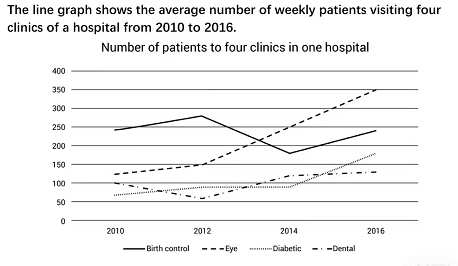
The line graph compares the average visitation figures for patients in four categories who went to clinics at a specific hospital weekly between 2010 and 2016. In general, it is noticeable that the number of patients at the four clinics increased for all types of visits except for birth control which was unchanged overall. The figure for eye issues became the most common over the period, overtaking birth control, while visits for diabetic and dental reasons were lower throughout.
There were nearly 250 visits related to birth control in 2010, a figure which rose to a peak of 275 by 2012, before a sharp decline to 175 in 2014, and a complete recovery to its starting figure by the end of the time surveyed. In contrast, visits to the doctor concerning eye issues started lower at 125, grew negligibly over the next two years, prior to surging in the final four years to a high point, relative to all visits, of 350.
Diabetic and dental visits were consistently less common with the former beginning at 60, rising steadily to plateau under 100, and finishing the period with a sharp uptick to 175. The latter began the period higher at 100 visits, fell to half that number in 2012, more than recovered to 125 in 2014, and grew marginally in the final two years recorded.
Analysis
1. The line graph compares the average visitation figures for patients in four categories who went to clinics at a specific hospital weekly between 2010 and 2016. 2. In general, it is noticeable that the number of patients at the four clinics increased for all types of visits except for birth control which was unchanged overall. 3. The figure for eye issues became the most common over the period, overtaking birth control, while visits for diabetic and dental reasons were lower throughout.
Paraphrase what the bar chart shows.
Write a clear overview summarising the differences and the overall trend.
This one is a little complex so it needs a second sentence for the overview.
1. There were nearly 250 visits related to birth control in 2010, a figure which rose to a peak of 275 by 2012, before a sharp decline to 175 in 2014, and a complete recovery to its starting figure by the end of the time surveyed. 2. In contrast, visits to the doctor concerning eye issues started lower at 125, grew negligibly over the next two years, prior to surging in the final four years to a high point, relative to all visits, of 350.
Begin writing about the data for the first categories.
Compare between each sentence.
1. Diabetic and dental visits were consistently less common with the former beginning at 60, rising steadily to plateau under 100, and finishing the period with a sharp uptick to 175. 2. The latter began the period higher at 100 visits, fell to half that number in 2012, more than recovered to 125 in 2014, and grew marginally in the final two years recorded.
Write about the final other parts of the graph – include everything!
Compare the categories.
Vocabulary
What do the words in bold below mean?Make some notes on paper to aid memory and then check below.
The line graph compares the average visitation figures for patients in four categories who went to clinics at a specific hospital weekly between 2010 and 2016. In general, it is noticeable that the number of patients at the four clinics increased for all types of visits except forbirth control which was unchanged overall. The figure for eye issues became the most common over the period, overtaking birth control, while visits for diabetic and dental reasons were lower throughout.
There were nearly 250 visits related to birth control in 2010, a figure which rose to a peak of 275 by 2012, before a sharp decline to 175 in 2014, and a complete recovery to its starting figure by the end of the time surveyed. In contrast, visits to the doctor concerning eye issuesstarted lower at 125, grew negligibly over the next two years, prior to surging in the final four years to a high point, relative to all visits, of 350.
Diabetic and dental visits were consistently less common with the former beginning at 60, rising steadily to plateau under 100, and finishing the period with a sharp uptick to 175. The latter began the period higher at 100 visits, fell to half that number in 2012, more than recovered to 125 in 2014, and grew marginally in the final two years recorded.
Answers
For extra practice, write an antonym (opposite word) on a piece of paper to help you remember the new vocabulary:
compares shows the differences between
average visitation figures for patients number of times people went to the hospital
clinics hospitals
specific hospital weekly this one medical center each week
In general overall
it is noticeable that it can clearly be seen that
all types of visits except forbirth control all kinds of trips not including pills to stop pregnancy
unchanged overall stable in general
eye issues problems with your eyes
most common over the period happened a lot during that time
overtaking going past
while in contrast
diabetic related to diabetes
dental related to taking care of your teeth
lower throughout less the whole time
nearly almost
related to birth control in concerning pills to prevent pregnancy
figure data
rose to a peak of increased to a high of
before a sharp decline to prior to a big drop to
complete recovery to totally getting back to the same level
starting figure by the end of the time surveyed beginning number at the end of the period
In contrast in comparison
concerning eye issuesstarted lower at having to do with eye problems began under at
grew negligibly over the next two years increased a bit for the next couple of years
prior to surging before increasing a lot
to a high point, relative to its peak, compared to
Diabetic can’t eat too much sugar
dental related to teeth
consistently less common with the former beginning at all the time not as often with the on mentioned before starting at
rising steadily to plateau under increasing consistently to level off at
finishing the period with a sharp uptick to ending the time with a big increase to
latter the one mentioned second
fell to half that number in decreased to 50% of the figure
more than recovered to came back up and exceeded the number before
grew marginally in the final two years recorded increased a bit at the end of the period
I recommend getting a pencil and piece of paper because that aids memory. Then write down the missing vocabulary from my sample answer in your notebook:
The line graph c_________s the a_______________________________s in four categories who went to c______s at a s__________________________y between 2010 and 2016. I___________l, i__________________t the number of patients at the four clinics increased for a______________________________________l which was u_________________l. The figure for e__________s became the m_______________________________d, o__________g birth control, w_____e visits for d________c and d__________l reasons were l______________________t.
There were n________y 250 visits r_________________________n 2010, a f_______e which r_________________f 275 by 2012, b________________________o 175 in 2014, and a c_________________o its s____________________________________________d. I_____________t, visits to the doctor c__________________________________t 125, g______________________________________s, p__________________g in the final four years t______________________t, r_____________o all visits, of 350.
D__________c and d_______l visits were c______________________________________________t 60, r____________________________r 100, and f__________________________________________o 175. The l________r began the period higher at 100 visits, f_____________________________n 2012, m________________________o 125 in 2014, and g_________________________________________d.
Listening Practice
Learn more about this topic by watching from YouTube below and practice with these activities:
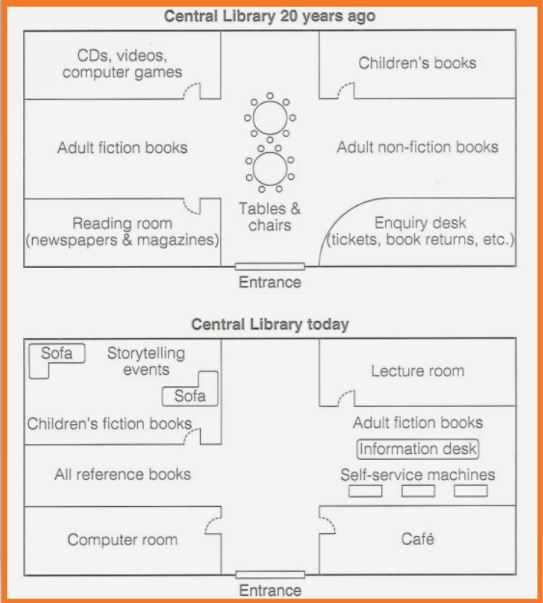
The diagram details a central library floor plan twenty years ago compared to the present day. Looking from an overall perspective, it is readily apparent that the library has a more open layout and there is greater emphasis on technology, self-service, and recreation. All rooms have been reorganized and only the entrance is unchanged.
Two decades ago, the most noticeable difference was two groupings of tables and chairs immediately upon entering the library that are no longer there today. To the left of the chairs there was a reading room that contained newspapers and magazines that has now been transformed into a computer room. Above that there used to be adult fiction but now this open area contains all the library’s reference books. The final rooms on the left side were previously for media such as CDs, videos, and games but now the children’s area has moved from the opposite corner and expanded to allow for sofas and storytelling events.
The former location of the children’s area on the upper left side of the library is now a room for lectures which is directly above a space with adult fiction, a long information desk, and 3 self-service machines. The final addition is a café that has taken the place of an enquiry desk for returns and other questions.
Analysis
1. The diagram details a central library floor plan twenty years ago compared to the present day. 2. Looking from an overall perspective, it is readily apparent that the library has a more open layout and there is greater emphasis on technology, self-service, and recreation. 3. All rooms have been reorganized and only the entrance is unchanged.
Paraphrase what the bar chart shows.
Write a clear overview summarising the differences .
Be safe and include a second sentence where you group and characterize the changes.
1. Two decades ago, the most noticeable difference was two groupings of tables and chairs immediately upon entering the library that are no longer there today. 2. To the left of the chairs there was a reading room that contained newspapers and magazines that has now been transformed into a computer room. 3. Above that there used to be adult fiction but now this open area contains all the library’s reference books. 4. The final rooms on the left side were previously for media such as CDs, videos, and games but now the children’s area has moved from the opposite corner and expanded to allow for sofas and storytelling events.
Begin writing about where everything is.
Compare between each sentence.
Add as much detail as possible.
Make sure you don’t miss anything.
1. The former location of the children’s area on the upper left side of the library is now a room for lectures which is directly above a space with adult fiction, a long information desk, and 3 self-service machines. 2. The final addition is a café that has taken the place of an enquiry desk for returns and other questions.
Write about the final other parts of the map – include everything!
This one is a bit long, but better than being too short!
Vocabulary
What do the words in bold below mean?Make some notes on paper to aid memory and then check below.
The diagram details a central library floor plan twenty years ago compared to the present day. Looking from an overall perspective, it is readily apparent that the library has a more open layout and there is greater emphasis on technology, self-service, and recreation. All rooms have been reorganized and only the entrance is unchanged.
Two decades ago, the most noticeable difference was two groupings of tables and chairs immediately upon entering the library that are no longer there today. To the left of the chairs there was a reading room that contained newspapers and magazines that has now been transformed into a computer room. Above that there used to be adult fiction but now this open area contains all the library’s reference books. The final rooms on the left side were previously for media such as CDs, videos, and games but now the children’s area has moved from the opposite corner and expanded to allow for sofas and storytelling events.
The former location of the children’s area on the upper left side of the library is now a room for lectures which is directly above a space with adult fiction, a long information desk, and 3 self-service machines. The final addition is a café that has taken the place of an enquiry desk for returns and other questions.
Answers
For extra practice, write an antonym (opposite word) on a piece of paper to help you remember the new vocabulary:
diagram details map shows
central library floor plan the rooms in a library where you can borrow books
compared to the present day in contrast to now
Looking from an overall perspective, it is readily apparent that overall
more open layout less cluttered
greater emphasis on more focus on
self-service place where you can look up / check-out yourself
recreation having fun
reorganized changed around
entrance place to go in
unchanged no different
Two decades ago 20 years ago
most noticeable difference biggest change
groupings things that are together
immediately upon entering the library as soon as you get into the library
no longer there today not there any more
To the left of on the left side of
reading room place to read
contained has
transformed into changed to
Above that over that
adult fiction books for adults
reference books books to look things up, encyclopedias
previously for media such as before for entertainment like
moved from the opposite corner over to the other side in the same place
expanded to allow for sofas made bigger for couches
storytelling events telling stories to kids
The former location of where it was before
upper left side of top left part
lectures talks
directly above right over
long information desk big place to find out information
self-service machines where you can do it yourself
final addition last thing added
taken the place of replaced
enquiry desk place to ask questions
returns and other questions give back books and make queries
I recommend getting a pencil and piece of paper because that aids memory. Then write down the missing vocabulary from my sample answer in your notebook:
The d________m d_____s a c____________________n twenty years ago c_______________o t_________________y. L___________________________________________________________t the library has a m_____________t and there is g__________________n technology, s___________e, and r__________n. All rooms have been r______________d and only the e_______e is u__________d.
T_________________o, the m__________________________e was two g________s of tables and chairs i________________________________y that are n____________________y. T_______________f the chairs there was a r______________m that c_________d newspapers and magazines that has now been t________________o a computer room. A__________t there used to be a____________n but now this open area contains all the library’s r__________________s. The final rooms on the left side were p________________________s CDs, videos, and games but now the children’s area has m___________________________r and e______________________s and s______________________s.
T__________________f the children’s area on the u___________________f the library is now a room for l_________s which is d___________e a space with adult fiction, a l_______________k, and 3 s_________________s. The f_____________________n is a café that has t____________________f an e______________k for r_______________________________s.
Listening Practice
Learn more about this topic by watching from YouTube below and practice with these activities:
This is an IELTS writing task 1 sample answer essay from the new IELTS Cambridge 18 book of past tests on the topic of the number of US households (in millions) by annual income.
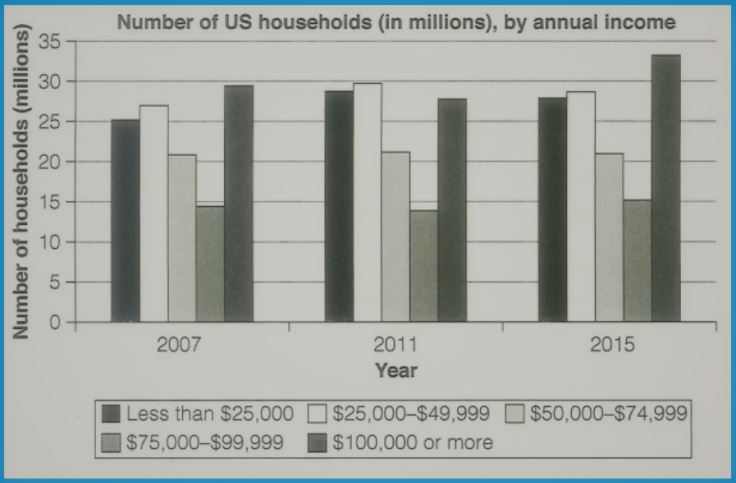
The bar chart details the total number of households in the United States categorized by average annual income from the year 2007 to 2015. Looking from an overall perspective, it is readily apparent that there were rising trends for all income brackets with the exception of those earning in the middle, which was stable. The greatest increase and the highest proportion by the end belonged to those earning the most.
In 2007, those with annual compensations under $25,000 numbered just over 25 million, a figure considerably higher than $50,000-$74,999 (21 million) and $75,000-99,999 (14 million) but beneath those earning $25,000-$49,999 (27 million) and over $100,000 (29 million). Four years later, there was a decline for the wealthiest homes to 26 million, the next wealthiest to 14 million and noticeable rises of around 3 million for the lower income brackets. Only the middle-income group was unchanged throughout the surveyed time period.
By 2015, the number of very wealthy households had surged to 33 million while the two lowest earning demographics fell slightly by about a million each to finish around 26 million. There was a moderate rise for the second highest earning households to end the period at precisely 15 million in total.
Analysis
1. The bar chart details the total number of households in the United States categorized by average annual income from the year 2007 to 2015. 2. Looking from an overall perspective, it is readily apparent that there were rising trends for all income brackets with the exception of those earning in the middle, which was stable. 3. The greatest increase and the highest proportion by the end belonged to those earning the most.
Paraphrase what the bar chart shows.
Write a clear overview summarising the differences and the overall trend.
This one is a little complex so it needs a second sentence for the overview.
1. In 2007, those with annual compensations under $25,000 numbered just over 25 million, a figure considerably higher than $50,000-$74,999 (21 million) and $75,000-99,999 (14 million) but beneath those earning $25,000-$49,999 (27 million) and over $100,000 (29 million). 2. Four years later, there was a decline for the wealthiest homes to 26 million, the next wealthiest to 14 million and noticeable rises of around 3 million for the lower income brackets. 3. Only the middle-income group was unchanged throughout the surveyed time period.
Begin writing about the data for the first categories.
Compare between each sentence.
Add as much detail as possible.
1. By 2015, the number of very wealthy households had surged to 33 million while the two lowest earning demographics fell slightly by about a million each to finish around 26 million. 2. There was a moderate rise for the second highest earning households to end the period at precisely 15 million in total.
Write about the final other parts of the graph – include everything!
Compare the categories.
Vocabulary
What do the words in bold below mean?Make some notes on paper to aid memory and then check below.
The bar chart details the total number of households in the United States categorized by average annual income from the year 2007 to 2015. Looking from an overall perspective, it is readily apparent that there were rising trends for all income brackets with the exception of those earning in the middle, which was stable. The greatest increase and the highest proportion by the end belonged to those earning the most.
In 2007, those with annual compensations under $25,000 numbered just over 25 million, a figure considerably higher than $50,000-$74,999 (21 million) and $75,000-99,999 (14 million) but beneath those earning $25,000-$49,999 (27 million) and over $100,000 (29 million). Four years later, there was a decline for the wealthiest homes to 26 million, the next wealthiest to 14 million and noticeable rises of around 3 million for the lower income brackets. Only the middle-income group was unchanged throughout the surveyed time period.
By 2015, the number of very wealthy households had surged to 33 million while the two lowest earning demographics fell slightly by about a million each to finish around 26 million. There was a moderate rise for the second highest earning households to end the period at precisely 15 million in total.
Answers
For extra practice, write an antonym (opposite word) on a piece of paper to help you remember the new vocabulary:
details shows
total number of households
categorized by average annual income grouped by how much earned in a year
Looking from an overall perspective, it is readily apparent that in general
rising trends for all income brackets with the exception of growth patterns for all groups but not for
stable consistent
The greatest increase the biggest rise
the highest proportion by the end belonged to the majority at the finish was for
earning the most making the most money
annual compensations under money earned in a year less than
numbered just over was a little above
a figure considerably higher than a number much more than
later after that
there was a decline for the wealthiest homes to the richest houses fell to
the next wealthiest the second richest
noticeable rises of big increases constituting
lower income brackets people earning less money
unchanged throughout the surveyed time period was stable the whole time
very wealthy households rich homes
surged increased a lot
while in contrast
two lowest earning demographics fell slightly by people who made the least went down a little in the year
each both of them
finish around end near
moderate rise small increase
end the period at precisely finish the time at exactly
I recommend getting a pencil and piece of paper because that aids memory. Then write down the missing vocabulary from my sample answer in your notebook:
The bar chart d______s the t___________________________s in the United States c___________________________________e from the year 2007 to 2015. L____________________________________________________t there were r____________________________________________________________________f those earning in the middle, which was s______e. T___________e and t______________________________________________o those e_____________t.
In 2007, those with a_____________________________r $25,000 n_________________r 25 million, a__________________________________________n $50,000-$74,999 (21 million) and $75,000-99,999 (14 million) but beneath those earning $25,000-$49,999 (27 million) and over $100,000 (29 million). Four years l____r, t________________________________________________o 26 million, t__________________t to 14 million and n_______________________f around 3 million for the l______________________s. Only the middle-income group was u____________________________________________________________d.
By 2015, the number of v______________________s had s_____d to 33 million w_____e the t________________________________________________y about a million e____h to f________________d 26 million. There was a m______________e for the second highest earning households to e____________________________y 15 million i__________l.
Listening Practice
Learn more about this topic by watching from YouTube below and practice with these activities:
This is an IELTS writing task 2 sample answer essay from the new IELTS Cambridge 18 book of past tests on the topic of people living longer and an ageing population.
IELTS Cambridge 18: Living Longer / An Ageing Population
Around the world, people are now living longer than ever before in the past. Some say an ageing population creates problems for governments. Others believe there are benefits to society having more elderly people.
To what extent do the advantages of possessing an ageing population outweigh the disadvantages?
It has become increasingly common today for individuals to live longer than they did in past generations. Although many point out that ageing populations hinder a nation economically, I would argue that the benefits for society as a whole overshadow these perceived drawbacks.
The main reason that many fixate on the negatives associated with an ageing population relates to the financial implications. Governments and companies must both take into account the age of their population and plan accordingly. For instance, Japan has a famously old population that requires the government to make budgetary allowances for better healthcare and shortages in the labor force. The economy more generally in Japan must overcome a shrinking consumer market as young people are more likely to shop, travel, and spend freely. This same situation applies to varying degrees in nearly every country around the world at different moments in their history.
However, the economic effects of an ageing population are less important than the value of older generations. In most societies globally, young people are more progressive and push society forward. Older generations typically serve as a stabilizing ballast that keeps forward momentum from becoming too chaotic. This can take the form of advice given by elders within families to young people or more broadly across the entire political spectrum of a country. Although this conservatism can feel limiting to younger generations at first, most would admit as they get older that the influence of more experienced and wiser family members was generally positive on an individual and societal level.
In conclusion, despite the economic repercussions of older population demographics, I believe that the less tangible benefits for families make this a positive development. Naturally, there are legitimate downsides that must be collectively managed by governments and individuals alike.
Analysis
1. It has become increasingly common today for individuals to live longer than they did in past generations. 2. Although many point out that ageing populations hinder a nation economically, I would argue that the benefits for society as a whole overshadow these perceived drawbacks.
Paraphrase the overall essay topic.
Write a clear opinion. Read more about introductions here.
1. The main reason that many fixate on the negatives associated with an ageing population relates to the financial implications. 2. Governments and companies must both take into account the age of their population and plan accordingly. 3. For instance, Japan has a famously old population that requires the government to make budgetary allowances for better healthcare and shortages in the labor force. 4. The economy more generally in Japan must overcome a shrinking consumer market as young people are more likely to shop, travel, and spend freely. 5. This same situation applies to varying degrees in nearly every country around the world at different moments in their history.
Write a topic sentence with a clear main idea at the end.
Explain your main idea.
Develop it with specific or hypothetical examples.
Keep developing it fully.
Vary long and short sentences.
1. However, the economic effects of an ageing population are less important than the value of older generations. 2. In most societies globally, young people are more progressive and push society forward. 3. Older generations typically serve as a stabilizing ballast that keeps forward momentum from becoming too chaotic. 4. This can take the form of advice given by elders within families to young people or more broadly across the entire political spectrum of a country. 5. Although this conservatism can feel limiting to younger generations at first, most would admit as they get older that the influence of more experienced and wiser family members was generally positive on an individual and societal level.
Write a new topic sentence with a new main idea at the end.
Explain your new main idea.
Include specific details and examples.
Add as much information as you can and make sure it links logically.
Keep adding…
1. In conclusion, despite the economic repercussions of older population demographics, I believe that the less tangible benefits for families make this a positive development. 2. Naturally, there are legitimate downsides that must be collectively managed by governments and individuals alike.
Summarise your main ideas.
Include a final thought. Read more about conclusions here.
Vocabulary
What do the words in bold below mean?Make some notes on paper to aid memory and then check below.
It has become increasingly common today for individuals to live longer than they did in past generations. Although many point out that ageing populations hinder a nation economically, I would argue that the benefits for society as a whole overshadow these perceived drawbacks.
The main reason that many fixate on the negatives associated with an ageing population relates to the financial implications. Governments and companies must both take into account the age of their population and plan accordingly. For instance, Japan has a famously old population that requires the government to make budgetary allowances for better healthcare and shortages in the labor force. The economy more generally in Japan must overcome a shrinking consumer market as young people are more likely to shop, travel, and spend freely. This same situation applies to varying degrees in nearly every country around the world at different moments in their history.
However, the economic effects of an ageing population are less important than the value of older generations. In most societies globally, young people are more progressive and push society forward. Older generations typically serve as a stabilizing ballast that keeps forward momentum from becoming too chaotic. This can take the form of advice given by elders within families to young people or more broadly across the entire political spectrum of a country. Although this conservatism can feel limiting to younger generations at first, most would admit as they get older that the influence of more experienced and wiser family members was generally positive on an individual and societal level.
In conclusion, despite the economic repercussions of older population demographics, I believe that the less tangible benefits for families make this a positive development. Naturally, there are legitimate downsides that must be collectively managed by governments and individuals alike.
Answers
For extra practice, write an antonym (opposite word) on a piece of paper to help you remember the new vocabulary:
It has become increasingly common today for more and more people do this now
in past generations before
Although despite, however
point out argue
ageing populations hinder a nation economically older demographics in a country hurt it in terms of finances
argue contend
benefits for society as a whole overshadow positives for everyone are stronger than
perceived drawbacks what people think are the bad parts
fixate on focus on
negatives associated with an ageing population bad parts related to having too many old people
financial implications
take into account consider
plan accordingly anticipate as a result
famously old population everyone knows there are lots of old people
make budgetary allowances save money
healthcare hospitals
shortages in the labor force not enough workers
overcome a shrinking consumer market recover from not having shoppers
spend freely use money without thinking much
This same situation applies to varying degrees true somewhat in other places
in nearly every country around the world in almost everywhere in the world
at different moments in their history throughout time
economic effects financial impact
value importance
In most societies globally around the world
progressive liberal, want to move forward
push society forward advance society
serve as a stabilizing ballast keep society from moving too fast
keeps forward momentum from becoming too chaotic stops it from going too quickly
This can take the form of one way this exists is
broadly across the entire political spectrum of a country generally over the social aspects of a nation
conservatism not progressive
limiting keeping back
at first initially
admit concede
influence effect
wiser family members smarter people in a family
generally positive on an individual and societal level overall good for people
despite the economic repercussions of regardless of the effects on finances
population demographics how many people are in a country
I recommend getting a pencil and piece of paper because that aids memory. Then write down the missing vocabulary from my sample answer in your notebook:
I_________________________________________r individuals to live longer than they did i________________s. A_____________h many p_________t that a_______________________________________y, I would a_____e that the b________________________________________w these p_____________________s.
The main reason that many f________n the n______________________________________n relates to the f__________________________s. Governments and companies must both t_______________t the age of their population and p_____________y. For instance, Japan has a f______________________n that requires the government to m___________________s for better h____________e and s_______________________e. The economy more generally in Japan must o________________________________t as young people are more likely to shop, travel, and s____________y. T______________________________________________________s i__________________________________________d a______________________________y.
However, the e_________________s of an ageing population are less important than the v______e of older generations. I__________________________y, young people are more p____________e and p__________________d. Older generations typically s_________________________t that k________________________________________________c. T___________________f advice given by elders within families to young people or more b____________________________________________y. Although this c__________m can feel l__________g to younger generations a________t, most would a_______t as they get older that the i_________e of more experienced and w___________________s was g_______________________________________________________l.
In conclusion, d______________________________________f older p_____________________s, I believe that the l___________________________s for families make this a positive development. N______________y, there are l_____________________s that must be c_______________________y governments and individuals a_____e.
Listening Practice
Learn more about this topic by watching from YouTube below and practice with these activities:
"The highest quality materials anywhere on the internet! Dave improved my writing and vocabulary so much. Really affordable options you don't want to miss out on!"