This is my IELTS writing task 2 sample answer essay on the topic of friendship from the real IELTS exam.
I write the essays on my blog for free for all students. If you want to support me to keep making materials, sign up for my full, exclusive IELTS EBooks here:
Friendships that take place online are not as meaningful as those where people meet each other face to face.
To what extent do you agree or disagree?
Certain concerned parties today would argue that there is inherently less value in online friendships. In my opinion, despite the unique features possible when making friends online, in-person friendships are more meaningful due to the human element.
Supporters of making friendships in the virtual world point out the diverse possibilities for communication. In the past, an individual had little choice other than to make friends within a generally narrow range. Today, the average social media user can contact individuals with more varied interests. For instance, people who are passionate about playing old board games can locate each other on a Facebook group or through an Instagram page and become friends as a result of a shared affinity. Using the internet, these people can stay in contact and sustain a potentially rewarding intellectual friendship.
Nonetheless, it is only possible to have a truly meaningful friendship when meeting face to face. Research has shown that the body produces endorphins that elevate one’s mood through touch and in-person conversation. These are signs that there is tremendous value in real life friendships based around physical proximity. The benefits of such relationships extend to the ability to communicate with body language, eye contact, and physical contact. These features are the intrinsic value and meaning most assign to quality friendships and are completely lacking in superficial online friendships that ultimately do little more than a waste of one’s valuable time and energy.
In conclusion, although being online affords the average person a number of conveniences that can enhance a friendship, there is indeed far greater value in connecting with a person in real life. Few would dispute this claim even as many friendships become increasingly situated in online contexts.
Analysis
1. Certain concerned parties today would argue that there is inherently less value in online friendships. 2. In my opinion, despite the unique features possible when making friends online, in-person friendships are more meaningful due to the human element.
Paraphrase the overall essay topic.
Write a clear opinion. Read more about introductions here.
1. Supporters of making friendships in the virtual world point out the diverse possibilities for communication. 2. In the past, an individual had little choice other than to make friends within a generally narrow range. 3. Today, the average social media user can contact individuals with more varied interests. 4. For instance, people who are passionate about playing old board games can locate each other on a Facebook group or through an Instagram page and become friends as a result of a shared affinity. 5. Using the internet, these people can stay in contact and sustain a potentially rewarding intellectual friendship.
Write a topic sentence with a clear main idea at the end.
Explain your main idea.
Develop it with specific or hypothetical examples.
Keep developing it fully.
Use specific examples.
1. Nonetheless, it is only possible to have a truly meaningful friendship when meeting face to face. 2. Research has shown that the body produces endorphins that elevate one’s mood through touch and in-person conversation. 3. These are signs that there is tremendous value in real life friendships based around physical proximity. 4. The benefits of such relationships extend to the ability to communicate with body language, eye contact, and physical contact. 5. These features are the intrinsic value and meaning most assign to quality friendships and are completely lacking in superficial online friendships that ultimately do little more than a waste of one’s valuable time and energy.
Write a new topic sentence with a new main idea at the end.
Explain your new main idea.
Include specific details and examples.
Add as much information as you can and make sure it links logically.
Finish the paragraph strong.
1. In conclusion, although being online affords the average person a number of conveniences that can enhance a friendship, there is indeed far greater value in connecting with a person in real life. 2. Few would dispute this claim even as many friendships become increasingly situated in online contexts.
Summarise your main ideas.
Include a final thought. Read more about conclusions here.
Vocabulary
What do the words in bold below mean?Make some notes on paper to aid memory and then check below.
Certain concerned parties today would argue that there is inherently less value in online friendships. In my opinion, despite the unique features possible when making friends online, in-person friendships are more meaningful due to the human element.
Supporters of making friendships in the virtual worldpoint out the diverse possibilities for communication. In the past, an individual had little choice other than to make friends within a generally narrow range. Today, the average social media user can contact individuals with more varied interests. For instance, people who are passionate about playing old board games can locate each other on a Facebook group or through an Instagram page and become friends as a result of a shared affinity. Using the internet, these people can stay in contact and sustain a potentially rewarding intellectual friendship.
Nonetheless, it is only possible to have a truly meaningful friendship when meeting face to face. Research has shown that the body produces endorphins that elevate one’s mood through touch and in-person conversation. These are signs that there is tremendous value in real life friendships based around physical proximity. The benefits of such relationships extend to the ability to communicate with body language, eye contact, and physical contact. These features are the intrinsic value and meaning most assign to quality friendships and are completely lacking in superficial online friendships that ultimately do little more than a waste of one’s valuable time and energy.
In conclusion, although being online affords the average person a number of conveniences that can enhance a friendship, there is indeed far greater value in connecting with a person in real life. Few would dispute this claim even as many friendships become increasingly situated in online contexts.
Answers
For extra practice, write an antonym (opposite word) on a piece of paper to help you remember the new vocabulary:
Certain concerned parties today would argue that some people today contend that
inherently less value in intrinsically not as important as
despite regardless of
unique features possible when new ways of using it allowed as
in-person friendships face to face relationships
meaningful due to the human element valuable because you can meet in person
Supporters of people in favor of
in the virtual world online
point out argue
the diverse possibilities for communication different options for talking
In the past before
little choice other than to not much option besides to
narrow range not many options
average social media user normal person online
contact talk to
varied interests different hobbies
passionate about care a lot about
board games Monopoly, Risk, etc.
locate find
as a result of a shared affinity because of the same interest
stay in contact and sustain a potentially rewarding intellectual friendship talk to each other and possibly keep up a relationship based around ideas and talking
Nonetheless regardless
truly meaningful friendship when meeting face to face actually important relationship as you talk in person
Research has shown that studies indicate that
body produces endorphins makes you feel good and happy
elevate one’s mood through touch and in-person conversation lift your spirits by touching people and talking in person
signs signals, clues
tremendous value real importance
based around physical proximity being near a person in the real world
benefits advantages
extend to include
body language eye contact, moving your hands, touch
eye contact looking in someone’s eyes
physical contact touching
features benefits
intrinsic value real importance
assign to quality friendships consider part of a good relationship
completely lacking in superficial online friendships not present when talking on the internet
ultimately in the end
waste of one’s valuable time and energy inefficient
affords the average person a number of conveniences allows people to live easier
enhance make better
indeed far greater value in connecting with actually more importance in reaching out to
Few would dispute this claim even as not many would argue this point
increasingly situated in online contexts more and more on the internet
I recommend getting a pencil and piece of paper because that aids memory. Then write down the missing vocabulary from my sample answer in your notebook:
C_________________________________________________________t there is i____________________________n online friendships. In my opinion, d________e the u______________________________n making friends online, i___________________________s are more m______________________________________t.
S_________________f making friendships i______________________________________________________________n. I_____________t, an individual had l__________________________o make friends within a generally n______________e. Today, the a______________________________r can c__________t individuals with more v___________________s. For instance, people who are p_________________t playing old b_______________s can l_________e each other on a Facebook group or through an Instagram page and become friends a__________________________y. Using the internet, these people can s_____________________________________________________________p.
N_____________s, it is only possible to have a t__________________________________________________________e. R__________________________t the b________________________s that e__________________________________________________________n. These are s____s that there is t__________________e in real life friendships b___________________________________y. The b________s of such relationships e__________o the ability to communicate with b_____________e, e_____________t, and p________________t. These f___________s are the i_____________e and meaning most a_________________________s and are c_____________________________________________________s that u________________y do little more than a w___________________________________________________y.
In conclusion, although being online a________________________________________________s that can e___________e a friendship, there is i____________________________________________h a person in real life. F______________________________________________s many friendships become i________________________________________s.
Listening Practice
Learn more about this topic by watching from YouTube below and practice with these activities:
Around the world, people are now living longer than ever before in the past. Some say an ageing population creates problems for governments. Others believe there are benefits to society having more elderly people.
To what extent do the advantages of possessing an ageing population outweigh the disadvantages?
In recent years, there has been growing interest in the relationship between equality and personal achievement. Some people believe that individuals can achieve more in egalitarian societies. Others believe that high levels of personal achievement are possible only if individuals are free to succeed or fail according to their individual merits.
Some people believe that children of all ages should have extra responsibilities (for example, helping at home or at work). Others believe that, outside of school, children should be free to enjoy their lives.
Some feel that individuals should try to assimilate completely to the country where they live while others feel it is more important to preserve their native culture.
Some think schools should rewards students who have the best academic results, while others think it’s more important to reward students who achieve other types of success (such as sports, music, and good behaviour).
Some people think that the news media has become much more influential in people’s lives today and it is a negative development. Do you agree or disagree?
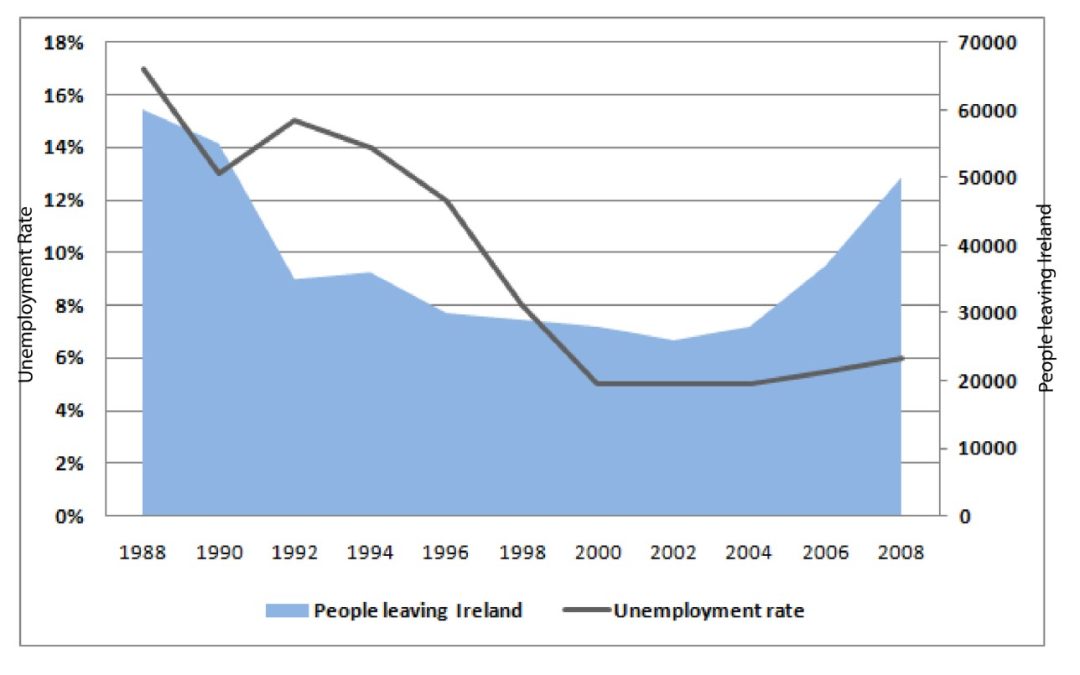
The line chart details the unemployment rate and number of people leaving Ireland from 1988 to 2008. Looking from an overall perspective, it is readily apparent that the figures followed a roughly complementary pattern except for an extended period in the 1990s. Both data sets declined overall though individuals leaving the country ended with an upwards trend.
In 1988, 17% of individuals were unemployed in Ireland and a slightly lower 15.5% decided to leave the country. Starting in 1990, the rates diverged with between 12% and 13% being unemployed up until 1996 and far fewer proportionally moving abroad (between 14% and 8%).
After 1996, a steep drop in terms of unemployment (down to a low of 5% by 2000) recreated a more symmetrical pattern. Individuals leaving the island nation was broadly stable around 7% before a sharp uptick over the final four years of the period to end at 13%. The rise for unemployment figures was more gradual and was finally registered at 6%.
Analysis
1. The line chart details the unemployment rate and number of people leaving Ireland from 1988 to 2008. 2. Looking from an overall perspective, it is readily apparent that the figures followed a roughly complementary pattern except for an extended period in the 1990s. 3. Both data sets declined overall though individuals leaving the country ended with an upwards trend.
Paraphrase what the bar chart shows.
Write a clear overview summarising the differences and the overall trend.
This one is a little complex so it needs a second sentence for the overview.
1. In 1988, 17% of individuals were unemployed in Ireland and a slightly lower 15.5% decided to leave the country. 2. Starting in 1990, the rates diverged with between 12% and 13% being unemployed up until 1996 and far fewer proportionally moving abroad (between 14% and 8%).
Begin writing about the data for the first categories.
Compare between each sentence.
1. After 1996, a steep drop in terms of unemployment (down to a low of 5% by 2000) recreated a more symmetrical pattern. 2. Individuals leaving the island nation was broadly stable around 7% before a sharp uptick over the final four years of the period to end at 13%. 3. The rise for unemployment figures was more gradual and was finally registered at 6%.
Write about the final other parts of the graph – include everything!
Compare the categories.
Don’t leave out any information but try to group as well.
Vocabulary
What do the words in bold below mean?Make some notes on paper to aid memory and then check below.
The line chart details the unemployment rate and number of people leaving Ireland from 1988 to 2008. Looking from an overall perspective, it is readily apparent that the figures followed a roughly complementary pattern except for an extended period in the 1990s. Both data sets declined overall though individuals leaving the country ended with an upwards trend.
In 1988, 17% of individuals were unemployed in Ireland and a slightly lower 15.5% decided to leave the country. Starting in 1990, the rates diverged with between 12% and 13% being unemployed up until 1996 and far fewer proportionally moving abroad (between 14% and 8%).
After 1996, a steep drop interms of unemployment (down to a low of 5% by 2000) recreated a more symmetrical pattern. Individuals leaving the island nation was broadly stable around 7% before a sharp uptick over the final four years of the period to end at 13%. The rise for unemployment figures was more gradual and was finally registered at 6%.
Answers
For extra practice, write an antonym (opposite word) on a piece of paper to help you remember the new vocabulary:
details shows
unemployment rate people without jobs
number of people leaving Ireland individuals moving abroad
Looking from an overall perspective, it is readily apparent that overall
figures followed a roughly complementary pattern except for an extended period in numbers were similar in their shape but for one long time
data sets declined overall numbers went down by the end
ended with an upwards trend increased near the end
slightly lower a little less
decided to leave the country chose to move abroad
Starting in beginning
diverged went in different directions
up until leading up to
far fewer proportionally moving abroad not as many people in terms of the percentage leaving for other countries
I recommend getting a pencil and piece of paper because that aids memory. Then write down the missing vocabulary from my sample answer in your notebook:
The line chart d_________s the u__________________e and n_________________________d from 1988 to 2008. L______________________________________________________________________t the f_______________________________________________________________________________n the 1990s. Both d______________________l though individuals leaving the country e_________________d.
In 1988, 17% of individuals were unemployed in Ireland and a s______________r 15.5% d______________________________y. S____________n 1990, the rates d_________d with between 12% and 13% being unemployed u________l 1996 and f____________________________________d (between 14% and 8%).
A_______r 1996, a______________________f unemployment (d_______________f 5% by 2000) r____________d a m________________________n. Individuals leaving the i____________n was b_________________d 7% b__________________________r the final four years of the period to e______t 13%. The r____e for unemployment figures was more g______l and was f____________________________t 6%.
Listening Practice
Learn more about this topic by watching from YouTube below and practice with these activities:
The best way to reduce poverty in developing countries is by giving up to six years of free education, so that they can at least read, write and use numbers.
To what extent do you agree or disagree?
Poverty remains a pressing issue in most developing countries, and one proposed solution is a provision of up to six years of free education, aiming to equip individuals with essential literacy and numeracy skills. In my opinion, I agree with this approach.
While free education is a crucial step towards poverty reduction, it is not a standalone solution. Equally essential are adequate infrastructure, trained teachers, and quality educational resources. Merely providing free education without ensuring its quality may result in a system that fails to deliver the desired outcomes. Therefore, governments could focus on holistic educational reforms, including teacher training programs, school infrastructure development, and curriculum enhancements, to maximize the impact of free education initiatives. For example, in China, alongside the introduction of free education policies, the government invested in teacher training programs and improved school infrastructure, leading to enhanced learning outcomes and noticeably higher student retention rates.
However, free education itself can significantly increase access to schooling, particularly for marginalized communities and children from low-income backgrounds. Financial barriers often prevent children from attending school, perpetuating the cycle of poverty. By eliminating tuition fees at young ages, developing countries can remove one of the major obstacles to education and ensure that all children have the opportunity to learn. For instance, in India, the implementation of free education policies has led to a rise in school enrollment rates among girls from disadvantaged communities, encouraging them to escape unfair conditions and pursue better futures through improved employability. This inclusivity in education can help bridge social and economic gaps, fostering a more equitable society.
In conclusion, I strongly agree that offering up to six years of free education can be a powerful tool for overcoming poverty in developing countries. By prioritizing education and implementing necessary reforms, developing nations can better empower their citizens and reduce poverty levels in the long-term.
Analysis
1. Poverty remains a pressing issue in most developing countries, and one proposed solution is a provision of up to six years of free education, aiming to equip individuals with essential literacy and numeracy skills. 2. In my opinion, I agree with this approach.
Paraphrase the overall essay topic.
Write a clear opinion. Read more about introductions here.
1. While free education is a crucial step towards poverty reduction, it is not a standalone solution. 2. Equally essential are adequate infrastructure, trained teachers, and quality educational resources. 3. Merely providing free education without ensuring its quality may result in a system that fails to deliver the desired outcomes. 4. Therefore, governments could focus on holistic educational reforms, including teacher training programs, school infrastructure development, and curriculum enhancements, to maximize the impact of free education initiatives. 5. For example, in China, alongside the introduction of free education policies, the government invested in teacher training programs and improved school infrastructure, leading to enhanced learning outcomes and noticeably higher student retention rates.
Write a topic sentence with a clear main idea at the end.
Explain your main idea.
Develop it with specific or hypothetical examples.
Keep developing it fully.
Use specific examples.
1. However, free education itself can significantly increase access to schooling, particularly for marginalized communities and children from low-income backgrounds. 2. Financial barriers often prevent children from attending school, perpetuating the cycle of poverty. 3. By eliminating tuition fees at young ages, developing countries can remove one of the major obstacles to education and ensure that all children have the opportunity to learn. 4. For instance, in India, the implementation of free education policies has led to a rise in school enrollment rates among girls from disadvantaged communities, encouraging them to escape unfair conditions and pursue better futures through improved employability. 5. This inclusivity in education can help bridge social and economic gaps, fostering a more equitable society.
Write a new topic sentence with a new main idea at the end.
Explain your new main idea.
Include specific details and examples.
Add as much information as you can and make sure it links logically.
Finish the paragraph strong.
1. In conclusion, I strongly agree that offering up to six years of free education can be a powerful tool for overcoming poverty in developing countries. 2. By prioritizing education and implementing necessary reforms, developing nations can better empower their citizens and reduce poverty levels in the long-term.
Summarise your main ideas.
Include a final thought. Read more about conclusions here.
Vocabulary
What do the words in bold below mean?Make some notes on paper to aid memory and then check below.
Poverty remains a pressing issue in most developing countries, and one proposed solution is a provision of up to six years of free education, aiming to equip individuals with essential literacy and numeracy skills. In my opinion, I agree with this approach.
While free education is a crucial step towards poverty reduction, it is not a standalone solution. Equally essential are adequate infrastructure, trained teachers, and quality educational resources. Merely providing free education without ensuring its quality may result in a system that fails to deliver the desired outcomes. Therefore, governments could focus on holistic educational reforms, including teacher training programs, school infrastructure development, and curriculum enhancements, to maximize the impact of free education initiatives. For example, in China, alongside the introduction of free education policies, the government invested in teacher training programs and improved school infrastructure, leading to enhanced learning outcomes and noticeably higher student retention rates.
However, free education itself can significantly increase access to schooling, particularly for marginalized communities and children from low-income backgrounds. Financial barriers often prevent children from attending school, perpetuating the cycle of poverty. By eliminating tuition fees at young ages, developing countries can remove one of the major obstacles to education and ensure that all children have the opportunity to learn. For instance, in India, the implementation of free education policies has led to a rise in school enrollment rates among girls from disadvantaged communities, encouraging them to escape unfair conditions and pursue better futures through improved employability. This inclusivity in education can help bridge social and economic gaps, fostering a more equitable society.
In conclusion, I strongly agree that offering up to six years of free education can be a powerful tool for overcoming poverty in developing countries. By prioritizing education and implementing necessary reforms, developing nations can better empower their citizens and reduce poverty levels in the long-term.
Answers
For extra practice, write an antonym (opposite word) on a piece of paper to help you remember the new vocabulary:
Poverty remains a pressing issue not having money is a big problem
one proposed solution is one remedy is
provision plan
aiming to equip individuals with essential literacy trying to help people read and write
numeracy skills math
approach way
crucial step towards poverty reduction key way to get rid of poverty
standalone solution remedy all on its own
Equally essential just as important
adequate infrastructure good enough buildings
trained teachers good teachers
quality educational resources good schools, whiteboards, etc.
Merely just
ensuring its quality may result in a system making sure of how good it is can cause a pattern
fails to deliver the desired outcomes doesn’t work out in the end
focus on holistic educational reforms try to do more overall fixes
teacher training programs ways to teach teachers
school infrastructure development making school buildings and facilities better
curriculum enhancements learning about better things
maximize the impact of be more efficient
alongside the introduction of with the advent of
invested in put money into
leading to enhanced learning outcomes causing better progress
noticeably higher student retention rates clearly more students staying in school
significantly increased access to a lot more growth in getting
marginalized communities poorer parts of society
low-income backgrounds poorer people
Financial barriers not enough money
attending going to
perpetuating the cycle of poverty people staying poor long-term
eliminating tuition fees not charging money for school
remove one of the major obstacles to education get rid of a challenge to learning
implementation put in place
school enrollment rates how many people go to school
disadvantaged communities poorer groups
encouraging fostering
escape unfair conditions get out of difficult places
pursue better futures through improved employability have better lives by getting better jobs
inclusivity open-minded
bridge social and economic gaps lessen differences in society
fostering a more equitable society make people more equal
strongly a lot
offering giving
powerful tool for overcoming poverty way to help poor people make money
By prioritizing making important
implementing necessary reforms putting in place important changes
empower encourage
reduce poverty levels in the long-term fewer poor people over time
I recommend getting a pencil and piece of paper because that aids memory. Then write down the missing vocabulary from my sample answer in your notebook:
P_______________________________e in most developing countries, and o_______________________s a p__________n of up to six years of free education, a___________________________________________y and n________________s. In my opinion, I agree with this a__________h.
While free education is a c__________________________________n, it is not a s________________________n. E_____________________l are a_________________________e, t______________s, and q______________________________s. M_______y providing free education without e_______________________________________m that f_________________________________s. Therefore, governments could f_____________________________________s, including t________________________s, s_______________________t, and c______________________________s, to m_________________________f free education initiatives. For example, in China, a___________________________f free education policies, the government i_________n teacher training programs and improved school infrastructure, l_______________________________________s and n__________________________________________s.
However, free education itself can s_____________________o schooling, particularly for m________________________s and children from l_________________________s. F_________________s often prevent children from a______________g school, p______________________________y. By e______________________s at young ages, developing countries can r________________________________________n and ensure that all children have the opportunity to learn. For instance, in India, the i_______________n of free education policies has led to a rise in s________________________s among girls from d_________________________s, e________________g them to e________________________s and p_________________________________________________y. This i___________y in education can help b____________________________________s, f_________________________________y.
In conclusion, I s__________y agree that o______g up to six years of free education can be a p_______________________________________y in developing countries. B____________g education and i___________________________s, developing nations can better e___________r their citizens and r_______________________________________________m.
Listening Practice
Learn more about this topic by watching from YouTube below and practice with these activities:
Practice with the related IELTS essay topics below:
Many people argue that in order to improve educational quality, high school students should be encouraged to question and offer criticisms on their teachers. Others think this will lead to a loss of respect and discipline in the classroom.
Some people believe that young people should choose the jobs that they want, but other people think they should be more realistic and think more about their future.
The increasing availability of low-cost airlines now lets people travel around the world. Some feel this is a positive development while others think it is negative overall.
In recent years, there has been a significant increase in the number of oil drilling operations in remote locations around the world. This has brought economic benefits to some countries, though it has also raised concerns about the environmental impact of these operations.
Fossil fuels are the main source of energy around the world today. In some countries, the use of alternative sources of energy is replacing fossil fuels.
Many governments think that economic progress is their most important goal. Some people, however, think that other types of progress are equally important for a country.
Discuss both these views and give your own opinion.
In an era of globalization, some people think that studying abroad is the best way to attain a well-paid job while others believe other options are better.
Some people believe that professionals, such as doctors and engineers, should be required to work in the country where they did their training. Others believe they should be free to work in another country if they wish.
More and more young people from wealthy countries are spending time in communities in poorer countries doing unpaid work such as teaching or building houses.
Why is this?
Who benefits more from this, the communities or these young people?
Some people say that individuals should change jobs during their working life often while others believe that doing the same job has advantages to individuals, companies, and society.
Many jobs require ongoing training and research to stay competitive in a world with rapidly evolving information and technology. Some believe that it is the responsibility of businesses to pay for this training for their staff while others feel it is up to the individual.
Smoking is a major cause of serious illness and death throughout the world today. In the interest of the public health, governments should ban cigarettes and other tobacco products.
Employers sometimes ask people applying for jobs for personal information, such as their hobbies and interests, and whether they are married or single. Some people say that this information may be relevant and useful. Others disagree.
Discuss both these views and give your own opinion.
There is little difference in the shops now operating in various nations. Some people think this is positive development,while other believe it is negative.
Many manufactured food and drink products contain high levels of sugar, which causes many health problems. Sugary products should be made more expensive to encourage people to consume less sugar.
Some people say young people should be completely free to choose their future job but others think young people must be more realistic in their choice.
Some people argue that job satisfaction is more important than job security, while others believe that they cannot always expect job satisfaction and a permanent job is more important.
Discuss both these views and give your own opinion.
"The highest quality materials anywhere on the internet! Dave improved my writing and vocabulary so much. Really affordable options you don't want to miss out on!"