Some people think that social networking sites have a huge negative impact on both individuals and society.
To what extent do you agree or disagree?
Many today argue that social media has an overall negative impact on both the average person and society more generally. I am in complete agreement with this opinion as individuals are likely to suffer from an unhealthy addiction and social media can cause fractures in society.
The most obvious effect of social media is on the mental health of individual users. Most people on social media have become to varying degrees addicted to the small dopamine bursts that come from scrolling through their feed, feeling outraged at posts, receiving likes, and making positive or negative comments. Each person is likely to gain satisfaction through a different route but all these self-esteem boosts are unhealthy relative to achieving something in the real world. In some cases, individuals retreat from the real world in favor of a virtual one where the stakes are considerably lower and interactions are safely one-sided.
Additionally, the drawbacks of social media are evident throughout society. There are numerous small groups and communities on Facebook that encourage anti-social impulses. For instance, many people post and read about conspiracy theories online on a daily basis. Over time, these individuals begin to feel isolated from mainstream society and the effects of this can appear during real-world events such as the January 6 insurrection and the Occupy Wall Street movement. Although these actions can be interpreted as protests, the viewpoints being expressed are often too extreme to lead to defensible and pragmatic reform.
In conclusion, social media is an overwhelming negative for both normal citizens and the entirety of society. Since governments are averse to regulation, it is important for individuals to abandon these platforms.
Analysis
1. Many today argue that social media has an overall negative impact on both the average person and society more generally. 2. I am in complete agreement with this opinion as individuals are likely to suffer from an unhealthy addiction and social media can cause fractures in society.
Paraphrase the overall essay topic.
Write a clear opinion. Read more about introductions here.
1. The most obvious effect of social media is on the mental health of individual users. 2. Most people on social media have become to varying degrees addicted to the small dopamine bursts that come from scrolling through their feed, feeling outraged at posts, receiving likes, and making positive or negative comments. 3. Each person is likely to gain satisfaction through a different route but all these self-esteem boosts are unhealthy relative to achieving something in the real world. 4. In some cases, individuals retreat from the real world in favor of a virtual one where the stakes are considerably lower and interactions are safely one-sided.
Write a topic sentence with a clear main idea at the end.
Explain your main idea.
Develop it with specific or hypothetical examples.
Keep developing it fully.
1. Additionally, the drawbacks of social media are evident throughout society. 2. There are numerous small groups and communities on Facebook that encourage anti-social impulses. 3. For instance, many people post and read about conspiracy theories online on a daily basis. 4. Over time, these individuals begin to feel isolated from mainstream society and the effects of this can appear during real-world events such as the January 6 insurrection and the Occupy Wall Street movement. 5. Although these actions can be interpreted as protests, the viewpoints being expressed are often too extreme to lead to defensible and pragmatic reform.
Write a new topic sentence with a new main idea at the end.
Explain your new main idea.
Include specific details and examples.
Add as much information as you can and make sure it links logically.
This paragraph can be longer.
1. In conclusion, social media is an overwhelming negative for both normal citizens and the entirety of society. 2. Since governments are averse to regulation, it is important for individuals to abandon these platforms.
Summarise your main ideas.
Include a final thought. Read more about conclusions here.
Vocabulary
What do the words in bold below mean?Make some notes on paper to aid memory and then check below.
Many today argue that social media has an overall negative impact on both the average person and society more generally. I am in complete agreement with this opinion as individuals are likely to suffer from an unhealthy addiction and social media can cause fractures in society.
The most obvious effect of social media is on the mental health of individual users. Most people on social media have become to varying degrees addicted to the small dopamine bursts that come from scrolling through their feed, feeling outraged at posts, receiving likes, and making positive or negative comments. Each person is likely to gain satisfaction through a different route but all these self-esteem boosts are unhealthy relative to achieving something in the real world. In some cases, individuals retreat from the real world in favor of a virtual one where the stakes are considerably lower and interactions are safely one-sided.
Additionally, the drawbacks of social media are evident throughout society. There are numerous small groups and communities on Facebook that encourage anti-social impulses. For instance, many people post and read about conspiracy theories online on a daily basis. Over time, these individuals begin to feel isolated from mainstream society and the effects of this can appear during real-world events such as the January 6 insurrection and the Occupy Wall Street movement. Although these actions can be interpreted as protests, the viewpoints being expressed are often too extreme to lead to defensible and pragmatic reform.
In conclusion, social media is an overwhelming negative for both normal citizens and the entirety of society. Since governments are averse to regulation, it is important for individuals to abandon these platforms.
Answers
For extra practice, write an antonym (opposite word) on a piece of paper to help you remember the new vocabulary:
social media has an overall negative impact on both the average person websites like Facebook hurt most people generally
society more generally all people in a country
I am in complete agreement with this opinion I agree 100%
likely to suffer from probably will be hurt by
unhealthy addiction not a good habit
cause fractures separate people
The most obvious effect of clearest result is
mental health emotional stability
varying degrees addicted to different amounts can’t stop using
small dopamine bursts little bits of pleasure
scrolling through their feed looking through social media
feeling outraged at posts be angry about social media
receiving likes getting thumbs up / love on a post
making positive or negative comments writing good and bad comments
gain satisfaction through a different route feel good in a different way
self-esteem boosts feeling good about yourself
unhealthy relative to achieving something in the real world not good for you compared to doing things in real life
In some cases sometimes
retreat from stop using
in favor of a virtual one caring more about online life
stakes are considerably lower situation is less risky
interactions talking to people
safely one-sided not interacting
Additionally also
drawbacks downsides
evident throughout clear the whole time
numerous small groups and communities many online clubs
encourage anti-social impulses promote being alone
conspiracy theories online on a daily basis crazy ideas every day
Over time as time goes on
feel isolated from mainstream society not feel part of the public discourse
appear during real-world events such as happen in real-life examples including
January 6 insurrection protest in the United States
Occupy Wall Street movement another protest in the United States
actions steps taken
interpreted as protests seen as freedom of speech
viewpoints opinions
expressed said
too extreme to lead to defensible too strong to result in good
pragmatic reform practical change
overwhelming negative for clearly bad for
normal citizens average people
entirety of all of
averse to regulation not interested in making laws
I recommend getting a pencil and piece of paper because that aids memory. Then write down the missing vocabulary from my sample answer in your notebook:
Many today argue that s_____________________________________________________________________n and s__________________________________y. I_____________________________________________n as individuals are l___________________m an u_____________________n and social media can c_________________s in society.
T________________________________f social media is on the m_________________h of individual users. Most people on social media have become to v__________________________o the s__________________s that come from s___________________________d, f_______________________________s, r__________________s, and m___________________________s. Each person is likely to g___________________________________e but all these s_______________________s are u__________________________________________________d. I____________________s, individuals r______________m the real world i____________________________________e where the s______________________________r and i____________s are s____________________d.
A________________y, the d________________s of social media are e_________________t society. There are n_____________________________________________s on Facebook that e_____________________________________s. For instance, many people post and read about c_________________________________________________s. O_______e, these individuals begin to f___________________________________y and the effects of this can a_____________________________________s the J__________________________________n and the O_______________________________t. Although these a_________s can be i_____________________s, the v_______________s being e___________d are often t________________________________e and p______________m.
In conclusion, social media is an o_____________________________r both n________________s and the e________________f society. Since governments are a__________________________n, it is important for individuals to a_______________________s.
Listening Practice
Learn more about this topic by watching from YouTube below and practice with these activities:
As the number of cars increases, more money has to be spent on road systems. Some people think the government should pay for this. Others, however, think that drivers should cover the costs.
Discuss both views and give your opinion.
Some today have argued that the funding for road systems should be the responsibility of governments instead of individuals. In my opinion, although maintaining roads can be considered a public service, private motorists should pay in order to more generally benefit society.
Proponents of governments assuming road costs argue this is a basic service tax-payers expect. In all countries, working adults must pay a certain percentage of their monthly salary to the government. From these contributions, individuals justly feel entitled to a variety of public services ranging from police and fire departments to affordable hospitals and safe infrastructure. Roads are a key component in this contract as most people drive in order to go to work, see friends, and take holidays. The government will itself benefit not only from fulfilling this mandate but also in terms of the financial byproduct of consumers being outside actively contributing to a market economy.
However, forcing drivers to pay these costs will greatly discourage private automobile ownership. This disincentive is crucial today because cities are overcrowded and private vehicles contribute to rising pollution levels. In large cities such as New York City and Tokyo, it is nearly impossible to traverse the city by automobile at peak rush hours. If there were fewer cars on the road, then people could travel more freely on bicycles, on foot, and using public transportation. Additionally, private vehicles are inefficient. Other forms of travel leave relatively small carbon footprints but cars, often carrying only one or two passengers, use more petrol than would normally be required to transport people. Replace cars with more efficient transport options and there would be a marked decrease in the consumption of fossil fuels.
In conclusion, despite the strong argument that tax-payers deserve public infrastructure such as roads, it is more important to discourage individuals from purchasing cars. In the long-term, this will greatly benefit cities and the world as a whole.
Analysis
1. Some today have argued that the funding for road systems should be the responsibility of governments instead of individuals. 2. In my opinion, although maintaining roads can be considered a public service, private motorists should pay in order to more generally benefit society.
Paraphrase the overall essay topic.
Write a clear opinion. Read more about introductions here.
1. Proponents of governments assuming road costs argue this is a basic service tax-payers expect. 2. In all countries, working adults must pay a certain percentage of their monthly salary to the government. 3. From these contributions, individuals justly feel entitled to a variety of public services ranging from police and fire departments to affordable hospitals and safe infrastructure. 4. Roads are a key component in this contract as most people drive in order to go to work, see friends, and take holidays. 5. The government will itself benefit not only from fulfilling this mandate but also in terms of the financial byproduct of consumers being outside actively contributing to a market economy.
Write a topic sentence with a clear main idea at the end.
Explain your main idea.
Develop it with specific or hypothetical examples.
Keep developing it fully.
You might add a counterpoint here.
1. However, forcing drivers to pay these costs will greatly discourage private automobile ownership. 2. This disincentive is crucial today because cities are overcrowded and private vehicles contribute to rising pollution levels. 3. In large cities such as New York City and Tokyo, it is nearly impossible to traverse the city by automobile at peak rush hours. 4. If there were fewer cars on the road, then people could travel more freely on bicycles, on foot, and using public transportation. 5. Additionally, private vehicles are inefficient. 6. Other forms of travel leave relatively small carbon footprints but cars, often carrying only one or two passengers, use more petrol than would normally be required to transport people. 7. Replace cars with more efficient transport options and there would be a marked decrease in the consumption of fossil fuels.
Write a new topic sentence with a new main idea at the end.
Explain your new main idea.
Include specific details and examples.
Add as much information as you can and make sure it links logically.
Continue your development.
This paragraph can be longer.
Finish the paragraph strong.
1. In conclusion, despite the strong argument that tax-payers deserve public infrastructure such as roads, it is more important to discourage individuals from purchasing cars. 2. In the long-term, this will greatly benefit cities and the world as a whole.
Summarise your main ideas.
Include a final thought. Read more about conclusions here.
Vocabulary
What do the words in bold below mean?Make some notes on paper to aid memory and then check below.
Some today have argued that the funding for road systems should be the responsibility of governments instead of individuals. In my opinion, although maintaining roads can be considered a public service, private motorists should pay in order to more generally benefit society.
Proponents of governments assuming road costs argue this is a basic service tax-payers expect. In all countries, working adults must pay a certain percentage of their monthly salary to the government. From these contributions, individuals justly feel entitled to a variety of public services ranging from police and fire departments to affordable hospitals and safe infrastructure. Roads are a key component in this contract as most people drive in order to go to work, see friends, and take holidays. The government will itself benefit not only from fulfilling this mandate but also in terms of the financial byproduct of consumers being outside actively contributing to a market economy.
However, forcing drivers to pay these costs will greatly discourage private automobile ownership. This disincentive is crucial today because cities are overcrowded and private vehicles contribute to rising pollution levels. In large cities such as New York City and Tokyo, it is nearly impossible to traverse the city by automobile at peak rush hours. If there were fewer cars on the road, then people could travel more freely on bicycles, on foot, and using public transportation. Additionally, private vehicles are inefficient. Other forms of travel leave relatively small carbon footprints but cars, often carrying only one or two passengers, use more petrol than would normally be required to transport people. Replace cars with more efficient transport options and there would be a marked decrease in the consumption of fossil fuels.
In conclusion, despite the strong argument that tax-payers deserve public infrastructure such as roads, it is more important to discourage individuals from purchasing cars. In the long-term, this will greatly benefit cities and the world as a whole.
Answers
For extra practice, write an antonym (opposite word) on a piece of paper to help you remember the new vocabulary:
Some today have argued that many people have made the point that
funding money, resources
road systems streets
responsibility of governments duty of the authorities
maintaining roads keeping streets up
considered a public service for the public good
private motorists people who drive their own vehicles
pay in order to more generally benefit society give money to help everyone out
Proponents of people who support
assuming road costs taking on the expense of streets
basic service tax-payers expect minimum that people who pay taxes want
certain percentage of their monthly salary to the government some amount of their money every month to the state
contributions what they give
feel entitled to a variety of public services ranging from police and fire departments to affordable hospitals and safe infrastructure think they should get things from the government related to health, safety, and roads/buildings
key component crucial part of
contract deal
in order to so that
take holidays go on a trip
benefit not only from fulfilling this mandate good not only to satisfy the deal
in terms of concerning
financial byproduct economic result
consumers being outside actively contributing to a market economy people who buy things adding to the consumer market
forcing drivers to pay these costs making people who drive pay for it
greatly discourage private automobile ownership make people not want to own cars
disincentive does not encourage people to do it
crucial key
overcrowded overpopulated
private vehicles contribute to rising pollution levels cars add to more climate change
In large cities such as in big urban areas like
nearly impossible almost can’t happen
traverse go across
automobile at peak rush hours car when it gets busy
freely when they want
Additionally also
inefficient not a productive way
relatively small carbon footprints comparatively little added to pollution
carrying bringing along
petrol gas
normally be required to usually have to
Replace take the place of
transport options ways of getting around
marked decrease in the consumption of fossil fuels big fall in the use of gas
despite the strong argument that tax-payers deserve regardless of the good point citizens should get
discourage not encourage
In the long-term over time
greatly benefit cities and the world as a whole help urban areas and the whole Earth
I recommend getting a pencil and piece of paper because that aids memory. Then write down the missing vocabulary from my sample answer in your notebook:
S__________________________________t the f___________g for r______________s should be the r_________________________________s instead of individuals. In my opinion, although m________________s can be c____________________________e, p_____________________s should p__________________________________________y.
P_________________f governments a_______________________s argue this is a b____________________________t. In all countries, working adults must pay a c___________________________________________________________t. From these c______________s, individuals justly f___________________________________________________________________________________________________________________________________e. Roads are a k__________________t in this c__________t as most people drive i___________o go to work, see friends, and t____________s. The government will itself b_____________________________________________e but also i____________f the f_____________________t of c_____________________________________________________________y.
However, f_________________________________s will g______________________________________p. This d____________e is c_________l today because cities are o______________d and p_______________________________________s. I________________s New York City and Tokyo, it is n_______________e to t__________e the city by a_________________________s. If there were fewer cars on the road, then people could travel more f________y on bicycles, on foot, and using public transportation. A_______________y, private vehicles are i________________t. Other forms of travel leave r__________________________________s but cars, often c________g only one or two passengers, use more p________l than would n________________________o transport people. R__________e cars with more efficient t______________________s and there would be a m______________________________________________s.
In conclusion, d____________________________________________e public infrastructure such as roads, it is more important to d__________________e individuals from purchasing cars. I________________m, this will g_________________________________________________e.
Listening Practice
Learn more about this topic by watching from YouTube below and practice with these activities:
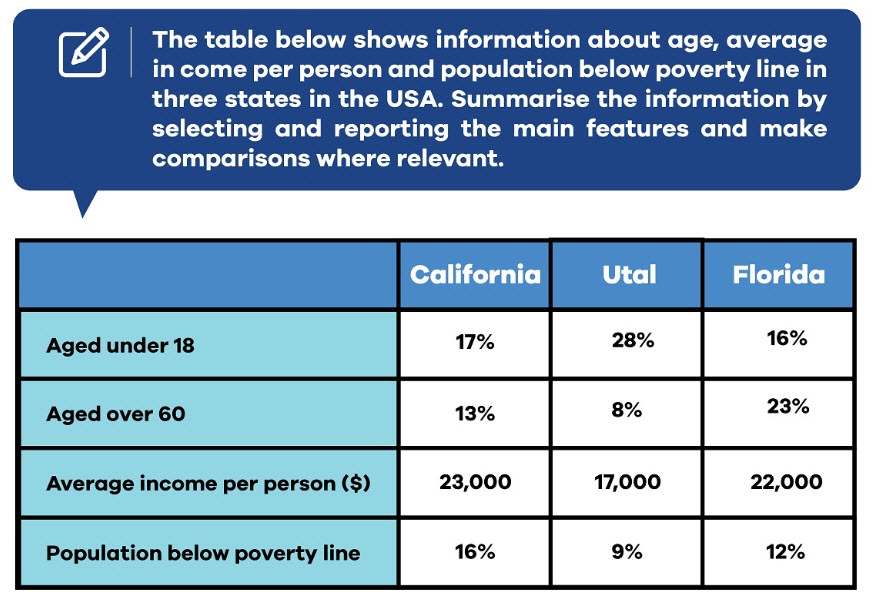
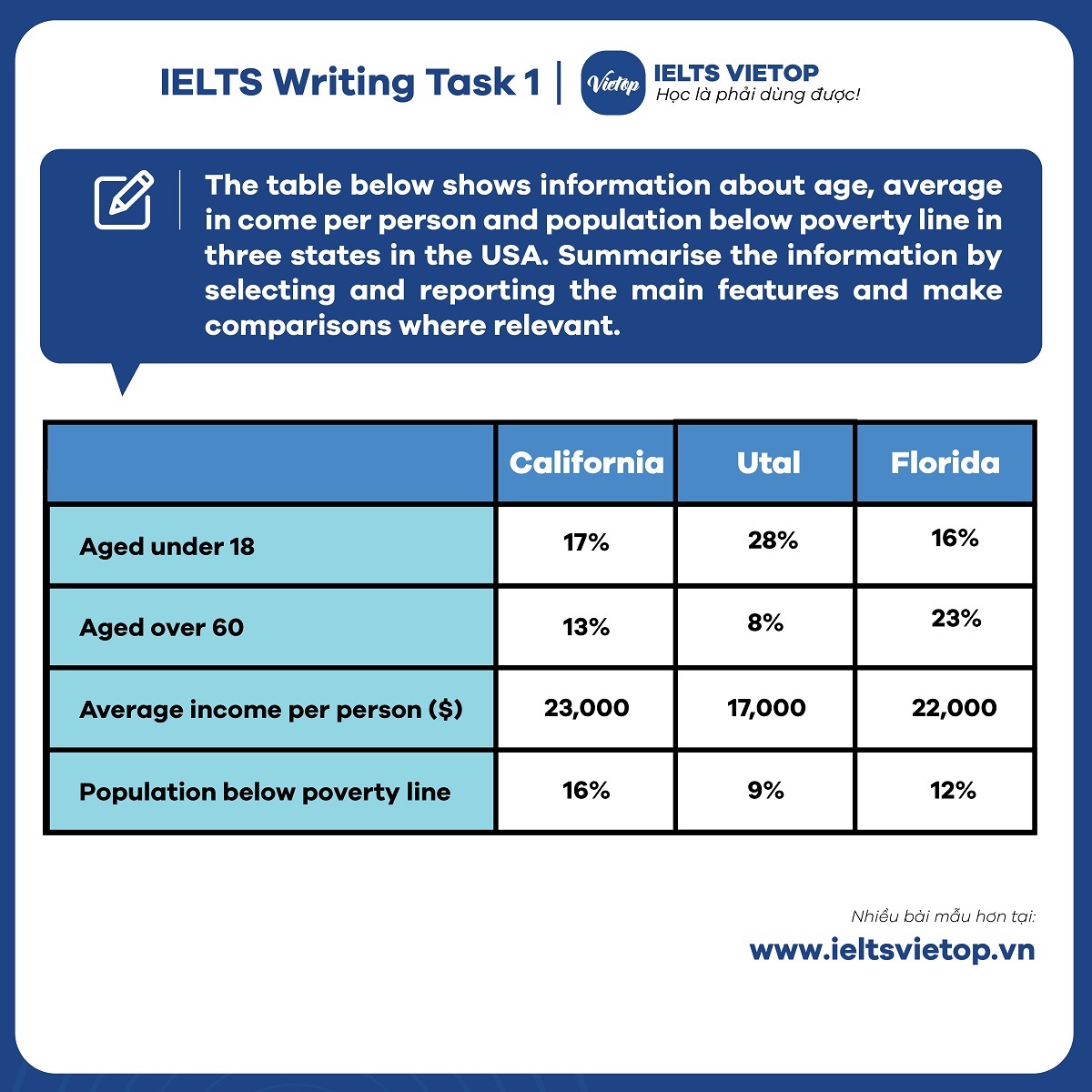
The table details age demographics and their relation to poverty in three states in the United States of America. Looking from an overall perspective, it is readily apparent that there are more young individuals in Utah, while those over 60 in poverty are more common in California and especially Florida. Average incomes are generally highest in California and Florida and the largest proportion of total residents in poverty is highest in California, followed by Florida, and lastly Utah.
In California, 16% of all residents are under the official poverty line, with 17% of all residents under 18 years old and 13% over 60. These figures are broadly similar to Florida where 12% of the population is in poverty (16% of total residents under the age of 18 and a notable 23% over 60). In terms of average income, California was recorded at $23,000 and Florida slightly lower at $22,000.
The figures in Utah are markedly different as only 9% of residents are considered poor. Of the total population age demographics, 28% are under the age of 18 but just 8% are elderly individuals. Additionally, average earnings are lower than the other two states at just $17,000.
Analysis
1. The table details age demographics and their relation to poverty in three states in the United States of America. 2. Looking from an overall perspective, it is readily apparent that there are more young individuals in Utah, while those over 60 in poverty are more common in California and especially Florida. 3. Average incomes are generally highest in California and Florida and the largest proportion of total residents in poverty is highest in California, followed by Florida, and lastly Utah.
Paraphrase what the bar chart shows.
Write a clear overview summarising the differences.
This one is a little complex so it needs a second sentence for the overview.
1. In California, 16% of all residents are under the official poverty line, with 17% of all residents under 18 years old and 13% over 60. 2. These figures are broadly similar to Florida where 12% of the population is in poverty (16% of total residents under the age of 18 and a notable 23% over 60). 3. In terms of average income, California was recorded at $23,000 and Florida slightly lower at $22,000.
Begin writing about the data for the first categories.
Compare between each sentence.
Include all the data.
1. The figures in Utah are markedly different as only 9% of residents are considered poor. Of the total population age demographics, 28% are under the age of 18 but just 8% are elderly individuals. 2. Additionally, average earnings are lower than the other two states at just $17,000.
Write about the final other parts of the graph – include everything!
Compare the categories.
Vocabulary
What do the words in bold below mean?Make some notes on paper to aid memory and then check below.
The table details age demographics and their relation to poverty in three states in the United States of America. Looking from an overall perspective, it is readily apparent that there are more young individuals in Utah, while those over 60 in poverty are more common in California and especially Florida. Average incomes are generally highest in California and Florida and the largest proportion of total residents in poverty is highest in California, followed by Florida, and lastly Utah.
In California, 16% of all residents are under the official poverty line, with 17% of all residents under 18 years old and 13% over 60. These figures are broadly similar to Florida where 12% of the population is in poverty (16% of total residents under the age of 18 and a notable 23% over 60). In terms of average income, California was recorded at $23,000 and Florida slightly lower at $22,000.
The figures in Utah are markedly different as only 9% of residents are considered poor. Of the total population age demographics, 28% are under the age of 18 but just 8% are elderly individuals. Additionally, average earnings are lower than the other two states at just $17,000.
Answers
For extra practice, write an antonym (opposite word) on a piece of paper to help you remember the new vocabulary:
details age demographics shows groups by how old people are
their relation to concerning
poverty not having much money, being poor
Looking from an overall perspective, it is readily apparent that overall
while however
common happens a lot
Average incomes how much you make
generally highest usually the most
largest proportion of total residents in biggest percentage of people who are
followed by after that
lastly finally
under the official poverty line are officially poor
broadly similar to about the same to
population how many people live there
notable significant
In terms of average income when it comes to how much they make/earn
slightly lower at a little less at
markedly different as only totally different because
I recommend getting a pencil and piece of paper because that aids memory. Then write down the missing vocabulary from my sample answer in your notebook:
The table d_______________________________s and t___________________________y in three states in the United States of America. L______________________________________________________t there are more young individuals in Utah, w_____e those over 60 in poverty are more c_____________n in California and especially Florida. A__________________s are g_________________t in California and Florida and the l______________________________________n poverty is highest in California, f______________y Florida, and l________y Utah.
In California, 16% of all residents are u__________________________e, with 17% of all residents under 18 years old and 13% over 60. These figures are b________________________o Florida where 12% of the p________________n is in poverty (16% of total residents under the age of 18 and a n_________e 23% over 60). I________________________e, California was recorded at $23,000 and Florida s___________________t $22,000.
The figures in Utah are m__________________t as only 9% of residents are c_____________d poor. Of the total population age demographics, 28% are under the age of 18 but just 8% are e_________y individuals. A___________y, average earnings are l___________n the other two states at j____t $17,000.
Listening Practice
Learn more about this topic by watching from YouTube below and practice with these activities:
"The highest quality materials anywhere on the internet! Dave improved my writing and vocabulary so much. Really affordable options you don't want to miss out on!"