Some people say that to prevent illness and disease, governments should focus more on reducing environmental pollution and housing problems.
To what extent do you agree or disagree?
Certain concerned parties today contend that the optimal means of improving public health is to confront pressing environmental and housing problems. In my opinion, though these solutions would be helpful, it is more important to prioritize proper nutrition.
On the one hand, there are current issues concerning housing and the environment that impact health. Many illnesses and conditions are either directly or indirectly related to one’s environment. For instance, a person who lives in an overcrowded metropolis such as Hanoi or Beijing must deal on a daily basis with the immediate dangers of air pollution, potential drinking water contamination, car accidents, and elevated crimes rates. If there were fewer individuals in these cities and the air was cleaner because there were more open, green areas, then it is probable that hospitals would be able to focus more on a reduced number of patients.
On the other hand, there are various causes for diseases and the primary one is poor nutrition. In the last several decades, lifespans globally have increased exponentially, largely as a result of advances in medical science and greater understanding of the human body. A standout example of this would be the plant-based diets that are widely recommended by most nutritionists. A person who consumes little meat, reduces their carbohydrate intake, and mostly does not eat sugar will drastically lower the risk of conditions ranging from diabetes and heart disease to Alzheimer’s and cancer. National health authorities can widely and effectively address these health problems by legislating the levels of unhealthy ingredients in food products.
In conclusion, those in favor of combatting housing and environmental problems make legitimate arguments though improving the average citizen’s diet is in fact the best guarantee of good health. Naturally, governments should pursue a balanced policy.
Analysis
1. Certain concerned parties today contend that the optimal means of improving public health is to confront pressing environmental and housing problems. 2. In my opinion, though these solutions would be helpful, it is more important to prioritize proper nutrition.
Paraphrase the overall essay topic.
Write a clear opinion. Read more about introductions here.
1. On the one hand, there are current issues concerning housing and the environment that impact health. 2. Many illnesses and conditions are either directly or indirectly related to one’s environment. 3. For instance, a person who lives in an overcrowded metropolis such as Hanoi or Beijing must deal on a daily basis with the immediate dangers of air pollution, potential drinking water contamination, car accidents, and elevated crimes rates. 4. If there were fewer individuals in these cities and the air was cleaner because there were more open, green areas, then it is probable that hospitals would be able to focus more on a reduced number of patients.
Write a topic sentence with a clear main idea at the end.
Explain your main idea.
Develop it with specific or hypothetical examples.
Keep developing it fully.
1. On the other hand, there are various causes for diseases and the primary one is poor nutrition. 2. In the last several decades, lifespans globally have increased exponentially, largely as a result of advances in medical science and greater understanding of the human body. 3. A standout example of this would be the plant-based diets that are widely recommended by most nutritionists. 4. A person who consumes little meat, reduces their carbohydrate intake, and mostly does not eat sugar will drastically lower the risk of conditions ranging from diabetes and heart disease to Alzheimer’s and cancer. 5. National health authorities can widely and effectively address these health problems by legislating the levels of unhealthy ingredients in food products.
Write a new topic sentence with a new main idea at the end.
Explain your new main idea.
Include specific details and examples.
Add as much information as you can and make sure it links logically.
Continue your development.
1. In conclusion, those in favor of combatting housing and environmental problems make legitimate arguments though improving the average citizen’s diet is in fact the best guarantee of good health. 2. Naturally, governments should pursue a balanced policy.
Summarise your main ideas.
Include a final thought. Read more about conclusions here.
Vocabulary
What do the words in bold below mean?Make some notes on paper to aid memory and then check below.
Certain concerned parties today contend that the optimal means of improving public health is to confront pressing environmental and housing problems. In my opinion, though these solutions would be helpful, it is more important to prioritize proper nutrition.
On the one hand, there are current issues concerning housing and the environment that impact health. Many illnesses and conditions are either directly or indirectly related to one’s environment. For instance, a person who lives in an overcrowded metropolis such as Hanoi or Beijing must deal on a daily basis with the immediate dangers of air pollution, potential drinking water contamination, car accidents, and elevated crimes rates. If there were fewer individuals in these cities and the air was cleaner because there were more open, green areas, then it is probable that hospitals would be able to focus more on a reduced number of patients.
On the other hand, there are various causes for diseases and the primary one is poor nutrition. In the last several decades, lifespans globally have increased exponentially, largely as a result of advances inmedical science and greater understanding of the human body. A standout example of this would be the plant-based diets that are widely recommended by most nutritionists. A person who consumes little meat, reduces their carbohydrate intake, and mostly does not eat sugar will drastically lower the risk of conditions ranging from diabetes and heart disease to Alzheimer’s and cancer. National health authorities can widely and effectively address these health problems by legislating the levels of unhealthy ingredients in food products.
In conclusion, those in favor of combatting housing and environmental problems make legitimate arguments though improving the average citizen’s diet is in fact the best guarantee of good health. Naturally, governments should pursue a balanced policy.
Answers
For extra practice, write an antonym (opposite word) on a piece of paper to help you remember the new vocabulary:
Certain concerned parties today contend some people now argue
optimal means of improving public health best ways of keeping people healthy
confront pressing environmental and housing problems deal with modern problems related to the environment and where people live
solutions remedies
prioritize proper nutrition care more about eating right
On the one hand firstly
current issues concerning new problems having to do with
illnesses sicknesses
conditions illnesses
either directly or indirectly related to one’s environment right from or somehow from what’s around you
overcrowded metropolis big cities
deal on a daily basis with the immediate dangers of air pollution handle every day with risks from unhealthy air
potential drinking water contamination possibly drinking bad water
elevated crimes rates more criminal offenses
more open, green areas public spaces and parks
then it is probable that therefore there is a good chance that
focus more on a reduced number of patients concentrate more on fewer sick people
On the other hand however
various causes for different reasons for
primary one main one
poor nutrition unhealthy
In the last several decades over 20 to 30 years
lifespans how long people live
increased exponentially went up a lot
largely as a result of advances inmedical science mostly because of better medicine
greater understanding of the human body better conception of human health
A standout example of this would be the best instance of this is
plant-based diets mostly just eating vegetables
widely recommended by most nutritionists the advice of most doctors
consumes little meat not eating too many animals
reduces their carbohydrate intake not having so many grains and breads
mostly does not eat sugar will drastically lower the risk of conditions ranging from diabetes and heart disease to Alzheimer’s and cancer not eating sweet foods makes it less likely you will get diabetes or have a heart attack or suffer from dementia or get cancer
National health authorities can widely and effectively address governments can unilaterally deal with
legislating putting into law
levels how high it is
unhealthy ingredients in food products fats, sugar, carbs
those in favor of combatting housing and environmental problems make legitimate arguments people who support working against these problems make good points
in fact the best guarantee of good health the optimal way to make sure you are healthy
Naturally of course
pursue a balanced policy follow a more moderate path
I recommend getting a pencil and piece of paper because that aids memory. Then write down the missing vocabulary from my sample answer in your notebook:
C_____________________________________d that the o_____________________________________h is to c___________________________________________________________s. In my opinion, though these s_________s would be helpful, it is more important to p________________________n.
O________________d, there are c___________________g housing and the environment that impact health. Many i___________s and c___________s are e_____________________________________________t. For instance, a person who lives in an o________________________s such as Hanoi or Beijing must d_______________________________________________________________n, p____________________________________________n, car accidents, and e________________________s. If there were fewer individuals in these cities and the air was cleaner because there were m______________________________s, t____________________________________t hospitals would be able to f____________________________________________s.
O_________________d, there are v___________________r diseases and the p_______________e is p________________n. I__________________________s, l____________s globally have i_____________________y, l_______________________________________e and g________________________________________y. A___________________________________e the p_________________s that are w_____________________________________s. A person who c_____________________t, r_________________________e, and m________________________________________________________________________________________________________________________________r. N_________________________________s these health problems by l___________g the l________s of u___________________________________s.
In conclusion, t______________________________________________________________________s though improving the average citizen’s diet is i_____________________________h. N____________y, governments should p___________________________y.
Listening Practice
Learn more about this topic by watching from YouTube below and practice with these activities:
Here all the sample answer IELTS essays that I have written on the topic of the environment!
This includes essays related to pollution, environmental science, factories, climate change/global warming, endangered animals, alternative/clean energy, fossil fuels, recycling, and more.
Eco-tourism often involves visiting remote and fragile ecosystems, which raises concerns about the impact on local cultures and indigenous communities.
Many people believe that it is easier to have a healthy lifestyle in the countryside. Other believe that there are health benefits to living in cities.
It is a natural process for animal species to become extinct (e.g. dinosaurs, dodos, etc.). There is no reason why people should try to prevent this from happening.
Some people believe that wild animals should not be kept in zoos or other man-made environments as there is no longer a need for them in the 21st century.
Some people say that supermarkets and manufacturers have a responsibility to reduce the amount of packaging on products they sell. Others believe that it is the consumer’s responsibility to avoid buying products which have a lot of packaging.
In the future, people may have to live on other planets. Some think that it is therefore important to spend money researching other planets such as Mars.
Most agree that we should be training children to recycle waste to preserve the Earth’s natural resources. However, some believe that it is parents who should teach their children to recycle waste while others feels schools are more responsible.
Some people say that the main environmental problem of our time is the loss of particular species of plants and animals. Others say that there are more important environmental problems.
Discuss both these views and give your own opinion.
Climate change is a phenomenon that affects countries all over the world. Many people strongly believe that it is the responsibility of individuals, rather than corporations and governments, to deal with this problem.
Some people believe that car-free days are effective ways to reduce air pollution. However, others argue that there are other ways that are more effective.
Many governments think that economic progress is their most important goal. Some people, however, think that other types of progress are equally important for a country.
Discuss both these views and give your own opinion.
Some people claim that not enough waste from homes is recycled and that the only way to increase recycling is for governments to make it a legal requirement.
Some people think that the government should strictly control the supply of fresh water, as it is a limited resource, while others it should not be regulated.
In many cities, problems related to overpopulation are becoming more common. Some governments are now encouraging businesses and individuals to move out of cities to rural areas.
Do the advantages of this trend outweigh the disadvantages?
Some people believe that children of all ages should have extra responsibilities (for example, helping at home or at work). Others believe that, outside of school, children should be free to enjoy their lives.
Discuss both views and give your own opinion.
Many today have argued for the importance of children having greater responsibility in the home. I am generally in agreement with this position, though it should naturally not be taken to extremes.
Critics of such an approach maintain that it can overburden young children. In many societies around the world today, children are under immense pressure at school to perform well academically. In many Asian countries, for example, young children must study at school until the late afternoon, have dinner, and then take additional classes before doing their homework each night. If these students were also tasked with cleaning the house or washing their own clothes, they simply would not have enough time to complete all their responsibilities and rest for the next day.
However, increased responsibility encourages greater maturity and self-reliance. A child who must ensure their room is clean and takes part in either cooking or cleaning up afterwards better understands the importance of time management and how to run a household. In contrast, some parents are overly protective of their children and do not instill traits related to independence. If a child grows up and attends university without a variety of life skills or the maturity that comes from looking after themselves, then they will likely struggle to adjust and may be viewed as childish by their peers.
In conclusion, though there must be logical limits to the amount of work that children should do in the home, it is an advisable approach overall to increase a child’s sense of responsibility. The benefits later in life justify any potential fatigue.
Analysis
1. Many today have argued for the importance of children having greater responsibility in the home. 2. I am generally in agreement with this position, though it should naturally not be taken to extremes.
Paraphrase the overall essay topic.
Write a clear opinion. Read more about introductions here.
1. Critics of such an approach maintain that it can overburden young children. 2. In many societies around the world today, children are under immense pressure at school to perform well academically. 3. In many Asian countries, for example, young children must study at school until the late afternoon, have dinner, and then take additional classes before doing their homework each night. 4. If these students were also tasked with cleaning the house or washing their own clothes, they simply would not have enough time to complete all their responsibilities and rest for the next day.
Write a topic sentence with a clear main idea at the end.
Explain your main idea.
Develop it with specific or hypothetical examples.
Keep developing it fully.
You might add a counterpoint here.
1. However, increased responsibility encourages greater maturity and self-reliance. 2. A child who must ensure their room is clean and takes part in either cooking or cleaning up afterwards better understands the importance of time management and how to run a household. 3. In contrast, some parents are overly protective of their children and do not instill traits related to independence. 4. If a child grows up and attends university without a variety of life skills or the maturity that comes from looking after themselves, then they will likely struggle to adjust and may be viewed as childish by their peers.
Write a new topic sentence with a new main idea at the end.
Explain your new main idea.
Include specific details and examples.
Add as much information as you can and make sure it links logically.
Continue your development.
Finish the paragraph strong.
1. In conclusion, though there must be logical limits to the amount of work that children should do in the home, it is an advisable approach overall to increase a child’s sense of responsibility. 2. The benefits later in life justify any potential fatigue.
Summarise your main ideas.
Include a final thought. Read more about conclusions here.
Vocabulary
What do the words in bold below mean?Make some notes on paper to aid memory and then check below.
Many today have argued for the importance of children having greater responsibility in the home. I am generally in agreement with this position, though it should naturally not be taken to extremes.
Critics of such an approach maintain that it can overburden young children. In many societies around the world today, children are under immense pressure at school to perform well academically. In many Asian countries, for example, young children must study at school until the late afternoon, have dinner, and then take additional classes before doing their homework each night. If these students were also tasked with cleaning the house or washing their own clothes, they simply would not have enough time to complete all their responsibilities and rest for the next day.
However, increased responsibility encourages greater maturity and self-reliance. A child who must ensure their room is clean and takes part in either cooking or cleaning up afterwards better understands the importance of time management and how to run a household. In contrast, some parents are overly protective of their children and do not instill traits related to independence. If a child grows up and attends university without a variety of life skills or the maturity that comes from looking after themselves, then they will likely struggle to adjust and may be viewed as childish by their peers.
In conclusion, though there must be logical limits to the amount of work that children should do in the home, it is an advisable approach overall to increase a child’s sense of responsibility. The benefits later in life justify any potential fatigue.
Answers
For extra practice, write an antonym (opposite word) on a piece of paper to help you remember the new vocabulary:
argued for the importance of are in favor of
greater responsibility in the home more duty in one’s house
I am generally in agreement with this position I agree mostly with the opinion that
naturally of course
taken to extremes pursued in a strong way
Critics those against it
approach maintain way argue
overburden put too much pressure on
under immense pressure at school to perform well academically have lots of stress to do well in their classes
late afternoon around 3 – 5pm
take additional classes sign up for more courses
each night every night
tasked with are assigned
complete all their responsibilities finish their work
rest relaxing
increased responsibility encourages greater maturity and self-reliance more duty motivates them to be more responsible
ensure make sure of
takes part in engages in
afterwards after that
how to run a household how to take care of your place
overly protective of looking too much after
instill traits related to independence sculpt kids to be self-reliant
attends goes to
without a variety of life skills not having lots of abilities like cooking, cleaning, etc.
maturity how old you are emotionally
looking after themselves taking care of themselves
likely struggle to adjust probably have difficulty adapting
may be viewed as childish by their peers might seem immature by other classmates
logical limits rational levels
advisable approach overall good idea in general
sense of responsibility feeling of duty
later in life justify any potential fatigue after that make it worth it to be tired
I recommend getting a pencil and piece of paper because that aids memory. Then write down the missing vocabulary from my sample answer in your notebook:
Many today have a______________________________f children having g______________________________e. I a____________________________________________n, though it should n____________y not be t_____________s.
C_______s of such an a__________________n that it can o____________n young children. In many societies around the world today, children are u_____________________________________________________________y. In many Asian countries, for example, young children must study at school until the l__________________n, have dinner, and then t__________________s before doing their homework e_____________t. If these students were also t_____________h cleaning the house or washing their own clothes, they simply would not have enough time to c__________________________________s and r____t for the next day.
However, i_________________________________________________________________________e. A child who must e______e their room is clean and t_____________n either cooking or cleaning up a__________s better understands the importance of time management and h___________________d. In contrast, some parents are o_____________________f their children and do not i_____________________________________________e. If a child grows up and a_________s university w_____________________________________________s or the m________y that comes from l_______________________s, then they will l___________________________t and m_____________________________________________s.
In conclusion, though there must be l_____________s to the amount of work that children should do in the home, it is an a_______________________________l to increase a child’s s______________________y. The benefits l________________________________________________e.
Listening Practice
Learn more about this topic by watching from YouTube below and practice with these activities:
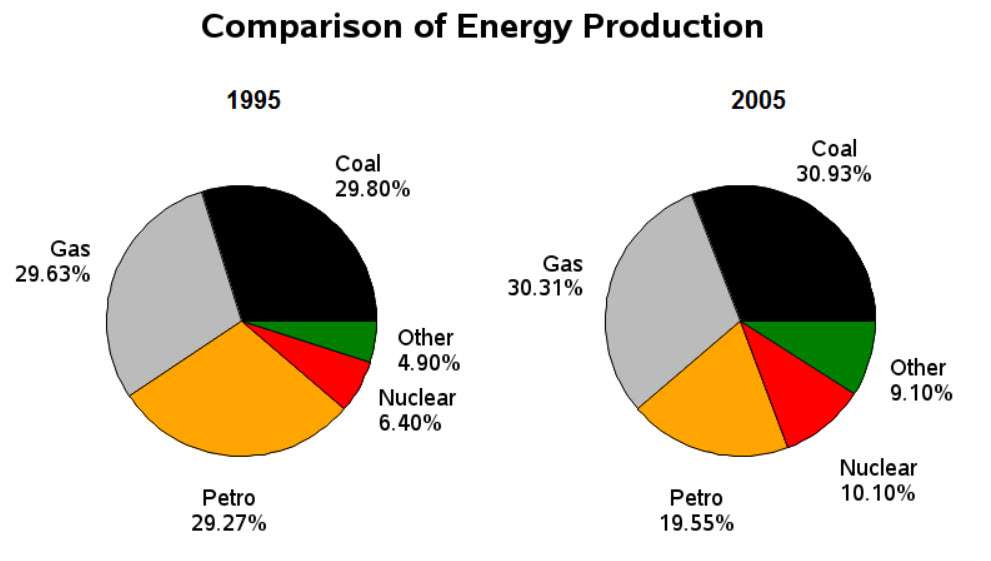
The pie charts show information about energy production in a country in two separate years.
The pie charts detail the distribution of various energy sources in a given nation in the years 1995 and 2005. Looking from an overall perspective, it is readily apparent that production of two main energies (coal and gas) rose marginally, while petrol declined considerably. ‘Other’ and nuclear production also grew greatly, despite remaining less popular in both years.
In 1995, coal, gas, and petrol were roughly equal in terms of energy production with each slightly above 29%. By 2005, the figures for coal and gas had risen moderately (30.93% and 30.31%, respectively) while petrol exploitation declined to represent just 19.55% of all sources.
The data for the remaining categories was considerably lower with ‘other’ accounting for 4.9% of energy production to begin the period and nuclear noticeably higher at 6.4%. By 2005, ‘other’ had narrowed the disparity and nearly doubled to 9.1% as nuclear energy use grew more slowly to reach 10.1%.
Analysis
1. The pie charts detail the distribution of various energy sources in a given nation in the years 1995 and 2005. 2. Looking from an overall perspective, it is readily apparent that production of two main energies (coal and gas) rose marginally, while petrol declined considerably. 3. ‘Other’ and nuclear production also grew greatly, despite remaining less popular in both years.
Paraphrase what the bar chart shows.
Write a clear overview summarising the differences and the overall trend.
This one is a little complex so it needs a second sentence for the overview.
1. In 1995, coal, gas, and petrol were roughly equal in terms of energy production with each slightly above 29%. 2. By 2005, the figures for coal and gas had risen moderately (30.93% and 30.31%, respectively) while petrol exploitation declined to represent just 19.55% of all sources.
Begin writing about the data for the first categories.
Compare between each sentence.
1. The data for the remaining categories was considerably lower with ‘other’ accounting for 4.9% of energy production to begin the period and nuclear noticeably higher at 6.4%. 2. By 2005, ‘other’ had narrowed the disparity and nearly doubled to 9.1% as nuclear energy use grew more slowly to reach 10.1%.
Write about the final other parts of the graph – include everything!
Compare the categories.
Vocabulary
What do the words in bold below mean?Make some notes on paper to aid memory and then check below.
The pie charts detail the distribution of various energy sources in a given nation in the years 1995 and 2005. Looking from an overall perspective, it is readily apparent that production of two main energies (coal and gas) rose marginally, while petrol declined considerably. ‘Other’ and nuclear production also grew greatly, despiteremaining less popular in both years.
In 1995, coal, gas, and petrol were roughly equal in terms of energy production with each slightly above 29%. By 2005, the figures for coal and gas had risen moderately (30.93% and 30.31%, respectively) while petrol exploitation declined to represent just 19.55% of all sources.
The data for the remaining categories was considerably lower with ‘other’ accounting for 4.9% of energy production to begin the period and nuclear noticeably higher at 6.4%. By 2005, ‘other’ had narrowed the disparity and nearly doubled to 9.1% as nuclear energy use grew more slowly to reach 10.1%.
Answers
For extra practice, write an antonym (opposite word) on a piece of paper to help you remember the new vocabulary:
detail show
distribution how it is allocated to each category
various energy sources in a given nation where energy comes from in a country
Looking from an overall perspective, it is readily apparent that overall
rose marginally increased a bit
petrol declined considerably gas went down a lot
nuclear related to radiation and uranium
grew greatly increased a lot
despiteremaining less popular in both years regardless of being less common in each time period
roughly equal in terms of about the same concerning
slightly above just a bit over
figures numbers
had risen moderately had increased a bit
respectively in turn
exploitation declined taking advantage of decreased
represent just stand for only
data figures
remaining categories extra areas
considerably lower with much less than
accounting for representing
to begin the period starting the time at
noticeably higher at much bigger at
narrowed the disparity came much closer to each other, to being equal
nearly doubled almost 2x
grew more slowly to reach increased slightly to get to
I recommend getting a pencil and piece of paper because that aids memory. Then write down the missing vocabulary from my sample answer in your notebook:
The pie charts d_______l the d______________n of v_________________________________________n in the years 1995 and 2005. L______________________________________________t production of two main energies (coal and gas) r______________y, while p______________________________y. ‘Other’ and n___________r production also g____________y, d___________________________________s.
In 1995, coal, gas, and petrol were r_________________________f energy production with each s____________e 29%. By 2005, the f_________s for coal and gas h______________________y (30.93% and 30.31%, r_____________y) while petrol e_______________________d to r___________t 19.55% of all sources.
The d_____a for the r___________________________s was c_____________________________h ‘other’ a____________________r 4.9% of energy production t______________________d and nuclear n_______________________t 6.4%. By 2005, ‘other’ had n________________________y and n_______________d to 9.1% as nuclear energy use g_____________________________h 10.1%.
Listening Practice
Learn more about this topic by watching from YouTube below and practice with these activities:
In recent years, there has been growing interest in the relationship between equality and personal achievement. Some people believe that individuals can achieve more in egalitarian societies. Others believe that high levels of personal achievement are possible only if individuals are free to succeed or fail according to their individual merits.
Discuss both sides and give your own opinion.
In recent decades, there has been considerable debate about whether or not individual achievement is greater in egalitarian or more hierarchical societies. In my opinion, despite the benefits of egalitarianism as a political principle, it should not be pursued as a social ideal.
Those who argue egalitarian societies are better for achievement point out the benefits of opportunity. The most well-known examples of this are in socialist nations in Europe like France where income disparity is less pronounced than in more capitalist countries. In such liberal countries, a person can receive a good education, secure stable employment, receive unemployment benefits in the case of an economic downturn, and support the rest of society by paying high taxes. Being part of such a community is itself a motivation for individuals to perform well at work and pursue life goals. This is especially the case as a person will not have to feel anxious about the possibility of being left behind by society at large.
I would contend that when conditions are generally equal individuals should then be permitted to compete without considerable governmental regulation. The standout example for this situation would be in the United States. Although there are more problems related to income inequality, there is also greater innovation across a variety of sectors. One cause of this is that individuals are motivated by the desire to excel and earn the financial rewards that accompany success. A person is therefore encouraged to attain their own definition of success or they might be forced to live on the fringes of society.
In conclusion, though there is a cruel element to competition, it is the best way to encourage innovation and growth in an individual and society as a whole. Naturally, such an approach is only possible when systemic problems related to discrimination have first been eliminated.
Analysis
1. In recent decades, there has been considerable debate about whether or not individual achievement is greater in egalitarian or more hierarchical societies. 2. In my opinion, despite the benefits of egalitarianism as a political principle, it should not be pursued as a social ideal.
Paraphrase the overall essay topic.
Write a clear opinion. Read more about introductions here.
1. Those who argue egalitarian societies are better for achievement point out the benefits of opportunity. 2. The most well-known examples of this are in socialist nations in Europe like France where income disparity is less pronounced than in more capitalist countries. 3. In such liberal countries, a person can receive a good education, secure stable employment, receive unemployment benefits in the case of an economic downturn, and support the rest of society by paying high taxes. 4. Being part of such a community is itself a motivation for individuals to perform well at work and pursue life goals. 5. This is especially the case as a person will not have to feel anxious about the possibility of being left behind by society at large.
Write a topic sentence with a clear main idea at the end.
Explain your main idea.
Develop it with specific or hypothetical examples.
Keep developing it fully.
You might add a counterpoint here.
1. I would contend that when conditions are generally equal individuals should then be permitted to compete without considerable governmental regulation. 2. The standout example for this situation would be in the United States. 3. Although there are more problems related to income inequality, there is also greater innovation across a variety of sectors. 4. One cause of this is that individuals are motivated by the desire to excel and earn the financial rewards that accompany success. 5. A person is therefore encouraged to attain their own definition of success or they might be forced to live on the fringes of society.
Write a new topic sentence with a new main idea at the end.
Explain your new main idea.
Include specific details and examples.
Add as much information as you can and make sure it links logically.
Continue your development.
1. In conclusion, though there is a cruel element to competition, it is the best way to encourage innovation and growth in an individual and society as a whole. 2. Naturally, such an approach is only possible when systemic problems related to discrimination have first been eliminated.
Summarise your main ideas.
Include a final thought. Read more about conclusions here.
Vocabulary
What do the words in bold below mean?Make some notes on paper to aid memory and then check below.
In recent decades, there has been considerable debate about whether or not individual achievement is greater in egalitarian or more hierarchical societies. In my opinion, despite the benefits of egalitarianism as a political principle, it should not be pursued as a social ideal.
Those who argue egalitarian societies are better for achievement point out the benefits of opportunity. The most well-known examples of this are in socialist nations in Europe like France where income disparity is less pronounced than in more capitalist countries. In such liberal countries, a person can receive a good education, secure stable employment, receive unemployment benefits in the case of an economic downturn, and support the rest of society by paying high taxes. Being part of such a community is itself a motivation for individuals to perform well at work and pursue life goals. This is especially the case as a person will not have to feel anxious about the possibility of being left behind by society at large.
I would contend that when conditions are generally equal individuals should then be permitted to compete without considerable governmental regulation. The standout example for this situation would be in the United States. Although there are more problems related to income inequality, there is also greater innovation across a variety of sectors. One cause of this is that individuals are motivated by the desire to excel and earn the financial rewards that accompany success. A person is therefore encouraged to attain their own definition of success or they might be forced to live on the fringes of society.
In conclusion, though there is a cruel element to competition, it is the best way to encourage innovation and growth in an individual and society as a whole. Naturally, such an approach is only possible when systemic problems related to discrimination have first been eliminated.
Answers
For extra practice, write an antonym (opposite word) on a piece of paper to help you remember the new vocabulary:
In recent decades the last 20 or 30 years
there has been considerable debate about whether or not lots of conflict concerning
achievement how much you get done
greater more than
egalitarian equal
more hierarchical societies countries with clear classes
despite the benefits of egalitarianism as a political principle regardless of the advantages of equal rights
should not be pursued as a social ideal is not a desirable way to live
point out argue
benefits advantages
opportunity chance
The most well-known examples of this are in socialist nations best instances exist in more equal countries
income disparity differences in how much people earn
less pronounced than in more capitalist countries not as different as in more market-oriented nations
liberal socialist, more open and free
receive get
secure stable employment have a good job
receive unemployment benefits in the case of an economic downturn get money from the government when the economy is not doing well
support the rest of society by paying high taxes help everyone by paying some of your salary to the government
motivation encouragement
perform well do well
pursue life goals seek out achievements in life
This is especially the case as particularly the true because
anxious nervous
possibility chance
left behind by society at large not keeping up with the rest of the public
contend argue
conditions situations
generally equal mostly the same
permitted to compete without considerable governmental regulation allowed to do what they want without interference
The standout example for this situation would be best instance of this is
related to income inequality concerning people not being equal
innovation across a variety of sectors new ideas in many industries
One cause of this is that one source is
desire what you want
excel do well
earn the financial rewards make money
accompany success go along with success
attain their own definition of success achieve what they want
on the fringes of society nearly outside of society
cruel element to competition mean part of fighting with others
I recommend getting a pencil and piece of paper because that aids memory. Then write down the missing vocabulary from my sample answer in your notebook:
I_________________________s, t_______________________________________________________t individual a______________t is g_________r in e_______________n or m_____________________________s. In my opinion, d____________________________________________e, it s_________________________________________________l.
Those who argue egalitarian societies are better for achievement p____________t the b___________s of o______________y. T_______________________________________________________s in Europe like France where i__________________y is l__________________________________________________________s. In such l__________l countries, a person can r__________e a good education, s__________________________________t, r_______________________________________________________________n, and s____________________________________________s. Being part of such a community is itself a m_________________n for individuals to p_________________l at work and p____________________s. T______________________________s a person will not have to feel a______________s about the p_________________y of being l__________________________________e.
I would c__________d that when c_______________s are g______________________l individuals should then be p_________________________________________________________n. T_________________________________________e in the United States. Although there are more problems r_________________________y, there is also greater i__________________________________________s. O______________________________t individuals are motivated by the d_______e to e_______l and e_____________________________s that a______________________s. A person is therefore encouraged to a____________________________________________s or they might be forced to live o______________________________y.
In conclusion, though there is a c_____________________________n, it is the best way to encourage innovation and growth in an individual and s_______________________e. N________________y, such an a________h is only possible when s______________________________s related to d________________n have f_____t been e___________d.
Listening Practice
Learn more about this topic by watching from YouTube below and practice with these activities:
"The highest quality materials anywhere on the internet! Dave improved my writing and vocabulary so much. Really affordable options you don't want to miss out on!"