IELTS Task 1 Essay: Map of a Museum in 1990 and 2010
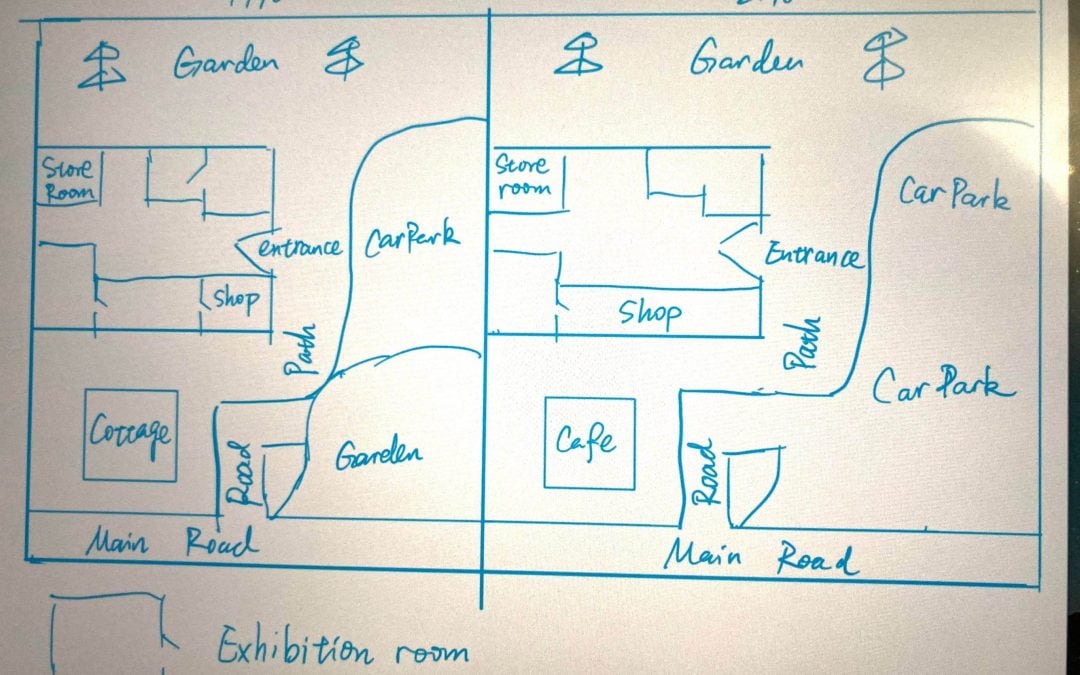
The diagrams show a museum and its surroundings in 1990 and 2010.
The map details renovations to a museum and the surrounding grounds from 1990 to 2010. Looking from an overall perspective, it is readily apparent that the museum itself decreased the square footage for exhibitions and outside there were significant alterations to the surrounding area to allow for greater access and leisure.
Internally, the museum in 1990 contained a store room in the top left corner, various exhibition spaces on all sides, and a small shop in the bottom right. By 2010, the only modification was that the shop was extended towards the left at the expense of the adjacent exhibition room.
Outside the main structure, the largest single change was the expansion of the car park on the right side which subsumed a garden beneath it. The paths and roads as well as the garden above the car park were unchanged. The final difference was the cottage in the bottom left corner across from the museum was renovated to become a cafe.
Analysis
1. The map details renovations to a museum and the surrounding grounds from 1990 to 2010. 2. Looking from an overall perspective, it is readily apparent that the museum itself decreased the square footage for exhibitions and outside there were significant alterations to the surrounding area to allow for greater access and leisure.
Paraphrase what the map shows.
Write a clear overview summarising the differences.
1. Internally, the museum in 1990 contained a store room in the top left corner, various exhibition spaces on all sides, and a small shop in the bottom right. 2. By 2010, the only modification was that the shop was extended towards the left at the expense of the adjacent exhibition room.
Begin writing about the map.
Make sure you compare as much as possible.
1. Outside the main structure, the largest single change was the expansion of the car park on the right side which subsumed a garden beneath it. 2. The paths and roads as well as the garden above the car park were unchanged. 3. The final difference was the cottage in the bottom left corner across from the museum was renovated to become a cafe.
Write about the final, other parts of the map – include everything!
Compare the categories.
Add in everything, even what has not changed.
Vocabulary
What do the words in bold below mean?Take some notes on a piece of paper to aid your memory:
The map details renovations to a museum and the surrounding grounds from 1990 to 2010. Looking from an overall perspective, it is readily apparent that the museum itself decreased the square footage for exhibitions and outside there were significant alterations to the surrounding area to allow for greater access and leisure.
Internally, the museum in 1990 contained a store room in the top left corner, various exhibition spaces on all sides, and a small shop in the bottom right. By 2010, the only modification was that the shop was extended towards the left at the expense of the adjacent exhibition room.
Outside the main structure, the largest single change was the expansion of the car park on the right side which subsumed a garden beneath it. The paths and roads as well as the garden above the car park were unchanged. The final difference was the cottage in the bottom left corner across from the museum was renovated to become a cafe.
Answers
Try to write down or think of an antonym/opposite word for further practice:
details shows
renovations changes
surrounding grounds area around it
Looking from an overall perspective, it is readily apparent that in general
Remember and fill in the blanks. Note it on a piece of paper so you can remember better:
The map d__________s r________________s to a museum and the s_________________s from 1990 to 2010. L__________________________________________________t the museum itself decreased the s_____________e for e_____________s and o_______e there were s_____________________s to the s________________a to a_______r g______________s and l_________e.
I__________y, the museum in 1990 c________d a s________m in the top left corner, v___________________s on a_____________s, and a s_________p in the bottom right. By 2010, the only m__________n was that the shop was e______________s the left a__________________f the adjacent exhibition room.
Outside the m_________________e, the l_________________________e was the e__________n of the car park on the right side which s___________d a g________________h it. The p______s and r______s a__________s the garden above the car park were u_________d. The f_________________e was the cottage in the bottom left corner a_____________m the museum was r____________d to become a c___e.
Listening Practice
Listen to the related topic below and practice with these activities:
Here all the sample answer IELTS essays that I have written on the topic of family!
This includes essays related to children, husbands, wives, spouses, grandparents, work/life balance, houses, apartments, parents, childbirth, and more.
In some countries, there has been an increase in the number of advertisements which try to persuade children to buy snacks, toys, and other goods. Parents often claim that these ads are unfair.
Some believe that younger family members should be legally responsible for supporting older family members when they become physically, mentally and financially unable to look after themselves.
Some people believe that allowing children to make their own choices on everyday matters (such as food, clothes and entertainment) is likely to result in a society of individuals who only think about their own wishes. Other people believe that it is important for children to make decisions about matters that affect them.
Some people believe that the experiences children have before they go to school will have the greatest effect on their future life. Others argue that experiences gained when they are teenagers have a bigger influence.
Some people believe that children should do sports so that they will grow up as healthy adults, but others feel sports are just about enjoying yourself.
Discuss these both views and give your own opinion.
Some people think children should have the freedom to make mistakes, while other people believe that adults should prevent children from making mistakes.
Some people claim that not enough waste from homes is recycled and that the only way to increase recycling is for governments to make it a legal requirement.
To what extent do you agree or disagree?
Many today would claim that the optimal method to encourage individuals to recycle more often is for governments to legally enforce it. In my opinion, there are subtler approaches governments could take though this reform would undoubtedly be effective.
The principle rationale in favor of this argument is that only governments can force the average person to act when there are pressing social concerns. The world is facing an uncertain future because of increasingly severe environmental problems largely related to overpopulation and human activity. Therefore, governments can justifiably compel their citizens to contribute to the solution by recycling. At the moment, only a small proportion of households recycle consistently but a law that required all families to separate and categorize their garbage would undeniably help combat climate change. This is best evidenced in nations where residents do recycle frequently and the environment is not as direly threatened, such as in Japan.
However, the public backlash to this reform could be avoided with more nuanced reforms. Instead of forcing all households to recycle the government could institute a variety of reforms such as offering incentives to companies that recycle, educating young people about the benefits of recycling, and making recycling in schools a point of emphasis. These minor alterations to existing policy would allow the general public to slowly transition to a more sustainable lifestyle and avoid any potential controversy. If, on the other hand, the reforms were strictly mandated, there is a strong chance that in nations like the United States where individuals are protective of their civil liberties, the government might do more harm than good in the short-term.
In conclusion, though compulsory recycling is a well-intentioned aim, it should not be prioritized over less invasive regulations. In this way, governments will be able to achieve long-term success without alienating the public.
Analysis
1. Many today would claim that the optimal method to encourage individuals to recycle more often is for governments to legally enforce it. 2. In my opinion, there are subtler approaches governments could take though this reform would undoubtedly be effective.
Paraphrase the overall essay topic.
Write a clear opinion. Read more about introductions here.
1. The principle rationale in favor of this argument is that only governments can force the average person to act when there are pressing social concerns. 2. The world is facing an uncertain future because of increasingly severe environmental problems largely related to overpopulation and human activity. 3. Therefore, governments can justifiably compel their citizens to contribute to the solution by recycling. 4. At the moment, only a small proportion of households recycle consistently but a law that required all families to separate and categorize their garbage would undeniably help combat climate change. 5. This is best evidenced in nations where residents do recycle frequently and the environment is not as direly threatened, such as in Japan.
Write a topic sentence with a clear main idea at the end.
Explain your main idea.
Develop it with specific or hypothetical examples.
Keep developing it fully.
Short sentences can make your writing clearer.
State the fullest possible result.
1. However, the public backlash to this reform could be avoided with more nuanced reforms. 2. Instead of forcing all households to recycle the government could institute a variety of reforms such as offering incentives to companies that recycle, educating young people about the benefits of recycling, and making recycling in schools a point of emphasis. 3. These minor alterations to existing policy would allow the general public to slowly transition to a more sustainable lifestyle and avoid any potential controversy. 4. If, on the other hand, the reforms were strictly mandated, there is a strong chance that in nations like the United States where individuals are protective of their civil liberties, the government might do more harm than good in the short-term.
Write a new topic sentence with a new main idea at the end.
Explain your new main idea.
Include specific details and examples.
Add as much information as you can and make sure it links logically.
1. In conclusion, though compulsory recycling is a well-intentioned aim, it should not be prioritized over less invasive regulations. 2. In this way, governments will be able to achieve long-term success without alienating the public.
Summarise your main ideas.
Include a final thought. Read more about conclusions here.
Vocabulary
What do the words in bold below mean?Make some notes on paper to aid memory and then check below.
Many today would claim that the optimal method to encourage individuals to recycle more often is for governments to legally enforce it. In my opinion, there are subtler approaches governments could take though this reform would undoubtedly be effective.
The principle rationale in favor of this argument is that only governments can force the average person to act when there are pressing social concerns. The world is facing an uncertain future because of increasingly severe environmental problems largely related to overpopulation and human activity. Therefore, governments can justifiably compel their citizens to contribute to the solution by recycling. At the moment, only a small proportion of households recycle consistently but a law that required all families to separate and categorize their garbage would undeniably help combat climate change. This is best evidenced in nations where residents do recycle frequently and the environment is not as direly threatened, such as in Japan.
However, the public backlash to this reform could be avoided with more nuanced reforms. Instead of forcing all households to recycle the government could institute a variety of reforms such as offering incentives to companies that recycle, educating young people about the benefits of recycling, and making recycling in schools a point of emphasis. These minor alterations to existing policy would allow the general public to slowly transition to a more sustainable lifestyle and avoid any potential controversy. If, on the other hand, the reforms were strictly mandated, there is a strong chance that in nations like the United States where individuals are protective of their civil liberties, the government might do more harm than good in the short-term.
In conclusion, though compulsory recycling is a well-intentioned aim, it should not be prioritized over less invasive regulations. In this way, governments will be able to achieve long-term success without alienating the public.
Answers
For extra practice, write an antonym (opposite word) on a piece of paper to help you remember the new vocabulary:
claim argue
optimal method best way
encourage say it is a good idea
recycle turn waste into something new
legally enforce make into a law
subtler approaches not as overt change
though however
reform change
undoubtedly definitely
effective would work
principle rationale main reason
in favor of supporting
argument claim
force make them do this
average person normal resident
pressing social concerns important problems for all of the public
facing confronting
uncertain future not a clear future
increasingly severe getting worse and worse
environmental problems issues related to nature
largely related to mostly concerning
overpopulation more and more people
human activity what people do
justifiably compel with good reason force
contribute add to
solution remedy
At the moment right now
small proportion little percentage
consistently all the time
required need to
separate apart from
categorize put into groups
garbage trash
undeniably definitely
combat climate change fight the worsening environment
evidenced supported by
residents people who live in place, citizens
direly threatened deeply at risk
public backlash people angry about it
avoided get around
nuanced reforms complex new regulations
Instead of rather than
institute put in place
variety different kinds
offering incentives give rewards
benefits good for
a point of emphasis something to focus on
minor alterations small changes
existing policy what is already being done
slowly transition over time move to
sustainable lifestyle environmentally-friendly ways of living
avoid any potential controversy stay away from upsetting people
reforms changes
strictly mandated strong laws
strong chance good chance of
protective care a lot about
civil liberties freedoms
might do more harm than good in the short-term might actually hurt
I recommend getting a pencil and piece of paper because that aids memory. Then write down the missing vocabulary from my sample answer in your notebook:
Many today would c______m that the o_________________d to e______________e individuals to r________e more often is for governments to l________________e it. In my opinion, there are s_____________________s governments could take t________h this r_______m would u_________________y be e__________e.
The p______________________e i_____________f this a____________t is that only governments can f_____e the a_________________n to act when there are p________________________s. The world is f______g an u___________________e because of i________________________e e_____________________s l_______________________o o______________n and h______________y. Therefore, governments can j________________l their citizens to c______________e to the s_________n by recycling. A_______________t, only a s______________n of households recycle c_________________y but a law that r_____________d all families to s___________e and c____________e their g__________e would u___________y help c______________________e. This is best e__________d in nations where r_________s do recycle frequently and the environment is not as d________________d, such as in Japan.
However, the p______________h to this reform could be a_______d with more n________________s. I____________f forcing all households to recycle the government could i___________e a v________y of reforms such as o_______________s to companies that recycle, educating young people about the b__________s of recycling, and making recycling in schools a_____________________s. These m________________s to e________________y would allow the general public to s______________________n to a more s______________________e and a______________________________y. If, on the other hand, the r_________s were s_____________________d, there is a s_______________e that in nations like the United States where individuals are p_______________e of their c________________s, the government m___________________________________________________________m.
In conclusion, though c______________y recycling is a w_____________________________m, it should not be p___________________r less i_____________e regulations. I_______________y, governments will be able to a_____________________________s without a_____________g the public.
Listening Practice
Learn more about this topic by watching from YouTube below and practice with these activities:
In marriages today, some argue that it is the responsibility of both spouses to earn a living for the family.
To what extent do you agree or disagree?
Many these days contend that both spouses should work and provide for the entire family. In my opinion, though advisable in certain circumstances, it is preferable to subdivide roles within a family.
Those who support this argument focus on the righteousness of empowering women in marriages. Historically, women did not have the freedom in most cultures to work. In recent decades, as women have gained more rights both formally and informally in society, this has allowed them to extend themselves through their careers. Connected to this empowerment is also a sense of duty. Not only do women now have the opportunity to work and develop their full potential, they also have the privilege of taking on greater responsibility. The end result is they can both help alleviate financial burdens at home and gain improved self-esteem.
However, a clear division of responsibilities in a family is the best way to nurture one’s child. If both parents work, as has become increasingly common in Western nations, there is a strong likelihood the children will be neglected. Though affluent families can mitigate this drawback with a nanny to look after the children and a cleaner, this is a poor substitute for the love of one’s actual parents. Moreover, most working-class families must simply work harder at their jobs and at home. This can produce significant fatigue over the long term and cause parents to feel powerless, overextended, and even lead to anxiety conditions and depression.
In conclusion, ideally both parents would have jobs but in reality this does not allow for proper balance in a family. This does not imply that only males should have jobs as either the husband or wife can become the primary earner.
Analysis
1. Many these days contend that both spouses should work and provide for the entire family. 2. In my opinion, though advisable in certain circumstances, it is preferable to subdivide roles within a family.
Paraphrase the overall essay topic.
Write a clear opinion. Read more about introductions here.
1. Those who support this argument focus on the righteousness of empowering women in marriages. 2. Historically, women did not have the freedom in most cultures to work. 3. In recent decades, as women have gained more rights both formally and informally in society, this has allowed them to extend themselves through their careers. 4. Connected to this empowerment is also a sense of duty. 5. Not only do women now have the opportunity to work and develop their full potential, they also have the privilege of taking on greater responsibility. 6. The end result is they can both help alleviate financial burdens at home and gain improved self-esteem.
Write a topic sentence with a clear main idea at the end.
Explain your main idea.
Develop it with specific or hypothetical examples.
Keep developing it fully.
Short sentences can make your writing clearer.
State the fullest possible result.
1. However, a clear division of responsibilities in a family is the best way to nurture one’s child. 2. If both parents work, as has become increasingly common in Western nations, there is a strong likelihood the children will be neglected. 3. Though affluent families can mitigate this drawback with a nanny to look after the children and a cleaner, this is a poor substitute for the love of one’s actual parents. 4. Moreover, most working-class families must simply work harder at their jobs and at home. 5. This can produce significant fatigue over the long term and cause parents to feel powerless, overextended, and even lead to anxiety conditions and depression.
Write a new topic sentence with a new main idea at the end.
Explain your new main idea.
Include specific details and examples.
Add as much information as you can and make sure it links logically.
Develop the example fully.
1. In conclusion, ideally both parents would have jobs but in reality this does not allow for proper balance in a family. 2. This does not imply that only males should have jobs as either the husband or wife can become the primary earner.
Summarise your main ideas.
Include a final thought. Read more about conclusions here.
Vocabulary
What do the words in bold below mean?Make some notes on paper to aid memory and then check below.
Many these days contend that both spouses should work and provide for the entire family. In my opinion, though advisable in certain circumstances, it is preferable to subdivide roles within a family.
Those who support this argument focus on the righteousness of empowering women in marriages. Historically, women did not have the freedom in most cultures to work. In recent decades, as women have gained more rights both formally and informally in society, this has allowed them to extend themselves through their careers. Connected to this empowerment is also a sense of duty. Not only do women now have the opportunity to work and develop their full potential, they also have the privilege of taking on greater responsibility. The end result is they can both help alleviate financial burdens at home and gain improved self-esteem.
However, a clear division of responsibilities in a family is the best way to nurture one’s child. If both parents work, as has become increasingly common in Western nations, there is a strong likelihood the children will be neglected. Though affluent families can mitigate this drawback with a nanny to look after the children and a cleaner, this is a poor substitute for the love of one’s actual parents. Moreover, most working-class families must simply work harder at their jobs and at home. This can produce significant fatigue over the long term and cause parents to feel powerless, overextended, and even lead toanxiety conditions and depression.
In conclusion, ideally both parents would have jobs but in reality this does not allow for proper balance in a family. This does not imply that only males should have jobs as either the husband or wife can become the primary earner.
Answers
For extra practice, write an antonym (opposite word) on a piece of paper to help you remember the new vocabulary:
contend argue
spouses husbands and wives
provide for earn money for
entire family whole family, all children and the husband and wife
advisable a good idea
certain circumstances some cases
preferable better
subdivide roles split responsibilities
within inside of
support help
argument contention
focus on pinpoint
righteousness feeling right and just
empowering feeling more confident
historically in the past
freedom ability to do what you want
most cultures many nations
in recent decades the last 20 or 30 years or so
gained have acquired
formally in laws
informally in society more generally
allowed permitted
extend themselves do more
careers jobs
connected related to
empowerment becoming stronger
sense of duty feeling of responsibility
opportunity chance
develop their full potential achieve more in life
privilege something to be grateful for
taking on greater responsibility assume more duty in life
end result final consequence
alleviate financial burdens help fix money issues
gain improved self-esteem feel more confident
clear division definite separation
nurture help to grow
increasingly common more and more prevalent
Western nations countries in Europe, America
strong likelihood good chance of
neglected not paid attention to
affluent rich
mitigate lessen
drawback downside
nanny someone who looks after the children
cleaner person who cleans the house
poor substitute doesn’t replace fully
actual in fact, real
working-class families less wealthy families, normal families
significant fatigue lots of tiredness
over the long term for a while
powerless without any power, weak
overextended overburdened
even lead to actually cause
anxiety conditions worrying
depression feeling very sad
in reality actually
proper balance in everything in order
imply necessitate
primary earner main person making money for a family, primary breadwinner
I recommend getting a pencil and piece of paper because that aids memory. Then write down the missing vocabulary from my sample answer in your notebook:
Many these days c_________d that both s________s should work and p___________r the e________________y. In my opinion, though a___________e in c_______________________s, it is p__________e to s_____________________n a family.
Those who s_________t this a__________t f___________n the r________________s of e__________g women in marriages. H______________y, women did not have the f__________m in m__________s to work. I____________s, as women have g_________d more rights both f___________y and i___________y in society, this has a__________d them to e__________________s through their c___________s. C__________d to this e________________t is also a s_____________y. Not only do women now have the o______________y to work and d___________________l, they also have the p_________e of t__________________________________y. The e__________t is they can both help a________________________s at home and g________________m.
However, a c____________n of responsibilities in a family is the best way to n______e one’s child. If both parents work, as has become i___________________n in W_____________s, there is a s______________d the children will be n_______d. Though a_________t families can m________e this d________k with a n_____y to look after the children and a c_________r, this is a p______________e for the love of one’s a_______l parents. Moreover, most w______________________s must simply work harder at their jobs and at home. This can produce s________________e o________________m and cause parents to feel p________s, o____________d, and e___________oa___________________s and d________n.
In conclusion, ideally both parents would have jobs but i________y this does not allow for p_____________n a family. This does not i_____y that only males should have jobs as either the husband or wife can become the p_____________r.
Listening Practice
Learn more about this topic by watching from YouTube below and practice with these activities:
Are families becoming more distant in your country?
Writing Practice
Practice with the related IELTS essay topic below:
Some believe that younger family members should be legally responsible for supporting older family members when they become physically, mentally and financially unable to look after themselves.
IELTS Task 1 Essay: Women in Australia – First Child
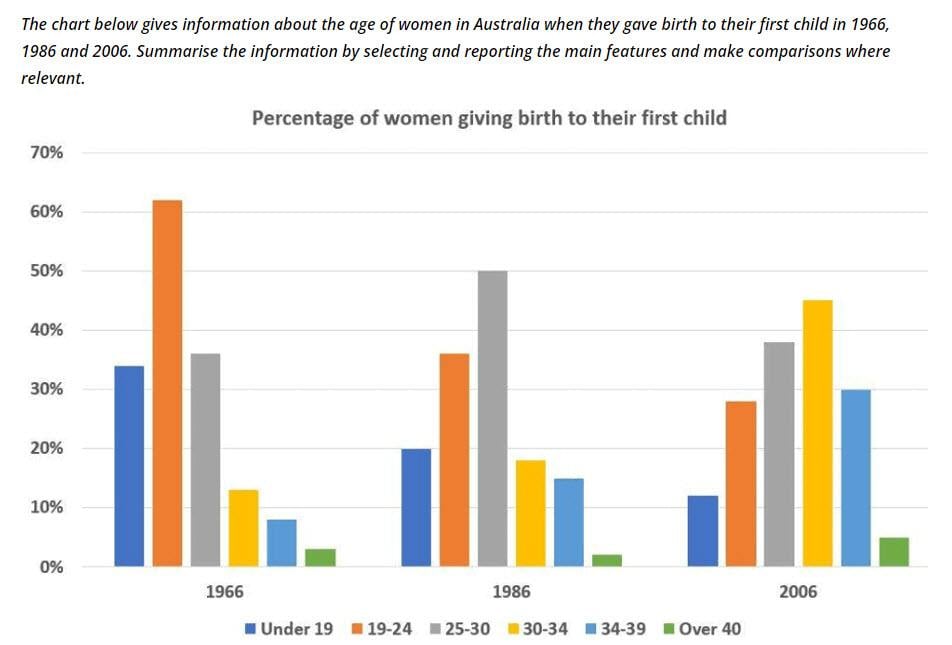
The bar chart details when women in Australia had their first child from 1966 to 2006. Looking from an overall perspective, it is readily apparent that women in the past tended to have their first child earlier in life, especially very young women. Having a child in one’s 30s became much more common, though after one’s 30s it remained relatively rare.
In 1966, 33% of women had their first child under the age of 19. This figure dropped precipitously to reach 11% by 2006. The data for women 19-24 underwent a similar drop, falling from 62% to 50% and finally 28%.
In contrast, 36% of women were 19-24 years old when they first gave birth in 1966 and this number then rose to 50% in 1986 before dropping back to just above the original figure to end the period. The largest rise occurred in the 30-34 age range which more than quadrupled (11% to 18% to 45%). This paralleled the growth for ages 34-39, nearly doubling every 20 years from 9% to 17% and lastly 30%. Finally, there was little change for women over 40 despite marginal growth from 3% to 5%.
Analysis
1. The bar chart details when women in Australia had their first child from 1966 to 2006. 2. Looking from an overall perspective, it is readily apparent that women in the past tended to have their first child earlier in life, especially very young women. 3. Having a child in one’s 30s became much more common, though after one’s 30s it remained relatively rare.
Paraphrase what the table shows.
Write a clear overview summarising the differences.
You might need another sentence for your overview.
1. In 1966, 33% of women had their first child under the age of 19. This figure dropped precipitously to reach 11% by 2006. 2. The data for women 19-24 underwent a similar drop, falling from 62% to 50% and finally 28%.
Begin writing about the data for the first categories.
Make sure you compare as much as possible.
1. In contrast, 36% of women were 19-24 years old when they first gave birth in 1966 and this number then rose to 50% in 1986 before dropping back to just above the original figure to end the period. 2. The largest rise occurred in the 30-34 age range which more than quadrupled (11% to 18% to 45%). 3. This paralleled the growth for ages 34-39, nearly doubling every 20 years from 9% to 17% and lastly 30%. 4. Finally, there was little change for women over 40 despite marginal growth from 3% to 5%.
Write about the final, other parts of the graph – include everything!
Compare the categories.
Vocabulary
What do the words in bold below mean?Take some notes on a piece of paper to aid your memory:
The bar chart details when women in Australia had their first child from 1966 to 2006. Looking from an overall perspective, it is readily apparent that women in the past tended to have their first child earlier in life, especially very young women. Having a child in one’s 30s became much more common,though after one’s 30s it remained relatively rare.
In 1966, 33% of women had their first child under the age of 19. This figure dropped precipitously to reach 11% by 2006. The data for women 19-24 underwent a similar drop, falling from 62% to 50% and finally 28%.
In contrast, 36% of women were 19-24 years old when they first gave birth in 1966 and this number then rose to 50% in 1986 before dropping back to just above the original figure to end the period. The largest rise occurred in the 30-34 age range which more than quadrupled (11% to 18% to 45%). This paralleled the growth for ages 34-39, nearly doubling every 20 years from 9% to 17% and lastly 30%. Finally, there was little change for women over 40 despite marginal growth from 3% to 5%.
Answers
Try to write down or think of an antonym/opposite word for further practice:
details shows
first child first kid
Looking from an overall perspective, it is readily apparent that overall
in the past formerly
tended to usually
earlier in life when younger
especially in particular
common happened a lot
remained relatively rare stayed not that common
under less than
figure dropped precipitously number fell a lot
reach got to
data numbers
underwent a similar drop also fell
falling from … to going down to
finally lastly
in contrast however
first gave birth had their first child
rose increased
before dropping back to prior to decreasing
just above the original figure a little over the first number
to end the period at the end of the time surveyed
largest rise occurred in biggest increase was in
age range age bracket
quadrupled 4x, 400%
paralleled mirrored
growth increase
nearly doubling almost 2x, 200%
lastly finally
little change not much different
despite marginal growth regardless of a little rise
Remember and fill in the blanks. Note it on a piece of paper so you can remember better:
The bar chart d_____s when women in Australia had their f_________d from 1966 to 2006. L________________________________________t women i_________________o have their first child e_________e, e________y very young women. Having a child in one’s 30s became much more c_________n,though after one’s 30s it r__________________e.
In 1966, 33% of women had their first child u______r the age of 19. This f________________________y to r_____h 11% by 2006. The d__a for women 19-24 u________________________p, f___________m 62% t__ 50% and f______y 28%.
I___________t, 36% of women were 19-24 years old when they f____________h in 1966 and this number then r____e to 50% in 1986 b_________________________o j_______________________e t__________________d. The l_____________________n the 30-34 a_________e which more than q____________d (11% to 18% to 45%). This p___________d the g________h for ages 34-39, n____________________g every 20 years from 9% to 17% and l______y 30%. Finally, there was l______________e for women over 40 d___________________h from 3% to 5%.
Listening Practice
Listen to the related topic below and practice with these activities:
"The highest quality materials anywhere on the internet! Dave improved my writing and vocabulary so much. Really affordable options you don't want to miss out on!"