This is an IELTS writing task 1 letter from the real general training exam on the topic of writing a letterto a friend about a gadget.
Please consider supporting my efforts to creative high quality IELTS materials for students around the world by signing up for my Patreon (and don’t miss any of my exclusive IELTS Ebooks)!
Dave
IELTS Essay: A Gadget
You recently bought an electric gadget for your home. Your friend wants the same gadget and needs your advice. In this letter you should include:
What the gadgetis
What you think about it
Advice about other alternatives your friend could buy
Hey Jimmy,
I know you’ve been considering getting a smart speaker so I wanted to let you know I just got a Google Home speaker. It’s not the latest model, I bought one of the last gen versions because I saw it on sale on Amazon for close to half off. If you check now, the sale might still be going on.
Anyway, I absolutely love it so far. It syncs with my Spotify account and also my robot vacuum. It naturally works with voice commands and I haven’t had any issues with it recognizing me for the most part. I use it for tons of stuff now: setting reminders, alarms, timers, asking random questions, sending messages, etc.
It is a bit on the costly side so if you missed the discount there are a few other viable options. Amazon has some cheaper voice assistants – though some people I know have trouble syncing those with Spotify so I wouldn’t want one personally. Other than that, I think the home speakers by companies like JBL and Sonos are out of your price range, frankly.
Let me know if you have any other questions!
Dave
Analysis
1. Hey Jimmy,
2. I know you’ve been considering getting a smart speaker so I wanted to let you know I just got a Google Home speaker. 3. It’s not the latest model, I bought one of the last gen versions because I saw it on sale on Amazon for close to half off. If you check now, the sale might still be going on.
Address the letter to someone.
You can begin with a greeting.
Include the first bullet point.
1. Anyway, I absolutely love it so far. 2. It syncs with my Spotify account and also my robot vacuum. 3. It naturally works with voice commands and I haven’t had any issues with it recognizing me for the most part. 4. I use it for tons of stuff now: setting reminders, alarms, timers, asking random questions, sending messages, etc.
Begin to develop the second point.
Add more detail to it.
This one is focused on second point so include a lot.
The more you add, the higher your task achievement mark.
1. It is a bit on the costly side so if you missed the discount there are a few other viable options. 2. Amazon has some cheaper voice assistants – though some people I know have trouble syncing those with Spotify so I wouldn’t want one personally. 3. Other than that, I think the home speakers by companies like JBL and Sonos are out of your price range, frankly.
4. Let me know if you have any other questions!
5. Dave
Develop the last point.
Keep developing it.
Add an ending sentence.
Use a phrase like regards or sincerely.
Write your name at the end of the letter.
Vocabulary
What do the words in bold below mean?Take notes on a piece of paper to aid memory retention.
Hey Jimmy,
I know you’ve been considering getting a smart speaker so I wanted to let you know I just got a Google Homespeaker. It’s not the latest model, I bought one of the last gen versions because I saw it on sale on Amazon for close to half off. If you check now, the sale might still be going on.
Anyway, I absolutely love it so far. It syncs with my Spotify account and also my robot vacuum. It naturally works with voice commands and I haven’t had any issues with it recognizing me for the most part. I use it for tons of stuff now: setting reminders, alarms, timers, asking random questions, sending messages, etc.
It is a bit on the costly side so if you missed the discount there are a few other viable options. Amazon has some cheaper voice assistants – though some people I know have trouble syncing those with Spotify so I wouldn’t want one personally. Other than that, I think the home speakers by companies like JBL and Sonos are out of your price range, frankly.
Let me know if you have any other questions!
Dave
Answers
Practice writing sentences with the words below on a piece of paper:
considering thinking about
smart speaker a speaker you can talk to
Google Homespeaker Google’s version of a smart speaker
latest model newest one
last gen versions models from before
on sale on Amazon discounted on a website
close to half off nearly 50% less
check look at
going on happening
Anyway regardless
absolutely definitely
so far up to this point
syncs match and work with
Spotify account music streaming platform
robot vacuum device for cleaning a house
naturally works with voice commands of course your must talk to it to activate it
issues problems
recognizing noticing
for the most part generally
tons of stuff lots of things
setting reminders making notes
alarms wake-up calls
timers alarms
asking random questions asking things
sending messages messaging people
etc. and so on
a bit on the costly side a little expensive
missed didn’t get
discount on sale
viable options usable choices
cheaper not expensive
have trouble have difficulty
personally for me
Other than that besides that
out of your price range too expensive for you
frankly honestly
Let me know if you have any other questions ask me anything else you want to know
I know you’ve been c____________g getting a s____________r so I wanted to let you know I just got a G________________r. It’s not the l_____________l, I bought one of the l__________________s because I saw it o_________________n for c_________________f. If you c_____k now, the sale might still be g________n.
A_______y, I a___________y love it s______r. It s_____s with my S________________t and also my r_______________m. It n_____________________________s and I haven’t had any i______s with it r______________g me f________________t. I use it for t_____________f now: s________________s, a________s, t_______s, a___________________s, s______________s, e____.
It is a_____________________e so if you m__________d the d__________t there are a few other v_____________s. Amazon has some c______r voice assistants – though some people I know h____________e syncing those with Spotify so I wouldn’t want one p__________y. O___________t, I think the home speakers by companies like JBL and Sonos are o____________________e, f_________y.
L_________________________________________!
Dave
Listening Practice
Learn more about this topic in the video below and practice with these activities:
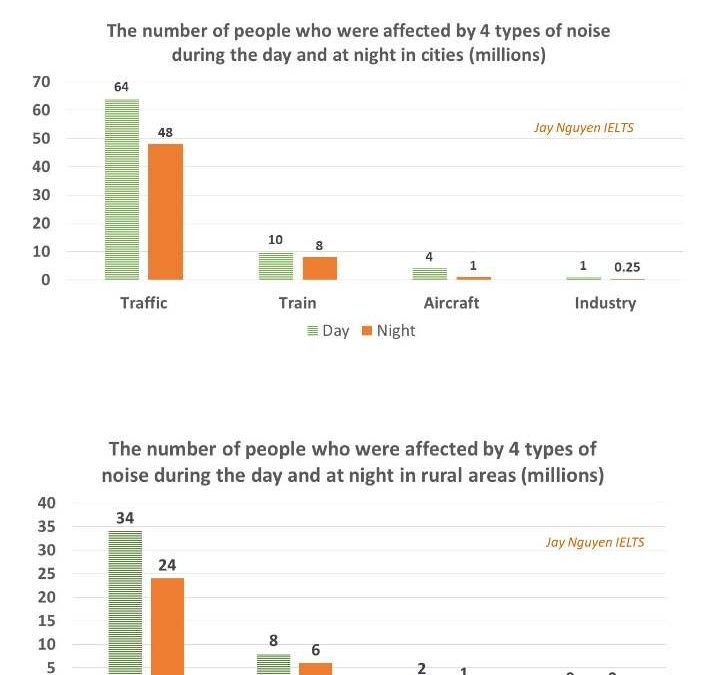
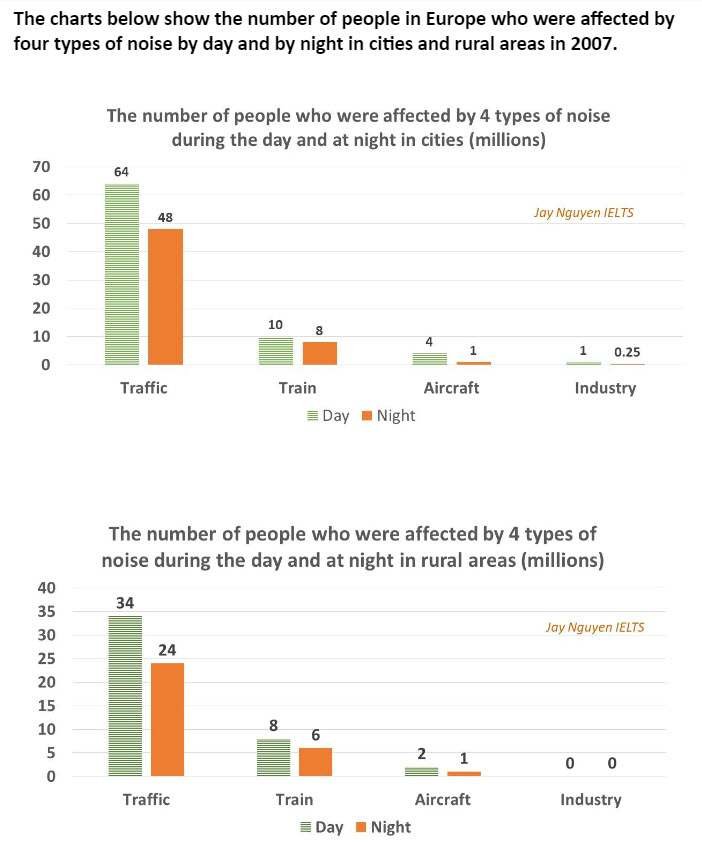
The bar charts detail noise levels in Europe in 2007 delineated by time of day and rural or urban location. Looking from an overall perspective, it is readily apparent that traffic was overwhelmingly the main source of noise, followed by trains, aircraft, and finally industry. Noise levels were also higher during the day in both rural and urban areas though cities were generally noisier at all times.
Traffic noise in cities during the day and at night was very common, affecting 64 million and 48 million residents, respectively. Rural figures for traffic noise were approximately half as high at 34 million and 24 million. Turning to noise from trains, in cities, 10 million individuals were impacted in the day and 8 million at night. In rural areas, this data was only slightly lower (8 million and 6 million).
Aircraft and industry accounted for considerably less noise disturbance in 2007 with just 4 million and 1 million affected by flights in cities during the day and at night, in turn. 2 million residents also heard aircrafts at night in the countryside, with half as many aware of daytime flights. In terms of industry, the data for the countryside was negligible and in cities stood at 1 million impacted during days and .25 during nights.
Analysis
1. The bar charts detail noise levels in Europe in 2007 delineated by time of day and rural or urban location. 2. Looking from an overall perspective, it is readily apparent that traffic was overwhelmingly the main source of noise, followed by trains, aircraft, and finally industry. 3. Noise levels were also higher during the day in both rural and urban areas though cities were generally noisier at all times.
Paraphrase what the table shows.
Write a clear overview summarising the differences.
You might need another sentence for your overview.
1. Traffic noise in cities during the day and at night was very common, affecting 64 million and 48 million residents, respectively. 2. Rural figures for traffic noise were approximately half as high at 34 million and 24 million. 3. Turning to noise from trains, in cities, 10 million individuals were impacted in the day and 8 million at night. 4. In rural areas, this data was only slightly lower (8 million and 6 million).
Begin writing about the data for the first categories.
Make sure you compare as much as possible.
Keep describing and comparing.
This one has lots of data so is a little longer than normal.
1. Aircraft and industry accounted for considerably less noise disturbance in 2007 with just 4 million and 1 million affected by flights in cities during the day and at night, in turn. 2. 2 million residents also heard aircrafts at night in the countryside, with half as many aware of daytime flights. 3. In terms of industry, the data for the countryside was negligible and in cities stood at 1 million impacted during days and .25 during nights.
Write about the final, other parts of the graph – include everything!
Compare the categories.
Finish all the data.
Vocabulary
What do the words in bold below mean?Take some notes on a piece of paper to aid your memory:
The bar charts detail noise levels in Europe in 2007 delineated by time of day and rural or urban location. Looking from an overall perspective, it is readily apparent thattraffic was overwhelmingly the main source of noise, followed by trains, aircraft, and finally industry. Noise levels were also higher during the day in both rural and urban areas though cities were generally noisier at all times.
Traffic noise in cities during the day and at night was very common, affecting 64 million and 48 million residents, respectively. Rural figures for traffic noise were approximately half as high at 34 million and 24 million. Turning to noise from trains, in cities, 10 million individuals were impacted in the day and 8 million at night. In rural areas, this data was only slightly lower (8 million and 6 million).
Aircraft and industry accounted for considerably less noise disturbance in 2007 with just 4 million and 1 million affected by flights in cities during the day and at night, in turn. 2 million residents also heard aircrafts at night in the countryside, with half as many aware of daytime flights. In terms of industry, the data for the countryside was negligible and in cities stood at 1 million impacted during days and .25 during nights.
Answers
Try to write down or think of an antonym/opposite word for further practice:
detail show
noise how loud it is
delineated describe, detail
rural countryside
urban location from cities
Looking from an overall perspective, it is readily apparent thattraffic overall
Remember and fill in the blanks. Note it on a piece of paper so you can remember better:
The bar charts d________l n_____e levels in Europe in 2007 d___________d by time of day and r____l or u___________n. L_______________________________________________tt_______c was o____________y the m_________e of noise, followed by trains, a_______t, and finally i____y. Noise levels were also h______r during the day in both rural and urban areas t_______h cities were g_________y noisier a________s.
Traffic noise in cities during the day and at night was very c_______n, a______g 64 million and 48 million residents, r___________y. Rural f______s for traffic noise were a________________y h_____________h at 34 million and 24 million. T____________o noise from trains, in cities, 10 million individuals were i_________d in the day and 8 million at night. In rural areas, this data was only s___________r (8 million and 6 million).
Aircraft and industry a_______________r c___________________s noise d___________e in 2007 with just 4 million and 1 million affected by flights in cities during the day and at night, i_____n. 2 million r____________s also h________d aircrafts at night in the countryside, with h________________y a________e of daytime flights. I____________f industry, the data for the countryside was n_____________e and in cities s___________t 1 million impacted during days and .25 during nights.
Listening Practice
Listen to the related topic below and practice with these activities:
This includes essays related to science, machines, artificial intelligence, computers, smartphones, space travel, the internet, scientific research, technological progress, and more.
Enjoy!
Dave
IELTS Technology Topics
Innovation is often driven by the pursuit of profit and economic growth. However, some argue that it should prioritize addressing social and environmental issues.
The demand for coaching services has grown significantly in the digital age, with online coaching platforms becoming prevalent. Some now feel online coaching is a superior option to in-person coach.
Many would argue that scientific research requires a degree of oversight from the relevant governmental authorities. In my opinion, properly handled, this is a sensible and necessary policy.
What are the advantages and disadvantages of this?
People today often use the internet to learn about the culture of other countries. This means that it is not that important to travel to those countries.
Some scientists believe that in the future computers will be more intelligent than human beings. While some see this as a positive development others worry about the negative consequences.
Many people put their personal information online (address, telephone number, and so on) for purposes such as signing up for social networks or online banking.
Instead of requiring primary school students to do experiments themselves, schools should only alllow them to watch experiments demonstrated by teachers.
Some people believe that it is good to share as much information as possible in scientific research, business, and the academic world. Others believe that some information is too important or too valuable to be shared freely.
Discuss both these views and give your own opinion.
This is my IELTS writing task 2 sample answer essay on the topic of the best solution to crime from the real IELTS exam.
I actually wrote about almost the same question a few years back but it’s always good practice to try the same question a second time – especially tricky ones about crime!
Be sure to check out some of my other resources here:
Prison is the common way most countries try to solve the problem of crime. However, a more effective solution is to provide the public a better education.
To what extent do you agree or disagree?
Some would argue that although punishment is the most pervasive means of combatting crime globally, education would in fact be far more efficacious. In my opinion, there are strong grounds for this opinion but ultimately deterrence remains the central core of all legal systems.
Those who favor education are trying to resolve systemic issues. There can be little debate over the fact that crime is overwhelmingly driven by necessity. Individuals who have few other options in life are more likely to see criminal activity as a viable alternative. By educating a population well and providing at minimum a high school diploma for every citizen, governments can effectively eliminate this motive. For instance, countries with quality education systems are much less likely to have high crime rates.
However, the solution detailed above is difficult to implement and the simplest method to discourage crime is to punish criminal acts. There are many justifications cited for punishment but the most basic is the need to deter future crimes. A criminal being put in prison does not reverse their past action but it does deter the same action being committed by other individuals in the future. If there were no punishments or extremely lenient sentences, it is a near inevitability that individuals would commit crimes, for a range of motives, more frequently.
In conclusion, education addresses the root causes of crime yet punishment is still a more effective preventative countermeasure. A combination of both is naturally ideal.
Analysis
1. Some would argue that although punishment is the most pervasive means of combatting crime globally, education would in fact be far more efficacious. 2. In my opinion, there are strong grounds for this opinion but ultimately deterrence remains the central core of all legal systems.
Paraphrase the overall essay topic.
Write a clear opinion. Read more about introductions here.
1. Those who favor education are trying to resolve systemic issues. 2. There can be little debate over the fact that crime is overwhelmingly driven by necessity. 3. Individuals who have few other options in life are more likely to see criminal activity as a viable alternative. 4. By educating a population well and providing at minimum a high school diploma for every citizen, governments can effectively eliminate this motive. 5. For instance, countries with quality education systems are much less likely to have high crime rates.
Write a topic sentence with a clear main idea at the end.
Explain your main idea.
Develop it with specific or hypothetical examples.
Keep developing it fully.
Short sentences can make your writing clearer.
1. However, the solution detailed above is difficult to implement and the simplest method to discourage crime is to punish criminal acts. 2. There are many justifications cited for punishment but the most basic is the need to deter future crimes. 3. A criminal being put in prison does not reverse their past action but it does deter the same action being committed by other individuals in the future. 4. If there were no punishments or extremely lenient sentences, it is a near inevitability that individuals would commit crimes, for a range of motives, more frequently.
Write a new topic sentence with a new main idea at the end.
Explain your new main idea.
Include specific details and examples.
Add as much information as you can and make sure it links logically.
1. In conclusion, education addresses the root causes of crime yet punishment is still a more effective preventative countermeasure. 2. A combination of both is naturally ideal.
Summarise your main ideas.
Include a final thought. Read more about conclusions here.
Vocabulary
What do the words in bold below mean?Make some notes on paper to aid memory and then check below.
Some would argue that although punishment is the most pervasive means ofcombatting crime globally, education would in fact be far more efficacious. In my opinion, there are strong grounds for this opinion but ultimately deterrence remains the central core of all legal systems.
Those who favor education are trying to resolve systemic issues. There can be little debate over the fact that crime is overwhelmingly driven by necessity. Individuals who have few other options in life are more likely to see criminal activity as a viable alternative. By educating a population well and providing at minimum a high school diploma for every citizen, governments can effectively eliminate this motive. For instance, countries with quality education systems are much less likely to have high crime rates.
However, the solution detailed above is difficult to implement and the simplest method to discourage crime is to punish criminal acts. There are many justifications cited for punishment but the most basic is the need to deter future crimes. A criminal being put in prison does not reverse their past action but it does deter the same action being committed by other individuals in the future. If there were no punishments or extremely lenient sentences, it is a near inevitability that individuals would commit crimes, for a range of motives, more frequently.
In conclusion, education addresses the root causes of crime yet punishment is still a more effective preventative countermeasure. A combination of both is naturally ideal.
Answers
For extra practice, write an antonym (opposite word) on a piece of paper to help you remember the new vocabulary:
argue point out
although but
most pervasive means ofcombatting most common way of fighting
globally around the world
education schooling
in fact actually
efficacious effective
strong grounds good basis
ultimately in the end
deterrence not doing something because you are afraid of the consequences
I recommend getting a pencil and piece of paper because that aids memory. Then write down the missing vocabulary from my sample answer in your notebook:
Some would a_________e that a___________h punishment is the m____________________________________g crime g__________y, e___________n would i_____t be far more e_______________s. In my opinion, there are s___________________s for this opinion but u_____________________________s the c_______________e of all l__________s.
Those who favor education are trying to r_________________s. There can be l_______________r the f____t that crime is o______________________y d___________y n__________y. Individuals who have f______________________e are more likely to see c_______________________________e. By educating a population well and p_______________________________________a for every c______n, governments can e_________________e this m______e. For instance, countries with q________________s are much less likely to have h_______________s.
However, the solution d_____________e is d____________________t and the s______t method to d______________e crime is to p_______________________s. There are many j_______________________d for punishment but the m__________c is the need to d_______________________s. A criminal being put in prison does not r________e their p___________n but it does deter the same action being committed by other individuals in the future. If there were no punishments or e_____________________________s, it is a n____________________y that individuals would commit crimes, for a_____________________________s, more frequently.
In conclusion, education a______________s the r___________s of crime yet punishment is still a more effective p______________________________e. A c____________n of both is n_____________l.
Listening Practice
Learn more about this topic by watching from YouTube below and practice with these activities:
"The highest quality materials anywhere on the internet! Dave improved my writing and vocabulary so much. Really affordable options you don't want to miss out on!"