This is an IELTS writing task 2 sample answer essay from the new Cambridge IELTS 17 book of past test papers on the topic of children spending hours of their smartphones.
Some children spend hours every day on smartphones.
Why is this the case?
Do you think this is a positive or negative development?
These days, children are spending more and more hours each day using smartphones. In my opinion, this is a natural consequence of the ubiquity of phones and is a decidedly negative phenomenon.
The main cause of this trend is access to portable devices. Since the introduction of the original iPhone, countless phone manufacturers have imitated Apple’s innovation and virtually every family possesses multiple devices. The owners of these phones are typically over-worked and stressed parents who are often willing to allow their children to use their smartphones to listen to music, watch movies, and keep themselves entertained. In many parts of the world, parents even purchase phones specifically for their children to use. The increased hours children spend on phones is therefore a combination of tremendous access coupled with a natural desire to use them.
The main repercussions from increased smartphone usage among children are negative. Firstly, smartphones have replaced healthier habits. Children raised before the advent of the portable smartphone were more likely to read books, socialize with friends, and take part in outdoor activities. These practices are all far healthier physically, intellectually, and emotionally. Moreover, the usage of phones itself is actively detrimental to normal cognitive development. Many researchers have theorized that the 21st century spike in cases of dissociative anxiety disorders can be directly correlated with the technological age in general and smartphones more specifically.
In conclusion, children use smartphones for hours every day because of their availability and the result of this is a steep decline in healthy lifestyles. As governments cannot restrict such usage, it is the responsibility of parents to effectively regulate screen time for their children.
Analysis
1. These days, children are spending more and more hours each day using smartphones. 2. In my opinion, this is a natural consequence of the ubiquity of phones and is a decidedly negative phenomenon.
Paraphrase the overall essay topic.
Write a clear opinion. Read more about introductions here.
1. The main cause of this trend is access to portable devices. 2. Since the introduction of the original iPhone, countless phone manufacturers have imitated Apple’s innovation and virtually every family possesses multiple devices. 3. The owners of these phones are typically over-worked and stressed parents who are often willing to allow their children to use their smartphones to listen to music, watch movies, and keep themselves entertained. 4. In many parts of the world, parents even purchase phones specifically for their children to use. 5. The increased hours children spend on phones is therefore a combination of tremendous access coupled with a natural desire to use them.
Write a topic sentence with a clear main idea at the end.
Explain your main idea.
Develop it with specific or hypothetical examples.
Keep developing it fully.
Short sentences can make your writing clearer.
1. The main repercussions from increased smartphone usage among children are negative. 2. Firstly, smartphones have replaced healthier habits. 3. Children raised before the advent of the portable smartphone were more likely to read books, socialize with friends, and take part in outdoor activities. 4. These practices are all far healthier physically, intellectually, and emotionally. 5. Moreover, the usage of phones itself is actively detrimental to normal cognitive development. 6. Many researchers have theorized that the 21st century spike in cases of dissociative anxiety disorders can be directly correlated with the technological age in general and smartphones more specifically.
Write a new topic sentence with a new main idea at the end.
Explain your new main idea.
Include specific details and examples.
Add as much information as you can and make sure it links logically.
Finish the paragraph strong.
Use complex and simple sentences.
1. In conclusion, children use smartphones for hours every day because of their availability and the result of this is a steep decline in healthy lifestyles. 2. As governments cannot restrict such usage, it is the responsibility of parents to effectively regulate screen time for their children.
Summarise your main ideas.
Include a final thought. Read more about conclusions here.
Vocabulary
What do the words in bold below mean?Make some notes on paper to aid memory and then check below.
These days, children are spending more and more hours each day using smartphones. In my opinion, this is a natural consequence of the ubiquity of phones and is a decidedly negative phenomenon.
The main cause of this trend is access to portable devices. Since the introduction of the original iPhone, countless phone manufacturers have imitated Apple’sinnovation and virtually every family possesses multiple devices. The owners of these phones are typically over-worked and stressed parents who are often willing to allow their children to use their smartphones to listen to music, watch movies, and keep themselves entertained. In many parts of the world, parents even purchase phones specifically for their children to use. The increased hours children spend on phones is therefore a combination of tremendous access coupled with a natural desire to use them.
The main repercussions from increased smartphone usage among children are negative. Firstly, smartphones have replaced healthier habits. Children raised before the advent of the portable smartphone were more likely to read books, socialize with friends, and take part in outdoor activities. These practices are all far healthier physically, intellectually, and emotionally. Moreover, the usage of phones itself is actively detrimental to normal cognitive development. Many researchers have theorized that the 21st centuryspike in cases of dissociative anxiety disorders can be directly correlated with the technological agein general and smartphones more specifically.
In conclusion, children use smartphones for hours every day because of their availability and the result of this is a steep decline in healthy lifestyles. As governments cannot restrict such usage, it is the responsibility of parents to effectively regulate screen time for their children.
Answers
For extra practice, write an antonym (opposite word) on a piece of paper to help you remember the new vocabulary:
these days today
smartphones cell phones, iPhones, etc.
natural consequence normal result
ubiquity how common they are
decidedly negative phenomenon definitely bad
cause result in
trend pattern
access ability to use
portable devices smartphones
introduction release
original first
countless phone manufacturers many different phone maters
imitated copied
Apple’sinnovation invention by the company Apple
virtually essentially
possesses multiple devices have smartphones
owners people who have them
typically normally
over-worked too busy
stressed worried about
often willing typically will do
allow permit
keep themselves entertained allow themselves to be distracted
In many parts of the world in various countries
purchase buy
specifically in particular
increased hours more time
therefore thus
combination putting together
tremendous access more ability to use
coupled with combined with
natural desire normal want
main repercussions major effect
smartphone usage using phones
replaced healthier habits take the place of better actions
raised grew up
advent beginning of
portable smartphone phones you can carry with you
socialize spend time with others
take part in participate in
outdoor activities doing things outside
practices actions, habits
physically related to the body
intellectually related to the mind
emotionally related to feelings
actively detrimental really hurts
normal cognitive development healthy mental growth
I recommend getting a pencil and piece of paper because that aids memory. Then write down the missing vocabulary from my sample answer in your notebook:
T__________s, children are spending more and more hours each day using s________s. In my opinion, this is a natural c____________e of the u________y of phones and is a d__________________________n.
The main c______e of this t______d is a______s to p____________s. Since the i___________n of the o________l iPhone, c_________________________s have i______________________n and v________y every family p________________________s. The o___________s of these phones are t_________y o______________d and s__________d parents who are o______________g to a_______w their children to use their smartphones to listen to music, watch movies, and k__________________________d. I_____________________________d, parents even p__________e phones s__________y for their children to use. The i___________________s children spend on phones is t___________e a c____________n of t____________________s c_____________h a n_________________e to use them.
The m_______________________s from increased s___________________e among children are negative. Firstly, smartphones have r________________________s. Children r_______d before the a_______t of the p__________________e were more likely to read books, s__________e with friends, and t_______________n o_______________s. These p_______s are all far healthier p__________________y, i______________y, and e___________y. Moreover, the usage of phones itself is a______________________l to n____________________________t. Many researchers have t__________d that the 2______________ys____________n c__________f d____________________________s can be directly c_____________h the t___________________l and smartphones m________________y.
In conclusion, children use smartphones for hours every day because of their a________y and the result of this is a s__________________n h_________________s. As governments cannot r_________t such usage, it is the r_____________y of parents to e_________y r________e s_________e for their children.
Listening Practice
Learn more about this topic by watching from YouTube below and practice with these activities:
This is an IELTS writing task 1 sample answer essay on the topic of the process of how to make olive oil.
Please consider supporting my efforts to creative high quality IELTS materials for students around the world by signing up for my Patreon (and so you won’t miss out on any of my exclusive IELTS Ebooks)!
Dave
IELTS Essay Task 1: Olive Oil
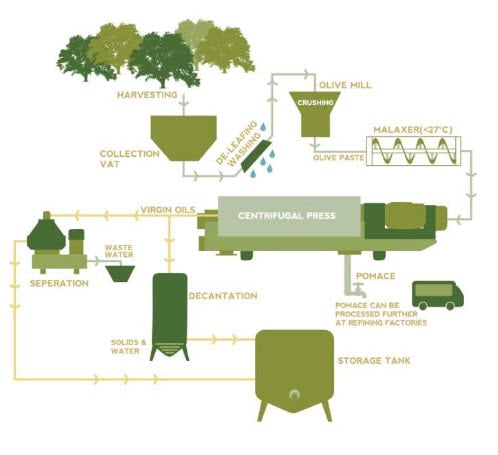
The diagram details the process of producing olive oil.
Summarise the information by selecting and reporting the main features, and make comparisons where relevant.
The diagram delineates the process by which olive oil is made. The production can be divided into 3 main groups beginning with initial harvesting and treatment, followed by creation of the oil, and lastly storage for future use.
The process begins with the olives being harvested from trees and placed in a collection vat. The olives must then be de-leafed and cleaned with water before they are put into an olive mill to crush them into olive paste. The paste is then put through a malaxer set to a temperature not greater than 27 °C. After the malaxer, paste then enters a centrifugal press which creates virgin oils.
Subsequent to this, the virgin oils are then either separated (with waste water being discharged) or decanted, which filters out both solids and water. Regardless of the method of separation, both products are reserved in a storage tank to finish the steps detailed in the diagram.
Analysis
1. The diagram delineates the process by which olive oil is made. 2. The production can be divided into 3 main groups beginning with initial harvesting and treatment, followed by creation of the oil, and lastly storage for future use.
Paraphrase what the process shows.
Write a clear overview summarising the major groups. Read here about overviews for processes.
1. The process begins with the olives being harvested from trees and placed in a collection vat. 2. The olives must then be de-leafed and cleaned with water before they are put into an olive mill to crush them into olive paste. 3. The paste is then put through a malaxer set to a temperature not greater than 27 °C. 4. After the malaxer, paste then enters a centrifugal press which creates virgin oils.
Begin writing about the details of the process.
This one is tricky to get up to the word count (no longer required on IELTS) so try to make it a little wordy.
Include every step in the process.
Make sure you use good linking words.
1. Subsequent to this, the virgin oils are then either separated (with waste water being discharged) or decanted, which filters out both solids and water. 2. Regardless of the method of separation, both products are reserved in a storage tank to finish the steps detailed in the diagram.
Write about the rest of the process – include everything!
Try to paraphrase some of the words from process as well.
Vocabulary
What do the words in bold below mean?Take some notes on a piece of paper to aid your memory:
The diagram delineates the process by which olive oil is made. The production can be divided into 3 main groupsbeginning with initial harvesting and treatment, followed by creation of the oil, and lastly storage for future use.
The process begins with the olives being harvested from trees and placed in a collection vat. The olives must then be de-leafed and cleaned with water before they are put into an olive mill to crush them into olive paste. The paste is then put through a malaxer set to a temperature not greater than 27 °C. After the malaxer, paste then enters a centrifugal press which creates virgin oils.
Subsequent to this, the virgin oils are then either separated (with waste water being discharged) or decanted, which filters out both solids and water. Regardless of the method of separation, both byproducts are reserved in a storage tank to finish the steps detailed in the diagram.
Answers
Try practicing with the vocabulary below by writing an antonym/opposite word on a piece of paper (or just thinking of one):
delineates shows
process by which way in which
olive oil used for cooking and salads
production making of something
divided into separated into
main groups big areas
beginning with starting with
initial harvesting first picking
treatment how something is processed
followed by after that
creation making of something
lastly storage for future use finally kept somewhere to use later
harvested picked
placed in put in
collection vat place to store things
de-leafed leaves taken off
olive mill place to grind olives
crush smushed
olive paste a gel kind of substance made from olives
The diagram d__________s the p________________h o________l is made. The p________n can be d_________o 3 m_________sb___________h i____________g and t________t, f_____________y c______n of the oil, and l_________________________e.
The process begins with the olives being h________d from trees and p__________n a c______________t. The olives must then be d___________d and cleaned with water before they are put into an o__________l to c______h them into o_________e. The paste is then p__________h a malaxer s______________n 27 °C. After the malaxer, paste then enters a c______________s which creates virgin oils.
Subsequent to this, the virgin oils are then either s________d (with w___________r being d_________d) or d________d, which f_____________t both s_______s and water. R____________f the method of separation, both p__________s are r________d in a s_________________k to f_______h the s_____________d in the d________m.
Listening Practice
Listen to the related topic below and practice with these activities:
The best way to make the road transport of goods safer is to ask drivers to take a driving test each year.
To what extent do you agree or disagree?
Some today argue that the transportation of goods would be safer if drivers were required to take mandatory driving tests each year. In my opinion, this is not a realistic solution despite its potential benefits.
Those in favor of such a reform point out that truck drivers need these courses more than other motorists. After driving for many years, it is natural that individuals may forget certain rules and a course to refresh their knowledge of road safety and etiquette cannot possibly do any harm. Added to this is the fact that truck drivers transporting goods are on the road far more than your average commuter. Therefore, it is logical that their ability to drive well will have an outsized impact on overall road safety statistics. A truck driver who submits to yearly re-certification under this proposal is likely to have at least a superior formal understanding of driving laws.
However, the effects of such learning might be marginal and the program itself would be prohibitively expensive. Individuals who often drive might not be strictly following the rules they learned when they first got their licenses but they are better informed of the realities and nuances of actual driving. Years of experience on the road, similar to any job, will likely do more to develop their ability than standardized testing and certification. Moreover, implementation of annual driving tests would necessitate immense bureaucratic expenses. Not only would there need to be a large department in charge but transport drivers themselves would waste time each year getting recertified. In the aggregate, the effect on road safety would be negligible but the impact on efficiency would be significant.
In conclusion, although this proposal is well-intentioned, its actual implementation would likely be inefficient and wasteful. Therefore, more viable options should be explored.
Analysis
1. Some today argue that the transportation of goods would be safer if drivers were required to take mandatory driving tests each year. 2. In my opinion, this is not a realistic solution despite its potential benefits.
Paraphrase the overall essay topic.
Write a clear opinion. Read more about introductions here.
1. Those in favor of such a reform point out that truck drivers need these courses more than other motorists. 2. After driving for many years, it is natural that individuals may forget certain rules and a course to refresh their knowledge of road safety and etiquette cannot possibly do any harm. 3. Added to this is the fact that truck drivers transporting goods are on the road far more than your average commuter. 4. Therefore, it is logical that their ability to drive well will have an outsized impact on overall road safety statistics. 5. A truck driver who submits to yearly re-certification under this proposal is likely to have at least a superior formal understanding of driving laws.
Write a topic sentence with a clear main idea at the end.
Explain your main idea.
Develop it with specific or hypothetical examples.
Keep developing it fully.
Short sentences can make your writing clearer.
1. However, the effects of such learning might be marginal and the program itself would be prohibitively expensive. 2. Individuals who often drive might not be strictly following the rules they learned when they first got their licenses but they are better informed of the realities and nuances of actual driving. 3. Years of experience on the road, similar to any job, will likely do more to develop their ability than standardized testing and certification. 4. Moreover, implementation of annual driving tests would necessitate immense bureaucratic expenses. 5. Not only would there need to be a large department in charge but transport drivers themselves would waste time each year getting recertified. 6. In the aggregate, the effect on road safety would be negligible but the impact on efficiency would be significant.
Write a new topic sentence with a new main idea at the end.
Explain your new main idea.
Include specific details and examples.
Add as much information as you can and make sure it links logically.
Finish the paragraph strong.
Use complex and simple sentences.
1. In conclusion, although this proposal is well-intentioned, its actual implementation would likely be inefficient and wasteful. 2. Therefore, more viable options should be explored.
Summarise your main ideas.
Include a final thought. Read more about conclusions here.
Vocabulary
What do the words in bold below mean?Make some notes on paper to aid memory and then check below.
Some today argue that the transportation of goods would be safer if drivers were required to take mandatory driving tests each year. In my opinion, this is not a realistic solution despite its potential benefits.
Those in favor of such a reform point out that truck drivers need these courses more than other motorists. After driving for many years, it is natural that individuals may forget certain rules and a course to refresh their knowledge of road safety and etiquette cannot possibly do any harm. Added to this is the fact that truck drivers transporting goods are on the road far more than your average commuter. Therefore, it is logical that their ability to drive well will have an outsized impact on overall road safety statistics. A truck driver who submits to yearly re-certification under this proposal is likely to have at least a superior formal understanding of driving laws.
However, the effects of such learning might be marginal and the program itself would be prohibitively expensive. Individuals who often drive might not be strictly following the rules they learned when they first got their licenses but they are better informed of the realities and nuances of actual driving. Years of experience on the road, similar to any job, will likely do more to develop their ability than standardized testing and certification. Moreover, implementation of annual driving tests would necessitate immense bureaucratic expenses. Not only would there need to be a large department in charge but transport drivers themselves would waste time each year getting recertified. In the aggregate, the effect on road safety would be negligible but the impact on efficiency would be significant.
In conclusion, although this proposal is well-intentioned, its actual implementation would likely be inefficient and wasteful. Therefore, more viable options should be explored.
Answers
For extra practice, write an antonym (opposite word) on a piece of paper to help you remember the new vocabulary:
argue point out
transportation of goods bring items and products from place to place
drivers people who drive
required need to
take mandatory driving tests required tests for your license
realistic solution despite possible fix regardless of
potential benefits possible advantages
Those in favor of such a reform point out people who support it argue
motorists people who drive
natural of course
forget certain rules not remember the laws
refresh remember, make new again
knowledge of road safety what you know about driving
etiquette how to behave on the road
do any harm hurt
Added to this is the fact that also
far more than a lot more than
average commuter normal driver
logical makes sense
outsized impact very large effect
overall road safety statistics the numbers for accidents, etc.
submits allows themselves to be subjected to
yearly re-certification under new license for
at least a superior formal understanding of driving laws at minimum know the law well
marginal minor
program initiative
prohibitively expensive too costly
strictly following the rules rigidly obeying the law
better informed know more about
realities truth
nuances complexities
actual driving how people really drive
similar to like
standardized testing tests
certification licenses
implementation put into place
annual yearly
necessitate immense bureaucratic expenses would require lots of money
large department in charge group of people managing it
waste time each year getting recertified not a good use of time renewing your license
In the aggregate combined
negligible not much effect
efficiency good use of time, energy
significant major
well-intentioned good reasons to try it
actual implementation how it is actually put into place
I recommend getting a pencil and piece of paper because that aids memory. Then write down the missing vocabulary from my sample answer in your notebook:
Some today a______e that the t_______________________s would be safer if d________s were r________d to t____________________________s each year. In my opinion, this is not a r_______________________e its p_____________s.
T____________________________________t that truck drivers need these courses more than other m___________s. After driving for many years, it is n________l that individuals may f_____________________s and a course to r__________h their k_____________________y and e_____________e cannot possibly d_________m. A___________________t truck drivers transporting goods are on the road f________________n your a______________r. Therefore, it is l_______l that their ability to drive well will have an o______________t on o_____________________________s. A truck driver who s___________s to y____________________________r this proposal is likely to have a_________________________________________________s.
However, the effects of such learning might be m__________l and the p_________m itself would be p___________________e. Individuals who often drive might not be s_________________________s they learned when they first got their licenses but they are b_________________d of the r____________s and n____________s of a___________g. Years of experience on the road, s___________o any job, will likely do more to develop their ability than s_____________________g and c____________n. Moreover, i___________________n of a_________l driving tests would n____________________________________s. Not only would there need to be a l_____________________________e but transport drivers themselves would w________________________________d. I___________________e, the effect on road safety would be n__________e but the impact on e___________y would be s__________t.
In conclusion, although this proposal is w_______________d, its a___________________n would likely be i____________t and w_________l. Therefore, more v______________s should be e_________d.
Listening Practice
Learn more about this topic by watching from YouTube below and practice with these activities:
More and more young people from wealthy countries are spending time in communities in poorer countries doing unpaid work such as teaching or building houses.
Why is this?
Who benefits more from this, the communities or these young people?
It is becoming increasingly common these days for individuals from wealthier nations to donate their time to aiding less developed countries. In my opinion, this is a natural result of advances in media and technology and it benefits the wealthy far more than those being ostensibly helped.
The main reason this has become a pervasive trend in recent decades is that young people are more aware of and capable of traveling to other countries. The last several decades have witnessed the rise of media beyond traditional television shows and newspapers and now include websites and social media. The average young person today can use their smartphone to easily access information from a variety of sources on issues in distant countries. Additionally, individuals today are generally able to travel conveniently abroad. Air travel is not only far faster than past modes of travel including ships and trains but has also become cheaper as average incomes have risen, particularly in developed nations.
However, this phenomenon is mostly concerned with improving the self-esteem of the wealthy. Young people often lack confidence and one way to improve their own self-image is to volunteer for causes in other countries. A young person of privilege might feel guilty about their own standard of living and lack of accomplishments in life and therefore travel abroad to help others in order to gain confidence. When this person returns home, they will be able to flaunt their achievements in front of friends, their parents, and on university entrance essays. In contrast, the people who have been helped are unlikely to experience a significant change in their lives and the cost of housing and training young volunteers might even outweigh their contributions.
In conclusion, young people today are able to travel to other countries because of new developments in technology and media and this chiefly benefits the travelers. There are nonetheless sometimes concomitant advantages for locals as well.
Analysis
1. It is becoming increasingly common these days for individuals from wealthier nations to donate their time to aiding less developed countries. 2. In my opinion, this is a natural result of advances in media and technology and it benefits the wealthy far more than those being ostensibly helped.
Paraphrase the overall essay topic.
Write a clear opinion. Read more about introductions here.
1. The main reason this has become a pervasive trend in recent decades is that young people are more aware of and capable of traveling to other countries. 2. The last several decades have witnessed the rise of media beyond traditional television shows and newspapers and now include websites and social media. 3. The average young person today can use their smartphone to easily access information from a variety of sources on issues in distant countries. 4. Additionally, individuals today are generally able to travel conveniently abroad. 5. Air travel is not only far faster than past modes of travel including ships and trains but has also become cheaper as average incomes have risen, particularly in developed nations.
Write a topic sentence with a clear main idea at the end.
Explain your main idea.
Develop it with specific or hypothetical examples.
Keep developing it fully.
Short sentences can make your writing clearer.
Use complex and simple sentences.
1. However, this phenomenon is mostly concerned with improving the self-esteem of the wealthy. 2. Young people often lack confidence and one way to improve their own self-image is to volunteer for causes in other countries. 3. A young person of privilege might feel guilty about their own standard of living and lack of accomplishments in life and therefore travel abroad to help others in order to gain confidence. 4. When this person returns home, they will be able to flaunt their achievements in front of friends, their parents, and on university entrance essays. 5. In contrast, the people who have been helped are unlikely to experience a significant change in their lives and the cost of housing and training young volunteers might even outweigh their contributions.
Write a new topic sentence with a new main idea at the end.
Explain your new main idea.
Include specific details and examples.
Add as much information as you can and make sure it links logically.
Finish the paragraph strong.
1. In conclusion, young people today are able to travel to other countries because of new developments in technology and media and this chiefly benefits the travelers. 2. There are nonetheless sometimes concomitant advantages for locals as well.
Summarise your main ideas.
Include a final thought. Read more about conclusions here.
Vocabulary
What do the words in bold below mean?Make some notes on paper to aid memory and then check below.
It is becoming increasingly common these days for individuals from wealthier nations to donate their time to aiding less developed countries. In my opinion, this is a natural result of advances in media and technology and it benefits the wealthy far more than those being ostensibly helped.
The main reason this has become a pervasive trend in recent decades is that young people are more aware of and capable of traveling to other countries. The last several decades have witnessed the rise of media beyond traditional television shows and newspapers and now include websites and social media. The average young person today can use their smartphone to easily access information from a variety of sources on issues in distant countries. Additionally, individuals today are generally able to travel convenientlyabroad. Air travel is not only far faster than past modes of travel including ships and trains but has also become cheaper as average incomes have risen, particularly in developed nations.
However, this phenomenon is mostly concerned with improving the self-esteem of the wealthy. Young people often lack confidence and one way to improve their own self-image is to volunteer for causes in other countries. A young person of privilege might feel guilty about their own standard of living and lack of accomplishments in life and therefore travel abroad to help others in order to gain confidence. When this person returns home, they will be able to flaunt their achievements in front of friends, their parents, and on university entrance essays. In contrast, the people who have been helped are unlikely to experience a significant change in their lives and the cost of housing and training young volunteers might even outweigh their contributions.
In conclusion, young people today are able to travel to other countries because of new developments in technology and media and this chiefly benefits the travelers. There are nonetheless sometimes concomitant advantages for locals as well.
Answers
For extra practice, write an antonym (opposite word) on a piece of paper to help you remember the new vocabulary:
increasingly common happens more and more
wealthier nations richer countries
donate give time or money to someone else
aiding less developed countries helping poorer countries
natural result inevitable end
advances developments
media news, TV, etc.
technology machinery, computers, etc.
far more than a lot more than
ostensibly seemingly
pervasive trend common pattern
in recent decades the last 20 or 30 years
aware of know about
capable of can do
The last several decades have witnessed the rise of media recently there are more and more ways to learn about the world
traditional television shows normal TV programs
newspapers where you read the news
social media Facebook, Instagram, TikTok, etc.
easily access information from a variety of sources get what you want to know from many places
issues problems
distant countries places far away
generally overall
convenientlyabroad easily to other countries
far faster much quicker
past modes of travel different ways of moving
ships boats
trains way to travel across countries
cheaper not expensive
average incomes normal amount earned
risen increased
particularly in especially in
developed nations richer countries
phenomenon event, happening
mostly concerned with improving has to do with mainly
self-esteem how you feel about yourself
lack confidence low self-esteem
self-image how you view yourself
volunteer person who helps others
causes things you care about
A young person of privilege a rich kid
guilty bad conscience
standard of living quality of life
lack of accomplishments haven’t done much in life
therefore thus
confidence feeling good about yourself
flaunt show off
achievements what you’ve accomplished
university entrance essays writing to apply for university
I recommend getting a pencil and piece of paper because that aids memory. Then write down the missing vocabulary from my sample answer in your notebook:
It is becoming i______________________n these days for individuals from w_________________s to d_________e their time to a_________________________________s. In my opinion, this is a n____________t of a___________s in m_____a and t_____________y and it benefits the wealthy f______________n those being o_________y helped.
The main reason this has become a p________________d i_______________s is that young people are more a_________f and c______________f traveling to other countries. T______________________________________________a beyond t____________________________s and n______________s and now include websites and s___________a. The average young person today can use their smartphone to e___________________________________________s on i______s in d_____________________s. Additionally, individuals today are g_________y able to travel c_______________________d. Air travel is not only f______________r than p__________________l including s_____s and t_________s but has also become c________r as a______________s have r_____n, p______________________________s.
However, this p___________n is m______________________________g the s________m of the wealthy. Young people often l________________e and one way to improve their own s___________e is to v____________r for c________s in other countries. A___________________e might feel g___________y about their own s__________________g and l___________________s in life and t__________e travel abroad to help others in order to gain c____________e. When this person returns home, they will be able to f________t their a_______________s in front of friends, their parents, and on u__________________________s. In contrast, the people who have been helped are u_____y to e___________e a s________________e in their lives and the cost of housing and t_________________________s might even o_________h their c________s.
In conclusion, young people today are able to travel to other countries because of new developments in technology and media and this c______________s the travelers. There are n_________s s_________s c_____________t a_________s for l_______s as well.
Listening Practice
Learn more about this topic by watching from YouTube below and practice with these activities:
Is charity always altruistic or can it be selfish?
What kinds of charities are there in your country?
Do corporations in your country contribute to charity?
Should charities be allowed to make a profit?
Writing Practice
Practice with the related IELTS essay topics below:
Some people think that famous people can help international aid organizations to draw attention to important problems. Others believe that the celebrities can make the problems seem less important.
Doctors should be responsible for educating their patients about how to improve their health.
To what extent do you agree or disagree?
Some today contend that doctors should be responsible for wide-ranging advice on how their patients can achieve better health. In my opinion, though this is not technically the core job of a doctor, it should nonetheless be considered an essential duty.
Those who argue against this contention point out that doctors have more urgent priorities. Doctors must first of all accurately diagnose patients. This involves asking various questions, performing tests, and a misdiagnosis is a potentially life-altering event in the life of a patient. Once a patient has been diagnosed and the prognosis delivered, doctors must then focus on treatment options. Depending on the severity and the evolution of the illness, the doctor may need to focus intently during this period and possibly seek out a second opinion. If the hypothetical doctor described were also distracted by the mandate to give health advice, there is the small chance that this could hinder their primary duties.
However, these priorities are not always in conflict with the giving of advice that is likely to have more overall impact. Doctors can focus on diagnosis and treatment while also imparting general health advice without allowing these goals to interfere. Moreover, giving advice is more valuable than treatment of disease as it can be a preventative measure. Studies over the last century have repeatedly replicated the finding that prevention of illness through healthy lifestyle choices is the number one driver behind increased longevity and health in the modern world. Although the results of such advice are not as immediately tangible as, for instance, during chemotherapy, they are far more effective in the long-term.
In conclusion, doctors should give their patients advice on how to lead a healthy life in order to prevent the onset of a variety of conditions. In this way, doctors can more faithfully fulfil their Hippocratic oaths.
Analysis
1. Some today contend that doctors should be responsible for wide-ranging advice on how their patients can achieve better health. 2. In my opinion, though this is not technically the core job of a doctor, it should nonetheless be considered an essential duty.
Paraphrase the overall essay topic.
Write a clear opinion. Read more about introductions here.
1. Those who argue against this contention point out that doctors have more urgent priorities. 2. Doctors must first of all accurately diagnose patients. 3. This involves asking various questions, performing tests, and a misdiagnosis is a potentially life-altering event in the life of a patient. 4. Once a patient has been diagnosed and the prognosis delivered, doctors must then focus on treatment options. 5. Depending on the severity and the evolution of the illness, the doctor may need to focus intently during this period and possibly seek out a second opinion. 6. If the hypothetical doctor described were also distracted by the mandate to give health advice, there is the small chance that this could hinder their primary duties.
Write a topic sentence with a clear main idea at the end.
Explain your main idea.
Develop it with specific or hypothetical examples.
Keep developing it fully.
Short sentences can make your writing clearer.
Use complex and simple sentences.
1. However, these priorities are not always in conflict with the giving of advice that is likely to have more overall impact. 2. Doctors can focus on diagnosis and treatment while also imparting general health advice without allowing these goals to interfere. 3. Moreover, giving advice is more valuable than treatment of disease as it can be a preventative measure. 4. Studies over the last century have repeatedly replicated the finding that prevention of illness through healthy lifestyle choices is the number one driver behind increased longevity and health in the modern world. 5. Although the results of such advice are not as immediately tangible as, for instance, during chemotherapy, they are far more effective in the long-term.
Write a new topic sentence with a new main idea at the end.
Explain your new main idea.
Include specific details and examples.
Add as much information as you can and make sure it links logically.
Finish the paragraph strong.
1. In conclusion, doctors should give their patients advice on how to lead a healthy life in order to prevent the onset of a variety of conditions. 2. In this way, doctors can more faithfully fulfil their Hippocratic oaths.
Summarise your main ideas.
Include a final thought. Read more about conclusions here.
Vocabulary
What do the words in bold below mean?Make some notes on paper to aid memory and then check below.
Some today contend that doctors should be responsible for wide-ranging advice on how their patients can achieve better health. In my opinion, though this is not technically the core job of a doctor, it should nonetheless be considered an essential duty.
Those who argue against this contention point out that doctors have more urgent priorities. Doctors must first of all accurately diagnose patients. This involves asking various questions, performing tests, and a misdiagnosis is a potentially life-altering event in the life of a patient. Once a patient has been diagnosed and the prognosis delivered, doctors must then focus on treatment options. Depending on the severity and the evolution of the illness, the doctor may need to focus intently during this period and possibly seek out a second opinion. If the hypothetical doctor described were also distracted by the mandate to give health advice, there is the small chance that this could hinder their primary duties.
However, these priorities are not always in conflict with the giving of advice that is likely to have more overall impact. Doctors can focus on diagnosis and treatment while also imparting general health advice without allowing these goals to interfere. Moreover, giving advice is more valuable than treatment of disease as it can be a preventative measure. Studies over the last century have repeatedly replicated the finding that prevention of illness through healthy lifestyle choices is the number one driver behind increased longevity and health in the modern world. Although the results of such advice are not as immediately tangible as, for instance, during chemotherapy, they are far more effective in the long-term.
In conclusion, doctors should give their patients advice on how to lead a healthy life in order to prevent the onset of a variety of conditions. In this way, doctors can more faithfully fulfil their Hippocratic oaths.
Answers
For extra practice, write an antonym (opposite word) on a piece of paper to help you remember the new vocabulary:
contend argue
responsible have a duty for
wide-ranging advice lots of different suggestions
achieve better health feel better
technically in a narrow way
core job main occupation
nonetheless regardless
considered an essential duty thought of as their main work
argue against this contention point people who disagree say
more urgent priorities more pressing issues
first of all accurately diagnose patients initially figure out what the illness is
involves concerns
various questions different questions
performing tests getting results
misdiagnosis incorrect diagnosis of a disease
potentially life-altering event in the life of a patient possible change their lives
prognosis delivered the outlook given
focus on treatment options look closely at how to treat the disease
Depending on considering
severity how bad it is
evolution changes over time
illness disease
focus intently concentrate hard on
possibly seek out a second opinion potentially get advice from other doctors
hypothetical imaginary
described detailed
distracted by neglected by
mandate ordered
small chance little probability
hinder held back
primary duties main jobs
in conflict against each other
giving of advice handing out suggestions
overall impact general effect
diagnosis deciding what the disease is
treatment dealing with a disease or condition
imparting general health advice giving ideas about health
allowing these goals to interfere letting these competing priorities
valuable important
preventative measure stops something from happening
Studies over the last century have repeatedly replicated the finding that research has shown that
number one driver main cause
increased longevity living longer
modern world contemporary world
results effects
immediately tangible physically apparent
chemotherapy treatment for cancer
far more effective in the long-term better over a long time
in order to so that
onset beginning
variety of conditions different illnesses
In this way so
faithfully fulfil truly satisfy
Hippocratic oaths the promise doctors make to help patients
I recommend getting a pencil and piece of paper because that aids memory. Then write down the missing vocabulary from my sample answer in your notebook:
Some today c________d that doctors should be r_____________e for w________________e on how their patients can a______________h. In my opinion, though this is not t________________y the c______b of a doctor, it should n____________s be c_____________________y.
Those who a_____________________________t out that doctors have m___________________s. Doctors must f_________________________________s. This i________s asking v____________s, p______________s, and a m___________s is a p________________________________________t. Once a patient has been diagnosed and the p_______________d, doctors must then f____________________________s. D_____________n the s__________y and the e________n of the i______s, the doctor may need to f_______________y during this period and p______________________________n. If the h__________l doctor d_________d were also d___________y the m________e to give health advice, there is the s_________e that this could h_____r their p_________s.
However, these priorities are not always i__________t with the g_____________e that is likely to have more o____________t. Doctors can focus on d__________s and t__________t while also i________________e without a_________________________________e. Moreover, giving advice is more v________e than treatment of disease as it can be a p_______________e. S______________________________________________________________t prevention of illness through healthy lifestyle choices is the n_____________r behind i_____________y and health in the m_______________d. Although the r______s of such advice are not as i________________e as, for instance, during c______________y, they are f_______________________________m.
In conclusion, doctors should give their patients advice on how to lead a healthy life i_____________o prevent the o____t of a v______________________s. _____________y, doctors can more f_____________l their H_______________s.
Listening Practice
Learn more about this topic by watching from YouTube below and practice with these activities:
"The highest quality materials anywhere on the internet! Dave improved my writing and vocabulary so much. Really affordable options you don't want to miss out on!"