This is an IELTS writing task 2 sample answer essay from the new Cambridge IELTS 17 book of past test papers about shop closures and openings in a country.
You can read essays and guides for the other IELTS Cambridge books, including Cambridge 17, here:
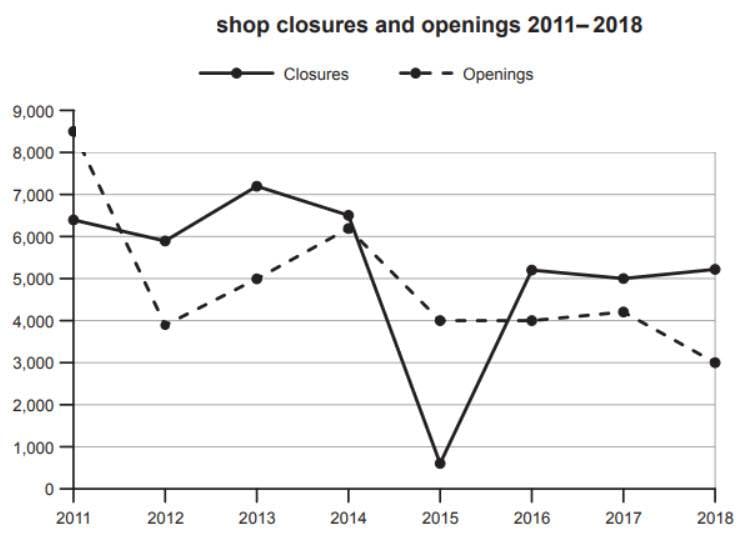
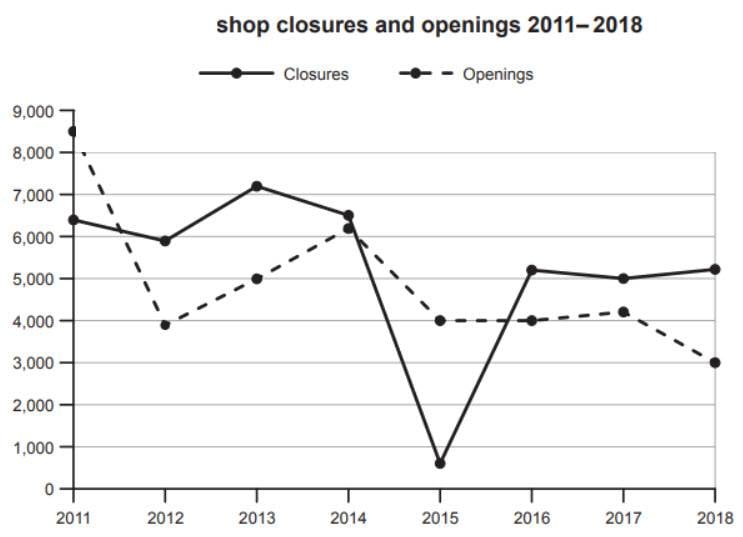
The chart shows the number of shops that closed and the number of new shops opening in a country from 2011 to 2018.
The line chart details shop closures and openings in a given nation between 2011 and 2018. Looking from an overall perspective, it is readily apparent that both figures were in decline, though most noticeably the number of openings. After erratic trends for both categories, by the end of the period closures had become more common.
In 2011, there were approximately 8,500 openings in the country, significantly higher than the 6,200 closures. Over the next several years, openings dropped to a low of 4,000 and then partly recovered to 6,100 in 2014. Openings were more stable and rose to a peak of 7,100 in 2013 before reaching nearly the same level as closures in 2014.
After this point, closures fell dramatically to just 600 in 2015 before returning to slightly depressed levels and finishing the time surveyed at 5,100. In contrast, openings declined less substantially to around 4,000 between 2015 and 2017 and dipped to end at 3,000 precisely in 2018.
Analysis
1. The line chart details shop closures and openings in a given nation between 2011 and 2018. 2. Looking from an overall perspective, it is readily apparent that both figures were in decline, though most noticeably the number of openings. 3. After erratic trends for both categories, by the end of the period closures had become more common.
Paraphrase what the bar chart shows.
Write a clear overview summarising the differences.
You might need another sentence for your overview.
1. In 2011, there were approximately 8,500 openings in the country, significantly higher than the 6,200 closures. 2. Over the next several years, openings dropped to a low of 4,000 and then partly recovered to 6,100 in 2014. 3. Openings were more stable and rose to a peak of 7,100 in 2013 before reaching nearly the same level as closures in 2014.
Begin writing about the data for the first categories.
Make sure you compare as much as possible.
Vary long and short sentences.
1. After this point, closures fell dramatically to just 600 in 2015 before returning to slightly depressed levels and finishing the time surveyed at 5,100. 2. In contrast, openings declined less substantially to around 4,000 between 2015 and 2017 and dipped to end at 3,000 precisely in 2018.
Write about the final other parts of the graph –
include everything!
Vocabulary
What do the words in bold below mean?Make some notes on paper to aid memory and then check below.
The line chart details shop closures and openings in a given nation between 2011 and 2018. Looking from an overall perspective, it is readily apparent that both figures were in decline, though most noticeably the number of openings. After erratic trends for both categories, by the end of the period closures had become more common.
In 2011, there were approximately 8,500 openings in the country, significantly higher than the 6,200 closures. Over the next several years, openings dropped to a low of 4,000 and then partly recovered to 6,100 in 2014. Openings were more stable and rose to a peak of 7,100 in 2013 before reaching nearly the same level as closures in 2014.
After this point, closures fell dramatically to just 600 in 2015 before returning to slightly depressed levels and finishing the time surveyed at 5,100. In contrast, openings declined less substantially to around 4,000 between 2015 and 2017 and dipped to end at 3,000 precisely in 2018.
Answers
For extra practice, write an antonym (opposite word) on a piece of paper to help you remember the new vocabulary:
details shows
closures shutting down, not opening
openings starting up, beginning
in a given nation in some country
between 2011 and 2018 from 2011 to 2018
Looking from an overall perspective, it is readily apparent that overall
figures numbers
in decline decreasing
though despite
most noticeably moreso
erratic trends fluctuating patterns
by the end of the period at the end of the time
common more popular
approximately around
significantly higher than a lot more than
dropped fell
low lowest point
partly recovered came back up but not all the way
stable little change
rose to a peak of hit a high point of
reaching nearly the same level as getting to the same point as
after this point now
fell dramatically decreased a lot
returning to slightly depressed levels going back down to lower numbers
I recommend getting a pencil and piece of paper because that aids memory. Then write down the missing vocabulary from my sample answer in your notebook:
The line chart d_________s shop c_______s and o___________s i___________________n b_______________8. L___________________________________________t both f_________s were i___________e, t_________________________y the number of openings. After e_____________s for both categories, b______________________d closures had become more c______n.
In 2011, there were a_______________y 8,500 openings in the country, s_________________n the 6,200 closures. Over the next several years, openings d_________d to a l___w of 4,000 and then p______________d to 6,100 in 2014. Openings were more s______e and r__________________f 7,100 in 2013 before r_________________________________s closures in 2014.
A______________t, closures f___________________y to just 600 in 2015 before r___________________________________s and f____________________________________t 5,100. I____________t, openings d_________________________y to a_______d 4,000 between 2015 and 2017 and d________d to e______t 3,000 p_________y in 2018.
Listening Practice
Learn more about this topic by watching from YouTube below and practice with these activities:
This is an IELTS writing task 2 sample answer essay from the new Cambridge IELTS 17 book of past test papers on the topic of health problems and alternative medicines and treatments.
Nowadays, an increasing number of people with health problems are using alternative medicines and treatments instead of visiting their normal doctor.
Do you think this is a positive or negative development?
In recent years, a growing number of unwell individuals have begun to adopt the use of alternative medicines and treatments. In my opinion, though these can sometimes be effective, this trend is negative overall due to the superiority of modern medicine.
Those who support alternative remedies argue there is historical evidence in favor of their effectiveness. A pertinent example of this would be the popularity of traditional Chinese medicine in Asia. Many of their medicines and treatments date back hundreds or even thousands of years. Over that time, they have been tested and their effect verified in some cases. Contemporary health researchers are often able to later identify the scientific rationale but it is possible there are remedies in use today that we still do not understand. This ignorance should not serve as a justification to question their overall importance.
However, the vast majority of viable medical treatment is modern. Scientists now understand more rigorously the underlying structures of cells, viruses, bacteria, cancers, and various other maladies. This has allowed for the creation of undeniably effective procedures such as surgery and the discovery of crucial medicines like penicillin. There is no doubt as to why these medicines work and therefore in the future they will only become more refined and safe. In contrast, traditional medicine may be effective for unknown reasons but its applicability is limited and it will not advance overtime.
In conclusion, with few exceptions, traditional medicine is a better alternative to less verifiable treatments and pharmaceuticals. Individuals can attempt to use them but should rely on their usual doctors.
Analysis
1. In recent years, a growing number of unwell individuals have begun to adopt the use of alternative medicines and treatments. 2. In my opinion, though these can sometimes be effective, this trend is negative overall due to the superiority of modern medicine.
Paraphrase the overall essay topic.
Write a clear opinion. Read more about introductions here.
1. Those who support alternative remedies argue there is historical evidence in favor of their effectiveness. 2. A pertinent example of this would be the popularity of traditional Chinese medicine in Asia. 3. Many of their medicines and treatments date back hundreds or even thousands of years. 4. Over that time, they have been tested and their effect verified in some cases. 5. Contemporary health researchers are often able to later identify the scientific rationale but it is possible there are remedies in use today that we still do not understand. 6. This ignorance should not serve as a justification to question their overall importance.
Write a topic sentence with a clear main idea at the end.
Explain your main idea.
Develop it with specific or hypothetical examples.
Keep developing it fully.
Short sentences can make your writing clearer.
Use complex and simple sentences.
1. However, the vast majority of viable medical treatment is modern. 2. Scientists now understand more rigorously the underlying structures of cells, viruses, bacteria, cancers, and various other maladies. 3. This has allowed for the creation of undeniably effective procedures such as surgery and the discovery of crucial medicines like penicillin. 4. There is no doubt as to why these medicines work and therefore in the future they will only become more refined and safe. 5. In contrast, traditional medicine may be effective for unknown reasons but its applicability is limited and it will not advance overtime.
Write a new topic sentence with a new main idea at the end.
Explain your new main idea.
Include specific details and examples.
Add as much information as you can and make sure it links logically.
Finish the paragraph strong.
1. In conclusion, with few exceptions, traditional medicine is a better alternative to less verifiable treatments and pharmaceuticals. 2. Individuals can attempt to use them but should rely on their usual doctors.
Summarise your main ideas.
Include a final thought. Read more about conclusions here.
Vocabulary
What do the words in bold below mean?Make some notes on paper to aid memory and then check below.
In recent years, a growing number of unwell individuals have begun to adopt the use of alternative medicines and treatments. In my opinion, though these can sometimes be effective, this trend is negative overall due to the superiority of modern medicine.
Those who support alternative remedies argue there is historical evidencein favor of their effectiveness. A pertinent example of this would be the popularity of traditional Chinese medicine in Asia. Many of their medicines and treatments date back hundreds or even thousands of years. Over that time, they have been tested and their effect verified in some cases. Contemporary health researchers are often able to later identify the scientific rationale but it is possible there are remedies in use today that we still do not understand. This ignorance should not serve as a justification to question their overall importance.
However, the vast majority of viable medical treatment is modern. Scientists now understand more rigorously the underlying structures of cells, viruses, bacteria, cancers, and various other maladies. This has allowed for the creation of undeniably effective procedures such as surgery and the discovery of crucial medicines like penicillin. There is no doubt as to why these medicines work and therefore in the future they will only become more refined and safe. In contrast, traditional medicine may be effective for unknown reasons but its applicability is limited and it will not advance overtime.
In conclusion, with few exceptions, traditional medicine is a better alternative toless verifiable treatments and pharmaceuticals. Individuals can attempt to use them but should rely on their usual doctors.
Answers
For extra practice, write an antonym (opposite word) on a piece of paper to help you remember the new vocabulary:
in recent years in the last few decades
growing increasing
unwell sick
begun started to
adopt start using
medicines pills, drugs, etc.
treatments ways to deal with illnesses
though despite
effective works well
trend pattern
negative overall bad in general
due to because of
the superiority of modern medicine how much better new medicine and doctors are
support alternative remedies favor less traditional doctors
argue point out
historical evidence examples from the past
in favor of supporting
effectiveness works well
A pertinent example of this would be a good instance of this is
popularity how common it is
traditional Chinese medicine older treatments from China
date back from a long time ago
Over that time as time passes
tested verified
verified proven true
in some cases sometimes
Contemporary health researchers are doctors today can
later identify after that figure out
scientific rationale good reasons
remedies in use today treatments now
ignorance not knowing about
serve as are the basis for
justification reason for
question doubt
overall importance how valuable they are in general
vast majority most of
viable medical useful treatment
rigorously intensively
underlying structures basic parts
cells fundamental component of life
viruses dangerous spreading diseases
bacteria cause disease
cancers a serious illness
various other maladies different diseases
allowed for made it possible
creation making of
undeniably effective procedures definitely work
surgery operating on someone
discovery finding of
crucial medicines key treatments
penicillin a drug for treating infections
There is no doubt as to it can’t be denied that
therefore thus
refined made better
safe not dangerous
In contrast however
unknown reasons ignorance of why
applicability how much it can be used in other cases
limited contained
advance move forward
with few exceptions not many other instances
better alternative to better way to
less verifiable treatments medicines that can’t be trusted
I recommend getting a pencil and piece of paper because that aids memory. Then write down the missing vocabulary from my sample answer in your notebook:
Nowadays, an increasing number of people with health problems are using alternative medicines and treatments instead of visiting their normal doctor.
Do you think this is a positive or negative development?
I__________________s, a g__________g number of u________l individuals have b______n to a______t the use of alternative m______________s and t_____________s. In my opinion, t______h these can sometimes be e___________e, this t_____d is n____________________l d_________________________________________e.
Those who s______________________________s a________e there is h_______________________ei____________f their e____________s. A____________________________________________e the p__________y of t___________________________e in Asia. Many of their medicines and treatments d________k hundreds or even thousands of years. O_______________e, they have been t______d and their effect v___________d i______________s. C________________________________e often able to l____________y the s________________e but it is possible there are r__________s i_____________y that we still do not understand. This i_________e should not s_________s a j________________n to q___________n their o_____________e.
However, the v________________________fv_______________l treatment is modern. Scientists now understand more r___________y the u_____________________s of c_____s, v_________s, b_________a, c_________s, and v__________________s. This has a________________r the c___________n of u_______________________________s such as s___________y and the d____________y of c_______________________s like p__________n. T_____________________________s to why these medicines work and t____________e in the future they will only become more r____________d and s___e. I______________t, traditional medicine may be effective for u______________________s but its a__________________y is l____________d and it will not a________e overtime.
In conclusion, w____________________s, traditional medicine is a b____________________________ol_______________________________s and p____________________s. Individuals can a___________t to use them but should r_________n their u_______________s.
Listening Practice
Learn more about this topic by watching from YouTube below and practice with these activities:
Combine the different skills when you practice so that your brain groups together the language – this will make your progress much faster.
Listening Activities for Cambridge IELTS 17
Over and over: The most important key to improving your listening is to listen multiple times. Listen over and over and try to hear new sounds, words, etc. Then check with the tapescript to find where your weaknesses are.
Test environment: Find out how the exam works in your country and simulate the environment. Headphones or speaker? Sitting at a desk? Really cold room? This can help to alleviate anxiety on the day of the test.
After you listen: This is the key period for improvement. Fill in the answers but maybe write some other possibilities – keep your practice light and easy. You should be having fun with it and playing around with your listening skills. Vary it up by putting down the book and listening to a video on YouTube or a podcast as well.
Focus Activity: Sometimes students have trouble focusing on all areas at one: vocabulary, grammar, ideas, etc. Make it easier on yourself. Just write one paragraph for a topic and focus on your vocabulary. Then write the same paragraph but focus on grammar. Then on ideas. Change the order with the next paragraph. Keep building up your skills and then later try to write a whole essay focusing on all skills at once.
Sample Answers: Take advantage of sample answers to improve. Go back to your old essays and then check with my sample answers. Can you take any of my vocabulary and put it in? Any grammar? Keep going back to your old essays adding in what you learn from my samples. Then later when you practice on your own, try to remember some of what you have learned.
More ideas for teachers and students: I wrote a whole post about this before. Some ideas will apply for classes but lots of them you can also do all on your own without a teacher or another student: https://howtodoielts.com/ielts-lesson-activities/
ReadingActivities for Cambridge IELTS 17
Listen and stop: Start listening to a test but every once in a while stop the listening. What was the last sentence you heard? The last word? Can you predict the next word? The next sentence? Change up the way you practice so that your development is more consistent and faster.
Paraphrases/Synonyms: These are really key on IELTS. After doing a test, highlight the key words in the questions. Highlight how those words change in the reading. Make a list in your notebook of the differences. This will raise your awareness of the differences and help you understand the test much better.
Summaries: Summarizing is simple but also really, really hard. After a reading try to write a few sentences to summarize the practice. But change it up. Sometimes you can just write 1 sentence – sometimes a whole paragraph. Sometimes, just summarize a single paragraph or paraphrase one sentence. Always change the way that you practice to keep challenging yourself!
SpeakingActivities for Cambridge IELTS 17
Different Answers: Some students practice by repeating the same answers over and over again. This will make you sound really robotic. Instead, try answering the same question with slightly different details each time. This will make you sound more natural, fluent, and you will get the chance to use a wider range of vocabulary.
Simulate the Test: Watch a test on YouTube to understand how it will really work. One of my favorites is here. Then either use the computer or a friend to practice a real test for yourself. This will help to reduce your anxiety later when you take the real test.
Combination: You should always be combining your skills. So, after doing a reading, do some speaking questions on the same topic. Record your answers. Then do a writing. Go back and listen to your answers. Is there any better vocabulary that you could have used? Record yourself again. Keep practicing the same topic. Listen back to your answers a day later. Try again with better vocabulary and record yourself. Keep repeating this process over and over again so that you can hear your progress and know that you are not wasting your time!
This is an IELTS writing task 2 sample answer essay from the new Cambridge IELTS 17 book of past test papers related to professionals such as doctors and engineers working in other countries.
Some people believe that professionals, such as doctors and engineers, should be required to work in the country where they did their training. Others believe they should be free to work in another country if they wish.
Discuss views and give your own opinion.
Certain groups today have argued that skilled professionals should be obliged to work where they did their initial training, while others feel they are owed the right to work anywhere. In my opinion, assuming that the qualifications translate, all individuals ought to have the freedom to choose their country of occupation.
Those who oppose this practice contend that professionals owe a debt of gratitude to the location of their training. Qualified professionals ranging from medical practitioners and engineers to scientists and teachers at some point likely relied deeply on governmental and educational resources in their local area. It is therefore logical that these individuals should remain at least in the same country and contribute their skills to bettering society as a whole. For instance, a doctor who has benefited from quality schools and government aid in the United States can justifiably be asked to help their fellow citizens and train future doctors.
However, the right to choose freely where one works and lives is paramount. Since many professionals will likely end up remaining where they did their training, this is rarely a pressing problem in most nations. Given that reality, workers should not be restricted in their movement and choice of living environment. When moving to another locale, they will likely have to ensure their standardization and certification are valid and learn the intricacies of working in another nation. However, these are simply individual impediments and should not be used as definitive counter-arguments. Preventing individuals from working in other countries would also considerably impair the sharing of expertise and culture across international borders.
In conclusion, though there are certain standards that must be reached, all working professionals should be free to work abroad. This policy is largely already in place for most occupations.
Analysis
1. Certain groups today have argued that skilled professionals should be obliged to work where they did their initial training, while others feel they are owed the right to work anywhere. 2. In my opinion, assuming that the qualifications translate, all individuals ought to have the freedom to choose their country of occupation.
Paraphrase the overall essay topic.
Write a clear opinion. Read more about introductions here.
1. Those who oppose this practice contend that professionals owe a debt of gratitude to the location of their training. 2. Qualified professionals ranging from medical practitioners and engineers to scientists and teachers at some point likely relied deeply on governmental and educational resources in their local area. 3. It is therefore logical that these individuals should remain at least in the same country and contribute their skills to bettering society as a whole. 4. For instance, a doctor who has benefited from quality schools and government aid in the United States can justifiably be asked to help their fellow citizens and train future doctors.
Write a topic sentence with a clear main idea at the end.
Explain your main idea.
Develop it with specific or hypothetical examples.
Keep developing it fully.
1. However, the right to choose freely where one works and lives is paramount. 2. Since many professionals will likely end up remaining where they did their training, this is rarely a pressing problem in most nations. 3. Given that reality, workers should not be restricted in their movement and choice of living environment. 4. When moving to another locale, they will likely have to ensure their standardization and certification are valid and learn the intricacies of working in another nation. 5. However, these are simply individual impediments and should not be used as definitive counter-arguments. 6. Preventing individuals from working in other countries would also considerably impair the sharing of expertise and culture across international borders.
Write a new topic sentence with a new main idea at the end.
Explain your new main idea.
Include specific details and examples.
Add as much information as you can and make sure it links logically.
Finish the paragraph strong.
This paragraph should be a little longer.
1. In conclusion, though there are certain standards that must be reached, all working professionals should be free to work abroad. 2. This policy is largely already in place for most occupations.
Summarise your main ideas.
Include a final thought. Read more about conclusions here.
Vocabulary
What do the words in bold below mean?Make some notes on paper to aid memory and then check below.
Certain groups today have argued that skilled professionals should be obliged to work where they did their initial training, while others feel they are owed the right to work anywhere. In my opinion, assuming that the qualifications translate, all individuals ought to have the freedom to choose their country of occupation.
Those who oppose this practice contend that professionals owe a debt of gratitude to the location of their training. Qualified professionals ranging from medical practitioners and engineers to scientists and teachersat some point likely relied deeply on governmental and educational resources in their local area. It is therefore logical that these individuals should remainat least in the same country and contribute their skills to bettering society as a whole. For instance, a doctor who has benefited from quality schools and government aid in the United States can justifiably be asked to help their fellow citizens and train future doctors.
However, the right to choose freely where one works and lives is paramount. Since many professionals will likely end up remaining where they did their training, this is rarely a pressing problem in most nations. Given that reality, workers should not be restricted in their movement and choice of living environment. When moving to another locale, they will likely have to ensure their standardization and certification are valid and learn the intricacies of working in another nation. However, these are simply individual impediments and should not be used as definitive counter-arguments. Preventing individuals from working in other countries would also considerably impair the sharing of expertise and culture across international borders.
In conclusion, though there are certain standards that must be reached, all working professionals should be free to work abroad. This policy is largely already in place for most occupations.
Answers
For extra practice, write an antonym (opposite word) on a piece of paper to help you remember the new vocabulary:
certain groups today some people
argued contended
skilled professionals people with jobs that require training and education
obliged should have to do it
initial training first learning
while however
owed are obliged to
right deserve to
assuming that given that
qualifications translate certifications carry over
ought to have should have
country of occupation where you work
oppose go against
practice contend policy argue
owe a debt of gratitude have to pay back
location place
training learning and studying and practicing
Qualified professionals people who are trained and certified
ranging from medical practitioners and engineers to scientists and teachers including doctors, etc.
at some point eventually
relied deeply had to get a lot of help from
governmental federal
educational resources schools
local area where you live
logical rational
remainat least stay at minimum
contribute add to
bettering society as a whole making life better for all
quality schools good education
government aid federal support
justifiably good reason for it
help their fellow citizens aid other people in the country
train future doctors help teacher young doctors
paramount crucial
will likely end up probably will happen
remaining staying
rarely not often
pressing problem key issue
Given that reality since
workers employees
restricted limited
movement going to a new place
choice of living environment where you live
locale place
ensure make sure of
standardization making sure everything is the same and certified
certification standardized
valid not fraudulent
intricacies complexities
simply individual impediments only personal obstacles
definitive counter-arguments strong argument against
preventing stopping
considerably impair hurt a lot
sharing of expertise and culture across international borders collaborating and working with others
I recommend getting a pencil and piece of paper because that aids memory. Then write down the missing vocabulary from my sample answer in your notebook:
C_____________________y have a________d that s_________________s should be o________d to work where they did their i_____________g, w_____e others feel they are o_____d the r______t to work anywhere. In my opinion, a_____________t the q________________________e, all individuals o_______________e the freedom to choose their c_____________________n.
Those who o_________e this p______________d that professionals o_____________________e to the l________n of their t_______g. Q_______________s r________________________________________________________sa______________t likely r________y on g____________l and e______________________s in their l___________a. It is therefore l________l that these individuals should r_______________t in the same country and c_____________e their skills to b_________________________e. For instance, a doctor who has benefited from q________________s and g____________________d in the United States can j____________y be asked to h_____________________________s and t______________________s.
However, the right to choose freely where one works and lives is p___________t. Since many professionals w__________________________________g where they did their training, this is r________y a p___________m in most nations. G________________y, w_________s should not be r____________d in their m____________t and c________________t. When moving to another l_______e, they will likely have to e______e their s____________n and c______________n are v_____d and learn the i____________s of working in another nation. However, these are s____________________s and should not be used as d___________________________s. P__________g individuals from working in other countries would also c________________r the s_________________________________________________s.
In conclusion, though there are c___________________s that must be r_________d, all working professionals should be free to work abroad. This p_____y is l___________________________e for most o_______________s.
Listening Practice
Learn more about this topic by watching from YouTube below and practice with these activities:
This is an IELTS writing task 2 sample answer essay from the new Cambridge IELTS 17 book of past test papers on the topic of taking risks in professional and personal lives.
IELTS Cambridge 17 Essay: Taking Risks in Professional and Personal Lives
It is important for people to take risks, in both their professional lives and personal lives.
Do the advantages of taking these risks outweigh the disadvantages?
Some would argue that taking risks, both in terms of one’s private life and one’s working career, is advantageous overall. I am generally in agreement with this contention due to the potential for advancement and growth.
Firstly, risk-taking can expedite one’s career goals. Many workers decide early on that they are content with their position in society and therefore often fail to actualize their potential. Others, however, attempt various business enterprises and transition from field to field in order to find a good match. Although this may lead to short-term setbacks, in the long-term such ambitious individuals are far more likely to become very successful in life. Assuming that these risks are taken early in one’s career, there is a strong likelihood that they will eventually profit the risk-taker in question.
Moreover, an individual who takes risks will also develop more mature personal relationships. In more conservative countries, many young people do not begin to have serious romantic relationships until after university. The result of this is that they are often immature and it can lead to poor and naive choices in terms of marriage and parenting. In contrast, a person who takes risks in their personal life and enters into various relationships throughout high school and university will become a better judge of character. Their allegedly risky behavior can then serve as the foundation for personal growth and increased maturity.
In conclusion, taking risks can be a catalyst for tremendous growth and is therefore advisable. The disadvantages of risk-taking can also be mitigated in most contexts by not being inordinately reckless.
Analysis
1. Some would argue that taking risks, both in terms of one’s private life and one’s working career, is advantageous overall. 2. I am generally in agreement with this contention due to the potential for advancement and growth.
Paraphrase the overall essay topic.
Write a clear opinion. Read more about introductions here.
1. Firstly, risk-taking can expedite one’s career goals. 2. Many workers decide early on that they are content with their position in society and therefore often fail to actualize their potential. 3. Others, however, attempt various business enterprises and transition from field to field in order to find a good match. 4. Although this may lead to short-term setbacks, in the long-term such ambitious individuals are far more likely to become very successful in life. 5. Assuming that these risks are taken early in one’s career, there is a strong likelihood that they will eventually profit the risk-taker in question.
Write a topic sentence with a clear main idea at the end.
Explain your main idea.
Develop it with specific or hypothetical examples.
Keep developing it fully.
Short sentences can make your writing clearer.
1. Moreover, an individual who takes risks will also develop more mature personal relationships. 2. In more conservative countries, many young people do not begin to have serious romantic relationships until after university. 3. The result of this is that they are often immature and it can lead to poor and naive choices in terms of marriage and parenting. 4. In contrast, a person who takes risks in their personal life and enters into various relationships throughout high school and university will become a better judge of character. 5. Their allegedly risky behavior can then serve as the foundation for personal growth and increased maturity.
Write a new topic sentence with a new main idea at the end.
Explain your new main idea.
Include specific details and examples.
Add as much information as you can and make sure it links logically.
Finish the paragraph strong.
1. In conclusion, taking risks can be a catalyst for tremendous growth and is therefore advisable. 2. The disadvantages of risk-taking can also be mitigated in most contexts by not being inordinately reckless.
Summarise your main ideas.
Include a final thought. Read more about conclusions here.
Vocabulary
What do the words in bold below mean?Make some notes on paper to aid memory and then check below.
Some would argue that taking risks, both in terms of one’s private life and one’s working career, is advantageous overall. I am generally in agreement with this contention due to the potential for advancement and growth.
Firstly, risk-taking can expedite one’s career goals. Many workers decide early on that they are content with their position in society and therefore often fail to actualize their potential. Others, however, attempt various business enterprises and transition from field to field in order to find a good match. Although this may lead to short-term setbacks, in the long-term such ambitious individuals are far more likely to become very successful in life. Assuming that these risks are taken early in one’s career, there is a strong likelihood that they will eventually profit the risk-taker in question.
Moreover, an individual who takes risks will also develop more maturepersonal relationships. In more conservative countries, many young people do not begin to have serious romantic relationships until after university. The result of this is that they are often immature and it can lead to poor and naive choices in terms of marriage and parenting. In contrast, a person who takes risks in their personal life and enters into various relationshipsthroughout high school and university will become a better judge of character. Their allegedly risky behavior can then serve as the foundation for personal growth and increased maturity.
In conclusion, taking risks can be a catalyst fortremendous growth and is therefore advisable. The disadvantages of risk-taking can also be mitigated in most contexts by not being inordinately reckless.
Answers
For extra practice, write an antonym (opposite word) on a piece of paper to help you remember the new vocabulary:
taking risks making decisions that are not always safe
in terms of concerning
private life personal lives
working career jobs
advantageous overall good in general
I am generally in agreement with this contention I mostly agree
due to because of
potential possible
advancement moving forward
growth becoming a better person
risk-taking making risky decisions
expedite make faster
career goals pursue a good job and career path
decide early on choose from the beginning
content satisfied with
position job
fail to actualize don’t fully achieve
attempt try
business enterprises jobs and businesses
transition from field to field move from job to job
good match good fit
short-term setbacks drawbacks right away
ambitious individuals people with big dreams
are far more likely to become greater chance they will
Assuming given that
risks are taken doing risky actions
career job
strong likelihood good chance of it
profit what you get/earn
risk-taker person who takes risks
in question being discussed here
develop change
maturepersonal relationships better interactions with others
conservative countries traditional nations
serious romantic relationships boyfriends, girlfriends, partners, etc.
The result of this is that the consequence is
immature not mature, childish
poor not good
naive innocent
in terms of concerning
enters into various relationshipsthroughout have many different relationships during
better judge of character understand people better
allegedly it is assumed that
serve as the foundation for are the basis for
personal growth how a person changes and gets better
I recommend getting a pencil and piece of paper because that aids memory. Then write down the missing vocabulary from my sample answer in your notebook:
Some would argue that t________________s, both i____________f one’s p_____________e and one’s w______________r, is a_____________________l. I_________________________________________________n d______o the p_________l for a_________t and g_________h.
Firstly, r__________g can e_________e one’s c__________s. Many workers d______________n that they are c_______t with their p________n in society and therefore often f____________e their potential. Others, however, a_______t various b__________________s and t___________________________d in order to find a g_________h. Although this may lead to s________________________s, in the long-term such a____________________s a_______________________________e very successful in life. A___________g that these r________________n early in one’s c_______r, there is a s_____________d that they will eventually p______t the r___________________________n.
Moreover, an individual who takes risks will also d__________p more m______________________s. In more c____________________________s, many young people do not begin to have s___________________________s until after university. T_________________________t they are often i____________e and it can lead to p____r and n____e choices i________________f marriage and parenting. In contrast, a person who takes risks in their personal life and e____________________________________t high school and university will become a b_________________r. Their a__________y risky behavior can then s_______________________________r p___________________h and i________________y.
In conclusion, taking risks can be a____________________________s growth and is therefore a__________e. The disadvantages of risk-taking can also be m__________d in most c______________s by not being i____________________s.
Listening Practice
Learn more about this topic by watching from YouTube below and practice with these activities:
"The highest quality materials anywhere on the internet! Dave improved my writing and vocabulary so much. Really affordable options you don't want to miss out on!"