This is an IELTS writing task 2 sample answer essay from the new Cambridge IELTS 17 book of past test papers related to a map of an industrial area in the town of Norbiton.
IELTS Cambridge 17 Essay: Map of an Industrial Area (Norbiton)
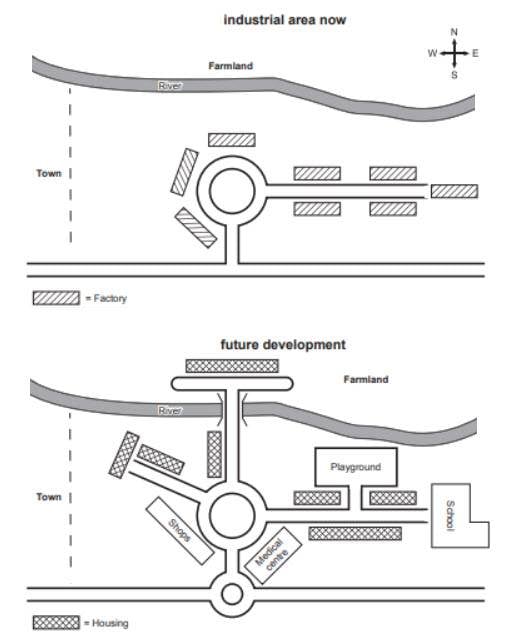
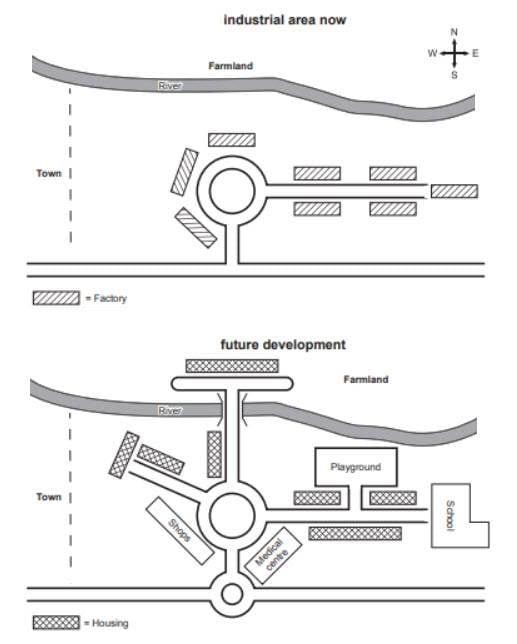
The maps illustrate an industrial area in Norbiton in the present day compared with plans for future development of the site.
The above maps detail Norbiton in the present day and plans for future development. Looking from an overall perspective, it is readily apparent that the town will become less industrial and more residential with the construction of facilities for housing, education, shopping, and medical care. This development will occur primarily to the west and north with only a small patch of farmland remaining undisturbed.
In the current town, there is a central roundabout surrounded by factories and a road running from west to east out of Norbiton. In the future, the roundabout will remain but the factories around it will become shops, new housing will line a northwestern road, and there will be a new hospital built to the southeast. The original road going to the east will also now have housing on either side along with a large playground to the north and a school at the easternmost border of the town.
Outside the center of the town, there are also plans for a smaller roundabout in the south which will bisect an existing street. In the north, there will be a bridge over the river and the farmland to the north will be partly replaced with housing, though not to the east where no alterations will be made.
Analysis
1. The above maps detail Norbiton in the present day and plans for future development. 2. Looking from an overall perspective, it is readily apparent that the town will become less industrial and more residential with the construction of facilities for housing, education, shopping, and medical care. 3. This development will occur primarily to the west and north with only a small patch of farmland remaining undisturbed.
Paraphrase what the map shows.
Write a clear overview summarising the differences.
You might need another sentence for your overview.
1. In the current town, there is a central roundabout surrounded by factories and a road running from west to east out of Norbiton. 2. In the future, the roundabout will remain but the factories around it will become shops, new housing will line a northwestern road, and there will be a new hospital built to the southeast. 3. The original road going to the east will also now have housing on either side along with a large playground to the north and a school at the easternmost border of the town.
Begin writing about the first part of the map.
Make sure you compare as much as possible.
Don’t leave anything out!
1. Outside the center of the town, there are also plans for a smaller roundabout in the south which will bisect an existing street. 2. In the north, there will be a bridge over the river and the farmland to the north will be partly replaced with housing, though not to the east where no alterations will be made.
Write about the final, other parts of the map – include everything!
Mention anything that has not changed on the map too.
Vocabulary
What do the words in bold below mean?Make some notes on paper to aid memory and then check below.
The above maps detail Norbiton in the present day and plans for future development. Looking from an overall perspective, it is readily apparent that the town will become less industrial and more residential with the construction of facilities for housing, education, shopping, and medical care. This development will occur primarily to the west and north with only a small patch of farmland remaining undisturbed.
In the current town, there is a central roundabout surrounded by factories and a road running from west to east out of Norbiton. In the future, the roundabout will remain but the factories around it will become shops, new housing will line a northwestern road, and there will be a new hospital built to the southeast. The original road going to the east will also now have housing on either sidealong with a large playground to the north and a school at the easternmost border of the town.
Outside the center of the town, there are also plans for a smaller roundabout in the south which will bisect an existing street. In the north, there will be a bridge over the river and the farmland to the north will be partly replaced with housing, though not to the east where no alterations will be made.
Answers
For extra practice, write an antonym (opposite word) on a piece of paper to help you remember the new vocabulary:
above over
detail show
in the present day today
future development plans for later
Looking from an overall perspective, it is readily apparent that overall
less industrial not as many factories and businesses
more residential more people living there in homes
construction building of
facilities places
housing places to live
education schools
shopping places to shop
medical care hospitals
occur primarily happens mostly
to the west and north in the right and top part
small patch little piece
farmland agricultural land
remaining undisturbed staying unchanged
In the current town where it is now
central roundabout rotary in the middle
surrounded by on all sides
running from west to east out of going from left to right
line are alongside of
northwestern top left
southeast. bottom right
original how it was
on either side on both sides of
along with and
playground place for kids to play
easternmost border to the east, the furthest point
I recommend getting a pencil and piece of paper because that aids memory. Then write down the missing vocabulary from my sample answer in your notebook:
The a______e maps d______l Norbiton i_________________y and plans for f_____________________t. L___________________________________________t the town will become l_______________l and m________________l with the c______________n of f_________s for h_________g, e__________n, s_______g, and m____________e. This development will o____r p_________y t____________________________h with only a s________h of f__________________________d.
I___________________n, there is a c___________________t s_________________y factories and a road r______________________________f Norbiton. In the future, the roundabout will remain but the factories around it will become shops, new housing will l____e a n_____________n road, and there will be a new hospital built to the s_____________t. The o_________l road going to the east will also now have housing o_____________ea___________h a large p____________d to the north and a school at the e__________________r of the town.
O__________e the center of the town, there are also plans for a smaller roundabout in the south which will b_______t an e___________g street. In the north, there will be a b_______e over the river and the farmland to the north will be p____________d with housing, t_________h not to the east where no a___________s will be made.
Listening Practice
Learn more about this topic by watching from YouTube below and practice with these activities:
In an era of globalization, some people think that studying abroad is the best way to attain a well-paid job while others believe other options are better.
Discuss both views and give your own opinion.
Some today would argue that the rise of globalization necessitates studying abroad if an individual desires a stable career path. In my opinion, though this is an ideal route to success, there are superior methods.
Those who argue in favor of studying abroad make the contention that it allows a person to network and understand the world better. The majority of students who study in other countries are leaving less developed nations to study in more affluent countries. When studying abroad, not only will they be exposed to other cultures and ways of living, but they are also likely to make key connections that can help them in the future. After graduation, they can rely on their network when applying for jobs, starting businesses, or simply seeking advice. Without these advantages, a person will have a more difficult time attaining a well-paying job.
However, the surest pathway to success is to gain experience in any given profession, regardless of the location. A person who is studying and working abroad faces roughly the same obstacles when applying for jobs. If they remain in their country of origin, they will not only understand the local market better but also possess inherent advantages in terms of language, culture, and family support. Many of the most successful entrepreneurs in the world and highly-regarded executives studied and work in their native country. For instance, in Vietnam there are numerous start-up businesses that identify local needs and work to meet demand, oftentimes without the benefit of an education abroad or even an advanced university degree.
In conclusion, most individuals studying abroad are more likely to succeed because of other factors and therefore most individuals should pursue different means of securing stable employment in today’s volatile employment market. Governments should naturally support individuals in these matters.
Analysis
1. Some today would argue that the rise of globalization necessitates studying abroad if an individual desires a stable career path. 2. In my opinion, though this is an ideal route to success, there are superior methods.
Paraphrase the overall essay topic.
Write a clear opinion. Read more about introductions here.
1. Those who argue in favor of studying abroad make the contention that it allows a person to network and understand the world better. 2. The majority of students who study in other countries are leaving less developed nations to study in more affluent countries. 3. When studying abroad, not only will they be exposed to other cultures and ways of living, but they are also likely to make key connections that can help them in the future. 4. After graduation, they can rely on their network when applying for jobs, starting businesses, or simply seeking advice. 5. Without these advantages, a person will have a more difficult time attaining a well-paying job.
Write a topic sentence with a clear main idea at the end.
Explain your main idea.
Develop it with specific or hypothetical examples.
Keep developing it fully.
Short sentences can make your writing clearer.
1. However, the surest pathway to success is to gain experience in any given profession, regardless of the location. 2. A person who is studying and working abroad faces roughly the same obstacles when applying for jobs. 3. If they remain in their country of origin, they will not only understand the local market better but also possess inherent advantages in terms of language, culture, and family support. 4. Many of the most successful entrepreneurs in the world and highly-regarded executives studied and work in their native country. 5. For instance, in Vietnam there are numerous start-up businesses that identify local needs and work to meet demand, oftentimes without the benefit of an education abroad or even an advanced university degree.
Write a new topic sentence with a new main idea at the end.
Explain your new main idea.
Include specific details and examples.
Add as much information as you can and make sure it links logically.
Finish the paragraph strong.
1. In conclusion, most individuals studying abroad are more likely to succeed because of other factors and therefore most individuals should pursue different means of securing stable employment in today’s volatile employment market. 2. Governments should naturally support individuals in these matters.
Summarise your main ideas.
Include a final thought. Read more about conclusions here.
Vocabulary
What do the words in bold below mean?Make some notes on paper to aid memory and then check below.
Some today would argue that the rise of globalization necessitates studying abroad if an individual desires a stable career path. In my opinion, though this is an ideal route to success, there are superior methods.
Those who argue in favor of studying abroad make the contention that it allows a person to network and understand the world better. The majority of students who study in other countries are leaving less developed nations to study in more affluent countries. When studying abroad, not only will they be exposed to other cultures and ways of living, but they are also likely to make key connections that can help them in the future. After graduation, they can rely on their network when applying for jobs, starting businesses, or simply seeking advice. Without these advantages, a person will have a more difficult time attaining a well-paying job.
However, the surest pathway to success is to gain experience in any given profession, regardless of the location. A person who is studying and working abroad faces roughly the same obstacles when applying for jobs. If they remain in their country of origin, they will not only understand the local market better but also possess inherent advantagesin terms of language, culture, and family support. Many of the most successful entrepreneurs in the world and highly-regarded executives studied and work in their native country. For instance, in Vietnam there are numerous start-up businesses that identify local needs and work to meet demand, oftentimes without the benefit of an education abroad or even an advanced university degree.
In conclusion, most individuals studying abroad are more likely to succeed because of other factors and therefore most individuals should pursue different means of securing stable employment in today’s volatile employment market. Governments should naturally support individuals in these matters.
Answers
For extra practice, write an antonym (opposite word) on a piece of paper to help you remember the new vocabulary:
argue make the point that
rise of globalization more and more countries interacting and influencing each other
necessitates makes it needed to do this
studying abroad learning in other countries
desires hopes to, wants to
stable career path good job
ideal route best way
success achievement
superior methods better ways
those who argue in favor of people who support
contention argument
allows permits
network people that you know
understand the world better learn more about life
The majority of most of
leaving less developed nations going away from poorer countries
affluent countries rich nations
exposed to be able to learn about
ways of living culture
make key connections network
graduation leaving school
rely on depend on
applying for making applications for
seeking advice looking for ideas
Without these advantages not having these benefits
difficult time attaining a well-paying job hard time getting good employment
surest pathway best way
gain experience have time doing things
any given profession a job
regardless of the location wherever you are
faces roughly the same obstacles has more or less similar challenges
remain stay
local market the place where you live
possess inherent advantages has intrinsic benefits
I recommend getting a pencil and piece of paper because that aids memory. Then write down the missing vocabulary from my sample answer in your notebook:
Some today would a_____e that the r________________n n____________s s_______________d if an individual d_________s a s_______________h. In my opinion, though this is an i___________e to s________s, there are s______________________s.
T___________________________f studying abroad make the c____________n that it a_______s a person to n__________k and u___________________________r. T________________________f students who study in other countries are l___________________________s to study in more a_______________s. When studying abroad, not only will they be e_____________o other cultures and w________________g, but they are also likely to m_____________________s that can help them in the future. After g_____________n, they can r________n their network when a______________r jobs, starting businesses, or simply s_________________e. W______________________s, a person will have a more d__________________________________________b.
However, the s__________________y to success is to g_____________e in a_______________n, r___________________n. A person who is studying and working abroad f___________________________s when applying for jobs. If they r_______n in their country of origin, they will not only understand the l____________t better but also p__________________si___________f language, culture, and f______________t. Many of the most successful e_____________s in the world and h_____________________s studied and work in their native country. For instance, in Vietnam there are n__________________________s that i_____________________s and work to m____________d, o_____________s w_______________________f an education abroad or e_______________________e.
In conclusion, most individuals studying abroad are more likely to succeed because of other factors and therefore most individuals should p__________________________________________t in t_________________________t. Governments should n______________________t individuals i_____________________s.
Listening Practice
Learn more about this topic by watching from YouTube below and practice with these activities:
Although it is generally illegal, physical punishment continues in many countries. Some argue that parents should have the right to punish their children in this way.
Do you agree or disagree?
Some traditional parents argue that they should be allowed to punish their children physically. I am in strong disagreement with this contention despite the legitimacy of parental rights.
Those in favor of parents being permitted to punish their children physically point out this is an historically ingrained privilege. For thousands of years, parents have had the ability to raise their children according to their own beliefs and values. This includes choices related to culture, religion, diet, and lifestyle. Physical punishment can be theoretically added to this list as it has a massive impact on a child’s psychology and future identity. The support for this practice is that many successful individuals have anecdotally expressed gratitude to parents who hit them when they were younger, believing that it instilled a sense of discipline in them.
However, research has shown that the positive impact in select cases of corporal punishment is greatly outweighed by emotional and psychological abuse. The vast majority of children who were physically abused develop either temporary or lasting side-effects. The most common one is that children are not as confident and willing to express themselves because they consistently fear punishment from a loved one. As they get older, this can become a barrier both for interpersonal relationships and their public persona. Many children who have only learned discipline through physical punishment end up hitting their own children and this can create an ongoing cycle of abuse.
In conclusion, although parents should have the right to raise their children as they see fit, this prerogative must be limited in the case of physical abuse. In most nations, there are already laws banning corporal punishment.
Analysis
1. Some traditional parents argue that they should be allowed to punish their children physically. 2. I am in strong disagreement with this contention despite the legitimacy of parental rights.
Paraphrase the overall essay topic.
Write a clear opinion. Read more about introductions here.
1. Those in favor of parents being permitted to punish their children physically point out this is an historically ingrained privilege. 2. For thousands of years, parents have had the ability to raise their children according to their own beliefs and values. 3. This includes choices related to culture, religion, diet, and lifestyle. 4. Physical punishment can be theoretically added to this list as it has a massive impact on a child’s psychology and future identity. 5. The support for this practice is that many successful individuals have anecdotally expressed gratitude to parents who hit them when they were younger, believing that it instilled a sense of discipline in them.
Write a topic sentence with a clear main idea at the end.
Explain your main idea.
Develop it with specific or hypothetical examples.
Keep developing it fully.
Short sentences can make your writing clearer.
1. However, research has shown that the positive impact in select cases of corporal punishment is greatly outweighed by emotional and psychological abuse. 2. The vast majority of children who were physically abused develop either temporary or lasting side-effects. 3. The most common one is that children are not as confident and willing to express themselves because they consistently fear punishment from a loved one. 4. As they get older, this can become a barrier both for interpersonal relationships and their public persona. 5. Many children who have only learned discipline through physical punishment end up hitting their own children and this can create an ongoing cycle of abuse.
Write a new topic sentence with a new main idea at the end.
Explain your new main idea.
Include specific details and examples.
Add as much information as you can and make sure it links logically.
Finish the paragraph strong.
1. In conclusion, although parents should have the right to raise their children as they see fit, this prerogative must be limited in the case of physical abuse. 2. In most nations, there are already laws banning corporal punishment.
Summarise your main ideas.
Include a final thought. Read more about conclusions here.
Vocabulary
What do the words in bold below mean?Make some notes on paper to aid memory and then check below.
Some traditional parents argue that they should be allowed to punish their children physically. I am in strong disagreement with this contention despite the legitimacy of parental rights.
Those in favor of parents being permitted to punish their children physically point out this is an historically ingrained privilege. For thousands of years, parents have had the ability to raise their children according to their own beliefs and values. This includes choices related to culture, religion, diet, and lifestyle. Physical punishment can be theoretically added to this list as it has a massive impact on a child’s psychology and future identity. The support for this practice is that many successful individuals have anecdotally expressed gratitude to parents who hit them when they were younger, believing that it instilled a sense of discipline in them.
However, research has shown that the positive impact in select cases of corporal punishment is greatly outweighed by emotional and psychological abuse. The vast majority of children who were physically abused develop either temporary or lasting side-effects. The most common one is that children are not as confident and willing to express themselves because they consistently fear punishment from a loved one. As they get older, this can become a barrier both for interpersonal relationships and their public persona. Many children who have only learned discipline through physical punishment end up hitting their own children and this can create an ongoing cycle of abuse.
In conclusion, although parents should have the right to raise their children as they see fit, this prerogative must be limited in the case of physical abuse. In most nations, there are already laws banning corporal punishment.
Answers
For extra practice, write an antonym (opposite word) on a piece of paper to help you remember the new vocabulary:
traditional parents conservative moms and dads
argue point out
allowed to permitted to
punish hurt
physically related to the body
I am in strong disagreement with this contention I greatly disagree with this idea
despite regardless of
legitimacy rightness
parental rights what parents should be allowed to do
those in favor of people who support
permitted allowed
point out argue
historically ingrained privilege a right that dates back a long time
raise how a parent nurtures a child
according to because of
beliefs ideas
values what you believe is important
includes choices what you decide
related to concerning
culture the traditions in your country
religion belief in God
diet what you eat
lifestyle how you live
theoretically in theory
added to combined with
list verb of list
massive impact lots of effect
psychology related to the mind
future identity who you are later in life
The support for this practice people who are in favor of this
anecdotally based on stories
expressed gratitude to given thanks to
hit beat
believing having faith in
instilled put into someone
sense of discipline feeling of controlling yourself
however despite
positive impact good effect
in select cases in certain situations
corporal punishment hurting the body, physical punishment
outweighed stronger than
emotional related to feelings
psychological abuse hurting the mind
vast majority most of
physically abused hurting the body
temporary not lasting
lasting side-effects the results last a long time
confident good self-esteem
willing to express can act how they want
consistently steadily
loved one parent
barrier obstacle
interpersonal relationships friends and partners
public persona at work, outside the home
learned discipline through became more strong-willed
I recommend getting a pencil and piece of paper because that aids memory. Then write down the missing vocabulary from my sample answer in your notebook:
Some t________________________s a______e that they should be a______________o p_______h their children p__________y. I________________________________________________n d______e the l_____________y of p______________s.
T________________f parents being p__________d to punish their children physically p________t this is an h_______________________________________e. For thousands of years, parents have had the ability to r______e their children a______________o their own b_______s and v_______s. This i___________________________________e, r_________n, d____t, and l__________e. Physical punishment can be t___________________y a_________o this l___t as it has a m______________t on a child’s p_______________y and f____________y. T__________________________e is that many successful individuals have a_____________y e________________________o parents who h__t them when they were younger, b________g that it i_________d a s____________________e in them.
H__________r, research has shown that the p______________t i___________________s of c________________t is greatly o______________d by e______________l and p__________________e. The v_____________y of children who were p___________________d develop either t____________y or l____________________s. The most common one is that children are not as c__________t and w____________________s themselves because they c____________y fear punishment from a l_____________e. As they get older, this can become a b________r both for i________________________________s and their p________________a. Many children who have only l__________________________h physical punishment e________p hitting their own children and this can create an o_______________e of abuse.
In conclusion, although parents should have the right to r______e their children as they s_________t, this p____________e must be l_____________________________f physical abuse. In most nations, there are already laws b___________g corporal punishment.
Listening Practice
Learn more about this topic by watching from YouTube below and practice with these activities:
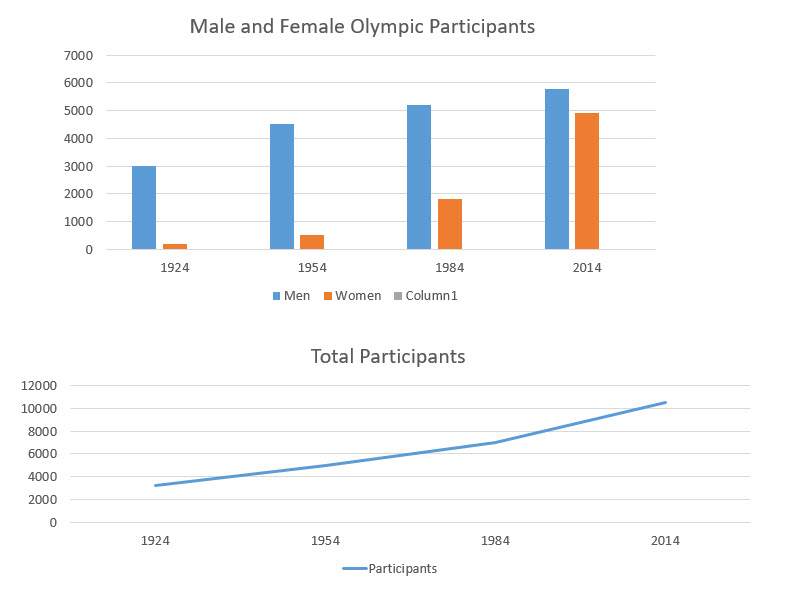
The charts detail the number of participants at the Olympics every 30 years from 1924 to 2014 in total and by gender. Looking from an overall perspective, it is readily apparent that while the totals rose steadily, there was more dramatic growth in terms of female participants to the point where there emerged a less noticeable gap between the genders by the end of the period.
In 1924, the disparity between the sexes was significant with just over 100 women and precisely 3000 men. Over the next 30 years, the figure for males rose to 4,500 and women more than double to a still minor 500. In 1984, there was more impressive growth for women (1,800) and a steady increase for men (5,100). Finally, the difference between the genders narrowed considerably in 2014 with 5,800 men and 4,900 of their female counterparts participating in the Olympics.
In terms of the overall totals, the data began at slightly over 3,000 in 1924 and rose consistently for the next 90 years, reaching a final high of greater than 10,000 in 2014.
Analysis
1. The charts detail the number of participants at the Olympics every 30 years from 1924 to 2014 in total and by gender. 2. Looking from an overall perspective, it is readily apparent that while the totals rose steadily, there was more dramatic growth in terms of female participants to the point where there emerged a less noticeable gap between the genders by the end of the period.
Paraphrase what the table shows.
Write a clear overview summarising the differences.
1. In 1924, the disparity between the sexes was significant with just over 100 women and precisely 3000 men. 2. Over the next 30 years, the figure for males rose to 4,500 and women more than double to a still minor 500. 3. In 1984, there was more impressive growth for women (1,800) and a steady increase for men (5,100). 4. Finally, the difference between the genders narrowed considerably in 2014 with 5,800 men and 4,900 of their female counterparts participating in the Olympics.
Begin writing about the data for the first categories.
Make sure you compare as much as possible.
Keep describing and comparing.
This one has lots of data so is a little longer than normal.
1. In terms of the overall totals, the data began at slightly over 3,000 in 1924 and rose consistently for the next 90 years, reaching a final high of greater than 10,000 in 2014.
Write about the final, other parts of the graph – include everything!
Vocabulary
What do the words in bold below mean?Take some notes on a piece of paper to aid your memory:
The charts detail the number of participants at the Olympics every 30 years from 1924 to 2014 in total and by gender. Looking from an overall perspective, it is readily apparent that while the totals rose steadily, there was more dramatic growth in terms of female participants to the point where there emerged a less noticeable gap between the genders by the end of the period.
In 1924, the disparity between the sexes was significant with just over 100 women and precisely 3000 men. Over the next 30 years, the figure for males rose to 4,500 and women more than double to a still minor 500. In 1984, there was more impressive growth for women (1,800) and a steady increase for men (5,100). Finally, the difference between the genders narrowed considerably in 2014 with 5,800 men and 4,900 of their female counterparts participating in the Olympics.
In terms of the overall totals, the data began at slightly over 3,000 in 1924 and rose consistently for the next 90 years, reaching a final high of greater than 10,000 in 2014.
Answers
Try to write down or think of an antonym/opposite word for further practice:
detail show
participants people taking part in
Olympics an international sporting event
every 30 years from each 30 years starting in
in total overall
by gender according to male/female
Looking from an overall perspective, it is readily apparent that overall
totals overall figures
steadily consistently
dramatic growth going up a lot
in terms of concerning
female participants women athletes
to the point where at the level at which
emerged came out at
less noticeable gap not as big of a difference
genders by the end of the period sexes at the end of the time surveyed
disparity difference
sexes genders
significant considerable
just over slightly above
precisely exactly
Over the next 30 years for the follow 3 decades
figure number
rose increased
more than double to more than 2x
still minor continues to be negligible
impressive growth considerable rise
steady increase consistent rise
narrowed considerably became much more equal
female counterparts participating in the Olympics women in the Olympics
Remember and fill in the blanks. Note it on a piece of paper so you can remember better:
The charts d________l the number of p_____________s at the O_________s e_____________________m 1924 to 2014 i_________l and b_________r. L_______________________________________________________________t while the t_______s rose s_________y, there was more d__________________h i_________________f f_______________s t____________________e there e_______d a l___________________p between the g____________s b_________________________d.
In 1924, the d_________y between the s____s was s____________t with j_________r 100 women and p_________y 3000 men. O_____________________s, the f_____e for males r____e to 4,500 and women m__________________________o a s____________r 500. In 1984, there was more i_______________________h for women (1,800) and a s_______________e for men (5,100). Finally, the difference between the genders n_______________________y in 2014 with 5,800 men and 4,900 of their f____________________________s p____________________________s.
I_______________f the overall totals, the d____a b_____n at s_________y over 3,000 in 1924 and r__________________y for the next 90 years, r______________________f greater than 10,000 in 2014.
Listening Practice
Listen to the related topic below and practice with these activities:
"The highest quality materials anywhere on the internet! Dave improved my writing and vocabulary so much. Really affordable options you don't want to miss out on!"