This is my IELTS writing task 2 sample answer essay on the topic of whether money for education should be spent on better computers or teachers from the real IELTS exam.
Be sure to sign up for my full IELTS EBooks here to support my efforts to keep writing these essays for students:
Some believe that money for education should mainly be spent on better computers while others believe it would be better spent on teachers.
Discuss both views and give your own opinion.
Many feel that funding allocated for education should be primarily spent on computers rather than paying the teaching staff higher salaries. In my opinion, though technology is important today, teachers are still considerably more valuable and deserving of prioritization.
Proponents argue increased funding for computer technology reflects shifts in modern society. Expertise with computers is becoming essential not only for one’s daily life but also most careers. At the moment, schools focus on a wide range of subjects that may not have any direct applicability later in a student’s life such as history, biology, physics, literature, art, and so on. It is logical that focusing more on a useful area such as new computers will maximize funding for schools. However, this thinking neglects the key finding in numerous studies that a wide base of knowledge is more important than early specialization.
Moreover, teachers can potentially be a crucial influence on their pupils. Most adults are grateful to at least one teacher who serves as a lifelong role model. This is because students can connect with a teacher emotionally and intellectually. For example, a teacher may introduce and elucidate a number of great thinkers and writers that later shape a student’s political or moral philosophy. By providing greater funding for teachers, this simply ensures that more qualified teachers will apply for jobs. Additionally, teachers who are passionate about their work, and are underpaid at the moment, are likely to feel more motivated and appreciated with higher salaries.
In conclusion, those who argue in favor of computers are short-sighted as teachers have greater overall impact. Naturally, it is more difficult to measure and study the value of quality teachers and provide definitive evidence for this viewpoint.
Analysis
1. Many feel that funding allocated for education should be primarily spent on computers rather than paying the teaching staff higher salaries. 2. In my opinion, though technology is important today, teachers are still considerably more valuable and deserving of prioritization.
Paraphrase the overall essay topic.
Write a clear opinion. Read more about introductions here.
1. Proponents argue increased funding for computer technology reflects shifts in modern society. 2. Expertise with computers is becoming essential not only for one’s daily life but also most careers. 3. At the moment, schools focus on a wide range of subjects that may not have any direct applicability later in a student’s life such as history, biology, physics, literature, art, and so on. 4. It is logical that focusing more on a useful area such as new computers will maximize funding for schools. 5. However, this thinking neglects the key finding in numerous studies that a wide base of knowledge is more important than early specialization.
Write a topic sentence with a clear main idea at the end.
Explain your main idea.
Develop it with specific or hypothetical examples.
Keep developing it fully.
You can sometimes include the counterpoint here too.
1. Moreover, teachers can potentially be a crucial influence on their pupils. 2. Most adults are grateful to at least one teacher who serves as a lifelong role model. 3. This is because students can connect with a teacher emotionally and intellectually. 4. For example, a teacher may introduce and elucidate a number of great thinkers and writers that later shape a student’s political or moral philosophy. 5. By providing greater funding for teachers, this simply ensures that more qualified teachers will apply for jobs. 6. Additionally, teachers who are passionate about their work, and are underpaid at the moment, are likely to feel more motivated and appreciated with higher salaries.
Write a new topic sentence with a new main idea at the end.
Explain your new main idea.
Include specific details and examples.
Add as much information as you can and make sure it links logically.
Continue your development.
Finish the paragraph strong.
1. In conclusion, those who argue in favor of computers are short-sighted as teachers have greater overall impact. 2. Naturally, it is more difficult to measure and study the value of quality teachers and provide definitive evidence for this viewpoint.
Summarise your main ideas.
Include a final thought. Read more about conclusions here.
Vocabulary
What do the words in bold below mean?Make some notes on paper to aid memory and then check below.
Many feel that funding allocated for education should be primarily spent oncomputersrather than paying the teaching staff higher salaries. In my opinion, though technology is important today, teachers are still considerably more valuable and deserving of prioritization.
Proponents argue increased funding for computer technology reflects shifts in modern society. Expertise with computers is becoming essential not only for one’s daily life but also most careers. At the moment, schools focus on a wide range of subjects that may not have any direct applicability later in a student’s life such as history, biology, physics, literature, art, and so on. It is logical that focusing more on a useful area such as new computers will maximize funding for schools. However, this thinking neglects the key finding in numerous studies that a wide base of knowledge is more important than early specialization.
Moreover, teachers can potentially be a crucial influence on their pupils. Most adults are grateful to at least one teacher who serves as a lifelong role model. This is because students can connect with a teacher emotionally and intellectually. For example, a teacher may introduce and elucidate a number of great thinkers and writers that later shape a student’s political or moral philosophy. By providing greater funding for teachers, this simply ensures that more qualified teachers will apply for jobs. Additionally, teachers who are passionate about their work, and are underpaid at the moment, are likely to feel more motivated and appreciated with higher salaries.
In conclusion, those who argue in favor of computers are short-sighted as teachers have greater overall impact. Naturally, it is more difficult to measure and study the value of quality teachers and provide definitive evidence for this viewpoint.
Answers
For extra practice, write an antonym (opposite word) on a piece of paper to help you remember the new vocabulary:
funding money
allocated for meant for
primarily spent on mostly money given to
computers laptops, desktops, etc.
rather than instead of
paying the teaching staff higher salaries teachers making more money
considerably much more
valuable important
deserving should receive
prioritization more importance
proponents argue increased funding for people in favor point out more money for
reflects shifts is related to changes
modern society the contemporary world
expertise with doing well with
essential importance
daily life how people live each day
At the moment right now
focus on prioritize
wide range of subjects many classes at school
direct applicability relate right away to
later in a student’s life as kids get older
history study of the past
biology study of life forms
physics study of how the universe words
literature study of books
art study of pictures, music, etc.
and so on etc.
logical rational
focusing emphasizing
useful area key place
maximize make the most of
neglects doesn’t pay attention to
key finding crucial information
numerous studies much research
wide base of knowledge lots of information learned
early specialization learning something early on
potentially possibly
crucial influence key effect
pupils students
adults older people
grateful feel thanks to
at least one at minimum one
serves as a lifelong role model look up to that person forever
I recommend getting a pencil and piece of paper because that aids memory. Then write down the missing vocabulary from my sample answer in your notebook:
Many feel that f____________g a________________r education should be p______________________nc_____________sr_______________n p__________________________________________________s. In my opinion, though technology is important today, teachers are still c________________y more v__________e and d_________g of p________________n.
P____________s a_______e i_________________________r computer technology r____________s in m_________________y. E__________________h computers is becoming e_____________l not only for one’s ______________e but also most careers. A________________t, schools f___________n a w_____________________s that may not have any d____________________y l___________________________e such as h_________y, b________y, p__________s, l_______e, a__t, a_____________n. It is l__________l that f_____________g more on a u____________a such as new computers will m________________e funding for schools. However, this thinking n____________s the k_________________g in n___________________s that a w__________________e is more important than e_________________________n.
Moreover, teachers can p__________________y be a c____________________e on their p__________s. Most a_______s are g__________l to a_____________e teacher who s______________________l. This is because students can c________________h a teacher e____________________y and i_____________y. For example, a teacher may i______________e and e_________________e a number of g______________s and w_______s that later s____e a student’s p______________l or m_____________________y. By p_____________________r funding for teachers, this s_______________________s that more q____________d teachers will a_____________r jobs. A___________________y, teachers who are p__________________e about their work, and are u______________d at the moment, are likely to feel more m____________d and a______________d with h_______________s.
In conclusion, those who argue in favor of computers are s_________________d as teachers have g_______________________t. N________________y, it is more difficult to m___________e and study the value of quality teachers and p__________________________e for this v____________t.
Listening Practice
Learn more about this topic by watching from YouTube below and practice with these activities:
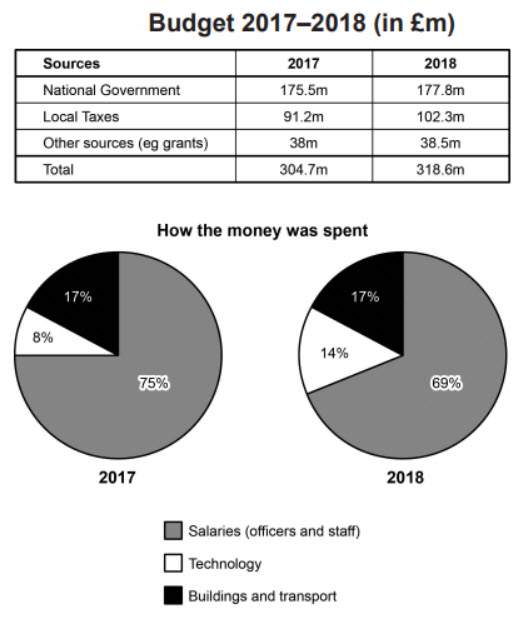
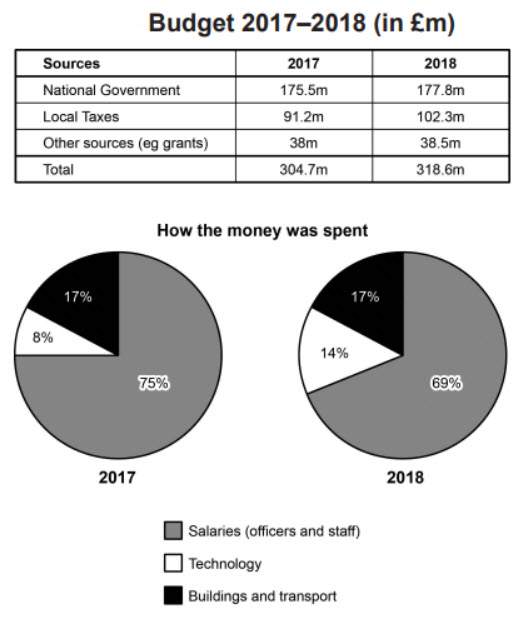
The table and charts detailed below give information about the police budget in 2017 and 2018 in on area of Britain. The table illustrates where the money came from and the charts show how it was distributed.
The table details the sources of funding for the police and the pie charts show the distribution of this budget. Looking from an overall perspective, it is readily apparent that the contributions of all sources increased, though local taxes displayed the greatest funding growth. In terms of spending, there was a marked increase in technology funding, buildings and transport was unchanged, and salaries declined though this category continued to represent the vast majority of the budget.
In 2017, the national government contributed 175.5 million pounds, slightly below the number for the following year (177.8m). Local taxes, in contrast, were lower overall in both years but grew considerably from £91.2 million to £102.3 million. Other sources, such as grants, were largely unchanged, rising slightly from 38 to 38.5 million. The total figure grew by 13.9m to 318.6m.
In terms of budgetary allocation, 75% of the budget was devoted to salaries in 2017 and this figure declined to 69% the following year. Money for technology nearly doubled, going from 8% to 14%, while spending on buildings and transport was unaltered at 17% in each year surveyed.
Analysis
1. The table details the sources of funding for the police and the pie charts show the distribution of this budget. 2. Looking from an overall perspective, it is readily apparent that the contributions of all sources increased, though local taxes displayed the greatest funding growth. 3. In terms of spending, there was a marked increase in technology funding, buildings and transport was unchanged, and salaries declined though this category continued to represent the vast majority of the budget.
Paraphrase what the bar chart shows.
Write a clear overview summarising the differences.
You might need another sentence for your overview.
1. In 2017, the national government contributed 175.5 million pounds, slightly below the number for the following year (177.8m). 2. Local taxes, in contrast, were lower overall in both years but grew considerably from £91.2 million to £102.3 million. 3. Other sources, such as grants, were largely unchanged, rising slightly from 38 to 38.5 million. The total figure grew by 13.9m to 318.6m.
Begin writing about the data for the first categories.
Make sure you compare as much as possible.
Vary long and short sentences.
1. In terms of budgetary allocation, 75% of the budget was devoted to salaries in 2017 and this figure declined to 69% the following year. 2. Money for technology nearly doubled, going from 8% to 14%, while spending on buildings and transport was unaltered at 17% in each year surveyed.
Write about the final other parts of the graph –
include everything!
Vocabulary
What do the words in bold below mean?Make some notes on paper to aid memory and then check below.
The table details the sources of funding for the police and the pie charts show the distribution of this budget. Looking from an overall perspective, it is readily apparent that the contributions of all sources increased, though local taxes displayed the greatest funding growth. In terms of spending, there was a marked increase in technology funding, buildings and transport was unchanged, and salaries declined though this category continued to represent the vast majority of the budget.
In 2017, the national government contributed 175.5 million pounds, slightly below the number for the following year (177.8m). Local taxes, in contrast, were lower overall in both years but grew considerably from £91.2 million to £102.3 million. Other sources, such as grants, were largely unchanged, rising slightly from 38 to 38.5 million. The total figure grew by 13.9m to 318.6m.
In terms of budgetary allocation, 75% of the budget was devoted to salaries in 2017 and this figure declined to 69% the following year. Money for technology nearly doubled, going from 8% to 14%, while spending on buildings and transport was unaltered at 17% in each year surveyed.
Answers
For extra practice, write an antonym (opposite word) on a piece of paper to help you remember the new vocabulary:
details shows
sources of funding for where the money comes from to provide for
police officers, cops
distribution how something is spread out
budget amount of money to spend
Looking from an overall perspective, it is readily apparent that overall
sources where it comes from
local taxes local government
displayed showed
greatest funding growth most of the money comes from
In terms of spending when it comes to money used
marked noticeable
salaries money earned each month
though however
category group
continued to kept on
represent showed
vast majority of the budget most of the money spent
I recommend getting a pencil and piece of paper because that aids memory. Then write down the missing vocabulary from my sample answer in your notebook:
The table d_______s the s_________________________r the p______e and the pie charts show the d____________n of this b_________t. L__________________________________________________________t the contributions of all s__________s increased, though l______________s d____________d the g________________________h. I______________________g, there was a m_______d increase in technology funding, buildings and transport was unchanged, and s__________s declined t______h this c____________y c_________________o r___________t the v_________________________t.
In 2017, the n_____________t contributed 175.5 million p_________s, s_________w the number for the following year (177.8m). L___________s, i____________t, were l__________________l in both years but g___________________y from £91.2 million to £102.3 million. O______________s, such as g_______s, were l_____________________d, r________________y from 38 to 38.5 million. The t______________e grew by 13.9m to 318.6m.
I_______________f b________________n, 75% of the budget was d_____________o salaries in 2017 and this f____________d to 69% t__________________r. Money for technology n________________d, going from 8% to 14%, while spending on buildings and transport was u___________d at 17% in e_______________________d.
Listening Practice
Learn more about this topic by watching from YouTube below and practice with these activities:
Young people committing crimes should be treated the same as adults by the authorities.
To what extent do you agree or disagree?
There are reformers today who argue that adults and young people should be treated equally under the law. In my opinion, despite the ostensible fairness of this proposal, it disregards crucial psychological differences.
Those who believe all ages should receive equal treatment, point out that this will engender a greater deterring effect. The main reason that all individuals in society are punished is not for justice alone, but as a means to ensure others will not commit similar crimes. Young people learn in school and the world generally that their actions will have consequences and that crimes are punishable with prison time and other penalties. If these censures are weakened, then the chances a young person will attempt to commit a crime will logically increase, even if the total number of young people engaging in criminal behavior today is lower than at any point in human history.
However, age is a just mitigating factor. Adults who commit crimes have had more time to develop socially and intellectually while young people might not fully grasp the consequences of their choices for themselves and others. For instance, there have been recent cases where young people were influenced by extremist elements now pervasive in social media. Young people are more impressionable in these situations and often lack the confidence and maturity to think for themselves. This vulnerability extends to their emotional and intellectual development and justifies laws that protect young people from receiving overly harsh sentences.
In conclusion, though there are practical reasons to support equal punishments for all ages, this alteration would be unfair to young people. Courts should consider a range of factors before selecting an appropriate punishment.
Analysis
1. There are reformers today who argue that adults and young people should be treated equally under the law. 2. In my opinion, despite the ostensible fairness of this proposal, it disregards crucial psychological differences.
Paraphrase the overall essay topic.
Write a clear opinion. Read more about introductions here.
1. Those who believe all ages should receive equal treatment, point out that this will engender a greater deterring effect. 2. The main reason that all individuals in society are punished is not for justice alone, but as a means to ensure others will not commit similar crimes. 3. Young people learn in school and the world generally that their actions will have consequences and that crimes are punishable with prison time and other penalties. 4. If these censures are weakened, then the chances a young person will attempt to commit a crime will logically increase, even if the total number of young people engaging in criminal behavior today is lower than at any point in human history.
Write a topic sentence with a clear main idea at the end.
Explain your main idea.
Develop it with specific or hypothetical examples.
Keep developing it fully.
1. However, age is a just mitigating factor. 2. Adults who commit crimes have had more time to develop socially and intellectually while young people might not fully grasp the consequences of their choices for themselves and others. 3. For instance, there have been recent cases where young people were influenced by extremist elements now pervasive in social media. 4. Young people are more impressionable in these situations and often lack the confidence and maturity to think for themselves. 5. This vulnerability extends to their emotional and intellectual development and justifies laws that protect young people from receiving overly harsh sentences.
Write a new topic sentence with a new main idea at the end.
Explain your new main idea.
Include specific details and examples.
Add as much information as you can and make sure it links logically.
Finish the paragraph strong.
1. In conclusion, though there are practical reasons to support equal punishments for all ages, this alteration would be unfair to young people. 2. Courts should consider a range of factors before selecting an appropriate punishment.
Summarise your main ideas.
Include a final thought. Read more about conclusions here.
Vocabulary
What do the words in bold below mean?Make some notes on paper to aid memory and then check below.
There are reformers today who argue that adults and young people should be treated equally under the law. In my opinion, despite the ostensible fairness of this proposal, it disregards crucial psychological differences.
Those who believe all ages should receive equal treatment, point out that this will engender a greater deterring effect. The main reason that all individuals in society are punished is not for justice alone, but as a means to ensure others will not commit similar crimes. Young people learn in school and the world generally that their actions will have consequences and that crimes are punishable with prison time and other penalties. If these censures are weakened, then the chances a young person will attempt to commit a crime will logically increase, even if the total number of young people engaging in criminal behavior today is lowerthan at any point in human history.
However, age is a just mitigating factor. Adults who commit crimes have had more time to develop socially and intellectually while young people might not fully grasp the consequences of their choices for themselves and others. For instance, there have been recent cases where young people were influenced by extremist elements now pervasive in social media. Young people are more impressionable in these situations and often lack the confidence and maturity to think for themselves. This vulnerability extends to their emotional and intellectual development and justifies laws that protect young people from receiving overly harsh sentences.
In conclusion, though there are practical reasons to support equal punishments for all ages, this alteration would be unfair to young people. Courts should consider a range of factors before selecting an appropriate punishment.
Answers
For extra practice, write an antonym (opposite word) on a piece of paper to help you remember the new vocabulary:
reformers people who want to make changes
argue point out, contend
adults older people
young people people who are younger
treated equally under the law have the same punishments and dealt with the same way
despite regardless of
ostensible fairness seemingly just, right
proposal idea
disregards ignores
crucial key
psychological differences mental disparities
receive get
point out argue
engender creates
greater deterring effect does more to stop others from doing the same
justice fairness
as a means to in order to
ensure make sure of
commit similar crimes do the same things
generally overall
actions will have consequences you must be responsible
punishable can be punished in this way
prison time time in jail
penalties punishments
censures admonishments
weakened curbed, limited
chances odds of something happening
attempt try
logically rationally
engaging in taking part in
criminal behavior committing crimes
lowerthan at any point in human history never better than now
just right, fair
mitigating factor reason to lessen punishment
develop grow
socially relating to others
intellectually relating to the mind
might not fully grasp the consequences of their choices for themselves and others can’t completely understand the results of their actions
recent cases instances that happened not that long ago
influenced impacted
extremist elements strong opinions
pervasive common
social media Facebook, Instagram, TikTok, etc.
impressionable easily influenced
lack don’t have
confidence self-esteem
maturity feeling like an adult
vulnerability weakness
extends to also includes
emotional related to emotions
justifies gives reason for
protect keep safe
receiving overly harsh sentences get too strict punishments
I recommend getting a pencil and piece of paper because that aids memory. Then write down the missing vocabulary from my sample answer in your notebook:
There are r__________s today who a____e that a_____s and y____________e should be t________________________w. In my opinion, d__________e the o______________________s of this p_____________l, it d__________s c_________________________________________s.
Those who believe all ages should r_________e equal treatment, p________t that this will e_________r a g_____________________t. The main reason that all individuals in society are punished is not for j_____e alone, but a__________________________e others will not c____________________s. Young people learn in school and the world g__________y that their a____________________________________s and that crimes are p_____________e with p_________e and other p____________s. If these c____________s are w___________d, then the c_________s a young person will a_________t to commit a crime will l______________y increase, even if the total number of young people e________________n c___________________________r today is l______________________________________________________y.
However, age is a j____t m______________________r. Adults who commit crimes have had more time to d_______________________y and i___________________y while young people m___________________________________________________________________s. For instance, there have been r__________s where young people were i__________d by e____________________s now p___________e in s__________a. Young people are more i___________________e in these situations and often l___k the c____________e and m________y to think for themselves. This v_____________y e_________o their e_____________l and i_______________l development and j________s laws that p__________t young people from r__________________________________s.
In conclusion, though there are p________________s to support e________________________s for all ages, this a__________n would be unfair to young people. Courts should consider a___________________s before s__________g an a________________________t.
Listening Practice
Learn more about this topic by watching from YouTube below and practice with these activities:
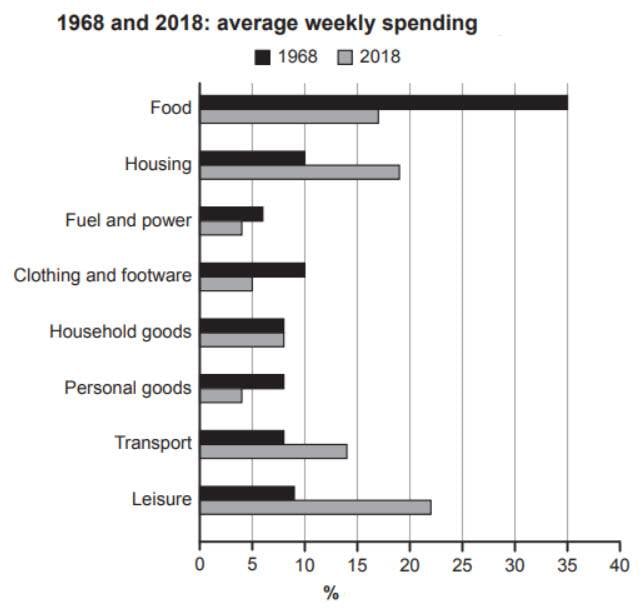
This is an IELTS writing task 2 sample answer essay from the new Cambridge IELTS 17 book of past test papers on the topic of a bar chart showing how families in one country spent weekly income in 1968 and 2018.
You can read essays and guides for the other IELTS Cambridge books, including Cambridge 17, here:
IELTS Cambridge 17 Task 1 Essay: Average Weekly Spending
The bar chart provides information about how families in a country spent weekly income in both 1968 and in 2018.
The bar chart details average spending per week for families in a given country in the years 1968 and 2018. Looking from an overall perspective, it is readily apparent that while spending for food, fuel and power, clothing and footware, and personal goods declined, the inverse was true for the remaining categories, with only household goods unchanged. Although spending on food was by far the most common in 1968, by 2018 leisure occupied the majority of the family budget, followed closely by housing.
In 1968, families spent on average 35% of their weekly income on food, greatly outstripping other budgetary concerns, each of which represented between 5% and 10%. Among these, fuel and power was the lowest at 6%.
By 2018, spending patterns diverged more widely. Food represented a still significant 17% of the budget, trailing housing at 19% (a 9% overall rise) and leisure at 22% (a 13% increase). Transport also displayed a notable growth to 14%. Fuel and power, clothing and footware, and personal goods all fell to 4%, 5%, and 4%, respectively. Household goods was the only expense to remain fixed, at 7%.
Analysis
1. The bar chart details average spending per week for families in a given country in the years 1968 and 2018. 2. Looking from an overall perspective, it is readily apparent that while spending for food, fuel and power, clothing and footware, and personal goods declined, the inverse was true for the remaining categories, with only household goods unchanged. 3. Although spending on food was by far the most common in 1968, by 2018 leisure occupied the majority of the family budget, followed closely by housing.
Paraphrase what the bar chart shows.
Write a clear overview summarising the differences.
This one is a little complex so it needs a second sentence for the overview.
1. In 1968, families spent on average 35% of their weekly income on food, greatly outstripping other budgetary concerns, each of which represented between 5% and 10%. 2. Among these, fuel and power was the lowest at 6%.
Begin writing about the data for the first categories.
Make sure you compare as much as possible.
1. By 2018, spending patterns diverged more widely. Food represented a still significant 17% of the budget, trailing housing at 19% (a 9% overall rise) and leisure at 22% (a 13% increase). 2. Transport also displayed a notable growth to 14%. Fuel and power, clothing and footware, and personal goods all fell to 4%, 5%, and 4%, respectively. 3. Household goods was the only expense to remain fixed, at 7%.
Write about the final other parts of the graph – include everything!
Compare the categories.
Finish with the rest of the data.
Vocabulary
What do the words in bold below mean?Make some notes on paper to aid memory and then check below.
The bar chart details average spending per week for families in a given country in the years 1968 and 2018. Looking from an overall perspective, it is readily apparent that while spending for food, fuel and power, clothing and footware, and personal goods declined, the inverse was true for the remaining categories, with only household goods unchanged. Although spending on food was by far the most common in 1968, by 2018 leisure occupied the majority of the family budget, followed closely by housing.
In 1968, families spent on average 35% of their weekly income on food, greatly outstripping other budgetary concerns, each of which represented between 5% and 10%. Among these, fuel and power was the lowest at 6%.
By 2018, spending patterns diverged more widely. Food represented a still significant 17% of the budget, trailing housing at 19% (a 9% overall rise) and leisure at 22% (a 13% increase). Transport also displayed a notable growth to 14%. Fuel and power, clothing and footware, and personal goods all fell to 4%, 5%, and 4%, respectively. Household goods was the only expense to remain fixed, at 7%.
Answers
For extra practice, write an antonym (opposite word) on a piece of paper to help you remember the new vocabulary:
details shows
average spending per week amount of money every 7 days spent on average
in a given country in a random nation
Looking from an overall perspective, it is readily apparent that overall
declined decreased
the inverse was true for the opposite is the case for
remaining categories other groups
unchanged remained the same
by far the most common a lot more popular
occupied represented
majority most of
family budget how much money a family spends on average
followed closely by right after that
weekly income money earned each week
greatly outstripping much more than
other budgetary concerns different things to spend money on
I recommend getting a pencil and piece of paper because that aids memory. Then write down the missing vocabulary from my sample answer in your notebook:
The bar chart d_______s a___________________________k for families i___________________y in the years 1968 and 2018. L___________________________________________________________t while spending for food, fuel and power, clothing and footware, and personal goods d_________d, t_____________________________r the r_________________s, with only household goods u_______________d. Although spending on food was b________________________n in 1968, by 2018 leisure o__________d the m_________y of the f_____________t, f____________________y housing.
In 1968, families spent on average 35% of their w___________e on food, g_______________________________g o______________________s, e___________________________d between 5% and 10%. A____________e, fuel and power was the l_________t at 6%.
By 2018, s______________________s d____________________y. Food r_________________d a still s_____________t 17% of the budget, t____________g housing at 19% (a 9% overall rise) and leisure at 22% (a 13% increase). Transport also d__________d a n____________________h to 14%. Fuel and power, clothing and footware, and personal goods all fell to 4%, 5%, and 4%, r________________y. Household goods was the only e__________e to r______________d, at 7%.
Listening Practice
Learn more about this topic by watching from YouTube below and practice with these activities:
"The highest quality materials anywhere on the internet! Dave improved my writing and vocabulary so much. Really affordable options you don't want to miss out on!"