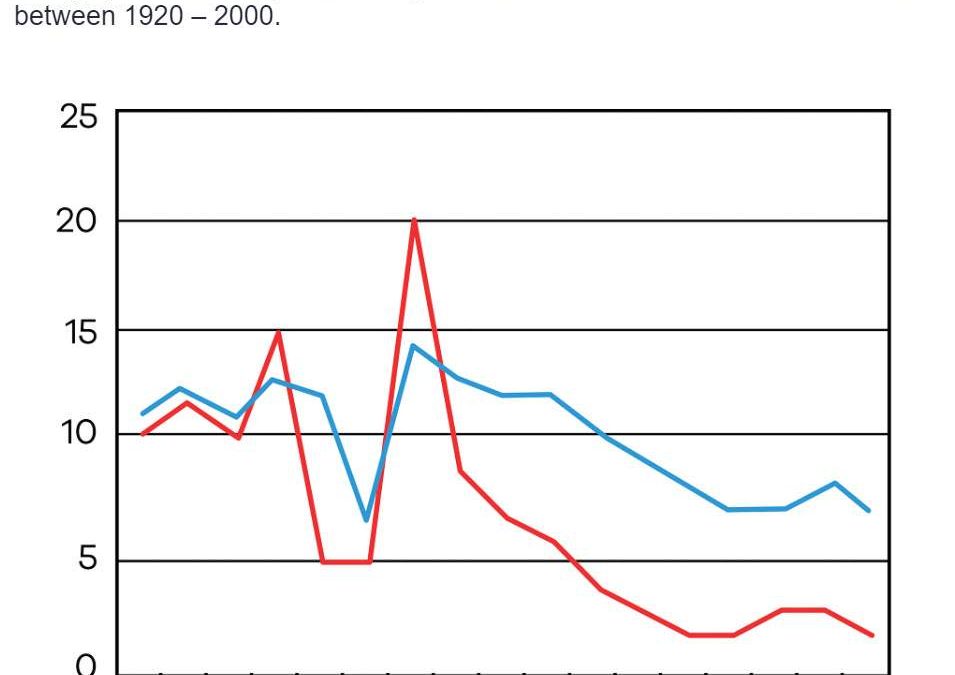
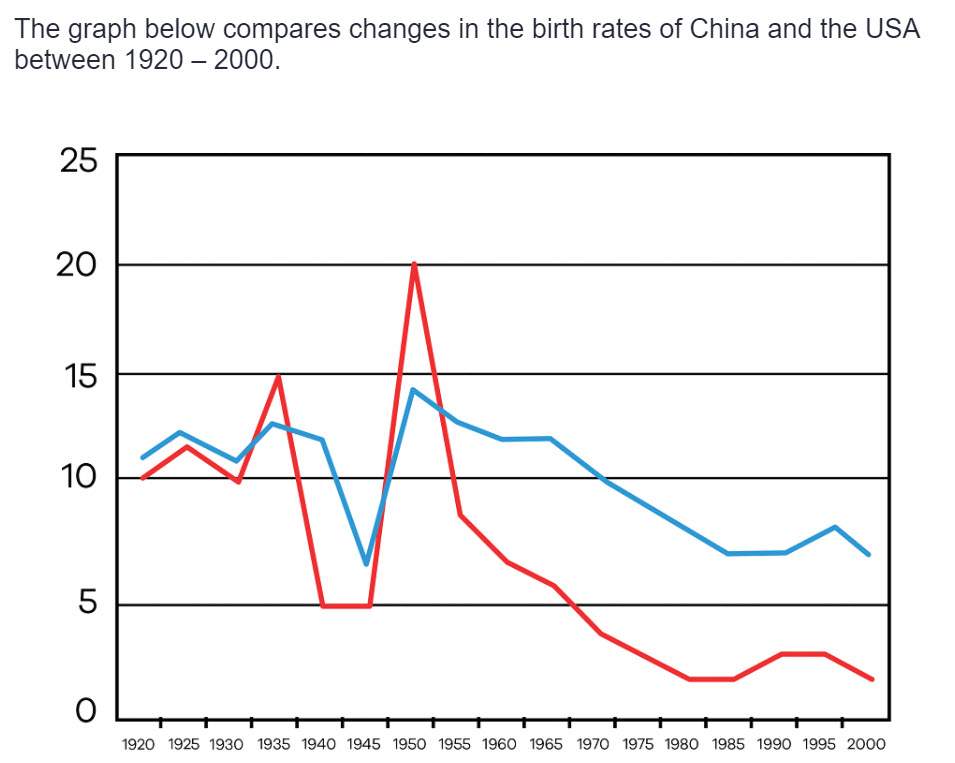
The line chart details birth rates for the United States and China from 1920 to 2000. Looking from an overall perspective, it is readily apparent that while birth rates in both nations followed similar trajectories and fell over the period, China’s decline was the most dramatic. The birth rate in the USA was higher for the majority of the period, with two brief exceptions in the first half of the century.
In 1920, the birth rate in the US stood at around 11%, 1% higher than that of China. The pattern for both nations was similar and erratic until around 1930 when there was a surge in China’s birth rate to 15% and a smaller rise in the US to 12%. Birth rates then dropped for the next 15 years, with China reaching a notable low of 5% and the USA dipping to 6%.
The birth rate in China quadrupled over the next few years to a high of 20%, which preceded a steady downturn with minor fluctuations and a data point at around 2% to end the period surveyed. Similarly, birth rates in the US rose, less significantly to approximately 14%, and thereafter experienced a more gradual slump to finish at 7% in 2000.
Analysis
1. The line chart details birth rates for the United States and China from 1920 to 2000. 2. Looking from an overall perspective, it is readily apparent that while birth rates in both nations followed similar trajectories and fell over the period, China’s decline was the most dramatic. 3. The birth rate in the USA was higher for the majority of the period, with two brief exceptions in the first half of the century.
Paraphrase what the table shows.
Write a clear overview summarising the differences.
You might need another sentence for your overview.
1. In 1920, the birth rate in the US stood at around 11%, 1% higher than that of China. 2. The pattern for both nations was similar and erratic until around 1930 when there was a surge in China’s birth rate to 15% and a smaller rise in the US to 12%. 3. Birth rates then dropped for the next 15 years, with China reaching a notable low of 5% and the USA dipping to 6%.
Begin writing about the data for the first categories.
Make sure you compare as much as possible.
Some task 1s essays will be a bit longer than others.
1. The birth rate in China quadrupled over the next few years to a high of 20%, which preceded a steady downturn with minor fluctuations and a data point at around 2% to end the period surveyed. 2. Similarly, birth rates in the US rose, less significantly to approximately 14%, and thereafter experienced a more gradual slump to finish at 7% in 2000.
Write about the final, other parts of the graph – include everything!
Compare the categories.
Vocabulary
What do the words in bold below mean?Take some notes on a piece of paper to aid your memory:
The line chart details birth rates for the United States and China from 1920 to 2000. Looking from an overall perspective, it is readily apparent that while birth rates in both nations followed similar trajectories and fell over the period, China’s decline was the most dramatic. The birth rate in the USA was higher for the majority of the period, with two brief exceptions in the first half of the century.
In 1920, the birth rate in the US stood at around 11%, 1% higher than that of China. The pattern for both nations was similar and erratic until around 1930 when there was a surge in China’s birth rate to 15% and a smaller rise in the US to 12%. Birth rates then dropped for the next 15 years, with China reaching a notable low of 5% and the USA dipping to 6%.
The birth rate in China quadrupled over the next few years to a high of 20%, which preceded a steady downturn with minor fluctuations and a data point at around 2% to end the period surveyed. Similarly, birth rates in the US rose, less significantly toapproximately 14%, and thereafter experienced a more gradual slump to finish at 7% in 2000.
Answers
Try to write down or think of an antonym/opposite word for further practice:
details birth rates shows how many people are being born
Looking from an overall perspective, it is readily apparent that while overall
similar trajectories almost the same patterns
fell over the period went down over that time
decline drop
most dramatic strongest
the majority of the period for most of the time
brief exceptions times when this was not true
first half of the century first 50 years of 1900
stood at around was close to
pattern trajectory
similar almost the same
erratic uneven
until up to
around close to
surge big rise
smaller rise small increase
dropped fell
reaching a notable low of get to a low point of
dipping falling to
quadrupled 400%, 4x
a high of the largest point at
preceded before
steady downturn consistently going down
minor fluctuations small erratic rises and falls
data point statistic
end the period surveyed finish the time detailed
similarly in a similar way, the same
less significantly toapproximately not as much to about
Remember and fill in the blanks. Note it on a piece of paper so you can remember better:
The line chart d________s b________s for the United States and China from 1920 to 2000. L___________________________________________e birth rates in both nations followed s_________________s and f____________________d, China’s d________e was the m____________c. The birth rate in the USA was higher for t___________________________d, with two b_______________s in the f_____________________y.
In 1920, the birth rate in the US s_______________d 11%, 1% higher than that of China. The p__________n for both nations was s_______r and e_________c u_______l a_______d 1930 when there was a s_____e in China’s birth rate to 15% and a s__________e in the US to 12%. Birth rates then d_________d for the next 15 years, with China r__________________________f 5% and the USA d________g to 6%.
The birth rate in China q____________d over the next few years to a______f 20%, which p_________d a s________________n with m________________s and a d___________t at around 2% to e______________________d. S___________y, birth rates in the US rose, l__________________________oa___________________y 14%, and t____________r e_______________d a more g______________p to f_______h at 7% in 2000.
Listening Practice
Listen to the related topic below and practice with these activities:
The shortage of housing in big cities can cause severe consequences. Only government action can solve this problem.
To what extent do you agree or disagree?
Some today argue that only governments are capable of countering problems in cities resulting from housing shortages. In my opinion, although governments should be the primary actors, individuals can also offer aid.
On the one hand, only governments have the authority to enact truly large-scale change. Governments by design make decisions for the benefit of the entire citizenry. An example of how this could relate to housing issues would be the urban planning in New York City over the last century. The authorities there had to contend with an unprecedented population surge in a limited urban area. They responded by building skyscrapers that could house many residents, expanding public transport, and constructing various highways to allow commuters to live nearby the city. These solutions could only have been successfully undertaken at the behest of the government.
However, though the role of individuals is less prominent, it still exists. In the previous example, voters in New York City were able to make their voices heard by voting for mayors and governors that best served them. In the event that the government is not addressing housing problems sufficiently, then citizens can write to their representatives, organize protests, or take more drastic action such as relocating to a new city. In the era of social media, it is now more possible than ever before for the average person to openly discuss these issues. Individuals will always find methods to pressure governments, including in areas related to housing.
In conclusion, I disagree with those who contend only government action can improve housing issues in major metropolitan areas as individuals can collectively always engender some degree of reform. Governments will ideally enact laws based on the needs of the general populace.
Analysis
1. Some today argue that only governments are capable of countering problems in cities resulting from housing shortages. 2. In my opinion, although governments should be the primary actors, individuals can also offer aid.
Paraphrase the overall essay topic.
Write a clear opinion. Read more about introductions here.
1. On the one hand, only governments have the authority to enact truly large-scale change. 2. Governments by design make decisions for the benefit of the entire citizenry. 3. An example of how this could relate to housing issues would be the urban planning in New York City over the last century. 4. The authorities there had to contend with an unprecedented population surge in a limited urban area. 5. They responded by building skyscrapers that could house many residents, expanding public transport, and constructing various highways to allow commuters to live nearby the city. 6. These solutions could only have been successfully undertaken at the behest of the government.
Write a topic sentence with a clear main idea at the end.
Explain your main idea.
Develop it with specific or hypothetical examples.
Keep developing it fully.
Use short and long sentences.
Finish the paragraph strong.
1. However, though the role of individuals is less prominent, it still exists. 2. In the previous example, voters in New York City were able to make their voices heard by voting for mayors and governors that best served them. 3. In the event that the government is not addressing housing problems sufficiently, then citizens can write to their representatives, organize protests, or take more drastic action such as relocating to a new city. 4. In the era of social media, it is now more possible than ever before for the average person to openly discuss these issues. 5. Individuals will always find methods to pressure governments, including in areas related to housing.
Write a new topic sentence with a new main idea at the end.
Explain your new main idea.
Include specific details and examples.
Add as much information as you can and make sure it links logically.
Develop the example fully.
1. In conclusion, I disagree with those who contend only government action can improve housing issues in major metropolitan areas as individuals can collectively always engender some degree of reform. 2. Governments will ideally enact laws based on the needs of the general populace.
Summarise your main ideas.
Include a final thought. Read more about conclusions here.
Vocabulary
What do the words in bold below mean?Make some notes on paper to aid memory and then check below.
Some today argue that only governments are capable of countering problems in cities resulting fromhousing shortages. In my opinion, although governments should be the primary actors, individuals can also offer aid.
On the one hand, only governments have the authority to enact truly large-scale change. Governments by design make decisions for the benefit of the entire citizenry. An example of how this could relate to housing issues would be the urban planning in New York City over the last century. The authorities there had to contend with an unprecedented population surge in a limited urban area. They responded by building skyscrapers that could house many residents, expanding public transport, and constructing various highways to allow commuters to live nearby the city. These solutions could only have been successfully undertaken at the behest of the government.
However, though the role of individuals is less prominent, it still exists. In the previous example, voters in New York City were able to make their voices heard by voting for mayors and governors that best served them. In the event that the government is not addressing housing problems sufficiently, then citizens can write to their representatives, organize protests, or take more drastic action such as relocating to a new city. In the era of social media, it is now more possible than ever before for the average person to openly discuss these issues. Individuals will always find methods to pressure governments, including in areas related to housing.
In conclusion, I disagree with those who contend only government action can improve housing issues in major metropolitan areas as individuals can collectively always engender some degree of reform. Governments will ideally enact laws based on the needs of the general populace.
Answers
For extra practice, write an antonym (opposite word) on a piece of paper to help you remember the new vocabulary:
capable of are able to
countering problems fixing issues
resulting from coming from
housing shortages not enough real estate, a shortage of homes for people
primary actors main people in charge
offer aid give help
on the one hand firstly
authority governments, people in charge
enact truly large-scale change make really big alterations
by design deliberately, the way it is supposed to be
decisions choices
benefit advantage
entire citizenry whole country
An example of how this could relate to housing issues would be one instance of this concerning the shortage of houses is
urban planning design of a city
over the last century the last 100 years
contend with deal with
unprecedented population surge a lot more people
limited urban area small space for the city
responded answered
building skyscrapers erecting large buildings
house verb for live in a place
expanding public transport more buses, subways, etc.
constructing various highways building overpasses and expressways
allow commuters permit people going to work/school
nearby next to
successfully undertaken done well
at the behest of requested by
though but
less prominent not as noticeable
exists is there
In the previous example the instance mentioned before
voters citizens in a country
make their voices heard make demands
voting deciding in elections
mayors people in charge of cities
governors people in charge of states
best served them most for their interests
In the event that when it happens that
not addressing not dealing with
sufficiently enough
citizens people of a country
write send letters
representatives people who are for them in government
organize protests put together demonstrations
take more drastic action do more serious steps
such as including
relocating to a new city moving to a new urban area
In the era of social media because of Facebook, Instagram, Twitter, etc.
more possible than ever before truer than in the past
average person normal citizen
openly discuss talk about freely
methods ways
pressure stress
including in also in
major metropolitan areas big cities
collectively grouped together
engender some degree of reform create changes
ideally enact laws hopefully create new regulations
I recommend getting a pencil and piece of paper because that aids memory. Then write down the missing vocabulary from my sample answer in your notebook:
Some today argue that only governments are c__________f c____________________s in cities r___________________mh______________________s. In my opinion, although governments should be the p_____________s, individuals can also o_________d.
O_________________d, only governments have the a_________y to e______t t____________________e. Governments b__________n make d___________s for the b__________t of the e_____________y. A_____________________________________________________e the u_____________g in New York City o____________________y. The authorities there had to c___________h an u____________________________e in a l___________________a. They r____________d by b_________________s that could h_______e many residents, e__________________________t, and c__________________________s to a_____________________s to live n________y the city. These solutions could only have been s____________y u_____________n a__________________f the government.
However, t___________h the role of individuals is l__________________t, it still e______s. I_______________________e, v_________s in New York City were able to m______________________d by v______g for m_______s and g____________s that b_____________________m. I______________________t the government is n_________________g housing problems s_____________y, then c__________s can w_____e to their r_________________s, o__________________s, or t___________________________n s__________s r_____________________________y. I___________________________a, it is now m_____________________________e for the a_______________n to o________________s these issues. Individuals will always find m___________s to p________e governments, i______________n areas related to housing.
In conclusion, I disagree with those who contend only government action can improve housing issues in m__________________________s as individuals can c_______________y always e_____________r s____________________m. Governments will i_____________________s based on the needs of t____________________e.
Listening Practice
Learn more about this topic by watching from YouTube below and practice with these activities:
More and more people today are moving away from where their friends and family live.
Do the advantages of this trend outweigh the disadvantages?
Some feel the growing tendency for individuals to move away from where their friends and family live is a decidedly negative phenomenon. In my opinion, the perceived downsides related to social disintegration are overstated and do not supersede the benefits for individuals.
On the one hand, living apart from friends and family weakens social bonds. An individual living together with their family or a close group of friends will naturally spend time with them talking, preparing meals, doing housework, and generally being together. Strong bonds develop and the inverse is true as time apart typically leads to more tenuous emotional connections. For instance, a person who moves to a new country after university is likely to make new friends and may stay in touch with former connections as a formality. Over time, this person might feel lonely and struggle to maintain long-term relationships.
On the other hand, moving is often a catalyst for individual growth. Someone who moves to a new country for work or study is likely to encounter people from different backgrounds with a greater number of viewpoints and experiences than their former friends and family. Interacting with new people can lead to a broader range of interests and a keener understanding of other cultures. Moreover, many individuals leave their hometowns in order to escape toxic situations. Families can be controlling and limiting, either intentionally or unintentionally, and moving to a new location allows a person to choose their friends, break old patterns of behavior, and achieve better mental health.
In conclusion, despite the threat of weakened familial and friendship bonds, there are significant benefits for the individual that make this trend positive. A balance is needed but this change is not inherently objectionable.
Analysis
1. Some feel the growing tendency for individuals to move away from where their friends and family live is a decidedly negative phenomenon. 2. In my opinion, the perceived downsides related to social disintegration are overstated and do not supersede the benefits for individuals.
Paraphrase the overall essay topic.
Write a clear opinion. Read more about introductions here.
1. On the one hand, living apart from friends and family weakens social bonds. 2. An individual living together with their family or a close group of friends will naturally spend time with them talking, preparing meals, doing housework, and generally being together. 3. Strong bonds develop and the inverse is true as time apart typically leads to more tenuous emotional connections. 4. For instance, a person who moves to a new country after university is likely to make new friends and may stay in touch with former connections as a formality. 5. Over time, this person might feel lonely and struggle to maintain long-term relationships.
Write a topic sentence with a clear main idea at the end.
Explain your main idea.
Develop it with specific or hypothetical examples.
Keep developing it fully.
Use short and long sentences.
1. On the other hand, moving is often a catalyst for individual growth. 2. Someone who moves to a new country for work or study is likely to encounter people from different backgrounds with a greater number of viewpoints and experiences than their former friends and family. 3. Interacting with new people can lead to a broader range of interests and a keener understanding of other cultures. 4. Moreover, many individuals leave their hometowns in order to escape toxic situations. 5. Families can be controlling and limiting, either intentionally or unintentionally, and moving to a new location allows a person to choose their friends, break old patterns of behavior, and achieve better mental health.
Write a new topic sentence with a new main idea at the end.
Explain your new main idea.
Include specific details and examples.
Add as much information as you can and make sure it links logically.
Develop the example fully.
1. In conclusion, despite the threat of weakened familial and friendship bonds, there are significant benefits for the individual that make this trend positive. 2. A balance is needed but this change is not inherently objectionable.
Summarise your main ideas.
Include a final thought. Read more about conclusions here.
Vocabulary
What do the words in bold below mean?Make some notes on paper to aid memory and then check below.
Some feel the growing tendency for individuals to move away from where their friends and family live is a decidedly negative phenomenon. In my opinion, the perceived downsides related to social disintegration are overstated and do not supersede the benefits for individuals.
On the one hand, living apart from friends and family weakens social bonds. An individual living together with their family or a close group of friends will naturally spend time with them talking, preparing meals, doing housework, and generally being together. Strong bonds develop and the inverse is true as time apart typically leads to more tenuous emotional connections. For instance, a person who moves to a new country after university is likely to make new friends and may stay in touch with former connections as a formality. Over time, this person might feel lonely and struggle to maintain long-term relationships.
On the other hand, moving is often a catalyst for individual growth. Someone who moves to a new country for work or study is likely to encounter people from different backgrounds with a greater number of viewpoints and experiences than their former friends and family. Interactingwith new people can lead to a broader range of interests and a keener understanding of other cultures. Moreover, many individuals leave their hometowns in order to escape toxic situations. Families can be controlling and limiting, either intentionally or unintentionally, and moving to a new location allows a person to choose their friends, break old patterns of behavior, and achieve better mental health.
In conclusion, despite the threat of weakened familial and friendship bonds, there are significant benefits for the individual that make this trend positive. A balance is needed but this change is not inherently objectionable.
Answers
For extra practice, write an antonym (opposite word) on a piece of paper to help you remember the new vocabulary:
growing tendency for more and more likely to
move away from leave home, go to a new place
decidedly negative phenomenon definitely bad
perceived downsides bad parts people claim
related to concerning
social disintegration bonds between people weakening
overstated made too strong
supersede stronger than
living apart from not living together with
weakens social bonds not as close to friends and family
close group tight-knit
naturally of course
preparing meals making food
generally being together overall spending time in each other’s company
inverse opposite
time apart not staying together
typically leads to usually causes
tenuous emotional connections weak links
stay in touch talk to
former connections people they knew before
formality only for appearances
over time for a period of time
struggle have trouble with
maintain long-term relationships keep up friendships
a catalyst for results in
individual growth people getting better
encounter be in contact with
different backgrounds from other social classes, groups, etc.
greater number of viewpoints and experiences more opinions and life experiences
interactingwith talking to
broader range more variety
interests what you like to do
keener understanding better knowledge about
hometowns where you are from
escape toxic situations get out of bad relationships
controlling always in charge
limiting not allowing to grow
intentionally on purpose
unintentionally not on purpose
location place
break old patterns of behavior not keep repeating past mistakes
achieve better mental health be healthier emotionally
despite regardless of
threat of weakened familial possibility of worse connections
friendship bonds friends together
significant benefits real advantages
balance keep equal
not inherently objectionable not intrinsically bad
I recommend getting a pencil and piece of paper because that aids memory. Then write down the missing vocabulary from my sample answer in your notebook:
Some feel the g_______________________r individuals to m__________________m where their friends and family live is a d_________________________________n. In my opinion, the p_____________________s r______________o s_____________________n are o____________d and do not s___________e the benefits for individuals.
On the one hand, l_________________m friends and family w___________________s. An individual living together with their family or a c___________p of friends will n_________y spend time with them talking, p_______________s, doing housework, and g_________________________r. Strong bonds develop and the i________e is true as t____________t t_______________o more t____________________________s. For instance, a person who moves to a new country after university is likely to make new friends and may s_______________h with f__________________s as a f_____________y. O___________e, this person might feel lonely and s___________e to m__________________________s.
On the other hand, moving is often a______________r i________________h. Someone who moves to a new country for work or study is likely to e__________r people from d_________________s with a g__________________________f v_______________________________s than their former friends and family. I_______________h new people can lead to a b_________________e of i___________s and a k________________g of other cultures. Moreover, many individuals leave their h______________s in order to e________________________s. Families can be c___________g and l__________g, either i_____________y or u_________________y, and moving to a new l__________n allows a person to choose their friends, br_______________________________r, and a_____________________________h.
In conclusion, d_________e the t_______________________________l and f______________s, there are s_______________________s for the individual that make this trend positive. A b___________e is needed but this change is n_________________________________e.
Listening Practice
Learn more about this topic by watching from YouTube below and practice with these activities:
"The highest quality materials anywhere on the internet! Dave improved my writing and vocabulary so much. Really affordable options you don't want to miss out on!"