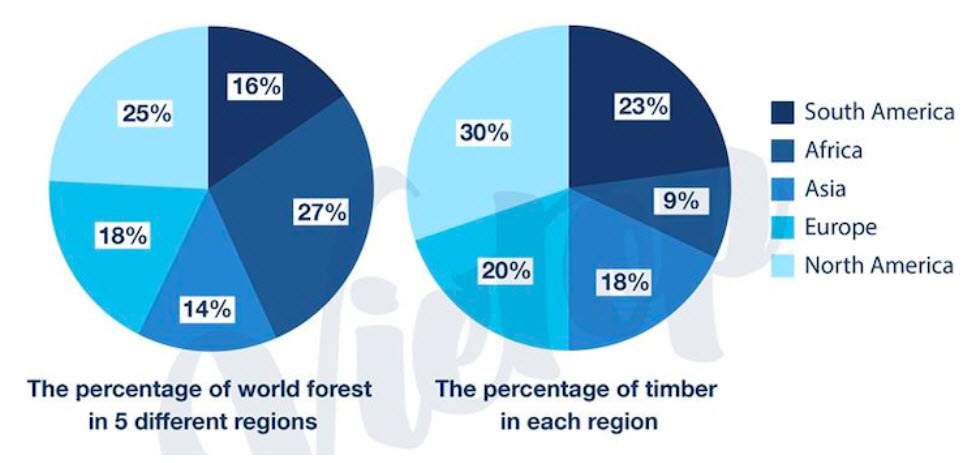
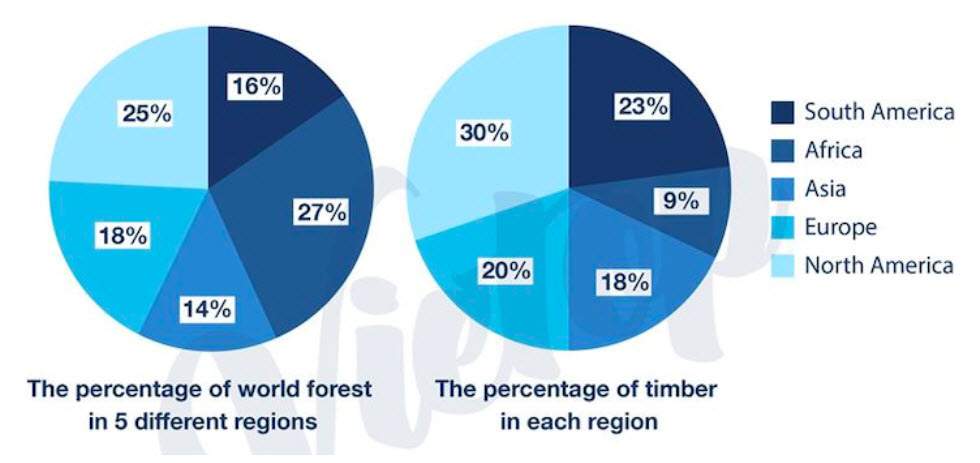
The pie charts give information about the world’s forest in five different regions.
Summarize the information by selecting and reporting the main features, and make comparisons where relevant.
The pie charts detail information about the world’s forests and timber according to continent. Looking from an overall perspective, it is readily apparent that most of the world’s forests are in Africa and North America, followed by Europe, South America, and lastly Asia. In contrast, Africa possesses the least timber while North America has the most.
Looking first of all at North America and Africa, the former continent represents 25% of the world’s forest and the latter 27%. In terms of timber, the figure is slightly higher for North America (30%) and drastically lower for Africa (9%).
Forest and timber ratios are more even in the other regions. European nations contain 18% of the world’s forests and 20% of its timber. South America is marginally lower at 16% for forests and moderately higher at 23% for timber. Finally, Asian forests constitute 14% of the global total and 18% of all timber.
Analysis
1. The pie charts detail information about the world’s forests and timber according to continent. 2. Looking from an overall perspective, it is readily apparent that most of the world’s forests are in Africa and North America, followed by Europe, South America, and lastly Asia. 3. In contrast, Africa possesses the least timber while North America has the most.
Paraphrase what the table shows.
Write a clear overview summarising the differences.
You might need another sentence for your overview.
1. Looking first of all at North America and Africa, the former continent represents 25% of the world’s forest and the latter 27%. 2. In terms of timber, the figure is slightly higher for North America (30%) and drastically lower for Africa (9%).
Begin writing about the data for the first categories.
Make sure you compare as much as possible.
1. Forest and timber ratios are more even in the other regions. 2. European nations contain 18% of the world’s forests and 20% of its timber. 3. South America is marginally lower at 16% for forests and moderately higher at 23% for timber. 4. Finally, Asian forests constitute 14% of the global total and 18% of all timber.
Write about the final, other parts of the graph – include everything!
Compare the categories.
Keep adding more data.
Don’t leave anything out!
Vocabulary
What do the words in bold below mean?Take some notes on a piece of paper to aid your memory:
The pie charts detail information about the world’s forests and timber according to continent. Looking from an overall perspective, it is readily apparent that most of the world’s forests are in Africa and North America, followed by Europe, South America, and lastly Asia. In contrast, Africa possesses the least timber while North America has the most.
Looking first of all at North America and Africa, the former continent represents 25% of the world’s forest and the latter 27%. In terms of timber, the figure is slightly higher for North America (30%) and drastically lower for Africa (9%).
Forest and timber ratios are more even in the other regions. European nationscontain 18% of the world’s forests and 20% of its timber. South America is marginally lower at 16% for forests and moderately higher at 23% for timber. Finally, Asian forests constitute 14% of the global total and 18% of all timber.
Answers
Try to write down or think of an antonym/opposite word for further practice:
detail information about shows data for
forests the woods
timber wood that is cut down and sold
according to regarding
continent Africa, Asia, etc.
Looking from an overall perspective, it is readily apparent that overall
Remember and fill in the blanks. Note it on a piece of paper so you can remember better:
The pie charts d__________________________t the world’s f_________s and t_______r a_________________________t. L_________________________________________________________t most of the world’s forests are in Africa and North America, f______________y Europe, South America, and l________y Asia. I__________t, Africa possesses t_________t timber w____e North America has the most.
L____________________t North America and Africa, the f________r continent r_________s 25% of the world’s forest and the l________r 27%. I__________f timber, the figure is s_____________________r North America (30%) and d_______________r for Africa (9%).
Forest and timber r________s are more e___n in the o______________s. E____________________________n 18% of the world’s forests and 20% of its timber. South America is m_______________r at 16% for forests and m________________r at 23% for timber. Finally, Asian forests c____________e 14% of t_______________l and 18% of all timber.
Listening Practice
Listen to the related topic below and practice with these activities:
Some people say patriotism causes problems and is negative overall. Others feel that it is beneficial for society at large.
Do the advantages of patriotism outweigh its disadvantages?
Many feel that patriotism has a beneficial impact overall. In my opinion, although there are legitimate reasons to be proud of one’s country, patriotic feelings do generally produce more negatives than positives.
Proponents of patriotism argue it is a natural impulse with tangible benefits. Firstly, a strong sense of patriotism can be motivating. Individuals who have pride in their country are more likely to work hard for the common good. This applies to a variety of positions in society and may include soldiers serving in the military, healthcare workers during times of national emergencies, and even common workers contributing to a flourishing national economy. Secondly, individuals can use investment in their country’s successes to support their own self-esteem. Most people support their country similar to how sports fans root for a team. Success elevates their mood and connects them to a wider community.
However, patriotism is often taken to extremes. This occurs most frequently with vulnerable segments of society. For instance, it is common for military recruiters to target less affluent individuals. If they serve in a war abroad, then there is a strong likelihood they will later suffer from a mental or physical handicap. More generally, most people employ patriotism as a proxy for their own personal achievements. This can be evidenced during the furor surrounding the Olympics every four years. This quintessentially patriotic event costs taxpayers tremendously, inflames tensions between rival countries, and distracts from investing time in personal development. At best, patriotism is a marginal net negative and at worst it can foster an unhealthy dependency.
In conclusion, though patriotism is beneficial economically and in terms of one’s self-esteem at times, the drawbacks related to disassociation are more significant. Mental health should not be dependent on the fortunes of one’s compatriots.
Analysis
1. Many feel that patriotism has a beneficial impact overall. 2. In my opinion, although there are legitimate reasons to be proud of one’s country, patriotic feelings do generally produce more negatives than positives.
Paraphrase the overall essay topic.
Write a clear opinion. Read more about introductions here.
1. Proponents of patriotism argue it is a natural impulse with tangible benefits. 2. Firstly, a strong sense of patriotism can be motivating. 3. Individuals who have pride in their country are more likely to work hard for the common good. 4. This applies to a variety of positions in society and may include soldiers serving in the military, healthcare workers during times of national emergencies, and even common workers contributing to a flourishing national economy. 5. Secondly, individuals can use investment in their country’s successes to support their own self-esteem. 6. Most people support their country similar to how sports fans root for a team. Success elevates their mood and connects them to a wider community.
Write a topic sentence with a clear main idea at the end.
Explain your main idea.
Develop it with specific or hypothetical examples.
Keep developing it fully.
Use short and long sentences.
Finish the paragraph strong.
1. However, patriotism is often taken to extremes. 2. This occurs most frequently with vulnerable segments of society. For instance, it is common for military recruiters to target less affluent individuals. 3. If they serve in a war abroad, then there is a strong likelihood they will later suffer from a mental or physical handicap. 4. More generally, most people employ patriotism as a proxy for their own personal achievements. 5. This can be evidenced during the furor surrounding the Olympics every four years. 6. This quintessentially patriotic event costs taxpayers tremendously, inflames tensions between rival countries, and distracts from investing time in personal development. 7. At best, patriotism is a marginal net negative and at worst it can foster an unhealthy dependency.
Write a new topic sentence with a new main idea at the end.
Explain your new main idea.
Include specific details and examples.
Add as much information as you can and make sure it links logically.
Develop the example fully.
Make sure you have something really specific.
Conclude the paragraph.
1. In conclusion, though patriotism is beneficial economically and in terms of one’s self-esteem at times, the drawbacks related to disassociation are more significant. 2. Mental health should not be dependent on the fortunes of one’s compatriots.
Summarise your main ideas.
Include a final thought. Read more about conclusions here.
Vocabulary
What do the words in bold below mean?Make some notes on paper to aid memory and then check below.
Many feel that patriotism has a beneficial impact overall. In my opinion, although there are legitimate reasons to be proud of one’s country, patriotic feelings do generally produce more negatives than positives.
Proponents of patriotism argue it is a natural impulse with tangible benefits. Firstly, a strong sense of patriotism can be motivating. Individuals who have pride in their country are more likely to work hard for the common good. This applies to a variety of positions in society and may include soldiers serving in the military, healthcare workers during times of national emergencies, and even common workers contributing to a flourishing national economy. Secondly, individuals can use investment in their country’s successes to support their own self-esteem. Most people support their country similar to how sports fans root for a team. Success elevates their mood and connects them to a wider community.
However, patriotism is often taken to extremes. This occurs most frequently with vulnerable segments of society. For instance, it is common for military recruiters to target less affluent individuals. If they serve in a war abroad, then there is a strong likelihood they will later suffer from a mental or physical handicap. More generally, most people employ patriotism as a proxy for their own personal achievements. This can be evidenced during the furor surrounding the Olympics every four years. This quintessentially patriotic event costs taxpayers tremendously, inflames tensions between rival countries, and distracts from investing time in personal development. At best, patriotism is a marginal net negative and at worst it can foster an unhealthy dependency.
In conclusion, though patriotism is beneficial economically and in terms of one’s self-esteem at times, the drawbacks related todisassociation are more significant. Mental health should not be dependent on the fortunes of one’s compatriots.
Answers
For extra practice, write an antonym (opposite word) on a piece of paper to help you remember the new vocabulary:
patriotism caring a lot and loving and feeling pride for your country
beneficial impact overall good in general
legitimate reasons real justifications
proud feel good about
patriotic feelings emotions of love for your country
generally produce overall create
negatives harmful
positives benefits
proponents people who support
argue point out
natural impulse normal feeling
tangible benefits real help
strong sense big feeling
motivating encouraging
pride love, thinking highly of
work hard for the common good help everyone
applies relates to
variety different kinds
positions jobs
soldiers serving in the military people who fight in wars, the army
healthcare workers doctors and nurses
times of national emergencies when there are big problems
common workers normal people
contributing to adding to
a flourishing national economy the economy doing well
investment caring about
successes doing well
support their own self-esteem help how about they feel about themselves
similar to like
root for support
elevates lifts up
mood feelings
connects puts together with
wider community society
taken to extremes in some instances
occurs most frequently happens a lot
vulnerable segments of society poorer people
military recruiters people looking for soldiers
target less affluent individuals look for poor people
serve be in
war abroad fights in other countries
strong likelihood good chance of
suffer have difficulty
mental or physical handicap bad mental health or out of shape
I recommend getting a pencil and piece of paper because that aids memory. Then write down the missing vocabulary from my sample answer in your notebook:
Many feel that p___________m has a b_____________________l. In my opinion, although there are l_________________s to be p______d of one’s country, p_________________s do g__________________e more n_________s than p_____________s.
P_______________s of patriotism a_____e it is a n________________e with t_________________s. Firstly, a s_______________e of patriotism can be m____________g. Individuals who have p_____e in their country are more likely to w_______________________d. This a__________s to a v_________y of p_________s in society and may include s______________________y, h__________________s during t__________________________s, and even c________________s c__________________o a_________________________y. Secondly, individuals can use i____________t in their country’s s____________s to s____________________m. Most people support their country s______________o how sports fans r_________r a team. Success e_________s their m____d and c__________s them to a w________________y.
However, patriotism is often t__________________s. This o____________________y with v_________________________y. For instance, it is common for m__________________s to t_________________________s. If they s_____e in a w____________d, then there is a s__________________d they will later s______r from a m_____________________p. M______________y, most people e____________________m as a p_____y for their own p____________________s. This can be e____________d during the f____________________g the Olympics every four years. This q_______________________c event c___________________________y, i___________________________________s, and d_________s from i_______________e in p___________________t. At best, patriotism is a m__________________________e and a_________t it can foster an unhealthy dependency.
In conclusion, though patriotism is beneficial e______________y and i______________f one’s self-esteem a_______s, the d____________s r______________od__________________n are more s_____________t. M______________h should not be d____________________n the f_____________s of one’s c______________s.
Listening Practice
Learn more about this topic by watching from YouTube below and practice with these activities:
Educating young people is naturally important. However, some think governments ught to invest more education for adults in need.
To what extent do you agree or disagree?
Here is a free preview of the introduction to my essay:
Many people today have called for a reorienting to focus more on education for vulnerable segments of the adult population. In my opinion, youth education should remain the priority.
The best curriculum is not one based on a static body of knowledge, but one which teaches students to cope with change.
To what extent do you agree or disagree?
Many would argue that schools today should focus more on adaptability rather than traditional, discrete subjects. In my opinion, although there is a strong argument for this contention given the disruptive nature of modern industries, it is nonetheless important to preserve the traditional role of subjects in a curriculum.
Those who support this reform contend that the skills needed for modern workforces are changing rapidly. Past generations could rely on subjects learned in high school and university, such as those related to accounting, finance, and so on, providing lasting job security. This guarantee is less stable now due to advances in automation specifically and technology generally. At many companies, human workers are being phased out of specific roles and entire jobs and replaced by cheap software. Therefore, schools should teach adaptable methods for handling change that will help them cope with an uncertain future job market.
However, traditional subjects provide an invaluable base of knowledge for the average student. By learning about core subjects a person becomes more well-rounded intellectually. In high school and university this likely includes math, literature, the sciences, history, physical education, economics, philosophy, art, and so on. Naturally, most of these subjects will not yield practical skills that are used on a daily basis throughout life and that is the source of many later complaints about school curricula. However, it is impossible to know the final utility of a given skill or piece of information. A good example of this would be the classes that Steve Jobs took about calligraphy in university which later informed the lasting design of computer interfaces and word processors.
In conclusion, despite pragmatic employment concerns, it is essential for students to possess foundational knowledge about multiple disciplines. Moreover, a binary distinction between subject knowledge and flexible skills is not always necessary.
Analysis
1. Many would argue that schools today should focus more on adaptability rather than traditional, discrete subjects. 2. In my opinion, although there is a strong argument for this contention given the disruptive nature of modern industries, it is nonetheless important to preserve the traditional role of subjects in a curriculum.
Paraphrase the overall essay topic.
Write a clear opinion. Read more about introductions here.
1. Those who support this reform contend that the skills needed for modern workforces are changing rapidly. 2. Past generations could rely on subjects learned in high school and university, such as those related to accounting, finance, and so on, providing lasting job security. 3. This guarantee is less stable now due to advances in automation specifically and technology generally. 4. At many companies, human workers are being phased out of specific roles and entire jobs and replaced by cheap software. 5. Therefore, schools should teach adaptable methods for handling change that will help them cope with an uncertain future job market.
Write a topic sentence with a clear main idea at the end.
Explain your main idea.
Develop it with specific or hypothetical examples.
Keep developing it fully.
Use short and long sentences.
1. However, traditional subjects provide an invaluable base of knowledge for the average student. 2. By learning about core subjects a person becomes more well-rounded intellectually. 3. In high school and university this likely includes math, literature, the sciences, history, physical education, economics, philosophy, art, and so on. 4. Naturally, most of these subjects will not yield practical skills that are used on a daily basis throughout life and that is the source of many later complaints about school curricula. 5. However, it is impossible to know the final utility of a given skill or piece of information. 6. A good example of this would be the classes that Steve Jobs took about calligraphy in university which later informed the lasting design of computer interfaces and word processors.
Write a new topic sentence with a new main idea at the end.
Explain your new main idea.
Include specific details and examples.
Add as much information as you can and make sure it links logically.
Develop the example fully.
Make sure you have something really specific.
1. In conclusion, despite pragmatic employment concerns, it is essential for students to possess foundational knowledge about multiple disciplines. 2. Moreover, a binary distinction between subject knowledge and flexible skills is not always necessary.
Summarise your main ideas.
Include a final thought. Read more about conclusions here.
Vocabulary
What do the words in bold below mean?Make some notes on paper to aid memory and then check below.
Many would argue that schools today should focus more on adaptability rather than traditional, discrete subjects. In my opinion, although there is a strong argument for this contentiongiven the disruptive nature of modern industries, it is nonetheless important to preserve the traditional role of subjects in a curriculum.
Those who support this reform contend that the skills needed for modern workforces are changing rapidly. Past generations could rely on subjects learned in high school and university, such as those related to accounting, finance, and so on, providing lasting job security. This guarantee is less stable now due to advances in automation specifically and technology generally. At many companies, human workers are being phased out of specific roles and entire jobs and replacedby cheap software. Therefore, schools should teach adaptable methods for handling change that will help them cope with an uncertain future job market.
However, traditional subjects provide an invaluablebase of knowledge for the average student. By learning about core subjects a person becomes more well-rounded intellectually. In high school and university this likely includes math, literature, the sciences, history, physical education, economics, philosophy, art, and so on. Naturally, most of these subjects will not yield practical skills that are used on a daily basis throughout life and that is the source of many later complaints about school curricula. However, it is impossible to know the final utility of a given skill or piece of information. A good example of this would be the classes that Steve Jobs took about calligraphy in university which later informed the lasting design of computer interfaces and word processors.
In conclusion, despite pragmatic employment concerns, it is essential for students to possess foundational knowledge about multiple disciplines. Moreover, a binary distinction between subject knowledge and flexible skills is not always necessary.
Answers
For extra practice, write an antonym (opposite word) on a piece of paper to help you remember the new vocabulary:
argue contend
focus more look more at
adaptability be able to change
rather than instead of
traditional old, conservative, normal
discrete subjects separate areas of study
strong argument good point
contention argument
given some random
disruptive nature way they disrupt, change industries
modern industries new technologies
nonetheless regardless
preserve keep
traditional role normal place
curriculum what is studied at a school
support are in favor of
reform change
contend argue
modern workforces people employed
past generations parents, grandparents, etc.
rely on depend on
related to concerning
accounting dealing with numbers
finance dealing with money
and so on etc.
providing lasting job security guaranteeing a job later
guarantee making sure of
less stable not certain
due to advances in because of changes in
automation specifically and technology generally computers and robots doing things especially but also tech overall
phased out replaced
replacedby something taking the place of
cheap software inexpensive programs
adaptable methods new ways
handling change dealing with adaptability
cope with deal with
uncertain future job market problems in the future finding a job
traditional subjects normal academic subjects
invaluablebase of knowledge really important subjects
average student normal person studying
core subjects basic things studied in school
well-rounded intellectually all around good for your thinking
literature books
the sciences biology, chemistry, etc.
physical education gym
economics studying about money and economies
philosophy studying about knowledge and life
naturally of course
will not yield practical skills won’t actually produce anything
daily basis throughout life every day your whole life
source where it comes from
complaints criticisms
curricula plural of curriculum
final utility last usage
calligraphy study of writing letters
later informed after that went into
lasting design permanent look
computer interfaces how computers look and function on the screen
word processors MS word, etc.
despite pragmatic employment concerns regardless of real worries about jobs
essential crucial
possess foundational knowledge have info about lots of areas
I recommend getting a pencil and piece of paper because that aids memory. Then write down the missing vocabulary from my sample answer in your notebook:
Many would a______e that schools today should f__________e on a_______________y r______________n t_____________l, d__________________s. In my opinion, although there is a s_________________t for this c_______________n the d__________________e of m___________________s, it is n____________s important to p_________e the t_______________e of subjects in a c___________m.
Those who s_________t this r_______m c_________d that the skills needed for m_________________s are changing rapidly. P_____________________s could r_______n subjects learned in high school and university, such as those r____________o a______________g, f___________e, a_____________n, p_____________________________y. This g_____________e is l___________e now d_______o a_______________n a__________________________________________y. At many companies, human workers are being p____________t of specific roles and entire jobs and r______________y c_______________e. Therefore, schools should teach a____________________s for h__________________e that will help them c________h an u_______________________t.
However, t_____________________s provide an i__________________________e for the a_______________t. By learning about c__________________s a person becomes more w___________________________y. In high school and university this likely includes math, l_________________e, t_______________s, history, p___________________n, e_____________s, p_____________y, art, and so on. N____________y, most of these subjects w____________________________s that are used on a d_________________________________e and that is the s____________e of many later c_______________s about school c___________a. However, it is impossible to know the f_____________y of a given skill or piece of information. A good example of this would be the classes that Steve Jobs took about c______________y in university which l_____________d the l_________________n of c_____________________s and w____________s.
In conclusion, d____________e p______________________________s, it is e__________l for students to p______________________________e about m___________________s. Moreover, a b_________________n between s_____________________e and f_______________s is not always n____________y.
Listening Practice
Learn more about this topic by watching from YouTube below and practice with these activities:
Practice with the related IELTS essay topic below:
Many people argue that in order to improve educational quality, high school students should be encouraged to question and offer criticisms on their teachers. Others think this will lead to a loss of respect and discipline in the classroom.
Weddings around the world have become more expensive and larger in recent decades. In my opinion, this is a natural progression and is positive in the vast majority of contexts.
One explanation for more lavish weddings is increasingly higher expectations coupled with a burgeoning global middle class. It is a natural desire for humans to strive to surpass previous standards. Any person who has attended weddings in the past will naturally attempt to exceed what they have experienced both in terms of size and expense. This propensity to exceed past achievements is combined with increased disposable income. Economies around the world, particularly in developing nations, have risen dramatically recently, enabling individuals to spend on a variety of luxuries including memorable wedding parties.
I believe this development is positive overall due to the impact it has on the average person. Admittedly, excessive spending in any area can be a negative if it greatly exceeds one’s earnings. Assuming a person is planning a wedding that will not hinder them financially in the future, then it is a massive positive for the bride, groom, and all attendees. Most people, even beyond those getting married and their family, consider weddings to meaningful and enduring memories. The small and large bursts of happiness produced by such an event in the aggregate are worth more than a wide range of other expenses that individuals often prioritize.
In conclusion, weddings are larger and costlier today because of raised expectations and this is largely positive given the impact on individuals. It is nonetheless essential that weddings are not taken to extreme excesses beyond one’s means.
Analysis
1. Weddings around the world have become more expensive and larger in recent decades. 2. In my opinion, this is a natural progression and is positive in the vast majority of contexts.
Paraphrase the overall essay topic.
Write a clear opinion. Read more about introductions here.
1. One explanation for more lavish weddings is increasingly higher expectations coupled with a burgeoning global middle class. 2. It is a natural desire for humans to strive to surpass previous standards. 3. Any person who has attended weddings in the past will naturally attempt to exceed what they have experienced both in terms of size and expense. 4. This propensity to exceed past achievements is combined with increased disposable income. 5. Economies around the world, particularly in developing nations, have risen dramatically recently, enabling individuals to spend on a variety of luxuries including memorable wedding parties.
Write a topic sentence with a clear main idea at the end.
Explain your main idea.
Develop it with specific or hypothetical examples.
Keep developing it fully.
Use short and long sentences.
1. I believe this development is positive overall due to the impact it has on the average person. 2. Admittedly, excessive spending in any area can be a negative if it greatly exceeds one’s earnings. 3. Assuming a person is planning a wedding that will not hinder them financially in the future, then it is a massive positive for the bride, groom, and all attendees. 4. Most people, even beyond those getting married and their family, consider weddings to meaningful and enduring memories. 5. The small and large bursts of happiness produced by such an event in the aggregate are worth more than a wide range of other expenses that individuals often prioritize.
Write a new topic sentence with a new main idea at the end.
Explain your new main idea.
Include specific details and examples.
Add as much information as you can and make sure it links logically.
Develop the example fully.
1. In conclusion, weddings are larger and costlier today because of raised expectations and this is largely positive given the impact on individuals. 2. It is nonetheless essential that weddings are not taken to extreme excesses beyond one’s means.
Summarise your main ideas.
Include a final thought. Read more about conclusions here.
Vocabulary
What do the words in bold below mean?Make some notes on paper to aid memory and then check below.
Weddings around the world have become more expensive and larger in recent decades. In my opinion, this is a natural progression and is positive in the vast majority of contexts.
One explanation for more lavish weddings is increasingly higher expectations coupled with a burgeoning global middle class. It is a natural desire for humans to strive to surpass previous standards. Any person who has attended weddings in the past will naturally attempt to exceed what they have experienced both in terms of size and expense. This propensity to exceed past achievements is combined withincreased disposable income. Economies around the world, particularly in developing nations, have risen dramatically recently, enabling individuals to spend on a variety of luxuries including memorable wedding parties.
I believe this development is positive overall due to the impact it has on the average person. Admittedly, excessive spendingin any area can be a negative if it greatly exceeds one’s earnings. Assuming a person is planning a wedding that will not hinder them financially in the future, then it is a massive positive for the bride, groom, and all attendees. Most people, even beyond those getting married and their family, consider weddings to meaningful and enduring memories. The small and large bursts of happiness produced by such an event in the aggregate are worth more than a wide range of other expenses that individuals often prioritize.
In conclusion, weddings are larger and costlier today because of raised expectations and this is largely positive giventhe impact on individuals. It is nonetheless essential that weddings are not taken to extreme excessesbeyond one’s means.
Answers
For extra practice, write an antonym (opposite word) on a piece of paper to help you remember the new vocabulary:
weddings big parties to celebrate getting married
expensive cost a lot of money
larger bigger
in recent decades the last 20 or 30 years or so
natural progression normal development
positive good
vast majority of contexts many different situations
explanation reason
lavish very expensive and large
increasingly higher expectations wanting more
coupled with combined with
burgeoning global middle class more people with money
natural desire normal feeling
strive try hard for
surpass previous standards exceed past achievements
attended went to
naturally attempt of course try
exceed do better than
experienced went to
in terms of concerning
expense money
propensity tendency
exceed past achievements do better than in the past
combined with coupled with
increased disposable income more money to spend
economies money earned and spent in a country
particularly in especially in
developing nations less wealthy countries
risen dramatically recently gone up a lot
enabling allowing for
spend use money
variety different types
luxuries items you don’t need
memorable wedding parties big weddings
due to because of
average person normal citizen
admittedly it must be admitted
excessive spending not spending too much
in any area in any respect
greatly exceeds a lot more than
earnings wages
assuming if it’s true that
hinder hold back
financially related to money
massive positive really good
bride woman getting married
groom man getting married
attendees people going to
beyond past
consider think about
meaningful important
enduring lasting
bursts sudden jolts
produced by created by
in the aggregate combined
wide range of different types of
expenses money to be spent
prioritize consider more important
costlier costs more money
raised expectations higher hopes
largely positive mostly good
giventhe considering that
nonetheless regardless
essential crucial
extreme excessesbeyond one’s means spending a lot more than one can afford
I recommend getting a pencil and piece of paper because that aids memory. Then write down the missing vocabulary from my sample answer in your notebook:
W_________s around the world have become more e___________e and l_____________________s. In my opinion, this is a n________________________n and is p___________e in the v_____________________s.
One e______________n for more l______h weddings is i________________________________s c_____________h a b______________________________s. It is a n_______________e for humans to s________e to s_______________________s. Any person who has a____________d weddings in the past will n_________________t to e_______d what they have e_____________d both i____________________f size and e__________e. This p_________y to e______________________s is c________________hi________________________e. E____________s around the world, p_____________________n d_______________s, have r______________________________y, e__________g individuals to s_______d on a v_______y of l____________s including m____________________________s.
I believe this development is positive overall d________o the impact it has on the a____________________n. A____________y, e______________________gi___________a can be a negative if it g_______________________s one’s e__________s. A__________g a person is planning a wedding that will not h________r them f_____________y in the future, then it is a m________________e for the b_______e, g_________m, and all a___________s. Most people, even b________d those getting married and their family, c_________r weddings to m___________l and e__________g memories. The small and large b____s of happiness p_____________y such an event i__________________e are worth more than a w_______________f other e____________s that individuals often p___________e.
In conclusion, weddings are larger and c__________r today because of r_______________s and this is l_______________e g_____________e impact on individuals. It is n______________s e_________l that weddings are not taken to e_______________________________________s.
Listening Practice
Learn more about this topic by watching from YouTube below and practice with these activities:
"The highest quality materials anywhere on the internet! Dave improved my writing and vocabulary so much. Really affordable options you don't want to miss out on!"