This is an IELTS writing task 2 sample answer essay on the topic of private or public healthcare and medical services from the real IELTS exam.
Please consider supporting me on Patreon.com/howtodoielts to receive my exclusive IELTS Ebooks – you can even sign up for private live lessons with me!
Dave
IELTS Essay: Private or Public Healthcare
Some feel governments, rather than private companies, should be in charge of medical services.
To what extent do you agree or disagree?
There has been widespread debate in recent years concerning whether healthcare should be private or public. In my opinion, despite the importance of government regulation in the healthcare industry, a freer system will naturally encourage greater innovation.
The best support for government controlled healthcare comes from the exorbitant costs of private care. The United States is the best known example of this phenomenon. There are countless stories of vulnerable individuals requiring medical attention who face the prospect of years of nearly insurmountable medical bills. If the government runs the hospitals, as is the case in more progressive nations including Canada and England, the average person does not have to worry about prohibitively expensive medical emergencies. Citizens living in these countries now consider free medical treatment for the injured or ill as a foundational human right that governments have a responsibility to safeguard.
However, governments are notorious for stiffling innovation. This applies to a range of sectors and can best be evidenced by the failure of communism as an economic model. The less extreme forms of socialism that guide many European nations guarantee basic care but hospitals are not motivated to compete and excel. Despite the many drawbacks of the U.S. healthcare system, hospitals there routinely fund and are driven to uncover new treatments and procedures in order to attract more patients. While surging costs may leave behind vulnerable segments of the population, hospitals have a powerful motivation to produce the best possible results for those who can afford treatment.
In conclusion, medicine should be available for all citizens but this cannot be at the expense of the quality of healthcare. Governments should regulate the medical industry and provide welfare schemes yet still allow for a competitive environment.
Analysis
1. There has been widespread debate in recent years concerning whether healthcare should be private or public. 2. In my opinion, despite the importance of government regulation in the healthcare industry, a freer system will naturally encourage greater innovation.
Paraphrase the overall essay topic.
Write a clear opinion. Read more about introductions here.
1. The best support for government controlled healthcare comes from the exorbitant costs of private care. 2. The United States is the best known example of this phenomenon. 3. There are countless stories of vulnerable individuals requiring medical attention who face the prospect of years of nearly insurmountable medical bills. 4. If the government runs the hospitals, as is the case in more progressive nations including Canada and England, the average person does not have to worry about prohibitively expensive medical emergencies. 5. Citizens living in these countries now consider free medical treatment for the injured or ill as a foundational human right that governments have a responsibility to safeguard.
Write a topic sentence with a clear main idea at the end.
Explain your main idea.
Develop it with specific examples.
Keep developing it fully.
Relate it back to the overall topic.
1. However, governments are notorious for stiffling innovation. 2. This applies to a range of sectors and can best be evidenced by the failure of communism as an economic model. 3. The less extreme forms of socialism that guide many European nations guarantee basic care but hospitals are not motivated to compete and excel. 4. Despite the many drawbacks of the U.S. healthcare system, hospitals there routinely fund and are driven to uncover new treatments and procedures in order to attract more patients. 5. While surging costs may leave behind vulnerable segments of the population, hospitals have a powerful motivation to produce the best possible results for those who can afford treatment.
Write a new topic sentence with a new main idea at the end.
Explain your new main idea.
Include specific details and examples.
Continue developing it fully!
Vary short and long sentences.
1. In conclusion, medicine should be available for all citizens but this cannot be at the expense of the quality of healthcare. 2. Governments should regulate the medical industry and provide welfare schemes yet still allow for a competitive environment.
Summarise your main ideas.
Include a final thought. Read more about conclusions here.
Vocabulary
What do the words in bold below mean?Make some notes on paper to aid memory and then check below.
There has been widespread debatein recent years concerning whether healthcare should be private or public. In my opinion, despite the importance of government regulation in the healthcare industry, a freer system will naturally encourage greater innovation.
The best support for government controlled healthcare comes from the exorbitant costs of private care. The United States is the best known example of this phenomenon. There are countless stories of vulnerable individuals requiring medical attention who face the prospect of years of nearly insurmountablemedical bills. If the government runs the hospitals, as is the case in more progressive nations including Canada and England, the average person does not have to worry about prohibitively expensive medical emergencies. Citizens living in these countries now consider free medical treatment for the injured or ill as a foundational human right that governments have a responsibility to safeguard.
However, governments are notorious for stiffling innovation. This applies to a range of sectors and can best be evidenced by the failure of communism as an economic model. The less extreme forms of socialism that guide many European nations guarantee basic care but hospitals are not motivated to compete and excel. Despite the many drawbacks of the U.S. healthcare system, hospitals there routinely fund and are driven to uncover new treatments and procedures in order to attract more patients. While surging costs may leave behind vulnerable segments of the population, hospitals have a powerful motivation to produce the best possible results for those who can afford treatment.
In conclusion, medicine should be available for all citizens but this cannot be at the expense of the quality of healthcare. Governments should regulate the medical industry and provide welfare schemes yet still allow for a competitive environment.
Answers
For extra practice, write an antonym (opposite word) on a piece of paper to help you remember the new vocabulary:
widespread debate lots of controversy
in recent years in the last several years
concerning having to do with
whether if
healthcare hospital and medicine
private not public, open to companies and profit making
public owned by the government
In my opinion I think
despite regardless of
regulation rules
healthcare industry hospitals
freer system more open industry
naturally of course
encourage foster
greater innovation more new ideas
best support superior help
government controlled healthcare nations running hospitals
exorbitant costs very expensive
private care not public hospitals
best known example most famous instance
phenomenon development
countless stories many instances
vulnerable weak
requiring medical attention need help from doctors
face the prospect potentially must deal with
nearly insurmountable almost unbeatable
medical bills money to be paid to hospitals
runs in charge of
as is the case in more progressive nations which is true in more modern countries
including such as
average person normal person
prohibitively expensive costs too much
emergencies have to deal with right away
consider free medical treatment think of free hospitals
injured hurt
ill sick
foundational human right basic human privilege
responsibility duty
safeguard keep safe
notorious infamous
stiffling innovation slowing new ideas
range of sectors many industries
best be evidenced clearest support
failure didn’t work
communism system of government with state-owned enterprises
economic model way of running a country
less extreme forms of socialism not as a severe as communism
guide way forward
guarantee basic care safeguard a degree of help
compete fight agains each other
excel do well
drawbacks tradeoffs
U.S. healthcare system United States hospitals
routinely fund typically give money to
driven pushed by
uncover discover
treatments new techniques
procedures ways of treating a sickness
attract bring people in
surging increasing
leave behind can’t catch up
vulnerable segments of the population poorer people
I recommend getting a pencil and piece of paper because that aids memory. Then write down the missing vocabulary from my sample answer in your notebook:
There has been w____________________ei________________s c_____________g w____________r h______________e should be p__________e or p_______c. I_____________n, d_________e the importance of government r___________n in the h___________________y, a f_______________m will n___________y e_____________e g___________________n.
The b_______________t for g______________________________e comes from the e_________________s of p_____________e. The United States is the b________________e of this p________________n. There are c__________________s of v______________e individuals r____________________________n who f_____________________t of years of n_________________________em______________s. If the government r______s the hospitals, a________________n m_____________________s i______________g Canada and England, the a_________________n does not have to worry about p_________________________e medical e________________s. Citizens living in these countries now c____________________________t for the i_________d or i__l as a f____________________________t that governments have a r_______________y to s__________d.
However, governments are n___________s for s________________n. This applies to a r_________________s and can b________________d by the f__________e of c_______________m as an e_________________l. The l__________________________m that g_________e many European nations g___________________e but hospitals are not motivated to c_________e and e_______l. Despite the many d______________s of the U___________________m, hospitals there r________________d and are d________n to u_________r new t_____________s and p_____________s in order to a__________t more patients. While s_________g costs may l_______________d v_________________________n, hospitals have a p_____________________n to p____________e the b_________________________s for those who can a_________d treatment.
In conclusion, medicine should be a______________e for all citizens but this cannot be a___________________f the q__________y of healthcare. Governments should r_____________e the m________________y and p______________________s yet still a_____________r a c_____________________________t.
Listening Practice
Learn more about this topic in the video below and practice with these activities:
Here are the questions – comment your answers below for some feedback!
What kind of flowers do you know?
Are there any flowers that have special meanings in China?
Have you ever planted any flowers?
Have you sent flowers to others?
Here is a preview of the answer to the first question:
What kind of flowers do you know?
I wouldn’t say I’m a big flower person but naturally I recognize roses, lilies, sunflowers – the famous ones, haha. In my hometown in the spring tourists flock there to see the flowers blooming – the plum blossom, cherry blossoms and so on. Taking selfies with flowers is one of the biggest national pastimes in China.
If you want sample answers for these questions, the full speaking Ebook is only available on my Patreon.
This is an IELTS writing task 2 sample answer essay on the topic of children visiting museums to learn about history from the real IELTS exam.
Please consider supporting me on Patreon.com/howtodoielts to receive my exclusive IELTS Ebooks – you can even sign up for private live lessons with me!
Dave
IELTS Essay: Children Visiting Museums
Some people think that children can learn about history by visiting museums, while others feel that there are better ways to learn about history.
Discuss both views and give your opinion.
Some believe that visiting museums is the best method for learning about the past. I am in agreement with this sentiment, although such trips cannot become the most common approach.
The long-term study of history must remain in the classroom. This is due to logistical concerns and the efficiency of textbooks and lectures. The average student at high school, for example, might be assigned several pages of reading which are then reviewed in class. The teacher can next move on to covering topics in greater depth or proceed with the curriculum to other historical periods. This regular pattern ensures steady progress. Traveling to and learning in a museum is more interactive but there are tradeoffs related to the amount of material that can be learned. A museum visit, in contrast to the classroom, involves travel time and its focus is limited to the specific items on display.
However, museum learning promises greater depth of learning. A good example of this would be the many museums in urban areas such as New York City. Students who visit and view real artifacts from the past at The American Museum of Natural History are likely to remember not only the objects, but also their significance to history. Researchers have demonstrated that the human brain learns retains more information visually and the combination of readings before and after a trip, conversations with other students, and commentary from teachers contributes to a formidable and memorable lesson. There is thereby a greater chance that students who spend time learning at museums will internalize facts and dates for both standardized tests and later in life.
In conclusion, museum visits are a memorable and ideal approach to the instruction of history, though the classroom must remain standard practice. Whenever possible, school systems should fund field trips to museums.
Analysis
1. Some believe that visiting museums is the best method for learning about the past. 2. I am in agreement with this sentiment, although such trips cannot become the most common approach.
Paraphrase the overall essay topic.
Write a clear opinion. Read more about introductions here.
1. The long-term study of history must remain in the classroom. 2. This is due to logistical concerns and the efficiency of textbooks and lectures. 3. The average student at high school, for example, might be assigned several pages of reading which are then reviewed in class. 4. The teacher can next move on to covering topics in greater depth or proceed with the curriculum to other historical periods. 5. This regular pattern ensures steady progress. Traveling to and learning in a museum is more interactive but there are tradeoffs related to the amount of material that can be learned. 6. A museum visit, in contrast to the classroom, involves travel time and its focus is limited to the specific items on display.
Write a topic sentence with a clear main idea at the end.
Explain your main idea.
Develop it with specific examples.
Keep developing it fully.
Relate it back to the overall topic.
Conclude with a strong statement.
1. However, museum learning promises greater depth of learning. 2. A good example of this would be the many museums in urban areas such as New York City. 3. Students who visit and view real artifacts from the past at The American Museum of Natural History are likely to remember not only the objects, but also their significance to history. 4. Researchers have demonstrated that the human brain learns retains more information visually and the combination of readings before and after a trip, conversations with other students, and commentary from teachers contributes to a formidable and memorable lesson. 5. There is thereby a greater chance that students who spend time learning at museums will internalize facts and dates for both standardized tests and later in life.
Write a new topic sentence with a new main idea at the end.
Explain your new main idea.
Include specific details and examples.
Continue developing it fully!
Vary short and long sentences.
1. In conclusion, museum visits are a memorable and ideal approach to the instruction of history, though the classroom must remain standard practice. 2. Whenever possible, school systems should fund field trips to museums.
Summarise your main ideas.
Include a final thought. Read more about conclusions here.
Vocabulary
What do the words in bold below mean?Make some notes on paper to aid memory and then check below.
Some believe that visiting museums is the best method for learning about the past. I am in agreement with this sentiment, although such trips cannot become the most common approach.
The long-term study of history must remain in the classroom. This is due to logistical concerns and the efficiency of textbooks and lectures. The average student at high school, for example, might be assigned several pages of reading which are then reviewed in class. The teacher can next move on to covering topics in greater depth or proceed with the curriculum to other historical periods. This regular pattern ensures steady progress. Traveling to and learning in a museum is more interactive but there are tradeoffs related to the amount of material that can be learned. A museum visit, in contrast to the classroom, involves travel time and its focus is limited to the specific items on display.
However, museum learning promises greater depth of learning. A good example of this would be the many museums in urban areas such as New York City. Students who visit and view real artifacts from the past at The American Museum of Natural History are likely to remember not only the objects, but also their significance to history. Researchers have demonstrated that the human brain learns retains more information visually and the combination of readings before and after a trip, conversations with other students, and commentary from teachers contributes to a formidable and memorable lesson. There is thereby a greater chance that students who spend time learning at museums will internalize facts and dates for both standardized tests and later in life.
In conclusion, museum visits are a memorable and ideal approach to the instruction of history, though the classroom must remain standard practice. Whenever possible, school systems should fund field trips to museums.
Answers
For extra practice, write an antonym (opposite word) on a piece of paper to help you remember the new vocabulary:
best method main way
the past history
I am in agreement with this sentiment I agree with this idea
although however
trips visits
most common approach way to be done most of the time
long-term over a long time
remain stay
classroom studying in a class
this is due to this is because of
logistical concerns pragmatic issues
efficiency not wasting time
textbooks books students study from
lectures talking to all the students
average student normal kid
assigned given to do
reviewed revised
move on go forward
covering going over
greater depth more detail
proceed go along
curriculum what you study over the course of a year
historical periods times in the past
regular pattern repeating trend
ensures guarantees
steady progress stable development
interactive more active and engaged
tradeoffs bad sides
related to concerning
amount number of
in contrast to compared to
focus emphasis
limited kept within bounds
specific items actual artifacts
on display being shown
promises greater depth leads to more learning
urban areas cities
view real artifacts see actual objects from the past
objects items
significance importance
researchers have demonstrated that scientists have shown that
retains keeps
visually what you can see
combination mix
readings textbook chapters
conversations talking with
commentary lecture
contributes adds to
formidable impressive, meaningful
memorable lesson easy to remember class
thereby therefore
greater chance more probability
internalize commit deeply
standardized tests exams in school
ideal approach best way
instruction of teaching of
remain standard practice still be the normal way of doing it
I recommend getting a pencil and piece of paper because that aids memory. Then write down the missing vocabulary from my sample answer in your notebook:
Some believe that visiting museums is the b___________d for learning about t_________t. I__________________________________________t, a________h such t______s cannot become the m______________________________h.
The l____________m study of history must r_________n in the c____________m. T_________________o l______________________s and the e_______________y of t______________s and l___________s. The a_______________t at high school, for example, might be a____________d several pages of reading which are then r____________d in class. The teacher can next m_________n to c____________g topics in g___________________h or p___________d with the c_____________m to other h___________________s. This r__________________n e__________s s___________________s. Traveling to and learning in a museum is more i_____________e but there are t____________s r____________o the a_________t of material that can be learned. A museum visit, i______________o the classroom, involves travel time and its f_________s is l_____________d to the s______________s o_____________y.
However, museum learning p_____________________h of learning. A good example of this would be the many museums in u______________s such as New York City. Students who visit and v____________________s from the past at The American Museum of Natural History are likely to remember not only the o____________s, but also their s______________e to history. R_______________________________t the human brain learns r__________s more information v__________y and the c_______________n of r___________s before and after a trip, c_______________s with other students, and c_______________y from teachers c______________s to a f_______________e and m__________________n. There is t____________y a g_______________e that students who spend time learning at museums will i______________e facts and dates for both s____________________s and later in life.
In conclusion, museum visits are a memorable and i________________h to the i_________________f history, though the classroom must r_______________________________e. W_________________e, s_______________s should f___________________s to museums.
Listening Practice
Learn more about this topic in the video below and practice with these activities:
Please consider supporting my efforts to creative high quality IELTS materials for students around the world by signing up for my Patreon (and so you won’t miss out on any of my exclusive IELTS Ebooks)!
Dave
IELTS Essay Task 1: Consumption of Vegetables and Fish
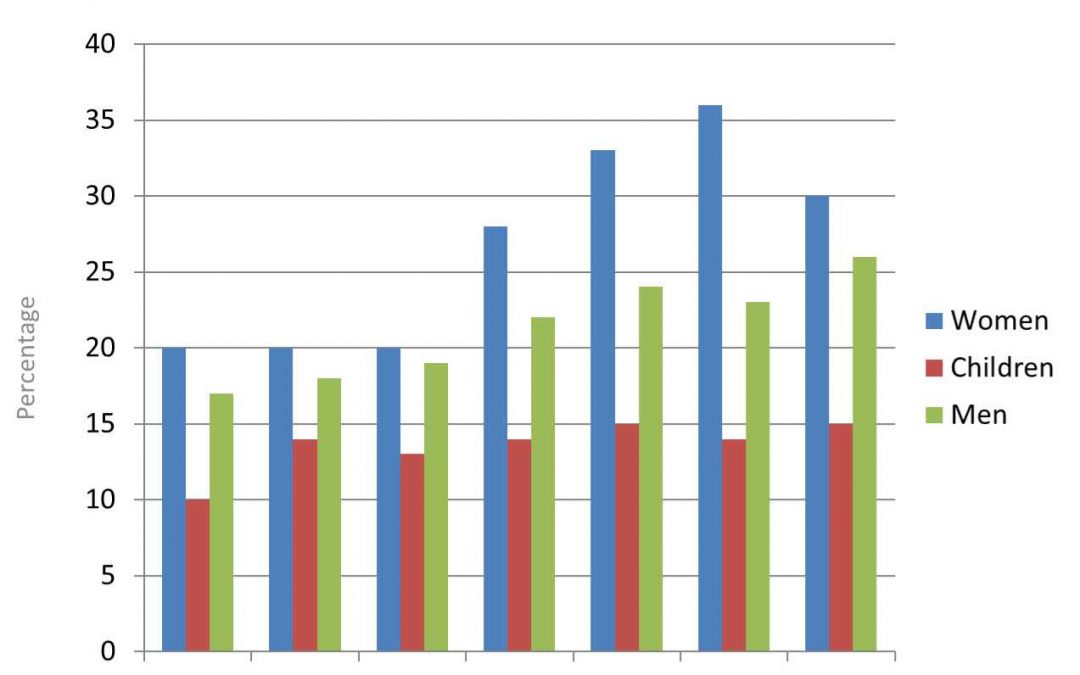
The bar chart illustrates the number of people in the UK eating more than 5 portions of vegetables and fish per day.
Summarise the information by selecting and reporting the main features, and make comparisons where relevant.
IELTS Bar Chart: Consumption of Fish & Vegetables
The bar chart illustrates statistics concerning individuals in the UK consuming 5 or more portions of vegetables and fish per day from 2011 to 2017. Looking from an overall perspective, it is readily apparent that percentages for women, children and men all rose over the period and women had the highest numbers throughout. The increase for children, comparatively, was modest.
Women began the period with 20% consuming more than 5 portions of vegetables and fish a day and this figure was stable until 2013 when it began to rise precipitously to eventually reach a high of 36% in 2016, before a fall to 30% to end the period. The numbers for males finished slightly lower at 26%, however their growth was steadier, rising in each year besides 2016 from a starting point of 16% in 2011.
The figures for children were much lower to begin (10%), preceding a relative surge to 14% the next year. Percentages then fluctuated around 14% and finished at a peak of 15% by the end of the period.
Analysis
1. The bar chart illustrates statistics concerning individuals in the UK consuming 5 or more portions of vegetables and fish per day from 2011 to 2017. 2. Looking from an overall perspective, it is readily apparent that percentages for women, children and men all rose over the period and women had the highest numbers throughout. 3. The increase for children, comparatively, was modest.
Paraphrase what the bar chart shows.
Write a clear overview summarising the differences.
You might need a second sentence for your overview.
1. Women began the period with 20% consuming more than 5 portions of vegetables and fish a day and this figure was stable until 2013 when it began to rise precipitously to eventually reach a high of 36% in 2016, before a fall to 30% to end the period. 2. The numbers for males finished slightly lower at 26%, however their growth was steadier, rising in each year besides 2016 from a starting point of 16% in 2011.
Begin writing about the data for the first category.
Describe the next area and compare it to the area before.
1. The figures for children were much lower to begin (10%), preceding a relative surge to 14% the next year. 2. Percentages then fluctuated around 14% and finished at a peak of 15% by the end of the period.
Write about the final other parts of the bar chart – include everything!
There is a lot of data in this one but try to get to all of it.
Vocabulary
What do the words in bold below mean?Take some notes on a piece of paper to aid your memory:
The bar chart illustrates statistics concerning individuals in the UK consuming 5 or more portions of vegetables and fish per day from 2011 to 2017. Looking from an overall perspective, it is readily apparent that percentages for women, children and men all rose over the period and women had the highest numbers throughout. The increase for children, comparatively, was modest.
Women began the period with 20% consuming more than 5 portions of vegetables and fish a day and this figure was stable until 2013 when it began to rise precipitously to eventually reach a high of 36% in 2016, before a fall to 30% to end the period. The numbers for males finished slightly lower at 26%, however their growth was steadier, rising in each year besides 2016 from a starting point of 16% in 2011.
The figures for children were much lower to begin (10%), preceding a relative surge to 14% the next year. Percentages then fluctuated around 14% and finished at a peak of 15% by the end of the period.
Answers
Try to write down or think of an antonym/opposite word for further practice:
illustrates shows
statistics data
concerning as it relates to
the UK England
consuming eating
portions amount of food
per day each day
Looking from an overall perspective, it is readily apparent that overall
rose increased
period time in question
highest numbers biggest figures
throughout the whole time
comparatively compared/relative to
modest small
began the period started
a day each day
stable no chance
when as
rise precipitously grow a lot
eventually in the end
reach a high of get to a top point of
before a fall preceding a decrease
to end the period to finish the time
slightly lower a little less
growth rise
steadier with less fluctuation
besides also
from a starting point of beginning at
much lower a lot less
relative surge compared to other rises, a large rise
Remember and fill in the blanks. Note it on a piece of paper so you can remember better:
The bar chart i________________s s______________s c______________g individuals in t______K c______________g 5 or more p__________s of vegetables and fish p_________y from 2011 to 2017. L____________________________________________________t percentages for women, children and men all r_____e over the p_______d and women had the h______________s t______________t. The increase for children, c_______________y, was m_________t.
Women b___________________d with 20% consuming more than 5 portions of vegetables and fish a________y and this figure was s__________e until 2013 w______n it began to r_________________y to e__________________________f 36% in 2016, b_____________l to 30% t__________________d. The numbers for males finished s_________________r at 26%, however their g_________h was s___________r, rising in each year b__________s 2016 f________________________f 16% in 2011.
The figures for children were m__________r to begin (10%), preceding a r________________e to 14% t_______________r. Percentages then f___________d around 14% and finished a_________________f 15% by the end of the period.
Listening Practice
Listen to the related topic below and practice with these activities:
This is an IELTS writing task 2 sample answer essay on the topic of more crimes being committed by youngsters from the real IELTS exam.
Please consider supporting me on Patreon.com/howtodoielts to receive my exclusive IELTS Ebooks – you can even sign up for private live lessons with me!
Dave
IELTS Essay General Training: Strict Teachers
Some people believe that teacher should be strict in order to best motivate students while others say that friendly teachers are more important.
Discuss both sides and give your own opinion.
Many feel that strict teaching better encourages academic excellence. In my opinion, though there is value is discipline, it is more important to motivate hard work through healthier means.
On the one hand, a harsh teacher can ensure a basic minimum of good behavior. Most individuals will remember a strict teacher from their childhood who carefully monitored and inspired fear. The punishment for not paying attention, cheating, or performing badly would be a critical comment at best and, at worst, corporal punishment. This fear of being physically or mentally injured is the primary catalyst that then compels hard work and discourages misbehavior. Though modern viewpoints categorize this as abuse, there is little doubt that it was effective in the past at curbing the actions that negatively affect academic performance.
However, to inspire a healthy attitude towards achievement, teachers must foster a more positive learning environment. The above-mentioned methods, including both positive and negative reinforcement, focus on the external opinion of teacher’s and, by extension, society at large. This can overburden students and stands in contrast to a freer learning style that encourages students to explore their own passions, make mistakes, and learn simply for the sake of learning. Evidence for the superiority of this approach can be found in recent research showing the impact of a positive mindset on learning and the importance of growing in a safe environment without the risk of punishment. Following this approach is therefore more likely to result in a long-lasting positive attitude towards learning.
In conclusion, despite the value of strict discipline for discouraging bad behavior, it cannot motivate passionate commitment as well as more modern methodologies. Teachers should strive for a balance but focus on a friendly atmosphere that allows for self-expression.
Analysis
1. Many feel that strict teaching better encourages academic excellence. 2. In my opinion, though there is value is discipline, it is more important to motivate hard work through healthier means.
Paraphrase the overall essay topic.
Write a clear opinion. Read more about introductions here.
1. On the one hand, a harsh teacher can ensure a basic minimum of good behavior. 2. Most individuals will remember a strict teacher from their childhood who carefully monitored and inspired fear. 3. The punishment for not paying attention, cheating, or performing badly would be a critical comment at best and, at worst, corporal punishment. 4. This fear of being physically or mentally injured is the primary catalyst that then compels hard work and discourages misbehavior. 5. Though modern viewpoints categorize this as abuse, there is little doubt that it was effective in the past at curbing the actions that negatively affect academic performance.
Write a topic sentence with a clear main idea at the end.
Explain your main idea.
Develop it with specific examples.
Keep developing it fully.
Stay focused on the same main idea.
1. However, to inspire a healthy attitude towards achievement, teachers must foster a more positive learning environment. 2. The above-mentioned methods, including both positive and negative reinforcement, focus on the external opinion of teacher’s and, by extension, society at large. 3. This can overburden students and stands in contrast to a freer learning style that encourages students to explore their own passions, make mistakes, and learn simply for the sake of learning. 4. Evidence for the superiority of this approach can be found in recent research showing the impact of a positive mindset on learning and the importance of growing in a safe environment without the risk of punishment. 5. Following this approach is therefore more likely to result in a long-lasting positive attitude towards learning.
Write a new topic sentence with a new main idea at the end.
Explain your new main idea.
Include specific details and examples.
Continue developing it fully!
Conclude with a strong statement.
1. In conclusion, despite the value of strict discipline for discouraging bad behavior, it cannot motivate passionate commitment as well as more modern methodologies. 2. Teachers should strive for a balance but focus on a friendly atmosphere that allows for self-expression.
Summarise your main ideas.
Include a final thought. Read more about conclusions here.
Vocabulary
What do the words in bold below mean?Make some notes on paper to aid memory and then check below.
Many feel that strict teaching better encourages academic excellence. In my opinion, though there is value is discipline, it is more important to motivate hard work through healthier means.
On the one hand, a harsh teacher can ensure a basic minimum of good behavior. Most individuals will remember a strict teacher from their childhood who carefully monitored and inspired fear. The punishment for not paying attention, cheating, or performing badly would be a critical comment at best and, at worst, corporal punishment. This fear of being physically or mentally injured is the primary catalyst that then compels hard work and discourages misbehavior. Though modern viewpoints categorize this as abuse, there is little doubt that it was effective in the past at curbing the actions that negatively affect academic performance.
However, to inspire a healthy attitude towards achievement, teachers must foster a more positive learning environment. The above-mentioned methods, including both positive and negative reinforcement, focus on the external opinion of teacher’s and, by extension, society at large. This can overburden students and stands in contrast to a freer learning style that encourages students to explore their own passions, make mistakes, and learn simply for the sake of learning. Evidence for the superiority of this approach can be found in recent research showing the impact of a positive mindset on learning and the importance of growing in a safe environment without the risk of punishment. Following this approach is therefore more likely to result in a long-lasting positive attitude towards learning.
In conclusion, despite the value of strict discipline for discouraging bad behavior, it cannot motivate passionate commitment as well as more modern methodologies. Teachers should strive for a balance but focus on a friendly atmosphere that allows for self-expression.
Answers
For extra practice, write an antonym (opposite word) on a piece of paper to help you remember the new vocabulary:
strict harsh
encourages fosters
academic excellence doing well in school
value importance
discipline not breaking the rules, working hard
motivate want to do
healthier means better ways
on the one hand on the one side
harsh strict, mean
ensure make sure
basic minimum least required
good behavior acting nice
remember recall
childhood when you were a kid
carefully monitored watched carefully
inspired fear makes people afraid
punishment being disciplined
not paying attention day-dreaming
cheating taking someone else’s answers
performing badly doing poorly
critical comment bad feedback
at best in the best situation
at worst in the worst situation
corporal punishment being hit
fear scared of
physically related to the body
mentally injured hurt related to the mind, emotions
primary catalyst main cause
compels forces
discourages misbehavior keep from behaving badly
modern viewpoints new opinions
categorize put into a category/group
abuse hurting someone else
little doubt not much chance it is not true
effective impactful
curbing the actions slowing down behavior
negatively affect hurt
academic performance how well you do in school
inspire fill with motivation
healthy attitude towards achievement good way of thinking about school and work
foster encourage, create
more positive learning environment better atmosphere for learning
above-mentioned methods ways talked about above
positive and negative reinforcement praise and punishment
focus on emphasize
external opinion outside viewpoints
by extension generalized
society at large all people
overburden put too much on
stands in contrast is in opposition to
freer learning style freedom to learn how you want
explore discover
passions caring a lot about
make mistakes do things wrong
learn simply for the sake of learning for no other end/reason
evidence support
superiority better
approach way
recent research studies from the last few years
positive mindset good attitude
importance value
growing in a safe environment becoming confident in a good atmosphere
without the risk of punishment no chance of being reprimanded
following using
result in causes
long-lasting life-long
despite regardless of
discouraging not encouraging
commitment dedication
modern methodologies new ways of teaching
strive try hard
balance keep equal
focus on put emphasis on
friendly atmosphere nice classroom setting
allows for self-expression students can act freely
I recommend getting a pencil and piece of paper because that aids memory. Then write down the missing vocabulary from my sample answer in your notebook:
Many feel that s______t teaching better e___________s a___________________e. In my opinion, though there is v_______e is d___________e, it is more important to m___________e hard work through h_________________s.
O___________________d, a h________h teacher can e________e a b________________m of g_________________r. Most individuals will r________________r a strict teacher from their c__________d who c_____________________d and i_______________r. The p____________t for n_____________________n, c_________g, or p________________y would be a c______________________t a________t and, a__________t, c_______________________t. This f_______r of being p____________y or m_________________d is the p__________________t that then c__________s hard work and d____________________r. Though m__________________________e this as a_______e, there is l_____________t that it was e__________e in the past at c____________________s that n_____________________________________e.
However, to i__________e a h_______________________________________t, teachers must f__________r a m_______________________________________t. The a______________________________s, including both p_________________________________t, f___________n the e______________n of teacher’s and, b______________n, s__________________e. This can o______________n students and s_____________________o to a f_______________________e that encourages students to e___________e their own p_____________s, m_________________s, and l__________________________________g. E____________e for the s____________y of this a_______________h can be found in r___________________h showing the impact of a p_____________________t on learning and the i__________________e of g_________________________________________________t. F____________g this approach is therefore more likely to r____________n a l_____________g positive attitude towards learning.
In conclusion, d_________e the value of strict discipline for d_________________g bad behavior, it cannot motivate passionate c________________t as well as more m________________________s. Teachers should s__________e for a b_____________e but f______________n a f____________________e that a__________________________n.
Listening Practice
Learn more about this topic in the funny video below and practice with these activities:
"The highest quality materials anywhere on the internet! Dave improved my writing and vocabulary so much. Really affordable options you don't want to miss out on!"