This is an IELTS writing task 2 sample answer essay on the topic of celebrating family events from the real IELTS general training exam.
Please consider supporting me on Patreon.com/howtodoielts to receive my exclusive IELTS Ebooks! (You can also sign up for live, personal lessons with me there.)
Dave
IELTS Essay: Celebrating Family Events
Some people spend a lot of money celebrating personal family events, such as weddings and birthdays.
How important is it to celebrate such events?
Do you think people spend too much money on these events?
It is common for individuals to invest heavily in celebrating important family events. In my opinion, such celebrations are vital to healthy family life and the associated costs are reasonable in most cases.
Events that bring together the whole family encourage stronger internal cohesion. This is best illustrated through the counter-example of families that rarely meet for large social gatherings. These families are likely to grow distant and remain family members in name rather than actuality. Family members that often meet, such as in many Asian nations where familial bonds are prioritised, are closer to both their immediate and extended family. The result of such closeness is they can ask for advice, lend a helping hand, and feel the unconditional support and love that is essential for mental health.
Generally, for these events families spend only as much as they can reasonably afford. There are rare exceptions, such as when a newly married couple spends excessively on the wedding. However, most families abide by an internal calculus that keeps their spending under control. A wealthy family may stage lavish reunions, family dinners, and weddings, but they are able to afford them and only appear excessive from the perspective of less privileged spectators. A less affluent family, on the other hand, will tend to hold more modest events and, in the case of weddings, may be able to recoup a substantial proportion of the costs from gifts. For example, the giving of an envelope containing money at a wedding is common in Vietnam and helps couples begin their marriage on solid financial footing.
In conclusion, family gatherings play a key part in strengthening bonds and their cost is justifiable and moderate. Families should therefore strive to maintain their traditions in an increasingly insular society.
Analysis
1. It is common for individuals to invest heavily in celebrating important family events. 2. In my opinion, such celebrations are vital to healthy family life and the associated costs are reasonable in most cases.
Paraphrase the overall essay topic.
Write a clear opinion. Read more about introductions here.
1. Events that bring together the whole family encourage stronger internal cohesion. 2. This is best illustrated through the counter-example of families that rarely meet for large social gatherings. 3. These families are likely to grow distant and remain family members in name rather than actuality. 4. Family members that often meet, such as in many Asian nations where familial bonds are prioritised, are closer to both their immediate and extended family. 5. The result of such closeness is they can ask for advice, lend a helping hand, and feel the unconditional support and love that is essential for mental health.
Write a topic sentence with a clear main idea at the end.
Explain your main idea.
Develop it with specific examples.
Keep developing it fully.
Stay focused on the same main idea.
1. Generally, for these events families spend only as much as they can reasonably afford. 2. There are rare exceptions, such as when a newly married couple spends excessively on the wedding. 3. However, most families abide by an internal calculus that keeps their spending under control. 4. A wealthy family may stage lavish reunions, family dinners, and weddings, but they are able to afford them and only appear excessive from the perspective of less privileged spectators. 5. A less affluent family, on the other hand, will tend to hold more modest events and, in the case of weddings, may be able to recoup a substantial proportion of the costs from gifts. 6. For example, the giving of an envelope containing money at a wedding is common in Vietnam and helps couples begin their marriage on solid financial footing.
Write a new topic sentence with a new main idea at the end.
Explain your new main idea.
Include specific details and examples.
Continue developing it…
as fully as possible!
Here I add an extra example to make it more specific.
1. In conclusion, family gatherings play a key part in strengthening bonds and their cost is justifiable and moderate. 2. Families should therefore strive to maintain their traditions in an increasingly insular society.
Summarise your main ideas.
Include a final thought. Read more about conclusions here.
Vocabulary
What do the words in bold below mean?Make some notes on paper to aid memory and then check below.
It is common for individuals to invest heavily in celebrating important family events. In my opinion, such celebrations are vital to healthy family life and the associated costs are reasonable in most cases.
Events that bring together the whole familyencourage stronger internal cohesion. This is best illustrated through the counter-example of families that rarely meet for large social gatherings. These families are likely to grow distant and remain family membersin name rather than actuality. Family members that often meet, such as in many Asian nations where familial bonds are prioritised, are closer to both their immediate and extended family. The result of such closeness is they can ask for advice, lend a helping hand, and feel the unconditional support and love that is essential for mental health.
Generally, for these events families spend only as much as they can reasonably afford. There are rare exceptions, such as when a newly married couple spends excessively on the wedding. However, most families abide by an internal calculus that keeps their spending under control. A wealthy family may stage lavish reunions, family dinners, and weddings, but they are able to afford them and only appear excessive from the perspective of less privileged spectators. A less affluent family, on the other hand, will tend tohold more modest events and, in the case of weddings, may be able to recoup a substantial proportion of the costs from gifts. For example, the giving of an envelope containing money at a wedding is common in Vietnam and helps couples begin their marriage on solid financial footing.
In conclusion, family gatherings play a key part in strengthening bonds and their cost is justifiable and moderate. Families should therefore strive to maintain their traditions in an increasingly insular society.
Answers
common pervasive
invest heavily put a lot of money into
celebrating important family events birthdays, weddings, family reunions, etc.
vital really important
healthy family life good relationships in families
associated costs related expenses
reasonable not excessive
in most cases generally
bring together make closer
whole family everyone in the family
encourage foster
best illustrated clearest illustrations
counter-example example showing the opposite
rarely not often
large social gatherings big get-togethers
grow distant become like strangers
remain family members continue to be family
in name not in reality
rather than instead of
actuality reality
familial bonds relationships between family members
prioritised considered more important
immediate and extended family parents/siblings and then more distant family members like cousins
result outcome
closeness how close your are
advice suggestions
lend a helping hand give help
unconditional support no strings attached support
essential vital
mental health your mental state, emotions, etc.
generally overall
reasonably afford able to pay for
rare exceptions some different instances
newly married just married
excessively too strong
abide by stick to
internal calculus calculator in your head
keeps their spending under control stops them from spending too much money
stage lavish reunions put on big celebrations
appear excessive seem to be too much
perspective viewpoint
less privileged spectators poorer people
affluent rich
on the other hand however
tend tohold more modest events usually have less expensive celebrations
I recommend getting a pencil and piece of paper because that aids memory. Then write down the missing vocabulary from my sample answer in your notebook:
It is c___________n for individuals to i______________y in c________________________________s. In my opinion, such celebrations are v_____l to h___________________e and the a_________________s are r______________________________s.
Events that b_______________r the w______________ye_____________e stronger internal cohesion. This is b_________________d through the c__________________e of families that r________y meet for l______________________s. These families are likely to g______________t and r_______________________si__________e r____________n a____________y. Family members that often meet, such as in many Asian nations where f_________________s are p___________d, are closer to both their i______________________________y. The r________t of such c__________s is they can ask for a_________e, l________________d, and feel the u_______________________t and love that is e___________l for m______________h.
G__________y, for these events families spend only as much as they can r___________________d. There are r__________________s, such as when a n__________________d couple spends e_______________y on the wedding. However, most families a_________y an i____________________s that k_________________________________l. A wealthy family may s_______________________s, family dinners, and weddings, but they are able to afford them and only a___________________e from the p_____________e of l___________________________s. A less a__________t family, o__________________d, will t_______________________________s and, in the case of weddings, may be able to r_______p a s__________________________n of the costs from gifts. For example, the giving of an e___________e containing money at a wedding is common in Vietnam and helps couples begin their marriage on s_____________________________g.
In conclusion, family gatherings play a key part in s_____________________s and their cost is j____________e and m___________e. Families should therefore s_______e to m_____________n their t_____________s in an increasinly i_________r society.
Listening Practice
Learn more about this topic in the video below and practice with these activities:
This is an IELTS writing task 2 sample answer essay that is only available on my Patreon based on a real question related to urban and rural life from the IELTS exam.
Here is the questions itself:
Many believe that living in a city offers greater benefits compared to life in the countryside.
To what extent do you agree or disagree?
Sign up for that Ebook as well as lots of other ones and the opportunity to chat with me personally or take a live lesson!
This is an IELTS writing task 1 sample answer essay on the topic of a line graph showing proportions of residents living in Australia from different countries from the real IELTS exam.
Please consider supporting my efforts to creative high quality IELTS materials for students around the world by signing up for my Patreon (and so you won’t miss out on any of my exclusive IELTS Ebooks)!
Dave
IELTS Essay Task 1: Australian Residents
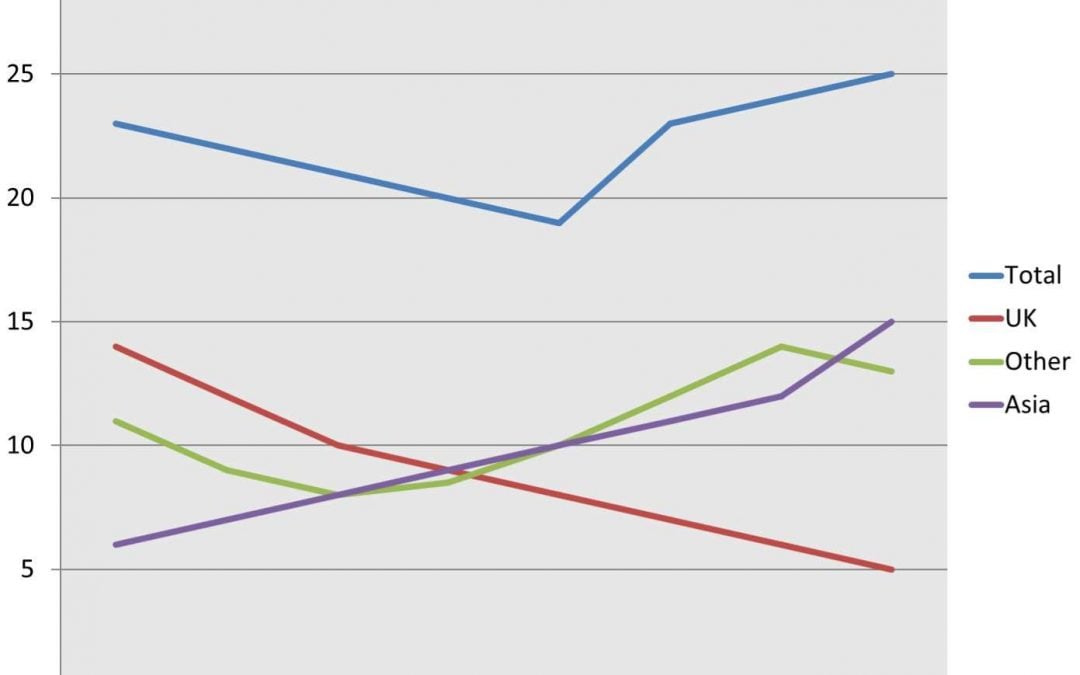
The line chart details the proportion of residents living in Australia in millions from different regions between 1976 and 2011.
The line chart compares figures for millions of residents from the UK, Asia, and other living in Australia from 1976 to 2011. Looking from an overall perspective, it is readily apparent that those from the UK experienced a steep decline, which was compensated for with a rise among others and, in particular, Asians. Total numbers also rose overall.
Individuals from the UK began the period leading all demographics at nearly 14 million before a precipitous fall to 10 million by 1986. In contrast, Asian residents grew steadily from just over 6 million to 9 million by 1991 (overtaking the UK in that year) and continued this upward trajectory to finish with a final surge to 15 million in 2011. The UK had fallen to 5 million in the same year.
Other displayed a more erratic trend with initial figures at 11 million, a moderate decline to 8 million by 1986, a consistent rise to 14 million by 2006, and a slight pullback to 13 million to end the period. Total numbers remained between 19 and 25 million throughout the period with a low point in 1996 and a peak in 2011.
Analysis
1. The line chart compares figures for millions of residents from the UK, Asia, and other living in Australia from 1976 to 2011. 2. Looking from an overall perspective, it is readily apparent that those from the UK experienced a steep decline, which was compensated for with a rise among others and, in particular, Asians. 3. Total numbers also rose overall.
Paraphrase what the graph shows.
Write a clear overview summarising the major trends and differences.
Add an extra sentence to be sure that you have covered everything.
1. Individuals from the UK began the period leading all demographics at nearly 14 million before a precipitous fall to 10 million by 1986. 2. In contrast, Asian residents grew steadily from just over 6 million to 9 million by 1991 (overtaking the UK in that year) and continued this upward trajectory to finish with a final surge to 15 million in 2011. 3. The UK had fallen to 5 million in the same year.
Begin writing about the differences.
Compare as much as possible.
Move on to the next category to describe.
Try to include all the data you can.
1. Other displayed a more erratic trend with initial figures at 11 million, a moderate decline to 8 million by 1986, a consistent rise to 14 million by 2006, and a slight pullback to 13 million to end the period. 2. Total numbers remained between 19 and 25 million throughout the period with a low point in 1996 and a peak in 2011.
Write about the rest of the information.
Make sure you have detailed all the information.
Vocabulary
What do the words in bold below mean?Take some notes on a piece of paper to aid your memory:
The line chart compares figures for millions of residents from the UK, Asia, and other living in Australia from 1976 to 2011. Looking from an overall perspective, it is readily apparent that those from the UK experienced a steep decline, which was compensated for with a rise among others and, in particular, Asians. Total numbers also rose overall.
Individuals from the UK began the period leading all demographics at nearly 14 million before a precipitous fall to 10 million by 1986. In contrast, Asian residents grew steadily from just over 6 million to 9 million by 1991 (overtaking the UK in that year) and continued this upward trajectory to finish with a final surge to 15 million in 2011. The UK had fallen to 5 million in the same year.
Other displayed a more erratic trend with initial figures at 11 million, a moderate decline to 8 million by 1986, a consistent rise to 14 million by 2006, and a slight pullback to 13 million to end the period. Total numbers remained between 19 and 25 million throughout the period with a low point in 1996 and a peak in 2011.
Answers
compares figures shows the differences between numbers
residents people living these
looking from an overall perspective, it is readily apparent that overall
The line chart c_________________s for millions of r____________s from the UK, Asia, and other living in Australia from 1976 to 2011. L___________________________________________t those from the UK e_____________d a s_____________e, which was c___________________r with a r_____e among others and, i_________________r, Asians. T_______l numbers also rose o_________l.
Individuals from the UK began the period l_______g all d______________s at nearly 14 million b_________e a p_______________l to 10 million by 1986. I______________t, Asian residents g______________y from just over 6 million to 9 million by 1991 (o_____________g the UK in that year) and c__________d this u_______________y to f_________h with a f_______________e to 15 million in 2011. The UK had f_______n to 5 million in the same year.
Other d__________d a more e_____________d with i_____________s at 11 million, a m_________________e to 8 million by 1986, a c_________________e to 14 million by 2006, and a s_________________k to 13 million to e_______________d. Total numbers r_________________n 19 and 25 million t______________________d with a l_____________t in 1996 and a p_____k in 2011.
Listening Practice
Listen to the related topic below and practice with these activities:
This is an IELTS writing task 2 sample answer essay on the topic of studying abroad from the real IELTS exam.
Please consider supporting me on Patreon.com/howtodoielts to receive my exclusive IELTS Ebooks – you can even sign up for private live lessons with me!
Dave
IELTS Essay: Study Abroad
Some claim that studying abroad has great benefits for a student’s home country.
To what extent do you agree or disagree?
Many believe that studying in another country is largely beneficial for the home country of the students in question. In my opinion, the losses entailed by these students potentially emigrating are outweighed by the expertise they often bring back.
Critics of this contention argue that many of the best and brightest students never return to their country of origin. This is especially the case as it regards developing countries, including both ordinary and famous examples. The average student from a developing nation that studies abroad in the United States or Europe, will likely have the opportunity to pursue a career there. Once hired by a company, there is a clear pathway to residency and even citizenship in the future. Since these students must meet higher admission requirements, it logically follows that a significant percentage will never return and share their newly acquired expertise with their fellow citizens.
Nonetheless, the instances above are rare and there are tangible effects from knowledgeable graduates returning to their home. Such students are capable of contributing novel outlooks and perspectives in society generally the workplace more specifically. One illustrative example of this in Vietnam is Ngo Bao Chau who studied mathematics at Oxford. After his studies abroad, he was awarded the most prestigious mathematics award, the Fields Medal, in 2007. Upon his return to Vietnam, he established a mathematics academy in Hanoi that distinguishes itself from other institutions with an innovative approach borrowed from Western schools. None of this would likely have come to pass if he had simply remained in Vietnam to study like most other students.
In conclusion, despite the risks that talented individuals may choose to reside permanently in a new country, there are more concrete benefits for the home country. Governments should therefore encourage such students with state scholarships.
Analysis
1. Many believe that studying in another country is largely beneficial for the home country of the students in question. 2. In my opinion, the losses entailed by these students potentially emigrating are outweighed by the expertise they often bring back.
Paraphrase the overall essay topic.
Write a clear opinion. Read more about introductions here.
1. Critics of this contention argue that many of the best and brightest students never return to their country of origin. 2. This is especially the case as it regards developing countries, including both ordinary and famous examples. 3. The average student from a developing nation that studies abroad in the United States or 4. Europe, will likely have the opportunity to pursue a career there. 5. Once hired by a company, there is a clear pathway to residency and even citizenship in the future. 6. Since these students must meet higher admission requirements, it logically follows that a significant percentage will never return and share their newly acquired expertise with their fellow citizens.
Write a topic sentence with a clear main idea at the end.
Explain your main idea.
Develop it with specific examples.
Keep developing it fully.
Stay focused on the same main idea.
Finish by adding extra detail.
1. Nonetheless, the instances above are rare and there are tangible effects from knowledgeable graduates returning to their home. 2. Such students are capable of contributing novel outlooks and perspectives in society generally the workplace more specifically. 3. One illustrative example of this in Vietnam is Ngo Bao Chau who studied mathematics at Oxford. 4. After his studies abroad, he was awarded the most prestigious mathematics award, the Fields Medal, in 2007. 5. Upon his return to Vietnam, he established a mathematics academy in Hanoi that distinguishes itself from other institutions with an innovative approach borrowed from Western schools. 6. None of this would likely have come to pass if he had simply remained in Vietnam to study like most other students.
Write a new topic sentence with a new main idea at the end.
Explain your new main idea.
Include specific details and examples.
Continue developing it…
as fully as possible!
Conclude by relating it back to the overall topic.
1. In conclusion, despite the risks that talented individuals may choose to reside permanently in a new country, there are more concrete benefits for the home country. 2. Governments should therefore encourage such students with state scholarships.
Summarise your main ideas.
Include a final thought. Read more about conclusions here.
Vocabulary
What do the words in bold below mean?Make some notes on paper to aid memory and then check below.
Many believe that studying in another country is largely beneficial for the home country of the students in question. In my opinion, the losses entailed by these students potentially emigrating are outweighed by the expertise they often bring back.
Critics of this contention argue that many of the best and brightest students never return to their country of origin. This is especially the case as it regards developing countries, including both ordinary and famous examples. The average student from a developing nation that studies abroad in the United States or Europe, will likely have the opportunity to pursue a career there. Once hired by a company, there is a clear pathway to residency and even citizenship in the future. Since these students must meet higher admission requirements, it logically follows that a significant percentage will never return and share their newly acquired expertise with their fellow citizens.
Nonetheless, the instances above are rare and there are tangible effects from knowledgeable graduates returning to their home. Such students are capable of contributing novel outlooks and perspectives in society generally the workplace more specifically. One illustrative example of this in Vietnam is Ngo Bao Chau who studied mathematics at Oxford. After his studies abroad, he was awarded the most prestigious mathematics award, the Fields Medal, in 2007. Upon his return to Vietnam, he established a mathematics academy in Hanoi that distinguishes itself from other institutions with an innovative approach borrowed from Western schools. None of this would likely have come to pass if he had simply remained in Vietnam to study like most other students.
In conclusion, despite the risks that talented individuals may choose to reside permanently in a new country, there are more concrete benefits for the home country. Governments should therefore encourage such students with state scholarships.
Answers
largely beneficial mostly good
home country nation you are from
in question relevant here
losses entailed what has been taken away
potentially emigrating possible moving
outweighed stronger than
expertise knowledgeable
bring back return
critics detractors
contention opinion
best and brightest smartest
country of origin nation you are from
especially the case as it regards in particular when it has to do with
average normal
studies abroad studying in another country
likely have the opportunity probably have the chance
pursue a career follow a job
hired employed
clear pathway good route
residency living in a country
citizenship becoming a citizen of a country
since because
meet higher admission requirements hard to get into schools
logically follows makes sense that
significant percentage sizeable proportion
return go back
share give information about
newly acquired expertise learned new information
fellow citizens other residents
nonetheless regardless
rare uncommon
tangible concrete
knowledgeable graduates smart people who have finished school
capable competent
contributing novel outlooks giving new opinions, perspectives
I recommend getting a pencil and piece of paper because that aids memory. Then write down the missing vocabulary from my sample answer in your notebook:
Many believe that studying in another country is l______________________l for the h________________y of the students i_________________n. In my opinion, the l_________________d by these students p_______________________g are o________________d by they e______________e the often b_____________k.
C__________s of this c_______________n argue that many of the b____________________________t students never return to their c___________________n. This is e_________________________________s developing countries, including both ordinary and famous examples. The a______________e student from a developing nation that s__________________d in the United States or Europe, will l_______________________y to p________________r there. Once h_____d by a company, there is a c______________y to r___________y and even c____________p in the future. S____e these students must m____________________________________s, it l___________________s that a s_____________________e will never r__________n and s_______e their n___________________________________e with their f_________________s.
N_____________s, the instances above are r____e and there are t________e effects from k_________________________s returning to their home. Such students are c__________e of c_________________________s and p_____________s in society g____________y the workplace m_____________________y. One i_______________e example of this in Vietnam is Ngo Bao Chau who studied mathematics at Oxford. After his studies abroad, he was a________________d the most p_____________s mathematics award, the Fields Medal, in 2007. Upon his return to Vietnam, he e______________d a m________________________y in Hanoi that d________________s itself from other i_______________s with an i_____________________h b__________________m Western schools. None of this would likely have c_________________s if he had simply r_____________d in Vietnam to study like most other students.
In conclusion, d_______e the r_____s that talented individuals may choose to r________________________y in a new country, there are more c_________e benefits for the home country. Governments should therefore e___________e such students with s____________________s.
Listening Practice
Learn more about this topic in the video below and practice with these activities:
This is an IELTS writing task 2 sample answer essay on the topic of hard work from the real IELTS general training exam.
Please consider supporting me on Patreon.com/howtodoielts so that I can continue publishing these essays! You can also sign up for private live lessons with my through Patreon!
Dave
IELTS Essay: Hard Work
Some people work harder than other.
Why is this?
Is this a positive or negative habit?
Some people work harder than others. In my opinion, this is due to natural differences in temperament and it is largely a positive characteristic, though there are exceptions.
The main motivating factor behind disparities in work ethic is character. The extent to which this is genetic or imbued by parents and other influences during childhood is in debate. There can be little doubt, however, that some are born with a natural proclivity to focus and the willpower to push themselves to accomplish their work. Well known examples of this abound in the biographies of great men. Naturally, in each of these cases, there tends to be situational factors underpinning such ambitious drives and these include a supportive family, access to quality education, and lack of neglect or abuse.
On the whole, working hard is a positive trait. This does not hold true in exceptional instances where individuals are surrounded by psychological problems and work to the detriment of their own well-being. Most employees and entrepreneurs can balance home and work life and therefore minimise the tradeoffs. The advantages, on the other hand, are substantial. A diligent worker can expect to earn more money, which can then be used to support their family or invested back into a passion project. Elon Musk is a quintessential example of a hard-working businessman who has profited individually and now contributes greatly to the advancement of mankind through a variety of forward-looking initiatives.
In conclusion, hard work has its source in the make-up of an individual and results in mostly positive benefits. Nonetheless, those who are driven must be wary of losing sight of their true goals as they achieve higher levels of success.
Analysis
1. Some people work harder than others. 2. In my opinion, this is due to natural differences in temperament and it is largely a positive characteristic, though there are exceptions.
Paraphrase the overall essay topic.
Write a clear opinion. Read more about introductions here.
1. The main motivating factor behind disparities in work ethic is character. 2. The extent to which this is genetic or imbued by parents and other influences during childhood is in debate. 3. There can be little doubt, however, that some are born with a natural proclivity to focus and the willpower to push themselves to accomplish their work. 4. Well known examples of this abound in the biographies of great men. 5. Naturally, in each of these cases, there tends to be situational factors underpinning such ambitious drives and these include a supportive family, access to quality education, and lack of neglect or abuse.
Write a topic sentence with a clear main idea at the end.
Explain your main idea.
Develop it with specific detail.
Continue to develop it.
Develop it as fully as possible.
1. On the whole, working hard is a positive trait. 2. This does not hold true in exceptional instances where individuals are surrounded by psychological problems and work to the detriment of their own well-being. 3. Most employees and entrepreneurs can balance home and work life and therefore minimise the tradeoffs. 4. The advantages, on the other hand, are substantial. 5. A diligent worker can expect to earn more money, which can then be used to support their family or invested back into a passion project. 6. Elon Musk is a quintessential example of a hard-working businessman who has profited individually and now contributes greatly to the advancement of mankind through a variety of forward-looking initiatives.
Write a new topic sentence with a new main idea at the end.
Explain your new main idea.
Include specific details and examples.
The more specific, the better.
Add on any extra detail that you can that is related for a better task achievement score.
This paragraph can be slightly longer but not too much!
1. In conclusion, hard work has its source in the make-up of an individual and results in mostly positive benefits. 2. Nonetheless, those who are driven must be wary of losing sight of their true goals as they achieve higher levels of success.
Summarise your main ideas.
Include a final thought. Read more about conclusions here.
Vocabulary
What do the words in bold below mean?Take notes on a piece of paper so that you remember them better:
Some people work harder than others. In my opinion, this is due to natural differences in temperament and it is largely a positive characteristic, though there are exceptions.
The main motivating factor behind disparities in work ethic is character. The extent to which this isgenetic or imbued by parents and other influences during childhood is in debate. There can be little doubt, however, that some are born with a natural proclivity to focus and the willpower to push themselves to accomplish their work. Well known examples of this abound in the biographies of great men. Naturally, in each of these cases, there tends to besituational factors underpinning such ambitious drives and these include a supportive family, access to quality education, and lack of neglect or abuse.
On the whole, working hard is a positive trait. This does not hold true in exceptional instances where individuals are surrounded by psychological problems and work to the detriment of their own well-being. Most employees and entrepreneurs can balance home and work life and therefore minimise the tradeoffs. The advantages, on the other hand, are substantial. A diligent worker can expect to earn more money, which can then be used to support their family or invested back into a passion project. Elon Musk is a quintessential example of a hard-working businessman who has profited individually and now contributes greatly to the advancement of mankind through a variety of forward-looking initiatives.
In conclusion, hard work has its source in the make-up of an individual and results in mostly positive benefits. Nonetheless, those who are driven must be wary of losing sight of their true goals as they achieve higher levels of success.
Answers
natural differences inherent disparities
temperament personality
largely mostly
characteristic quality
exceptions outside the norm
main motivating factor primary reason
behind underpinning
disparities differences
work ethic working hard
character how a person is
extent to which this is level this relates to
genetic biological
imbued fostered, imparted
influences people who shape someone
in debate open to question
there can be little doubt not much chance
born with inborn
natural proclivity born with it
focus pay attention to
willpower self-control
push themselves force themselves
accomplish achieve
well known examples of this abound famous instances of this are very common
biographies books about a person’s life
naturally obviously
in each of these cases in both instances
tends to besituational factors contextual matters
underpinning serving as a foundation for
ambitious drives desire to achieve a lot
include make part of
supportive family caring parents
access be able to get to
quality education good schools
lack not have
neglect not taking care of
abuse being hurt
on the whole in general
trait quality
not hold true not still the case
exceptional instances outliers, exceptions
surrounded all around
psychological problems mental issues
detriment disadvantage
well-being health
entrepreneurs people who start their own business
balance keep both equal
therefore minimise as a result keep under control
tradeoffs disadvantages
on the other hand however
substantial meaningful
diligent caring
can expect to earn will likely make
support their family take care of a wife and kids
invested back put money back into
passion project something you care greatly about
quintessential example good instance
hard-working businessman good worker
profited gained
contributes greatly adds a lot to
advancement of mankind making the world better
variety lots of different kinds
forward-looking initiatives ideas for the future
source foundation
make-up constitution, character
results in leads to
nonetheless regardless of
driven motivated
wary worried about
losing sight not paying attention to, forgetting about
true goals real aims
achieve higher levels of success become more successful
I recommend getting a pencil and piece of paper because that aids memory. Then write down the missing vocabulary from my sample answer in your notebook:
Some people work harder than others. In my opinion, this is due to n_________________________s in t______________t and it is l_________y a positive c__________________c, though there are e____________s.
The m__________________________r b_______d d______________s in w_______________c is c____________r. The e________________________sg__________c or i_________d by parents and other i___________s during childhood is i___________e. T___________________t, however, that some are b___________h a n_____________________y to f_______s and the w___________r to p___________________s to a_____________h their work. W_______________________________d in the b______________s of great men. N___________y, i_______________________s, there t___________es__________________s u____________g such a______________s and these i_________e a s___________________y, a_________s to q__________________n, and l_____k of n_______t or a_______e.
O____________e, working hard is a positive t______t. This does n______________e in e___________________s where individuals are s______________d by p___________________s and work to the d__________t of their own w____________g. Most employees and e_____________s can b_________e home and work life and t_______________________e the t___________s. The advantages, o__________________d, are s_____________l. A d__________t worker c_________________n more money, which can then be used to s_________________y or i_______________k into a p_________________t. Elon Musk is a q______________________e of a h__________________________n who has p__________d individually and now c_______________________y to the a______________________d through a v__________y of f______________________________s.
In conclusion, hard work has its s________e in the m_________p of an individual and r___________n mostly positive benefits. N______________s, those who are d_______n must be w_____y of l______________t of their t___________s as they a_________________________s.
Listening Practice
Learn more about this topic in the video below and practice with these activities:
"The highest quality materials anywhere on the internet! Dave improved my writing and vocabulary so much. Really affordable options you don't want to miss out on!"