This is an IELTS writing task 2 sample answer essay on the topic of it being harder to study at school from the real IELTS general training exam.
Please consider supporting me on Patreon.com/howtodoielts to receive my exclusive IELTS Ebooks! (You can also sign up for live, personal lessons with me there.)
Dave
IELTS Essay: Harder to Study at School
Many students find it is harder to study at university or college compared to when they were in grade school.
Why is this?
What are some possible solutions for this problem?
Many university students find concentrating on their new academic life considerably more challenging than past schooling. In my opinion, this is typically due to the altered structure of university teaching and the best solutions are to prepare and support students in the transition.
The primary cause of a lack of concentration at university is adjustment to novel ways of learning. In high school or secondary school, students fall into a set pattern of daily classes and homework assignments. This changes greatly depending on the pedagogical techniques of the university in question. Most university courses will only meet once or twice a week and the workload outside the classroom is larger and may include writing long essays and reading entire books. Students must therefore have the self-discipline to work mostly on their own and then be prepared for more rigorous discussion than they are used to with professors and other students.
The solutions to the problem mentioned above involve the activity of high schools and universities. For high school students who will be moving on to higher education, it is important that there are courses offered that roughly simulate the rigor of university. An example of this would be the AP courses on offer at most American high schools. Additionally, university professors play a key role, particularly freshman year. Professors must be patient but also strict in ensuring students understand their responsibilities. This could entail simple awareness raising related to how to manage their time effectively or clear illustrations of the standards required for academic comprehension and output in university.
In conclusion, though it is challenging for students to adapt to new styles of teaching and learning, they can be aided by empathetic teachers. The new environment will always be an obstacle and part of the importance of university is learning independently to overcome it.
Analysis
1. Many university students find concentrating on their new academic life considerably more challenging than past schooling. 2. In my opinion, this is typically due to the altered structure of university teaching and the best solutions are to prepare and support students in the transition.
Paraphrase the overall essay topic.
Write a clear opinion. Read more about introductions here.
1. The primary cause of a lack of concentration at university is adjustment to novel ways of learning. 2. In high school or secondary school, students fall into a set pattern of daily classes and homework assignments. 3. This changes greatly depending on the pedagogical techniques of the university in question. 4. Most university courses will only meet once or twice a week and the workload outside the classroom is larger and may include writing long essays and reading entire books. 5. Students must therefore have the self-discipline to work mostly on their own and then be prepared for more rigorous discussion than they are used to with professors and other students.
Write a topic sentence with a clear main idea at the end.
Explain your main idea.
Develop it with specific examples.
Keep developing it fully.
Stay focused on the same main idea.
1. The solutions to the problem mentioned above involve the activity of high schools and universities. 2. For high school students who will be moving on to higher education, it is important that there are courses offered that roughly simulate the rigor of university. 3. An example of this would be the AP courses on offer at most American high schools. 4. Additionally, university professors play a key role, particularly freshman year. 5. Professors must be patient but also strict in ensuring students understand their responsibilities. 6. This could entail simple awareness raising related to how to manage their time effectively or clear illustrations of the standards required for academic comprehension and output in university.
Write a new topic sentence with a new main idea at the end.
Explain your new main idea.
Include specific details and examples.
Continue developing it…
as fully as possible!
Finish with a strong statement.
1. In conclusion, though it is challenging for students to adapt to new styles of teaching and learning, they can be aided by empathetic teachers. 2. The new environment will always be an obstacle and part of the importance of university is learning independently to overcome it.
Summarise your main ideas.
Include a final thought. Read more about conclusions here.
Vocabulary
What do the words in bold below mean?Make some notes on paper to aid memory and then check below.
Many university students find concentrating on their new academic lifeconsiderably more challenging than past schooling. In my opinion, this is typically due to the altered structure of university teaching and the best solutions are to prepare and support students in the transition.
The primary cause of a lack of concentration at university is adjustment to novel ways of learning. In high school or secondary school, students fall into a set pattern of daily classes and homework assignments. This changes greatly depending on the pedagogical techniques of the university in question. Most university courses will only meet once or twice a week and the workload outside the classroom is larger and may include writing long essays and reading entire books. Students must therefore have the self-discipline to work mostly on their own and then be prepared for more rigorous discussion than they are used to with professors and other students.
The solutions to the problem mentioned above involve the activity of high schools and universities. For high school students who will be moving on to higher education, it is important that there are courses offered that roughly simulate the rigor of university. An example of this would be the AP courses on offer at most American high schools. Additionally, university professors play a key role, particularly freshman year. Professors must be patient but also strict in ensuring students understand their responsibilities. This could entail simple awareness raising related to how to manage their time effectively or clear illustrations of the standards required for academic comprehension and output in university.
In conclusion, though it is challenging for students to adapt to new styles of teaching and learning, they can be aided by empathetic teachers. The new environment will always be an obstacle and part of the importance of university is learning independently to overcome it.
Answers
For extra practice, write down an antonym (opposite word) for each of the new words below:
concentrating focusing
new academic life university
considerably greatly
challenging difficult
past schooling high school, primary, secondary school
typically normally
due to because of
altered structure different way
prepare get ready
support help
transition change
primary cause main reason
lack of concentration can’t focus
adjustment change
novel ways new methods
fall into a set pattern become set in their ways
greatly depending on a lot in the case where
pedagogical techniques ways of teaching
in question relevant now
meet once or twice a week have class a couple times in a week
I recommend getting a pencil and piece of paper because that aids memory. Then write down the missing vocabulary from my sample answer in your notebook:
Many university students find c______________g on their n_________________ec______________y more c_________________g than p_____________g. In my opinion, this is t______________y d________o the a_________________e of university teaching and the best solutions are to p__________e and s____________t students in the t____________n.
The p________________e of a l_____________________n at university is a____________t to n____________s of learning. In high school or secondary school, students f______________________n of daily classes and homework assignments. This changes g__________y d________________n the p_______________________s of the university i______________n. Most university courses will only m__________________________k and the w_________________________________m is larger and may include writing long essays and reading entire books. Students must t____________e have the s___________________e to work mostly on their own and then be prepared for more r____________s discussion than they are u________o with professors and other students.
The solutions to the problem mentioned above i__________e the activity of high schools and universities. For high school students who will be m______________n to h___________________n, it is important that there are courses offered that r_______________e the r______r of university. An example of this would be the A___________s o____________r at most American high schools. A________________y, university professors p________________e, p______________y f________________r. Professors must be p_________t but also s_________t in e__________g students understand their responsibilities. This could e________l simple a_____________________g related to how to m___________________________y or c__________________s of the s______________________d for a________________________n and o__________t in university.
In conclusion, though it is challenging for students to a_______t to new styles of teaching and learning, they can be a_________d by e______________c teachers. The new environment will always be an o_________e and p_______________________f university is learning i________________y to o___________e it.
Listening Practice
Learn more about this topic in the video below and practice with these activities:
This is an IELTS writing task 2 sample answer essay on the topic of developed countries and happiness from the real IELTS exam.
A really tough topic – don’t try to come up with the most amazing ideas ever for it. Focus on a good, reasonable idea fully developed because the topic is so broad and difficult!
Please consider supporting me on Patreon.com/howtodoielts to receive my exclusive IELTS Ebooks – you can even sign up for private live lessons with me!
Dave
IELTS Essay: Developed Countries & Happiness
In recent times, economic growth has helped many become richer, both in developed and developing countries. However, those in developed countries are not as happy as they were in the past.
Why is this?
What can be learned from this?
As global wealth increases, there has been a surprising decrease in reported levels of happiness in developed nations. In my opinion, this is due to lifestyle changes and it teaches that money is merely a baseline requirement for happiness.
The main reason individuals in wealthy nations are less happy today relates to how people live. In the past, people had fewer free time options and this led to more time being outside and socializing. Modern lifestyles are predicated around isolation. For example, the average worker or student after a long day is likely to spend at least a few hours watching movies on Netflix, messaging friends, checking social media, and listening to music. These 21st century habits would seemingly elevate happiness levels but they are in fact a passive means of achieving low levels of contentment and pleasure. In the aggregate, this minimum threshold of commitment pales in comparison to more substantial activities.
The lesson from this development is that wealth is only the foundation of happiness. Many would claim that money has no relationship to happiness, however, this is naive since families living in poverty must obsess over simple matters such as shelter and sustenance. Money only serves to guarantee basic necessities and happiness is an active byproduct of action. This can be seen most clearly in nations that score high on happiness surveys such as in Northern Europe and Japan. Individuals in these countries tend to have more focused lives and feel they are part of a community and culture that requires active engagement. These societies prioritise involvement with others and community responsibility and shun the insular hobbies that have led to dissatisfaction in other developed nations.
In conclusion, lower levels of happiness are due to modern ways of living and this illustrates the relative importance of wealth. Happiness itself should not be an aim but rather a result of pursuing worthier life goals.
Analysis
1. As global wealth increases, there has been a surprising decrease in reported levels of happiness in developed nations. 2. In my opinion, this is due to lifestyle changes and it teaches that money is merely a baseline requirement for happiness.
Paraphrase the overall essay topic.
Write a clear opinion. Read more about introductions here.
1. The main reason individuals in wealthy nations are less happy today relates to how people live. 2. In the past, people had fewer free time options and this led to more time being outside and socializing. 3. Modern lifestyles are predicated around isolation. 4. For example, the average worker or student after a long day is likely to spend at least a few hours watching movies on Netflix, messaging friends, checking social media, and listening to music. 5. These 21st century habits would seemingly elevate happiness levels but they are in fact a passive means of achieving low levels of contentment and pleasure. 6. In the aggregate, this minimum threshold of commitment pales in comparison to more substantial activities.
Write a topic sentence with a clear main idea at the end.
Explain your main idea.
Develop it with specific examples.
Keep developing it fully.
Stay focused on the same main idea.
Finish by adding extra detail.
1. The lesson from this development is that wealth is only the foundation of happiness. 2. Many would claim that money has no relationship to happiness, however, this is naive since families living in poverty must obsess over simple matters such as shelter and sustenance. 3. Money only serves to guarantee basic necessities and happiness is an active byproduct of action. 4. This can be seen most clearly in nations that score high on happiness surveys such as in Northern Europe and Japan. 5. Individuals in these countries tend to have more focused lives and feel they are part of a community and culture that requires active engagement. 6. These societies prioritise involvement with others and community responsibility and shun the insular hobbies that have led to dissatisfaction in other developed nations.
Write a new topic sentence with a new main idea at the end.
Explain your new main idea.
Include specific details and examples.
Continue developing it…
as fully as possible!
Conclude by relating it back to the overall topic.
1. In conclusion, lower levels of happiness are due to modern ways of living and this illustrates the relative importance of wealth. 2. Happiness itself should not be an aim but rather a result of pursuing worthier life goals.
Summarise your main ideas.
Include a final thought. Read more about conclusions here.
Vocabulary
What do the words in bold below mean?Make some notes on paper to aid memory and then check below.
As global wealth increases, there has been a surprising decrease in reported levels of happiness in developed nations. In my opinion, this is due to lifestyle changes and it teaches that money is merely a baseline requirement for happiness.
The main reason individuals in wealthy nations are less happy today relates to how people live. In the past, people had fewer free time options and this led to more time being outside and socializing. Modern lifestyles are predicated around isolation. For example, the average worker or student after a long day is likely to spend at least a few hours watching movies on Netflix, messaging friends, checking social media, and listening to music. These 21st century habits would seemingly elevate happiness levels but they are in fact a passive means of achieving low levels of contentment and pleasure. In the aggregate, this minimum threshold of commitment pales in comparison to more substantial activities.
The lesson from this development is that wealth is only the foundation of happiness. Many would claim that money has no relationship to happiness, however, this is naive since families living in poverty must obsess over simple matters such as shelter and sustenance. Money only serves to guarantee basic necessities and happiness is an active byproduct of action. This can be seen most clearly in nations that score high on happiness surveys such as in Northern Europe and Japan. Individuals in these countries tend to have more focused lives and feel they are part of a community and culture that requires active engagement. These societies prioritise involvement with others and community responsibility and shun the insular hobbies that have led to dissatisfaction in other developed nations.
In conclusion, lower levels of happiness are due to modern ways of living and this illustrates the relative importance of wealth. Happiness itself should not be an aim but rather a result of pursuing worthier life goals.
Answers
For extra practice, write an antonym (opposite word) on a piece of paper to help you remember the new vocabulary:
global wealth amount of money in the world
surprising decrease shocking fall
reported levels the amount people say
developed nations rich countries
lifestyle changes different ways of living
merely only
baseline requirement minimum needed
relates to has to do with
fewer free time options not as many choices for hobbies
socializing talking to people
predicated based on
isolation being alone
average worker normal employee
long day whole day at work/school
at least at the minimum
checking social media looking at Facebook, Instagram, TikTok, etc.
21st century habits new pastimes in the 2000s
seemingly elevate ostensibly make better
in fact actually
passive means not an active way
achieving accomplishing
contentment satisfaction
pleasure happiness
in the aggregate all combined
minimum threshold the least required
commitment duty
pales in comparison is weaker than
substantial meaningful
foundation basis
claim argue
naive innocent, unrealistic
poverty poor
obsess fixate on
simple matters ordinary issues
shelter home
sustenance food
serves to works to
guarantee ensure
basic necessities minimum to live
active byproduct result of
This can be seen most clearly in a good example of this is
score high get good marks
surveys reports
Northern Europe Finland, Denmark, Sweden, etc.
focused lives purposeful lives
community neighborhood
culture traditions and people around you
requires active engagement needs actual input
prioritise consider more important
involvement with others interpersonal relationships
community responsibility duty to those around you
shun ignore
insular hobbies isolated pastimes
dissatisfaction not feeling content, satisfied
relative importance of wealth how important money is compared to other factors
aim goal
pursuing worthier life goals going after more important aims in life
I recommend getting a pencil and piece of paper because that aids memory. Then write down the missing vocabulary from my sample answer in your notebook:
As g_______________h increases, there has been a s__________________e in r________________s of happiness in d________________s. In my opinion, this is due to l________________s and it teaches that money is m______y a b________________________t for happiness.
The main reason individuals in wealthy nations are less happy today r____________o how people live. In the past, people had f_________________________s and this led to more time being outside and s________________g. Modern lifestyles are p_____________d around i__________n. For example, the a_________________r or student after a l_____________y is likely to spend a________t a few hours watching movies on Netflix, messaging friends, c___________________a, and listening to music. These 2_________________s would s________________e happiness levels but they are i_______t a p_____________s of a_______________g low levels of c________________t and p___________e. I____________________e, this m_____________________d of c______________t p________________n to more s______________l activities.
The lesson from this development is that wealth is only the f___________n of happiness. Many would c______m that money has no relationship to happiness, however, this is n______e since families living in p________y must o________s over s_________________s such as s_________r and s_____________e. Money only s____________o g____________e b__________________s and happiness is an a__________________t of action. T________________________n nations that s_________h on happiness s________s such as in N_____________________e and Japan. Individuals in these countries tend to have more focused lives and feel they are part of a c______________y and c_________e that r______________________________t. These societies p____________________________s and c_________________________y and s_____n the i____________________s that have led to d_________________n in other developed nations.
In conclusion, lower levels of happiness are due to modern ways of living and this illustrates the r_________________________h. Happiness itself should not be an a____m but rather a result of p___________________________s.
Listening Practice
Learn more about this topic in the video below and practice with these activities:
What was the biggest decision you made in your life?
At what age are people happiest?
Writing Practice
Practice with the same basic topic below and then check with my sample answer:
Some people believe that it is best to accept a bad situation, such as an unsatisfactory job or shortage of money. Others argue that it is better to try and improve such situations.
Discuss both these views and give your own opinion.
This is an IELTS writing task 1 sample answer essay on the topic of the process of how cocoa beans and liquid chocolate is produced.
Please consider supporting my efforts to creative high quality IELTS materials for students around the world by signing up for my Patreon (and so you won’t miss out on any of my exclusive IELTS Ebooks)!
Dave
IELTS Essay Task 1: Cocoa Beans and Chocolate Process Diagram
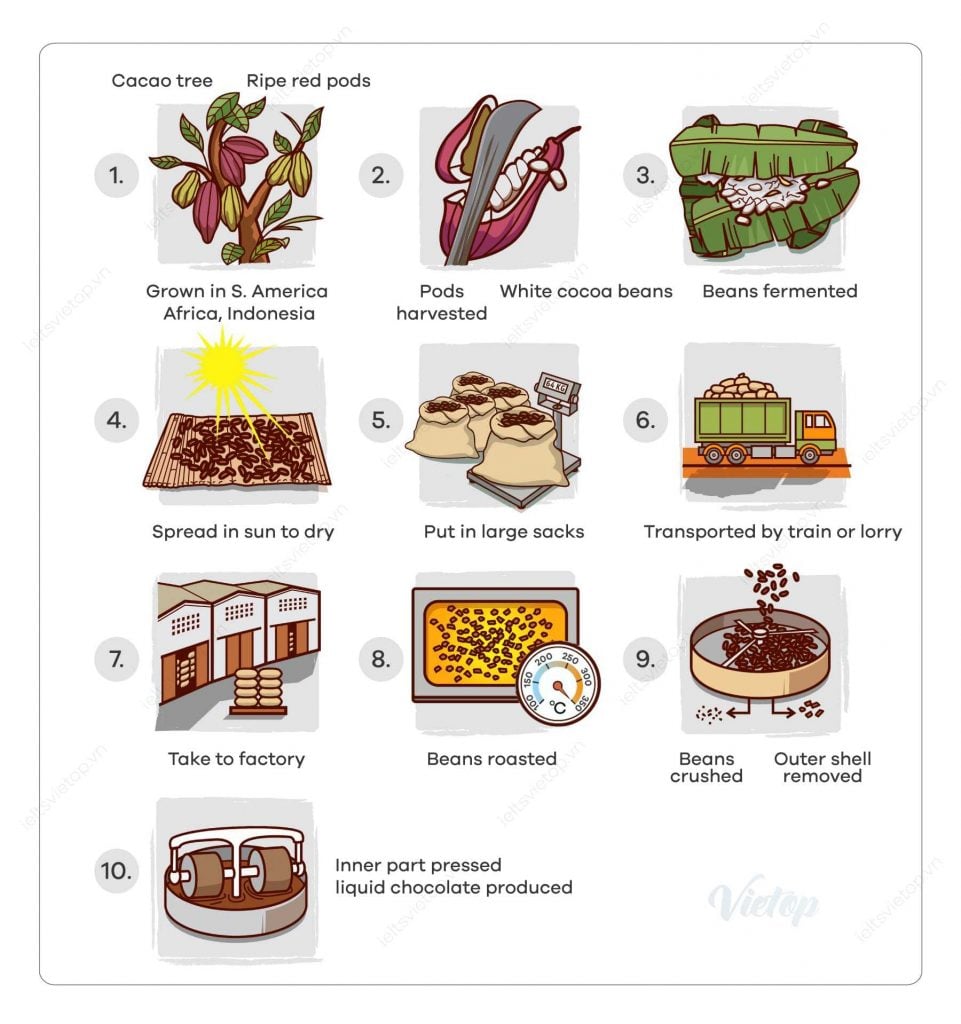
The process diagram details the steps by which liquid chocolcate is produced from cocoa beans.
The process illustrated above details how cocoa beans are harvested in order to produce liquid chocolate. Looking from an overall perspective, it is readily apparent that this combination of a man-made and natural process involves 3 main stages beginning with the collection and initial treatment of the beans followed by transportation and final processing in a factory.
The cacao tree is grown in South America, Africa and Indonesia and the pods are ripe for harvest when they turn red. The pods are then split open and the white cocoa beans are fermented under leaves before being left in the sun to dry. Subsequently, they are placed in large sacks and sent by either train or truck to factories for further preparations.
In the factory, the beans are roasted at 350 °C prior to being crushed in a grinder so that the outer shell can be separated out. The final step involves taking the inner part of the bean from the last step and pressing it into liquid chocolate.
Analysis
1. The process illustrated above details how cocoa beans are harvested in order to produce liquid chocolate. 2. Looking from an overall perspective, it is readily apparent that this combination of a man-made and natural process involves 3 main stages beginning with the collection and initial treatment of the beans followed by transportation and final processing in a factory.
Paraphrase what the process shows.
Write a clear overview summarising the major trends and differences.
1. The cacao tree is grown in South America, Africa and Indonesia and the pods are ripe for harvest when they turn red. 2. The pods are then split open and the white cocoa beans are fermented under leaves before being left in the sun to dry. 3. Subsequently, they are placed in large sacks and sent by either train or truck to factories for further preparations.
Begin writing about the details of the process.
Compare as much as possible.
Finish the last steps of the process.
1. In the factory, the beans are roasted at 350 °C prior to being crushed in a grinder so that the outer shell can be separated out. 2. The final step involves taking the inner part of the bean from the last step and pressing it into liquid chocolate.
Write about the rest of the process – include everything!
Try to paraphrase some of the words from process as well.
Vocabulary
What do the words in bold below mean?Take some notes on a piece of paper to aid your memory:
The process illustrated above details how cocoa beans are harvested in order to produce liquid chocolate. Looking from an overall perspective, it is readily apparent that this combination of a man-made and natural process involves 3 main stagesbeginning with the collection and initial treatment of the beans followed by transportation and final processing in a factory.
The cacao tree is grown in South America, Africa and Indonesia and the pods are ripe for harvest when they turn red. The pods are then split open and the white cocoa beans are fermented under leaves before being leftin the sun to dry. Subsequently, they are placed in large sacks and sent by either train or truck to factories for further preparations.
In the factory, the beans are roasted at 350 °C prior to being crushed in a grinder so that the outer shell can be separated out. The final step involves taking the inner part of the bean from the last step and pressing it into liquid chocolate.
Answers
illustrated above describe in the picture
details shows
harvested picked
in order to so that
produce make
liquid chocolate chococalte in liquid form
Looking from an overall perspective, it is readily apparent that overall
combination both together
man-made done by people
natural process done by nature
involves has to do with
main stages big steps
beginning with starting with
collection putting together
initial treatment first state of dealing with them
followed by after that
final processing last stage
factory place to make the chocolate, plant
cacao tree where chocolate pods are grown
pods containers
ripe ready
harvest picked
turn become
split open cut open
fermented left to age
leaves from a tree
leftin the sun to dry allowed to become dry in the heat
The process i___________________e d__________s how cocoa beans are h__________d i_____________o p_________e l___________________e. L__________________________________________t this c_____________n of a m______________e and n_______________s i____________s 3 m_____________sb_________________h the c___________n and i__________________t of the beans f________________y transportation and f________________g in a f__________y.
The c___________e is grown in South America, Africa and Indonesia and the p___s are r___e for h_________t when they t_____n red. The pods are then s________n and the white cocoa beans are f_____________d under l________s before being l_________________________y. S______________y, they are p___________d in l________________s and s______t by either train or truck to factories for f_________________________s.
In the factory, the beans are r___________d at 350 °C p______o being c________d in a g________r so that the o_____________l can be s_______________t. The final step involves taking the inner part of the bean from the last step and p___________g it into liquid chocolate.
Listening Practice
Listen to the related topic below and practice with these activities:
This is an IELTS writing task 2 sample answer essay on the topic of minority languages from the real IELTS exam.
Please consider supporting me on Patreon.com/howtodoielts to receive my exclusive IELTS Ebooks – you can even sign up for private live lessons with me!
Dave
IELTS Essay: Minority Languages
Some feel governments should invest in preserving minority languages, while others feel this is not a good use of resources.
Discuss both views and give your own opinion.
Many are of the belief that it would be worthwhile for governments to prioritise the preservation of various minority languages. In my opinion, despite limited potential efficacy this sentiment is justifiable.
Detractors of this proposal argue that investment is unlikely to have a major impact. In order for minority groups to earn a living and enjoy the conveniences of the modern world, they require knowledge of a nation’s most widely spoken language. In fact, many indigenous peoples themselves desire to move away from their hometowns to live in large cities and join the modern workforce. For example, in the Hmong people of Southeast Asia, it is typically the older generation that seeks to communicate in their native tongue and preserve traditional ways of life. The younger generation, generally, would rather learn the most useful language and integrate with the dominant national culture. Therefore efforts by governments oppose what individuals desire and are unlikely to be successful.
Nonetheless, there is cultural value in preserving a language. A language uniquely represents and codifies the external world. Everything from the verb structures and choice of nouns to the intonation and rhythm of the language present a singular way of interacting with and deciphering the world at large. For example, in many languages there are words that are not precisely translatable and users therefore are more likely to see events and objects differently. As the world becomes increasingly globalised, I would argue that the importance of a plurality of perspectives only becomes more crucial. If such languages die out, they will likely never be resurrected and the world will be poorer for the loss.
In conclusion, regardless of the potential challenges faced in preserving minority languages, their continued existence is essential to diversity. Governments must therefore make every effort to ensure their survival.
Analysis
1. Many are of the belief that it would be worthwhile for governments to prioritise the preservation of various minority languages. 2. In my opinion, despite limited potential efficacy this sentiment is justifiable.
Paraphrase the overall essay topic.
Write a clear opinion. Read more about introductions here.
1. Detractors of this proposal argue that investment is unlikely to have a major impact. 2. In order for minority groups to earn a living and enjoy the conveniences of the modern world, they require knowledge of a nation’s most widely spoken language. 3. In fact, many indigenous peoples themselves desire to move away from their hometowns to live in large cities and join the modern workforce. 4. For example, in the Hmong people of Southeast Asia, it is typically the older generation that seeks to communicate in their native tongue and preserve traditional ways of life. 5. The younger generation, generally, would rather learn the most useful language and integrate with the dominant national culture. 6. Therefore efforts by governments oppose what individuals desire and are unlikely to be successful.
Write a topic sentence with a clear main idea at the end.
Explain your main idea.
Develop it with specific examples.
Keep developing it fully.
Stay focused on the same main idea.
Finish by adding extra detail.
1. Nonetheless, there is cultural value in preserving a language. 2. A language uniquely represents and codifies the external world. 3. Everything from the verb structures and choice of nouns to the intonation and rhythm of the language present a singular way of interacting with and deciphering the world at large. 4. For example, in many languages there are words that are not precisely translatable and users therefore are more likely to see events and objects differently. 5. As the world becomes increasingly globalised, I would argue that the importance of a plurality of perspectives only becomes more crucial. 6. If such languages die out, they will likely never be resurrected and the world will be poorer for the loss.
Write a new topic sentence with a new main idea at the end.
Explain your new main idea.
Include specific details and examples.
Continue developing it…
as fully as possible!
Conclude by relating it back to the overall topic.
1. In conclusion, regardless of the potential challenges faced in preserving minority languages, their continued existence is essential to diversity. 2. Governments must therefore make every effort to ensure their survival.
Summarise your main ideas.
Include a final thought. Read more about conclusions here.
Vocabulary
What do the words in bold below mean?Make some notes on paper to aid memory and then check below.
Many are of the belief that it would be worthwhile for governments to prioritise the preservation of various minority languages. In my opinion, despite limited potential efficacy this sentiment is justifiable.
Detractors of this proposal argue that investment is unlikely to have a major impact. In order for minority groups to earn a living and enjoy the conveniences of the modern world, they require knowledge of a nation’s most widely spoken language. In fact, many indigenous peoples themselves desire to move away from their hometowns to live in large cities and join the modern workforce. For example, in the Hmong people of Southeast Asia, it is typically the older generation that seeks to communicate in their native tongue and preserve traditional ways of life. The younger generation, generally, would rather learn the most useful language and integrate with the dominant national culture. Therefore efforts by governments oppose what individuals desire and are unlikely to be successful.
Nonetheless, there is cultural value in preserving a language. A language uniquely represents and codifies the external world. Everything from the verb structures and choice of nouns to the intonation and rhythm of the language present a singular way of interacting with and deciphering the world at large. For example, in many languages there are words that are not precisely translatable and users therefore are more likely to see events and objects differently. As the world becomes increasingly globalised, I would argue that the importance of a plurality of perspectives only becomes more crucial. If such languages die out, they will likely never be resurrected and the world will be poorer for the loss.
In conclusion, regardless of the potential challenges faced in preserving minority languages, their continued existence is essential to diversity. Governments must therefore make every effort to ensure their survival.
Answers
of the belief believe
worthwhile important
prioritise place more importance on
preservation keep alive
various different types
minority languages less widely spoken languages
despite regardless of
limited potential efficacy no much actual effect
sentiment feeling
justifiable reasonable
detractors critics
proposal suggestion
investment money, time, etc.
major impact large effect
minority small group
earn a living make money
conveniences modern luxury’s
modern world today’s world and lifestyles
require knowledge need to know about
most widely spoken language common languages
indigenous peoples groups native to a country
desire want
move away leave
hometowns where you are from
modern workforce working at companies, in cities, etc.
Hmong an ethnic minority from Asia
typically usually
seeks tries to
native tongue native language
traditional ways of life old modes of living
integrate join in
dominant national culture main culture of a country
efforts trying
oppose go against
desire want to
successful works out
nonetheless regardless
cultural value important for the culture
uniquely represents new ways of showing
codifies makes into a symbol, language
external world outside world, reality
verb structures how verbs are used
intonation the tone of your voice
rhythm the musical quality of a language
present a singular way show a unique method
interacting with communicating with
deciphering figuring out
at large in general
not precisely translatable can’t be put in another language
users people who speak a language
increasingly globalised more and more similar
plurality of perspectives different ways of seeing the world
I recommend getting a pencil and piece of paper because that aids memory. Then write down the missing vocabulary from my sample answer in your notebook:
Many are o_______________f that it would be w___________e for governments to p__________e the p_______________n of v__________s m___________________s. In my opinion, d______________________________y this s___________t is j_____________e.
D____________s of this p____________l argue that i____________t is unlikely to have a m________________t. In order for m__________y groups to e____________g and enjoy the c_____________s of the m____________d, they r_________________e of a nation’s m____________________________e. In fact, many i_____________________s themselves d________e to m_____________y from their h____________s to live in large cities and join the m________________e. For example, in the H______g people of Southeast Asia, it is t__________y the older generation that s________s to communicate in their n_______________e and preserve t______________________e. The younger generation, generally, would rather learn the most useful language and i____________e with the d_________________________e. Therefore e________s by governments o________e what individuals d_________e and are unlikely to be s____________l.
N_____________s, there is c________________e in preserving a language. A language u__________________s and c__________s the e______________d. Everything from the v_______________s and choice of nouns to the i____________n and r________m of the language p______________________y of i__________________h and d________________g the world a__________e. For example, in many languages there are words that are n___________________________e and u_________s therefore are more likely to see events and objects differently. As the world becomes i_________________________d, I would argue that the importance of a p___________________________s only becomes more c__________l. If such languages d_________t, they will likely never be r_________________d and the world will be p____________________s.
In conclusion, r_________________f the p_________________________d in preserving minority languages, their c________________________e is essential to d_____________y. Governments must therefore m____________________t to e_______________e their s_______________l.
Listening Practice
Learn more about this topic in the video below and practice with these activities:
This is an IELTS writing task 1 letter from the real general training exam on the topic of writing to your boss about an application letter at work.
Please consider supporting my efforts to creative high quality IELTS materials for students around the world by signing up for my Patreon (and don’t miss any of my exclusive IELTS Ebooks)!
Dave
IELTS Essay: Application Letter
You are interested in applying for a new position at your company but have some questions. Write a letter to you boss. In your letter include:
Which position you are considering
What questions you have about it
How your boss can help you decide whether or not to apply
Dear John,
I am writing to inform you of my desire to apply for the position of assistant to the regional manager and ask your advice as to my suitability for this role. The job opening was advertised in a recent company-wide memo and would involve working for Ted Johnson, who holds your equivalent position in the Lynn district.
I have several questions. Firstly, will you be willing to recommend me for this position if I choose to apply? Secondly, what are the primary role requirements for such an assistant? Finally, would it be possible to keep my current job if my application is unsuccessful?
I would also like to ask for your thoughts before submitting a final application. I’ve been working directly under you for 3 years so you can best assess my abilities. You could greatly help me by being direct and honest as to my potential and whether or not I am pursuing a viable career path.
Thank you for taking the time.
Best Regards,
David
Analysis
1. Dear John,
2. I am writing to inform you of my desire to apply for the position of assistant to the regional manager and ask your advice as to my suitability for this role. 3. The job opening was advertised in a recent company-wide memo and would involve working for Ted Johnson, who holds your equivalent position in the Lynn district.
Address the letter to someone.
Include your purpose for writing.
Add in some more detail if you want.
1. I have several questions. 2. Firstly, will you be willing to recommend me for this position if I choose to apply? 3. Secondly, what are the primary role requirements for such an assistant? 4. Finally, would it be possible to keep my current job if my application is unsuccessful?
Begin to develop the second point.
Add more detail to it.
Keep developing it.
Put in as much as possible for a higher task achievement score.
1. I would also like to ask for your thoughts before submitting a final application. 2. I’ve been working directly under you for 3 years so you can best assess my abilities. 3. You could greatly help me by being direct and honest as to my potential and whether or not I am pursuing a viable career path.
4. Thank you for taking the time.
5. Best Regards,
6. David
Develop the last point.
Keep developing it.
Finish developing it.
Add a final thought at the end of the letter.
Use a phrase like regards or sincerely.
Write your name (or a fake one) at the end.
Vocabulary
What do the words in bold below mean?Take notes on a piece of paper to aid memory retention.
Dear John,
I am writing to inform you of my desire to apply for the position of assistant to the regional manager and ask your advice as to my suitability for this role. The job opening was advertised in a recent company-wide memo and would involve working for Ted Johnson, who holds your equivalent position in the Lynn district.
I have several questions. Firstly, will you be willing to recommend me for this position if I choose to apply? Secondly, what are the primary role requirements for such an assistant? Finally, would it be possible tokeep my current job if my application is unsuccessful?
I would also like to ask for your thoughts before submitting a final application. I’ve been working directly under you for 3 years so you can best assess my abilities. You could greatly help me by being direct and honest as to my potential and whether or not I am pursuing a viable career path.
Thank you for taking the time.
Best Regards,
David
Answers
I am writing to inform you my purpose for the letter is
desire want
apply put in an application
position job
assistant to the regional manager working under a boss in charge of a large area
advice suggestion
suitability how well you would fit in
role job
job opening new position available
advertised opened up
recent company-wide memo message sent to the whole company
would involve is likely to entail
holds has
equivalent position same job
district area
several a bunch
willing able to do it
recommend give support
primary role requirements main job duties
would it be possible tokeep could I potentially remain
current now
application noun for apply
unsuccessful doesn’t work out
thoughts ideas
submitting putting in
directly under working right below
assess form an opinion on
abilities capacities
greatly help be of much assistance
direct frank
honest truthful
potential possible
pursuing trying for
viable career path good way forward
thank you for taking the time thanks for listening
I_______________________u of my d________e to a_______y for the p_________n of a_______________________________r and ask your a________e as to my s____________y for this r______e. The j______________g was a____________d in a r________________________o and w______________e working for Ted Johnson, who h______s your e_____________________n in the Lynn d________t.
I have s__________l questions. Firstly, will you be w________g to r______________d me for this position if I choose to apply? Secondly, what are the p__________________________s for such an assistant? Finally, w_______________________________p my c__________t job if my a____________n is u_______________l?
I would also like to ask for your t____________s before s____________g a final application. I’ve been working d_______________r you for 3 years so you can best a_________s my a___________s. You could g_____________p me by being d_______t and h_________t as to my p_____________l and whether or not I am p___________g a v_________________h.
T_______________________________e.
B______________s,
David
Listening Practice
Learn more about this topic in the video below and practice with these activities:
"The highest quality materials anywhere on the internet! Dave improved my writing and vocabulary so much. Really affordable options you don't want to miss out on!"