This is an IELTS writing task 2 sample answer essay on the topic of laws to limit working hours from the real IELTS exam.
Please consider supporting me on Patreon.com/howtodoielts to receive my exclusive IELTS Ebooks! If you want a one-on-one private lesson with me for speaking or writing – you can also sign up there on Patreon!
Dave
IELTS Essay: Customer Needs
Some countries have introduced laws to limit working hours for employees.
Why are these laws introduced?
Do you think they are a positive or negative development?
An increasing number of nations have enacted laws to protect average working hours. In my opinion, these laws are meant to limit exploitive practices and they are advantageous if enforced well.
Lawmakers typically argue these reforms defend employees. Before labor laws existed, it was common for corporations to require long working days under extreme conditions. Modern stipulations that limit working hours are responding to these deeply-rooted historic concerns. For example, in many developing nations, the labor laws are often not strict, leading to so-called ‘sweatshops’ where employees work long hours in dangerous environments for little pay. This mistreatment has been exposed in the media and now citizens demand better treatment. The laws therefore establish basic guidelines to prevent employees from working excessive hours.
On the whole, these laws are positive as long as they are nuanced and enforced consistently. There are many countries where such laws have been passed but in practice they are not followed and workers have little recourse to report infractions. These laws must be strictly monitored including preventing employers from firing employees who make complaints. Moreover, there are possible exceptions. A factory worker, for example, should never be required to work too many hours as they are likely earning a low wage and putting their health at risk. However, many white collar workers, such as those at a start-up, may desire to work 90+ hour workweeks due to an overriding passion for a project. The law must discriminate between these dissimilar cases.
In conclusion, labor laws related to maximum working hours are meant to safeguard workers’ rights and are positive generally depending on their execution. It is important that governments propose laws they believe are enforceable and beneficial for the whole of society.
Analysis
1. An increasing number of nations have enacted laws to protect average working hours. 2. In my opinion, these laws are meant to limit exploitive practices and they are advantageous if enforced well.
Paraphrase the overall essay topic.
Write a clear opinion. Read more about introductions here.
1. Lawmakers typically argue these reforms defend employees. 2. Before labor laws existed, it was common for corporations to require long working days under extreme conditions. 3. Modern stipulations that limit working hours are responding to these deeply-rooted historic concerns. 4. For example, in many developing nations, the labor laws are often not strict, leading to so-called ‘sweatshops’ where employees work long hours in dangerous environments for little pay. 5. This mistreatment has been exposed in the media and now citizens demand better treatment. 6. The laws therefore establish basic guidelines to prevent employees from working excessive hours.
Write a topic sentence with a clear main idea at the end.
Explain your main idea.
Develop it with specific examples.
Keep developing it fully.
Stay focused on the same main idea.
Finish by adding extra detail.
1. On the whole, these laws are positive as long as they are nuanced and enforced consistently. 2. There are many countries where such laws have been passed but in practice they are not followed and workers have little recourse to report infractions. 3. These laws must be strictly monitored including preventing employers from firing employees who make complaints. 4. Moreover, there are possible exceptions. 5. A factory worker, for example, should never be required to work too many hours as they are likely earning a low wage and putting their health at risk. 6. However, many white collar workers, such as those at a start-up, may desire to work 90+ hour workweeks due to an overriding passion for a project. 7. The law must discriminate between these dissimilar cases.
Write a new topic sentence with a new main idea at the end.
Explain your new main idea.
Include specific details and examples.
Continue developing it…
as fully as possible!
For this one, you might include some of the positive and negative.
Finish with a strong statement.
1. In conclusion, labor laws related to maximum working hours are meant to safeguard workers’ rights and are positive generally depending on their execution. 2. It is important that governments propose laws they believe are enforceable and beneficial for the whole of society.
Summarise your main ideas.
Include a final thought. Read more about conclusions here.
Vocabulary
What do the words in bold below mean?Make some notes on paper to aid memory and then check below.
An increasing number of nations have enacted laws to protect average working hours. In my opinion, these laws are meant to limit exploitivepractices and they are advantageous if enforced well.
Lawmakers typically argue these reforms defend employees. Before labor laws existed, it was common for corporations to require long working days under extreme conditions. Modern stipulations that limit working hours are responding to these deeply-rootedhistoric concerns. For example, in many developing nations, the labor laws are often not strict, leading to so-called ‘sweatshops’ where employees work long hours in dangerous environments for little pay. This mistreatment has been exposed in the media and now citizens demand better treatment. The laws therefore establish basic guidelines to prevent employees from working excessive hours.
On the whole, these laws are positive as long as they are nuanced and enforced consistently. There are many countries where such laws have been passed but in practice they are not followed and workers have little recourse to report infractions. These laws must be strictly monitored including preventing employers from firing employees who make complaints. Moreover, there are possible exceptions. A factory worker, for example, should never be required to work too many hours as they are likely earning a low wage and putting their health at risk. However, many white collar workers, such as those at a start-up, may desire to work 90+ hour workweeksdue to an overriding passion for a project. The law must discriminate between these dissimilar cases.
In conclusion, labor laws related to maximum working hours are meant to safeguard workers’ rights and are positive generally depending on their execution. It is important that governments propose laws they believe are enforceable and beneficial for the whole of society.
Answers
increasing growing
enacted laws pass regulations
protect average safeguard normal
meant supposed to be for
limit exploitivepractices keep under control taking advantage of workers
advantageous positive
if enforced well assuming they are actively followed
lawmakers the government
reforms changes
defend safeguard
labor laws rules safeguarding workers
common prevalent
corporations companies
require need
under extreme conditions in bad working environments
modern stipulations new rules
responding addressing
deeply-rootedhistoric concerns worries from a long time in the past
developing nations poorer countries
strict severe
leading causing
so-called often termed
‘sweatshops’ factories where workers are mistreated
dangerous environments unsafe workplaces
little pay not much of a salary
mistreatment treated badly
exposed made people aware of it
demand better treatment ask strongly for fairer laws
establish basic guidelines put in place minimum rules
prevent stop
excessive too strong
on the whole overall
as long as assuming that
nuanced complex
enforced consistently everyone follows them all the time
passed enacted
in practice in reality
recourse way to complain
report infractions make complaints about breaking the rules
strictly monitored watched closely
preventing stopping
firing getting laid off
make complaints report a problem
possible exceptions potential cases outside the norm
factory worker person working in a factory
earning a low wage not making much money
putting their health at risk easy to get sick, hurt
I recommend getting a pencil and piece of paper because that aids memory. Then write down the missing vocabulary from my sample answer in your notebook:
An i___________g number of nations have e_____________s to p_____________e working hours. In my opinion, these laws are m_______t to l___________________s and they are a________________s i_________________l.
L______________s typically argue these r_________s d________d employees. Before l____________s existed, it was c_________n for c_____________s to r__________e long working days u__________________________s. M_____________________s that limit working hours are r___________g to these d___________________________________s. For example, in many d_______________________s, the labor laws are often not s_______t, l_________g to s___________d ‘s_____________s’ where employees work long hours in d_____________________________s for l_________y. This m______________t has been e_________d in the media and now citizens d_______________________t. The laws therefore e_____________________s to p_________t employees from working e_____________e hours.
O_______________e, these laws are positive a__________s they are n________d and e______________________y. There are many countries where such laws have been p________d but i__________e they are not followed and workers have little r__________e to r___________________s. These laws must be s_____________________d including p___________g employers from f_______g employees who m__________________s. Moreover, there are p______________________s. A f__________________r, for example, should never be required to work too many hours as they are likely e______________________e and p_____________________________k. However, many w____________________s, such as those at a s_________p, may desire to work 9________________________sd________o an o____________________n for a project. The law must d_______________________n these d________________s.
In conclusion, labor laws related to m___________m working hours are meant to s____________d workers’ rights and are positive generally d______________n their e_________________n. It is important that governments p_____________s they believe are e_________________e and b______________l for t______________________y.
Listening Practice
Learn more about this topic in the video below and practice with these activities:
This is an IELTS writing task 1 letter from the real general training exam on the topic of writing a letter to complain a problem with the public transport.
Please consider supporting my efforts to creative high quality IELTS materials for students around the world by signing up for my Patreon (and don’t miss any of my exclusive IELTS Ebooks)!
Dave
IELTS Essay: New Job/City
You use public transport and have been facing issues. Write a letter to the public transport authorities. In your letter include:
Why public transport is important to you
What problem you face
Suggest what can be done to improve public transport
To whom it may concern,
I am writing because there is a problem with the local city bus near my home. I live on Mulberry Avenue near to the train station and must take the bus each morning to get to the downtown where I work as a paralegal at the courthouse. I also take the bus back in the evening if my work is finished early.
The issue in question concerns the deteriorating sanitary conditions of the bus. Public buses have a reputation for uncleanliness but in recent months I have noticed several of the seats emit a foul odor and the windows are building up a thin layer of grime. The smell is noticeable and it is becoming difficult to even see out of the windows.
I suggest that you do an overhaul of the buses on this route. You could begin by removing the seats that are obviously no longer suitable for paying commuters. It would also make sense to regularly clean the windows. These changes should be implemented immediately or I will be forced to lodge an official complaint.
Thank you for your time,
Dana
Analysis
1. To whom it may concern,
2. I am writing because there is a problem with the local city bus near my home. 3. I live on Mulberry Avenue near to the train station and must take the bus each morning to get to the downtown where I work as a paralegal at the courthouse. 4. I also take the bus back in the evening if my work is finished early.
Address the letter to someone.
Include your purpose for writing.
Add in some more detail if you want.
Keep adding detail for a higher task achievement score.
1. The issue in question concerns the deteriorating sanitary conditions of the bus. 2. Public buses have a reputation for uncleanliness but in recent months I have noticed several of the seats emit a foul odor and the windows are building up a thin layer of grime. 3. The smell is noticeable and it is becoming difficult to even see out of the windows.
Begin to develop the second point.
Add more detail to it.
Keep developing it.
1. I suggest that you do an overhaul of the buses on this route. 2. You could begin by removing the seats that are obviously no longer suitable for paying commuters. 3. It would also make sense to regularly clean the windows. 4. These changes should be implemented immediately or I will be forced to lodge an official complaint.
5. Thank you for your time,
6. Dana
Develop the last point.
Keep developing it.
Finish developing it.
Add a final thought at the end of the letter.
Use a phrase like regards or sincerely.
Write your name (or a fake one) at the end.
Vocabulary
What do the words in bold below mean?
To whom it may concern,
I am writing because there is a problem with the local city bus near my home. I live on Mulberry Avenue near to the train station and must take the bus each morning to get to the downtown where I work as a paralegal at the courthouse. I also take the bus back in the evening if my work is finished early.
The issue in questionconcerns the deteriorating sanitary conditions of the bus. Public buses have a reputation for uncleanliness but in recent months I have noticed several of the seats emit a foul odor and the windows are building up a thin layer of grime. The smell is noticeable and it is becoming difficult to even see out of the windows.
I suggest that you do an overhaul of the buses on this route. You could begin by removing the seats that are obviously no longer suitable for paying commuters. It would also make sense to regularly clean the windows. These changes should be implemented immediately or I will be forced to lodge an official complaint.
Thank you for your time,
Dana
Answers
to whom it may concern dear someone
local city bus bus that is near your home
take the bus get on a bus
get to the downtown go to the city centre
paralegal assistant to a lawyer
courthouse where judges and lawyers work
evening night time
issue in question problem relevant here
concerns has to do with
deteriorating getting worse
sanitary conditions how clean it is
reputation how something is regarded
uncleanliness dirty
in recent months last several months
noticed happened to see/smell
emit sent out
foul odor bad smell
building up getting stronger/dirtier
thin layer of grime small amount of dirt
noticeable can be seen
see out of the windows look out the windows
suggest advise
overhaul check over and fix
route way the bus goes
removing taking away
obviously clearly
no longer suitable not usable anymore
paying commuters people who pay to ride
make sense logical
regularly normally
implemented immediately put in place now
forced made to do it
lodge an official complaint make a formal complaint
I am writing because there is a problem with the l_______________s near my home. I live on Mulberry Avenue near to the train station and must t_____________s each morning to g__________________n where I work as a p___________l at the c____________e. I also take the bus back in the e________g if my work is finished early.
The i____________________nc__________s the d______________g s_________________________s of the bus. Public buses have a r____________n for u______________s but i_________________s I have n_________d several of the seats e_____t a f_________r and the windows are b_____________p a t__________________e. The smell is n____________e and it is becoming difficult to even s___________________s.
I s___________t that you do an o__________l of the buses on this r_______e. You could begin by r_____________g the seats that are o__________y n____________________e for p__________________s. It would also m_____________e to r____________y clean the windows. These changes should be i_____________________y or I will be f_________d to l________________________t.
T_____________________e,
Dana
Listening Practice
Learn more about this topic in the video below and practice with these activities:
This is an IELTS writing task 1 sample answer essay on the topic of a bar chart showing museum admissions in London from the real IELTS exam.
Please consider supporting my efforts to creative high quality IELTS materials for students around the world by signing up for my Patreon (and so you won’t miss out on any of my exclusive IELTS Ebooks)!
Dave
IELTS Essay Task 1: Museums
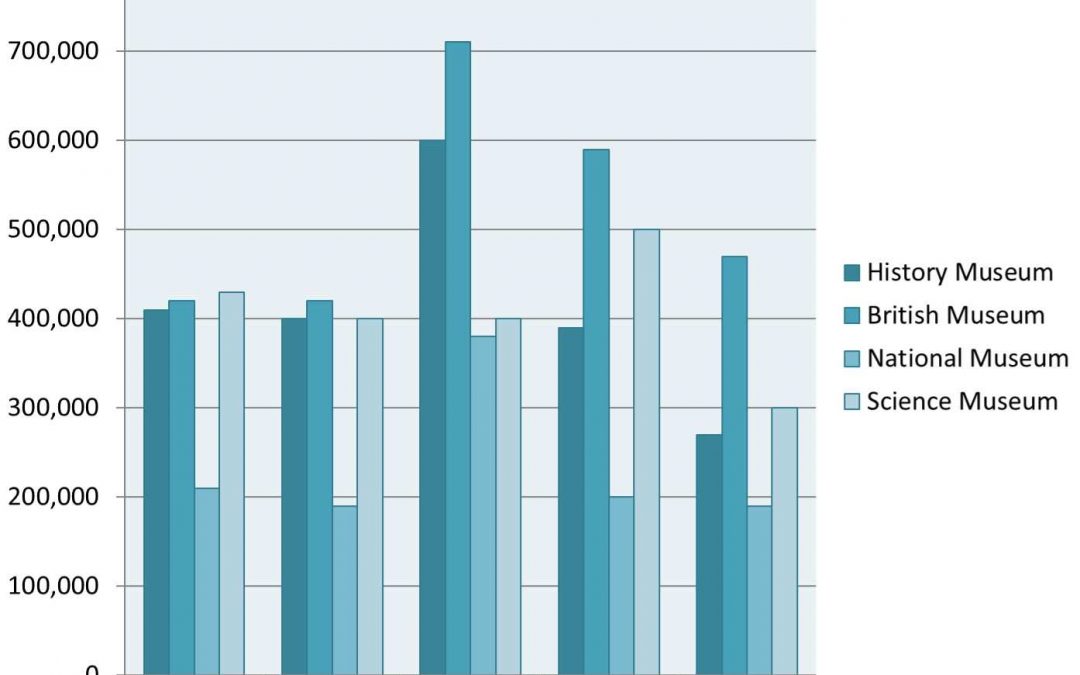
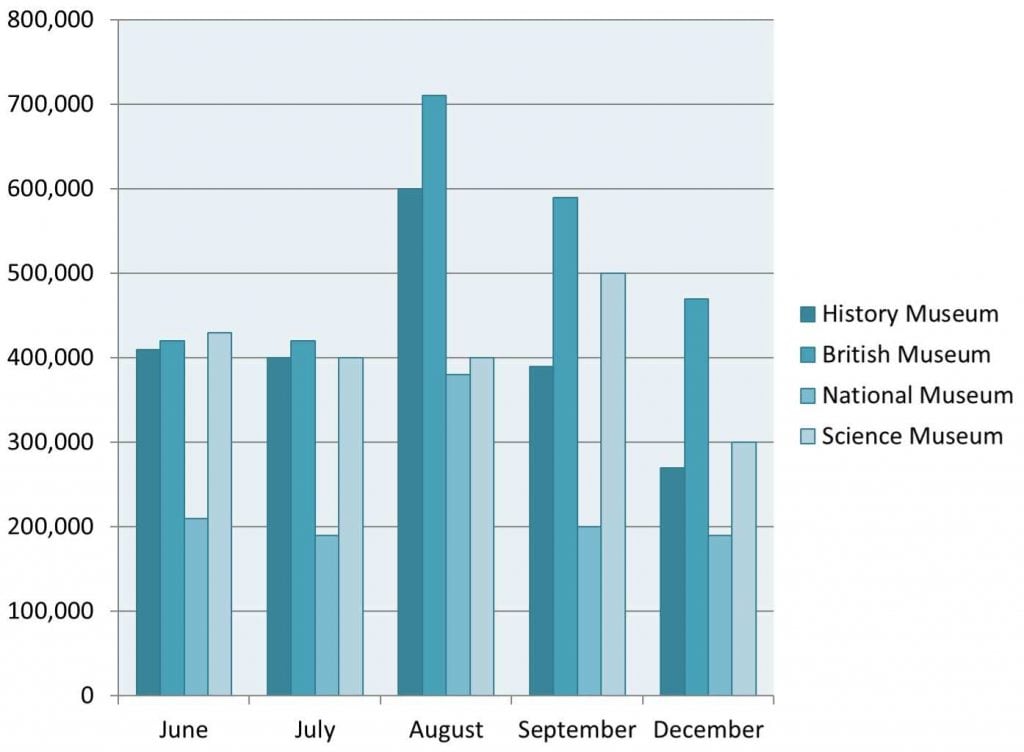
The bar chart shows the number of visitors to four London museums.
ielts essay task 1 museums
The bar chart compares attendance figures for museums in London over a period from June to December. Looking from an overall perspective, it is readily apparent that only the British Museum grew in popularity, while the others saw steep or moderate declines. In terms of overall figures, the British Museum was highest and the National Museum lowest throughout.
In June, the History Museum (410,000), the British Museum (420,000) and the Science Museum (430,000) had similar figures with the National Museum the outlier at just 210,000 visitors. Through July, numbers for all museums declined gradually, with the exception of the British Museum which was stable. August saw a shift in the pattern as the History and British Museum soared to 600,000 and 710,000, respectively. The Science Museum was unchanged but National Museum admissions doubled to 380,000.
By September, figures had fallen back to 390,000 and 590,000 for the History and British Museum, in turn, while the Science Museum rose to 500,000 visitors and the National Museum dipped to 200,000. At the end of the period, the History Museum continued to fall (270,000) along with the British Museum (470,000), National Museum (190,000), and the Science Museum (300,000).
Analysis
1. The bar chart compares attendance figures for museums in London over a period from June to December. 2. Looking from an overall perspective, it is readily apparent that only the British Museum grew in popularity, while the others saw steep or moderate declines. 3. In terms of overall figures, the British Museum was highest and the National Museum lowest throughout.
Paraphrase what the graph shows.
Write a clear overview summarising the major trends and differences.
Add an extra sentence to be sure that you have covered everything.
1. In June, the History Museum (410,000), the British Museum (420,000) and the Science Museum (430,000) had similar figures with the National Museum the outlier at just 210,000 visitors. 2. Through July, numbers for all museums declined gradually, with the exception of the British Museum which was stable. 3. August saw a shift in the pattern as the History and British Museum soared to 600,000 and 710,000, respectively. 4. The Science Museum was unchanged but National Museum admissions doubled to 380,000.
Begin writing about the differences.
Compare as much as possible.
Move on to the next category to describe.
Try to include all the data you can.
1. By September, figures had fallen back to 390,000 and 590,000 for the History and British Museum, in turn, while the Science Museum rose to 500,000 visitors and the National Museum dipped to 200,000. 2. At the end of the period, the History Museum continued to fall (270,000) along with the British Museum (470,000), National Museum (190,000), and the Science Museum (300,000).
Write about the rest of the information.
Make sure you have detailed all the information.
Vocabulary
What do the words in bold below mean?Take some notes on a piece of paper to aid your memory:
The bar chart compares attendance figures for museums in London over a period from June to December. Looking from an overall perspective, it is readily apparent that only the British Museum grew in popularity, while the others saw steep or moderate declines. In terms of overall figures, the British Museum was highest and the National Museum lowest throughout.
In June, the History Museum (410,000), the British Museum (420,000) and the Science Museum (430,000) had similar figures with the National Museum the outlier at just 210,000 visitors. Through July, numbers for all museums declined gradually, with the exception of the British Museum which was stable. August saw a shift in the pattern as the History and British Museum soared to 600,000 and 710,000, respectively. The Science Museum was unchanged but National Museum admissions doubled to 380,000.
By September, figures had fallen back to 390,000 and 590,000 for the History and British Museum, in turn, while the Science Museum rose to 500,000 visitors and the National Museum dipped to 200,000. At the end of the period, the History Museum continued to fall (270,000) along with the British Museum (470,000), National Museum (190,000), and the Science Museum (300,000).
Answers
compares shows differences between
attendance figures number of people going there
period time
looking from an overall perspective, it is readily apparent that overall
grew in popularity more people went there
steep fast, large
moderate a little
in terms of when it comes to
highest biggest
lowest throughout smallest the whole time
similar figures numbers about the same
outlier exception
through to the end of
declined gradually went down slowly
exception different from the norm
stable unchanged
shift change
pattern trend
soared rose a lot
respectively in turn
unchanged stable
doubled increased 2x
fallen back decreased after increasing before
dipped fell
at the end of the period by the end of the time surveyed
The bar chart c___________s a_______________s for museums in London over a period from June to December. L__________________________________t only the British Museum g____________________y, while the others saw s______p or m___________e declines. I_________f overall figures, the British Museum was h_______t and the National Museum l_________________t.
In June, the History Museum (410,000), the British Museum (420,000) and the Science Museum (430,000) had s_______________s with the National Museum the o__________r at just 210,000 visitors. T_________h July, numbers for all museums d________________y, with the e__________n of the British Museum which was s_______e. August saw a s______t in the p_________n as the History and British Museum s_________d to 600,000 and 710,000, r____________y. The Science Museum was u__________d but National Museum admissions d_______d to 380,000.
By September, figures had f_____________k to 390,000 and 590,000 for the History and British Museum, in turn, while the Science Museum rose to 500,000 visitors and the National Museum d_________d to 200,000. A___________________________d, the History Museum c__________________l (270,000) along with the British Museum (470,000), National Museum (190,000), and the Science Museum (300,000).
Listening Practice
Listen to the related topic below and practice with these activities:
This is an IELTS writing task 2 sample answer essay on the topic of whether or not consumers today really need advertising from the real IELTS exam.
I wrote about this same topic a year ago so this time I decided to have the opposite opinion. That’s a really good exercise to practice – try writing an essay about an old topic but have a new opinion about it!
If a product is good and meets customer needs, then people will buy it and advertising is unnecessary.
To what extent do you agree or disagree?
Some are of the belief that advertising is largely superfluous as most consumers are aware of their own needs. In my opinion, this is true despite the fact that advertising can occasionally serve informative purposes.
The stated aim of the majority of advertisements is to raise awareness among a potential audience. This applies to commercials, billboards, and online advertising. A good example would be the short commercials that play before videos on YouTube. These ads are designed to showcase an item or service that, based on advanced audience targeting, would appeal to a particular consumer or demographic. Since an individual has been targeted, it is likely that the advertisement will be relevant and, if the ad is well-designed, informative. For instance, this might be an advertisement for a smartphone targeted at a photography enthusiast that includes details about hardware specifications and picture quality.
However, the internet now allows individuals to research products more objectively on a case by case basis. When a particular person is interested in purchasing a new phone, because they lost an old one or they desire a more modern one, then they can compare prices online, read customer reviews, and consult a variety of blogs and sites like Consumer Report, which is well known for its unbiased appraisals. There are, admittedly, situations when individuals will uncover new products they might not have been aware of before through ads. However, this is more likely to occur organically in daily life if a person sees someone else, for example, with a useful smart watch. The advent of social media and sharing of personal information online also means that individuals have another media outlet aside from advertising that promotes new products and services.
In conclusion, advertising is no longer needed in modern society as there are other ways to research and discover products. This does not imply that advertising is ineffective, merely that in a perfect world it could be eliminated.
Analysis
1. Some are of the belief that advertising is largely superfluous as most consumers are aware of their own needs. 2. In my opinion, this is true despite the fact that advertising can occasionally serve informative purposes.
Paraphrase the overall essay topic.
Write a clear opinion. Read more about introductions here.
1. The stated aim of the majority of advertisements is to raise awareness among a potential audience. 2. This applies to commercials, billboards, and online advertising. 3. A good example would be the short commercials that play before videos on YouTube. 4. These ads are designed to showcase an item or service that, based on advanced audience targeting, would appeal to a particular consumer or demographic. 5. Since an individual has been targeted, it is likely that the advertisement will be relevant and, if the ad is well-designed, informative. 6. For instance, this might be an advertisement for a smartphone targeted at a photography enthusiast that includes details about hardware specifications and picture quality.
Write a topic sentence with a clear main idea at the end.
Explain your main idea.
Develop it with specific examples.
Keep developing it fully.
Stay focused on the same main idea.
Finish by adding extra detail.
1. However, the internet now allows individuals to research products more objectively on a case by case basis. 2. When a particular person is interested in purchasing a new phone, because they lost an old one or they desire a more modern one, then they can compare prices online, read customer reviews, and consult a variety of blogs and sites like Consumer Report, which is well known for its unbiased appraisals. 3. There are, admittedly, situations when individuals will uncover new products they might not have been aware of before through ads. 4. However, this is more likely to occur organically in daily life if a person sees someone else, for example, with a useful smart watch. 5. The advent of social media and sharing of personal information online also means that individuals have another media outlet aside from advertising that promotes new products and services.
Write a new topic sentence with a new main idea at the end.
Explain your new main idea.
Include specific details and examples.
Continue developing it…
as fully as possible!
1. In conclusion, advertising is no longer needed in modern society as there are other ways to research and discover products. 2. This does not imply that advertising is ineffective, merely that in a perfect world it could be eliminated.
Summarise your main ideas.
Include a final thought. Read more about conclusions here.
Vocabulary
What do the words in bold below mean?Make some notes on paper to aid memory and then check below.
Some are of the belief that advertising is largely superfluous as most consumers are aware of their own needs. In my opinion, this is true despite the fact that advertising can occasionally serve informative purposes.
The stated aim of the majority of advertisements is to raise awareness among a potential audience. This applies to commercials, billboards, and online advertising. A good example would be the short commercials that play before videos on YouTube. These ads are designed to showcase an item or service that, based on advanced audience targeting, would appeal to a particular consumer or demographic. Since an individual has been targeted, it is likely that the advertisement will be relevant and, if the ad is well-designed, informative. For instance, this might be an advertisement for a smartphone targeted at a photography enthusiast that includes details about hardware specifications and picture quality.
However, the internet now allows individuals to research products more objectively on a case by case basis. When a particular person is interested in purchasing a new phone, because they lost an old one or they desire a more modern one, then they can compare prices online, read customer reviews, and consult a variety of blogs and sites like Consumer Report, which is well known for its unbiased appraisals. There are, admittedly, situations when individuals will uncover new products they might not have been aware of before through ads. However, this is more likely to occur organically in daily life if a person sees someone else, for example, with a useful smart watch. The advent of social media and sharing of personal information online also means that individuals have another media outletaside from advertising that promotes new products and services.
In conclusion, advertising is no longer needed in modern society as there are other ways to research and discover products. This does not imply that advertising is ineffective, merely that in a perfect world it could be eliminated.
Answers
largely superfluous mostly not needed
aware know about
needs desires
despite the fact regardless of the truth that
occasionally serve informative purposes sometimes can be useful
stated aim real purpose
raise awareness make people know about
potential audience possible customers
applies is relevant here
billboards big posters outside
short commercials short videos advertising products
designed sculpted
showcase showing off
service delivery services, food delivery, etc.
based on advanced audience targeting comes from online user habits, search history, etc.
particular consumer a given shopper
demographic group of people
it is likely that it will probably happen that
relevant related
well-designed made well
informative gives information
photography enthusiast person who loves taking photos
includes details has info about
hardware specifications how fast the phone is
picture quality how good the pictures are
research studies
objectively without bias
case by case basis in each situation
compare prices online look at similar prices
customer reviews what people reported about it
consult look into
blogs websites with personal articles
unbiased appraisals objective reviews
admittedly I would concede
uncover find
occur organically happen without being forced
useful smart watch watch that has many purposes
advent beginning of
sharing of personal information online posting to social media
I recommend getting a pencil and piece of paper because that aids memory. Then write down the missing vocabulary from my sample answer in your notebook:
Some are of the belief that advertising is l__________________s as most consumers are a_______e of their own n_______s. In my opinion, this is true d_________________t that advertising can o______________________________________s.
The s_____________m of the majority of advertisements is to r____________________s among a p________________e. This a_______s to commercials, b___________s, and online advertising. A good example would be the s_____________________s that play before videos on YouTube. These ads are d__________d to s_____________e an item or s__________e that, b_______________________________g, would appeal to a p_____________________r or d______________c. Since an individual has been targeted, i_______________t the advertisement will be r____________t and, if the ad is w______________d, i_______________e. For instance, this might be an advertisement for a smartphone targeted at a p____________________t that i________________s about h____________________s and p______________y.
However, the internet now allows individuals to r__________h products more o_____________y on a c__________________s. When a particular person is interested in purchasing a new phone, because they lost an old one or they desire a more modern one, then they can c_____________________e, read c_________________s, and c_________t a variety of b_____s and sites like Consumer Report, which is well known for its u___________________s. There are, a______________y, situations when individuals will u_________r new products they might not have been aware of before through ads. However, this is more likely to o_________________y in daily life if a person sees someone else, for example, with a u__________________h. The a_________t of social media and s___________________________e also means that individuals have another m_____________ta__________m advertising that p___________s new products and services.
In conclusion, advertising is no longer needed in m___________y as there are other ways to research and discover products. This does not i_______y that advertising is i_________e, m_______y that i________________d it could be e_____________d.
Listening Practice
Learn more about this topic in the video below and practice with these activities:
This is an IELTS writing task 1 sample answer essay on the topic of distances travelled in the UK for 5 different kinds of transport from the real IELTS exam.
Please consider supporting my efforts to creative high quality IELTS materials for students around the world by signing up for my Patreon (and so you won’t miss out on any of my exclusive IELTS Ebooks)!
Dave
IELTS Essay Task 1: Distances Travelled Bar Chart
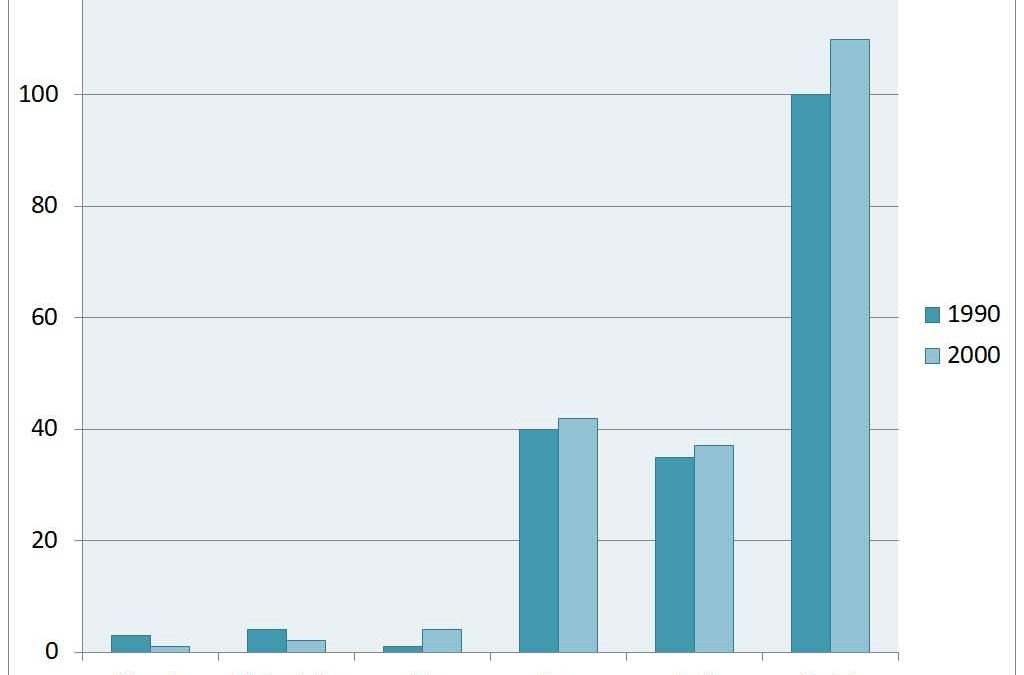
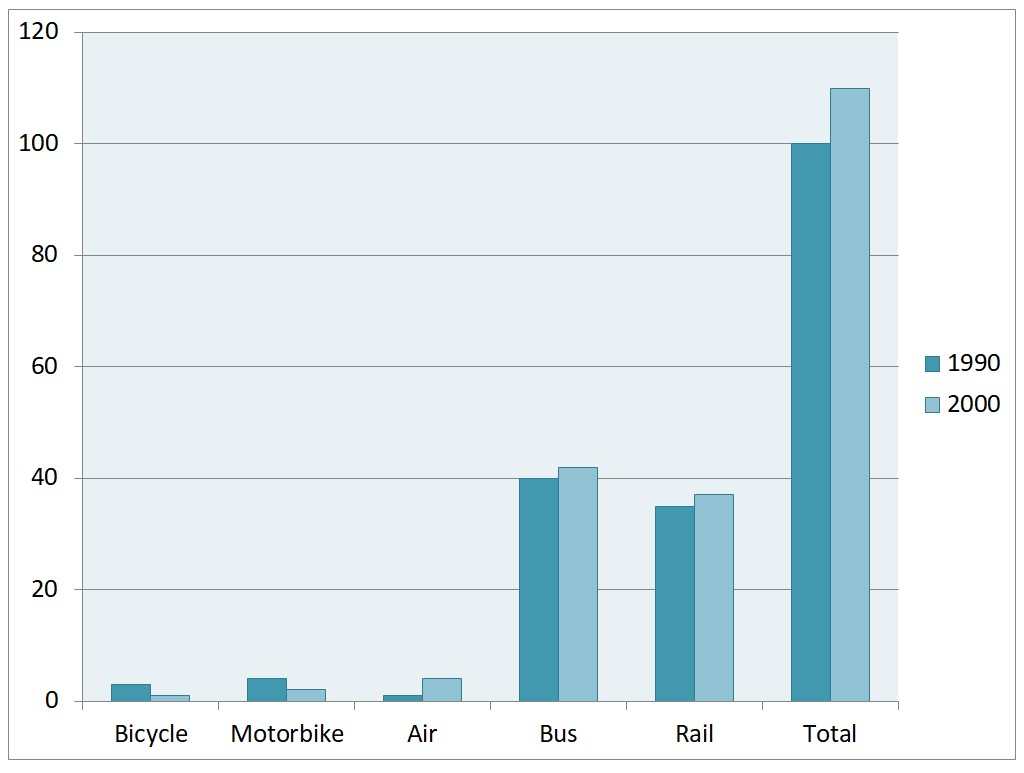
The chart illustrates distances traveled per person per week (in kilometers) in terms of 5 types of transport in the UK between 1990 and 2000.
The bar chart details the changes in travel habits by mode of transport in 1990 and 2000 in the UK. Looking from an overall perspective, it is readily apparent that the rise in total figures over the period was a result of increases from rail, bus and air as bicycle and motorbike usage fell. The most common forms of travel were by far bus and rail.
Looking first of all at the two leaders, busing accounted for precisely 40 kilometres in 1990, before a small increase to 42 by 2000. Rail was lower in both periods at 36 and 38 km, respectively.
The less used modes of transport were all below 5 km a week. Bicycles started at 2 and fell to 1 km while motorbikes halved from 4 to 2 km. Finally, air in 1990 was just above 1 but had quadrupled to 4 km per month per person by 2000.
Overall totals constituted 100 km in 1990 and a subsequent 110 by the end of the period surveyed.
Analysis
1. The bar chart details the changes in travel habits by mode of transport in 1990 and 2000 in the UK. 2. Looking from an overall perspective, it is readily apparent that the rise in total figures over the period was a result of increases from rail, bus and air as bicycle and motorbike usage fell. 3. The most common forms of travel were by far bus and rail.
Paraphrase what the graph shows.
Write a clear overview summarising the major trends and differences.
Add an extra sentence to be sure that you have covered everything.
1. Looking first of all at the two leaders, busing accounted for precisely 40 kilometres in 1990, before a small increase to 42 by 2000. 2. Rail was lower in both periods at 36 and 38 km, respectively.
Begin writing about the differences.
Compare as much as possible.
1. The less used modes of transport were all below 5 km a week. 2. Bicycles started at 2 and fell to 1 km while motorbikes halved from 4 to 2 km. 3. Finally, air in 1990 was just above 1 but had quadrupled to 4 km per month per person by 2000.
Write about the rest of the information.
Make sure you have detailed all the information.
Don’t leave anything out!
1. Overall totals constituted 100 km in 1990 and a subsequent 110 by the end of the period surveyed.
The total is also important to mention.
Vocabulary
What do the words in bold below mean?Take some notes on a piece of paper to aid your memory:
The bar chart details the changes in travel habits by mode of transport in 1990 and 2000 in the UK. Looking from an overall perspective, it is readily apparent that the rise in total figures over the period was a result of increases from rail, bus and air as bicycle and motorbike usage fell. The most common forms of travel were by far bus and rail.
Looking first of all at the two leaders, busing accounted for precisely 40 kilometres in 1990, before a small increase to 42 by 2000. Rail was lower in both periods at 36 and 38 km, respectively.
The less used modes of transport were all below 5 km a week. Bicycles started at 2 and fell to 1 km while motorbikes halved from 4 to 2 km. Finally, air in 1990 was just above 1 but had quadrupled to 4 km per month per person by 2000.
Overall totalsconstituted 100 km in 1990 and a subsequent 110 by the end of the period surveyed.
Answers
details describes
travel habits the way people get around
transport bikes, cars, etc.
Looking from an overall perspective, it is readily apparent that overall
rise increase
total figures overall numbers
a result of comes from
rail railroads/trains
air flights/airplanes
usage fell amount they were used declined
common forms well known ways
by far by a lot
looking first of all at considering to begin
accounted constituted
precisely exactly
before prior to
lower under
periods times
respectively in turn
less used modes of transport not as common ways of getting around
below under
started began
halved cut in half
per month per person each month for each person
overall totals final numbers
constituted made up
subsequent after that
by the end of the period surveyed at the end of the time recorded
The bar chart d________s the changes in t______________s by mode of t__________t in 1990 and 2000 in the UK. L____________________________________________t the r___e in t______________s over the period was a____________f increases from r_____l, bus and a___r as bicycle and motorbike u__________l. The most c______________s of travel were b_____r bus and rail.
L____________________t the two leaders, busing a____________d for p__________y 40 kilometres in 1990, b________e a small increase to 42 by 2000. Rail was l_____r in both p______s at 36 and 38 km, r_____________y.
The l_________________________t were all b______w 5 km a week. Bicycles s___________d at 2 and fell to 1 km while motorbikes h________d from 4 to 2 km. Finally, air in 1990 was just above 1 but had quadrupled to 4 km p_______________________n by 2000.
O______________sc____________d 100 km in 1990 and a s____________t 110 b____________________________d.
Listening Practice
Listen to the related topic below and practice with these activities:
"The highest quality materials anywhere on the internet! Dave improved my writing and vocabulary so much. Really affordable options you don't want to miss out on!"