This is an IELTS writing task 2 sample answer essay on the topic of the benefits and disadvantages of competition in university from the real IELTS exam.
Competition for university study is becoming increasingly strong.
Why are universities becoming more competitive?
Is this a positive or negative development?
In recent decades, there has been a rise in competitive admission rates for universities. In my opinion, this is largely due to improving income equality and is a positive trend on the whole.
The main cause of this phenomenon is a growth in the global middle class. In developed countries, education levels have been rising steadily since the beginning of the 20th century with diminishing returns as countries reach 90% and above. Therefore, the most significant increases now come from the developing world. In particular, Asian and Middle Eastern nations such as Vietnam, Malaysia, and the UAE have seen dramatic growth in per capita income, enabling families to send their children to university domestically or abroad. Coupled with increased tax revenue this allows governments to fund state schools and offer scholarships and grants to less privileged segments of the population. Larger applicant pools from around the world are concomitant with increased competition.
Despite the risk that less affluent families will be left behind, fiercer competition is an overwhelming positive. When a large number of applicants compete for limited number of spots, this motivates each individual to excel. For example, a student applying to Harvard University in the 1950s was competing against a limited number of other applications and could likely rely on wealth and social status to gain acceptance. Nowadays, the acceptance rate is below 5% as students from all over the world strive for a place at Harvard. This means students must work harder to differentiate themselves by taking on more meaningful extracurriculars, receiving higher grades, and writing more insightful college essays. All this hard work in the aggregate translates to personal growth even if they must settle for a lesser university.
In conclusion, rising incomes globally are responsible for increased competitiveness for university education and this clearly benefits both individuals and society. However, it is also important that governments and families mitigate the potentially negative effects of competition.
Analysis
1. In recent decades, there has been a rise in competitive admission rates for universities. 2. In my opinion, this is largely due to improving income equality and is a positive trend on the whole.
Paraphrase the overall essay topic.
Write a clear opinion. Read more about introductions here.
1. The main cause of this phenomenon is a growth in the global middle class. 2. In developed countries, education levels have been rising steadily since the beginning of the 20th century with diminishing returns as countries reach 90% and above. 3. Therefore, the most significant increases now come from the developing world. 4. In particular, Asian and Middle Eastern nations such as Vietnam, Malaysia, and the UAE have seen dramatic growth in per capita income, enabling families to send their children to university domestically or abroad. 5. Coupled with increased tax revenue this allows governments to fund state schools and offer scholarships and grants to less privileged segments of the population. 6. Larger applicant pools from around the world are concomitant with increased competition.
Write a topic sentence with a clear main idea at the end.
Explain your main idea.
Develop it with specific examples.
Keep developing it fully.
Stay focused on the same main idea.
Finish by linking it back to the main idea.
1. Despite the risk that less affluent families will be left behind, fiercer competition is an overwhelming positive. 2. When a large number of applicants compete for limited number of spots, this motivates each individual to excel. 3. For example, a student applying to Harvard University in the 1950s was competing against a limited number of other applications and could likely rely on wealth and social status to gain acceptance. 4. Nowadays, the acceptance rate is below 5% as students from all over the world strive for a place at Harvard. 5. This means students must work harder to differentiate themselves by taking on more meaningful extracurriculars, receiving higher grades, and writing more insightful college essays. 6. All this hard work in the aggregate translates to personal growth even if they must settle for a lesser university.
Write a new topic sentence with a new main idea at the end.
Explain your new main idea.
Include specific details and examples.
Continue developing it…
as fully as possible!
Any extra statement of the result will help.
1. In conclusion, rising incomes globally are responsible for increased competitiveness for university education and this clearly benefits both individuals and society. 2. However, it is also important that governments and families mitigate the potentially negative effects of competition.
Summarise your main ideas.
Include a final thought. Read more about conclusions here.
Vocabulary
What do the words in bold below mean?Make some notes on paper to aid memory and then check below.
In recent decades, there has been a rise in competitive admission rates for universities. In my opinion, this is largely due toimproving income equality and is a positive trendon the whole.
The main cause of this phenomenon is a growth in the global middle class. In developed countries, education levels have been rising steadily since the beginning of the 20th century with diminishing returns as countries reach 90% and above. Therefore, the most significant increases now come from the developing world. In particular, Asian and Middle Eastern nations such as Vietnam, Malaysia, and the UAE have seen dramatic growth in per capita income, enabling families to send their children to university domestically or abroad. Coupled with increased tax revenue this allows governments to fund state schools and offer scholarships and grants to less privileged segments of the population. Larger applicant pools from around the world are concomitant with increased competition.
Despite the risk that less affluent families will be left behind, fiercer competition is an overwhelming positive. When a large number of applicants compete for limited number of spots, this motivates each individual to excel. For example, a student applying to Harvard University in the 1950s was competing against a limited number of other applications and could likely rely onwealth and social status to gain acceptance. Nowadays, the acceptance rate is below 5% as students from all over the world strive for a place at Harvard. This means students must work harder to differentiate themselves by taking on more meaningful extracurriculars, receiving higher grades, and writing more insightful college essays. All this hard work in the aggregatetranslates to personal growtheven if they must settle for a lesser university.
In conclusion, rising incomes globally are responsible for increased competitiveness for university education and this clearly benefits both individuals and society. However, it is also important that governments and families mitigate the potentially negative effects of competition.
Answers
recent decades the last 20 or 30 years
rise growth
competitive admission rates harder to get into
largely due to mostly because of
improving income equality people earning more money
positive trendon the whole good overall
phenomenon trend
growth increase
global middle class people around the world earning decent salaries
developed countries rich nations
education levels how much schooling someone has
steadily at regular intervals
20th century 1900-2000
diminishing returns the rates of growth slow
reach 90% and above between 90 and 100%
significant meaningful
developing world poorer parts of the world
seen dramatic growth undergone a lot of positive change
per capita income the amount earned per person
enabling allowing for
domestically in one’s country
abroad in other countries
coupled with combined with
tax revenue money people pay the government
fund state schools give money to government schools
scholarships money for academic excellence
grants money the government gives students that they don’t have to pay back
less privileged segments of the population poorer people
larger applicant pools more total people applying
are concomitant with happen at the same time as a result
despite regardless of
risk threat
less affluent families poorer families
left behind neglected
fiercer more intense
applicants people who apply
motivates encourages
excel do really well
limited contained
applications what you send to apply
rely on depend on
wealth money
social status standing in society
gain acceptance get into
acceptance rate number of people admitted
differentiate separate yourself
taking on join
meaningful extracurriculars good activities outside school
I recommend getting a pencil and piece of paper because that aids memory. Then write down the missing vocabulary from my sample answer in your notebook:
In r_________________s, there has been a r___e in c__________________________s for universities. In my opinion, this is l_________y d_______oi__________________________y and is a p_______________________________e.
The main cause of this p________________n is a g________h in the g_______________________s. In d_________________s, e_________________s have been rising s__________y since the beginning of the 2____________y with d______________________s as countries r_____________________e. Therefore, the most s______________t increases now come from the d________________d. In particular, Asian and Middle Eastern nations such as Vietnam, Malaysia, and the UAE have s___________________h in p_______________e, e__________g families to send their children to university d_______________y or a_______d. C________________h increased t__________e this allows governments to f__________________s and offer s_______________s and g_______s to l_________________________________________n. L_________________s from around the world a_______________________h increased competition.
D_________e the r___k that l____________________s will be l___________d, f____________r competition is an overwhelming positive. When a large number of a____________s compete for limited number of spots, this m__________s each individual to e_______l. For example, a student applying to Harvard University in the 1950s was competing against a l_______d number of other a____________s and could likely r________nw______h and s____________s to g___________________e. Nowadays, the a________________e is below 5% as students from all over the world s_______e for a place at Harvard. This means students must work harder to d_____________e themselves by t_________n more m_____________________s, receiving higher grades, and writing more i____________l college essays. All this hard work i_____________________et____________o p_______________he_________f they must s_______e for a l_____________y.
In conclusion, rising incomes globally are r___________________r increased competitiveness for university education and this c______________________s both individuals and society. However, it is also important that governments and families m__________e the p________________________s of competition.
Listening Practice
Learn more about this topic in the video below and practice with these activities:
This is an IELTS writing task 1 letter from the real general training exam on the topic of writing a letter to a friend after moving to a new job and city.
Please consider supporting my efforts to creative high quality IELTS materials for students around the world by signing up for my Patreon (and don’t miss any of my exclusive IELTS Ebooks)!
Dave
IELTS Essay: New Job/City
Write a letter to a friend who worked at your previous company. You have moved to a new job in a new city.
describe your city
describe your job
describe the arrangements for him to visit you
Hey Kim,
I just finished the big move and I wanted to let you know how it all went. So far San Fran has been an upgrade on L.A.. Might be just the honeymoon period but the public transport and layout of the streets here make a big difference. Beyond that, SF is everything you’ve heard – nice community feel, very gentrified, lots of hills, haha.
My new work hasn’t been as great off the jump. I started at my new design company this last week and I’m having trouble with my new boss. The other co-workers are cool but my immediate manager won’t give me the time of day. Maybe because I’m new or I did something to get on her bad side. I hope it’ll pass because my first assignments have been boring and basic – not what I was looking for when I applied here.
Anyway, really looking forward to seeing you on the weekend! Give me a ring when your flight gets in and I can either pick you up at the airport or I’ll leave a spare key with my neighbor (Apartment 7.05) and tell him to be on the lookout for you. There’s a guest bedroom so you can sleep there.
See you soon!
Regards,
Dave
Analysis
1. Hi Kim,
2. I just finished the big move and I wanted to let you know how it all went. 3. So far San Fran has been an upgrade on L.A.. 4. Might be just the honeymoon period but the public transport and layout of the streets here make a big difference. 5. Beyond that, SF is everything you’ve heard – nice community feel, very gentrified, lots of hills, haha.
Address the letter to someone.
Include your purpose for writing.
Add in some more detail if you want.
Keep adding detail for a higher task achievement score.
The more the better!
1. My new work hasn’t been as great off the jump. 2. I started at my new design company this last week and I’m having trouble with my new boss. 3. The other co-workers are cool but my immediate manager won’t give me the time of day. 4. Maybe because I’m new or I did something to get on her bad side. 5. I hope it’ll pass because my first assignments have been boring and basic – not what I was looking for when I applied here.
Begin to develop the second point.
Add more detail to it.
Keep developing it.
Remember that the letter should be informal.
And the more detail, the higher your task achievement score.
1. Anyway, really looking forward to seeing you on the weekend! 2. Give me a ring when your flight gets in and I can either pick you up at the airport or I’ll leave a spare key with my neighbor (Apartment 7.05) and tell him to be on the lookout for you. 3. There’s a guest bedroom so you can sleep there.
4. See you soon!
5. Regards,
6. Dave
Develop the last point.
Keep developing it.
Finish developing it.
Write a goodbye statement.
Use a phrase like regards or sincerely.
Write your name at the end.
Vocabulary
What do the words in bold below mean?
Hey Kim,
I just finished the big move and I wanted to let you knowhow it all went. So farSan Fran has been an upgrade on L.A.. Might be just the honeymoon period but the public transport and layout of the streets here make a big difference. Beyond that, SF is everything you’ve heard – nice community feel, very gentrified, lots of hills, haha.
My new work hasn’t been as great off the jump. I started at my new design company this last week and I’m having trouble with my new boss. The other co-workers are cool but my immediate manager won’t give me the time of day. Maybe because I’m new or I did something to get on her bad side. I hope it’ll pass because my first assignments have been boring and basic – not what I was looking for when I applied here.
Anyway, really looking forward to seeing you on the weekend! Give me a ring when your flight gets in and I can either pick you up at the airport or I’ll leave a spare key with my neighbor (Apartment 7.05) and tell him to be on the lookout for you. There’s a guest bedroom so you can sleep there.
Answers
finished ended
big move making a change
let you know inform you
how it all went the result
so far at this point
San Fran San Francisco
upgrade improve
L.A. Los Angeles
honeymoon period nice time at the beginning of a new change/relationship
public transport subways, buses, etc.
layout city plan, streets, etc.
make a big difference help a lot
beyond that in addition
everything you’ve heard what has been said
community feel friendly atmosphere
gentrified taken over by rich people
hills not flat
off the jump from the very beginning
this last week the last 7 days
trouble difficulty
immediate manager boss right about you
won’t give me the time of day ignores me
get on her bad side dislikes me for some reason
pass get over it
not what I was looking for not what I was interested in
applied related to
really looking forward to seeing you can’t wait to see you
give me a ring call
flight gets in airplane arrives
either pick you up at the airport one option is to get you after you arrive
I just f___________d the b__________e and I wanted to l_____________wh______________t. S________rS_________n has been an u__________e on L____.. Might be just the h__________________d but the p___________________t and l__________t of the streets here m__________________________e. B_____________t, SF is e_________________________d – nice c________________l, very g____________d, lots of h______s, haha.
My new work hasn’t been as great o_____________p. I started at my new design company t_______________k and I’m having t__________e with my new boss. The other co-workers are cool but my i____________________r w_____________________________y. Maybe because I’m new or I did something to g___________________e. I hope it’ll p_____s because my first assignments have been boring and basic – n___________________________r when I a___________d here.
Anyway, r_________________________________u on the weekend! G_________________g when your f_______________n and I can e___________________________t or I’ll l_____________________y with my n____________r (Apartment 7.05) and tell him to be on the l___________t for you. There’s a g_________________m so you can sleep there.
See you soon!
Regards,
Dave
Listening Practice
Learn more about this topic in the video below and practice with these activities:
This is an IELTS writing task 2 sample answer essay on the topic of whether or not governments should help people around the world or focus on their own citizens from the real IELTS exam.
Second time I’ve seen this topic in the last 2 years!
It is impossible to help all people around the world in need so governments should focus on people from their own country.
To what extent do you agree or disagree?
Many today have suggested that governments should prioritise supporting their own citizenry over offering foreign aid. I strongly agree with this statement as international interventions often do more harm than good and governments have greater control concerning domestic assistance.
Firstly, foreign aid is notoriously difficult to manage. The majority of countries helped by foreign aid either end up exploiting the charity or become overly dependent. A good example of this would be the aid sent to many African nations during times of civil turmoil. Certain corrupt governments would often leverage the aid, whether it be food supplies or financial support, to maintain their autocratic position. Even in the rare cases where aid reaches its intended targets without interference from governments or non-governmental organisations, there is a strong likelihood of establishing a dependence. Individuals generally profit more long-term from developing characteristics related to self-reliance rather than becoming subservient in a dependent relationship.
Moreover, governments are able to affect greater change over their own populace. The are many different tactics that governments can choose ranging from funding a comprehensive social welfare net to allowing individuals to keep more of their tax dollars and contribute to the economy. A standout example of this would be in China where the government has tremendous sway over both public and private entities. This ensures that their assistance is not misused and that it supports truly vulnerable segments of the population. Their oversight and knowledge of their own country translates to a more efficient allocation of resources and this applies generally to governments globally.
In conclusion, there is little support for the efficacy of foreign aid and governments can intervene most effectively in their own nations. Therefore, foreign aid should be limited to times of extreme crisis.
Analysis
1. Many today have suggested that governments should prioritise supporting their own citizenry over offering foreign aid. 2. I strongly agree with this statement as international interventions often do more harm than good and governments have greater control concerning domestic assistance.
Paraphrase the overall essay topic.
Write a clear opinion. Read more about introductions here.
1. Firstly, foreign aid is notoriously difficult to manage. 2. The majority of countries helped by foreign aid either end up exploiting the charity or become overly dependent. 3. A good example of this would be the aid sent to many African nations during times of civil turmoil. Certain corrupt governments would often leverage the aid, whether it be food supplies or financial support, to maintain their autocratic position. 4. Even in the rare cases where aid reaches its intended targets without interference from governments or non-governmental organisations, there is a strong likelihood of establishing a dependence. 5. Individuals generally profit more long-term from developing characteristics related to self-reliance rather than becoming subservient in a dependent relationship.
Write a topic sentence with a clear main idea at the end.
Explain your main idea.
Develop it with specific examples.
Keep developing it fully.
Stay focused on the same main idea.
1. Moreover, governments are able to affect greater change over their own populace. 2. The are many different tactics that governments can choose ranging from funding a comprehensive social welfare net to allowing individuals to keep more of their tax dollars and contribute to the economy. 3. A standout example of this would be in China where the government has tremendous sway over both public and private entities. 4. This ensures that their assistance is not misused and that it supports truly vulnerable segments of the population. 5. Their oversight and knowledge of their own country translates to a more efficient allocation of resources and this applies generally to governments globally.
Write a new topic sentence with a new main idea at the end.
Explain your new main idea.
Include specific details and examples.
Continue developing it…
as fully as possible!
Any extra statement of the result will help.
1. In conclusion, there is little support for the efficacy of foreign aid and governments can intervene most effectively in their own nations. 2. Therefore, foreign aid should be limited to times of extreme crisis.
Summarise your main ideas.
Include a final thought. Read more about conclusions here.
Vocabulary
What do the words in bold below mean?Make some notes on paper to aid memory and then check below.
Many today have suggested that governments should prioritise supporting their own citizenry over offering foreign aid. I strongly agree with this statement as international interventions often do more harm than good and governments have greater control concerning domestic assistance.
Firstly, foreign aid is notoriously difficult to manage. The majority of countries helped by foreign aid either end up exploiting the charity or become overly dependent. A good example of this would be the aid sent to many African nations during times of civil turmoil. Certain corrupt governments would often leverage the aid, whether it be food supplies or financial support, to maintain their autocratic position. Even in the rare cases where aid reaches its intended targets without interference from governments or non-governmental organisations, there is a strong likelihood of establishing a dependence. Individuals generally profit more long-term from developing characteristics related to self-reliance rather than becoming subservient in a dependent relationship.
Moreover, governments are able to affect greater change over their own populace. The are many different tactics that governments can choose ranging fromfunding a comprehensive social welfare net to allowing individuals to keep more of their tax dollars and contribute to the economy. A standout example of this would be in China where the government has tremendous sway over both public and private entities. This ensures that their assistance is not misused and that it supports truly vulnerable segments of the population. Their oversight and knowledge of their own country translates to a more efficient allocation of resources and this applies generally to governments globally.
In conclusion, there is little support for the efficacy of foreign aid and governments can intervene most effectively in their own nations. Therefore, foreign aid should be limited to times of extreme crisis.
Answers
suggested advised
prioritise value more
supporting helping
citizenry people in a country
over offering foreign aid instead of giving help to other countries
statement opinion
international interventions helping other countries
more harm than good hurts more than it helps
concerning relating to
domestic assistance helping within a country
notoriously famous for bad reasons
difficult to manage hard to deal with
majority most of
either one or the other
end up finally
exploiting taking advantage of
charity organisation that helps others
overly dependent moreso relying on
times of civil turmoil wars, famines, unrest, etc.
corrupt taking bribes, stealing, etc.
whether it be food supplies or financial support if it is food or money
maintain keep up
autocratic position complete control
rare cases exceptions
reaches its intended targets finding where it is meant to go
interference getting in the way
non-governmental organisations charities
likelihood strong chance
dependence reliance on
generally profit overall get more from
long-term over time
characteristics qualities
self-reliance independence
subservient lower than
dependent relationship needing someone
populace people in a country
tactics methods
ranging from including
funding giving money for
comprehensive social welfare net total support for people in need
contribute give to
public citizenry
private entities companies
truly vulnerable segments actually in need parts of the country
oversight control over
translates means
efficient allocation better spreading of money
applies has to do with
globally all over the world
little support not much help
efficacy how well it works
intervene step in, interfere
limited under control
times of extreme crisis when something really bad happens (like a natural disaster)
I recommend getting a pencil and piece of paper because that aids memory. Then write down the missing vocabulary from my sample answer in your notebook:
Many today have s______________d that governments should p___________e s___________g their own c__________y o____r o__________________________d. I strongly agree with this s_____________t as i______________________________s often do m_________________d and governments have greater control c_____________g d____________________e.
Firstly, foreign aid is n_______________y d____________________e. The m__________y of countries helped by foreign aid e_______________________g the c________y or become o_____________________t. A good example of this would be the aid sent to many African nations during t________________________l. Certain c________t governments would often leverage the aid, w__________________________________________t, to m_________n their a____________________n. Even in the r____________s where aid r________________________s without i_____________e from governments or n_________________________________s, there is a strong l____________d of establishing a d_____________e. Individuals g__________________t more l_____________m from developing c__________________s related to s_________________e rather than becoming s______________t in a d_____________________p.
Moreover, governments are able to affect greater change over their own p__________e. The are many different t___________s that governments can choose r_______________mf___________g a c___________________________________________t to allowing individuals to keep more of their tax dollars and c______________e to the economy. A s____________t example of this would be in China where the government has t________________________y over both p__________c and p________________s. This e__________s that their assistance is not m___________d and that it supports t______________________________s of the population. Their o___________t and knowledge of their own country t_____________s to a more e_____________________n of resources and this a__________s generally to governments g_________y.
In conclusion, there is l_________________t for the e__________y of foreign aid and governments can i___________e most effectively in their own nations. Therefore, foreign aid should be l___________d to t____________________s.
Listening Practice
Learn more about this topic in the video below and practice with these activities:
This is an IELTS writing task 1 sample answer essay on the topic of 3 different types of bridges.
A really odd one – never seen one quite like this on IELTS before!
Please consider supporting my efforts to creative high quality IELTS materials for students around the world by signing up for my Patreon (and so you won’t miss out on any of my exclusive IELTS Ebooks)!
Dave
IELTS Essay Task 1: Bridges
IELTS Essay: Bridges
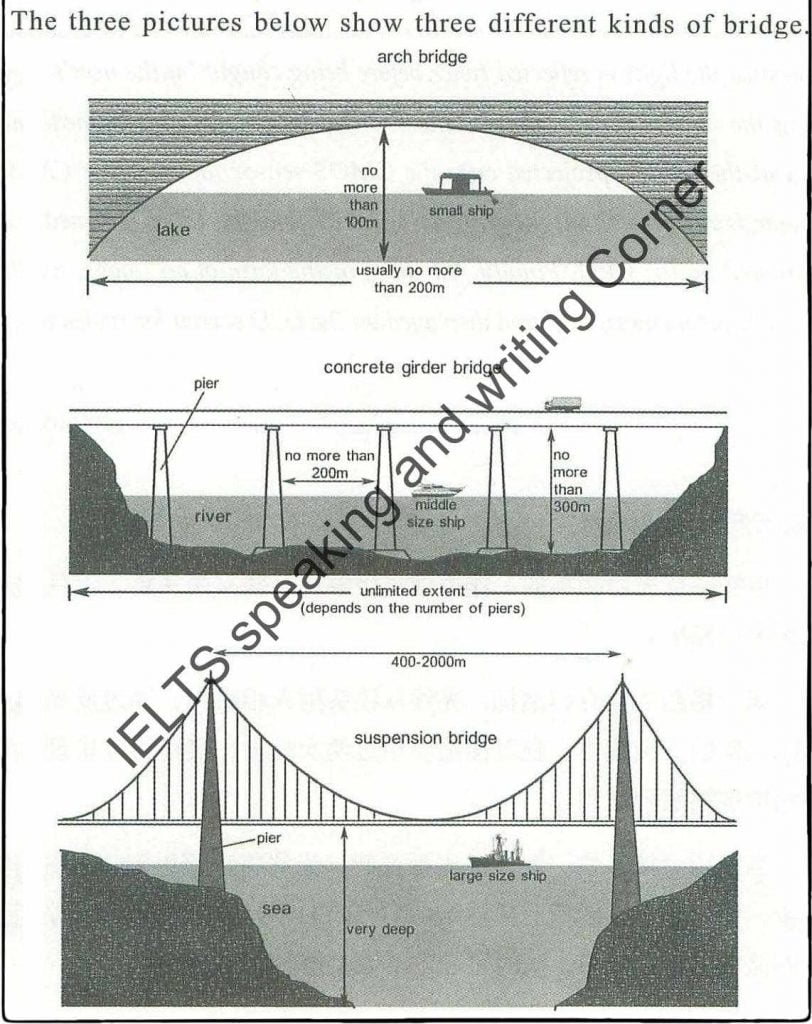
The diagram details 3 different constructions for bridges. Looking from an overall perspective, it is readily apparent that concrete girder bridges are potentially the longest and tallest, while suspension bridges allow for the largest ships to pass underneath. Arch bridges are not as tall or long and admit only the smallest ships.
Looking first of all at arch bridges, the permissible height is no more than 100 meters and the length is typically under 200m. These bridges are built over lakes, have a conical shape, and cover the smallest ships.
In contrast, concrete girder bridges can be an indeterminate length, though the maximum height is 300m. Concrete bridges are built over rivers and require a series of piers spaced under 200m apart to provide support, only allowing for the passage of medium-sized ships.
The modern suspension bridge can be between 400 and 2000m long and it is possible to build it over very deep seas as long as there is shallow land for pier structures to link at either end. The distance between piers enables the largest ships to traverse below safely.
Analysis
1. The diagram details 3 different constructions for bridges. 2. Looking from an overall perspective, it is readily apparent that concrete girder bridges are potentially the longest and tallest, while suspension bridges allow for the largest ships to pass underneath. 3. Arch bridges are not as tall or long and admit only the smallest ships.
Paraphrase what the graph shows.
Write a clear overview summarising the major trends and differences.
Add an extra sentence to be sure that you have covered everything.
1. Looking first of all at arch bridges, the permissible height is no more than 100 meters and the length is typically under 200m. 2. These bridges are built over lakes, have a conical shape, and cover the smallest ships.
Begin writing about the first bridge.
Compare as much as possible.
1. In contrast, concrete girder bridges can be an indeterminate length, though the maximum height is 300m. 2. Concrete bridges are built over rivers and require a series of piers spaced under 200m apart to provide support, only allowing for the passage of medium-sized ships.
Write about another bridge.
Make sure you have detailed all the informationabout it.
1. The modern suspension bridge can be between 400 and 2000m long and it is possible to build it over very deep seas as long as there is shallow land for pier structures to link at either end. 2. The distance between piers enables the largest ships to traverse below safely.
Write about the final bridge.
Make sure you have detailed all the information.
Vocabulary
What do the words in bold below mean?Take some notes on a piece of paper to aid your memory:
The diagram details 3 different constructions for bridges. Looking from an overall perspective, it is readily apparent thatconcrete girder bridges are potentially the longest and tallest, while suspension bridges allow for the largest ships to pass underneath. Arch bridges are not as tall or long and admit only the smallest ships.
Looking first of all at arch bridges, the permissible height is no more than 100 meters and the length is typically under 200m. These bridges are built over lakes, have a conical shape, and cover the smallest ships.
In contrast, concrete girder bridges can be an indeterminate length, though the maximum height is 300m. Concrete bridges are built over rivers and require a series of piersspaced under 200m apart to provide support, only allowing for the passage of medium-sized ships.
The modern suspension bridge can be between 400 and 2000m long and it is possible to build it over very deep seasas long as there isshallow land for pier structures to link at either end. The distance between piers enables the largest ships to traverse below safely.
Answers
details describes
constructions what has been built
Looking from an overall perspective, it is readily apparent that overall
concrete made from the substance roads and buildings are made of
potentially possible
suspension kept up
pass underneath go below
arch curved, bent
admit aloows
looking first of all at considering to begin with
permissible allowable
no more than not greater than
typically usually
conical shaped like a cone
cover allows for
in contrast however
indeterminate not exactly known
maximum fullest amount
require needs
series of piers poles to hold it up
spaced keeps the difference between
provide support holds up
allowing for making room for
passage travel
modern new
possible can happen
over very deep seas above oceans with lots of depth
The diagram d________s 3 different c_______________s for bridges. L____________________________________________tc__________e girder bridges are p___________y the longest and tallest, while s___________n bridges allow for the largest ships to p_________________h. A____h bridges are not as tall or long and a_____t only the smallest ships.
L__________________t arch bridges, the p______________e height is n______________n 100 meters and the length is t__________y under 200m. These bridges are built over lakes, have a c_______l shape, and c_______r the smallest ships.
I____________t, concrete girder bridges can be an i______________e length, though the m_________m height is 300m. Concrete bridges are built over rivers and r_________e a s________________ss_______d under 200m apart to p__________________t, only a________________r the p__________e of medium-sized ships.
The m___________n suspension bridge can be between 400 and 2000m long and it is p____________e to build it o____________________sa________________ss_________________d for pier structures to l_____k a____________d. The d__________e between piers e_________s the largest ships to t_________e below s________y.
Listening Practice
Listen to the related topic below and practice with these activities:
"The highest quality materials anywhere on the internet! Dave improved my writing and vocabulary so much. Really affordable options you don't want to miss out on!"