This is an IELTS writing task 2 sample answer essay on the topic of road safety and the minimum legal age for driving from the real IELTS exam.
I wrote about this same question when it came up on IELTS more than a year ago but I figure I would write about it again to see if my thinking has changed at all…
Some people think that the best way to increase road safety is to increase the minimum legal age for driving cars and riding motorbikes.
To what extent do you agree or disagree?
Many concerned policy makers today believe that raising the legal age for acquiring a license would improve road safety. In my opinion, though this might engender a negligible impact, there are superior solutions.
Proponents of this policy reform argue that a disproportionate number of accidents today are caused by younger people. In most countries, it is possible to apply for a learner’s permit at the age of 16 and soon after that a license. Teenagers often lack the maturity and experience required to drive responsibly and respond to challenging road conditions such as inclement weather and reckless drivers. If the legal age for driving was increased it would enable young people to spend more time learning the rules of the road and becoming more mature generally. This would presumably lead to a reduction in accidents, though there is little scientific evidence to support this particular hypothesis.
In fact, the causes of collisions are more closely correlated with other underlying problems. The chief cause of vehicular accidents globally relate to driving under the influence of alcohol. Most teenagers are not able to purchase alcohol legally and therefore the majority of accidents are caused by individuals over the legal age for drinking. This statistic is also more prominent among older individuals whose reflexes are in decline. Furthermore, altering the designs of towns and cities would have far greater tangible ramifications. Many urban environments, for example, were built long ago and more modern understandings of motorist behaviour could be beneficial. This might include emphasising subways and other public transport as opposed to motorways.
In conclusion, despite the marginal relationship between maturity and vehicular accidents, the most effective reforms would involve stricter drinking laws and better urban planning. These changes would be more likely to bring about the desired improvements.
Analysis
1. Many concerned policy makers today believe that raising the legal age for acquiring a license would improve road safety. 2. In my opinion, though this might engender a negligible impact, there are superior solutions.
Paraphrase the overall essay topic.
Write a clear opinion. Read more about introductions here.
1. Proponents of this policy reform argue that a disproportionate number of accidents today are caused by younger people. 2. In most countries, it is possible to apply for a learner’s permit at the age of 16 and soon after that a license. 3. Teenagers often lack the maturity and experience required to drive responsibly and respond to challenging road conditions such as inclement weather and reckless drivers. 4. If the legal age for driving was increased it would enable young people to spend more time learning the rules of the road and becoming more mature generally. 5. This would presumably lead to a reduction in accidents, though there is little scientific evidence to support this particular hypothesis.
Write a topic sentence with a clear main idea at the end.
Explain your main idea.
Develop it with specific examples.
Keep developing it fully.
Stay focused on the same main idea.
1. In fact, the causes of collisions are more closely correlated with other underlying problems. 2. The chief cause of vehicular accidents globally relate to driving under the influence of alcohol. 3. Most teenagers are not able to purchase alcohol legally and therefore the majority of accidents are caused by individuals over the legal age for drinking. 4. This statistic is also more prominent among older individuals whose reflexes are in decline. 5. Furthermore, altering the designs of towns and cities would have far greater tangible ramifications. 6. Many urban environments, for example, were built long ago and more modern understandings of motorist behaviour could be beneficial. 7. This might include emphasising subways and other public transport as opposed to motorways.
Write a new topic sentence with a new main idea at the end.
Explain your new main idea.
Include specific details and examples.
Continue developing it…
as fully as possible!
Any extra statement of the result will help.
The specific examples here are key.
1. In conclusion, despite the marginal relationship between maturity and vehicular accidents, the most effective reforms would involve stricter drinking laws and better urban planning. 2. These changes would be more likely to bring about the desired improvements.
Summarise your main ideas.
Include a final thought. Read more about conclusions here.
Vocabulary
What do the words in bold below mean?Make some notes on paper to aid memory and then check below.
Many concerned policy makers today believe that raising the legal age for acquiring a license would improve road safety. In my opinion, though this might engender a negligible impact, there are superior solutions.
Proponents of this policy reform argue that a disproportionate number of accidents today are caused by younger people. In most countries, it is possible to apply for a learner’s permit at the age of 16 and soon after that a license. Teenagers often lack the maturity and experience required to drive responsibly and respond to challenging road conditions such as inclement weather and reckless drivers. If the legal age for driving was increased it would enable young people to spend more time learning the rules of the road and becoming more mature generally. This would presumably lead to a reduction in accidents, though there is little scientific evidence to support this particular hypothesis.
In fact, the causes of collisions are more closely correlated with other underlying problems. The chief cause of vehicular accidents globally relate to driving under the influence of alcohol. Most teenagers are not able to purchase alcohol legally and therefore the majority of accidents are caused by individuals over the legal age for drinking. This statistic is also more prominent among older individuals whose reflexes are in decline. Furthermore, altering the designs of towns and cities would have far greater tangible ramifications. Many urban environments, for example, were built long ago and more modern understandings of motorist behaviour could be beneficial. This might include emphasising subways and other public transport as opposed tomotorways.
In conclusion, despite the marginal relationship between maturity and vehicular accidents, the most effective reforms would involve stricter drinking laws and better urban planning. These changes would be more likely to bring about the desired improvements.
Answers
concerned policy makers worried authorities
raising the legal age for acquiring a license increasing how old before you can drive
road safety how many accidents on the road
engender create
negligible impact marginal effect
superior solutions better remedies
proponents supporters
policy reform changes to the laws
disproportionate unequal
apply for a learner’s permit get a certificate to drive
license a document that allows you to drive
lack the maturity immature
required needed
drive responsibly drive carefully
respond to deal with
inclement weather bad weather, storms, etc.
reckless drivers dangerous driving
enable allow
rules of the road how you should drive
presumably you can assume
reduction decrease
little scientific evidence no support from studies
support this particular hypothesis evidence this idea
in fact actually
collisions accidents
more closely correlated directly related
underlying problems foundational issues
chief cause main source
globally around the world
under the influence of alcohol drunk
purchase alcohol legally buy drinks, beers, wine, etc.
majority most of
statistic data
prominent stands out
reflexes how you react
in decline decreasing
altering changing
far greater tangible ramifications much bigger results
I recommend getting a pencil and piece of paper because that aids memory. Then write down the missing vocabulary from my sample answer in your notebook:
Many c_________________________s today believe that r__________________________________e would improve r____________y. In my opinion, though this might e__________r a n________________t, there are s_________________s.
P_____________s of this p_____________m argue that a d__________________e number of accidents today are caused by younger people. In most countries, it is possible to a________________________t at the age of 16 and soon after that a l__________e. Teenagers often l_________________y and experience r____________d to d________________y and r____________o challenging road conditions such as i_________________r and r_________________s. If the legal age for driving was increased it would e________e young people to spend more time learning the r________________d and becoming more mature generally. This would p______________y lead to a r___________n in accidents, though there is l______________________e to s______________________________s.
I___________t, the causes of c_____________s are m____________________d with other u_______________________s. The c___________e of vehicular accidents g____________y relate to driving u___________________________l. Most teenagers are not able to p__________________________y and therefore the m___________y of accidents are caused by individuals over the legal age for drinking. This s____________c is also more p____________t among older individuals whose r____________s are i_____________e. Furthermore, a__________g the designs of towns and cities would have f___________________________s. Many u___________________s, for example, were built long ago and more m________________________s of m______________________r could be b______________l. This might include e_____________________s and other public transport a____________________om_____________s.
In conclusion, despite the m____________l relationship between maturity and vehicular accidents, the most effective reforms would involve s________________________s and b___________________g. These changes would be more likely to b_____________t the d______________________s.
Listening Practice
Learn more about this topic in the video below and practice with these activities:
Instead of requiring primary school students to do experiments themselves, schools should only alllow them to watch experiments demonstrated by teachers.
To what extent do you agree or disagree?
Some educators feel that for students to learn effectively they must do experiments themselves, rather than simple observing their teachers. In my opinion, this sentiment has its limits, but in general pupils would benefit more from such a hands-on approach.
Detractors argue that it is more efficient to watch a teacher perform an experiment in front of the class. Throughout the course of the academic year, in classes such as chemistry, biology and physics, teachers will have to cover dozens of topics and highlight numerous theorems. The teacher may perform experiments in order to illustrate concepts when applicable. If students conduct these exercises instead, it would mean less time to go over other areas and would necessitate reducing the size of the curriculum. Their learning may achieve greater depth but the breadth would be abridged.
Nonetheless, performing an experiment oneself promotes greater understanding. Take for example a chemistry class. Students are only likely to remember the end result if the teacher explains the formula for a chemical reaction, selects the ingredients themselves and then mixes and highlights the process. In contrast, if the students must identify, measure and carefully follow steps on their own, they will commit this information more deeply to memory. Their later analysis will further reinforce a more complex understanding of the forces at play in a given experiment. Recent pedagogical research supports the contention that the physicality of performing is a powerful aid to memory and the key to long-term retention.
In conclusion, though there are legitimate reasons to not apply this rule without nuance, it is important that students generally be given the opportunity to carry out experiments on their own. What students internalize will be naturally more memorable.
Analysis
1. Some educators feel that for students to learn effectively they must do experiments themselves, rather than simple observing their teachers. 2. In my opinion, this sentiment has its limits, but in general pupils would benefit more from such a hands-on approach.
Paraphrase the overall essay topic.
Write a clear opinion. Read more about introductions here.
1. Detractors argue that it is more efficient to watch a teacher perform an experiment in front of the class. 2. Throughout the course of the academic year, in classes such as chemistry, biology and physics, teachers will have to cover dozens of topics and highlight numerous theorems. 3. The teacher may perform experiments in order to illustrate concepts when applicable. 4. If students conduct these exercises instead, it would mean less time to go over other areas and would necessitate reducing the size of the curriculum. 5. Their learning may achieve greater depth but the breadth would be abridged.
Write a topic sentence with a clear main idea at the end.
Explain your main idea.
Develop it with specific examples.
Keep developing it fully.
Stay focused on the same main idea.
1. Nonetheless, performing an experiment oneself promotes greater understanding. 2. Take for example a chemistry class. 3. Students are only likely to remember the end result if the teacher explains the formula for a chemical reaction, selects the ingredients themselves and then mixes and highlights the process. 4. In contrast, if the students must identify, measure and carefully follow steps on their own, they will commit this information more deeply to memory. 5. Their later analysis will further reinforce a more complex understanding of the forces at play in a given experiment. 6. Recent pedagogical research supports the contention that the physicality of performing is a powerful aid to memory and the key to long-term retention.
Write a new topic sentence with a new main idea at the end.
Explain your new main idea.
Include specific details and examples.
Continue developing it…
as fully as possible!
Any extra statement of the result will help.
1. In conclusion, though there are legitimate reasons to not apply this rule without nuance, it is important that students generally be given the opportunity to carry out experiments on their own. 2. What students internalize will be naturally more memorable.
Summarise your main ideas.
Include a final thought. Read more about conclusions here.
Vocabulary
What do the words in bold below mean?Make some notes on paper to aid memory and then check below.
Some educators feel that for students to learn effectively they must do experiments themselves, rather than simple observing their teachers. In my opinion, this sentiment has its limits, but in general pupils would benefit more from such a hands-on approach.
Detractors argue that it is more efficient to watch a teacher perform an experiment in front of the class. Throughout the course of the academic year, in classes such as chemistry, biology and physics, teachers will have to cover dozens of topics and highlight numerous theorems. The teacher may perform experiments in order to illustrate concepts when applicable. If students conduct these exercises instead, it would mean less time to go over other areas and would necessitate reducing the size of the curriculum. Their learning may achieve greater depth but the breadth would be abridged.
Nonetheless, performing an experiment oneself promotes greater understanding. Take for example a chemistry class. Students are only likely to remember the end result if the teacher explains the formula for a chemical reaction, selects the ingredients themselves and then mixes and highlights the process. In contrast, if the students must identify, measure and carefully follow steps on their own, they will commit this information more deeply to memory. Their later analysis will further reinforce a more complex understanding of the forces at play in a given experiment. Recent pedagogical research supports the contention that the physicality of performing is a powerful aid to memory and the key to long-term retention.
In conclusion, though there are legitimate reasons to not apply this rule without nuance, it is important that students generally be given the opportunity to carry out experiments on their own. What students internalize will be naturally more memorable.
Answers
effectively essentially
experiments live classroom demonstrations/practice of a concept
observing wathing
sentiment opinion
limits extremes
in general pupils overall students
benefit get an advantage from
hands-on approach actually doing something in class
detractors critics
efficient good use of resources
perform conduct
throughout all the time
academic year the entire year at school
chemistry study of chemicals
biology study of life
physics study of laws of the universe
cover dozens of topics go over tons of areas
highlight focus on
numerous many
theorems ideas / theories
illustrate concepts show/explain how something works
applicable relevant
conduct do
go over review
necessitate reducing require cutting down on
curriculum what is learned in school
greater depth deeper understanding
breadth how wide/how many areas learned about
abridged reduced
promotes encourages
end result final product
formula the equation making up something
chemical reaction what is produced from an experiment
selects the ingredients choose what goes into it
mixes combines
highlights focuses on
process experiment
in contrast however
identify be able to name
measure keep track of the quantity
carefully follow steps methodically pay attention to the process
commit this information remember the data
more deeply more fully
later analysis thinking back on it
further reinforce add a layer of memory
complex understanding nuanced knowledge
forces at play elements being used
given provided
pedagogical related to teaching
supports the contention in favour of the opinion
physicality using the body
performing doing
powerful aid strong support
long-term retention remembering for a long time
legitimate valid
apply this rule follow this principle
nuance complexity
generally be given the opportunity overall be allowed to
I recommend getting a pencil and piece of paper because that aids memory. Then write down the missing vocabulary from my sample answer in your notebook:
Some educators feel that for students to learn e________________y they must do e__________________s themselves, rather than simple o____________g their teachers. In my opinion, this s____________t has its l_______s, but i__________l p________s would b_________t more from such a h_________________h.
D______________s argue that it is more e_____________t to watch a teacher p________m an experiment in front of the class. T______________t the course of the a_______________r, in classes such as c___________y, b________y and p__________s, teachers will have to c_____________________s and h__________t n___________s t______________s. The teacher may perform experiments in order to i_____________________s when a_____________e. If students c_________t these exercises instead, it would mean less time to g________r other areas and would n_________________g the size of the c______________m. Their learning may achieve g_______________h but the b________h would be a_________d.
Nonetheless, performing an experiment oneself p__________s greater understanding. Take for example a chemistry class. Students are only likely to remember the e________________t if the teacher explains the f___________a for a c________________n, s______________________s themselves and then m______s and h_____________s the p__________s. I____________t, if the students must i______________y, m_____________e and c_____________________s on their own, they will c_____________________________________y to memory. Their l______________s will f_________________e a more c______________________g of the f________________y in a g_______n experiment. Recent p______________l research s_______________________n that the p_____________y of p_____________g is a p________________d to memory and the key to l_____________________n.
In conclusion, though there are l______________e reasons to not a_______________e without n__________e, it is important that students g________________________________________y to c____________t experiments o________________n. What students i______________e will be n___________y more memorable.
Listening Practice
Learn more about this topic in the video below and practice with these activities:
This is an IELTS writing task 1 sample answer essay on the topic of total world production across 3 different regions.
Please consider supporting my efforts to creative high quality IELTS materials for students around the world by signing up for my Patreon (and so you won’t miss out on any of my exclusive IELTS Ebooks)!
Dave
IELTS Essay Task 1: World Production
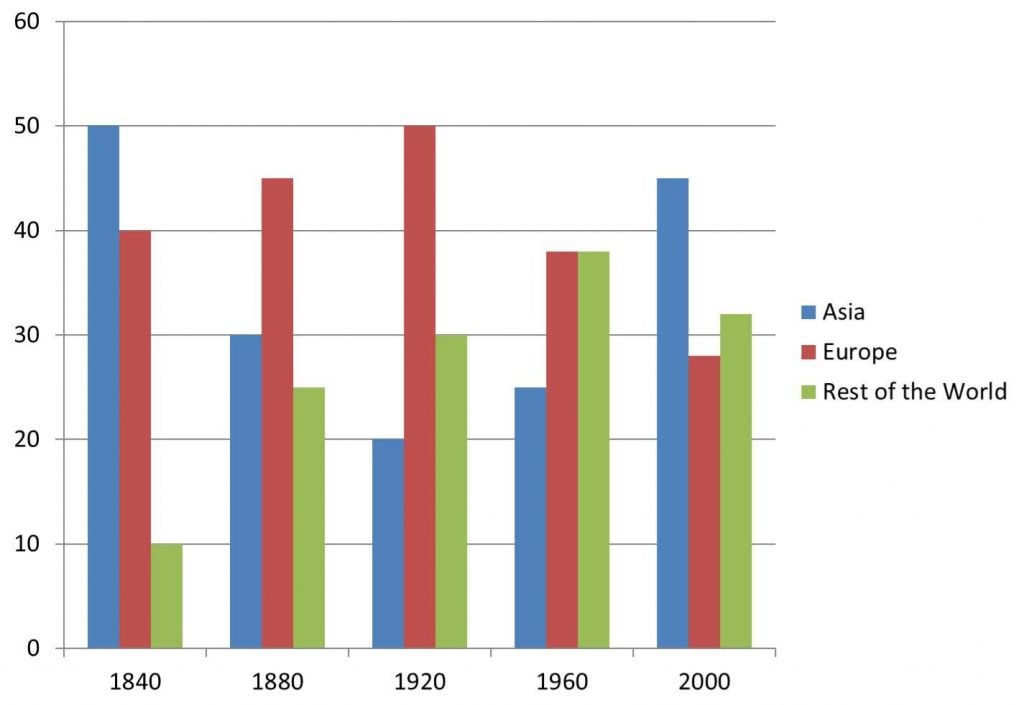
The bar graph shows the total manufacturing production in percentages Asia, Europe, and the rest of the world.
IELTS Essay: World Production
The bar chart details manufacturing production figures proportionally for Asia, Europe and the rest for the world from 1840 to 2000. Looking from an overall perspective, it is readily apparent that while Asia and Europe’s numbers are in decline overall, Asia is on the rise. The rest of the world experienced the most steady increase and by the end was second to Asia in production.
Asia began the period with the highest levels of production at 50%, with Europe slightly lower at 40% and the rest of the world constituting the final 10%. By 1880, the differences had narrowed with Asia falling to 30%, Europe at 45% and the rest of the world more than doubling to 15%. This trend continued through 1920 as Europe and the rest of the world both rose an additional 5% and Asia dropped 10% further.
After 1960 the pattern shifted as Asia begin to rise precipitously, first to 15% and then to 45%. In contrast, Europe underwent a decline to 38% in 1960 and 28% by 2000. Lastly, the rest of the world peaked in 1960 at 38% (even with Europe) before falling back slightly to 32% by the end of the period.
Analysis
1. The bar chart details manufacturing production figures proportionally for Asia, Europe and the rest for the world from 1840 to 2000. 2. Looking from an overall perspective, it is readily apparent that while Asia and Europe’s numbers are in decline overall, Asia is on the rise. 3. The rest of the world experienced the most steady increase and by the end was second to Asia in production.
Paraphrase what the graph shows.
Write a clear overview summarising the major trends and differences.
Add an extra sentence to be sure that you have covered everything.
1. Asia began the period with the highest levels of production at 50%, with Europe slightly lower at 40% and the rest of the world constituting the final 10%. 2. By 1880, the differences had narrowed with Asia falling to 30%, Europe at 45% and the rest of the world more than doubling to 15%. 3. This trend continued through 1920 as Europe and the rest of the world both rose an additional 5% and Asia dropped 10% further.
Begin writing about the differences.
Compare as much as possible.
Make sure you mention all data.
1. After 1960 the pattern shifted as Asia begin to rise precipitously, first to 15% and then to 45%. 2. In contrast, Europe underwent a decline to 38% in 1960 and 28% by 2000. 3. Lastly, the rest of the world peaked in 1960 at 38% (even with Europe) before falling back slightly to 32% by the end of the period.
Write about the rest of the information.
Make sure you have detailed all the information.
Don’t leave anything out!
Vocabulary
What do the words in bold below mean?Take some notes on a piece of paper to aid your memory:
The bar chart details manufacturing production figuresproportionally for Asia, Europe and the rest for the world from 1840 to 2000. Looking from an overall perspective, it is readily apparent that while Asia and Europe’s numbers are in decline overall, Asia is on the rise. The rest of the world experienced the most steady increase and by the end was second to Asia in production.
Asia began the period with the highest levels of production at 50%, with Europe slightly lower at 40% and the rest of the world constituting the final 10%. By 1880, the differences had narrowed with Asia falling to 30%, Europe at 45% and the rest of the world more than doubling to 15%. This trend continued through 1920 as Europe and the rest of the world both rose an additional 5% and Asia dropped 10% further.
After 1960 the pattern shifted as Asia begin to rise precipitously, first to 15% and then to 45%. In contrast, Europe underwent a decline to 38% in 1960 and 28% by 2000. Lastly, the rest of the world peaked in 1960 at 38% (even with Europe) before falling back slightly to 32% by the end of the period.
Answers
details describes
manufacturing production figures date for the amount of items produced
proportionally by percentage
looking from an overall perspective, it is readily apparent that overall
decline overall decrease in general
on the rise growing
experienced underwent
most steady increase went up at regular intervals
was second to just below
began the period with start at
slightly lower a little less
constituting making up
differences had narrowed disparities smaller
falling to declining to
more than doubling increasing at least 200%
trend pattern
rose grew
additional extra
dropped fell
further moreso
pattern shifted trend changed
precipitously quickly/a lot
underwent experienced
decline decrease
lastly finally
peaked reached a high point
even equal
falling back slightly decreasing a little
by the end of the period at the end of the time surveyed
The bar chart d______s m__________________________sp_____________y for Asia, Europe and the rest for the world from 1840 to 2000. L__________________________________________t while Asia and Europe’s numbers are in d______________l, Asia is o____________e. The rest of the world e______________d the m_________________e and by the end w____________o Asia in production.
Asia b_____________________h the highest levels of production at 50%, with Europe s_______________r at 40% and the rest of the world c____________g the final 10%. By 1880, the d__________________________d with Asia f____________o 30%, Europe at 45% and the rest of the world m__________________g to 15%. This t_______d continued through 1920 as Europe and the rest of the world both r_____e an a_____________l 5% and Asia d___________d 10% f_________r.
After 1960 the p_______________d as Asia begin to rise p______________y, first to 15% and then to 45%. In contrast, Europe u____________t a d________e to 38% in 1960 and 28% by 2000. L________y, the rest of the world p________d in 1960 at 38% (e_____n with Europe) before f__________________y to 32% b__________________________d.
Listening Practice
Listen to the related topic below and practice with these activities:
Museums and art galleries should show local history and culture instead of work from different countries.
Discuss both views and give opinion.
Some feel that museums and art galleries ought to primarily focus on showcasing local, rather than international, works. In my opinion, despite the importance of domestic pieces for national cohesion, there is greater value in international items.
Those who advocate for domestic art in national museums and exhibition halls point out the unifying effect. Students in every country are expected to learn their national history but these lessons can often feel impersonal and abstract. The chance to visit a museum and see authentic documents from the past revitalises history and can inspire patriotism. A standout example of this would be The Smithsonian in the United States, which houses key historic and cultural artifacts. Visitors from different parts of the country and disparate ethnic groups can potentially find common ground by reflecting on the struggles and achievements of their forefathers.
Regardless, the citizenry as a whole can learn more from international artworks. Most people have learned their own nation’s history well but possess limited understanding of other cultures. Going to a museum featuring items from around the world is therefore an enlightening experience. For example, The British Museum in London famously contains one of the world’s largest collections of culturally significant artifacts from around the world. By seeing and reading the plaques for a variety of artworks both young students and adults alike have the opportunity to broaden their understanding of the traditions, cultures, and events that underpin the modern world. Over time, this can lead to a more inclusive, culturally diversified society.
All in all, the patriotic positives of locally themed collections are outweighed by the educational benefits of globally sourced institutions. There must be a degree of balance but those in positions of authority should emphasise cultural diversity.
Analysis
1. Some feel that museums and art galleries ought to primarily focus on showcasing local, rather than international, works. 2. In my opinion, despite the importance of domestic pieces for national cohesion, there is greater value in international items.
Paraphrase the overall essay topic.
Write a clear opinion. Read more about introductions here.
1. Those who advocate for domestic art in national museums and exhibition halls point out the unifying effect. 2. Students in every country are expected to learn their national history but these lessons can often feel impersonal and abstract. 3. The chance to visit a museum and see authentic documents from the past revitalises history and can inspire patriotism. 4. A standout example of this would be The Smithsonian in the United States, which houses key historic and cultural artifacts. 5. Visitors from different parts of the country and disparate ethnic groups can potentially find common ground by reflecting on the struggles and achievements of their forefathers.
Write a topic sentence with a clear main idea at the end.
Explain your main idea.
Develop it with specific examples.
Keep developing it fully.
Stay focused on the same main idea.
1. Regardless, the citizenry as a whole can learn more from international artworks. 2. Most people have learned their own nation’s history well but possess limited understanding of other cultures. 3. Going to a museum featuring items from around the world is therefore an enlightening experience. 4. For example, The British Museum in London famously contains one of the world’s largest collections of culturally significant artifacts from around the world. 5. By seeing and reading the plaques for a variety of artworks both young students and adults alike have the opportunity to broaden their understanding of the traditions, cultures, and events that underpin the modern world. 6. Over time, this can lead to a more inclusive, culturally diversified society.
Write a new topic sentence with a new main idea at the end.
Explain your new main idea.
Include specific details and examples.
Continue developing it…
as fully as possible!
Any extra statement of the result will help.
1. All in all, the patriotic positives of locally themed collections are outweighed by the educational benefits of globally sourced institutions. 2. There must be a degree of balance but those in positions of authority should emphasise cultural diversity.
Summarise your main ideas.
Include a final thought. Read more about conclusions here.
Vocabulary
What do the words in bold below mean?Make some notes on paper to aid memory and then check below.
Some feel that museums and art galleries ought to primarily focus on showcasinglocal, rather than international, works. In my opinion, despite the importance of domestic pieces for national cohesion, there is greater value in international items.
Those who advocate for domestic art in national museums and exhibition hallspoint out the unifying effect. Students in every country are expected to learn their national history but these lessons can often feel impersonal and abstract. The chance to visit a museum and see authentic documents from the past revitalises history and can inspire patriotism. Astandout example of this would be The Smithsonian in the United States, which houses key historic and cultural artifacts. Visitors from different parts of the country and disparate ethnic groups can potentially find common ground by reflecting on the struggles and achievements of their forefathers.
Regardless, the citizenry as a whole can learn more from international artworks. Most people have learned their own nation’s history well but possess limited understanding of other cultures. Going to a museum featuring items from around the world is therefore an enlightening experience. For example, The British Museum in London famously contains one of the world’s largest collections of culturally significant artifacts from around the world. By seeing and reading the plaques for a variety of artworks both young students and adults alike have the opportunity to broaden their understanding of the traditions, cultures, and events that underpin the modern world. Over time, this can lead to a more inclusive, culturally diversified society.
All in all, the patriotic positives of locally themed collections are outweighed by the educational benefits of globally sourced institutions. There must be a degree of balance but those in positions of authority should emphasise cultural diversity.
Answers
primarily mainly
focus on concentrate
showcasing displaying
local from that country
international from around the world
domestic local, from your country
national cohesion uniting a country
value importance
advocate support
exhibition halls art galleries
point out argue
unifying effect how it brings people together
expected predicted
national history past of a country
impersonal no personal, removed
abstract far away, not concrete
authentic documents real items
revitalises brings life back to
inspire patriotism make you feel for your country
Astandout example of this would be a good instance is
houses contains
artifacts old items
disparate ethnic groups different demographics in society
potentially possibly
find common ground have something in common
reflecting thinking back on
struggles difficulties
achievements what you get done in life
forefathers ancestors
regardless nonetheless
citizenry people in a country
as a whole all together
possess have
limited understanding not much knowing
featuring having
enlightening experience insightful time
famously well known
culturally significant artifacts important art/historic objects
plaques information about the items
alike both
broaden widen
traditions past ways of doing things
underpin serve as the foundation for
modern world the world today
over time as time goes on
inclusive accepting and open
culturally diversified society world with lots of different cultures
all in all in conclusion
patriotic caring about your country
locally themed collections items taken from one’s own country
outweighed stronger than
globally sourced institutions items taken from around the world
I recommend getting a pencil and piece of paper because that aids memory. Then write down the missing vocabulary from my sample answer in your notebook:
Some feel that museums and art galleries ought to p___________y f__________n s_____________gl______l, rather than i_____________l, works. In my opinion, despite the importance of d_____________c pieces for n____________________n, there is greater v_____e in international items.
Those who a____________e for domestic art in national museums and e_______________sp___________t the u______________t. Students in every country are e___________d to learn their n_______________y but these lessons can often feel i___________l and a_________t. The chance to visit a museum and see a____________________s from the past r__________s history and can i__________________m. A________________________________e The Smithsonian in the United States, which h_________s key historic and cultural a_________s. Visitors from different parts of the country and d_________________________s can p_____________y f_____________________d by r_____________g on the s____________s and a________________s of their f_____________s.
R___________s, the c_____________y a____________e can learn more from international artworks. Most people have learned their own nation’s history well but p_________s l______________________g of other cultures. Going to a museum f___________g items from around the world is therefore an e__________________________e. For example, The British Museum in London f____________y contains one of the world’s largest collections of c__________________________s from around the world. By seeing and reading the p__________s for a variety of artworks both young students and adults a______e have the opportunity to b_________n their understanding of the t__________s, cultures, and events that u____________n the m_____________d. O____________e, this can lead to a more i____________e, c________________________y.
A___________l, the p_________c positives of l______________________________s are o___________d by the educational benefits of g_________________________s. There must be a____________________e but those in p_________________y should e_____________e cultural diversity.
Listening Practice
Learn more about this topic in the video below and practice with these activities:
"The highest quality materials anywhere on the internet! Dave improved my writing and vocabulary so much. Really affordable options you don't want to miss out on!"