This is an IELTS writing task 2 sample answer from the general training exam on the topic of choosing a job.
Jobs come up all the time in the general training exam!
Please consider supporting my efforts to creative high quality IELTS materials for students around the world by signing up for my Patreon (and so you won’t miss out on any of my exclusive IELTS Ebooks)!
Dave
IELTS Essay: Choosing a Job
Some people say young people should be completely free to choose their future job but others think young people must be more realistic in their choice.
Discuss both views and give your own opinion.
Many are of the view that young people should prioritise pragmatic career choices over their passions. In my opinion, youth is an opportunity to follow pursuits with a low probability of success.
Many parents in particular are heavily invested in the idea of security. This is often the case if they had a difficult upbringing or were born into times of national upheaval. For example, many parents in Vietnam who grew up immediately after the American War, are still scarred by their experiences of deprivation. As a result, it is a common refrain in Vietnam these days for young people to complain about how much control their parents have over their choice of a major or career. Most students consequently work in safe, tedious fields like finance, banking, advertising, and law. They have job security and a basic floor on their earning potential in the event of an economic downturn.
However, failing at a particular career path early in life does not foreclose future success. Most can major in a subject they love, work for several years in that field and the likely results will either be some degree of success or modest failure. If they fail, it is possible to move on in one’s twenties to study or work towards a safer, more lucrative position. This attempt is also justified by the rare instances of tremendous achievement including famous actors, directors, singers, and other artists. Therefore, choosing a career freely can be vindicated by the combination of potential fame, less transcendent but still respectable jobs, and the ability to transition to a new career before middle age.
In conclusion, the allure of security does not outweigh the myriad advantages of freely choosing a career one. Parents and students should both heed this advice or risk regretting the missed opportunity.
Analysis
1. Many are of the view that young people should prioritise pragmatic career choices over their passions. 2. In my opinion, youth is an opportunity to follow pursuits with a low probability of success.
Paraphrase the essay topic.
Write a clear opinion. Read more about introductions here.
1. Many parents in particular are heavily invested in the idea of security. 2. This is often the case if they had a difficult upbringing or were born into times of national upheaval. 3. For example, many parents in Vietnam who grew up immediately after the American War, are still scarred by their experiences of deprivation. 4. As a result, it is a common refrain in Vietnam these days for young people to complain about how much control their parents have over their choice of a major or career. 5. Most students consequently work in safe, tedious fields like finance, banking, advertising, and law. 6. They have job security and a basic floor on their earning potential in the event of an economic downturn.
Write a clear topic sentence with a main idea at the end.
Explain your main idea.
Begin a specific example.
Develop it.
Continue developing it by stating the results.
Finish developing the example.
1. However, failing at a particular career path early in life does not foreclose future success. 2. Most can major in a subject they love, work for several years in that field and the likely results will either be some degree of success or modest failure. 3. If they fail, it is possible to move on in one’s twenties to study or work towards a safer, more lucrative position. 4. This attempt is also justified by the rare instances of tremendous achievement including famous actors, directors, singers, and other artists. 5. Therefore, choosing a career freely can be vindicated by the combination of potential fame, less transcendent but still respectable jobs, and the ability to transition to a new career before middle age.
Write a new topic sentence with a new main idea at the end.
Explain your new main idea.
Develop a hypothetical example.
Keep adding specific detail.
Conclude with a strong statement.
1. In conclusion, the allure of security does not outweigh the myriad advantages of freely choosing a career one. 2. Parents and students should both heed this advice or risk regretting the missed opportunity.
Summarise your ideas and repeat your opinion.
Add a final thought. Read more about conclusions here.
Vocabulary
What do the words in bold below mean?
Many are of the view that young people should prioritise pragmatic career choicesover their passions. In my opinion, youth is an opportunity to follow pursuits with a low probability of success.
Many parents in particular are heavily invested in the idea of security. This is often the case if they had a difficult upbringing or were born into times of national upheaval. For example, many parents in Vietnam who grew up immediately after the American War, are still scarred by their experiences of deprivation. As a result, it is a common refrain in Vietnam these days for young people to complain about how much control their parents have over their choice of a major or career. Most students consequently work in safe, tedious fields like finance, banking, advertising, and law. They have job security and a basic floor on their earning potentialin the event of an economic downturn.
However, failing at a particular career path early in life does not foreclose future success. Most can major in a subject they love, work for several years in that field and the likely results will either be some degree of success or modest failure. If they fail, it is possible to move on in one’s twenties to study or work towards a safer, more lucrative position. This attempt is also justified by the rare instances of tremendous achievement including famous actors, directors, singers, and other artists. Therefore, choosing a career freely can be vindicated by the combination of potential fame, less transcendent but still respectable jobs, and the ability to transition to a new career before middle age.
In conclusion, the allure of security does not outweigh the myriad advantages of freely choosing a career one. Parents and students should both heed this advice or risk regretting the missed opportunity.
Answers
many are of the view some think
prioritise pragmatic career choices value a safe job
over above
passions what they love
opportunity chance
follow pursuits try to do
low probability not much of a chance of
in particular especially
heavily invested put a lot into
idea of security concept of safety
often the case usually
difficult upbringing bad childhood
born into were kids when
times of national upheaval bad part of a country’s history
immediately after following
scarred traumatised
experiences of deprivation times of trauma
as a result consequently
common refrain usually said
complain not happy about
control have power over
consequently as a result
safe security
tedious fields boring jobs
finance related to money
banking related to banks
advertising ads for products
law legal field
job security safe employment
basic floor minimum
earning potential how much they can make
in the event of an economic downturn if the economy crashes
failing at a particular career path early in life not succeeding early on with a job
foreclose future success prevent success later
major in study
likely results probably will happen
some degree of success to an extent going well
modest failure small failure
move on do something new
twenties 20s
work towards try to
safer more secure
lucrative position rich job
attempt try
rare instances sometimes
tremendous achievement great success
vindicated justified
combination altogether
potential fame possibly being a celebrity
less transcendent not as great
still respectable jobs good employment
transition change to/move on
middle age 40 – 55 years old
allure attraction
outweigh stronger than
myriad advantages many benefits
heed listen to
advice suggestion
risk regretting afraid they will have wished they did it
M______________________w that young people should p_________________________________so_____r their p___________s. In my opinion, youth is an o_______________y to f_________________s with a l_____________________y of success.
Many parents i_________________r are h________________d in the i_________________________y. This is o________________e if they had a d_____________________g or were b_______________________________________l. For example, many parents in Vietnam who grew up i__________________r the American War, are still s___________d by their e_________________________n. As a________t, it is a c_______________n in Vietnam these days for young people to c____________n about how much c__________l their parents have over their choice of a major or career. Most students c_______________y work in s_____e, t_________________s like f___________e, b__________g, a____________g, and l__w. They have j_____________y and a b___________r on their e______________________li___________________________________n.
However, f_____________________________________________________e does not f___________________________s. Most can m__________n a subject they love, work for several years in that field and the l_______________s will either be s________________________s or m__________________e. If they fail, it is possible to m__________n in one’s t____________s to study or w________________s a s_______r, more l____________________n. This a____________t is also justified by the r__________________s of t_________________________t including famous actors, directors, singers, and other artists. Therefore, choosing a career freely can be v______________d by the c______________n of p_______________e, l__________________________t but s________________________s, and the ability to t________________n to a new career before m_______________e.
In conclusion, the a_________e of security does not o___________h the m___________________________s of freely choosing a career one. Parents and students should both h______d this a________e or r____________________g the m____________________________y.
Listening Practice
Learn more about this topic in the video below and practice with these activities:
This is an IELTS writing task 1 sample answer essay on the topic of seniors in 3 difference countries.
It is a little tricky because the graph is in the past and future…
If you want to support my efforts to write these essays and also receive my exclusive Ebooks, check out my Patreon (where I’m currently running a discount)!
Dave
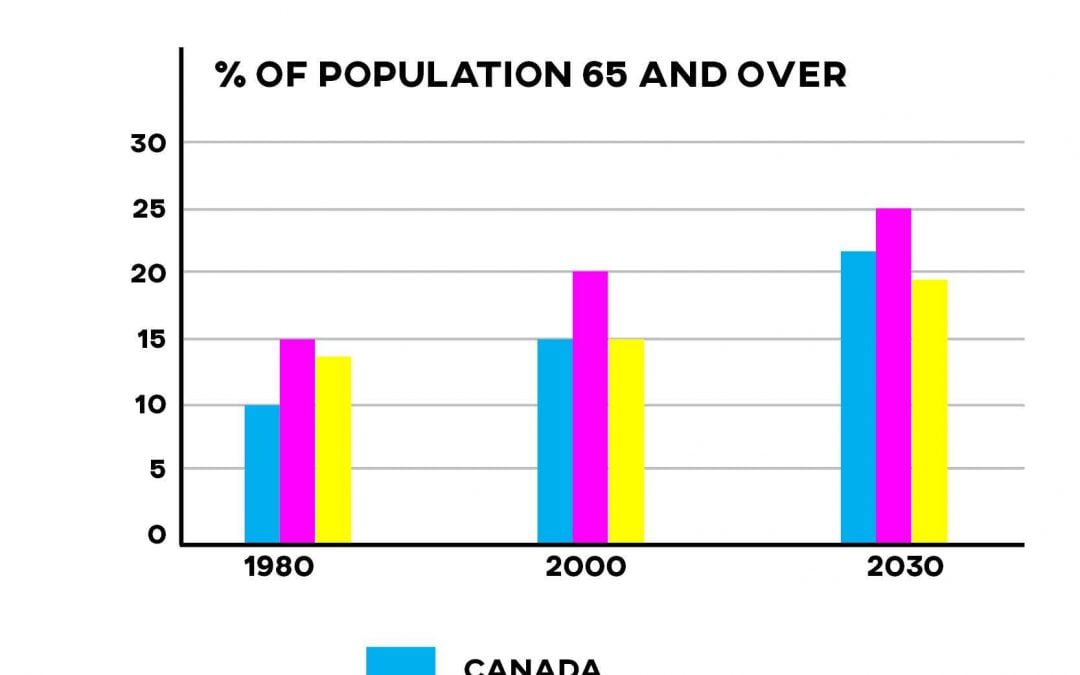
The graph details the percentages of elderly people in Canada, Germany, and the UK in the past with projections for the future. Looking from an overall perspective, it is readily apparent that Elderly populations have risen and are predicted to continue to grow steadily in all countries. Germany has and will continue to have the highest proportion, while Canada will likely overtake the UK.
In 1980, Germany had the greatest percentage of elderly at 15%, slightly above the UK and 5% higher than Canada. By 2000, percentages for Germany and Canada both surged by 5% (to 20% and 15%, respectively), compared to the UK which rose marginally to equal with Canada.
By 2030, Germany is expected to rise by another 5% to 25%, with Canada surpassing the United Kingdom and finishing at 22% and the latter’s figures lagging behind slightly at just under 20%.
Analysis
1. The graph details the percentages of elderly people in Canada, Germany, and the UK in the past with projections for the future. 2. Looking from an overall perspective, it is readily apparent that Elderly populations have risen and are predicted to continue to grow steadily in all countries. 3. Germany has and will continue to have the highest proportion, while Canada will likely overtake the UK.
Paraphrase what the graph shows.
Write a general overview covering the full trends.
Include a ranking in your overview. Read more about overviews here.
1. In 1980, Germany had the greatest percentage of elderly at 15%, slightly above the UK and 5% higher than Canada. 2. By 2000, percentages for Germany and Canada both surged by 5% (to 20% and 15%, respectively), compared to the UK, which rose marginally to equal with Canada.
Begin to describing the data.
Make sure you include all the data.
1. By 2030, Germany is expected to rise by another 5% to 25%, with Canada surpassing the United Kingdom and finishing at 22% and the latter’s figures lagging behind slightly at just under 20%.
Write about the final year and include everything.
Vocabulary
What do the words in bold below mean?
The graph details the percentages of elderly people in Canada, Germany, and the UK in the past with projections for the future. Looking from an overall perspective, it is readily apparent that Elderly populations have risen and are predicted to continue to grow steadily in all countries. Germany has and will continue to have the highest proportion, while Canada will likely overtake the UK.
In 1980, Germany had the greatest percentage of elderly at 15%, slightly above the UK and 5% higher than Canada. By 2000, percentages for Germany and Canada both surged by 5% (to 20% and 15%, respectively), compared to the UK, which rose marginally to equal with Canada.
By 2030, Germany is expectedto rise by another 5% to 25%, with Canada surpassing the United Kingdom and finishing at 22% and the latter’s figures lagging behind slightly at just under 20%.
Answers
details shows
elderly people older individuals
projections predictions
looking from an overall perspective, it is readily apparent that overall
The graph d________s the percentages of e______________e in Canada, Germany, and the UK in the past with p___________s for the future. L_________________________________________________t Elderly populations have r______n and a___________________o continue to g______________y in all countries. Germany has and will c____________o have the h____________________n, while Canada will l______________e the UK.
In 1980, Germany had the g______________________e of elderly at 15%, s____________e the UK and 5% h____________n Canada. By 2000, percentages for Germany and Canada both s_______d by 5% (to 20% and 15%, r______________y), c______________o the UK, which rose m______________y to e___________h Canada.
By 2030, Germany is e_________________e by another 5% to 25%, with Canada s_____________g the United Kingdom and f______________t 22% and the l________________s l______________________y at j_____________r 20%.
Listening Practice
Listen about this topic below and practice with these ideas:
Reading Practice
Read more and use these activities to practice your reading skills:
This is an IELTS writing task 2 sample answer essay from the real exam on the topic of outdoor activities.
If you want to support my efforts to write these essays and also receive my exclusive Ebooks, check out my Patreon (where I’m currently running a discount)!
Dave
IELTS Essay: Outdoor Activities
Some think that it is more important for children to engage in outdoor activities instead of playing videogames.
To what extent to you agree or disagree?
Many believe that children today play too many videogames and should instead spend more time outdoors. In my opinion, though the former diversion is more educational than in years past, the full scope of the latter makes it preferable.
Advocates of gaming point out their recent evolution. This goes beyond more realistic graphics and includes the topics and types of games now available. Many games today are essentially a cinematic experience, with fully realised characters and themes that rival other great works of art. In this way, games are as educational as more respected art forms such as novels and films. Moreover, not all games are passive. There are more and more games every year that require creative and logical thinking, such as puzzles and text based mysteries. The developers of the newest apps available for phones now take advantage of improving hardware to push forward the medium and engage the mind.
Nonetheless, the games mentioned above are the exceptions and the benefits of outdoor play are greater in general. The most obvious advantage is the effect on heath. The world is facing an obesity epidemic that is at least partly driven by more sedentary lifestyles centered around consumer electronics and gaming. Going outside is a natural antidote and can instill in children good habits that will promote a healthy life later. Additionally, outdoor activities offer the opportunity for children to engage in a social activity. Most games are, to varying degrees, an individual experience but playing with others outside will foster teamwork and improved interpersonal skills.
In conclusion, games can be worthwhile but they rarely have more value than going outside. It is therefore important that parents strive to limit children’s screen time.
Analysis
1. Many believe that children today play too many videogames and should instead spend more time outdoors. 2. In my opinion, though the former diversion is more educational than in years past, the full scope of the latter makes it preferable.
Paraphrase the essay topic.
Write a clear opinion. Read more about introductions here.
1. Advocates of gaming point out their recent evolution. 2. This goes beyond more realistic graphics and includes the topics and types of games now available. 3. Many games today are essentially a cinematic experience, with fully realised characters and themes that rival other great works of art. 4. In this way, games are as educational as more respected art forms such as novels and films. 5. Moreover, not all games are passive. 6. There are more and more games every year that require creative and logical thinking, such as puzzles and text based mysteries. 7. The developers of the newest apps available for phones now take advantage of improving hardware to push forward the medium and engage the mind.
1. Nonetheless, the games mentioned above are the exceptions and the benefits of outdoor play are greater in general. 2. The most obvious advantage is the effect on heath. 3. The world is facing an obesity epidemic that is at least partly driven by more sedentary lifestyles centered around consumer electronics and gaming. 4. Going outside is a natural antidote and can instill in children good habits that will promote a healthy life later. 5. Additionally, outdoor activities offer the opportunity for children to engage in a social activity. 6. Most games are, to varying degrees, an individual experience but playing with others outside will foster teamwork and improved interpersonal skills.
Write a new topic sentence with a new main idea at the end.
Explain your main idea.
Use specific examples.
Develop them fully.
Add in a related idea.
Develop it.
1. In conclusion, games can be worthwhile but they rarely have more value than going outside. 2. It is therefore important that parents strive to limit children’s screen time.
Summarise your ideas and repeat your opinion.
Add a final thought. Read more about conclusions here.
Vocabulary
What do the words in bold below mean?
Many believe that children today play too many videogames and should instead spend more time outdoors. In my opinion, though the former diversion is more educational than in years past, the full scope of the latter makes it preferable.
Advocates of gaming point out their recent evolution. This goes beyond more realistic graphics and includes the topics and types of games now available. Many games today are essentially a cinematic experience, with fully realised characters and themes that rival other great works of art. In this way, games are as educational as more respected art forms such as novels and films. Moreover, not all games are passive. There are more and more games every year that require creative and logical thinking, such as puzzles and text basedmysteries. The developers of the newest apps available for phones now take advantage of improving hardware to push forward the medium and engage the mind.
Nonetheless, the games mentioned above are the exceptions and the benefits of outdoor play are greater in general. The most obvious advantage is the effect on heath. The world is facing an obesity epidemic that is at least partly driven by more sedentary lifestylescentered around consumer electronics and gaming. Going outside is a natural antidote and can instill in children good habits that will promote a healthy lifelater. Additionally, outdoor activities offer the opportunity for children to engage in a social activity. Most games are, to varying degrees, an individual experience but playing with others outside will foster teamwork and improved interpersonal skills.
In conclusion, games can be worthwhile but they rarely have more value than going outside. It is therefore important that parents strive to limit children’s screen time.
Answers
instead rather than
though despite
former diversion one mentioned before distraction
educational help you learn
in years past in the past
full scope entire range
the latter one mentioned last
preferable better
advocates supporters
point out argue
evolution changes
goes beyond passes
realistic graphics better images
now available out now
essentially fundamentally
cinematic experience like a movie
fully realised characters realistic characters
themes what the game wants to say/express
rival compare well with
in this way like this
educational helps you learn
more respected art forms highly revered arts
moreover also
passive not active
more and more increasing
creative expressive
logical thinking rational thinking
puzzles problems to solve
text basedmysteries games based on writing
developers people who make games
take advantage exploit
improving hardware better phones, computers, etc.
push forward drive innovation
medium type of device
engage the mind must think about
nonetheless regardless
mentioned above written about before
exceptions outside the norm
greater in general larger overall
most obvious advantage clearest benefit
world is facing Earth is grappling with
obesity epidemic people getting fatter
at least partly driven by up to a point somewhat the source of
sedentary lifestyles not active
centered around have to do with
consumer electronics phones, computers, etc.
natural antidote clear remedy
instill teach
good habits good actions
promote a healthy lifelater be healthy throughout life
additionally also
offer the opportunity for allow for
engage in have to do with
social activity talking with others
to varying degrees to different extents
individual experience done alone
foster teamwork encourage working together
improved interpersonal skills better communication with others
worthwhile useful
rarely not often
therefore thus
strive try for
limit keep contained
screen time using phones, tablets, computers, etc.
Many believe that children today play too many videogames and should i________d spend more time outdoors. In my opinion, t__________h the f_______________n is more e____________l than i_____________t, the f___________e of t______________r makes it p_____________e.
A___________s of gaming p_________t their recent e___________n. This g________________d more r_________________s and includes the topics and types of games n__________________e. Many games today are e________________y a c______________________e, with f______________________s and t__________s that r______l other great works of art. I______________y, games are as e___________________l as m___________________s such as novels and films. M___________r, not all games are p____________e. There are m________________e games every year that require c___________e and l__________________g, such as p____________s and t_______________________s. The d______________s of the newest apps available for phones now t______________________e of i_____________________e to p_________________d the m____________m and e____________________d.
N______________s, the games m__________________e are the e_______________s and the benefits of outdoor play are g____________________l. The m______________________________e is the effect on heath. The w_________________g an o__________________c that is a________________________y more s_____________________sc___________________d c______________________s and gaming. Going outside is a n___________________e and can i__________l in children g_______________s that will p_____________________________r. A______________y, outdoor activities o________________________r children to e__________n a s_______________y. Most games are, t____________________s, an i____________________e but playing with others outside will f______________________k and i___________________________s.
In conclusion, games can be w_______________e but they r_________y have more value than going outside. It is t______________e important that parents s_________e to l_______t children’s s________________e.
If you want to support my efforts to write these essays and also receive my exclusive Ebooks, check out my Patreon (where I’m currently running a discount)!
Dave
Speaking Part 1
Where you Live
Did you like the house you grew up in?
What was your favourite area of the house you grew up in?
Where do you want to live in the future?
Newspapers/Magazines
Do you prefer to read newspapers or magazines?
Do you like reading the news online?
Is it more convenient nowadays to read the news online?
Do people in your country read the news a lot?
Concentration
Do you find it hard to concentrate?
What do you do to concentrate better?
Did you concentrate on your studies a lot when you were younger?
Do smartphones make it harder to concentrate?
Speaking Part 2
Talk about a time when you were not allowed to use your phone. Include
"The highest quality materials anywhere on the internet! Dave improved my writing and vocabulary so much. Really affordable options you don't want to miss out on!"