This is an IELTS writing task 2 sample answer essay on the topic of luck and a person’s aims from the real IELTS exam.
If you want to support my efforts to write these essays and also receive my exclusive Ebooks, check out my Patreon (where I’m currently running a discount)!
IELTS Essay: Luck
Whether or not a person achieves their aims in life is mostly related to luck.
To what extent do you agree or disagree?
Some are of the belief that luck is the determining factor when accomplishing a given goal. In my opinion, luck is pivotal in individual situations but its importance decreases over larger sample sizes.
The main argument for the primacy of luck is highly visible, singular examples. This translates to extremely successful individuals. For instance, Bill Gates and Steve Jobs were exceptionally intelligent and hard-working but they would never have become leading figures in history if they had not grown up in California in the 1970s during the computer boom. It is likely they would still be successful regardless of their era and place of birth but the extent of influence would be more limited. This same principle applies for the average individual as there are moments in one’s life that are best credited to good luck or an advantageous situation.
However, the significance of luck decreases over time. Take, for example, an average person. They may be born into a wealthy family and have a good start in life; they are lucky from the onset. Nonetheless, if they are not hard-working, there is a strong chance they will not be able to accomplish their goals in life. The reverse is true of someone born into a bad situation. There are exceptions, where the situation is dire or the period in history precludes success, but most people who apply themselves over a long period of time will ‘make their own luck’. This is because as sample sizes become larger, the influence of variance naturally decreases. It still requires some extraordinary luck to attain huge aims but more modest ones result from repeated action rather than fortune.
In conclusion, luck is decisive in particular instances but not more generally. It is therefore more important to place greater value on working hard in the long-term than on the off-chance of being lucky.
Analysis
1. Some are of the belief that luck is the determining factor when accomplishing a given goal. 2. In my opinion, luck is pivotal in individual situations but its importance decreases over larger sample sizes.
Paraphrase the overall essay topic.
Write a clear opinion. Read more about introductions for IELTS here.
1. The main argument for the primacy of luck is highly visible, singular examples. 2. This translates to extremely successful individuals. 3. For instance, Bill Gates and Steve Jobs were exceptionally intelligent and hard-working but they would never have become leading figures in history if they had not grown up in California in the 1970s during the computer boom. 4. It is likely they would still be successful regardless of their era and place of birth but the extent of influence would be more limited. 5. This same principle applies for the average individual as there are moments in one’s life that are best credited to good luck or an advantageous situation.
Write a clear topic sentence with your main idea at the end.
Explain your main idea.
Start a specific example.
Develop it.
Generalise from your example.
1. However, the significance of luck decreases over time. 2. Take, for example, an average person. 3. They may be born into a wealthy family and have a good start in life; they are lucky from the onset. 4. Nonetheless, if they are not hard-working, there is a strong chance they will not be able to accomplish their goals in life. 5. The reverse is true of someone born into a bad situation. 6. There are exceptions, where the situation is dire or the period in history precludes success, but most people who apply themselves over a long period of time will ‘make their own luck’. 7. This is because as sample sizes become larger, the influence of variance naturally decreases. 8. It still requires some extraordinary luck to attain huge aims but more modest ones result from repeated action rather than fortune.
Write a new topic sentence with a new main idea at the end.
Explain your main idea.
Add specific support such as a hypothetical example.
Develop the example.
Very your short and long sentences.
Add in any exceptions.
Explain your logic.
Conclude with a strong, clear statement.
1. In conclusion, luck is decisive in particular instances but not more generally. 2. It is therefore more important to place greater value on working hard in the long-term than on the off-chance of being lucky.
Repeat your main ideas and your opinion.
Add a final thought. Read more about conclusions here.
Vocabulary
What do the words in bold below mean?
Some are of the belief that luck is the determining factor when accomplishing a given goal. In my opinion, luck is pivotal in individual situations but its importance decreases over larger sample sizes.
The main argument for the primacy of luck is highly visible, singular examples. This translates to extremely successful individuals. For instance, Bill Gates and Steve Jobs were exceptionally intelligent and hard-working but they would never have become leading figures in history if they had not grown up in California in the 1970s during the computer boom. It is likely they would still be successful regardless of their era and place of birth but the extent of influence would be more limited. This same principle applies for the average individual as there are moments in one’s life that are best credited to good luck or an advantageous situation.
However, the significance of luck decreases over time. Take, for example, an average person. They may be born into a wealthy family and have a good start in life; they are lucky from the onset. Nonetheless, if they are not hard-working, there is a strong chance they will not be able to accomplish their goals in life. The reverse is true of someone born into a bad situation. There are exceptions, where the situation is dire or the period in history precludes success, but most people who apply themselves over a long period of time will ‘make their own luck’. This is because as sample sizes become larger, the influence of variance naturally decreases. It still requires some extraordinary luck to attain huge aims but more modest ones result fromrepeated actionrather thanfortune.
In conclusion, luck is decisive in particular instances but not more generally. It is therefore more important to place greater value on working hard in the long-term than on the off-chance of being lucky.
Answers
of the belief believe
luck good fortune
determining factor decisive
accomplishing achieving
given goal any random aim
pivotal key
individual situations certain contexts
importance decreases over larger sample sizes value is less important over time and many examples
main argument primary reason
primacy central importance
highly visible well-known
singular unique
translates means
extremely successful individuals people who have done well
exceptionally intelligent really smart
leading figures in history major leaders, people
grown up as they get older
computer boom computers beginning to develop
regardless nonetheless
era time period
extent degree
influence shaping
limited small, not much
same principle applies this translates to
average individual normal person
moments times
best credited is due to
advantageous situation good spot
significance importance
average person normal person
wealthy rich
good start good beginning
onset beginning
nonetheless regardless of
strong chance good odds
accomplish achieve
reverse switch
exceptions situations that don’t fit
dire dangerous
precludes success cancels out the possibility of success
Some are o_______________f that l_____k is the d____________________r when a______________________g a g_____________l. In my opinion, luck is p______l in i___________________________s but its i___________________________________________s.
The m____________________t for the p_____________y of luck is h_______________e, s__________r examples. This t_____________s to e______________________________________s. For instance, Bill Gates and Steve Jobs were e_________________________t and hard-working but they would never have become l_______________________________y if they had not g____________p in California in the 1970s during the c_______________m. It is likely they would still be successful r________________s of their e___a and place of birth but the e_________t of i__________e would be more l___________d. This s_____________________s for the a_____________________l as there are m_______________s in one’s life that are b_____________d to good luck or an a________________________n.
However, the s________________e of luck decreases over time. Take, for example, an a___________________n. They may be born into a w___________y family and have a g________________t in life; they are lucky from the o______t. N______________s, if they are not hard-working, there is a s______________e they will not be able to a_____________h their goals in life. The r_________e is true of someone born into a bad situation. There are e_____________s, where the situation is d____e or the period in history p__________________s, but most people who a_______y themselves o________________________e will ‘make their own luck’. This is because as s_______________s become larger, the i___________________________________s. It still r____________s some e_________________________y luck to attain huge aims but more m____________t ones r_______________mr_________________nr_________________nf___________e.
In conclusion, luck is d___________e in p_____________________s but not more g______________y. It is therefore more important to p_____________________e on working hard in the long-term than on the o_____________e of being lucky.
Listening Practice
Listen below and take some notes or practice with these activities:
Reading Practice
Read more about this topic and use these ideas to practice:
This is an IELTS writing task 2 sample answer essay on the topic of family and friends from the general training exam.
If you want to support my efforts to write these essays and also receive my exclusive Ebooks, check out my Patreon (where I’m currently running a discount)!
Dave
IELTS Essay: Family & Friends
Some people believe that family is more important than friends.
To what extent do you agree and disagree?
Many believe that family obligations outweigh those towards friends. In my opinion, though this varies by individual to some extent, family holds the stronger claim.
Those who feel friends are more important argue that as an adult, friends are more influential. While still living at home, there is little doubt that one’s family has more sway; this reverses after university when a person lives on their own. They will probably end up spending more time with friends from work or school, especially if they are living far from home. Additionally, friends are chosen and family is not. This autonomy in selecting a circle of friends means that they are more likely to, relative to one’s family, share similar beliefs and personal qualities.
Nonetheless, friends pass in and out of life and family lasts forever. Family has, naturally, the greatest influence in the developmental years of life when researchers believe the majority of identity formation takes place. Coupled with genetic factors, this is why family members have similar attitudes and beliefs, in general. Unlike friends, a person’s relationship with their family, assuming they are not estranged, will span their entire life. At various points throughout adulthood, most people will turn to their immediate or extended family for critical advice or support, strengthening familial bonds. This enduring link makes family a more powerful force than friends.
In conclusion, though friends can take on increasing value, family have the greatest importance taken as a whole. It is therefore key that families stay in touch and maintain friendly relations.
Analysis
1. Many believe that family obligations outweigh those towards friends. 2. In my opinion, though this varies by individual to some extent, family holds the stronger claim.
Paraphrase the essay topic.
Write a clear opinion. Read more about introductions here.
1. Those who feel friends are more important argue that as an adult, friends are more influential. 2. While still living at home, there is little doubt that one’s family has more sway; this reverses after university when a person lives on their own. 3. They will probably end up spending more time with friends from work or school, especially if they are living far from home. 4. Additionally, friends are chosen and family is not. 5. This autonomy in selecting a circle of friends means that they are more likely to, relative to one’s family, share similar beliefs and personal qualities.
Write a topic sentence with a clear main idea at the end.
Explain your main idea.
Write about it specifically.
Add more support for the same main idea.
Conclude with a strong statement.
1. Nonetheless, friends pass in and out of life and family lasts forever. 2. Family has, naturally, the greatest influence in the developmental years of life when researchers believe the majority of identity formation takes place. 3. Coupled with genetic factors, this is why family members have similar attitudes and beliefs, in general. 4. Unlike friends, a person’s relationship with their family, assuming they are not estranged, will span their entire life. 5. At various points throughout adulthood, most people will turn to their immediate or extended family for critical advice or support, strengthening familial bonds. 6. This enduring link makes family a more powerful force than friends.
Write a new topic sentence with a main idea at the end.
Begin to explain your main idea.
Continue developing it.
Make sure your arguments are specific.
Your arguments should be nuanced.
Relate it back to your main idea and the overall question.
1. In conclusion, though friends can take on increasing value, family have the greatest importance taken as a whole. 2. It is therefore key that families stay in touch and maintain friendly relations.
Summarise your main ideas and repeat your opinion.
Add a final thought. Read more about conclusions here.
Vocabulary
What do the words in bold below mean?
Many believe that family obligations outweigh those towards friends. In my opinion, though this varies by individual to some extent, family holds the stronger claim.
Those who feel friends are more important argue that as an adult, friends are more influential. While still living at home, there is little doubt that one’s family has more sway; this reverses after university when a person lives on their own. They will probably end up spending more time with friends from work or school, especially if they are living far from home. Additionally, friends are chosen and family is not. This autonomy in selecting a circle of friends means that they are more likely to, relative to one’s family, share similar beliefs and personal qualities.
Nonetheless, friends pass in and out of life and family lasts forever. Family has, naturally, the greatest influence in the developmental years of life when researchers believe the majority of identity formationtakes place. Coupled with genetic factors, this is why family members have similar attitudes and beliefs, in general. Unlike friends, a person’s relationship with their family, assuming they are not estranged, will span their entire life. At various points throughout adulthood, most people will turn to their immediate or extended family for critical advice or support, strengthening familial bonds. This enduring link makes family a more powerful force than friends.
In conclusion, though friends can take on increasing value, family have the greatest importance taken as a whole. It is therefore key that families stay in touch and maintain friendly relations.
Answers
obligations duties
outweigh stronger than
varies there is difference
to some extent to a degree
holds has
stronger claim better belief
argue feel
influential shape/sway
there is little doubt not much question
sway influence
reverses changes course
lives on their own not living at home
end up finally
especially in particular
far from distantly
additionally also
autonomy freedom
selecting choosing
circle of friends closest friends
relative to related to
share give
personal qualities characteristics, personality
pass in and out of life not permanent fixtures
lasts stays
naturally of course
greatest influence biggest force
developmental years when growing up
researchers scientists
majority most of
identity formationtakes place personalities begin to form
coupled with genetic factors combined with natural elements
attitudes views
beliefs opinions
in general overall
unlike friends in contrast to friends
estranged no longer have a relationship with, became strangers
span entire width
entire life whole life
various points different parts
throughout adulthood as an adult
turn to seek help from
immediate or extended family close family and more distant relatives
critical advice good suggestions
support help
strengthening familial bonds making families closer
enduring link strong relationship
more powerful force influential
take on increasing value becoming more important
taken as a whole overall
therefore thus
stay in touch keep in contact
maintain friendly relations still on good terms with
Many believe that family o_______________s o___________h those towards friends. In my opinion, though this v_______s by individual t_____________t, family h______s the s______________m.
Those who feel friends are more important a_______e that as an adult, friends are more i______________l. While still living at home, t____________________t that one’s family has more s_____y; this r__________s after university when a person l____________________n. They will probably e_______p spending more time with friends from work or school, e____________y if they are living f___________m home. A________________y, friends are chosen and family is not. This a___________y in s___________g a c________________s means that they are more likely to, r________________o one’s family, s___________e similar beliefs and p_____________________s.
Nonetheless, friends p________________________e and family l______s forever. Family has, n______________y, the g________________e in the d_____________________s of life when r_________________s believe the m_____________y of i_______________________nt_____________e. C__________________________s, this is why family members have similar a_____________s and b_________s, i________________l. U_______________s, a person’s relationship with their family, assuming they are not e______________d, will s_____n their e____________e. At v__________________________________d, most people will t________o their i_____________________________________y for c__________________e or s__________t, s______________________________s. This e____________k makes family a m____________________e than friends.
In conclusion, though friends can t_________n i____________________e, family have the greatest importance t____________________e. It is t_____________e key that families s______________h and m_________________________s.
Listening Practice
Listen below and use the activities in here to practice:
Reading Practice
Read more about this topic and practice with these ideas:
This is an IELTS writing task 1 sample answer essay related to water usage in Australia.
If you want to support my efforts to write these essays and also receive my exclusive Ebooks, check out my Patreon!
Dave
IELTS Essay Task 1 Water Usage Australia
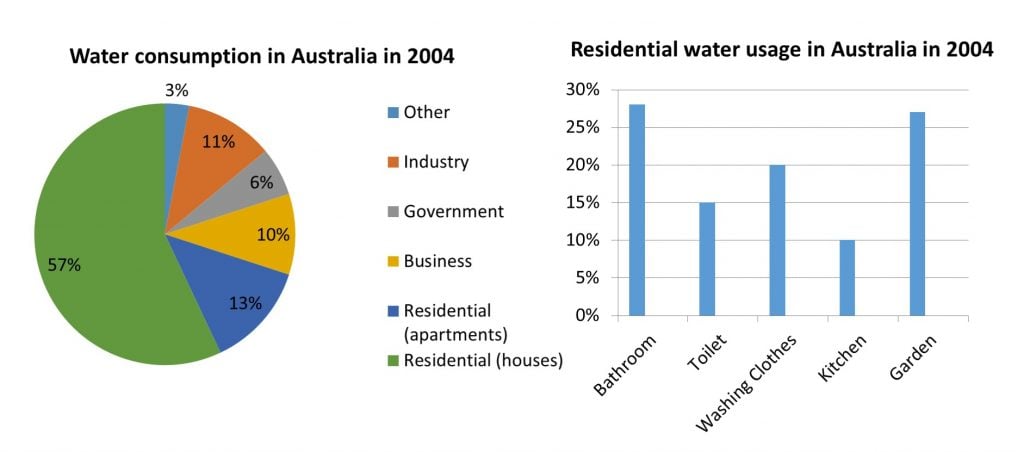
The charts show the total usage proportions for water in Australia and a breakdown of its residential purposes. Looking from an overall perspective, it is readily apparent that the vast majority of water is dedicated to houses, followed by apartments, industry, businesses and finally other. In terms of the residential use, it is mainly for bathrooms and gardens, with lower numbers for washing clothes, toilets and kitchens.
Looking first of all at the pie chart, houses represent 57% of total water usage, far surpassing apartments at 13%, industry at 11%, business 10%, government 6%, and lastly other (3%).
The bar chart delineates the uses of residential water, including both homes and apartments. Nearly 30% of all water was used for bathrooms, the highest figure, while gardens was slightly lower at 26%. Washing clothes translates to 20% of usage, followed by toilets at 15%, and kitchen use totaling just 10%.
Analysis
1. The charts show the total usage proportions for water in Australia and a breakdown of its residential purposes. 2. Looking from an overall perspective, it is readily apparent that the vast majority of water is dedicated to houses, followed by apartments, industry, businesses and finally other. 3. In terms of the residential use, it is mainly for bathrooms and gardens, with lower numbers for washing clothes, toilets and kitchens.
Paraphrase what the charts show.
Write an overview of the first chart.
And the second one! Read more about overviews here.
1. Looking first of all at the pie chart, houses represent 57% of total water usage, far surpassing apartments at 13%, industry at 11%, business 10%, government 6%, and lastly other (3%).
Describe the data fully.
1. The bar chart delineates the use of residential water, including both homes and apartments. 2. Nearly 30% of all water was used for bathrooms, the highest figure, while gardens was slightly lower at 26%. 3. Washing clothes translates to 20% of usage, followed by toilets at 15%, and kitchen use totaling just 10%.
Move on to the other graph.
Describe the data.
Make sure you don’t miss out on any data.
Vocabulary
What do the words in bold below mean?
The charts show the total usage proportions for water in Australia and a breakdown of its residential purposes. Looking from an overall perspective, it is readily apparent that the vast majority of water is dedicated to houses, followed by apartments, industry, businesses and finally other. In terms of the residential use, it is mainly for bathrooms and gardens, with lower numbers for washing clothes, toilets and kitchens.
Looking first of all at the pie chart, houses represent 57% of total water usage, far surpassing apartments at 13%, industry at 11%, business 10%, government 6%, and lastly other (3%).
The bar chart delineates the uses of residential water, including both homes and apartments. Nearly 30% of all water was used for bathrooms, the highest figure, while gardens was slightly lower at 26%. Washing clothes translates to 20% of usage, followed by toilets at 15%, and kitchen use totaling just 10%.
Answers
total usage proportions complete percentages
breakdown detailed
residential purposes how it is used for homes
looking from an overall perspective, it is readily apparent in general
The charts show the total usage proportions for water in Australia and a breakdown of its residential purposes. Looking from an overall perspective, it is readily apparent that the vast majority of water is dedicated to houses, followed by apartments, industry, businesses and finally other. In terms of the residential use, it is mainly for bathrooms and gardens, with lower numbers for washing clothes, toilets and kitchens.
Looking first of all at the pie chart, houses represent 57% of total water usage, far surpassing apartments at 13%, industry at 11%, business 10%, government 6%, and lastly other (3%).
The bar chart delineates the uses of residential water, including both homes and apartments. Nearly 30% of all water was used for bathrooms, the highest figure, while gardens was slightly lower at 26%. Washing clothes translates to 20% of usage, followed by toilets at 15%, and kitchen use totaling just 10%.
Listening Practice
Learn more about water scarcity below and practice with these activities:
Reading Practice
Read about water in Australia and practice with these ideas:
This is an IELTS writing task 2 sample answer essay on the topic of learning literature from the real IELTS exam.
If you want to support my efforts to write these essays and also receive my exclusive Ebooks, check out my Patreon!
Dave
IELTS Essay: Learning Literature
Some people think that it is a waste of time for high school students to study literature, such as novels and poems.
To what extent do you agree or disagree?
Many today claim that learning about literature should no longer be a key component of the high school curriculum. In my opinion, there are practical reasons for this sentiment but literature still serves a purpose.
Proponents of this reform argue other subjects deserve prioritisation. There is little doubt that in the 21st century, the most important subjects for students’ future careers relate to the sciences, such as engineering and computer science, or the practical humanities, like business. The earlier that students begin specialising, the more likely they are to have a head start on the competition and secure a well-paying job immediately after graduating high school or university. In contrast, the novels and poems that students read in high school are usually completely forgotten within a few years and do not teach any tangible skills that will help them advance in the real world.
Nonetheless, literature contains many of the most important and fundamental truths about the human condition. Life is about more than a career and great authors tackle the most fundamental philosophical and psychological questions. For example, the masters of 19th century Russian literature, including Tolstoy and Dostoevsky, are primarily concerned with human psychology and how this fits into a larger context of man’s search for meaning. Their exploration of these issues is relevant to everyone and cannot be replaced with a steady career. Moreover, the way in which great writers develop their themes, the aesthetic quality of their writing itself, imparts to careful readers the importance of artistic expression and may help them see outside the narrow modern confines of accumulating the most material wealth.
In conclusion, the utilitarian benefits of studying practical subjects do not outweigh the deeper values of literature. It is therefore advisable that literature be emphasised in high school classrooms.
Analysis
1. Many today claim that learning about literature should no longer be a key component of the high school curriculum. 2. In my opinion, there are practical reasons for this sentiment but literature still serves a purpose.
Paraphrase the overall essay topic.
Write a clear opinion. Read more about introductions here.
1. Proponents of this reform argue other subjects deserve prioritisation. 2. There is little doubt that in the 21st century, the most important subjects for students’ future careers relate to the sciences, such as engineering and computer science, or the practical humanities, like business. 3. The earlier that students begin specialising, the more likely they are to have a head start on the competition and secure a well-paying job immediately after graduating high school or university. 4. In contrast, the novels and poems that students read in high school are usually completely forgotten within a few years and do not teach any tangible skills that will help them advance in the real world.
Use a counter-example to fully develop your main idea.
1. Nonetheless, literature contains many of the most important and fundamental truths about the human condition. 2. Life is about more than a career and great authors tackle the most fundamental philosophical and psychological questions. 3. For example, the masters of 19th century Russian literature, including Tolstoy and Dostoevsky, are primarily concerned with human psychology and how this fits into a larger context of man’s search for meaning. 4. Their exploration of these issues is relevant to everyone and cannot be replaced with a steady career. 5. Moreover, the way in which great writers develop their themes, the aesthetic quality of their writing itself, imparts to careful readers the importance of artistic expression and may help them see outside the narrow modern confines of accumulating the most material wealth.
Write a new topic sentence with a new main idea at the end.
Explain your main idea.
Start a specific example.
Develop the example.
Develop it fully to finish the paragraph.
1. In conclusion, the utilitarian benefits of studying practical subjects do not outweigh the deeper values of literature. 2. It is therefore advisable that literature be emphasised in high school classrooms.
Repeat your opinion and summarise your main ideas.
Add a final thought. Read more about conclusions here.
Vocabulary
What do the words in bold below mean?
Many today claim that learning about literature should no longer be a key component of the high school curriculum. In my opinion, there are practical reasons for this sentiment but literature still serves a purpose.
Proponents of this reform argue other subjects deserve prioritisation. There is little doubt that in the 21st century, the most important subjects for students’ future careers relate to the sciences, such as engineering and computer science, or the practical humanities, like business. The earlier that students begin specialising, the more likely they are to have a head start on the competition and secure a well-paying job immediately after graduating high school or university. In contrast, the novels and poems that students read in high school are usually completely forgotten within a few years and do not teach any tangible skills that will help them advance in the real world.
Nonetheless, literature contains many of the most important and fundamental truths about the human condition. Life is about more than a career and great authors tackle the most fundamental philosophical and psychological questions. For example, the masters of 19th century Russian literature, including Tolstoy and Dostoevsky, are primarily concerned with human psychology and how this fits into a larger context of man’s search for meaning. Their exploration of these issues is relevant to everyone and cannot be replaced with a steady career. Moreover, the way in which great writers develop their themes, the aesthetic quality of their writing itself, imparts to careful readers the importance of artistic expression and may help them see outside the narrow modern confines of accumulating the most material wealth.
In conclusion, the utilitarian benefits of studying practical subjects do not outweigh the deeper values of literature. It is therefore advisable that literature be emphasised in high school classrooms.
Answers
claim argue
no longer not anymore
key component crucial part
curriculum what you’re learning at school
practical reasons real justifications
sentiment feeling
serves a purpose has a reason
proponents supporters
reform change
deserve prioritisation warrants valuing highly
there is little doubt that it is clear that
21st century 2000 – 2100
relate to has to do with
sciences chemistry, math, biology, physics, etc.
engineering figuring out how things work
computer science learning about computers
practical humanities business and economics
business learning about money, economics
specialising focusing on one area
head start getting ahead
competition fighting
secure safe
well-paying making good money
immediately after right following that
in contrast however
completely forgotten not remembered
tangible skills concrete abilities
advance getting ahead
real world reality
fundamental truths important facts about life
human condition people living in the world
tackle deal with
fundamental philosophical basic relating to life and death
psychological questions issues about the human mind
masters the best at something
19th century Russian literature books from Russia in the 1900s
Tolstoy Leo Tolstoy, writer of War and Peace
Dostoevsky Fyodor Dostoevsky, writer of The Brothers Karamazov
primarily concerned mainly to do with
human psychology how people think
fits into relates to
larger context what it concerns
man’s search for meaning finding a purpose in life
exploration finding out about
relevant related to
replaced instead of
steady career good job
moreover also
the way in which how it is done
develop their themes explore their concerns
aesthetic quality beauty, art
imparts gives
careful readers conscientious
artistic expression self-expression
see outside the narrow modern confines expand their worldview
accumulating the most material wealth getting richer
Many today c_____m that learning about literature should n__________r be a k______________t of the high school c______________m. In my opinion, there are p_______________s for this s_____________t but literature still s_________________e.
P_______________s of this r_________m argue other subjects d_________________________n. T_____________________________t in the 2______________________y, the most important subjects for students’ future careers r___________o the s_________s, such as e______________g and c__________________e, or the p______________________s, like b_____________s. The earlier that students begin s_____________g, the more likely they are to have a h____________t on the c______________n and s__________e a w_____________g job i________________________r graduating high school or university. I__________________t, the novels and poems that students read in high school are usually c__________________n within a few years and do not teach any t_______________s that will help them a____________e in the r____________d.
Nonetheless, literature contains many of the most important and f________________s about the h________________n. Life is about more than a career and great authors t_________e the most f___________________________l and p__________________________s. For example, the m___________s of 1_________________________________e, including T___________y and D_____________y, are p____________________d with h__________________y and how this f__________o a l______________t of m__________________________g. Their e____________n of these issues is r_____________t to everyone and cannot be r_________d with a s_______________r. M__________r, t_____________________h great writers d__________________s, the a______________________y of their writing itself, i___________s to c_________________s the importance of a_________________n and may help them s________________________________s of a_________________________________________h.
In conclusion, the u_____________________s of studying practical subjects do not o_____________h the d______________s of literature. It is therefore a_____________e that literature be e_______________d in high school classrooms.
Listening Practice
Listen with the video below and use the following activities:
Write about the related topic below, then check with my sample answer:
Some people say that school children should be mainly taught about the literature (e.g fiction and poetry) of their own country because it is more important than that of other countries.
This is an IELTS writing task 2 sample answer essay from the general training exam on the topic of taking care of elderly people.
If you want to support my efforts to write these essays and also receive my exclusive Ebooks, check out my Patreon!
Dave
IELTS Essay: Taking Care of Elderly People
Many people who care for the elderly do not have enough time to look after them.
What are the problems related to this?
What are some possible solutions?
The caretakers of elderly individuals are often overworked and feel they are neglecting their duties. In my opinion, this hurts quality of care and the best solution is comprehensive, societal reform.
The main issues resulting from lack of time to look after the elderly have to do with poor care. A nurse with several patients to visit, who might all require around the clock care, must prioritise. The neglected patients are then more likely to develop bed sores, poor nutrition, and depression. In more extreme situations, patients with dementia or life-threatening conditions for example, there may be serious injury. An Alzheimer’s patient may wander out of the house, get lost and not be able to find their way home. A critically ill patient may need urgent care and not be able to contact the hospital in an emergency.
These problems can be partly remedied if society felt responsible for the elderly. There are examples of nations, chiefly Asian countries like Japan, where old people are highly respected. This permeates all levels of society and translates to children and grandchildren being more willing to take on the burden of care, as well as more attentive doctors and better government-funded social welfare programs. All these measures combined not only have a tangible, daily impact but also shift the societal mindset from considering the elderly a nuisance to regarding them as a milestone in life that all must pass through, deserving of respect.
In conclusion, the problems related to limited opportunities for looking after the elderly concern their level of care and can be combatted with a number of measures permeating multiple layers of society. Though unlikely, these reforms would evidence a core of human compassion.
Analysis
1. The caretakers of elderly individuals are often overworked and feel they are neglecting their duties. 2. In my opinion, this hurts quality of care and the best solution is comprehensive, societal reform.
Paraphrase the essay topic.
Write a clear opinion. Read more about introductions for IELTS here.
1. The main issues resulting from lack of time to look after the elderly have to do with poor care. 2. A nurse with several patients to visit, who might all require around the clock care, must prioritise. 3. The neglected patients are then more likely to develop bed sores, poor nutrition, and depression. 4. In more extreme situations, patients with dementia or life-threatening conditions for example, there may be serious injury. 5. An Alzheimer’s patient may wander out of the house, get lost and not be able to find their way home. 6. A critically ill patient may need urgent care and not be able to contact the hospital in an emergency.
1. These problems can be partly remedied if society felt responsible for the elderly. 2. There are examples of nations, chiefly Asian countries like Japan, where old people are highly respected. 3. This permeates all levels of society and translates to children and grandchildren being more willing to take on the burden of care, as well as more attentive doctors and better government-funded social welfare programs. 4. All these measures combined not only have a tangible, daily impact but also shift the societal mindset from considering the elderly a nuisance to regarding them as a milestone in life that all must pass through, deserving of respect.
Write a new topic sentence with a new main idea at the end.
Begin a specific example.
Develop it.
Make sure that is as fully developed as possible.
1. In conclusion, the problems related to limited opportunities for looking after the elderly concern their level of care and can be combatted with a number of measures permeating multiple layers of society. 2. Though unlikely, these reforms would evidence a core of human compassion.
Summarise your main ideas and repeat your opinions.
Add a final thought. Read more about conclusions here.
Vocabulary
What do the words in bold below mean?
The caretakers of elderly individuals are often overworked and feel they are neglecting their duties. In my opinion, this hurts quality of care and the best solution is comprehensive, societal reform.
The main issues resulting from lack of time to look after the elderly have to do with poor care. A nurse with several patients to visit, who might all require around the clock care, must prioritise. The neglected patients are then more likely to develop bed sores, poor nutrition, and depression. In more extreme situations, patients with dementia or life-threatening conditions for example, there may be serious injury. An Alzheimer’s patient may wander out of the house, get lost and not be able to find their way home. A critically ill patient may need urgent care and not be able to contact the hospital in an emergency.
These problems can be partly remedied if society felt responsible for the elderly. There are examples of nations, chiefly Asian countries like Japan, where old people are highly respected. This permeates all levels of society and translates to children and grandchildren being more willing to take on the burden of care, as well as more attentive doctors and better government-funded social welfare programs. All these measures combined not only have a tangible, daily impact but also shift the societal mindset from considering the elderly a nuisance to regarding them as a milestone in life that all must pass through, deserving of respect.
In conclusion, the problems related to limited opportunities for looking after the elderly concern their level of care and can be combatted with a number of measures permeating multiple layers of society. Though unlikely, these reforms would evidence a core of human compassion.
Answers
caretakers people who take care
elderly individuals old people
overworked work too much
neglecting their duties not doing their jobs
quality of care how well someone is looked after
comprehensive complete
societal reform changes to society
main issues resulting from big problems coming from
poor care not well taken care of
several a bunch
around the clock care 24 hour care
prioritise make more important
neglected not paying attention to
bed sores lesions from not moving much
poor nutrition not eating well
depression feeling sad
in more extreme situations some bad cases
dementia forgetting things
life-threatening conditions cancer, paralysis, etc.
serious injury get hurt badly
Alzheimer’s patient condition where the mind deteriorates
wander out go outside
critically ill patient dying person
urgent care emergency situations
contact call
emergency urgent problem
partly remedied somewhat fixed
chiefly mainly
highly respected valued a lot
permeates all levels of society gets to all people
translates to means
take on the burden of care must take care of
attentive concientious
government-funded social welfare programs giving money to old people in retirement plans, checks, etc.
measures combined actions all together
tangible concrete
shift change
societal mindset way that society thinks
considering regarding
nuisance annoying
regarding as it relates to
milestone major moment in life
pass through go through
deserving of respect should be valued
limited opportunities not many chances
concern worry
level of care how well they are taken care of
combatted with fought
number of measures many steps
permeating going through
multiple layers of society many people
unlikely not going to happen probably
evidence support
core of human compassion people caring about others
The c____________s of e_____________________s are often o________________d and feel they are n_______________________s. In my opinion, this hurts q________________e and the best solution is c_______________e, s______________________m.
The m________________s r__________________m lack of time to look after the elderly have to do with p_____________e. A nurse with s_________l patients to visit, who might all require a______________________e, must p_____________e. The n____________d patients are then more likely to develop b__________s, p_________________n, and d_____________n. I________________________s, patients with d_______________a or l____________________________s for example, there may be s________________y. An A_________________t may w__________t of the house, get lost and not be able to find their way home. A c_____________________t may need u_______________e and not be able to c_________t the hospital in an e______________y.
These problems can be p_________________d if society felt responsible for the elderly. There are examples of nations, c_______y Asian countries like Japan, where old people are h__________________d. This p_________________________y and t________________o children and grandchildren being more willing to t_____________________________e, as well as more a_______________e doctors and better g______________________________________s. All these m___________________d not only have a t___________e, daily impact but also s_____t the s_________________t from c________________g the elderly a n__________e to r_____________g them as a m_________e in life that all must p_____________h, d_________________t.
In conclusion, the problems related to l__________________________s for looking after the elderly c_______________n their l_______________e and can be c________________h a n______________s p________________g m____________________________y. Though u___________y, these reforms would e___________e a c________________________________n.
Listening Practice
Listen more about this topic and use these activities to practice:
Reading Practice
Read about a good example of societal changes in Japan below and practice with these ideas:
"The highest quality materials anywhere on the internet! Dave improved my writing and vocabulary so much. Really affordable options you don't want to miss out on!"