This is an IELTS writing task 1 sample answer essay based on a map of Pentland.
Maps are always a bit tricky so be sure to check out how I wrote the overview below.
For my exclusive IELTS PDFs and Ebooks, sign up to Patreon here.
Dave
IELTS Essay: Map of Pentland
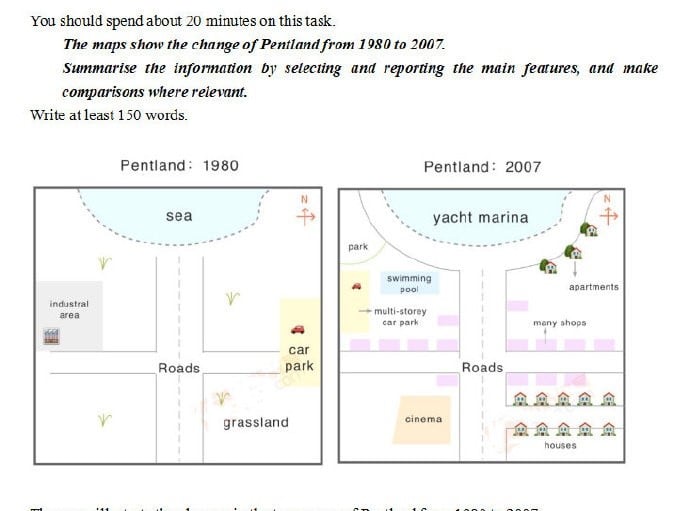
The map details alterations to the town of Pentland from 1980 to 2007. Looking from an overall perspective, it is readily apparent that there was a lot a of residential and commercial development over the years including construction of a marina for yachts, shops, houses and entertainment facilities.
In 1980, Pentland consisted mainly of grasslands to the south, two main intersecting roads, an eastern car park, an industrial area in the west and the sea to the north. By 2007, every area had changed or been relocated. An additional road was built by the coast (now a yacht marina) with a park bordering it in the northwest and seaside apartments on the opposite side.
The roads are now lined with shops and the car park added floors and moved from the eastern to western end of town, adjacent to a new swimming pool. In the south, grasslands made way for a cinema to the west and rows of houses along a new eastward avenue.
Analysis
1. The map details alterations to the town of Pentland from 1980 to 2007. 2. Looking from an overall perspective, it is readily apparent that there was a lot a of residential and commercial development over the years including construction of a marina for yachts, shops, houses and entertainment facilities.
Paraphrase the overall essay topic.
Write a general over for the map. Include the major changes and group them generally.
1. In 1980, Pentland consisted mainly of grasslands to the south, two main intersecting roads, an eastern car park, an industrial area in the west and the sea to the north. 2. By 2007, every area had changed or been relocated. 3. An additional road was built by the coast (now a yacht marina) with a park bordering it in the northwest and seaside apartments on the opposite side.
Begin to describe the changes.
Use sentences to transition.
Make sure all information is included.
1. The roads are now lined with shops and the car park added floors and moved from the eastern to western end of town, adjacent to a new swimming pool. 2. In the south, grasslands made way for a cinema to the west and rows of houses along a new eastward avenue.
Switch to another part of the map.
Don’t include any opinion and don’t forget any areas.
Vocabulary
What do the words in bold below mean?
The map details alterations to the town of Pentland from 1980 to 2007. Looking from an overall perspective, it is readily apparent that there was a lot a of residential and commercial development over the years including construction of a marina for yachts, shops, houses and entertainment facilities.
In 1980, Pentland consistedmainly of grasslands to the south, two main intersecting roads, an eastern car park, an industrial area in the west and the sea to the north. By 2007, every area had changed or been relocated. An additional road was built by the coast (now a yacht marina) with a park bordering it in the northwest and seaside apartments on the opposite side.
The roads are now lined with shops and the car park added floors and moved from the eastern to western end of town, adjacent to a new swimming pool. In the south, grasslands made way for a cinema to the west and rows of houses along a new eastward avenue.
Answers
details alterations describes changes
looking from an overall perspective, it is readily apparent that overall
residential and commercial development housing and businesses
The map d__________________s to the town of Pentland from 1980 to 2007. L_____________________________________________________t there was a lot a of r______________________________________t over the years including construction of a m___________a for y_________s, shops, houses and e_________________________________s.
In 1980, Pentland c____________dm_____________f grasslands t_____________h, two main i____________g roads, an e__________n car park, an industrial area i______________t and the sea t____________h. By 2007, every area had changed or been r___________d. An a_______________l road was built by the c_______t (now a yacht marina) with a park b___________g it in the northwest and s___________e apartments on the o______________e.
The roads are now l__________d with shops and the car park added floors and moved from the eastern to western e___________n, a_________t to a new swimming pool. In the south, grasslands m_____________r a cinema to the west and r______s of houses along a new e_______________e.
Speaking Practice
Practice speaking with the following real questions from the IELTS speaking exam:
Parks
Are there any parks near your home?
What do you do when you go to the park?
Do you often go to parks?
Is it common for people in your country to go to parks?
Writing Practice
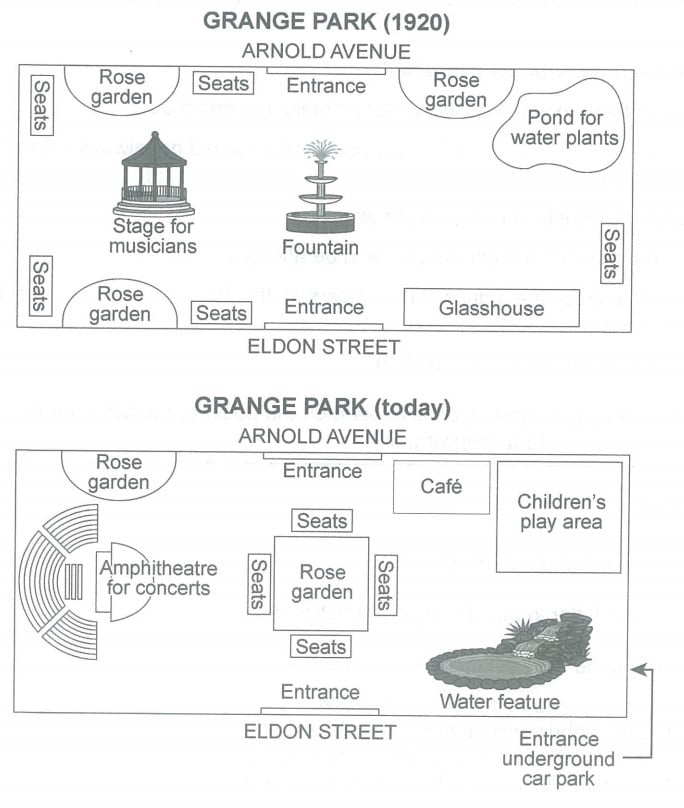
Write about another map below then check with my sample answer:
This is an IELTS writing task 2 sample answer essay on the topic of building sports facilities for top athletes from the real IELTS exam.
I have an Ebook just published on this specific essay available on my Patreon now too!
Dave
IELTS Essay: Sports Facilities
Some countries invest in specialized sports facilities for top athletes but not for the average people.
Is this a positive or negative development?
Heavy investment in sports facilities aimed at professional athletes is common in countries that want to compete in international events. This is a positive development for national pride but negative on the whole as it takes funding away from the average citizen.
Proponents of this practice would argue that it brings the nation together. The best examples of this relate to international competitions like the summer and winter Olympics. China and the United States have famously invested millions in building sports facilities for prospective Olympians and the results in terms of medals justify the expenditure. The wider implications for national unity come from an entire country watching the telecasts and rooting together. Divisive domestic disputes are temporarily forgotten as everyone focuses on the progress of their country. Much of this would be impossible without specialised sports facilities for the best competitors.
However, these facilities benefit a select few over the majority. Funding for such facilities is a limited part of a federal budget that must cover essential areas like health, education, and the military. Any money diverted towards preparing world-class athletes for international competitions is to some extent a waste as it cuts into the budget for facilities for average people. For example, many inner city youths in poorer neighborhoods lack access to parks and such facilities and this has been identified as one of the factors that allows for poverty to be inherited over generations. Direct the funding away from these expensive gyms for top athletes and it would be possible to build many more facilities that serve a much wider and underserved segment of the population.
In conclusion, despite the less tangible benefits to national cohesiveness, this a negative on level as it favours a talented minority. More resources should be allocated towards facilities for those in greater need.
Analysis
1. Heavy investment in sports facilities aimed at professional athletes is common in countries that want to compete in international events. 2. This is a positive development for national pride but negative on the whole as it takes funding away from the average citizen.
Paraphrase the overall essay topic.
Write a clear overall opinion. Read more about introductions here.
1. Proponents of this practice would argue that it brings the nation together. 2. The best examples of this relate to international competitions like the summer and winter Olympics. 3. China and the United States have famously invested millions in building sports facilities for prospective Olympians and the results in terms of medals justify the expenditure. 4. The wider implications for national unity come from an entire country watching the telecasts and rooting together. 5. Divisive domestic disputes are temporarily forgotten as everyone focuses on the progress of their country. 6. Much of this would be impossible without specialised sports facilities for the best competitors.
Keep developing it and don’t switch to a new main idea.
Relate it back to your topic sentence.
1. However, these facilities benefit a select few over the majority. 2. Funding for such facilities is a limited part of a federal budget that must cover essential areas like health, education, and the military. 3. Any money diverted towards preparing world-class athletes for international competitions is to some extent a waste as it cuts into the budget for facilities for average people. 4. For example, many inner city youths in poorer neighborhoods lack access to parks and such facilities and this has been identified as one of the factors that allows for poverty to be inherited over generations. 5. Direct the funding away from these expensive gyms for top athletes and it would be possible to build many more facilities that serve a much wider and underserved segment of the population.
Write another topic sentence with a new main idea at the end.
Explain it.
Begin to develop it.
Use a specific example.
Conclude with a strong statement.
1. In conclusion, despite the less tangible benefits to national cohesiveness, this a negative on level as it favours a talented minority. 2. More resources should be allocated towards facilities for those in greater need.
Repeat your opinion and summarise your ideas.
Add a final thought/detail. Read more about conclusions here.
Vocabulary
What do the words in bold below mean?
Heavy investment in sports facilities aimed at professional athletes is common in countries that want to compete in international events. This is a positive development for national pride but negative on the whole as it takes funding away from the average citizen.
Proponents of this practice would argue that it brings the nation together. The best examples of this relate to international competitions like the summer and winter Olympics. China and the United States have famously invested millions in building sports facilities for prospective Olympians and the results in terms of medals justify the expenditure. The wider implications for national unity come from an entire country watching the telecasts and rooting together. Divisive domestic disputes are temporarily forgotten as everyone focuses on the progress of their country. Much of this would be impossible without specialised sports facilities for the best competitors.
However, these facilities benefit a select few over the majority. Funding for such facilities is a limited part of a federal budget that must cover essential areas like health, education, and the military. Any money diverted towards preparing world-class athletes for international competitions is to some extent a waste as it cuts into the budget for facilities for average people. For example, many inner city youths in poorer neighborhoods lack access to parks and such facilities and this has been identified as one of the factors that allows for poverty to be inherited over generations. Direct the funding away from these expensive gyms for top athletes and it would be possible to build many more facilities that serve a much wider and underserved segment of the population.
In conclusion, despite the less tangible benefits to national cohesiveness, this a negative on level as it favours a talented minority. More resources should be allocated towards facilities for those in greater need.
Answers
heavy investment a lot of money put into
aimed at for
compete in international events the Olympics, World Cup, etc.
national pride caring about your country
negative on the whole bad on level
takes funding away from diverts money from
average citizen normal person
proponents advocates
practice development
brings the nation together unifies the country
international competitions Olympics, World Cup, etc.
summer and winter Olympics held every 4 years either in the summer or winter
famously invested millions well-known put lots of money into
prospective Olympians potential Olympic athletes
justify the expenditure good reason for the money
wider implications larger effects
national unity bringing a country together
entire country whole nation
telecasts TV broadcasts
rooting wanting to win
divisive domestic disputes dividing arguments in a country
temporarily not permanent
focuses on directed towards
progress moving forward
much of this a lot of
specialised sports facilities just for doing sports
best competitors strongest athletes
a select few some of
majority most of
limited part small piece of
federal budget money the government has to spend
cover essential areas have money for important parts
diverted towards sent in the direction of
world-class athletes best sports people
to some extent to a degree
waste not used well
cuts into takes away from
inner city youths kids living in the city
lack access can’t go to
identified pinpointed
one of the factors one element
poverty to be inherited over generations families staying poor over time
direct send towards
wider broader
underserved don’t get enough
less tangible benefits not as concrete advantages
national cohesiveness brings a country together
on level overall
favours benefits
talented minority just some people with a lot of ability
H___________________t in sports facilities a_______________t professional athletes is common in countries that want to c______________________________s. This is a positive development for n__________________e but n__________________e as it t__________________m the a______________n.
P_______________s of this p___________e would argue that it b____________________r. The best examples of this relate to i___________________________s like the s_________________________________s. China and the United States have f_________________________________s in building sports facilities for p_______________________s and the results in terms of medals j____________________________e. The w___________________s for n_________________y come from an e__________________y watching the t_____________s and r________g together. D____________________________s are t__________________y forgotten as everyone f_____________n the p___________s of their country. M_____________s would be impossible without s_______________________s for the b________________s.
However, these facilities benefit a_______________w over the m____________y. Funding for such facilities is a l_________________t of a f________________t that must c____________________s like health, education, and the military. Any money d___________________s preparing w___________________s for international competitions is t______________t a w_______e as it c__________o the budget for facilities for average people. For example, many i__________________s in poorer neighborhoods l_____________s to parks and such facilities and this has been i_____________d as o_______________s that allows for p____________________________________________s. D_________t the funding away from these expensive gyms for top athletes and it would be possible to build many more facilities that serve a much w________r and u___________________d segment of the population.
In conclusion, despite the l________________________s to n_______________________s, this a negative o___________l as it f____________s a t______________________y. More r________________s should be a_______________d towards facilities for those in g_______________d.
Cooking at home is a waste of time because there are so many convenient fast food options that make life less stressful.
To what extent do you agree or disagree?
Many people today feel that cooking food at home has become inessential due to the ubiquity of fast food restaurants. In my opinion, the understandable appeal of fast food does little to undermine the health benefits of preparing your own meals.
Fast food is convenient. This is evidenced through its popularity and is based on how quickly it can be purchased, its price, the fact you do not have to prepare it yourself and how easy it is to clean up afterwards. These incentives combine to entice the average worker, coming home tired after a long day, that some burgers from McDonald’s or a pizza from Domino’s will not only make their lives easier and reduce their stress levels but also help them cope with any personal problems. Given all these motivating factors, it is no surprise that many today have convinced themselves that cooking at home is a waste of time.
Regardless, the above listed reasons do not outweigh the health risks of fast food or the health benefits of home-cooked meals. Fast food has been shown, in numerous replicated studies over decades of research, to be one of the leading contributors to the risk factors for heart disease, diabetes, and cancer. The alternative to fast food is cooking at home. This is not always healthy; it is perfectly possible to prepare an unhealthy meal by oneself. However, home cooks have complete control over the ingredients and are not adding the preservatives or chemicals that are typically found in fast food. They are instead more likely to serve fresh fruits and vegetables and be generally conscious of what goes into their body, thereby improving short and long-term health.
In conclusion, fast food is a naturally attractive time and stress saver that does not imply people should stop cooking at home. The health benefits of home-cooking are crucial and this is unlikely to change in the near future.
Analysis
1. Many people today feel that cooking food at home has become inessential due to the ubiquity of fast food restaurants. 2. In my opinion, the understandable appeal of fast food does little to undermine the health benefits of preparing your own meals.
Paraphrase the overall essay topic.
Write a clear opinion. Read more about introductions here.
1. Fast food is convenient. 2. This is evidenced through its popularity and is based on how quickly it can be purchased, its price, the fact you do not have to prepare it yourself and how easy it is to clean up afterwards. 3. These incentives combine to entice the average worker, coming home tired after a long day, that some burgers from McDonald’s or a pizza from Domino’s will not only make their lives easier and reduce their stress levels but also help them cope with any personal problems. 4. Given all these motivating factors, it is no surprise that many today have convinced themselves that cooking at home is a waste of time.
Write a clear topic sentence with your main idea at the end. This sentence can be short.
Explain your main idea in detail.
Develop it fully – vary long and short sentences.
Conclude the paragraph.
1. Regardless, the above listed reasons do not outweigh the health risks of fast food or the health benefits of home-cooked meals. 2. Fast food has been shown, in numerous replicated studies over decades of research, to be one of the leading contributors to the risk factors for heart disease, diabetes, and cancer. 3. The alternative to fast food is cooking at home. 4. This is not always healthy; it is perfectly possible to prepare an unhealthy meal by oneself. 5. However, home cooks have complete control over the ingredients and are not adding the preservatives or chemicals that are typically found in fast food. 6. They are instead more likely to serve fresh fruits and vegetables and be generally conscious of what goes into their body, thereby improving short and long-term health.
Write another topic sentence with a new main idea.
Explain your main idea – you can use research to support your ideas.
Write short and long sentences.
Include any caveats or exceptions.
Keep developing your main idea.
Finish developing your main idea fully and don’t switch to a new one.
1. In conclusion, fast food is a naturally attractive time and stress saver that does not imply people should stop cooking at home. 2. The health benefits of home-cooking are crucial and this is unlikely to change in the near future.
Summarise your ideas and repeat your opinion.
Add a final thought/detail. Read more about conclusions here.
Vocabulary
What do the words in bold below mean?
Many people today feel that cooking food at home has become inessential due to the ubiquity of fast food restaurants. In my opinion, the understandable appeal of fast food does little to undermine the health benefits of preparing your own meals.
Fast food is convenient. This is evidenced through its popularity and is based on how quickly it can be purchased, its price, the fact you do not have to prepare it yourself and how easy it is to clean up afterwards. These incentives combine to entice the average worker, coming home tired after a long day, that some burgers from McDonald’s or a pizza from Domino’s will not only make their lives easier and reduce their stress levelsbut also help them cope with any personal problems. Given all these motivating factors, it is no surprise that many today have convinced themselves that cooking at home is a waste of time.
Regardless, the above listed reasons do not outweigh the health risks of fast food or the health benefits of home-cooked meals. Fast food has been shown, in numerous replicated studies over decades of research, to be one of the leading contributors to the risk factors for heart disease, diabetes, and cancer. The alternative to fast food is cooking at home. This is not always healthy; it is perfectly possible to prepare an unhealthy meal by oneself. However, home cooks have complete control over the ingredients and are not adding the preservatives or chemicals that are typically found in fast food. They are instead more likely to serve fresh fruits and vegetables and be generally conscious of what goes into their body, thereby improving short and long-term health.
In conclusion, fast food is a naturally attractive time and stress saver that does not imply people should stop cooking at home. The health benefits of home-cooking are crucial and this is unlikely to change in the near future.
Answers
inessential not important
ubiquity very common
understandable appeal easy to understand why people want it
undermine doubt
preparing your own meals cooking at home
convenient easy and simple
evidenced supported by
clean up afterwards do the dishes, etc.
incentives combine reasons together
entice attract
average worker normal person
not only … but also including both
reduce their stress levels make life less stressful
cope deal with
given all these motivating factors considering these enticements
no surprise naturally
convinced themselves make themselves think
waste of time not a good use of time
regardless nonetheless
outweigh stronger than
numerous replicated studies repeated in different research over and over
leading contributors main causes
risk factors what can lead to you getting a condition/disease
alternative different option
perfectly possible likely to happen
home cooks people who cook at home
complete control total oversight
ingredients what you put into a dish
adding the preservatives or chemicals putting in artificial substances
found in fast food that is in fast food
instead on the other hand
serve fresh fruits and vegetables recently bought foods
generally conscious more or less aware of
improving short and long-term health feeling better now and in the future
naturally attractive obviously something people want
saver keeps
imply necessarily
crucial really important
unlikely to change in the near future probably not going to be different later
Many people today feel that cooking food at home has become i________________l due to the u_______________y of fast food restaurants. In my opinion, the u_____________________l of fast food does little to u______________e the health benefits of p_______________________s.
Fast food is c______________t. This is e____________d through its popularity and is based on how quickly it can be purchased, its price, the fact you do not have to prepare it yourself and how easy it is to c______________________s. These i____________________e to e_________e the a________________r, coming home tired after a long day, that some burgers from McDonald’s or a pizza from Domino’s will n___________y make their lives easier and r______________________sb__________o help them c_____e with any personal problems. G___________________________________s, it is n_____________e that many today have c_______________________________s that cooking at home is a w_____________e.
R________________s, the above listed reasons do not o______________h the health risks of fast food or the health benefits of home-cooked meals. Fast food has been shown, in n_________________________________s over decades of research, to be one of the l________________________s to the r________________s for heart disease, diabetes, and cancer. The a________________e to fast food is cooking at home. This is not always healthy; it is p_________________e to prepare an unhealthy meal by oneself. However, h_____________s have c______________________l over the i__________________s and are not a___________________________________s that are typically f__________________d. They are i___________d more likely to s________________________________s and be g_______________________s of what goes into their body, thereby i_________________________________________h.
In conclusion, fast food is a n___________________________e time and stress s___________r that does not i_________y people should stop cooking at home. The health benefits of home-cooking are c___________l and this is u____________________________________e.
Listening Practice
Watch and listen to Gordon Ramsay cooking at home below:
Reading Practice
Learn some copycat recipes below so that you don’t have to go get fast food later:
"The highest quality materials anywhere on the internet! Dave improved my writing and vocabulary so much. Really affordable options you don't want to miss out on!"