This is an IELTS writing task 1 sample answer essay on the topic of households with cars in a European country.
For my full, exclusive IELTS PDFs, learn more about my Patreon here.
Dave
IELTS Essay Task 1: Households with Cars
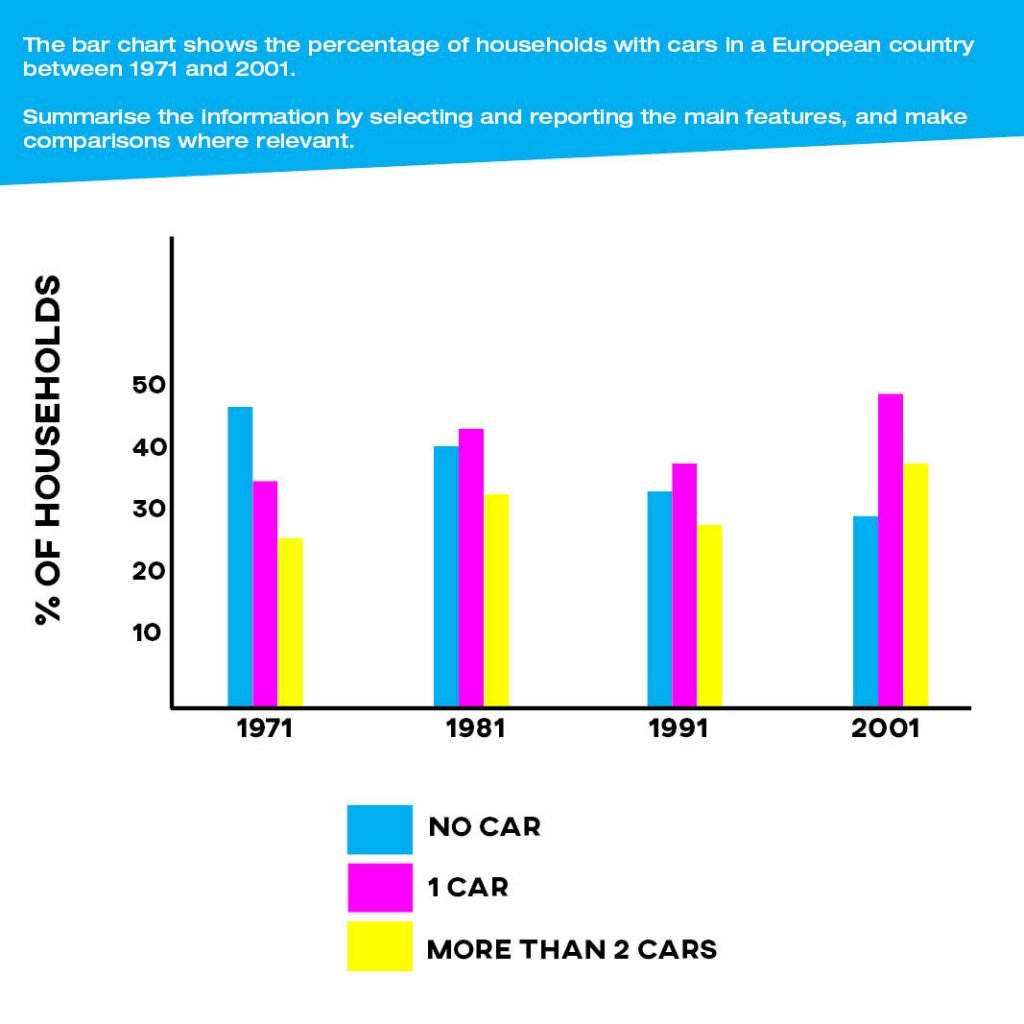
The bar chart compares the percentages for car ownership in a European country at 10 year intervals from 1971 to 2001. Looking from an overall perspective, it is readily apparent that proportions for households with no car and 1 car showed inverse patterns, with the latter rising to become most common by the end of the period. More than 2 cars increased as well, also overtaking no cars.
The number of homes in this European country with no car stood at just under 50% in 1971, before a steady decline by more than 5% each decade to finish at under 30% in 2001. In contrast, those houses with 1 car rose at less steady intervals from 35% to over 40% in 1981, followed by a dip to under 40% in 1991, and finally a surge to 50%.
More than 2 cars began the time surveyed with the lowest ratio (25%) then grew, mirroring the trajectory of 1 car and finishing at 35%, nearly 10% higher than no car households.
Analysis
1. The bar chart compares the percentages for car ownership in a European country at 10 year intervals from 1971 to 2001. 2. Looking from an overall perspective, it is readily apparent that proportions for households with no car and 1 car showed inverse patterns, with the latter rising to become most common by the end of the period. 3. More than 2 cars increased as well, also overtaking no cars.
Paraphrase the overall essay topic.
Begin your overview by describing the trends.
Make sure all categories are covered. Learn more about overviews here.
1. The number of homes in this European country with no car stood at just under 50% in 1971, before a steady decline by more than 5% each decade to finish at under 30% in 2001. 2. In contrast, those houses with 1 car rose at less steady intervals from 35% to over 40% in 1981, followed by a dip to under 40% in 1991, and finally a surge to 50%.
Start with one of the categories and include all the data.
Always compare the categories.
1. More than 2 cars began the time surveyed with the lowest ratio (25%) then grew, mirroring the trajectory of 1 car and finishing at 35%, nearly 10% higher than no car households.
Make sure that all areas and all data has been described fully and accurately.
Vocabulary
What do the words in bold below mean?
The bar chart compares the percentages for car ownership in a European country at 10 yearintervals from 1971 to 2001. Looking from an overall perspective, it is readily apparent thatproportions for households with no car and 1 car showed inverse patterns, with the latter rising to become most common by the end of the period. More than 2 cars increased as well, also overtaking no cars.
The number of homes in this European country with no car stood at just under 50% in 1971, before a steady decline by more than 5% each decade to finish at under 30% in 2001. In contrast, those houses with 1 car rose at less steady intervals from 35% to over 40% in 1981, followed by a dip to under 40% in 1991, and finally a surge to 50%.
More than 2 cars began the time surveyed with the lowest ratio (25%) then grew, mirroring the trajectory of 1 car and finishing at 35%, nearly 10% higher than no car households.
Answers
compares shows the differences between
10 yearintervals every 10 years
Looking from an overall perspective, it is readily apparent that overall
The bar chart c______________s the percentages for car ownership in a European country at 1_______________s from 1971 to 2001. L___________________________________________tp____________s for households with no car and 1 car s___________________________s, with the l___________r rising to become most common b____________________________d. More than 2 cars increased as well, also o_______________g no cars.
The number of homes in this European country with no car s_______d at j____________r 50% in 1971, b________e a s______________e by m___________n 5% each d___________e to f___________h at under 30% in 2001. I____________t, those houses with 1 car rose at l_________________s from 35% to over 40% in 1981, f____________________y a d___p to under 40% in 1991, and finally a s__________e to 50%.
More than 2 cars began the time s________________d with the l___________________o (25%) then grew, m______________g the t________________y of 1 car and f___________________t 35%, nearly 10% h_______________________n no car households.
Listening Practice
Watch the video below about car ownership in the future:
and a related speaking test here:
Reading Practice
Read more about this topic on The New York Times below:
This is an IELTS writing task 1 sample answer essay from the general training exam on whether it is better to live in cities or rural areas.
For my exclusive IELTS PDFs, sign up to my Patreon here.
Dave
IELTS Essay General Training: Cities vs Rural Areas
Some people think that cities are the best places to live. Others prefer to live in rural areas.
Discuss both views and give your own opinion.
There are fundamentally different reasons that dictate whether one lives in the countryside or an urban area. In my opinion, the health benefits of living in the countryside do not outweigh the range of opportunities available in cities.
The chief advantages of the countryside relate to health. City-dwelling lends itself to a more sedentary lifestyle and the threat of air pollution is ever-growing. In contrast, individuals living in the country are much more likely to walk or ride bikes as part of their daily routine. Over time this equates to healthier living habits and can reduce the risk of obesity and concomitant conditions such as cardiovascular disease and diabetes. Moreover, recent studies have found that worsening air quality in cities and the absorption of microparticles into the lungs is driving up rates of cancer and asthma. The countryside presents an alternative environment where cleaner air can result in both short and long-term health benefits.
Nonetheless, cities offer a wide array of options rural areas lack. This begins with the employment on offer. The vast majority of well-paid jobs are located in cities ranging from doctors to lawyers to managers in companies. Living in the countryside limits one to careers primarily centred around agriculture. Cities also contain a richer variety of educational and cultural opportunities. The best schools are usually found in cities and museums and concerts are rare in the countryside. Take New York City for example, where some of the most famous museums in the world are located next to beautiful concert venues and renowned five star restaurants. This broadens an individual’s horizons and makes cities ideal for both single people and families.
In conclusion, despite the healthier overall lifestyle enjoyed in the countryside, city life allows too many modern conveniences to be ignored. Each individual must decide what they value highest but most should opt for city life.
Analysis
1. There are fundamentally different reasons that dictate whether one lives in the countryside or an urban area. 2. In my opinion, the health benefits of living in the countryside do not outweigh the range of opportunities available in cities.
Paraphrase the overall essay topic.
Write a clear opinion. Read more about writing introductions here.
1. The chief advantages of the countryside relate to health. 2. City-dwelling lends itself to a more sedentary lifestyle and the threat of air pollution is ever-growing. 3. In contrast, individuals living in the country are much more likely to walk or ride bikes as part of their daily routine. 4. Over time this equates to healthier living habits and can reduce the risk of obesity and concomitant conditions such as cardiovascular disease and diabetes. 5. Moreover, recent studies have found that worsening air quality in cities and the absorption of microparticles into the lungs is driving up rates of cancer and asthma. 6. The countryside presents an alternative environment where cleaner air can result in both short and long-term health benefits.
Write another topic sentence with a clear main idea at the end.
Explain your main idea.
Use specific examples to support your idea.
State the results to develop your idea.
Don’t write about a new idea but you can write about multiple ideas within a topic (healthy).
Conclude with a summary sentence.
1. Nonetheless, cities offer a wide array of options rural areas lack. This begins with the employment on offer. 2. The vast majority of well-paid jobs are located in cities ranging from doctors to lawyers to managers in companies. 3. Living in the countryside limits one to careers primarily centred around agriculture. 4. Cities also contain a richer variety of educational and cultural opportunities. 5. The best schools are usually found in cities and museums and concerts are rare in the countryside. 6. Take New York City for example, where some of the most famous museums in the world are located next to beautiful concert venues and renowned five star restaurants. 7. This broadens an individual’s horizons and makes cities ideal for both single people and families.
Write another topic sentence with a new main idea at the end.
Explain your main idea.
Use counter-examples for more support.
Start with more general sentences.
Then get more specific.
Use a specific city as an example.
Conclude with a strong statement relating it back to your opinion.
1. In conclusion, despite the healthier overall lifestyle enjoyed in the countryside, city life allows too many modern conveniences to be ignored. 2. Each individual must decide what they value highest but most should opt for city life.
Summarise your ideas and repeat your opinion.
Add a final thought/detail. Read more about conclusions here.
Vocabulary
What do the words in bold below mean?
There are fundamentally different reasons that dictate whether one lives in the countryside or an urban area. In my opinion, the health benefits of living in the countryside do not outweigh the range of opportunities available in cities.
The chief advantages of the countryside relate to health. City-dwellinglends itself to a more sedentary lifestyle and the threat of air pollution is ever-growing. In contrast, individuals living in the country are much more likely to walk or ride bikes as part of their daily routine. Over time this equates to healthier living habits and can reduce the risk of obesity and concomitant conditions such as cardiovascular disease and diabetes. Moreover, recent studies have found that worsening air quality in cities and the absorption of microparticles into the lungs is driving uprates of cancer and asthma. The countryside presents an alternative environment where cleaner air can result in both short and long-term health benefits.
Nonetheless, cities offer a wide array of options rural areas lack. This begins with the employment on offer. The vast majority of well-paid jobs are located in cities ranging from doctors to lawyers to managers in companies. Living in the countryside limits one to careers primarily centred around agriculture. Cities also contain a richer variety of educational and cultural opportunities. The best schools are usually found in cities and museums and concerts are rare in the countryside. Take New York City for example, where some of the most famous museums in the world are located next to beautiful concert venues and renowned five star restaurants. This broadens an individual’s horizons and makes cities ideal for both single people and families.
In conclusion, despite the healthier overall lifestyle enjoyed in the countryside, city life allows too many modern conveniences to be ignored. Each individual must decide what they value highest but most should opt for city life.
Answers
fundamentally different reasons basically differing justifications
dictate decide
urban area city
health benefits good for you
outweigh stronger than
range of opportunities many chances
chief advantages main benefits
relate to regarding
city-dwellinglends itself living in a city makes you more likely to
more sedentary lifestyle less active living
threat of air pollution risk of poor air quality
ever-growing always increasing
in contrast however
part of their daily routine something you do everyday
equates means
healthier living habits doing something healthy everday
reduce the risk less chance of
obesity getting fat
concomitant conditions related problems
cardiovascular disease heart disease
diabetes a disease from eating too much sugar
recent studies have found research has shown
worsening air quality more air pollution
absorption becoming part of
microparticles small bits of stuff
driving uprates of cancer increasing the odds of getting cancer
asthma a breathing condition
presents allows for
alternative environment different place
cleaner air less air pollution
result in so
short and long-term health benefits in the near and distant future
nonetheless regardless
wide array of options many chances
lack don’t have
employment on offer jobs available
vast majority most of
well-paid jobs good employment
ranging from including
limits restricts
primarily centred around agriculture mostly to do with farming
contain a richer variety have a lot more
educational related to education
cultural opportunities museums, theatre, music, etc.
There are f______________________________s that d__________e whether one lives in the countryside or an u_____________a. In my opinion, the h______________s of living in the countryside do not o_____________h the r__________________________s available in cities.
The c___________________s of the countryside r____________o health. C_______________________________f to a m____________________e and the t_________________________n is e_______________g. I_______________t, individuals living in the country are much more likely to walk or ride bikes as p___________________________e. Over time this e______________s to h_____________________________s and can r___________________k of o__________y and c_____________________s such as c_______________________e and d____________s. Moreover, r______________________d that w_______________________y in cities and the a________________n of m____________________s into the lungs is d______________________r and a___________a. The countryside p_____________s an a____________________t where c_________________r can r______________n both s________________________s.
N_______________s, cities offer a w____________________s rural areas l_____k. This begins with the e_____________________r. The v_________________y of w_____________________s are located in cities r________________m doctors to lawyers to managers in companies. Living in the countryside l___________s one to careers p_________________________________e. Cities also c________________________y of e_________________l and c______________________s. The best schools are u___________________d in cities and museums and concerts are r_____e in the countryside. Take New York City for example, where some of the most famous museums in the world a_____________d next to beautiful c________________s and r______________________________s. This b_______________s an i__________________________s and makes cities i______l for both single people and families.
In conclusion, despite the healthier overall lifestyle e_______________n the countryside, city life allows too many m___________________s to be i_______________d. Each individual must decide what they v_______________t but most should o_____t for city life.
This is an IELTS writing task 2 sample answer essay on the topic of whether or not the current generation should protect the environment for the next generation.
For all my exclusive IELTS PDFs, learn more about my Patreon here.
Dave
IELTS Essay: The Next Generation
Some think the current generation should take steps to protect the environment for the next generation.
To what extent do you agree or disagree?
Many environmentalists feel that people today have a responsibility to ensure the Earth is left in good condition for future generations. In my opinion, though this duty is unfair, it is nonetheless a burden that must be taken up.
Those who argue against this sentiment can justly assign blame elsewhere. The main contributors to climate change and the current cataclysmic warnings were the large industrial powers on the 20th century. Automobiles and air travel became common in the last 100 years and are two leading drivers of the fossil fuel consumption many scientists link to global warming. Surging populations and advances in medicine have also contributed greatly to the over-production and mass consumption that defines the 21st century. It is objectively unfair that people today, and primarily the younger generation only now entering the workforce, should have to suffer for the thoughtlessness of wanton industrialisation.
Regardless, it is the responsibility of the present generation to take heed of these potentially dire warnings. People in the past were either intentionally or unintentionally unaware of the repercussions of their actions but individuals today cannot make such excuses. For example, the rapidly deteriorating polar ice caps are directly impacting the natural habitats of animals around the world and some climate scientists believe that an uptick in natural disasters is also related to this and other man-made changes to the ecosystem. Past generations who set the world on this path cannot come back and remedy their mistakes and future generations will resent the current one if steps are not taken towards drastic reforms.
In conclusion, though people today bear little responsibility for climate change, they must commit to reversing its effects. Leaving this problem for the children of the future will put them in a potentially unwinnable situation.
Analysis
1. Many environmentalists feel that people today have a responsibility to ensure the Earth is left in good condition for future generations. 2. In my opinion, though this duty is unfair, it is nonetheless a burden that must be taken up.
Paraphrase the overall essay topic.
Write a clear opinion. Read more about writing a band 7+ introduction here.
1. Those who argue against this sentiment can justly assign blame elsewhere. 2. The main contributors to climate change and the current cataclysmic warnings were the large industrial powers on the 20th century. 3. Automobiles and air travel became common in the last 100 years and are two leading drivers of the fossil fuel consumption many scientists link to global warming. 4. Surging populations and advances in medicine have also contributed greatly to the over-production and mass consumption that defines the 21st century. 5. It is objectively unfair that people today, and primarily the younger generation only now entering the workforce, should have to suffer for the thoughtlessness of wanton industrialisation.
Write a topic sentence with a clear main idea at the end.
Explain your main idea.
Develop it with specific examples.
Add in more specifics.
Conclude by relating it back to your main idea.
1. Regardless, it is the responsibility of the present generation to take heed of these potentially dire warnings. 2. People in the past were either intentionally or unintentionally unaware of the repercussions of their actions but individuals today cannot make such excuses. 3. For example, the rapidly deteriorating polar ice caps are directly impacting the natural habitats of animals around the world and some climate scientists believe that an uptick in natural disasters is also related to this and other man-made changes to the ecosystem. 4. Past generations who set the world on this path cannot come back and remedy their mistakes and future generations will resent the current one if steps are not taken towards drastic reforms.
Write another topic sentence with a clear main idea at the end.
Develop your main idea.
Use real examples.
If your sentences are long, it is ok to have just 4 in one paragraph.
1. In conclusion, though people today bear little responsibility for climate change, they must commit to reversing its effects. 2. Leaving this problem for the children of the future will put them in a potentially unwinnable situation.
Repeat your opinion and summarise both your main ideas.
Add a final thought. Read more about conclusions here.
Vocabulary
What do the words in bold below mean?
Many environmentalists feel that people today have a responsibility to ensure the Earth is left in good condition for future generations. In my opinion, though this duty is unfair, it is nonetheless a burden that must be taken up.
Those who argue against this sentiment can justly assign blame elsewhere. The main contributors to climate change and the current cataclysmic warnings were the large industrial powers on the 20th century. Automobiles and air travel became common in the last 100 years and are two leading drivers of the fossil fuel consumption many scientists link to global warming. Surging populations and advances in medicine have also contributed greatly to the over-production and mass consumption that defines the 21st century. It is objectively unfair that people today, and primarily the younger generation only now entering the workforce, should have to suffer for the thoughtlessness of wanton industrialisation.
Regardless, it is the responsibility of the present generation to take heed of these potentially dire warnings. People in the past were either intentionally or unintentionally unaware of the repercussions of their actions but individuals today cannot make such excuses. For example, the rapidly deteriorating polar ice caps are directly impacting the natural habitats of animals around the world and some climate scientists believe that an uptick in natural disasters is also related to this and other man-made changes to the ecosystem. Past generations who set the world on this path cannot come back and remedy theirmistakes and future generations will resent the current one if steps are not taken towards drastic reforms.
In conclusion, though people today bear little responsibility for climate change, they must commit to reversing its effects. Leaving this problem for the children of the future will put them in a potentially unwinnable situation.
Answers
environmentalists people who care about the environment
responsibility duty
ensure make sure
left in good condition remain in good quality
future generations people who come later
duty responsibility
unfair unjust
nonetheless regardless
burden duty
taken up take responsibility for
argue against object to
sentiment feeling
justly assign blame elsewhere correctly find fault with others
main contributors biggest causes
climate change global warming
current cataclysmic warnings dire predictions about the future
large industrial powers big companies, nations
20th century 1900 – 2000
two leading drivers main forces behind
fossil fuel consumption burning oil
link connections
surging populations increasing number of people
advances in medicine new medical procedures and technology
contributed greatly add a lot to
over-production making too much
mass consumption using too much
defines constitutes
objectively unfair definitely not right
primarily mainly
entering the workforce getting jobs
suffer hurt from
thoughtlessness not thinking about
wanton industrialisation thoughtless expansion of industry
regardless nonetheless
present generation people alive today
take heed consider
potentially dire warnings possible really bad predictions
intentionally meaning to do it
unintentionally unaware not knowing what they were doing
Many e________________________s feel that people today have a r________________y to e__________e the Earth is l_____________________n for f______________________s. In my opinion, though this d________y is u________r, it is n______________s a b__________n that must be t___________p.
Those who a_____________t this s______________t can j_______________________e. The m_____________________s to c__________________e and the c_________________________s were the l________________________s on the 2______________________y. Automobiles and air travel became common in the last 100 years and are t_____________________s of the f________________________n many scientists l______k to global warming. S________________________s and a_____________________e have also c_____________________y to the o______________________n and m_______________________n that d___________s the 21st century. It is o____________________r that people today, and p________________y the younger generation only now e_______________________e, should have to s___________r for the t________________s of w______________________n.
R_______________s, it is the responsibility of the p_________________n to t______________d of these p__________________________s. People in the past were either i___________________y or u____________________e of the r__________________s of their actions but individuals today cannot make such e_____________s. For example, the r_________________________________s are d___________________g the n_____________________s of animals around the world and some climate scientists believe that an u___________k in n______________________s is also related to this and other m______________e changes to the e__________________m. Past generations who s_________________________h cannot come back and r_________________________s and future generations will r_____________t the c_______________e if s__________________________n towards d___________________s.
In conclusion, though people today b_______________________y for climate change, they must c______________t to r_______________________s. L________________________m for the c_______________________e will put them in a p______________________________n.
Listening Practice
Keep your studies interesting by watching videos related to the topics:
Reading Practice
Read more about this topic below in The New York Times climate section:
This is an IELTS writing task 1 sample answer essay on the topic of oil use in a line chart.
Sign up here for my Patreon so you don’t miss out on my exlusive PDFs!
Dave
IELTS Essay Task 1: Oil Use
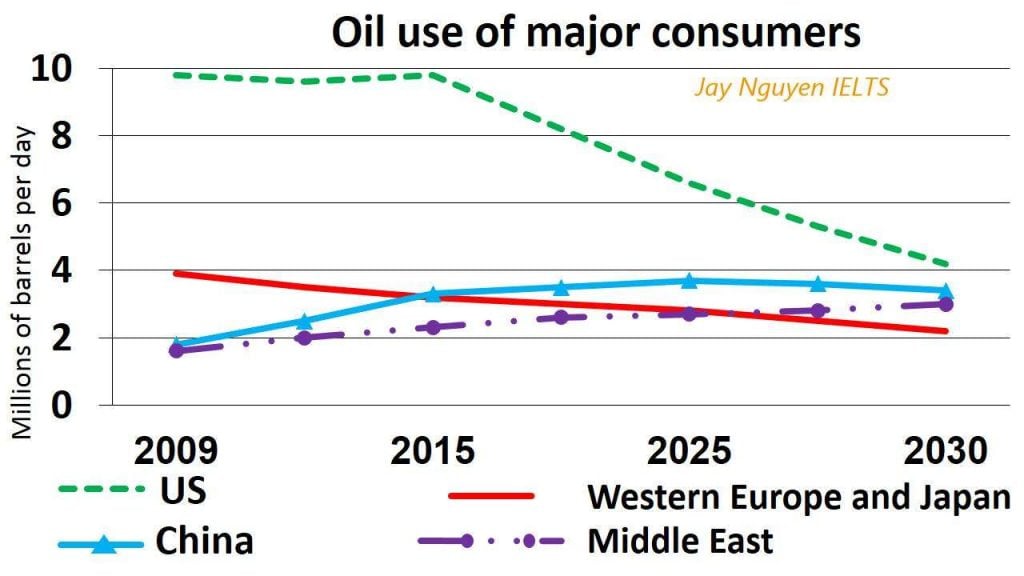
The line chart details the numbers for oil use in the US, China, the Middle East, and Western Europe and Japan from 2009 to 2030. Looking from an overall perspective, it is readily apparent that despite the US consuming the most oil throughout, this is projected to fall dramatically. Western Europe and Japan’s numbers will continue to decline to become the lowest by the end of the period while consumption will increase steadily in the Middle East and China.
Looking first of all at the United States, consumption began by hovering at just under 10 million from 2009 to 2015 though a precipitous fall is forecast to just over 4 million by 2030. Western Europe and Japan are also predicted to maintain a negative trend, which started at under 4 million barrels a day in 2009 and will end at just over 2 million.
The patterns are similar for China and the Middle East with both commencing at just under 2 million barrels. The former then rose quickly to slightly below 4 million by the present period and is expected to plateau and decline marginally at the end of the time surveyed. The latter will undertake a steadier rise and both regions will likely intersect at around 3 million barrels by 2030.
Analysis
1. The line chart details the numbers for oil use in the US, China, the Middle East, and Western Europe and Japan from 2009 to 2030. 2. Looking from an overall perspective, it is readily apparent that despite the US consuming the most oil throughout, this is projected to fall dramatically. 3. Western Europe and Japan’s numbers will continue to decline to become the lowest by the end of the period while consumption will increase steadily in the Middle East and China.
Paraphrase what the graph shows.
Write a general overview covering the full trends.
Make sure everything is included. Read about general overviews here.
1. Looking first of all at the United States, consumption began by hovering at just under 10 million from 2009 to 2015 though a precipitous fall is forecast to just over 4 million by 2030. 2. Western Europe and Japan are also predicted to maintain a negative trend, which started at under 4 million barrels a day in 2009 and will end at just over 2 million.
Begin with one of the areas.
Make sure that you always compare and always include all the data.
1. The patterns are similar for China and the Middle East with both commencing at just under 2 million barrels. 2. The former then rose quickly to slightly below 4 million by the present period and is expected to plateau and decline marginally at the end of the time surveyed. 3. The latter will undertake a steadier rise and both regions will likely intersect at around 3 million barrels by 2030.
Move on to the other areas.
Fully describe the data.
Make sure that mention any overtaking or intersections.
Vocabulary
What do the words in bold below mean?
The line chart details the numbers for oil use in the US, China, the Middle East, and Western Europe and Japan from 2009 to 2030. Looking from an overall perspective, it is readily apparent that despite the US consuming the most oil throughout, this is projected to fall dramatically. Western Europe and Japan’s numbers will continue to decline to become the lowest by the end of the period while consumption will increase steadily in the Middle East and China.
Looking first of all at the United States, consumption began by hovering at just under 10 million from 2009 to 2015 though a precipitous fall is forecast to just over 4 million by 2030. Western Europe and Japan are also predicted to maintain a negative trend, which started at under 4 millionbarrels a day in 2009 and will end at just over 2 million.
The patterns are similar for China and the Middle East with both commencing at just under 2 million barrels. The former then rose quickly to slightly below 4 million by the present period and is expected to plateau and decline marginally at the end of the time surveyed. The latter will undertake a steadier rise and both regions will likely intersect at around 3 million barrels by 2030.
Answers
details describes
oil use petrol consumption
looking from an overall perspective, it is readily apparent that in general
consuming using
throughout the whole time
projected expected to
fall dramatically decrease a lot
continue to decline keep decreasing
lowest by the end of the period the least by 2030
consumption use
increase steadily going up at regular intervals
looking first of all at considering first
hovering remaining around
precipitous fall steep decline
forecast look forward
just over a bit above
maintain a negative trend continue to decline
started at began at
millionbarrels a day the amount of oil each day used
end at finished at
patterns trends
commencing beginning at
former mentioned first
rose quickly increased fast
slightly below a little less
by the present period right now
plateau rise and level off
decline marginally decrease a little bit
end of the time surveyed end of the period in question
The line chart d___________s the numbers for o_______e in the US, China, the Middle East, and Western Europe and Japan from 2009 to 2030. L_________________________________________t despite the US c____________g the most oil t______________t, this is p____________d to f_________________y. Western Europe and Japan’s numbers will c__________________e to become the l_____________________________d while c______________n will i_____________________y in the Middle East and China.
L_______________________t the United States, consumption began by h____________g at just under 10 million from 2009 to 2015 though a p________________l is f___________t to j____________r 4 million by 2030. Western Europe and Japan are also predicted to m____________________d, which s___________t under 4 m______________________y in 2009 and will e______t just over 2 million.
The p__________s are similar for China and the Middle East with both c_______________g at just under 2 million barrels. The f___________r then r________________y to s_____________w 4 million b____________________d and is expected to p___________u and d____________________y at the e________________________d. The latter will u____________e a s_____________e and both r_________s will likely i____________t at around 3 million barrels by 2030.
This is an IELTS writing task 2 sample answer essay on the topic of online communications and meetings from the real IELTS exam.
The same topic came up on IELTS about a year ago and then again very recently.
For my exlusive PDFs related to IELTS, sign up for my Patreon here.
Dave
IELTS Essay: Online Communication
In many workplaces, online communication is now more common than face-to-face meetings.
Do the advantages of this trend outweigh the disadvantages?
Offices around the world these days are opting to hold meetings online to save both time and money. In my opinion, despite the potential loss of a strong rapport between co-workers, this is a positive considered as a whole.
Critics of these changes often point to its effect on interpersonal relationships in an office. The meeting itself is largely secondary as most information can be communicated just as easily through an online teleconference or an email. True value lies, instead, in the moments before, during and after meetings when colleagues have a chance to socialise or exchange ideas about what they have been working on. This is the reason some companies, famously Apple and Pixar, designed their offices to maximise opportunities for employees to chat with individuals from different departments. The strengthening of social bonds and the sharing of novel perspectives can both boost morale and help drive innovation.
Nonetheless, meeting online is more convenient for employees and saves money for companies. When employees must come in for their work already, many of the benefits listed above are already present and meetings mainly serve as a distraction. Remote workers will also appreciate not having to commute for a short meeting, especially if they have family or other working commitments. Moreover, companies benefit from the time that employees save because it allows them to better allocate their labour towards actual work, thereby increasing efficiency. There are also a range of costs that can be reduced once online communications become standard such as leasing less office space and savings related to office expenses and employee perks.
In conclusion, though communicating online can be detrimental to personal relationships in an office, they offer thoughtful conveniences to employees and help cut costs. Companies ought to shift as much training to online as possible.
Analysis
1. Offices around the world these days are opting to hold meetings online to save both time and money. 2. In my opinion, despite the potential loss of a strong rapport between co-workers, this is a positive considered as a whole.
Paraphrase the overall essay topic.
Write a clear opinion. Read more about IELTS introductions here.
1. Critics of these changes often point to its effect on interpersonal relationships in an office. 2. The meeting itself is largely secondary as most information can be communicated just as easily through an online teleconference or an email. 3. True value lies, instead, in the moments before, during and after meetings when colleagues have a chance to socialise or exchange ideas about what they have been working on. 4. This is the reason some companies, famously Apple and Pixar, designed their offices to maximise opportunities for employees to chat with individuals from different departments. 5. The strengthening of social bonds and the sharing of novel perspectives can both boost morale and help drive innovation.
1. Nonetheless, meeting online is more convenient for employees and saves money for companies. 2. When employees must come in for their work already, many of the benefits listed above are already present and meetings mainly serve as a distraction. 3. Remote workers will also appreciate not having to commute for a short meeting, especially if they have family or other working commitments. 4. Moreover, companies benefit from the time that employees save because it allows them to better allocate their labour towards actual work, thereby increasing efficiency. 5. There are also a range of costs that can be reduced once online communications become standard such as leasing less office space and savings related to office expenses and employee perks.
Write another topic sentence with a clear main idea at the end.
Explain the main idea.
Develop it.
Switch to a second advantage.
Develop that advantage fully.
1. In conclusion, though communicating online can be detrimental to personal relationships in an office, they offer thoughtful conveniences to employees and help cut costs. 2. Companies ought to shift as much training to online as possible.
Summarise your ideas and repeat your opinion.
Add a final thought. Read more about conclusions here.
Vocabulary
What do the words in bold below mean?
Offices around the world these days are opting to hold meetings online to save both time and money. In my opinion, despite the potential loss of a strong rapport between co-workers, this is a positive considered as a whole.
Critics of these changes often point to its effect on interpersonal relationships in an office. The meeting itself is largely secondary as most information can be communicated just as easily through an online teleconference or an email. True value lies, instead, in the moments before, during and after meetings when colleagues have a chance to socialise or exchange ideas about what they have been working on. This is the reason some companies, famously Apple and Pixar, designed their offices to maximise opportunities for employees to chat with individuals from different departments. The strengthening of social bonds and the sharing of novel perspectives can both boost morale and help drive innovation.
Nonetheless, meeting online is more convenient for employees and saves money for companies. When employees must come in for their work already, many of the benefits listed above are already present and meetings mainly serve as a distraction. Remote workers will also appreciate not having to commute for a short meeting, especially if they have family or other working commitments. Moreover, companies benefit from the time that employees save because it allows them to better allocate their labour towards actual work, thereby increasing efficiency. There are also a range of costs that can be reduced once online communications become standard such as leasing less office space and savings related to office expenses and employee perks.
In conclusion, though communicating online can be detrimental to personal relationships in an office, they offer thoughtful conveniences to employees and help cut costs. Companies ought to shift as much training to online as possible.
Answers
these days nowadays
opting choosing
hold meetings online have meetings over the internet
despite regardless of
potential loss possible disappearance
strong rapport good relationship
co-workers colleagues
considered as a whole on level
critics detractors
point to argue about
interpersonal relationships relations between people
largely secondary less important
just as easily equally simply
teleconference talk alone
true value lies actual importance comes from
instead actually
colleagues have a chance co-workers get the opportunity
socialise talk in a friendly way
exchange ideas share views
famously well-known
designed made for
maximise opportunities increase the chances
chat with talk to
different departments other parts of the company
strengthening making stronger
social bonds interpersonal relationships
sharing of novel perspectives exchanging new views
boost morale increase happiness
drive innovation make more creative
nonetheless regardless
convenient useful and easy
benefits listed above advantages I wrote about before
already present exist now
mainly serve mostly are
distraction draws away your focus
remote workers people who work from home
appreciate be grateful for
commute travel in to work
commitments obligations
better allocate divert towards more useful areas
towards going in that direction
thereby increasing efficiency as a result increasing productivity
Offices around the world t____________s are o_______g to h____________________e to save both time and money. In my opinion, d________e the p_______________s of a s________________t between c_______________s, this is a positive c_________________e.
C___________s of these changes often p_________o its effect on i_________________________s in an office. The meeting itself is l________________________y as most information can be communicated j________________y through an online t________________e or an email. T______________________s, i_________d, in the moments before, during and after meetings when c_________________________e to s_____________e or e_________________s about what they have been working on. This is the reason some companies, f___________y Apple and Pixar, d___________d their offices to m_________________________s for employees to c_____________h individuals from d__________________________s. The s___________________g of s_________________s and the s____________________s can both b_______________e and help d_________________n.
N________________s, meeting online is more c________________t for employees and saves money for companies. When employees must come in for their work already, many of the b___________________e are a__________________t and meetings m_________________e as a d____________n. R__________________s will also a_______________e not having to c_____________e for a short meeting, especially if they have family or other working c________________s. Moreover, companies benefit from the time that employees save because it allows them to b________________e their labour t____________s actual work, t______________________________y. There are also a r______________s that can be reduced once online communications become s_____________d such as l___________________________e and savings related to o_______________s and e_________________s.
In conclusion, though communicating online can be d_______________o personal relationships in an office, they offer t______________l conveniences to employees and h_______________s. Companies ought to s_______t as much training to online as possible.
"The highest quality materials anywhere on the internet! Dave improved my writing and vocabulary so much. Really affordable options you don't want to miss out on!"